Google is quietly testing ads in AI chatbots

Google has built an enormously successful business around the idea of putting ads in search results. Its most recent quarterly results showed the company made more than $50 billion from search ads, but what happens if AI becomes the dominant form of finding information? Google is preparing for that possibility by testing chatbot ads, but you won’t see them in Google’s Gemini AI—at least not yet.

A report from Bloomberg describes how Google began working on a plan in 2024 to adapt AdSense ads to a chatbot experience. Usually, AdSense ads appear in search results and are scattered around websites. Google ran a small test of chatbot ads late last year, partnering with select AI startups, including AI search apps iAsk and Liner.

The testing must have gone well because Google is now allowing more chatbot makers to sign up for AdSense. “AdSense for Search is available for websites that want to show relevant ads in their conversational AI experiences,” said a Google spokesperson.

If people continue shifting to using AI chatbots to find information, this expansion of AdSense could help prop up profits. There’s no hint of advertising in Google’s own Gemini chatbot or AI Mode search, but the day may be coming when you won’t get the clean, ad-free experience at no cost.

A path to profit

Google is racing to catch up to OpenAI, which has a substantial lead in chatbot market share despite Gemini’s recent growth. This has led Google to freely provide some of its most capable AI tools, including Deep Research, Gemini Pro, and Veo 2 video generation. There are limits to how much you can use most of these features with a free account, but it must be costing Google a boatload of cash.

https://arstechnica.com/ai/2025/05/google-is-quietly-testing-ads-in-ai-chatbots/
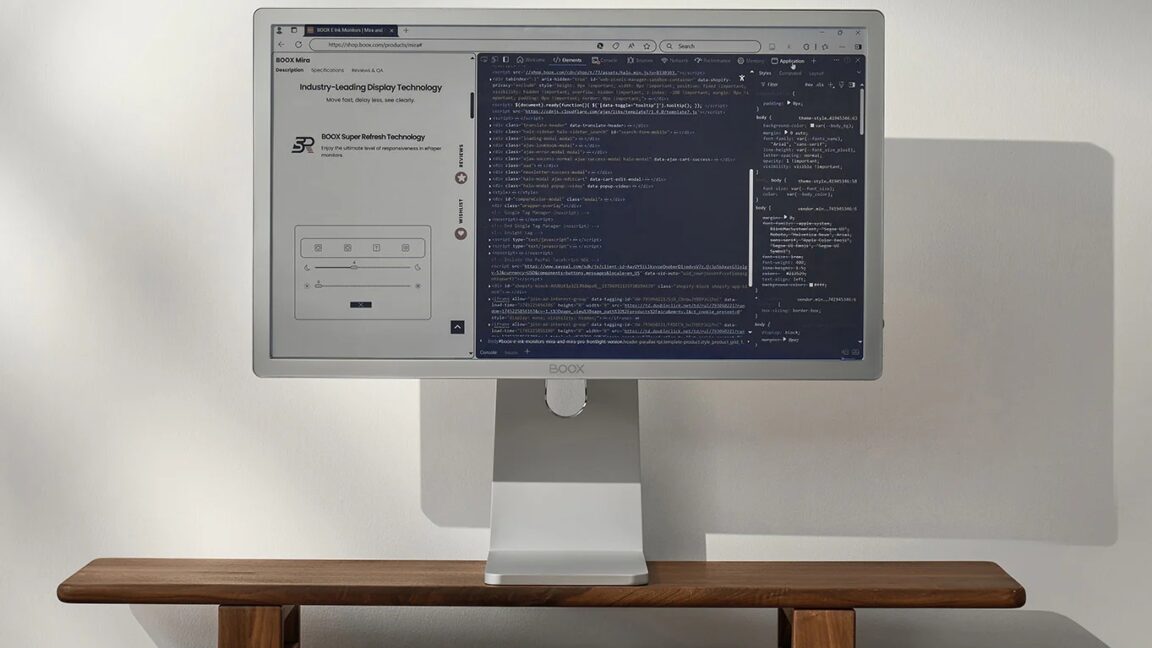


If you’re in the market for a $1,900 color E Ink monitor, one of them exists now

Color E Ink in its current state requires a whole lot of compromises, as we’ve found when reviewing devices like reMarkable’s Paper Pro or Amazon’s Kindle Colorsoft, including washed-out color, low refresh rates, and a grainy look that you don’t get with regular black-and-white E Ink. But that isn’t stopping device manufacturers from exploring the technology, and today, Onyx International has announced that it has a $1,900 color E Ink monitor that you can connect to your PC or Mac.

The Boox Mira Pro is a 25.3-inch monitor with a 3200×1800 resolution and a 16:9 aspect ratio, and it builds on the company’s previous black-and-white Mira Pro monitors. The Verge reports that the screen uses E Ink Kaleido 3 technology, which can display up to 4,096 colors. Both image quality and refresh rate will vary based on which of the monitor’s four presets you use (the site isn’t specific about the exact refresh rate, but does note that “E Ink monitors’ refresh speed is not as high as conventional monitors’, and increased speed will result in more ghosting.”)

The monitor’s ports include one full-size HDMI port, a mini HDMI port, a USB-C port, and a DisplayPort. Its default stand is more than a little reminiscent of Apple’s Studio Display, but it also supports VESA mounting.

Onyx International’s lineup of Boox devices usually focuses on Android-powered E Ink tablets, which the company has been building for over a decade. These are notable mostly because they combine the benefits of E Ink—text that’s easy on the eyes and long battery life—and access to multiple bookstores and other content sources via Google Play, rather than tying you to one manufacturer’s ecosystem as Amazon’s Kindles or other dedicated e-readers do.

https://arstechnica.com/gadgets/2025/04/e-ink-android-tablet-maker-onyx-boox-is-making-a-1900-color-e-ink-monitor/


Raspberry Pi cuts product returns by 50% by changing up its pin soldering

Getting the hang of through-hole soldering is tricky for those of us tinkering at home with our irons, spools, flux, and, sometimes, braids. It’s almost reassuring, then, to learn that through-hole soldering was also a pain for a firm that has made more than 60 million products with it.

Raspberry Pi boards have a combination of surface-mount devices (SMDs) and through-hole bits. SMDs allow for far more tiny chips, resistors, and other bits to be attached to boards by their tiny pins, flat contacts, solder balls, or other connections. For those things that are bigger, or subject to rough forces like clumsy human hands, through-hole soldering is still required, with leads poked through a connective hole and solder applied to connect and join them securely.

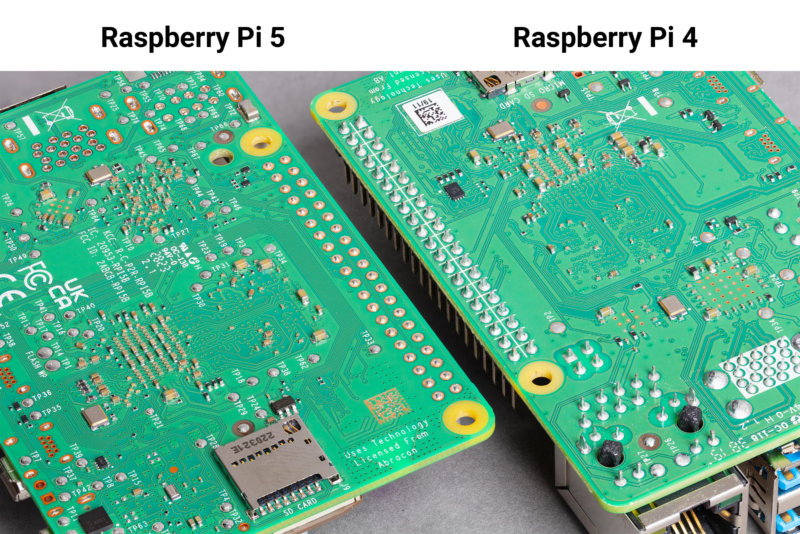
The Raspberry Pi board has a 40-pin GPIO header on it that needs through-hole soldering, along with bits like the Ethernet and USB ports. These require robust solder joints, which can’t be done the same way as with SMT (surface-mount technology) tools. “In the early days of Raspberry Pi, these parts were inserted by hand, and later by robotic placement,” writes Roger Thornton, director of applications for Raspberry Pi, in a blog post. The boards then had to go through a follow-up wave soldering step.

Now Pi boards have their tiny bits and bigger pieces soldered at the same time through an intrusive reflow soldering process undertaken with Raspberry Pi’s UK manufacturing partner, Sony. After adjusting component placement, the solder stencil, and the connectors, the board makers could then place and secure all their components in the same stage.

https://arstechnica.com/gadgets/2025/04/raspberry-pi-cuts-product-returns-by-50-by-changing-up-its-pin-soldering/


Sundar Pichai says DOJ demands are a “de facto” spin-off of Google search

The Department of Justice (DOJ) rested its case in Google’s search remedy trial earlier this week, giving Google a chance to push back on the government’s attempt to break up the search giant. Today is arguably Google’s best chance to make the case that it should not be harshly penalized in the ongoing search antitrust case, with CEO Sundar Pichai taking the stand.

Pichai attempted to explain why Google isn’t abusing its market position and why the DOJ’s proposed remedies are too extreme. The issue of Chrome divestment came up, but Google’s team also focused intensely on the potential effects of the DOJ’s data remedies, which could force Google to share its search index and technology with other firms.

A de facto spin-off

Pichai, who chose to stand while giving testimony, took issue with the government’s proposal to force Google to license search technology to other companies. The DOJ claims that Google’s status as a monopolist has resulted in it accumulating a huge volume of user data on search behavior. Plus, its significant technological lead means its index of the web is much more robust than competing services.

If the market is going to be rebalanced, the DOJ believes Google must be forced to license this data. Google has derisively referred to this as “white labeling” Google search.

According to Bloomberg, Pichai used even harsher language when discussing these remedies in court. He called this part of the government’s case “so far reaching, so extraordinary” that it would remake Google as a company and lead to numerous unintended consequences. To hear Pichai tell it, forcing Google to license this data for a nominal fee would be a “de facto divestiture of search.”

Giving other companies the option of using Google search index to map the web would make other products better, but Pichai claims they would essentially be able to reverse-engineer everything that makes Google’s platform special. And at that point, Google would need to reevaluate how it approaches innovation. Pichai suggests the data remedies could make it “unviable” for Google to invest in research and development as it has been for the past 20 years.

https://arstechnica.com/gadgets/2025/04/sundar-pichai-says-doj-demands-are-a-de-facto-spin-off-of-google-search/


Intel says it’s rolling out laptop GPU drivers with 10% to 25% better performance

Intel’s oddball Core Ultra 200V laptop chips—codenamed Lunar Lake—will apparently be a one-off experiment, not to be replicated in future Intel laptop chips. They’re Intel’s only processors with memory integrated onto the CPU package; the only ones with a neural processing unit that meets Microsoft’s Copilot+ performance requirements; and the only ones with Intel’s best-performing integrated GPUs, the Intel Arc 130V and 140V.

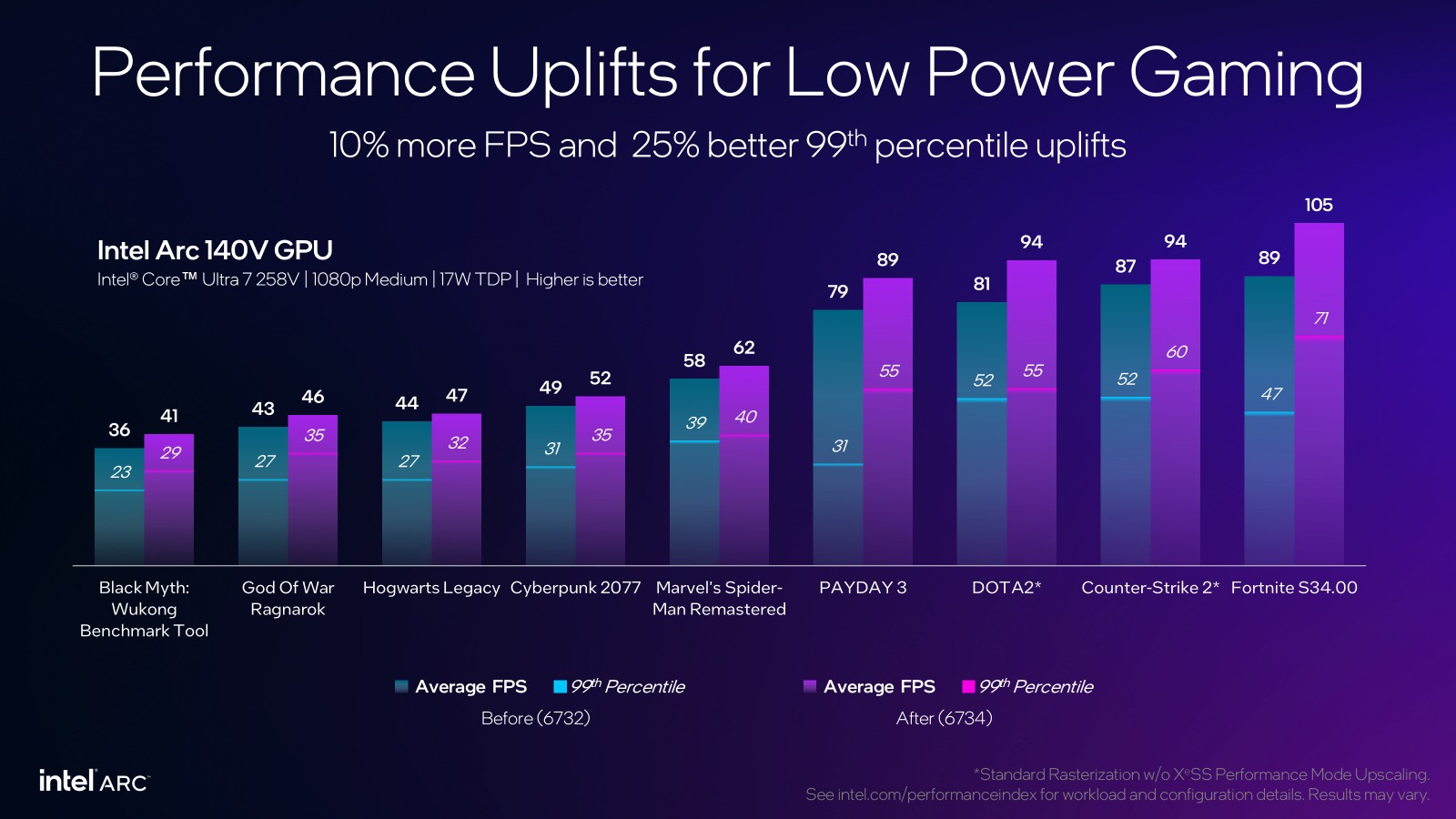
Today, Intel announced some updates to its graphics driver that specifically benefit those integrated GPUs, welcome news for anyone who bought one and is trying to get by with it as an entry-level gaming system. Intel says that version 32.0.101.6734 of its graphics driver can speed up average frame rates in some games by around 10 percent, and can speed up “1 percent low FPS” (that is, for any given frames per second measurement, whatever your frame rate is the slowest 1 percent of the time) by as much as 25 percent. This should, in theory, make games run better in general and ease some of the stuttering you notice when your game’s performance dips down to that 1 percent level.

Intel’s performance numbers for its new GPU drivers on a laptop running at the “common default power level” of 17 W. Credit: Intel

Intel’s performance comparisons were made using an MSI Claw 7 AI+ using an Arc 140V GPU, and they compare the performance of driver version 32.0.101.6732 (released April 2) to version 32.0.101.6734 (released April 8). The two additional driver packages Intel has released since then will contain the improvements, too.

https://arstechnica.com/gadgets/2025/04/intel-says-its-rolling-out-laptop-gpu-drivers-with-10-to-25-better-performance/


Trump admin lashes out as Amazon considers displaying tariff costs on its sites

This morning, Punchbowl News reported that Amazon was considering listing the cost of tariffs as a separate line item on its site, citing “a person familiar with the plan.” Amazon later acknowledged that there had been internal discussions to that effect but only for its import-focused Amazon Haul sub-store and that the company didn’t plan to actually list tariff prices for any items.

“This was never approved and is not going to happen,” reads Amazon’s two-sentence statement.

Amazon issued such a specific and forceful on-the-record denial in part because it had drawn the ire of the Trump administration. In a press briefing early this morning, White House Press Secretary Karoline Leavitt was asked a question about the report, which the administration responded to as though Amazon had made a formal announcement about the policy.

“This is a hostile and political act by Amazon,” Leavitt said, before blaming the Biden administration for high inflation and claiming that Amazon had “partnered with a Chinese propaganda arm.”

The Washington Post also reported that Trump had called Amazon founder Jeff Bezos to complain about the report.

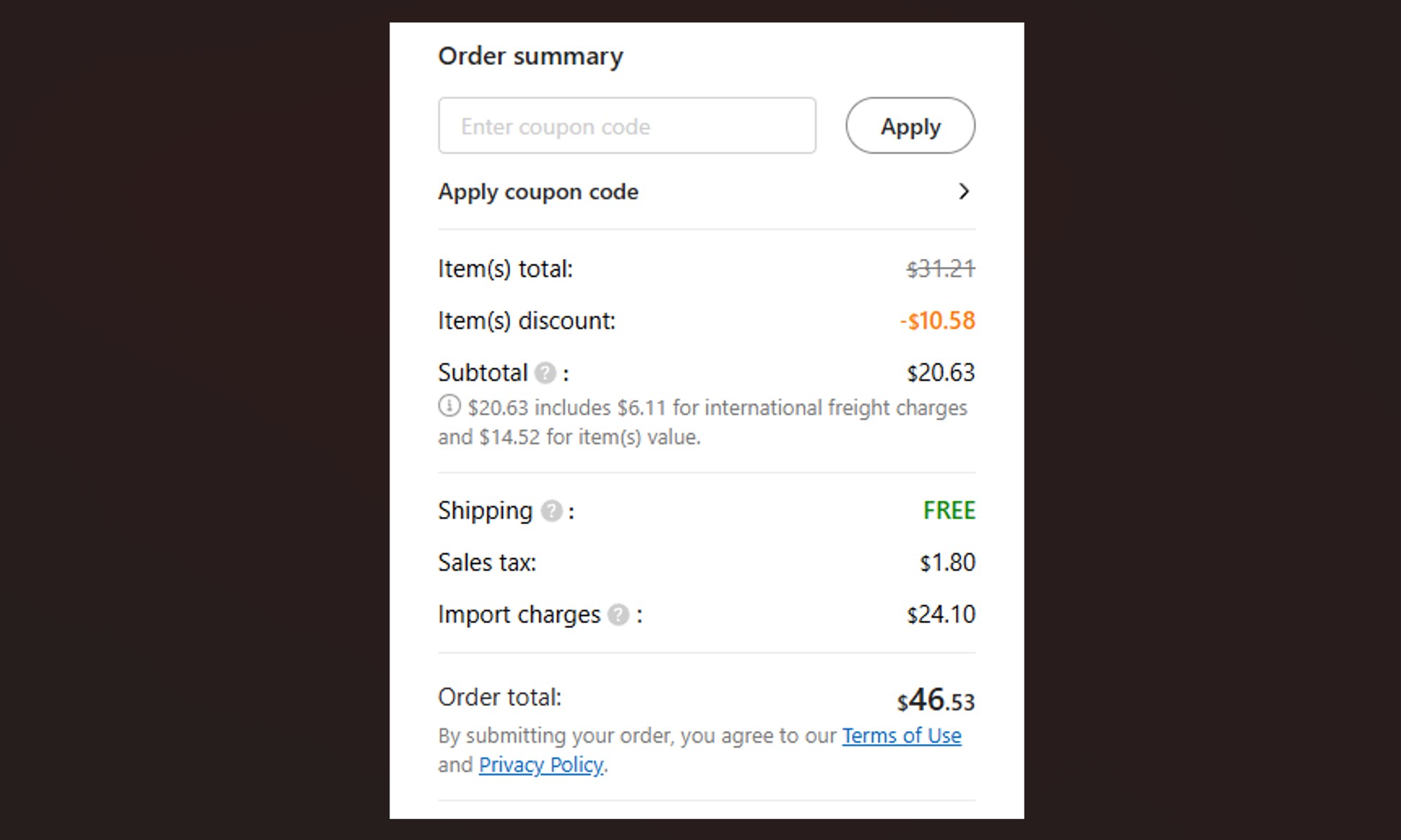
Amazon’s internal discussions reflect the current confusion around the severe and rapidly changing import tariffs imposed by the Trump administration, particularly tariffs of 145 percent on goods imported from China. Other retailers, particularly sites like Temu, AliExpress, and Shein, have all taken their own steps, either adding labels to listings when import taxes have already been included in the price, or adding import taxes as a separate line item in users’ carts at checkout as Amazon had discussed doing.

A Temu cart showing the price of an item’s import tax as a separate line item. Amazon reportedly considered and discarded a similar idea for its Amazon Haul sub-site.

Small purchases are seeing big hits

Most of these items are currently excluded from tariffs because of something called the de minimis exemption, which applies to any shipment valued under $800. The administration currently plans to end the de minimis exemption for packages coming from China or Hong Kong beginning on May 2, though the administration’s plans could change (as they frequently have before).

https://arstechnica.com/information-technology/2025/04/amazon-denies-it-will-start-listing-cost-of-tariffs-as-other-sites-start-doing-it/


Backblaze responds to claims of “sham accounting,” customer backups at risk

Backblaze went public in November 2021 and raised $100 million. Morpheus noted that since then, “Backblaze has reported losses every quarter, its outstanding share count has grown by 80 percent, and its share price has declined by 71 percent.”

Following Morpheus’ report, Investing reported on Thursday that Backblaze shares fell 8.3 percent.

Beyond the financial implications for stockholders, Morpheus’ report has sparked some concern for the primarily small businesses and individuals relying on Backblaze for data backup. Today, for example, How-To Geek reported that “Backblaze backups might be in trouble,” in reference to Morpheus’ report. The publication said that if Morpheus’ reporting was accurate, Backblaze doesn’t appear to be heading toward profitability. In its Q4 2024 earnings report [PDF], Backblaze reported a net loss of $48.5 million. In 2023, it reported a net loss of $59.7 million.

“If Backblaze suddenly shuts down, customers might lose access to existing backups,” How-To Geek said.

Backblaze responds

Ars Technica reached out to Backblaze about its response to concerns about the company’s financials resulting in lost backups. Patrick Thomas, Backblaze’s VP of marketing, called Morpheus’ claims “baseless.” He added:

The report is inaccurate and misleading, based largely on litigation of the same nature, and a clear attempt by short sellers to manipulate our stock price for financial gain.

Thomas also claimed that “independent, third-party reviews” have already found that there have been “no wrongdoing or issues” with Backblaze’s public financial results.

“Our storage cloud continues to deliver reliable, high-performance services that Backblaze customers rely on, and we remain fully focused on driving innovation and creating long-term value for our customers, employees, and investors,” Thomas said.

Backblaze will announce its Q1 2025 results on May 7. Regardless of what lies ahead for the company’s finances and litigation, commitment to the 3-2-1 backup rule remains prudent.

https://arstechnica.com/gadgets/2025/04/backblaze-responds-to-claims-of-sham-accounting-customer-backups-at-risk/


OnePlus lowers Watch 3 price by $150, promises refunds for early buyers

Things are still uncertain, but OnePlus claims to have made some adjustments to its supply chain so it can offer the Watch 3 at a more palatable price. It’s unlikely that OnePlus could eat the cost of that Chinese tariff on a wearable, so perhaps it found a way to redirect its shipments through another location with lower tariffs.

A company spokesperson confirms the watch is now listed at $349.99 in the US, and it will stay at that price despite any future changes to import tariffs. This is a bit higher than the original $330 price tag, but it’s not bad given the challenging market conditions and OnePlus’ Chinese roots.

“This change reflects our effort to be transparent, responsive, and committed to bringing the OnePlus Watch 3 to the US at a competitive price point, despite the ongoing market conditions,” a OnePlus spokesperson said.

At $500, the OnePlus Watch 3 was hard to justify when devices like the Pixel Watch, itself not exactly a bargain-priced wearable, are available for substantially less. Still, there are probably some OnePlus fans who bit at $500. The company says anyone who paid that price since the watch’s release in early April will get a refund of the difference—keep an eye out for an email from OnePlus support with details.

For anyone who was planning to pick up the Watch 3 and was scared off by the tariff increase, the lower price is available immediately in the OnePlus store.

https://arstechnica.com/gadgets/2025/04/oneplus-lowers-watch-3-price-by-150-promises-refunds-for-early-buyers/


“You wouldn’t steal a car” anti-piracy campaign may have used pirated fonts

Aquilina, who was speaking generally and not on the specifics of the anti-piracy campaign and its font use, said that using a font from a free source, with an “effectively implied license to use it,” could be “a good defense,” though “not a complete defense.” Typically, a rightsholder would go after websites distributing copies of their font, not after users of the end product.

Fonts used commercially that happen to be exact copies of existing and copyrighted fonts are “fairly common,” Aquilina said, “simply because of the popularity of certain fonts and a desire to use them, to create a certain aesthetic.” But, he said, there is “a very small percentage that could be, or are, litigated.” Even with software licenses at issue, a type foundry faces an uphill battle, as witnessed in the battle over Shake Shack’s typography (paywalled).

Still missing: the source of XBand Rough

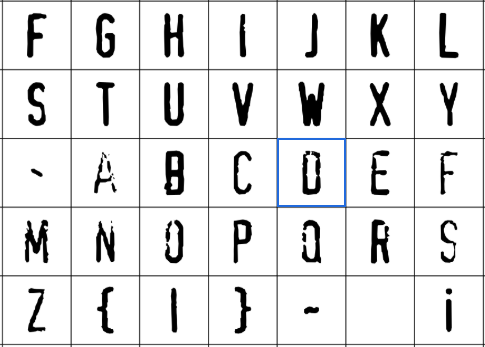
A few glyphs from FF Confidential, the font that was not used on some anti-piracy materials, even if it sure looked like that.

A few glyphs from FF Confidential, the font that was not used on some anti-piracy materials, even if it sure looked like that. Credit: MyFonts/MonotType

So where did Xband Rough come from?

The styling of the font name, “XBAND Rough” with the first noun in all-caps, calls to mind the early online gaming network XBAND, launched in 1994 and discontinued in 1997. In some XBand packages, a similar “rough” style can be seen on the lettering. The PDF sleuth, Rib, noted that XBAND Rough “came out four years after the original” (about 1996) and was “near-identical, except for the price.”

Another Bluesky user suggests “a plausible explanation” for the font, suggesting that Xband may have licensed FF Confidential and then given it the internal name “Xband Rough.” A copy of the font with that name could have been extracted from some Xband material and then “started floating around the Internet uncredited.” In the end, though, the real answer is unclear.

We contacted the Motion Picture Association (now just the MPA, sans “of America”), but they declined to comment.

The original “You Wouldn’t Steal a Car” campaign was simple to the point of being simplistic. IP law isn’t really like “stealing a car” in many cases—as has made clearly once again by the recent Xband Rough investigation.

https://arstechnica.com/gadgets/2025/04/you-wouldnt-steal-a-car-anti-piracy-campaign-may-have-used-pirated-fonts/


Looming tariffs are making it extra hard to be a tech geek

Please consider your purchase thoroughly before ordering.

Providing more detail around how tariffs impact a company like Qwerteykeys and its customers, the company noted that DHL, its “primary shipping partner,” will start charging a minimum handling fee of 17 percent plus 20 percent of the declared value as import duty starting May 2.

Meanwhile, Keyboardio, known for high-end, split mechanical keyboards, paused US orders as of April 23. In a blog post, the company said it fulfills orders out of Hong Kong because it’s “close to our factory, reasonably priced, and can easily handle fulfilling orders going all around the world.” The blog said:

The exact mechanics of how this is going to work are fuzzy. While we expect that people will stop importing as much due to tariffs making it unaffordable, it still implies a lot of additional work for custom[s]. It’s not clear to us—or the carriers—that customs is staffed up to handle this increased volume, and we’re expecting that any packages arriving to the USA once the de minimis rule goes away may have long processing delays.

Keyboardio also highlighted uncertainty around “which carriers will be operating, what documentation we’ll need (possibly including customers’ social security numbers), what clearance fees or additional customs bond fees will be assessed, or most critically, what the actual delivery timeline will be.”

Keyboardio admitted that if it does start shipping to the US again, its products are “going to be more expensive and more annoying to get.”

With many mechanical keyboard switches coming from China as well, building mechanical keyboards will likely get more costly and complicated soon, too.

I’m not alone

The looming threat of tariffs is throwing a wrench into the plans of all types of technology enthusiasts. People who love things like computers, computer peripherals, maker projects, and retro gaming are all being impacted, regardless of their political or economic viewpoints. As the world waits to see how the US tariff situation plays out, hobbyists wonder if we’ll be able to make that upgrade or finish a project with manageable costs.

https://arstechnica.com/gadgets/2025/04/looming-tariffs-are-making-it-extra-hard-to-be-a-tech-geek/