In depth with Windows 11 Recall—and what Microsoft has (and hasn’t) fixed
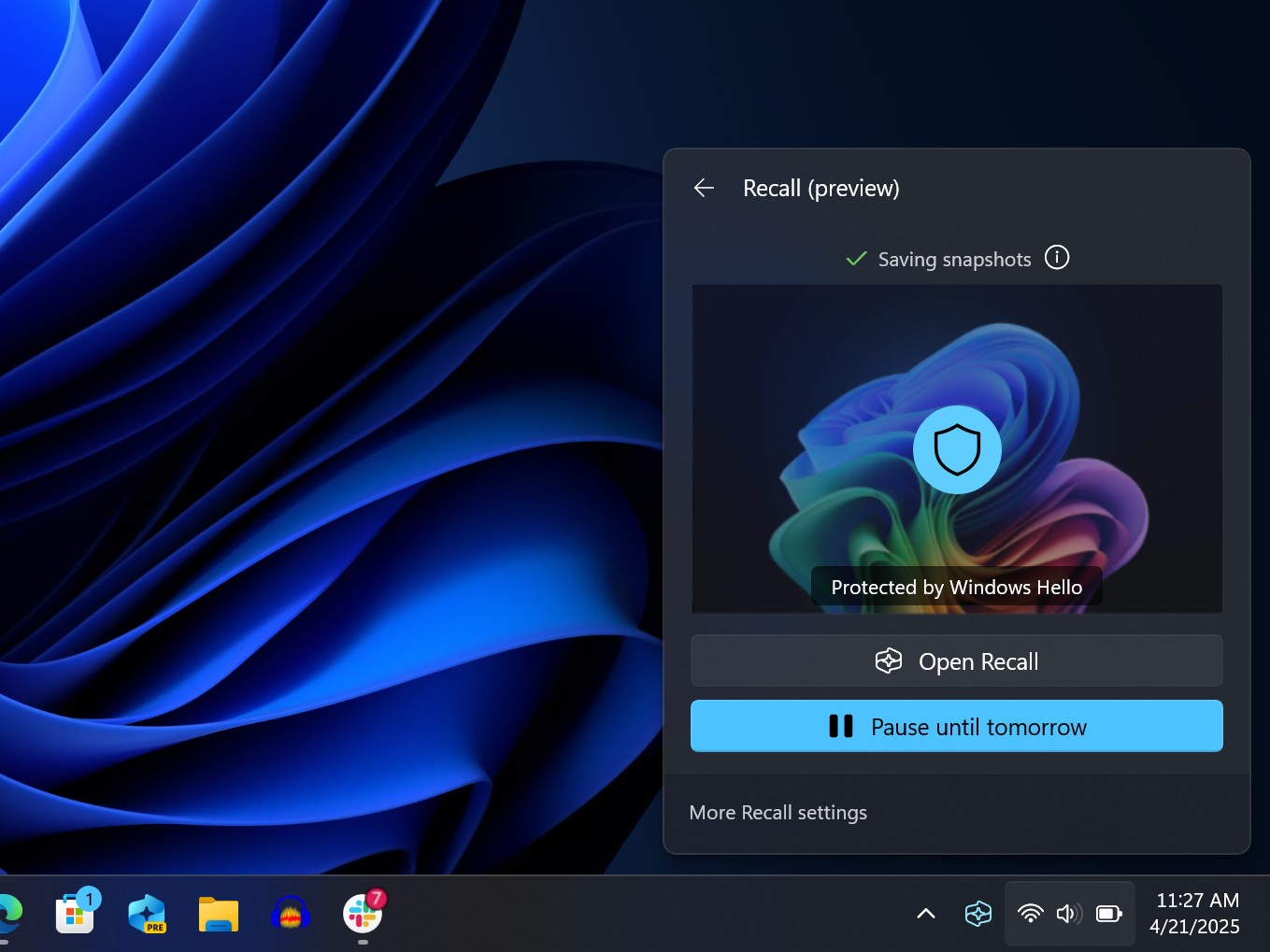
The Recall tray icon is always visible when the service is running, just so you’re always aware of it. Sometimes it will show you snapshot previews here if you’ve opened the Recall app and unlocked it recently, but usually these previews are blurred because Windows Hello is protecting them.

Andrew Cunningham
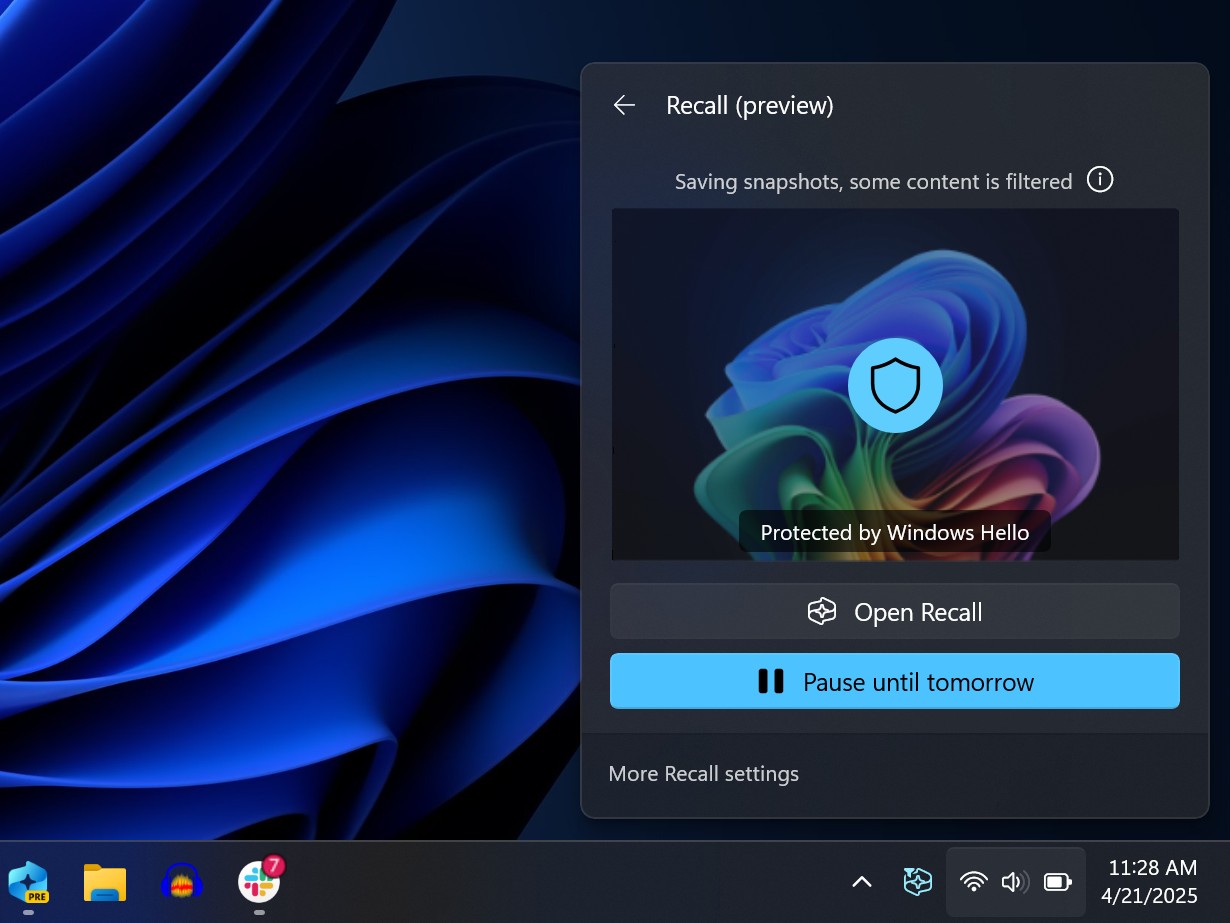
When anything is being filtered for any reason, the tray icon changes and you get a status message here, but Recall doesn’t tell you what is being filtered or why.

Andrew Cunningham

New to this version of Recall is an attempt at automated content filtering to address one of the major concerns about the original iteration of Recall—that it can capture and store sensitive information like credit card numbers and passwords. This filtering is based on the technology Microsoft uses for Microsoft Purview Information Protection, an enterprise feature used to tag sensitive information on business, healthcare, and government systems.

This automated content filtering is hit and miss. Recall wouldn’t take snapshots of a webpage with a visible credit card field, or my online banking site, or an image of my driver’s license, or a recent pay stub, or of the Bitwarden password manager while viewing credentials. But I managed to find edge cases in less than five minutes, and you’ll be able to find them, too; Recall saved snapshots showing a recent check, with the account holder’s name, address, and account and routing numbers visible, and others testing it have still caught it recording credit card information in some cases.

The automated filtering is still a big improvement from before, when it would capture this kind of information indiscriminately. But things will inevitably slip through, and the automated filtering won’t help at all with other kinds of data; Recall will take pictures of email and messaging apps without distinguishing between what’s sensitive (school information for my kid, emails about Microsoft’s own product embargoes) and what isn’t.
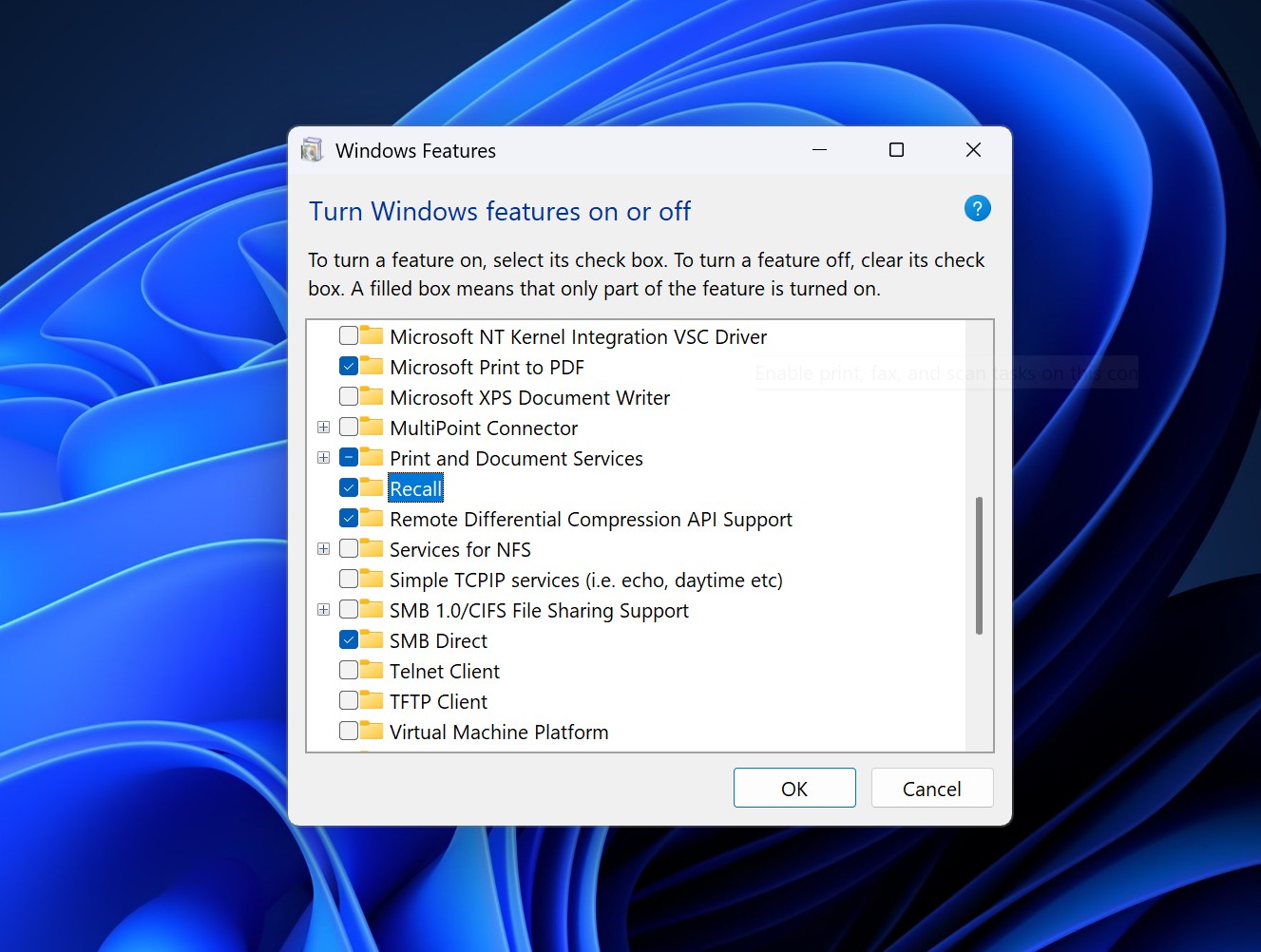
Recall can be removed entirely. If you take it out, it’s totally gone—the options to configure it won’t even appear in Settings anymore. Credit: Andrew Cunningham

The upshot is that if you capture months and months and gigabytes and gigabytes of Recall data on your PC, it’s inevitable that it will capture something you probably wouldn’t want to be preserved in an easily searchable database.

One issue is that there’s no easy way to check and confirm what Recall is and isn’t filtering without actually scrolling through the database and checking snapshots manually. The system tray status icon does change to display a small triangle and will show you a “some content is being filtered” status message when something is being filtered, but the system won’t tell you what it is; I have some kind of filtered app or browser tab open somewhere right now, and I have no idea which one it is because Windows won’t tell me. That any attempt at automated filtering is hit-and-miss should be expected, but more transparency would help instill trust and help users fine-tune their filtering settings.

https://arstechnica.com/gadgets/2025/04/in-depth-with-windows-11-recall-and-what-microsoft-has-and-hasnt-fixed/



Google adds YouTube Music feature to end annoying volume shifts

Google’s history with music services is almost as convoluted and frustrating as its history with messaging. However, things have gotten calmer (and slower) ever since Google ceded music to the YouTube division. The YouTube Music app has its share of annoyances, to be sure, but it’s getting a long-overdue feature that users have been requesting for ages: consistent volume.

Listening to a single album from beginning to end is increasingly unusual in this age of unlimited access to music. As your playlist wheels from one genre or era to the next, the inevitable vibe shifts can be grating. Different tracks can have wildly different volumes, which can be shocking and potentially damaging to your ears if you’ve got your volume up for a ballad only to be hit with a heavy guitar riff after the break.

The gist of consistent volume simple—it normalizes volume across tracks, making the volume roughly the same. Consistent volume builds on a feature from the YouTube app called “stable volume.” When Google released stable volume for YouTube, it noted that the feature would continuously adjust volume throughout the video. Because of that, it was disabled for music content on the platform.

https://arstechnica.com/gadgets/2025/04/youtube-music-gets-consistent-volume-option-to-save-your-ears/


Synology confirms that higher-end NAS products will require its branded drives

Popular NAS-maker Synology has confirmed and slightly clarified a policy that appeared on its German website earlier this week: Its “Plus” tier of devices, starting with the 2025 series, will require Synology-branded hard drives for full compatibility, at least at first.

“Synology-branded drives will be needed for use in the newly announced Plus series, with plans to update the Product Compatibility List as additional drives can be thoroughly vetted in Synology systems,” a Synology representative told Ars by email. “Extensive internal testing has shown that drives that follow a rigorous validation process when paired with Synology systems are at less risk of drive failure and ongoing compatibility issues.”

Without a Synology-branded or approved drive in a device that requires it, NAS devices could fail to create storage pools and lose volume-wide deduplication and lifespan analysis, Synology’s German press release stated. Similar drive restrictions are already in place for XS Plus and rack-mounted Synology models, though work-arounds exist.

Synology also says it will later add a “carefully curated drive compatibility framework” for third-party drives and that users can submit drives for testing and documentation. “Drives that meet Synology’s stringent standards may be validated for use, offering flexibility while maintaining system integrity.”

https://arstechnica.com/gadgets/2025/04/synology-confirms-need-for-synology-branded-drives-in-newer-plus-series-nas/


HP agrees to $4M settlement over claims of “falsely advertising” PCs, keyboards

HP Inc. has agreed to pay a $4 million settlement to customers after being accused of “false advertising” of computers and peripherals on its website.

Earlier this month, Judge P. Casey Pitts for the US District Court of the San Jose Division of the Northern District of California granted preliminary approval [PDF] of a settlement agreement regarding a class-action complaint first filed against HP on October 13, 2021. The complaint accused HP’s website of showing “misleading” original pricing for various computers, mice, and keyboards that was higher than how the products were recently and typically priced.

Per the settlement agreement [PDF], HP will contribute $4 million to a “non-reversionary common fund, which shall be used to pay the (i) Settlement Class members’ claims; (ii) court-approved Notice and Settlement Administration Costs; (iii) court-approved Settlement Class Representatives’ Service Award; and (iv) court-approved Settlement Class Counsel Attorneys’ Fees and Costs Award. All residual funds will be distributed pro rata to Settlement Class members who submitted valid claims and cashed checks.”

The two plaintiffs who filed the initial complaint may also file a motion to receive a settlement class representative service award for up to $5,000 each, which would come out of the $4 million pool.

People who purchased a discounted HP desktop, laptop, mouse, or keyboard that was on sale for “more than 75 percent of the time the products were offered for sale” from June 5, 2021, to October 28, 2024, are eligible for compensation. The full list of eligible products is available here [PDF] and includes HP Spectre, Chromebook Envy, and Pavilion laptops, HP Envy and Omen desktops, and some mechanical keyboards and wireless mice. Depending on the product, class members can receive $10 to $100 per eligible product purchased.

An amended complaint filed on July 15, 2022 [PDF] accused HP of breaking the Federal Trade Commission’s laws against deceptive pricing. Among the examples provided was Rodney Carvalho’s experience buying an HP All-in-One 24-dp1056qe in September 2021. The complaint reported that HP.com advertised the AIO as being on sale for $899.99 and featured text saying “Save $100 instantly.” The AIO’s listing reportedly had a strike-through price suggesting that the computer used to cost $999.99. But, per the complaint, “in the weeks and months prior to Carvalho’s purchase, HP rarely, if ever, offered his computer for sale at the advertised strike-through price of $999.99.” The filing claimed that the PC had been going for $899.99 since April 2021.

https://arstechnica.com/gadgets/2025/04/hp-agrees-to-4m-settlement-over-claims-of-falsely-advertising-pcs-keyboards/


Gemini 2.5 Flash comes to the Gemini app as Google seeks to improve “dynamic thinking”

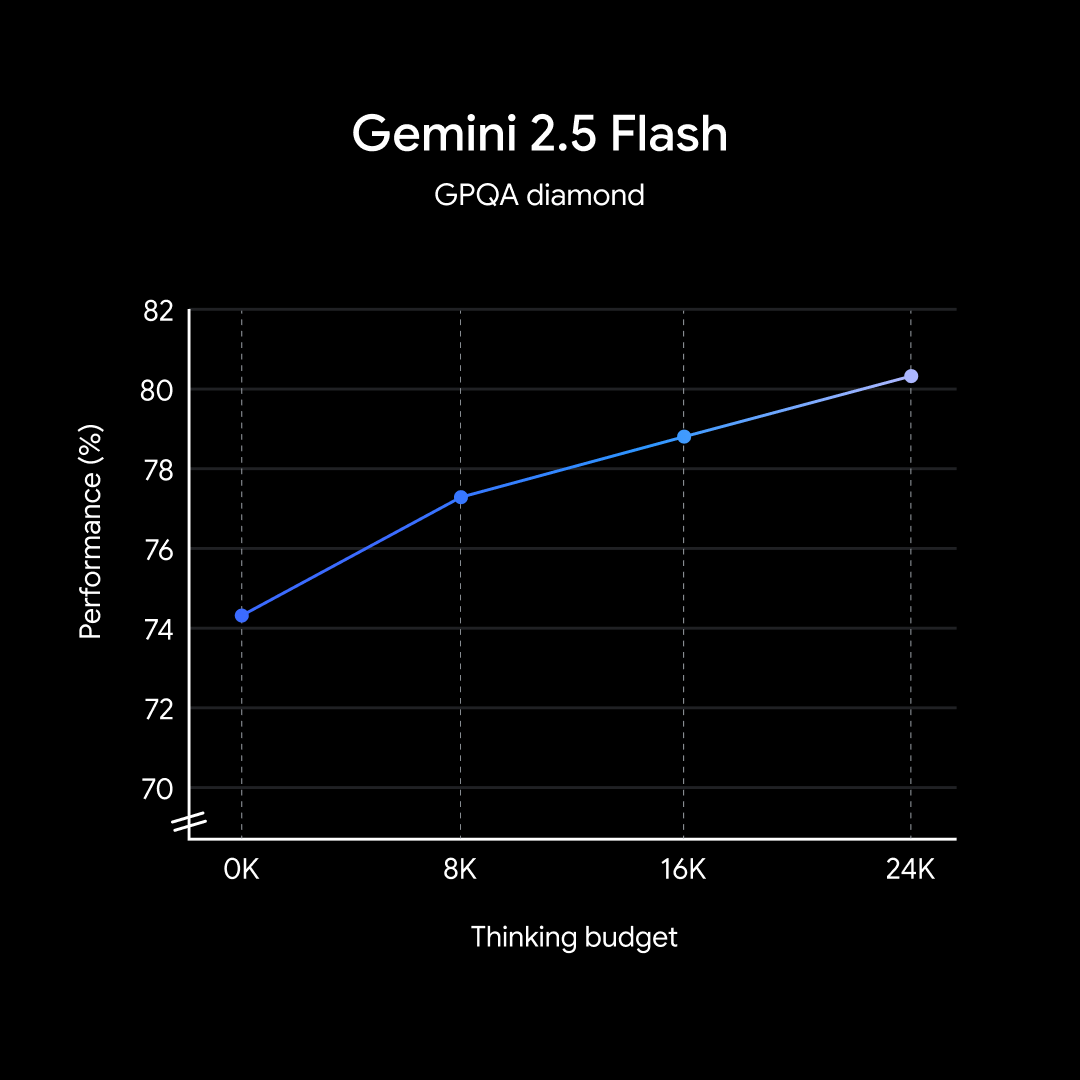
Gemini 2.5 Flash will allow developers to set a token limit for thinking or simply disable thinking altogether. Google has provided pricing per 1 million tokens at $0.15 for input, and output comes in two flavors. Without thinking, outputs are $0.60, but enabling thinking boosts it to $3.50. The thinking budget option will allow developers to fine-tune the model to do what they want for an amount of money they’re willing to pay. According to Doshi, you can actually see the reasoning improvements in benchmarks as you add more token budget.

2.5 Flash benchmark

2.5 Flash outputs get better as you add more reasoning tokens.

Credit: Google

2.5 Flash outputs get better as you add more reasoning tokens. Credit: Google

Like 2.5 Pro, this model supports Dynamic Thinking, which can automatically adjust the amount of work that goes into generating an output based on the complexity of the input. The new Flash model goes further by allowing developers to control thinking. According to Doshi, Google is launching the model now to guide improvements in these dynamic features.

“Part of the reason we’re putting the model out in preview is to get feedback from developers on where the model meets their expectations, where it under-thinks or over-thinks, so that we can continue to iterate on [dynamic thinking],” says Doshi.

Don’t expect that kind of precise control for consumer Gemini products right now, though. Doshi notes that the main reason you’d want to toggle thinking or set a budget is to control costs and latency, which matters to developers. However, Google is hoping that what it learns from the preview phase will help it understand what users and developers expect from the model. “Creating a simpler Gemini app experience for consumers while still offering flexibility is the goal,” Doshi says.

With the rapid cadence of releases, a final release for Gemini 2.5 doesn’t seem that far off. Google still doesn’t have any specifics to share on that front, but with the new developer options and availability in the Gemini app, Doshi tells us the team hopes to move the 2.5 family to general availability soon.

https://arstechnica.com/ai/2025/04/gemini-2-5-flash-comes-to-the-gemini-app-gives-developers-control-over-thinking/


Synology could bring “certified drive” requirements to more NAS devices

Synology, maker of network-attached storage (NAS) devices, will seemingly remove advanced features from its Plus devices that are not using hard drives provided by, or certified by, Synology itself, starting with its 2025 lineup.

A report on the German site HardwareLuxx (translated by Google) and a press release on Synology’s German-language website appear to confirm Synology’s strategy. The company, which sees “significant benefits” to its “proprietary hard drive solution” (also per Google’s translation), will be “expanding [its] integrated ecosystem to the Plus series.” For those Plus series models released in 2025, only Synology’s own hard drives, and third-party drives certified by Synology, will offer “the full range of functions and support.” Synology’s release states that it can provide the “highest levels of security and performance, while also offering significantly more efficient support.”

Ars has contacted Synology’s US offices for comment and will update this post with any response.

There is some chance that this move could be restricted to Germany or just the EU. Maintaining region-specific firmware is possible, if not efficient. Synology has previously rolled out its certified drive requirements for higher-end machines globally.

If you already have Plus-level or higher Synology hardware, this potential incoming change won’t impact you, at least until your next upgrade. You can also take existing drives from a Synology setup and move them into a 2025 or newer Plus model and continue having full support. Synology had already implemented this requirement for its XS Plus and rack-mounted models, notionally obliging those owners to use Synology-approved drives.

What you might lose from using non-Synology-approved hard drives could include pool creation and support for any issues. De-duplication, lifespan analysis, and automatic HDD firmware updates could also disappear on non-approved drives, Synology’s press release suggests.

https://arstechnica.com/gadgets/2025/04/synology-could-bring-certified-drive-requirements-to-more-nas-devices/


Google is gifting a year of Gemini Advanced to every college student in the US

Google CEO Sundar Pichai has reportedly set a goal for the company to reach 500 million Gemini users before the end of 2025. Rolling out new models may help the company get there, but you know what else helps? Giving away premium features for free. Google has announced today that it’s giving all US college students free access to Gemini Advanced, and not just for a month or two—the offer is good for a full year of service.

With Gemini Advanced, you get access to the more capable Pro models, as well as unlimited use of the Deep Research tool based on it. Subscribers also get a smattering of other AI tools, like the Veo 2 video generator, NotebookLM, and Gemini Live. The offer is for the Google One AI Premium plan, so it includes more than premium AI models, like Gemini features in Google Drive and 2TB of Drive storage.

Google has a new landing page for the deal, allowing eligible students to sign up for their free Google One AI Premium plan. The offer is valid from now until June 30. Anyone who takes Google up on it will enjoy the free plan through spring 2026. The company hasn’t specified an end date, but we would wager it will be June of next year. Google’s intention is to give students an entire school year of Gemini Advanced from now through finals next year. At the end of the term, you can bet Google will try to convert students to paying subscribers.

As for who qualifies as a “student” in this promotion, Google isn’t bothering with a particularly narrow definition. As long as you have a valid .edu email address, you can sign up for the offer. That’s something that plenty of people who are not actively taking classes still have. You probably won’t even be taking undue advantage of Google if you pretend to be a student—the company really, really wants people to use Gemini, and it’s willing to lose money in the short term to make that happen.

https://arstechnica.com/ai/2025/04/google-is-gifting-a-year-of-gemini-advanced-to-every-college-student-in-the-us/


LG TVs’ integrated ads get more personal with tech that analyzes viewer emotions

With all this information, ZenVision will group LG TV viewers into highly specified market segments, such as “goal-driven achievers,” “social connectors,” or “emotionally engaged planners,” an LG spokesperson told StreamTV Insider. Zenapse’s website for ZenVision points to other potential market segments, including “digital adopters,” “wellness seekers,” “positive impact & environment,” and “money matters.”

Companies paying to advertise on LG TVs can then target viewers based on the ZenVision-specified market segments and deliver an “emotionally intelligent ad,” as Zenapse’s website puts it.

This type of targeted advertising aims to bring advertisers more in-depth information about TV viewers than demographic data or even contextual advertising (which shows ads based on what the viewer is watching) via psychographic data. Demographic data gives advertisers viewer information, like location, age, gender, ethnicity, marital status, and income. Psychographic data is supposed to go deeper and allow advertisers to target people based on so-called psychological factors, like personal beliefs, values, and attitudes. As Salesforce explains, “psychographic segmentation delves deeper into their psyche” than relying on demographic data.

“As viewers engage with content, ZenVision’s understanding of a consumer grows deeper, and our… segmentation continually evolves to optimize predictions,” the ZenVision website says.

Getting emotional

LG’s partnership comes as advertisers struggle to appeal to TV viewers’ emotions. Google, for example, attempted to tug at parents’ heartstrings with the now-infamous Dear Sydney ad aired during the 2024 Summer Olympics. Looking to push Gemini, Google hit all the wrong chords with parents, and, after much backlash, pulled the ad.

The partnership also comes as TV OS operators seek new ways to use smart TVs to grow their own advertising businesses and to get people to use TVs to buy stuff.

https://arstechnica.com/gadgets/2025/04/lg-tvs-integrated-ads-get-more-personal-with-tech-that-analyzes-viewer-emotions/


Google suspended 39.2 million malicious advertisers in 2024 thanks to AI

Google may have finally found an application of large language models (LLMs) that even AI skeptics can get behind. The company just released its 2024 Ads Safety report, confirming that it used a collection of newly upgraded AI models to scan for bad ads. The result is a huge increase in suspended spammer and scammer accounts, with fewer malicious ads in front of your eyeballs.

While stressing that it was not asleep at the switch in past years, Google reports that it deployed more than 50 enhanced LLMs to help enforce its ad policy in 2024. Some 97 percent of Google’s advertising enforcement involved these AI models, which reportedly require even less data to make a determination. Therefore, it’s feasible to tackle rapidly evolving scam tactics.

Google says that its efforts in 2024 resulted in 39.2 million US ad accounts being suspended for fraudulent activities. That’s over three times more than the number of suspended accounts in 2023 (12.7 million). The factors that trigger a suspension usually include ad network abuse, improper use of personalization data, false medical claims, trademark infringement, or a mix of violations.

Despite these efforts, some bad ads still make it through. Google says it identified and removed 1.8 billion bad ads in the US and 5.1 billion globally. That’s a small drop from 5.5 billion ads removed in 2023, but the implication is that Google had to remove fewer ads because it stopped the fraudulent accounts before they could spread. The company claims most of the 39.2 million suspended accounts were caught before they ran a single ad.

https://arstechnica.com/gadgets/2025/04/google-used-ai-to-block-three-times-more-fraudulent-advertisers-in-2024/


Samsung’s Android 15 update has been halted

When asked about specifics, Samsung doesn’t have much to say. “The One UI 7 rollout schedule is being updated to ensure the best possible experience. The new timing and availability will be shared shortly,” the company said.

Samsung foldables

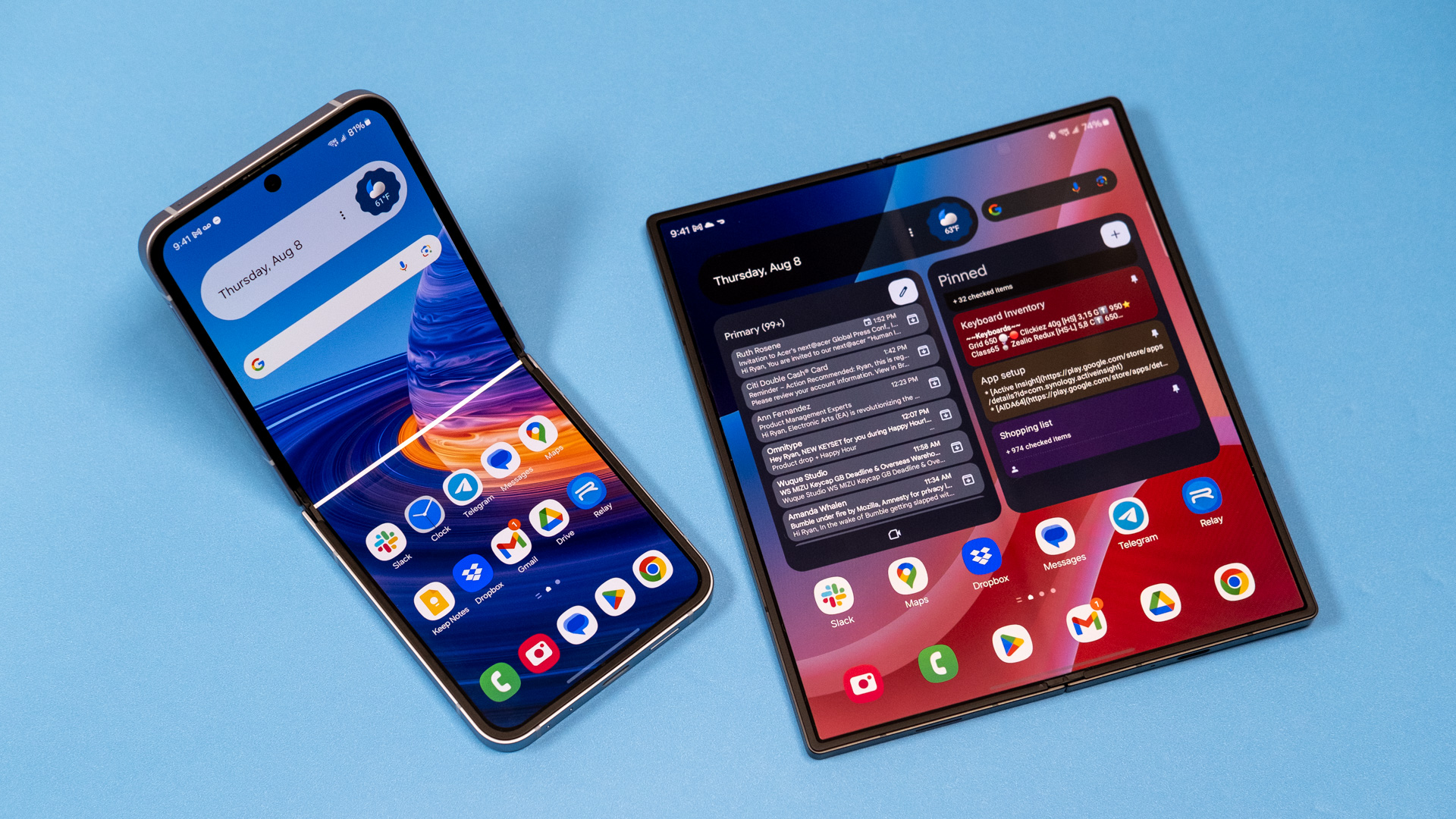
Samsung’s flagship foldables, the Z Flip 6 and Z Fold 6, are among the phones waiting on the One UI 7 update.

Credit: Ryan Whitwam

Samsung’s flagship foldables, the Z Flip 6 and Z Fold 6, are among the phones waiting on the One UI 7 update. Credit: Ryan Whitwam

One UI 7 is based on Android 15, which is the latest version of the OS for the moment. Google plans to release the first version of Android 16 in June, which is much earlier than in previous cycles. Samsung’s current-gen Galaxy S25 family launched with One UI 7, so owners of those devices don’t need to worry about the buggy update.

Samsung is no doubt working to fix the issues and restart the update rollout. Its statement is vague about timing—”shortly” can mean many things. We’ve reached out and will report if Samsung offers any more details on the pause or when it will be over.

When One UI 7 finally arrives on everyone’s phones, the experience will be similar to what you get on the Galaxy S25 lineup. There are a handful of base Android features in the update, but it’s mostly a Samsung affair. There’s the new AI-infused Now Bar, more expansive AI writing tools, camera UI customization, and plenty of interface tweaks.

https://arstechnica.com/gadgets/2025/04/samsungs-android-15-update-has-been-halted/