RCS texting updates will bring end-to-end encryption to green bubble chats
One of the best mostly invisible updates in iOS 18 was Apple’s decision to finally implement the Rich Communications Services (RCS) communication protocol, something that is slowly helping to fix the generally miserable experience of texting non-iPhone users with an iPhone. The initial iOS 18 update brought RCS support to most major carriers in the US, and the upcoming iOS 18.4 update is turning it on for a bunch of smaller prepaid carriers like Google Fi and Mint Mobile.

Now that Apple is on board, iPhones and their users can also benefit from continued improvements to the RCS standard. And one major update was announced today: RCS will now support end-to-end encryption using the Messaging Layer Security (MLS) protocol, a standard finalized by the Internet Engineering Task Force in 2023.

“RCS will be the first large-scale messaging service to support interoperable E2EE between client implementations from different providers,” writes GSMA Technical Director Tom Van Pelt in the post announcing the updates. “Together with other unique security features such as SIM-based authentication, E2EE will provide RCS users with the highest level of privacy and security for stronger protection from scams, fraud and other security and privacy threats. ”

https://arstechnica.com/gadgets/2025/03/rcs-texting-updates-will-bring-end-to-end-encryption-to-green-bubble-chats/
Why extracting data from PDFs is still a nightmare for data experts

“The biggest [drawback] is that they are probabilistic prediction machines and will get it wrong in ways that aren’t just ‘that’s the wrong word’,” Willis explains. “LLMs will sometimes skip a line in larger documents where the layout repeats itself, I’ve found, where OCR isn’t likely to do that.”

AI researcher and data journalist Simon Willison identified several critical concerns of using LLMs for OCR in a conversation with Ars Technica. “I still think the biggest challenge is the risk of accidental instruction following,” he says, always wary of prompt injections (in this case accidental) that might feed nefarious or contradictory instructions to a LLM.

“That and the fact that table interpretation mistakes can be catastrophic,” Willison adds. “In the past I’ve had lots of cases where a vision LLM has matched up the wrong line of data with the wrong heading, which results in absolute junk that looks correct. Also that thing where sometimes if text is illegible a model might just invent the text.”

These issues become particularly troublesome when processing financial statements, legal documents, or medical records, where a mistake might put someone’s life in danger. The reliability problems mean these tools often require careful human oversight, limiting their value for fully automated data extraction.

The path forward

Even in our seemingly advanced age of AI, there is still no perfect OCR solution. The race to unlock data from PDFs continues, with companies like Google now offering context-aware generative AI products. Some of the motivation for unlocking PDFs among AI companies, as Willis observes, doubtless involves potential training data acquisition: “I think Mistral’s announcement is pretty clear evidence that documents—not just PDFs—are a big part of their strategy, exactly because it will likely provide additional training data.”

Whether it benefits AI companies with training data or historians analyzing a historical census, as these technologies improve, they may unlock repositories of knowledge currently trapped in digital formats designed primarily for human consumption. That could lead to a new golden age of data analysis—or a field day for hard-to-spot mistakes, depending on the technology used and how blindly we trust it.

https://arstechnica.com/ai/2025/03/why-extracting-data-from-pdfs-is-still-a-nightmare-for-data-experts/


Gmail gains Gemini-powered “Add to calendar” button

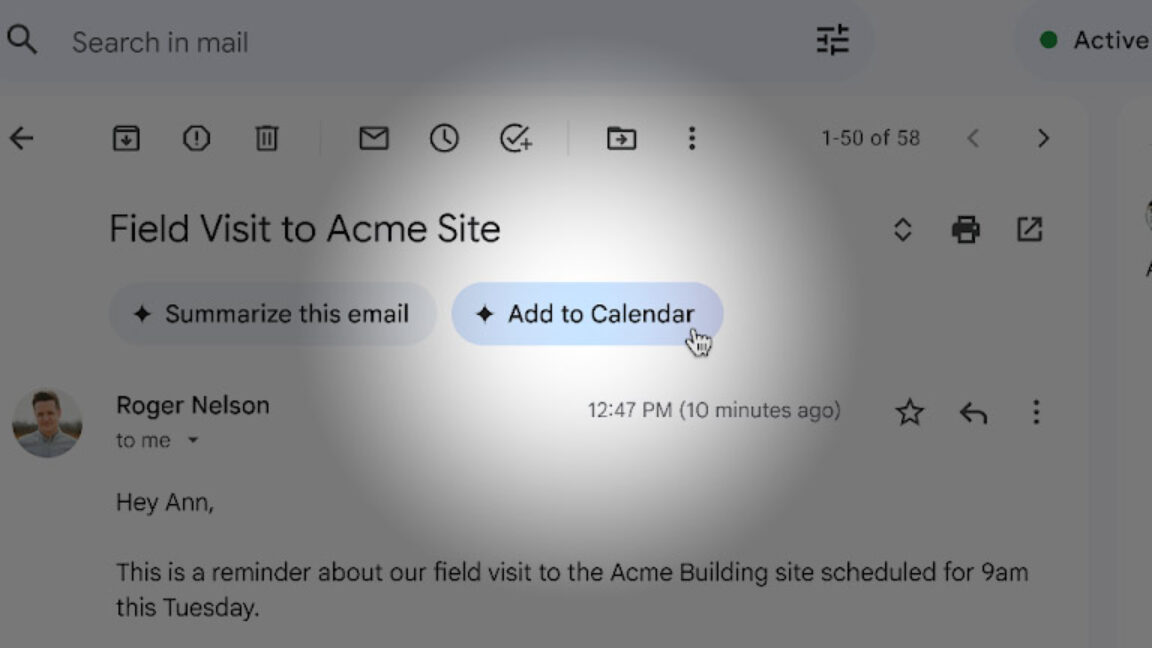
Google has a new mission in the AI era: to add Gemini to as many of the company’s products as possible. We’ve already seen Gemini appear in search results, text messages, and more. In Google’s latest update to Workspace, Gemini will be able to add calendar appointments from Gmail with a single click. Well, assuming Gemini gets it right the first time, which is far from certain.

The new calendar button will appear at the top of emails, right next to the summarize button that arrived last year. The calendar option will show up in Gmail threads with actionable meeting chit-chat, allowing you to mash that button to create an appointment in one step. The Gemini sidebar will open to confirm the appointment was made, which is a good opportunity to double-check the robot. There will be a handy edit button in the Gemini window in the event it makes a mistake. However, the robot can’t invite people to these events yet.

The effect of using the button is the same as opening the Gemini panel and asking it to create an appointment. The new functionality is simply detecting events and offering the button as a shortcut of sorts. You should not expect to see this button appear on messages that already have calendar integration, like dining reservations and flights. Those already pop up in Google Calendar without AI.

https://arstechnica.com/google/2025/03/gmail-gains-gemini-powered-add-to-calendar-button/


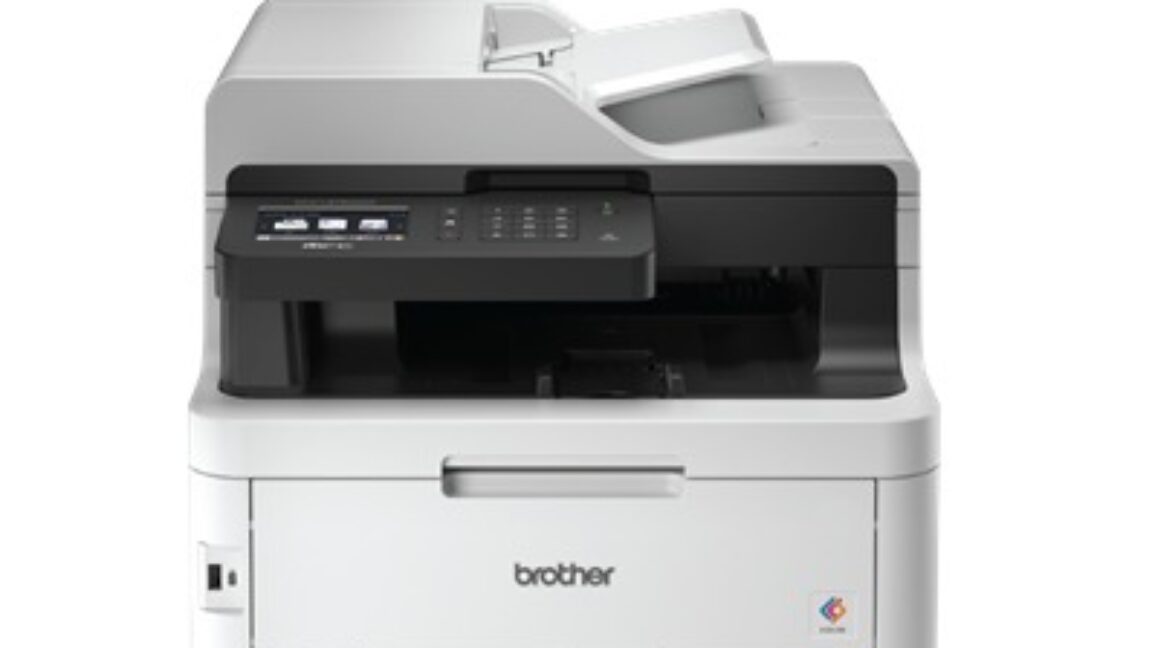
Firmware update bricks HP printers, makes them unable to use HP cartridges

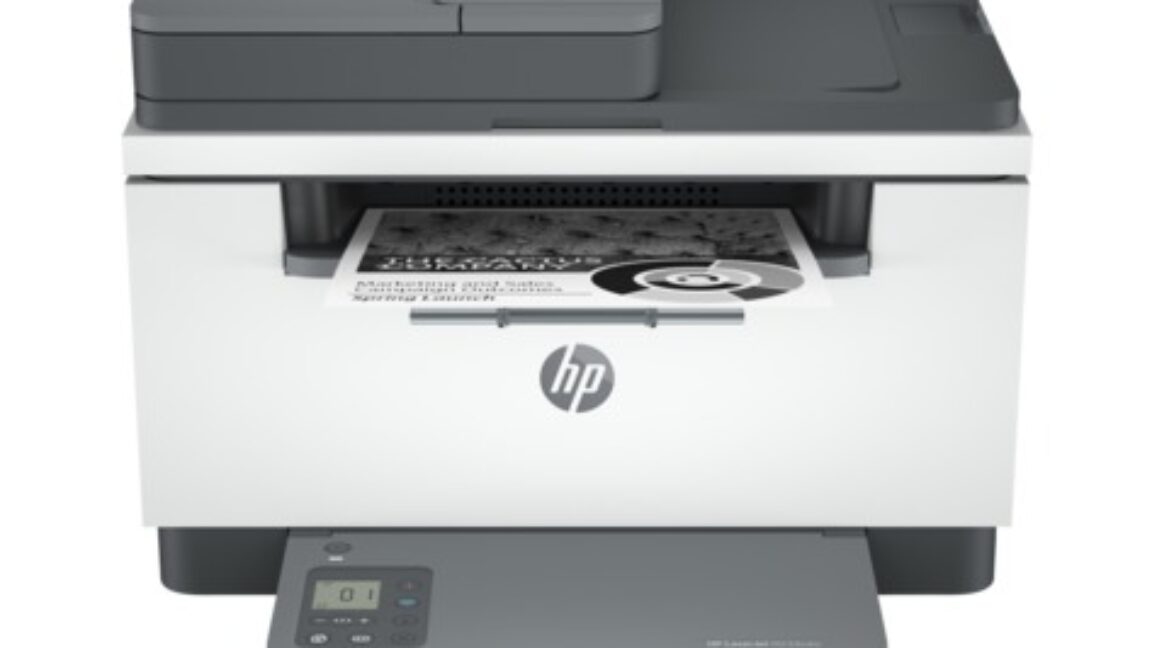
HP, along with other printer brands, is infamous for issuing firmware updates that brick already-purchased printers that have tried to use third-party ink. In a new form of frustration, HP is now being accused of issuing a firmware update that broke customers’ laser printers—even though the devices are loaded with HP-brand toner.

The firmware update in question is version 20250209, which HP issued on March 4 for its LaserJet MFP M232-M237 models. Per HP, the update includes “security updates,” a “regulatory requirement update,” “general improvements and bug fixes,” and fixes for IPP Everywhere. Looking back to older updates’ fixes and changes, which the new update includes, doesn’t reveal anything out of the ordinary. The older updates mention things like “fixed print quality to ensure borders are not cropped for certain document types,” and “improved firmware update and cartridge rejection experiences.” But there’s no mention of changes to how the printers use or read toner.

However, users have been reporting sudden problems using HP-brand toner in their M232–M237 series printers since their devices updated to 20250209. Users on HP’s support forum say they see Error Code 11 and the hardware’s toner light flashing when trying to print. Some said they’ve cleaned the contacts and reinstalled their toner but still can’t print.

“Insanely frustrating because it’s my small business printer and just stopped working out of nowhere[,] and I even replaced the tone[r,] which was a $60 expense,” a forum user wrote on March 8.

https://arstechnica.com/gadgets/2025/03/firmware-update-bricks-hp-printers-makes-them-unable-to-use-hp-cartridges/


Will the future of software development run on vibes?

For many people, coding is about telling a computer what to do and having the computer perform those precise actions repeatedly. With the rise of AI tools like ChatGPT, it’s now possible for someone to describe a program in English and have the AI model translate it into working code without ever understanding how the code works. Former OpenAI researcher Andrej Karpathy recently gave this practice a name—”vibe coding”—and it’s gaining traction in tech circles.

The technique, enabled by large language models (LLMs) from companies like OpenAI and Anthropic, has attracted attention for potentially lowering the barrier to entry for software creation. But questions remain about whether the approach can reliably produce code suitable for real-world applications, even as tools like Cursor Composer, GitHub Copilot, and Replit Agent make the process increasingly accessible to non-programmers.

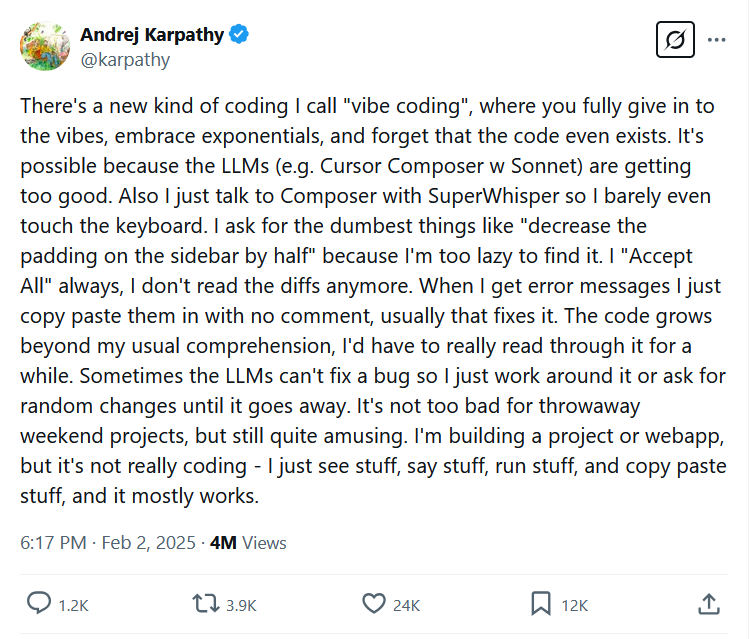
Instead of being about control and precision, vibe coding is all about surrendering to the flow. On February 2, Karpathy introduced the term in a post on X, writing, “There’s a new kind of coding I call ‘vibe coding,’ where you fully give in to the vibes, embrace exponentials, and forget that the code even exists.” He described the process in deliberately casual terms: “I just see stuff, say stuff, run stuff, and copy paste stuff, and it mostly works.”

Karapthy tweet screenshot: There's a new kind of coding I call "vibe coding", where you fully give in to the vibes, embrace exponentials, and forget that the code even exists. It's possible because the LLMs (e.g. Cursor Composer w Sonnet) are getting too good. Also I just talk to Composer with SuperWhisper so I barely even touch the keyboard. I ask for the dumbest things like "decrease the padding on the sidebar by half" because I'm too lazy to find it. I "Accept All" always, I don't read the diffs anymore. When I get error messages I just copy paste them in with no comment, usually that fixes it. The code grows beyond my usual comprehension, I'd have to really read through it for a while. Sometimes the LLMs can't fix a bug so I just work around it or ask for random changes until it goes away. It's not too bad for throwaway weekend projects, but still quite amusing. I'm building a project or webapp, but it's not really coding - I just see stuff, say stuff, run stuff, and copy paste stuff, and it mostly works.
A screenshot of Karpathy’s original X post about vibe coding from February 2, 2025. Credit: Andrej Karpathy / X

While vibe coding, if an error occurs, you feed it back into the AI model, accept the changes, hope it works, and repeat the process. Karpathy’s technique stands in stark contrast to traditional software development best practices, which typically emphasize careful planning, testing, and understanding of implementation details.

As Karpathy humorously acknowledged in his original post, the approach is for the ultimate lazy programmer experience: “I ask for the dumbest things, like ‘decrease the padding on the sidebar by half,’ because I’m too lazy to find it myself. I ‘Accept All’ always; I don’t read the diffs anymore.”

https://arstechnica.com/ai/2025/03/is-vibe-coding-with-ai-gnarly-or-reckless-maybe-some-of-both/


You knew it was coming: Google begins testing AI-only search results

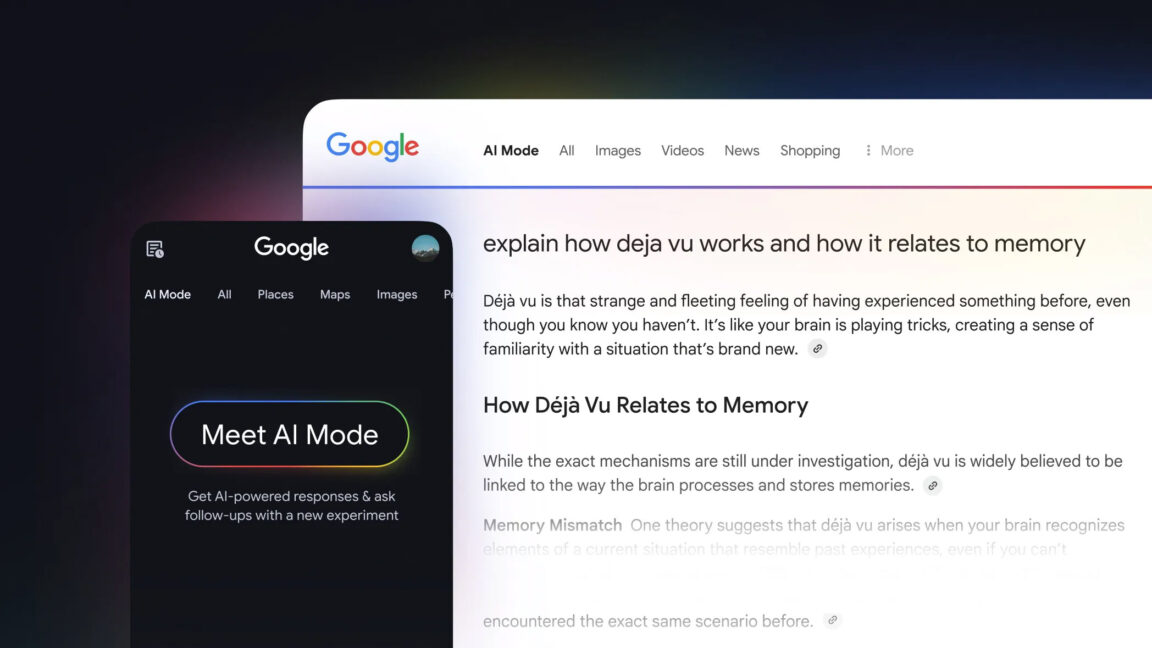
Google has become so integral to online navigation that its name became a verb, meaning “to find things on the Internet.” Soon, Google might just tell you what’s on the Internet instead of showing you. The company has announced an expansion of its AI search features, powered by Gemini 2.0. Everyone will soon see more AI Overviews at the top of the results page, but Google is also testing a more substantial change in the form of AI Mode. This version of Google won’t show you the 10 blue links at all—Gemini completely takes over the results in AI Mode.

This marks the debut of Gemini 2.0 in Google search. Google announced the first Gemini 2.0 models in December 2024, beginning with the streamlined Gemini 2.0 Flash. The heavier versions of Gemini 2.0 are still in testing, but Google says it has tuned AI Overviews with this model to offer help with harder questions in the areas of math, coding, and multimodal queries.

With this update, you will begin seeing AI Overviews on more results pages, and minors with Google accounts will see AI results for the first time. In fact, even logged out users will see AI Overviews soon. This is a big change, but it’s only the start of Google’s plans for AI search.

Gemini 2.0 also powers the new AI Mode for search. It’s launching as an opt-in feature via Google’s Search Labs, offering a totally new alternative to search as we know it. This custom version of the Gemini large language model (LLM) skips the standard web links that have been part of every Google search thus far. The model uses “advanced reasoning, thinking, and multimodal capabilities” to build a response to your search, which can include web summaries, Knowledge Graph content, and shopping data. It’s essentially a bigger, more complex AI Overview.

As Google has previously pointed out, many searches are questions rather than a string of keywords. For those kinds of queries, an AI response could theoretically provide an answer more quickly than a list of 10 blue links. However, that relies on the AI response being useful and accurate, something that often still eludes generative AI systems like Gemini.

https://arstechnica.com/google/2025/03/google-is-expanding-ai-overviews-and-testing-ai-only-search-results/


Brother denies using firmware updates to brick printers with third-party ink

Brother laser printers are popular recommendations for people seeking a printer with none of the nonsense. By nonsense, we mean printers suddenly bricking features, like scanning or printing, if users install third-party cartridges. Some printer firms outright block third-party toner and ink, despite customer blowback and lawsuits. Brother’s laser printers have historically worked fine with non-Brother accessories. A YouTube video posted this week, though, as well as older social media posts, claim that Brother has gone to the dark side and degraded laser printer functionality with third-party cartridges. Brother tells Ars that this isn’t true.

On March 3, YouTuber Louis Rossman posted a video saying that “Brother turns heel & becomes anti-consumer printer company.” The video, spotted by Tom’s Hardware, has 163,000 views as of this writing and seems to be based on a Reddit post from 2022. In that post, Reddit user 20Factorial said that firmware update W1.56 caused the automatic color registration feature to stop working on his Brother MFC-3750 when using third-party cartridges.

“With the colors not able to be aligned, the printer is effectively non-functional,” 20Factorial said. The Redditor went on to say that when asked, a Brother customer service agent confirmed that “the printer is non-functional without genuine toner.”

Rossman created a Wiki page breaking down the reported issues, including “printers continue to function with third-party toner but print at degraded quality unless OEM toner is installed.” He also noted that Brother printers automatically update when connected to the Internet and that Brother doesn’t offer older firmware versions to users.

Brother’s response

Brother denied to Ars Technica that it intentionally bricks printer functionality when users install third-party toner or ink. In a statement, the company said:

https://arstechnica.com/gadgets/2025/03/brother-denies-using-firmware-updates-to-brick-printers-with-third-party-ink/


AMD Radeon RX 9070 and 9070 XT review: RDNA 4 fixes a lot of AMD’s problems

Even if they come with a performance hit, new upscaling algorithms can still improve performance by making the lower-resolution presets look better. We run all of our testing in “Quality” mode, which generally renders at two-thirds of native resolution and scales up. But if FSR 4 running in Balanced or Performance mode looks the same to your eyes as FSR 3.1 running in Quality mode, you can still end up with a net performance improvement in the end.

RX 9070 or 9070 XT?

Just $50 separates the advertised price of the 9070 from that of the 9070 XT, something both Nvidia and AMD have done in the past that I find a bit annoying. If you have $549 to spend on a graphics card, you can almost certainly scrape together $599 for a graphics card. All else being equal, I’d tell most people trying to choose one of these to just spring for the 9070 XT.

That said, availability and retail pricing for these might be all over the place. If your choices are a regular RX 9070 or nothing, or an RX 9070 at $549 and an RX 9070 XT at any price higher than $599, I would just grab a 9070 and not sweat it too much. The two cards aren’t that far apart in performance, especially if you bump the 9070’s TBP up a little bit, and games that are playable on one will be playable at similar settings on the other.

Pretty close to great

If you’re building a 1440p or 4K gaming box, the 9070 series might be the ones to beat right now. Credit: Andrew Cunningham

We’ve got plenty of objective data in here, so I don’t mind saying that I came into this review kind of wanting to like the 9070 and 9070 XT. Nvidia’s 50-series cards have mostly upheld the status quo, and for the last couple of years, the status quo has been sustained high prices and very modest generational upgrades. And who doesn’t like an underdog story?

I think our test results mostly justify my priors. The RX 9070 and 9070 XT are very competitive graphics cards, helped along by a particularly mediocre RTX 5070 refresh from Nvidia. In non-ray-traced games, both cards wipe the floor with the 5070 and come close to competing with the $749 RTX 5070 Ti. In games and synthetic benchmarks with ray-tracing effects on, both cards can usually match or slightly beat the similarly priced 5070, partially (if not entirely) addressing AMD’s longstanding performance deficit here. Neither card comes close to the 5070 Ti in these games, but they’re also not priced like a 5070 Ti.

https://arstechnica.com/gadgets/2025/03/amd-radeon-rx-9070-and-9070-xt-review-rdna-4-fixes-a-lot-of-amds-problems/


Eerily realistic AI voice demo sparks amazement and discomfort online

An example argument with Sesame’s CSM created by Gavin Purcell.

Gavin Purcell, co-host of the AI for Humans podcast, posted an example video on Reddit where the human pretends to be an embezzler and argues with a boss. It’s so dynamic that it’s difficult to tell who the human is and which one is the AI model. Judging by our own demo, it’s entirely capable of what you see in the video.

“Near-human quality”

Under the hood, Sesame’s CSM achieves its realism by using two AI models working together (a backbone and a decoder) based on Meta’s Llama architecture that processes interleaved text and audio. Sesame trained three AI model sizes, with the largest using 8.3 billion parameters (an 8 billion backbone model plus a 300 million parameter decoder) on approximately 1 million hours of primarily English audio.

Sesame’s CSM doesn’t follow the traditional two-stage approach used by many earlier text-to-speech systems. Instead of generating semantic tokens (high-level speech representations) and acoustic details (fine-grained audio features) in two separate stages, Sesame’s CSM integrates into a single-stage, multimodal transformer-based model, jointly processing interleaved text and audio tokens to produce speech. OpenAI’s voice model uses a similar multimodal approach.

In blind tests without conversational context, human evaluators showed no clear preference between CSM-generated speech and real human recordings, suggesting the model achieves near-human quality for isolated speech samples. However, when provided with conversational context, evaluators still consistently preferred real human speech, indicating a gap remains in fully contextual speech generation.

Sesame co-founder Brendan Iribe acknowledged current limitations in a comment on Hacker News, noting that the system is “still too eager and often inappropriate in its tone, prosody and pacing” and has issues with interruptions, timing, and conversation flow. “Today, we’re firmly in the valley, but we’re optimistic we can climb out,” he wrote.

https://arstechnica.com/ai/2025/03/users-report-emotional-bonds-with-startlingly-realistic-ai-voice-demo/


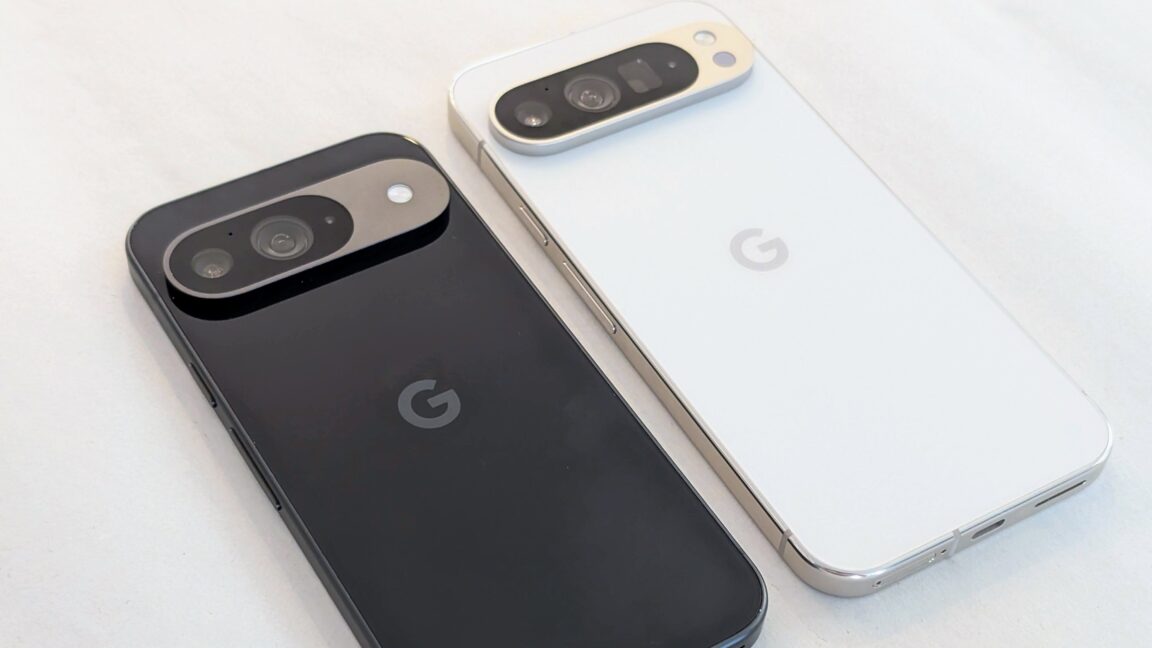
Google’s AI-powered Pixel Sense app could gobble up all your Pixel 10 data

Google’s AI ambitions know no bounds. A new report claims Google’s next phones will herald the arrival of a feature called Pixel Sense that will ingest data from virtually every Google app on your phone, fueling a new personalized experience. This app could be the premiere feature of the Pixel 10 series expected out late this year.

According to a report from Android Authority, Pixel Sense is the new name for Pixie, an AI that was supposed to integrate with Google Assistant before Gemini became the center of Google’s universe. In late 2023, it looked as though Pixie would be launched on the Pixel 9 series, but that never happened. Now, it’s reportedly coming back as Pixel Sense, and we have more details on how it might work.

Pixel Sense will apparently be able to leverage data you create in apps like Calendar, Gmail, Docs, Maps, Keep Notes, Recorder, Wallet, and almost every other Google app. It can also process media files like screenshots in the same way the Pixel Screenshots app currently does. The goal of collecting all this data is to help you complete tasks faster by suggesting content, products, and names by understanding the context of how you use the phone. Pixel Sense will essentially try to predict what you need without being prompted.

Samsung is pursuing a goal that is ostensibly similar to Now Brief, a new AI feature available on the Galaxy S25 series. Now Brief collects data from a handful of apps like Samsung Health, Samsung Calendar, and YouTube to distill your important data with AI. However, it rarely offers anything of use with its morning, noon, and night “Now Bar” updates.

Pixel Sense sounds like a more expansive version of this same approach to processing user data—and perhaps the fulfillment of Google Now’s decade-old promise. The supposed list of supported apps is much larger, and they’re apps people actually use. If pouring more and more data into a large language model leads to better insights into your activities, Pixel Sense should be better at guessing what you’ll need. Admittedly, that’s a big “if.”

https://arstechnica.com/google/2025/03/googles-ai-powered-pixel-sense-app-could-gobble-up-all-your-pixel-10-data/