Apple takes over third-party Apple Passwords autofill extension for Firefox
Over the last few years, Apple has steadily been building password manager-style features into macOS and iOS, including automatic password generation, password breach detection, and more. Starting with this year’s updates—iOS 18 and macOS 15 Sequoia—Apple broke all that functionality out into its own Passwords app, making it all even more visible as a competitor to traditional password managers like 1Password and Bitwarden.

One area where Apple has lagged behind its platform-agnostic competitors is in browser support. Users could easily autofill passwords in Safari on macOS, and Apple did support a basic extension for the Windows versions of Google Chrome and Microsoft Edge via iCloud for Windows. But the company only added a Chrome extension for macOS users in the summer of 2023, and it has never supported non-Chromium browsers at all.

That has finally changed, at least for Firefox users running macOS—Apple has an officially supported Passwords extension for Firefox that supports syncing and autofilling passwords in macOS Sonoma and macOS Sequoia. Currently, the extension doesn’t support older versions of macOS or any versions of Firefox for Windows or Linux. When you install the extension in Firefox on a Mac that’s already synced with your iCloud account, all you should need to do to sign in is input a six-digit code that macOS automatically generates for you. As with the Chromium extension, there’s no need to re-sign in to your iCloud account separately.

To enable this functionality, it looks like Apple has taken ownership of a third-party extension that supported autofilling Apple Passwords in Firefox—a GitHub page for the original extension is still available but says that Apple “are now the sole owners in charge of maintaining their own official iCloud Passwords extension.” That extension supports the versions of Windows that can run the official iCloud for Windows app, suggesting that Apple ought to be able to add official Windows support for the extension at some point down the line.

https://arstechnica.com/gadgets/2024/12/firefox-users-on-macos-can-finally-autofill-apple-passwords-in-their-browser/



Microsoft reiterates “non-negotiable” TPM 2.0 requirement for Windows 11

Windows 11 has other system requirements, though they weren’t the focus of this TPM-centric blog post. Windows 11 systems must have Secure Boot enabled, and they have to use a supported processor—an 8th-gen Intel Core CPU, an AMD Ryzen 2000 CPU, or a Qualcomm Snapdragon 850 CPU or newer. In fact, these CPU requirements exclude a couple of generations’ worth of Intel and AMD chips with built-in TPM 2.0 support.

Windows 11 also has nominal requirements for RAM and processor speed, but any system that meets the CPU or TPM requirements will easily clear those bars. If you have a supported CPU and your PC doesn’t appear to support TPM 2.0, you should be able to enable it in your system’s BIOS, either manually or by installing a BIOS update for your motherboard.

Windows 11 can be installed on unsupported systems, either those with an older TPM 1.2 module or no TPM enabled at all. It’s more annoying to install major updates on those systems, and Microsoft reserves the right to pull updates from those systems at any time, but aside from that, Windows 11 usually runs about as well on these PCs as Windows 10 did.

https://arstechnica.com/gadgets/2024/12/microsoft-reiterates-non-negotiable-tpm-2-0-requirement-for-windows-11/


Join us today for Ars Live: How Asahi Linux ports open software to Apple’s hardware

One of the key differences between Apple’s Macs and the iPhone and iPad is that the Mac can still boot and run non-Apple operating systems. This is a feature that Apple specifically built for the Mac, one of many features meant to ease the transition from Intel’s chips to Apple’s own silicon.

The problem, at least at first, was that alternate operating systems like Windows and Linux didn’t work natively with Apple’s hardware, not least because of missing drivers for basic things like USB ports, GPUs, and power management. Enter the Asahi Linux project, a community-driven effort to make open-source software run on Apple’s hardware.

In just a few years, the team has taken Linux on Apple Silicon from “basically bootable” to “plays native Windows games and sounds great doing it.” And the team’s ultimate goal is to contribute enough code upstream that you no longer need a Linux distribution just for Apple Silicon Macs.

On December 4 at 3:30 pm Eastern (12:30 pm Pacific), Ars Technica Senior Technology Reporter Andrew Cunningham will host a livestreamed YouTube conversation with Asahi Linux Project Lead Hector Martin and Graphics Lead Alyssa Rosenzweig that will cover the project’s genesis and its progress, as well as what the future holds.

View livestream

Add to Google Calendar

Add to calendar (.ics download)

https://arstechnica.com/apple/2024/12/join-us-tomorrow-for-ars-live-how-asahi-linux-ports-open-software-to-apples-hardware/


“Nightmare” Zipcar outage is a warning against complete app dependency

Zipcar’s rep declined to specify how many people were affected by the outage.

A warning against total app reliance

Zipcar’s app problems have not only cost it money but also traumatized some users who may think twice before using Zipcar again. The convenience of using apps to control physical products only exists if said apps are functioning and prepared for high-volume time periods, such as Thanksgiving weekend.

Despite Zipcar’s claims of a “small percentage” of users being affected, the company’s customer support system seemed overwhelmed. Long wait times coupled with misinformation regarding things like fees make already perturbed customers feel more deserted.

Those are the pitfalls of completely relying on apps for basic functionality. There was a time when Zipcar members automatically received physical “Zipcards” for opening doors. Now, they’re not really advertised, and users have to request one.

A Zipcard.
A Zipcard. Credit: Getty

Zipcars also used to include keys inside of locked cars more frequently. Reducing these physical aspects may have saved the company money but effectively put all of Zipcar’s eggs in one basket.

Nightmarish app problems like the one Zipcar experienced can be a deal-breaker. Just look at Sonos, whose botched app update is costing it millions. Further, turning something like car rentals into a virtually app-only service is a risky endeavor that can quickly overcomplicate simple tasks. Some New Zealand gas stations were out of luck earlier this year, for example, when a Leap Day glitch caused payment processing software to stop working. Gas stations that needed apps for payments weren’t able to make sales, and drivers were inconvenienced.

Apps can simplify and streamline while delivering ingenuity. But that doesn’t mean traditional, app-free measures should be eliminated as backups.

https://arstechnica.com/gadgets/2024/12/nightmare-zipcar-outage-is-a-warning-against-complete-app-dependency/


Intel’s second-generation Arc B580 GPU beats Nvidia’s RTX 4060 for $249

Turnover at the top of the company isn’t stopping Intel from launching new products: Today the company is announcing the first of its next-generation B-series Intel Arc GPUs, the Arc B580 and Arc B570.

Both are decidedly midrange graphics cards that will compete with the likes of Nvidia’s GeForce RTX 4060 and AMD’s RX 7600 series, but Intel is pricing them competitively: $249 for a B580 with 12GB of RAM and $219 for a B570 with 10GB of RAM. The B580 launches on December 13, while the B570 won’t be available until January 16.

The two cards are Intel’s first dedicated GPUs based on its next-generation “Battlemage” architecture, a successor to the “Alchemist” architecture used in the A-series cards. Intel’s Core Ultra 200 laptop processors were its first products to ship with Battlemage, though they used an integrated version with fewer of Intel’s Xe cores and no dedicated memory. Both B-series GPUs use silicon manufactured on a 5 nm TSMC process, an upgrade from the 6 nm process used for the A-series; as of this writing, no integrated or dedicated Arc GPUs have been manufactured by one of Intel’s factories.

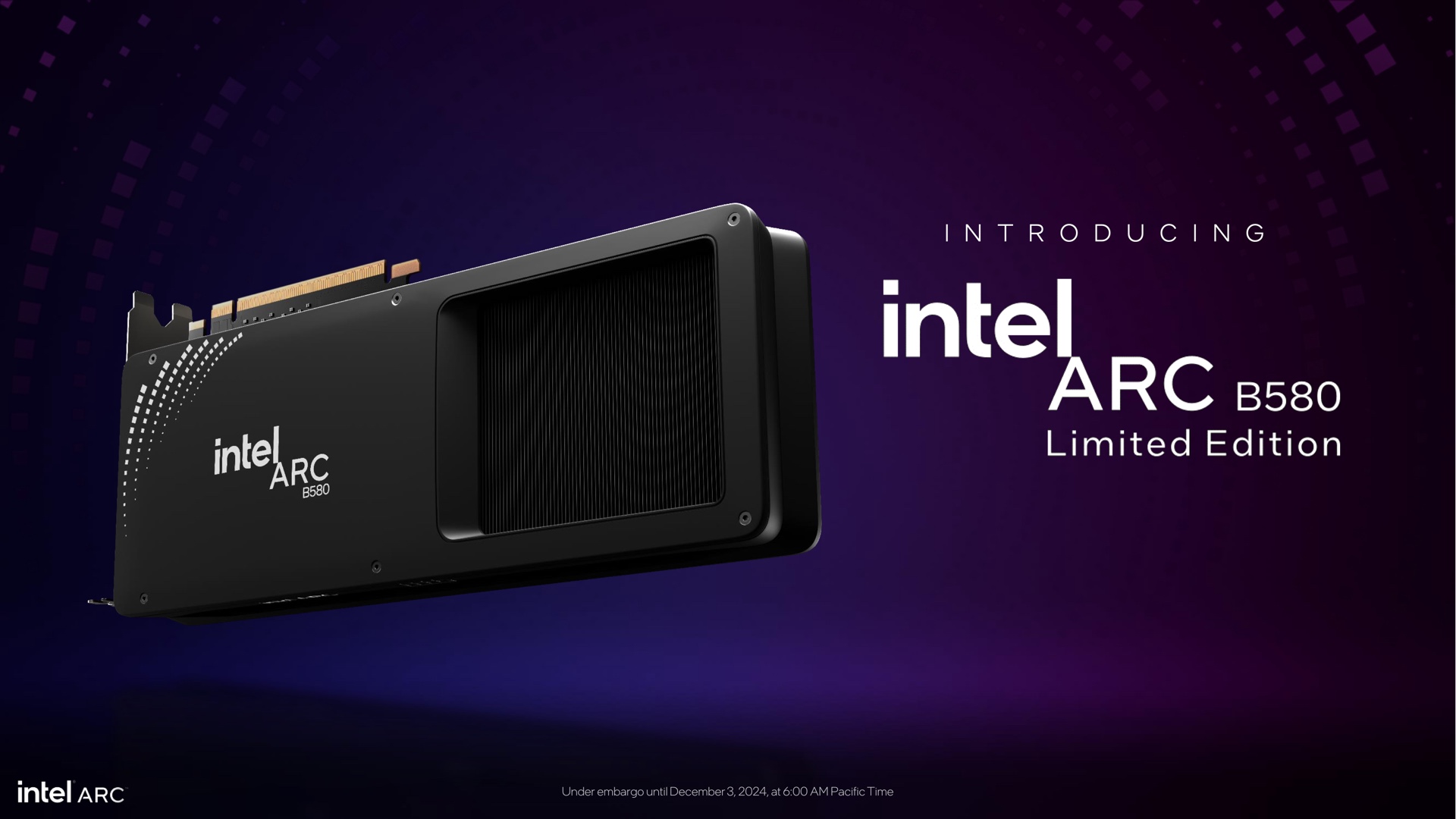
Both cards use a single 8-pin power connector, at least in Intel’s reference design; Intel is offering a first-party limited-edition version of the B580, while it looks like partners like Asus, ASRock, Gunnir, Maxsun, Onix, and Sparkle will be responsible for the B570.

The Arc B580 will be available in a limited-edition design from Intel.

Intel

Intel’s partners will handle the other cards, including all versions of the B570. The B580 and B570 will launch for $249 and $219, respectively.

Intel

Compared to the original Arc GPUs, both Battlemage cards should benefit from the work Intel has put into its graphics drivers over the last two years—a combination of performance improvements plus translation layers for older versions of DirectX have all improved Arc’s performance quite a bit in older games since late 2022. Hopefully buyers won’t need to wait months or years to get good performance out of the Battlemage cards.

The new cards also come with XeSS 2, the next-generation version of Intel’s upscaling technology (analogous to DLSS for Nvidia cards and FSR for AMD’s). Like DLSS 3 and FSR 3, one of XeSS 2’s main additions is a frame-generation feature that can interpolate additional frames to insert between the frames that are actually being rendered by the graphics card. These kinds of technologies tend to work best when the cards are already running at a reasonably high frame rate, but when they’re working well, they can lead to smoother-looking gameplay. A related technology, Xe Low Latency, aims to reduce the increase in latency that comes with frame-generation technologies, similar to Nvidia’s Reflex and AMD’s Anti-Lag.

https://arstechnica.com/gaming/2024/12/intel-targets-budget-friendly-1440p-gaming-with-249-and-219-arc-b500-gpus/


Vintage digicams aren’t just a fad. They’re an artistic statement.

Today’s young adults grew up in a time when their childhoods were documented with smartphone cameras instead of dedicated digital or film cameras. It’s not surprising that, perhaps as a reaction to the ubiquity of the phone, some young creative photographers are leaving their handsets in their pockets in favor of compact point-and-shoot digital cameras—the very type that camera manufacturers are actively discontinuing.

Much of the buzz among this creative class has centered around premium, chic models like the Fujifilm X100 and Ricoh GR, or for the self-anointed “digicam girlies” on TikTok, zoom point-and-shoots like the Canon PowerShot G7 and Sony RX100 models, which can be great for selfies.

But other shutterbugs are reaching back into the past 20 years or more to add a vintage “Y2K aesthetic” to their work. The MySpace look is strong with a lot of photographers shooting with authentic early-2000s “digicams,” aiming their cameras—flashes a-blazing—at their friends and capturing washed-out, low-resolution, grainy photos that look a whole lot like 2003.

Wired logo

“It’s so wild to me cause I’m an elder millennial,” says Ali O’Keefe, who runs the photography channel Two Months One Camera on YouTube. “My childhood is captured on film … but for [young people], theirs were probably all captured on, like, Canon SD1000s,” she says, referencing a popular mid-aughts point-and-shoot.

It’s not just the retro sensibility they’re after, but also a bit of cool cred. Everyone from Ayo Edibiri to Kendall Jenner is helping fuel digicam fever by publicly taking snaps with a vintage pocket camera.

The rise of the vintage digicam marks at least the second major nostalgia boom in the photography space. More than 15 years ago, a film resurgence brought thousands of cameras from the 1970s and ’80s out of closets and into handbags and backpacks. Companies like Impossible Project and Film Ferrania started up production of Polaroid-compatible and 35-mm film, respectively, firing up manufacturing equipment that otherwise would have been headed to the scrap heap. Traditional film companies like Kodak and Ilford have seen sales skyrocket. Unfortunately, the price of film stock also increased significantly, with film processing also getting more costly. (Getting a roll developed and digitally scanned now typically costs between $15 and $20.)

https://arstechnica.com/gadgets/2024/11/vintage-digicams-arent-just-a-fad-theyre-an-artistic-statement/


The upside-down capacitor in mid-‘90s Macs, proven and documented by hobbyists

Brown notes that the predecessor Mac LC and LC II had the correct connections, as did the LC 475, which uses the same power supply scheme. This makes him “confident that Apple made a boo-boo on the LC III,” or “basically the hardware equivalent of a copy/paste error when you’re writing code.”

Making sure rehabbers don’t make the same mistake

Why was this not noticed earlier, other than a couple forum threads seen by dedicated board rehabbers? There are a few reasons. For one thing, the rail was only used for a serial port or certain expansion card needs, so a capacitor failure, or out-of-spec power output, may not have been noticed. The other bit is that the original capacitor was rated for 16V, so even with -5V across it, it might not have failed, at least while it was relatively fresh. And it would not have failed in quite so spectacular a fashion as to generate stories and myths.

As to whether Apple knew about this but decided against acting on a somewhat obscure fault, one that might never cause real problems? By all means, let us know if you worked at Apple during that time and can clue us in. Ars has emailed Apple with this tremendously relevant question, the day before Thanksgiving, and will update this post with any comment.

By posting his analysis, Brown hopes to provide anyone else re-capping one of these devices with a bright, reflective warning sign to ignore Apple’s markings and install C22 the electrically correct way. Brown, reached by email, said that he heard from another hobbyist that the reverse voltage “would explain why the replacement cap” they installed “blew up.” Some restoration types, like Retro Viator, noticed the problem and fixed it pre-detonation.

Modern rehabbers tend to use tantalum capacitors to replace the fluid-filled kind that probably damaged the board they’re working on. Tantalum tends to react more violently to too much or reverse voltage, Brown wrote me.

Should C22 or other faulty capacitors destroy your LC III board entirely, Brown notes that 68kMLA member max1zzz has made a reverse-engineered full logic board schematic.

https://arstechnica.com/gadgets/2024/11/the-upside-down-capacitor-in-mid-90s-macs-proven-and-documented-by-hobbyists/


Smart gadgets’ failure to commit to software support could be illegal, FTC warns

Makers of smart devices that fail to disclose how long they will support their products with software updates may be breaking the Magnuson Moss Warranty Act, the Federal Trade Commission (FTC) warned this week.

The FTC released its statement after examining 184 smart products across 64 product categories, including soundbars, video doorbells, breast pumps, smartphones, home appliances, and garage door opener controllers. Among devices researched, the majority—or 163 to be precise—”did not disclose the connected device support duration or end date” on their product webpage, per the FTC’s report [PDF]. Contrastingly, 11.4 percent of devices examined shared a software support duration or end date on their product page.

Elusive information

In addition to manufacturers often neglecting to commit to software support for a specified amount of time, it seems that even when they share this information, it’s elusive.

For example, the FTC reported that some manufacturers made software support dates available but not on the related product’s webpage. Instead, this information is sometimes buried in specs, support, FAQ pages, or footnotes.

The FTC report added:

… some used ambiguous language that only imply the level of support provided, including phrases like, “lifetime technical support,” “as long as your device is fully operational,” and “continuous software updates,” for example. Notably, staff also had difficulty finding on the product webpages the device’s release date …

At times, the FTC found glaring inconsistencies. For example, one device’s product page said that the device featured “lifetime” support, “but the search result pointing to the manufacturer’s support page indicated that, while other updates may still be active, the security updates for the device had stopped in 2021,” per the FTC.

Those relying on Google’s AI Overviews may also be misled. In one case, AI Overviews pointed to a smart gadget getting “software support and updates for 3–6 months.” But through the link that AI Overviews provided, the FTC found that the three to six months figure that Google scraped actually referred to the device’s battery life. The next day, AI Overviews said that it couldn’t determine the duration of software support or updates for the gadget, the FTC noted.

https://arstechnica.com/gadgets/2024/11/smart-gadgets-failure-to-commit-to-software-support-could-be-illegal-ftc-warns/


Microsoft’s controversial Recall scraper is finally entering public preview

Users will be asked to reauthenticate with Windows Hello every time they access their Recall database. Credit: Microsoft

Microsoft has now delayed the feature multiple times to address those concerns, and it outlined multiple security-focused additions to Recall in a blog post in September. Among other changes, the feature is now opt-in by default and is protected by additional encryption. Users must also re-authenticate with Windows Hello each time they access the database. Turning on the feature requires Secure Boot, BitLocker disk encryption, and Windows Hello to be enabled. In addition to the manual exclusion lists for sites and apps, the new Recall also attempts to mask sensitive data like passwords and credit card numbers so they aren’t stored in the Recall database.

The new version of Recall can also be completely uninstalled for users who have no interest in it, or by IT administrators who don’t want to risk it exposing sensitive data.

Testers will need to kick the tires on all of these changes to make sure that they meaningfully address all the risks and issues that the original version of Recall had, and this Windows Insider preview is their chance to do it.

“Do security”

Part of the original Recall controversy was that Microsoft wasn’t going to run it through the usual Windows Insider process—it was intended to be launched directly to users of the new Copilot+ PCs via a day-one software update. This in itself was a big red flag; usually, even features as small as spellcheck for the Notepad app go through multiple weeks of Windows Insider testing before Microsoft releases them to the public. This gives the company a chance to fix bugs, collect and address user feedback, and even scrub new features altogether.

Microsoft is supposedly re-orienting itself to put security over all other initiatives and features. CEO Satya Nadella recently urged employees to “do security” when presented with the option to either launch something quickly or launch something securely. In Recall’s case, the company’s rush to embrace generative AI features almost won out over that “do security” mandate. If future AI features go through the typical Windows Insider testing process first, that will be a sign that Microsoft is taking its commitment to security seriously.

https://arstechnica.com/gadgets/2024/11/microsofts-controversial-recall-scraper-is-finally-entering-public-preview/


Google seems to have called it quits on making its own Android tablets—again

Depending on which Android-focused site you believe, either a third Pixel Tablet was apparently in the works at Google and canceled, as Android Headlines reported, or the second one, as Android Authority has it. Either way, there was reportedly a team at Google working on the next flagship Pixel-branded tablet, and now, seemingly due to profitability concerns, that work is over. At least until, maybe, a third Pixel Tablet in the future.

The Pixel Tablet, released last fall, was generally regarded as Google’s second re-entry into the tablet market that the iPad all but owns, at least at the consumer level. As such, it sought to distinguish itself from Apple’s slab by launching with a home-friendly dock and speaker cradle, taking on the appearance of a big smart home display when docked to it.

While there are no public sales figures, the device has not kick-started a resurgence of interest in Android tablets beyond the baseline sales of Amazon’s Kindle Fire devices (based on a Google-less fork of Android). Google will likely continue to support and promote Android tablets for other manufacturers and now has its own Pixel Fold devices occupying that middle space between phone and tablet forms.

Ars has contacted Google for comment and confirmation and will update this post with its response.

https://arstechnica.com/gadgets/2024/11/google-seems-to-have-called-it-quits-on-making-its-own-android-tablets-again/