Apple software leaks new Mac mini with five USB-C ports ahead of rumored event
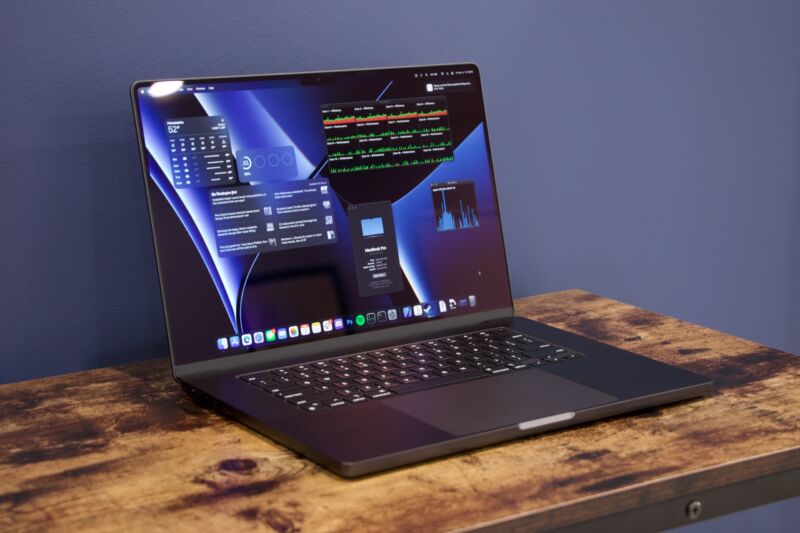
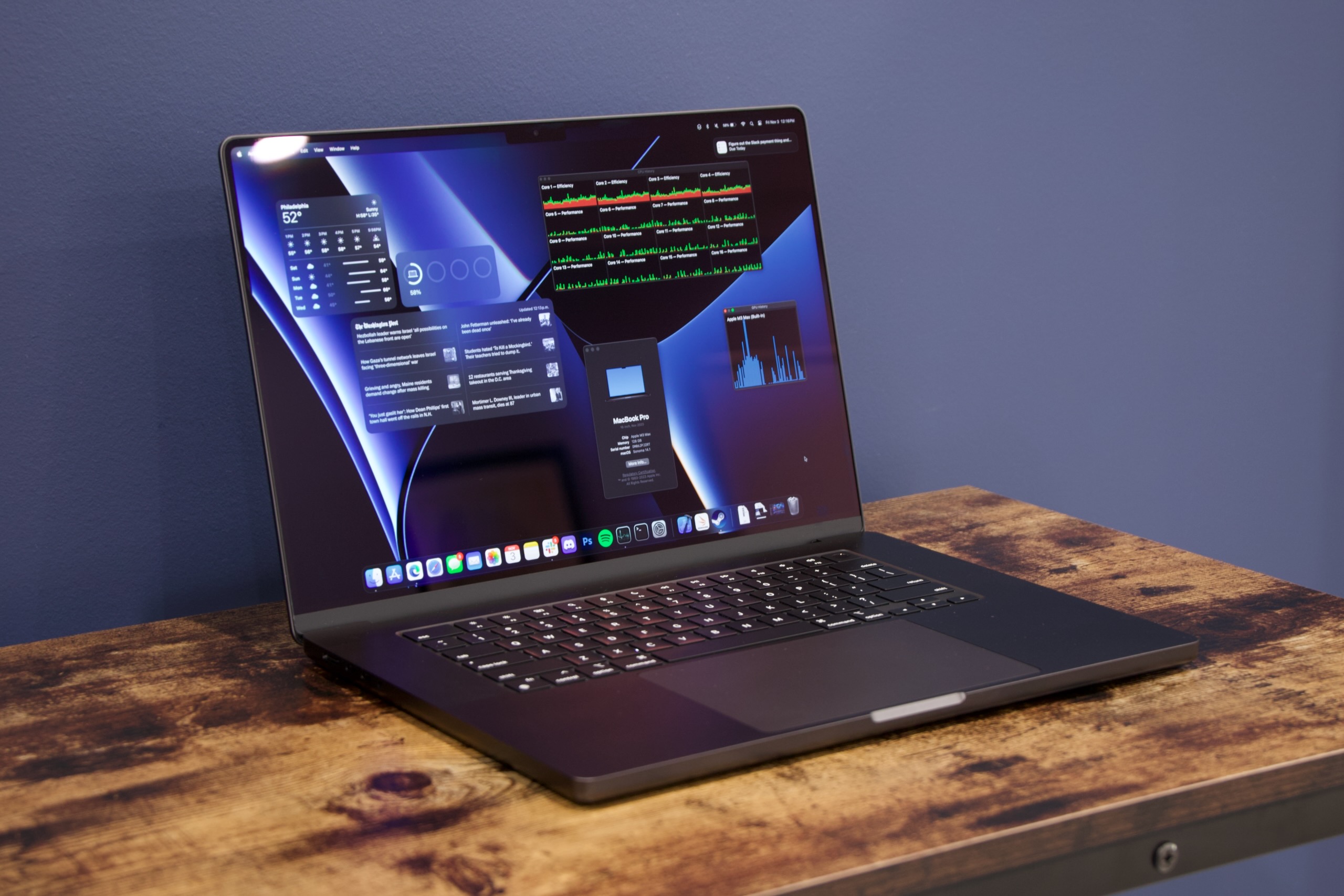
Apple's M3 Max-powered 16-inch MacBook Pro. New Pro laptops and some desktops could be on tap for later this fall.
Enlarge / Apple’s M3 Max-powered 16-inch MacBook Pro. New Pro laptops and some desktops could be on tap for later this fall.
Andrew Cunningham

Apple’s newest iPhones and Apple Watches don’t come out until later this week, but the rumor mill is already indicating that Apple is planning a product announcement for October to refresh some of the products that didn’t get a mention at the iPhone event. Apple scheduled its release calendar similarly last year, when it announced and released new iPhones in September and then launched the first wave of M3 Macs around Halloween.

Bloomberg’s Mark Gurman believes that the event will mainly focus on the first wave of Macs with M4 processors, following the standard M4’s introduction in the iPad Pro earlier this year. As he has reported previously, he expects new MacBook Pro models with the M4 and “pro-level M4 chip options,” presumably the M4 Pro and M4 Max. He also expects an M4 version of the 24-inch iMac.

But the most interesting of the new Macs will still be the redesigned Mac mini, which hasn’t gotten an M3 update at all and has been using the same basic external design since 2010. This Mac mini is said to be closer in size to the Apple TV than the current mini, but still uses an internal power supply so that owners won’t have to wrangle a power brick. At least some of the current device’s ports will be replaced by USB-C and/or Thunderbolt ports, something that MacRumors apparently confirmed earlier today when they found a reference to an “Apple silicon Mac mini (5 ports)” in an Apple software update (some of those ports are reportedly on the front of the device, a nice Mac Studio design upgrade that I’d like to see on a new Mac mini).

The “five port” descriptor does imply that there will be another model with either more or fewer ports—Apple used similar terminology to distinguish the two- and four-port versions of some MacBook Pro models in the Intel days. The current M2 Mac mini models have fewer ports than the models with the M2 Pro chip, because the more powerful processor also has more I/O capabilities—assuming we get one Mac mini with an M4 and an upgraded model with an M4 Pro, we’d expect the Pro version to have more ports.

Gurman says that other Mac models, including the Mac Studio, Mac Pro, and MacBook Air, will see M4-series updates throughout 2025. Of those, the Mac Studio and the Mac Pro have gone the longest without an update—they’re all still using M2-series chips.

Apple is also said to be planning some new lower-end iPads for the October event—not the first time that Macs and iPads have shared billing for one of these late-fall product announcements. The $349 iPad 10 and the iPad mini have both gone over a year without any kind of hardware update; it seems likely that they’ll both get newer chips, if not significantly updated designs.

https://arstechnica.com/?p=2050106


iOS 18 brings RCS to major carrier iPhones, but prepaid plans are still waiting

Thumb hovering over the Messages app on an iPhone
Enlarge / Illustration of a person who refuses to check their iPhone’s messages until RCS is enabled on their MVNO carrier, out of respect for their Android-toting friends and family.
Getty Images

The future of inter-OS mobile messaging is here, it’s just unevenly distributed.

With iOS 18, Apple has made it possible for non-Apple phones to message with iPhones through Rich Communication Services (RCS). This grants upgrades from standard SMS text messages, like read receipts, easier and higher-quality media sending, typing indicators, and emoji/response compatibility. More than that, it allows for messaging while on Wi-Fi without cellular services and makes group messages far less painful to navigate and leave. Notably, RCS messages between iPhones and non-iPhones will not be encrypted, like Apple’s private iMessage service available exclusively between Apple devices.

iOS 18 makes these RCS upgrades possible, but certainly not guaranteed, at least as of today. Lots of people have already been enjoying cross-platform RCS messaging when texting with iOS 18 beta users. And iPhones on the big carriers’ plans can now trade RCS with Android users. But some iPhone users, particularly on mobile virtual network operators (MVNOs)—typically pre-paid services that do not own network hardware but resell major carrier access—do not have an RCS option available to them yet.

Google, a major proponent of Apple adopting RCS, confirmed to Ars that Google Fi, its own MVNO cellular service, does not, as of this writing, offer RCS chat for iPhone users on Fi messaging with Android users. Android users on Google Fi can use RCS with iPhones on other carriers, so long as that iPhone has “RCS interoperability enabled.”

Reading between the lines, you might conclude that Google is waiting on Apple to enable RCS on a network-by-network basis, both for Fi and for Android users at large. And a Google spokesperson would suggest that is correct.

“We have been working for a long time to accelerate the adoption of RCS, and are excited that Apple is taking steps to adopt RCS with the launch of iOS 18,” a Google spokesperson said in a statement. “Only Apple has the ability to enable RCS interoperability for iPhone users on Fi, and our hope is that they will do so in the near future.”

Ars has contacted Apple, along with carriers Mint Mobile and Boost Mobile, for comment on RCS availability across carriers and will update this post with new information. Some customers of MVNOs offered by the major carriers themselves, like those on Visible from Verizon, have reported having RCS access with iOS 18 installed.

Apple got the message, kept it green

Users of other MVNOs have asked on Reddit why their upgrade from basic SMS to RCS did not occur during the iOS 18 betas. A co-founder and current CFO of Mint Mobile said on September 9 that it would “be a few months, unfortunately,” as the “backend transition is taking some time… Believe me, we want this out as soon as we can,” wrote Rizwan Kassim.

A moderator for the Mint Mobile subreddit suggested that the backend transition involves carriers setting up a relay API for messages, adding that to the “carrier bundle” they deliver to customers and then providing Apple with information it can add to a future iOS update.

If you have an iPhone that isn’t on one of the major carriers’ primary plans (AT&T, T-Mobile, or Verizon) and want to check if RCS should be available, you can do that in Settings. Head to General, choose About, and scroll down to the Carrier line under your active SIM or eSIM. Tap the “Carrier” line until you see “IMS Status.” If it reads “Voice & SMS,” you don’t have RCS yet, but if you see “Voice, SMS & RCS,” you do.

The version of RCS that iPhone and Android users might use now, or soon, is the “RCS Universal Profile,” which does not include the encryption that Google’s own messaging apps provide over RCS. Google’s “Get the Message” campaign tried to shame Apple into adopting RCS. The related site notes that “Apple is starting to #GetTheMessage” with RCS adoption but that iPhone users will have to “check with your carrier” to turn on the feature.

Apple announced RCS support in November 2023. The company’s choice of a particularly strong green color to denote messages that are not going over its own iMessage servers—but culturally associated with Android—have inspired both a notable Drake track, a wild month of efforts by messaging startup Beeper to work around its Apple-only nature, and a portion of the Department of Justice’s antitrust lawsuit against Apple. RCS support, whenever it arrives for whatever carrier, will not change the color of cross-platform messages.

https://arstechnica.com/?p=2049951


Neofetch is over, but many screenshot system info tools stand ready

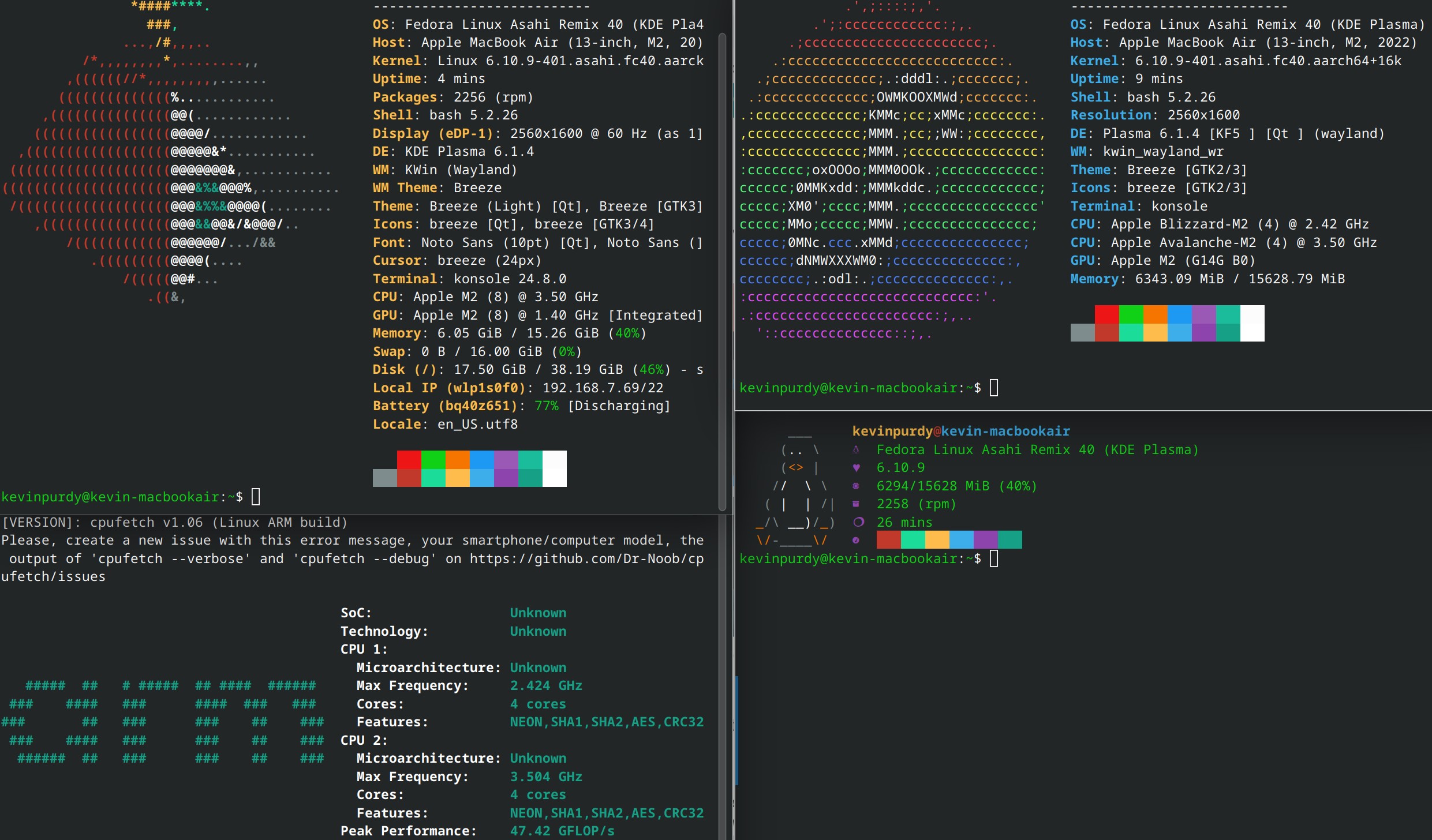
Four terminal windows open to different system information fetching tools
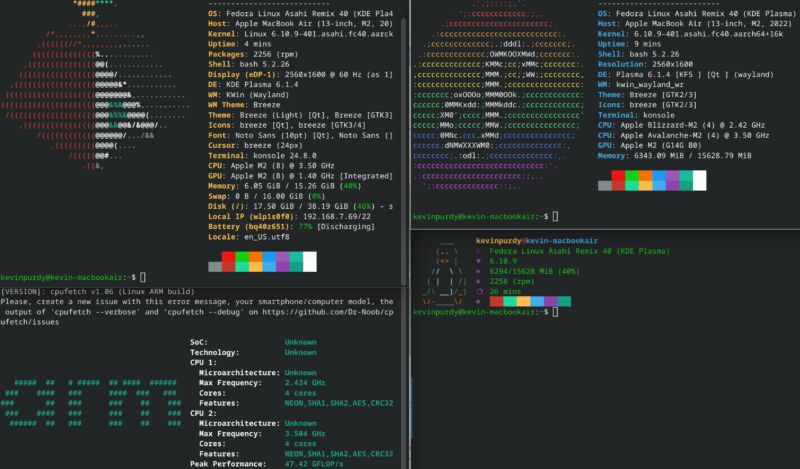
Enlarge / Sorry about all the black space in the lower-right corner. Nerdfetch does not make good use of the space it’s given—unlike the Asahi install on this MacBook.
Kevin Purdy

Almost nobody truly needed Neofetch, but the people who did use it? They really liked it.

Neofetch, run from a terminal, displayed key system information alongside an ASCII-art image of the operating system or distribution running on that system. You knew most of this data, but if you’re taking a screenshot of your system, it looked cool and conveyed a lot of data in a small space. “The overall purpose of Neofetch is to be used in screen-shots of your system,” wrote Neofetch’s creator, Dylan Araps, on its Github repository. “Neofetch shows the information other people want to see.”

Neofetch did that, providing cool screenshots and proof-of-life images across nearly 150 OS versions until late April. The last update to the tool was made three years before that, and Araps’ Github profile now contains a rather succinct coda: “Have taken up farming.” Araps joins “going to a commune in Vermont” and “I now make furniture out of wood” in the pantheon of programmers who do not just leave the field, but flee into another realm entirely.

As sometimes happens, the void was filled not by one decent replacement but many.

The neo-Neofetches

Fastfetch seems to have captured the default forum/thread/blog recommendation as a Neofetch replacement. It is under active development, with changes occurring just hours before this post was published. It’s highly customizable, available across most major platforms and distributions, and extensible through modules. It supports Wayland, provides more detailed memory and storage statistics, and, as the name suggests, is generally faster. It’s FOSS and has a tutorial on customizing and extending Fastfetch.

NerdFetch gives you the kind of icon customization you might expect if you’re the type who takes meticulously arranged screenshots of your desktop. By installing one of the glyph-packed Nerd Fonts, you can replace text inside your readout with icons readable at a glance. It’s available on POSIX-compliant systems (“Anything but Windows”). It lacks a lot of customization and module options, and it’s missing the big, custom OS logo (it seemingly shows a very abstract ASCII Tux in both MacOS and Asahi Linux). But it’s also compact and a bit different.

What else? There’s hyfetch, which is “neofetch with pride flags,” but it also contains inside it “neowofetch,” which is an updated neofetch sans pride coloring. The macchina system info tool is written in Rust and offers themeing, being “basic by default and extensible by design.” And cpufetch is, as you might imagine, a lot more CPU data, along with a logo. Curiously, cpufetch showed an “arm” rendering when I ran it under Asahi Linux on a MacBook, but then an Apple logo while inside MacOS. Works either way! Just interesting.

If you’ve put time into getting a Linux desktop just how you like it—or just getting Linux onto a device that really doesn’t want it—it follows that you’d want to show it off. These are not the last of the apps that will try to make fetch happen, but they’re a strong start.

Listing image by Kevin Purdy

https://arstechnica.com/?p=2049004


Unicode 16.0 release with new emoji brings character count to 154,998

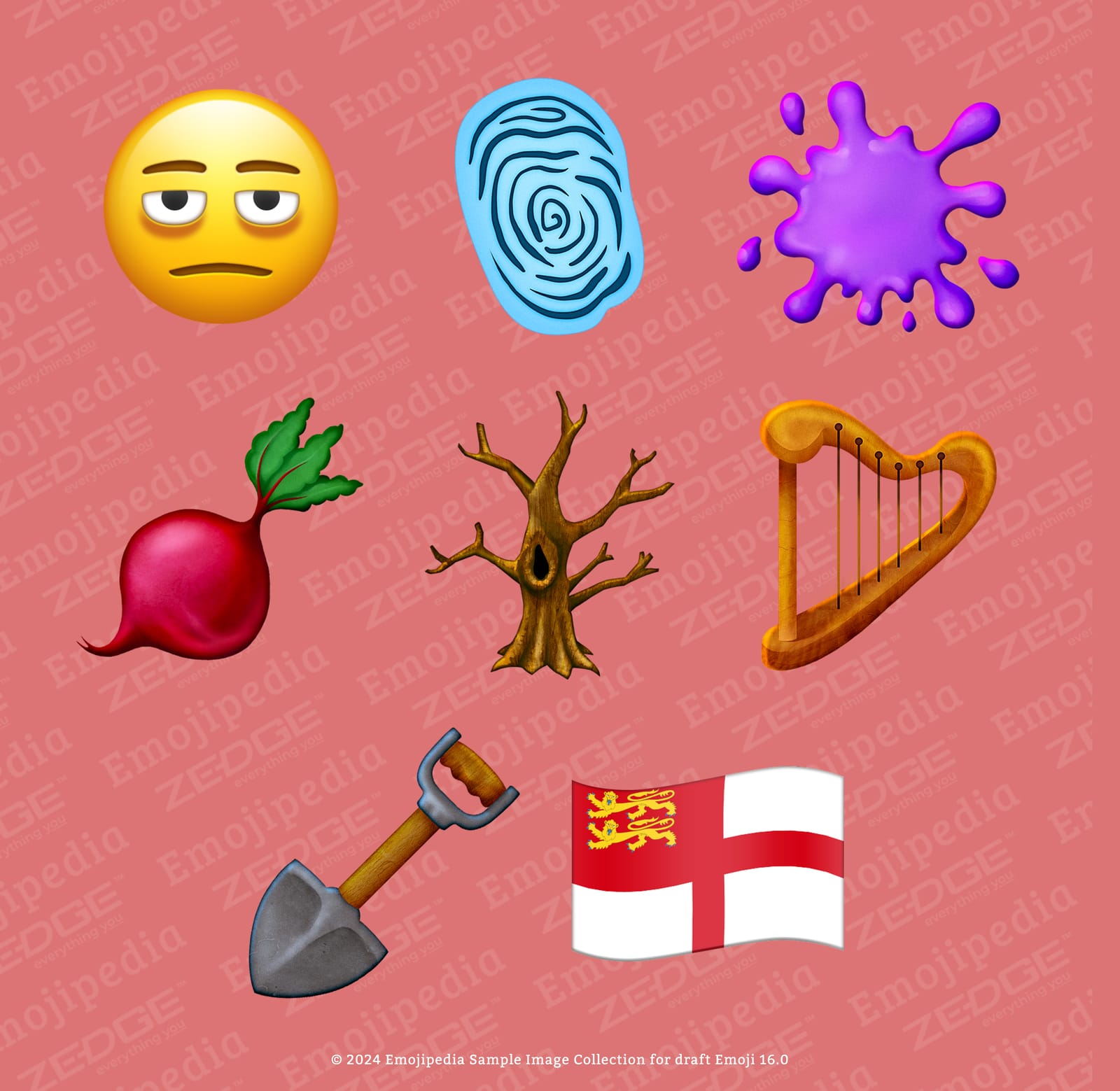
Emojipedia sample images of the new Unicode 16.0 emoji.
Enlarge / Emojipedia sample images of the new Unicode 16.0 emoji.

The Unicode Consortium has finalized and released version 16.0 of the Unicode standard, the elaborate character set that ensures that our phones, tablets, PCs, and other devices can all communicate and interoperate with each other. The update adds 5,185 new characters to the standard, bringing the total up to a whopping 154,998.

Of those 5,185 characters, the ones that will get the most attention are the eight new emoji characters, including a shovel, a fingerprint, a leafless tree, a radish (formally classified as “root vegetable”), a harp, a purple splat that evokes the ’90s Nickelodeon logo, and a flag for the island of Sark. The standout, of course, is “face with bags under eyes,” whose long-suffering thousand-yard stare perfectly encapsulates the era it has been born into. Per usual, Emojipedia has sample images that give you some idea of what these will look like when they’re implemented by various operating systems, apps, and services.

Unicode 16.0 also adds support for seven new modern and historical scripts: the West African Garay alphabet; the Gurung Khema, Kirat Rai, Ol Onal, and Sunuwar scripts from Northeast India and Nepal; and historical Todhri and Tulu-Tigalari scripts from Albania and Southwest India, respectively.

We last got new emoji in 2023’s Unicode 15.1 update, though all of these designs were technically modifications of existing emoji rather than new characters—many emoji, most notably for skin and hair color variants, use a base emoji plus a modifier emoji, combined together with a “zero-width joiner” (ZWJ) character that makes them display as one character instead. The lime emoji in Unicode 15.1 was actually a lemon emoji combined with the color green; the phoenix was a regular bird joined to the fire emoji. This was likely because 15.1 was only intended as a minor update to 2022’s Unicode 15.0 standard.

Most of the Unicode 16.0 emoji, by contrast, are their own unique characters. The one exception is the Sark flag emoji; flag sequences are created by placing two “regional indicator letters” directly next to each other and don’t require a ZWJ character between them.

Incorporation into the Unicode standard is only the first step that new emoji and other characters take on their journey from someone’s mind to your phone or computer; software makers like Apple, Google, Microsoft, Samsung, and others need to design iterations that fit with their existing spin on the emoji characters, they need to release software updates that use the new characters, and people need to download and install them.

We’ve seen a few people share on social media that the Unicode 16.0 release includes a “greenwashing” emoji designed by Shepard Fairey, an artist best known for the 2008 Barack Obama “Hope” poster. This emoji, and an attempt to gin up controversy around it, is all an elaborate hoax: there’s a fake Unicode website announcing it, a fake lawsuit threat that purports to be from a real natural gas industry group, and a fake Cory Doctorow article about the entire “controversy” published in a fake version of Wired. These were all published to websites with convincing-looking but fake domains, all registered within a couple of weeks of each other in August 2024. The face-with-bags-under-eyes emoji feels like an appropriate response.

https://arstechnica.com/?p=2049432


Music industry’s 1990s hard drives, like all HDDs, are dying

Hard drive seemingly exploding in flames and particles
Enlarge / Hard drives, unfortunately, tend to die not with a spectacular and sparkly bang, but with a head-is-stuck whimper.
Getty Images

One of the things enterprise storage and destruction company Iron Mountain does is handle the archiving of the media industry’s vaults. What it has been seeing lately should be a wake-up call: roughly one-fifth of the hard disk drives dating to the 1990s it was sent are entirely unreadable.

Music industry publication Mix spoke with the people in charge of backing up the entertainment industry. The resulting tale is part explainer on how music is so complicated to archive now, part warning about everyone’s data stored on spinning disks.

“In our line of work, if we discover an inherent problem with a format, it makes sense to let everybody know,” Robert Koszela, global director for studio growth and strategic initiatives at Iron Mountain, told Mix. “It may sound like a sales pitch, but it’s not; it’s a call for action.”

Hard drives gained popularity over spooled magnetic tape as digital audio workstations, mixing and editing software, and the perceived downsides of tape, including deterioration from substrate separation and fire. But hard drives present their own archival problems. Standard hard drives were also not designed for long-term archival use. You can almost never decouple the magnetic disks from the reading hardware inside, so that if either fails, the whole drive dies.

There are also general computer storage issues, including the separation of samples and finished tracks, or proprietary file formats requiring archival versions of software. Still, Iron Mountain tells Mix that “If the disk platters spin and aren’t damaged,” it can access the content.

But “if it spins” is becoming a big question mark. Musicians and studios now digging into their archives to remaster tracks often find that drives, even when stored at industry-standard temperature and humidity, have failed in some way, with no partial recovery option available.

“It’s so sad to see a project come into the studio, a hard drive in a brand-new case with the wrapper and the tags from wherever they bought it still in there,” Koszela says. “Next to it is a case with the safety drive in it. Everything’s in order. And both of them are bricks.”

Entropy wins

Mix’s passing along of Iron Mountain’s warning hit Hacker News earlier this week, which spurred other tales of faith in the wrong formats. The gist of it: You cannot trust any medium, so you copy important things over and over, into fresh storage. “Optical media rots, magnetic media rots and loses magnetic charge, bearings seize, flash storage loses charge, etc.,” writes user abracadaniel. “Entropy wins, sometimes much faster than you’d expect.”

There is discussion of how SSDs are not archival at all; how floppy disk quality varied greatly between the 1980s, 1990s, and 2000s; how Linear Tape-Open, a format specifically designed for long-term tape storage, loses compatibility over successive generations; how the binder sleeves we put our CD-Rs and DVD-Rs in have allowed them to bend too much and stop being readable.

Knowing that hard drives will eventually fail is nothing new. Ars wrote about the five stages of hard drive death, including denial, back in 2005. Last year, backup company Backblaze shared failure data on specific drives, showing that drives that fail tend to fail within three years, that no drive was totally exempt, and that time does, generally, wear down all drives. Google’s server drive data showed in 2007 that HDD failure was mostly unpredictable, and that temperatures were not really the deciding factor.

So Iron Mountain’s admonition to music companies is yet another warning about something we’ve already heard. But it’s always good to get some new data about just how fragile a good archive really is.

https://arstechnica.com/?p=2049391


Android apps are blocking sideloading and forcing Google Play versions instead

Image from an Android phone, suggesting user
Enlarge / It’s never explained what this collection of app icons quite represents. A disorganized app you tossed together by sideloading? A face that’s frowning because it’s rolling down a bar held up by app icons? It’s weird, but not quite evocative.

You might sideload an Android app, or manually install its APK package, if you’re using a custom version of Android that doesn’t include Google’s Play Store. Alternately, the app might be experimental, under development, or perhaps no longer maintained and offered by its developer. Until now, the existence of sideload-ready APKs on the web was something that seemed to be tolerated, if warned against, by Google.

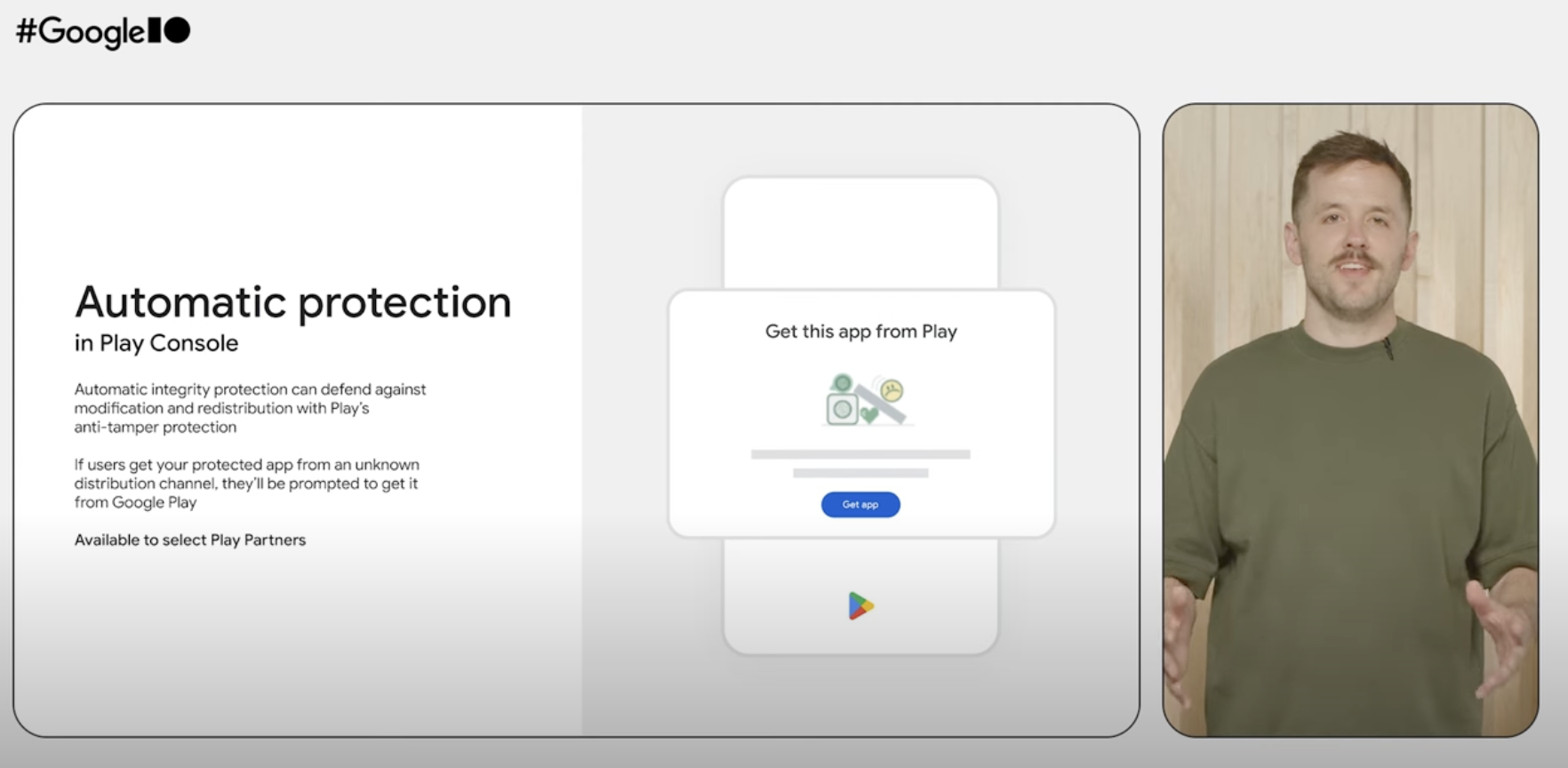
This quiet standstill is being shaken up by a new feature in Google’s Play Integrity API. As reported by Android Authority, developer tools to push “remediation” dialogs during sideloading debuted at Google’s I/O conference in May, have begun showing up on users’ phones. Sideloaders of apps from the British shop Tesco, fandom app BeyBlade X, and ChatGPT have reported “Get this app from Play” prompts, which cannot be worked around. An Android gaming handheld user encountered a similarly worded prompt from Diablo Immortal on their device three months ago.

Google’s Play Integrity API is how apps have previously blocked access when loaded onto phones that are in some way modified from a stock OS with all Google Play integrations intact. Recently, a popular two-factor authentication app blocked access on rooted phones, including the security-minded GrapheneOS. Apps can call the Play Integrity API and get back an “integrity verdict,” relaying if the phone has a “trustworthy” software environment, has Google Play Protect enabled, and passes other software checks.

Graphene has questioned the veracity of Google’s Integrity API and SafetyNet Attestation systems, recommending instead standard Android hardware attestation. Rahman notes that apps do not have to take an all-or-nothing approach to integrity checking. Rather than block installation entirely, apps could call on the API only during sensitive actions, issuing a warning there. But not having a Play Store connection can also deprive developers of metrics, allow for installation on incompatible devices (and resulting bad reviews), and, of course, open the door to paid app piracy.

“Unknown distribution channels” blocked

Google’s developer video about “Automatic integrity protection” (at the 12-minute, 24-second mark on YouTube) notes that “select” apps have access to automatic protection. This adds an automatic checking tool to your app and the “strongest version of Google Play’s anti-tamper protection.” “If users get your protected app from an unknown distribution channel,” a slide in the presentation reads, “they’ll be prompted to get it from Google Play,” available to “select Play Partners.”

Last year, Google introduced malware scanning of sideloaded apps at install time. Google and Apple have come out against legislation that would broaden sideloading rights for smartphone owners, citing security and reliability concerns. European regulators forced Apple earlier this year to allow for sideloading apps and app stores, though with fees and geographical restrictions in place.

https://arstechnica.com/?p=2049138


Huawei’s $2,800 trifold phone is a real thing it wants people to hold and use

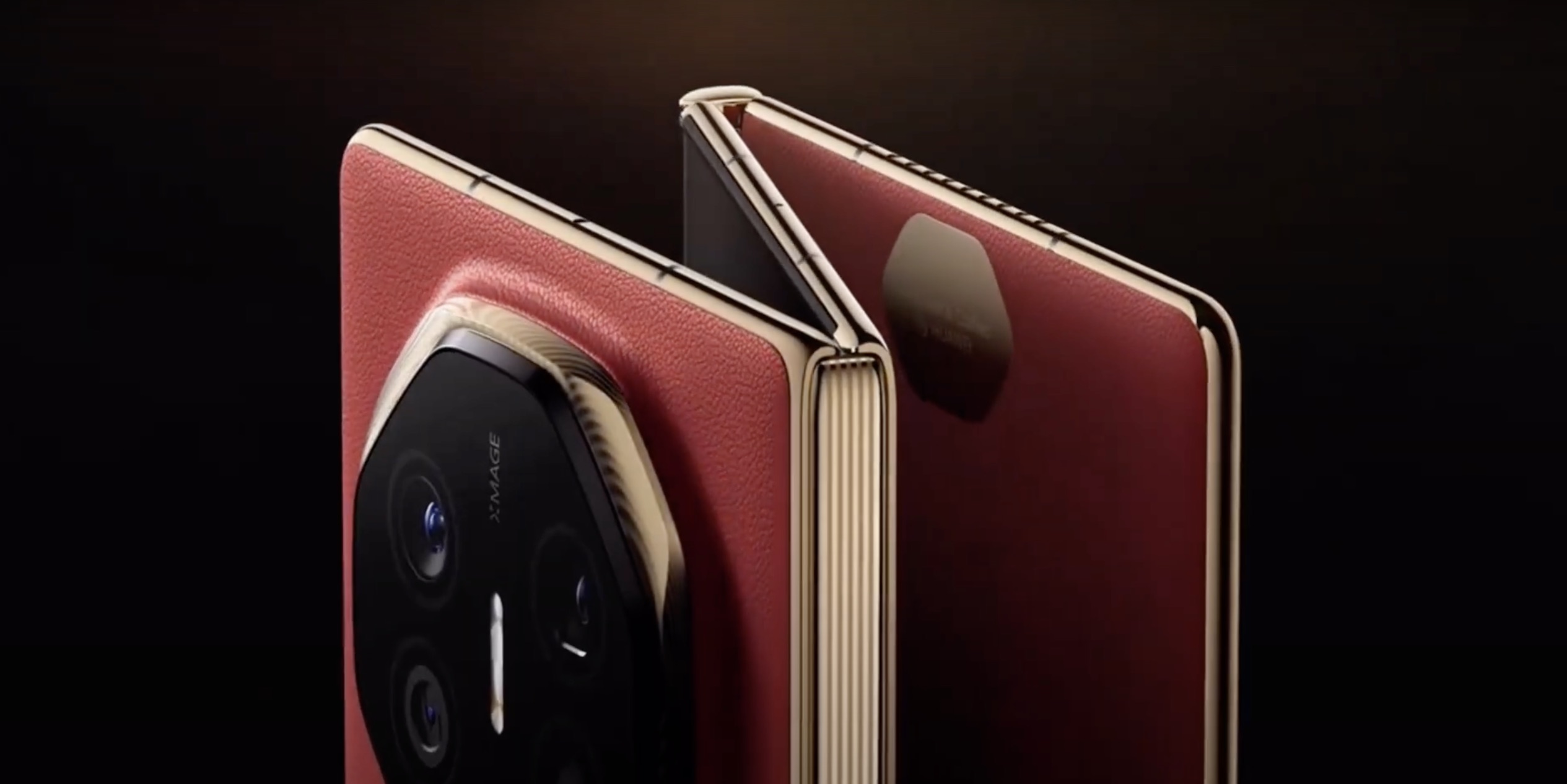
Shot of a red phone that folds into three, against a black background
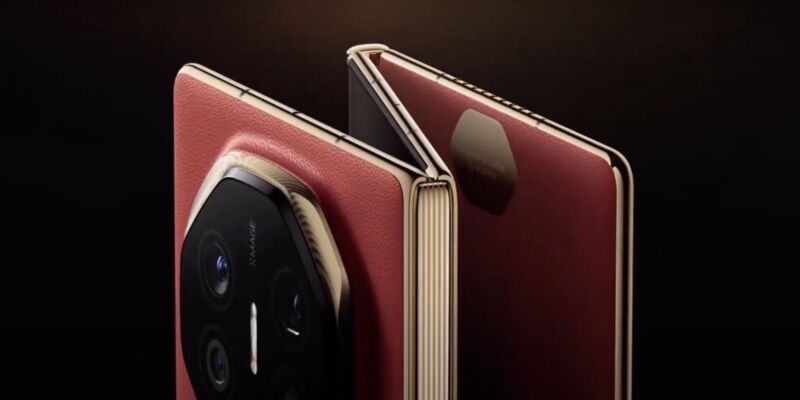
Enlarge / In the U.S., a folding phone has you carrying around nearly $2,000 of fragile, folding OLED phone. In China and export-friendly countries, the Mate XT adds $1,000 and yet another hinge.

Huawei’s Mate XT Ultimate is a phone that does not flip or fold, at least in the way of its Samsung or Google contemporaries. You could say it collapses, really, across two hinges, from a full 10.2-inch diagonal rectangle (about a half-inch short of a standard iPad) down to a traditional 6.4-inch rectangle phone slab. There’s also an in-between single-fold configuration at 7.9 inches. And there’s an optional folding keyboard.

This phone, which Huawei calls a “trifold,” would cost you the USD equivalent of $2,800 (19,999 yuan) if you could buy it in the US. Most notably, the phone launched just hours after Apple’s iPhone 16 event. As noted by The New York Times, Huawei’s product launches are often timed for maximum pushback against the US, which has sanctioned and attempted to stymie Huawei’s chip tech.

“It’s a piece of work that everyone has thought of but never managed to create,” Richard Yu, Huawei’s consumer group chairman, said during the Mate XT livestream unveiling. “I have always had a dream to put our tablet in my pocket, and we did it.”

For the price of two really good gaming PCs, you get 256GB storage (with pricier upgrades available), 16GB RAM, a 5,600 mAh battery, a 50-megapixel main camera, and two 12 MP ultrawide and periscope cameras. It weights 298 grams, is just 3.6 mm thick when unfolded, and its screen is an LTPO OLED with 120 Hz refresh. There are, just like US flagship phones, a lot of AI-powered promises stuck onto the software and camera.

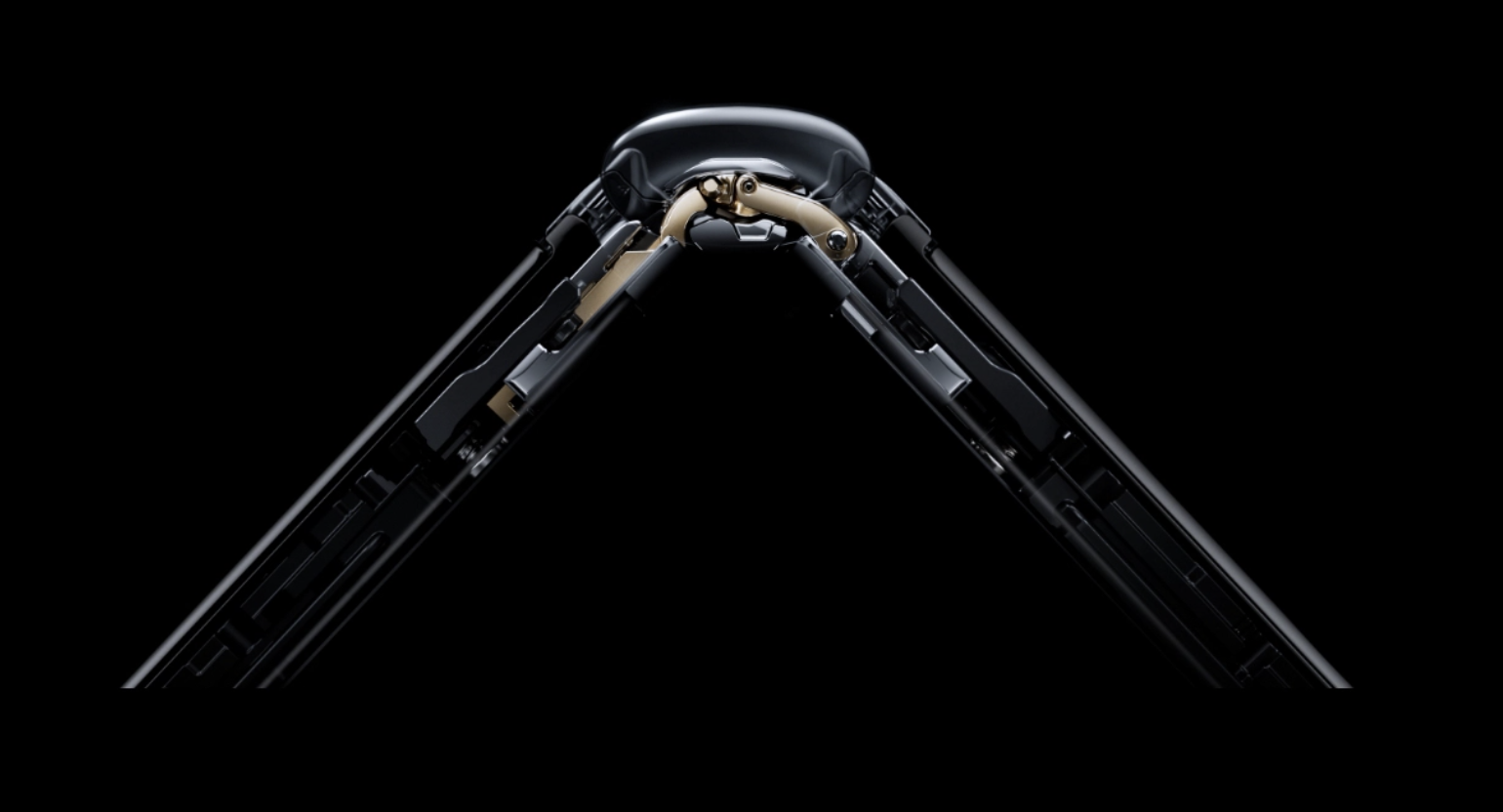
The "Tiangong" hinge system inside the Mate XT Ultimate.
The “Tiangong” hinge system inside the Mate XT Ultimate.

Beyond the price, the size, and the AI promises, the Mate XT Ultimate will be most interesting in how its hinges hold up. Huawei named its hinges after the Tiangong space station and says it allows for “internal and external bending” across dual tracks. It is made of a composite laminate and non-Newtonian fluid bits.

The Verge notes that the Mate XT Ultimate has seen some 3.7 million pre-orders through Chinese retailer Vmall—before a price was announced. It does not seem likely that the phone will be released outside China.

https://arstechnica.com/?p=2048860


“MNT Reform Next” combines open source hardware and usable performance

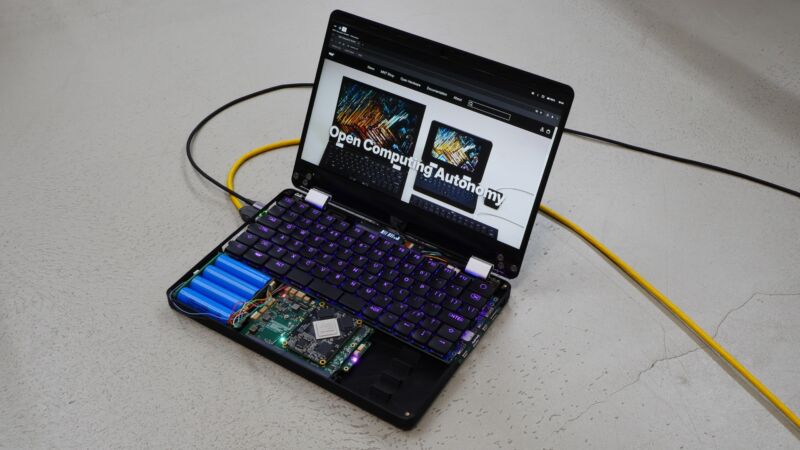
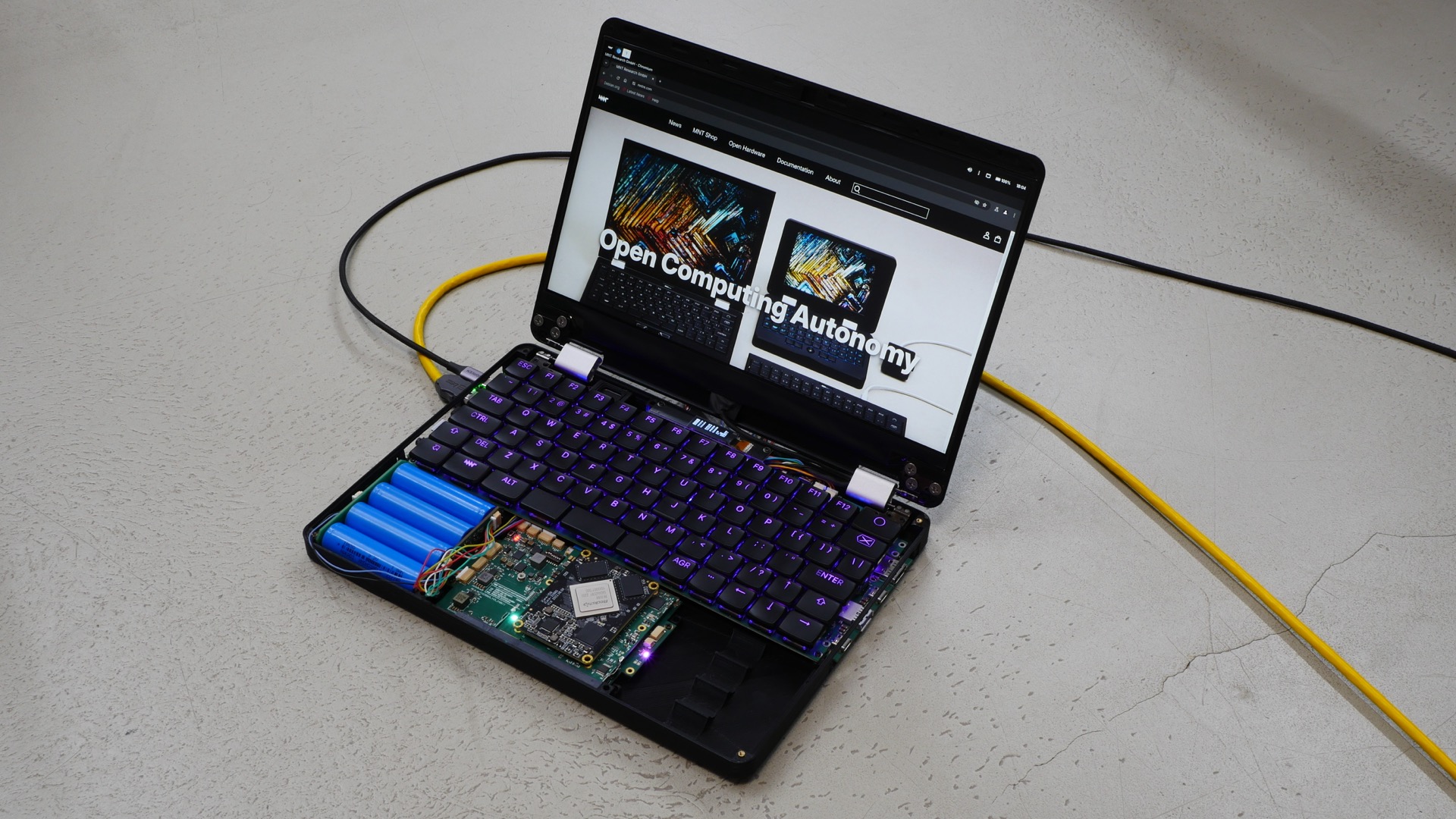
More streamlined (but still user-replaceable) battery packs are responsible for some of the Reform Next's space savings.
Enlarge / More streamlined (but still user-replaceable) battery packs are responsible for some of the Reform Next’s space savings.
MNT Research

The original MNT Reform laptop was an interesting experiment, an earnest stab at the idea of a laptop that used entirely open source, moddable hardware as well as open source software. But as a modern Internet-connected laptop, its chunky design and (especially) its super-slow processor let it down.

MNT Research has been upgrading the Reform laptop and its smaller counterpart, the Pocket Reform, continuously since we took a look at it two-and-a-half years ago. The most significant upgrade is probably the Rockchip RK3588 processor upgrade, which offers four ARM Cortex-A76 CPU cores (the same ones used in the Raspberry Pi 5’s Broadcom SoC) and four ARM Cortex-A55 cores, plus either 16GB or 32GB of RAM. While still not a high-end speed demon, these specs are enough to make it a competent workhorse laptop for browsing and productivity apps.

Now, MNT is revisiting the Reform with a more significant design update. The MNT Reform Next is smaller and thinner, defaults to a more traditional glass trackpad instead of a trackball, and is starting with the Rockchip RK3588 instead of the poky NXP/Freescale processor that the original laptop was saddled with.

MNT says that the new Reform’s thinner profile is enabled by splitting the motherboard into multiple, smaller boards that are easier to replace and by designing “completely custom battery packs that tightly integrated electronics into the mechanical structure.” MNT details a motherboard with a CPU module connected to it and three different “port boards” to add internal and external connectivity.

The batteries themselves are still user-replaceable LiFePO4 batteries, though there are switches on the motherboard for people who want to use Li-ion batteries instead. “This optional user choice trades longer runtime for less safety and environmental friendliness,” according to MNT’s blog post.

The new Reform adds additional ports, including HDMI and USB-C, and it retains the mechanical keyboard that we liked from the original. It charges over USB-C. It also features four PCIe lanes internally for connecting M.2 storage.

Per usual, MNT is announcing this product many months or years before it will be available. The company says the Reform Next is in the “prototype stage,” and to get the first batches, you’ll need to support the project via the Crowd Supply crowdfunding site first. Pricing and more detailed availability information haven’t been announced, but if the idea of an entirely open laptop still appeals to you, the company says it will have more to share “later this week.”

https://arstechnica.com/?p=2048810


Apple will release iOS 18, macOS 15, iPadOS 18, other updates on September 16

Apple will release iOS 18, macOS 15, iPadOS 18, other updates on September 16

Apple plans to release the next versions of iOS, iPadOS, macOS, and watchOS to the general public on September 16, the company announced via its website following its iPhone-centric product event earlier today. We should also see updates for tvOS and the HomePod operating system on the same date.

The new releases bring a number of new features and refinements to Apple’s platforms: better texting with Android devices thanks to support for the RCS standard, iPhone Mirroring that allows you to interact with your iPhone via your Mac, more UI customization options for iPhones and iPads, and other improvements besides.

What won’t be included in these initial releases is any hint of Apple Intelligence, the batch of generative AI and machine learning features that Apple announced at its Worldwide Developers Conference in June. Apple is testing some of the Apple Intelligence features in betas of iOS 18.1, iPadOS 18.1, and macOS 15.1, updates that will be released later this fall. When Apple Intelligence does arrive, compatibility will be limited: it will require an iPhone 15 Pro or one of the just-announced iPhone 16 or 16 Pro models; an iPad Air or Pro with an M1, M2, or M4 chip; or an Apple Silicon Mac. Apple will also be withholding Apple Intelligence from devices in the EU, at least for now.

The new operating systems will run on most of the same hardware that is currently compatible with iOS 17, iPadOS 17, and macOS Sonoma, including the last few generations of Intel Macs from 2018, 2019, and 2020. But there are a handful of exceptions, like the 2018 MacBook Air and a handful of older iPads. Phones as old as 2018’s iPhone XR and XS will be able to install and run the iOS 18 update.

Apple has released multiple beta versions of each operating system since WWDC in June, and release candidate builds will likely go out to users and developers today. These will enable developers to get final versions of their apps ready for launch day. Users who want to move over to the new operating systems early can also do so—you can be relatively confident that most of the biggest bugs have been worked out over the summer betas. However, as always when installing major updates, you should ensure you have good backups of your data beforehand.

https://arstechnica.com/?p=2048328


Apple updates both of its new iPhones with A18 and A18 Pro chips

Apple updates both of its new iPhones with A18 and A18 Pro chips

For the last couple years, Apple has reserved its most significant silicon updates for its iPhone Pro models, while the less expensive non-Pro iPhones have made do with year-old chips. This year, Apple is introducing new A18-series chips for both Pro and non-Pro iPhones, chips which it says are “designed for Apple Intelligence from the ground up.”

The Apple A18 (no Pro, no Bionic, just A18) will power the new iPhone 16 and 16 Plus—the iPhone 15 used an A16 Bionic, and jumping two chip generations in one year makes for more impressive-sounding performance numbers.

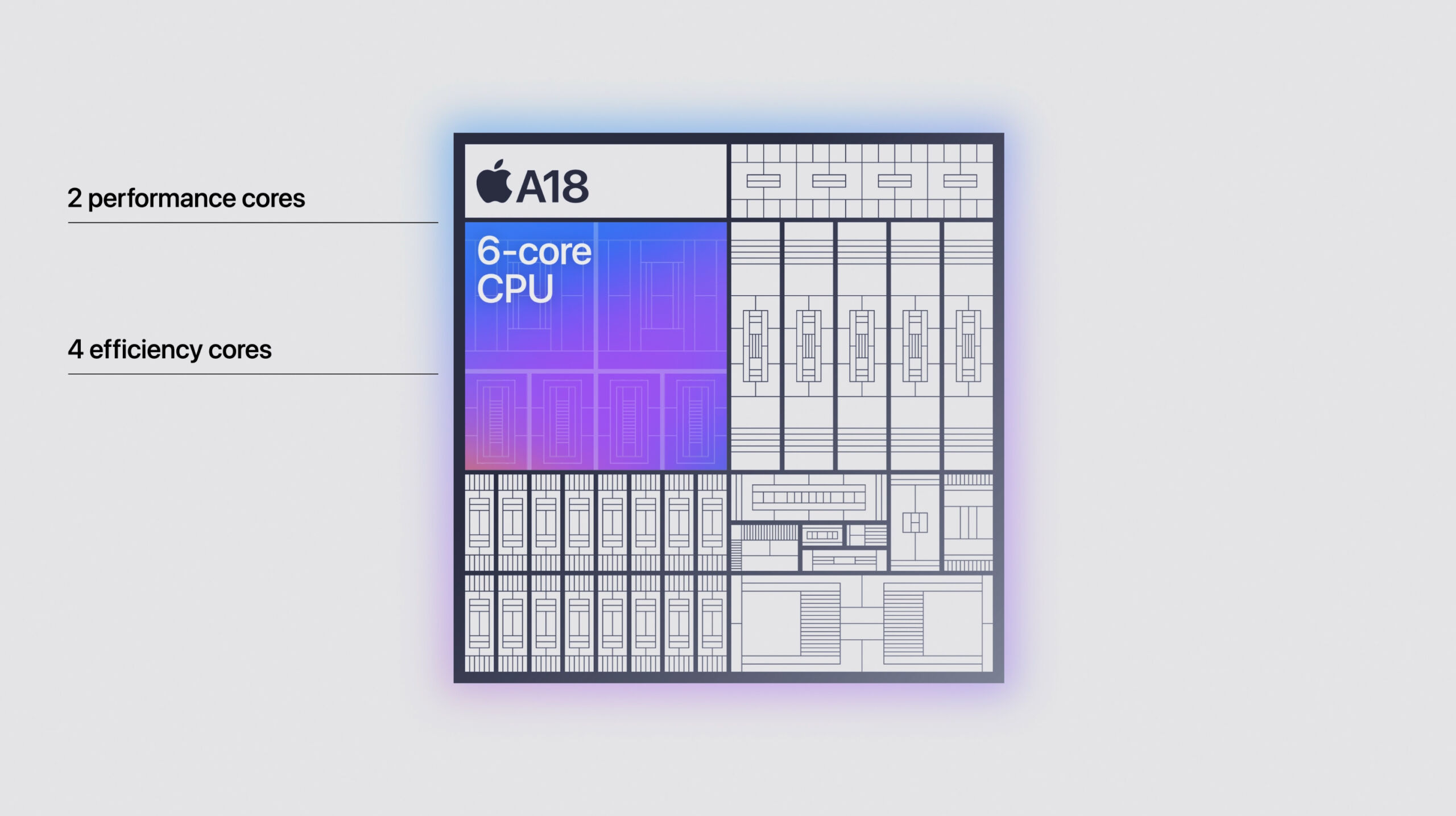
Like the last few generations of iPhone chip, the A18 includes a 6-core CPU with two high-performance processor cores and four high-efficiency cores. Apple says the CPU is 30 percent faster than the A16 chip in the iPhone 15. The A18 also includes a 5-core GPU that Apple says is 40 percent faster than the GPU in the iPhone 15—the A18 GPU also supports hardware-accelerated ray tracing, which was introduced in the A17 Pro.

The A18 includes a six-core CPU with two high-performance cores and four high-efficiency cores.
Enlarge / The A18 includes a six-core CPU with two high-performance cores and four high-efficiency cores.

A 16-core neural engine will accelerate Apple Intelligence’s AI and machine learning capabilities, and 17 percent higher memory bandwidth compared to the A16 rounds out its capabilities. The chip is built using a “second-generation 3 nm” manufacturing process, most likely from longtime Apple manufacturing partner TSMC.

Apple didn’t mention RAM specifically—it rarely does, for iPhones—but the A18 likely has at least 8GB of RAM to help it run Apple Intelligence models. The A16 in the iPhone 15 included 6GB of RAM.

The iPhone 16 Pro gets a new Pro chip; the A18 Pro’s upgrades over the A18 are mostly subtle, and it’s less of an upgrade over the iPhone 15 Pro and its A17 Pro chip.

Apple is still using a six-core CPU with two high-performance cores and four high-efficiency cores, but Apple says that “larger caches” and “next-generation ML accelerators” will boost its performance a bit beyond the cores in the regular A18. Apple says CPU performance should be around 15 percent faster than in the A17 Pro.

The GPU in the A18 Pro uses the same architecture as the A18, but it has six GPU cores instead of five, and it is 20 percent faster than the A17 Pro’s GPU. Apple said that hardware-accelerated ray tracing could be up to twice as fast as in the A17 Pro, but the regular A18 Pro should benefit from this improvement, too. The A18 Pro has the same 16-core Neural Engine as the A18, and also benefits from 17 percent more memory bandwidth.

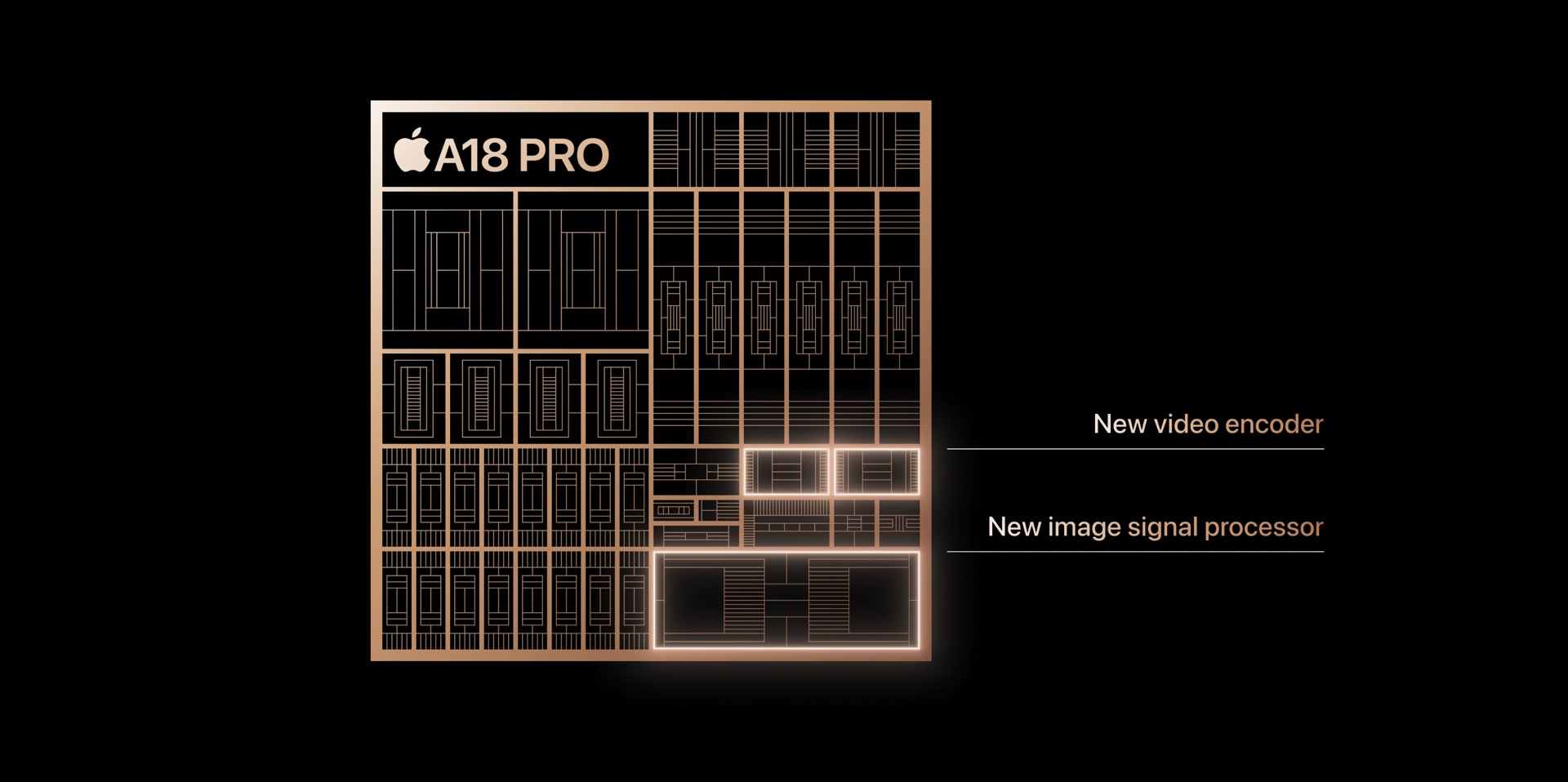
Better video and I/O capabilities help separate the A18 Pro from the regular A18.
Enlarge / Better video and I/O capabilities help separate the A18 Pro from the regular A18.

Some things that make the A18 Pro “pro” are related to its I/O, and its media encoding and decoding hardware. The A18 Pro supports ProRes video encoding, has a new image signal processor that apparently isn’t in the A18, and also supports “faster USB 3 speeds” than the A17 Pro. For those using their iPhones to shoot professional-grade video, these are small but welcome improvements over the A18 that will help shoot better video, and make it easier to offload video to a computer when it’s time to edit.

https://arstechnica.com/?p=2048465