Blocking AI bots from Microsoft, others has been “pain in the a**”: Reddit CEO

A general view of the Reddit homepage

Reddit CEO Steve Huffman is standing by Reddit’s decision to block companies from scraping the site without an AI agreement.

Last week, 404 Media noticed that search engines that weren’t Google were no longer listing recent Reddit posts in results. This was because Reddit updated its Robots Exclusion Protocol (txt file) to block bots from scraping the site. The file reads: “Reddit believes in an open Internet, but not the misuse of public content.” Since the news broke, OpenAI announced SearchGPT, which can show recent Reddit results.

The change came a year after Reddit began its efforts to stop free scraping, which Huffman initially framed as an attempt to stop AI companies from making money off of Reddit content for free. This endeavor also led Reddit to begin charging for API access (the high pricing led to many third-party Reddit apps closing).

In an interview with The Verge today, Huffman stood by the changes that led to Google temporarily being the only search engine able to show recent discussions from Reddit. Reddit and Google signed an AI training deal in February said to be worth $60 million a year. It’s unclear how much Reddit’s OpenAI deal is worth. Huffman said:

Without these agreements, we don’t have any say or knowledge of how our data is displayed and what it’s used for, which has put us in a position now of blocking folks who haven’t been willing to come to terms with how we’d like our data to be used or not used.

Per The Verge, Huffman claimed that Microsoft, Anthropic, and Perplexity haven’t been negotiating. The three companies haven’t commented on Huffman’s interview.

“[It’s been] a real pain in the ass to block these companies,” Huffman told The Verge.

A person familiar with the matter previously told Ars that Microsoft has refused to enter an agreement that adheres to Reddit’s data-privacy rules. Speaking with The Verge, Huffman claimed Microsoft previously used data from Reddit for AI training and Bing result summaries but didn’t tell Reddit. He also claimed that data from Reddit has “been sold through the Bing API to other search engines,” per The Verge.

AI debate

A Microsoft spokesperson told me last week that “Microsoft respects the robots.txt standard and we honor the directions provided by websites that do not want content on their pages to be used with our generative AI models.” But as The Verge pointed out, Jordi Ribas, corporate VP of search and AI at Microsoft, took to X on July 29 to emphasize how the changes to Reddit favor Google “impacting competition from Bing and Bing-powered engines.”

Huffman also reportedly made reference to a June CNBC interview where Mustafa Suleyman, CEO of Microsoft AI, said: “I think that with respect to content that is already on the open web, the social contract of that content since the ’90s has been that it is fair use. Anyone can copy it, re-create with it, reproduce with it. That has been freeware, if you like. That’s been the understanding.” Suleyman added that his comment didn’t refer to certain types of web content, like news organizations.

“We’ve had Microsoft, Anthropic, and Perplexity act as though all of the content on the internet is free for them to use. That’s their real position,” Huffman said.

Reddit hasn’t disclosed how much money is needed for deals that would enable scraping from Microsoft, Perplexity, Anthropic, or smaller companies. Reddit spokesperson Tim Rathschmidt told Ars last week that Reddit has been speaking “with multiple search engines” and that Reddit’s “open to working with partners big and small.”

It is likely that Reddit is targeting big AI deals, which it views as an important part of its business. Colin Hayhurst, CEO of search engine Mojeek, told Ars last week that Reddit didn’t respond to his emails about Mojeek getting blocked until 404 Media’s report came out.

Reddit’s efforts to find new revenue streams as it attempts to become profitable for the first time have been riddled with hiccups, including a massive user protest in response to Reddit’s API rule changes. The company is seeking to strike deals at a time when publishers, the music industry, and more are grappling with the legality of AI bots and looking to set precedence. Reddit’s reliance on free, user-generated content brings further complications to the debate.

Advance Publications, which owns Ars Technica parent Condé Nast, is the largest shareholder of Reddit.

https://arstechnica.com/?p=2040398


Apple stealthily adds minor features in iOS 17.6, macOS 14.6 releases

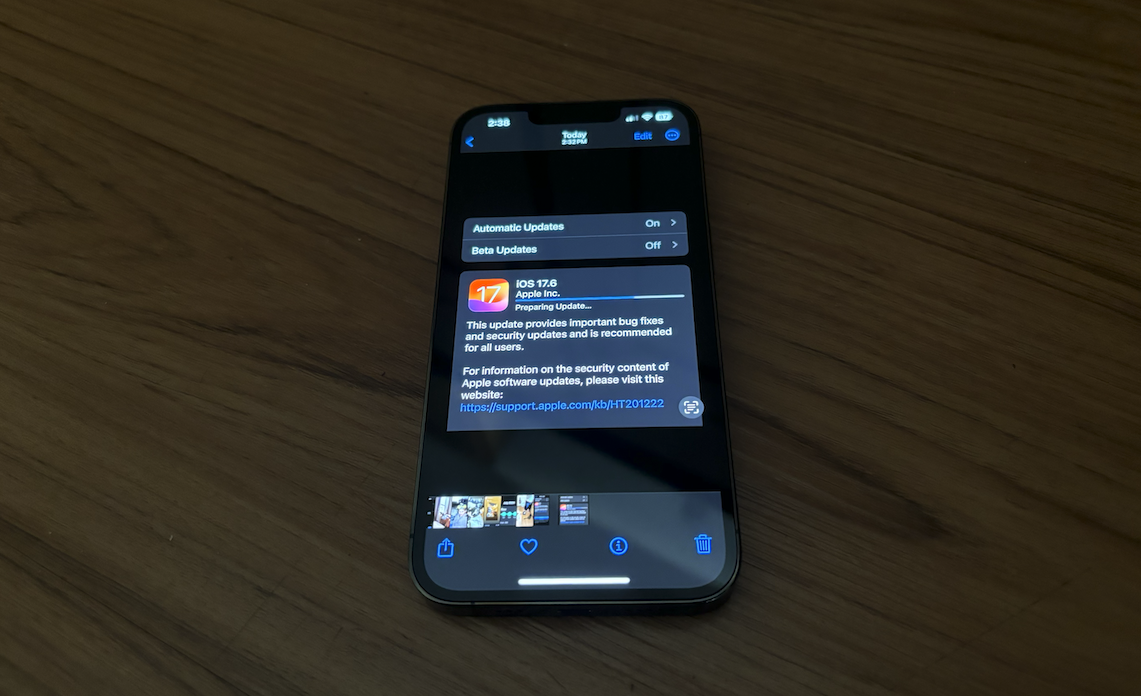
An iPhone lies on a wood surface, showing the Software Update panel on its screen
Enlarge / iOS 17.6 installing on an iPhone 13 Pro.
Samuel Axon

Apple has some minor updates for all its operating systems, and the releases include iOS 17.6, iPadOS 17.6, tvOS 17.6, watchOS 10.6, and macOS Sonoma 14.6.

Apple’s notes for these updates simply say they include bug fixes, security updates, or optimizations. However, there are a few hidden features.

macOS 14.6 reportedly enables multi-display support in clamshell mode on the M3 MacBook Pro, allowing users of that device to use two external displays at once. That was already possible on the M3 Pro and M3 Max variations. Apple had previously released a similar update to bring that functionality to the M3 MacBook Air.

iOS 17.6 and iPadOS 17.6 have added a feature called Catch Up, which is targeted at sports fans who use Apple’s TV app.

The feature allows users to watch a quick sequence of highlights that have been produced so far from an in-progress Major League Soccer game before joining the live feed.

That’s about it, though. These are minor updates, and they are likely the final ones other than security hotfixes until Apple begins rolling out its annual updates, such as iOS 18 and macOS Sequoia 15, later this fall.

Those updates are expected to include several new features, though the biggest—Apple Intelligence, a suite of generative AI features—will not arrive until iOS 18.1, which was just released as a developer beta for the first time.

iOS 17.6, iPadOS 17.6, tvOS 17.6, watchOS 10.6, and macOS Sonoma 14.6 are available to download and install on all supported devices now.

https://arstechnica.com/?p=2040130


Darkness reigns over Wikipedia as official dark mode comes to pass

A bulb, seemingly containing the Wikipedia logo, shining amidst a dark background of text.
Enlarge / Wikipedia’s decades of content can be a light to you in dark places, and now you can choose the dark for yourself.
Aurich Lawson | Getty Images | Wikipedia

Dark mode, night mode, light-on-dark design, or whatever you want to call the version of computer content that doesn’t feel blindingly bright at night, had something of a peak moment around 2019–2020. That’s when Android and iOS designed a system-wide way to implement a darker theme, and signal to compatible apps to do the same. Many, many systems, apps, websites, and other digital tools soon followed.

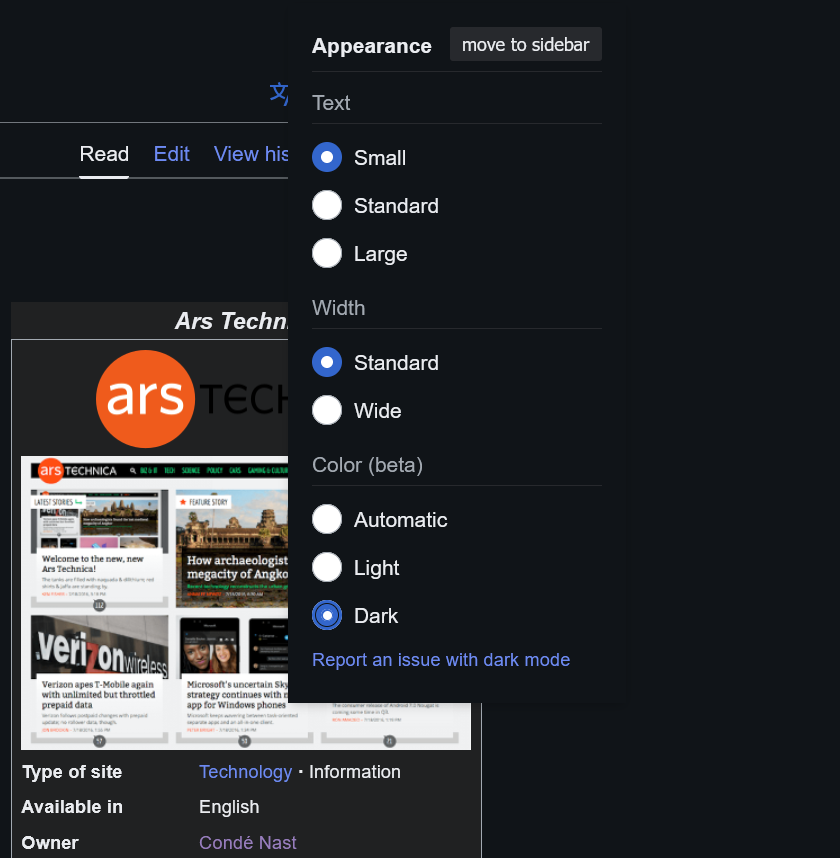
Except, most notably, Wikipedia. Despite being one of the sites most sympathetic to late-night mind wandering, Wikipedia had no official way to switch its iconic white pages into something more sleep and eyeball-friendly. Now, after great effort from its community, a dark mode (technically a dark “Color” setting) is available to most Wikipedia visitors on both desktop and mobile.

On desktop, look for a sidebar on the right-hand side that has buttons for setting text size and width, and then “Color (beta).” If you don’t see a sidebar, look for an eyeglasses-like icon in the upper-right corner near the search and account tools. On mobile, look for the three horizontal bars (aka hamburger button) in the upper-left corner of a page, choose Settings, then pick your Color. There is the standard Light you know, Dark, and Automatic, which takes its color cues from your system.

Dark mode is in beta, though it looks pretty decent on most user-facing pages.

More than a year ago, a dark mode handily won out as the most-requested feature in Wikipedia’s Community Wishlist Survey for 2023. It might seem simple to flip the colors on a predominantly text-based website to their inverse opposites. But as noted in a discussion on the 2023 survey on Reddit, though, it’s never quite so simple. Many of Wikipedia’s inline styles have hard-coded colors. Browser extensions that turn Wikipedia dark tend to contain a huge number of manual overrides for those. As redditor gwern put it:

It’s truly one of those things where you can get 95% of the way by simply adding 1 line of CSS like body{filter: invert(100%);}, but then to get to 99% correctness and squash all the annoying bugs, you have to completely rewrite your entire site design, and getting to 100% is impossible.

Wikipedia’s tracker for bugs and issues, Phabricator, shows a “Provide a dark / night mode skin or theme” ticket going back to June 22, 2010. Things really start picking up in early 2022, and the discussion goes lots of places, including accessibility, machine learning, and color-coded map keys. The broad task was marked as “Resolved” on July 12, though many subtasks remain.

https://arstechnica.com/?p=2039811


Synology BeeStation review: A great way to start getting real about backups

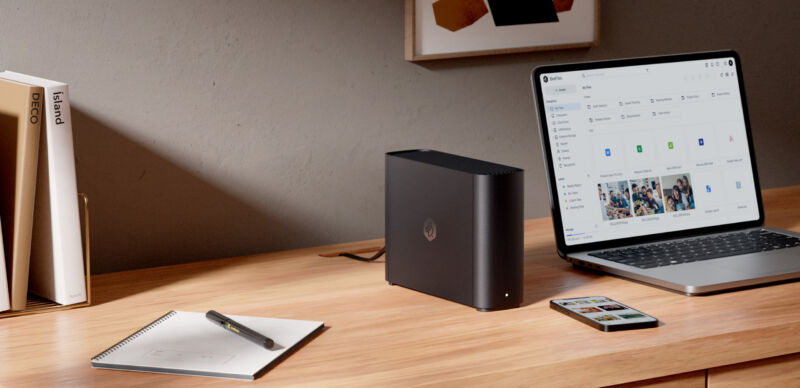
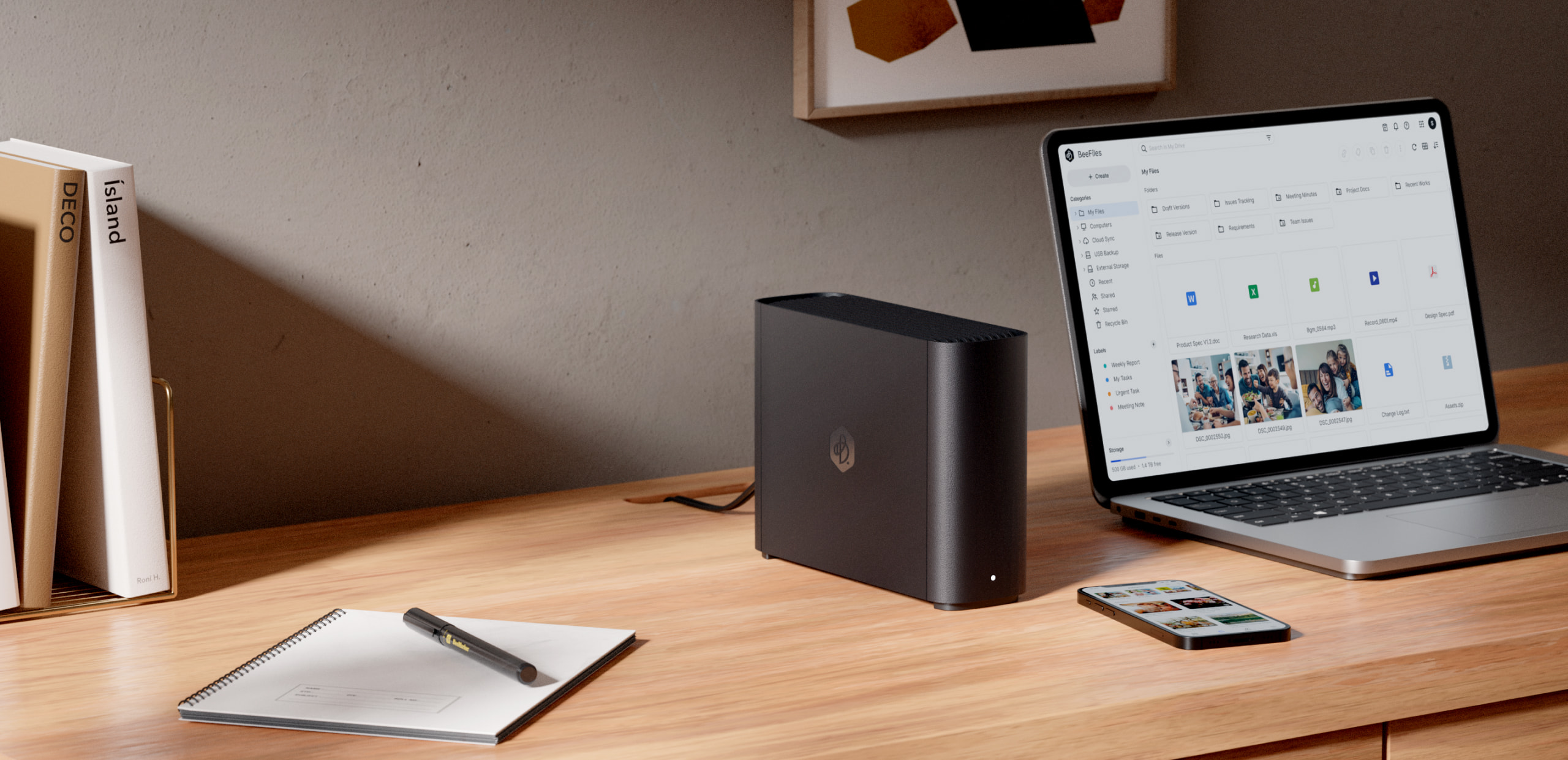
BeeStation drive next to a laptop and smartphone aon a desk, with a notebook and pen in the foreground, laptop screen showing photos from BeeStation in a grid.
Enlarge / In this handout image from Synology, a thoughtful worker uses BeeFiles on their MacBook and BeePhotos on their iPhone, always keeping their BeeStation close at hand. They might have important thoughts about the books “Island” or “DECO” to keep stored privately, redundantly, forever.

Dropbox is not backup. A portable hard drive is not backup. Real backup, experienced people have told me, starts with the 3-2-1 rule: three copies, two types of storage (or devices), and one copy is remote.

And yet my data backup system remains precarious. I have tried many schemes, ranging from “pay for Google Drive space and just dump it all there” to “multi-platform rsync/crontab-based headless system I try to build out with help from StackExchange.” I try not to be the person in an informercial, insisting that there must be a better way, but when it comes to backing up music, photos, cloud-based email and files, settings, and more, I am indeed that person. There has to be a better way, and it can’t just be the heavy lift of setting up a Synology NAS, right?

Well, what if Synology itself knew that not everybody is ready to become a self-employed, single-client junior sysadmin? That’s how I think about the BeeStation ($220 as of this writing). It’s just enough backup to be way better than what most people think of as backup (praying that a giant corporation never loses or closes their account), but it’s still just one device. It can also create a pretty smooth ascent to full-on NAS if this little taste of self-directed storage spurs your ambitions.

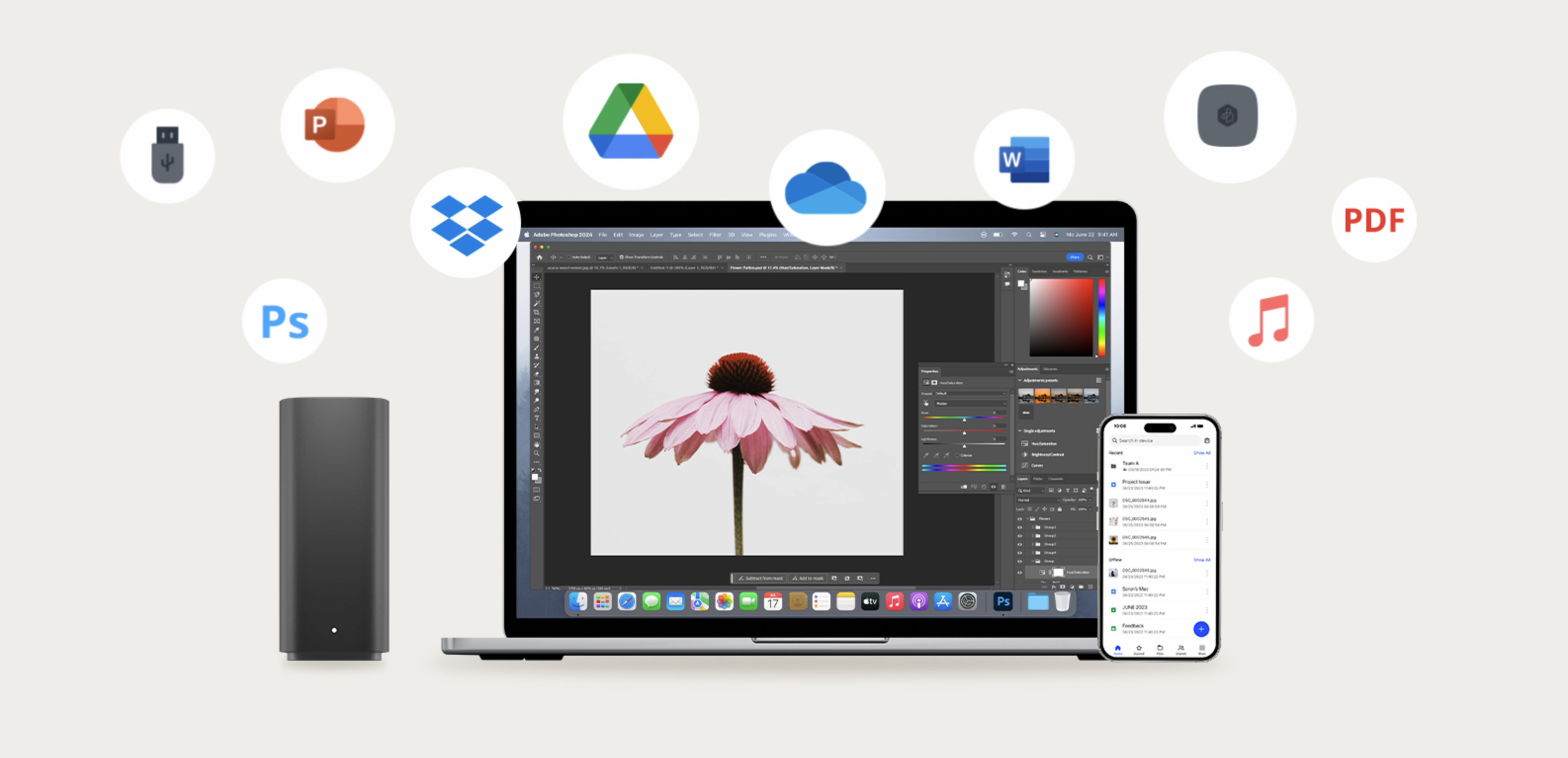
Synology’s primary pitch is that you can use BeeStation on “Your Personal Cloud Journey,” with machine-learning object and face recognition sorting for photos and synced, versioned files for working. On this level, I’m not as impressed, though some people will likely appreciate these self-hosted alternatives to Drive, Dropbox, Google Photos, and iCloud more than I do. And they’re certainly a good way to get more use out of your backups.

The BeeStation’s best feature is how it makes good backup habits automatic. Within a couple of weeks of setting it up, I had both my and my spouse’s Drive and Dropbox accounts synced and regularly backed up; my older music, movie, and miscellaneous files stashed away; and our photos regularly backed up from our phones. All this was then backed up to Synology’s cloud servers every week (for an add-on cost), and everything was accessible remotely and on the local network.

Hardware

If you’ve ever owned a hard drive that rests inside a powered, external closure, you’ve had something similar to the BeeStation. It’s a black plastic box, it has one or two cables plugged into it, and it sits there and occasionally makes some spinning-up or access noises.

Not many noises, though, unless you’re doing a big backup or are using it as an ersatz Dropbox to work on files throughout the day. The BeeStation’s innards are full of heatsinks, passive cooling systems, and vibration dampers, and that design work has paid off. Compared to a (non-Synology) two-HDD-bay NAS system that my BeeStation ran next to, the BeeStation was relatively meek and serene.

Without having owned the device for a full three years’ warranty period, I can only speak to how little I noticed this object during a few months’ time in my office. Synology’s bee-themed branding is subtle, with just a quarter-sized logo imprint on each size. There’s a power light on the front to tell you it’s working, and plugs are in the back. The USB-A and USB-C ports are right next to each other, so if you’re using a particularly bulky thumb drive or cable head for either one, you might have to invest in adapters or short connection cables.

As for performance, that’s not what this device is about. The Realtek chip inside will not be running Plex, a torrent downloader, or anything of the sort (nor does the OS support that). When I handed it my full 140GB (compressed) Google Photos export for importing into BeePhotos, it took an entire weekend for the system to decompress, analyze, and set them in place. Transferring files from a USB4 stick was as fast as I could imagine it being; while I’m sure the 1GB memory is a bottleneck, I only do this a few times a year. As with any other backup plan, you should only need to sync the new and changed files once the bulk is in place.

https://arstechnica.com/?p=2038468


Union game performers strike over AI voice and motion-capture training

Image of SAG-AFTRA logo next to a raised fist holding up a game controller, with
Enlarge / One day, using pixellated fonts and images to represent that something is a video game will not be a trope. Today is not that day.

SAG-AFTRA has called for a strike of all its members working in video games, with the union demanding that its next contract not allow “companies to abuse AI to the detriment of our members.”

The strike mirrors similar actions taken by SAG-AFTRA and the Writers Guild of America (WGA) last year, which, while also broader in scope than just AI, were similarly focused on concerns about AI-generated work product and the use of member work to train AI.

“Frankly, it’s stunning that these video game studios haven’t learned anything from the lessons of last year—that our members can and will stand up and demand fair and equitable treatment with respect to A.I., and the public supports us in that,” Duncan Crabtree-Ireland, chief negotiator for SAG-AFTRA, said in a statement.

During the strike, the more than 160,000 members of the union will not provide talent to games produced by Disney, Electronic Arts, Blizzard Activision, Take-Two, WB Games, and others. Not every game is affected. Some productions may have interim agreements with union workers, and others, like continually updated games that launched before the current negotiations starting September 2023, may be exempt.

The publishers and other companies issued statements to the media through a communications firm representing them. “We are disappointed the union has chosen to walk away when we are so close to a deal, and we remain prepared to resume negotiations,” a statement offered to The New York Times and other outlets read. The statement said the two sides had found common ground on 24 out of 25 proposals and that the game companies’ offer was responsive and “extends meaningful AI protections.”

The Washington Post says the biggest remaining issue involves on-camera performers, including motion capture performers. Crabtree-Ireland told the Post that while AI training protections were extended to voice performers, motion and stunt work was left out. “[A]ll of those performers deserve to have their right to have informed consent and fair compensation for the use of their image, their likeness or voice, their performance. It’s that simple,” Crabtree-Ireland said in June.

It will be difficult to know the impact of a game performer strike for some time, if ever, owing to the non-linear and secretive nature of game production. A game’s conception, development, casting, acting, announcement, and further development (and development pivots) happen on whatever timeline they happen upon.

SAG-AFTRA has a tool for searching game titles to see if they are struck for union work, but it is finicky, recognizing only specific production titles, code names, and ID numbers. Searches for Grande Theft Auto VI and 6 returned a “Game Over!” (i.e., struck), but Kotaku confirmed the game is technically unaffected, even though its parent publisher, Take-Two, is generally struck.

Video game performers in SAG-AFTRA last went on strike in 2016, that time regarding long-term royalties. The strike lasted 340 days, still the longest in that union’s history, and was settled with pay raises for actors while residuals and terms on vocal stress remained unaddressed. The impact of that strike was generally either hidden or largely blunted, as affected titles hired non-union replacements. Voice work, as noted by the original English voice for Bayonetta, remains a largely unprotected field. https://arstechnica.com/?p=2039502


X is training Grok AI on your data—here’s how to stop it

An AI-generated image released by xAI during the launch of Grok
Enlarge / An AI-generated image released by xAI during the open-weights launch of Grok-1.

Elon Musk-led social media platform X is training Grok, its AI chatbot, on users’ data, and that’s opt-out, not opt-in. If you’re an X user, that means Grok is already being trained on your posts if you haven’t explicitly told it not to.

Over the past day or so, users of the platform noticed the checkbox to opt out of this data usage in X’s privacy settings. The discovery was accompanied by outrage that user data was being used this way to begin with.

The social media posts about this sometimes seem to suggest that Grok has only just begun training on X users’ data, but users actually don’t know for sure when it started happening.

Earlier today, X’s Safety account tweeted, “All X users have the ability to control whether their public posts can be used to train Grok, the AI search assistant.” But it didn’t clarify either when the option became available or when the data collection began.

You cannot currently disable it in the mobile apps, but you can on mobile web, and X says the option is coming to the apps soon.

On the privacy settings page, X says:

To continuously improve your experience, we may utilize your X posts as well as your user interactions, inputs, and results with Grok for training and fine-tuning purposes. This also means that your interactions, inputs, and results may also be shared with our service provider xAI for these purposes.

X’s privacy policy has allowed for this since at least September 2023.

It’s increasingly common for user data to be used this way; for example, Meta has done the same with its users’ content, and there was an outcry when Adobe updated its terms of use to allow for this kind of thing. (Adobe quickly backtracked and promised to “never” train generative AI on creators’ content.)

How to opt out

You can’t opt out within the iOS or Android apps yet, but you can do so in a few quick steps on either mobile or desktop web. To do so:

  • Click or tap “More” in the nav panel
  • Click or tap “Settings and privacy”
  • Click or tap “Privacy and safety”
  • Scroll down and click or tap “Grok” under “Data sharing and personalization”
  • Uncheck the box “Allow your posts as well as your interactions, inputs, and results with Grok to be used for training and fine-tuning,” which is checked by default.

Alternatively, you can follow this link directly to the settings page and uncheck the box with just one more click. If you’d like, you can also delete your conversation history with Grok here, provided you’ve actually used the chatbot before.

https://arstechnica.com/?p=2039543


Sonos CEO apologizes for botched app redesign, promises month-by-month updates

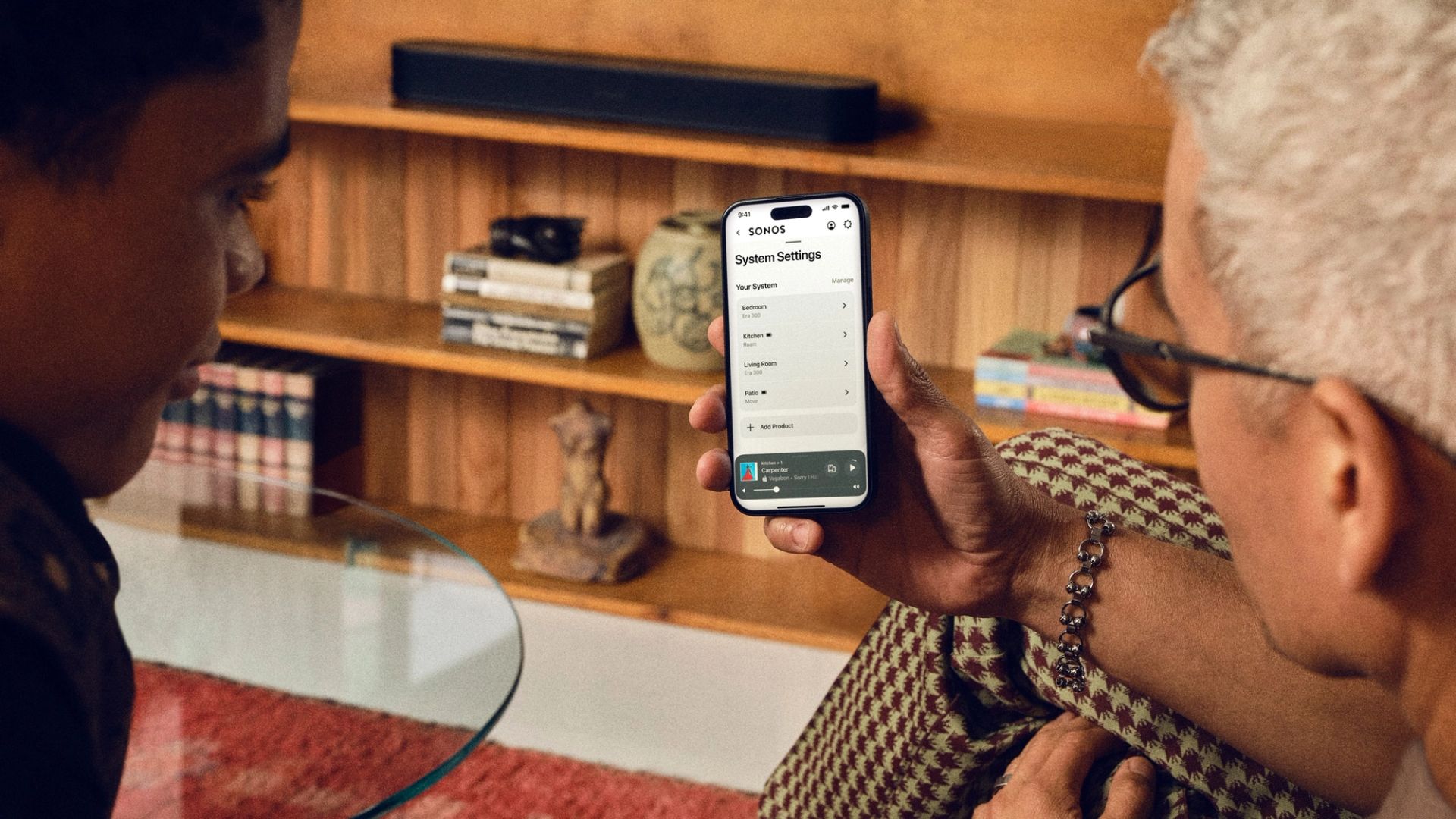
Two people with extremely 70s vibes looking at Sonos' app, with shag carpeting, wood paneling, and houndstooth pants in the frame.
Enlarge / I don’t know how Sonos’ app might have developed during the groovy era their marketing images aim to summon, but it feels like it might not have wanted to rush head-long into disappointing users quite so quickly.

Sonos issued a redesigned app in May, and what lots of customers noticed about it wasn’t the refreshed look, but the things from the previous design entirely missing. Not small things, but things that Sonos enthusiasts would really notice: sleep timers, local music library access and management, playlist and song queue editing, plus accessibility downgrades.

In May, a Sonos executive told The Verge that it “takes courage to rebuild a brand’s core product from the ground up, and to do so knowing it may require taking a few steps back to ultimately leap into the future.” You might ask if bravery could have been mustered to not release an app before it was feature-complete.

Now, nearly three months after shipping, Sonos leadership has pivoted from excitement about future innovations to humility, apology, and a detailed roadmap of fixes. CEO Patrick Spence starts his “Update on the Sonos app from Patrick” with a personal apology, a note that “there isn’t an employee at Sonos who isn’t pained by having let you down,” and a pledge that fixing the app is the No. 1 priority.

New update have arrived every two weeks since the big change, Spence writes, and there are more to come. A better device-adding experience and, finally, a local music library interface should arrive in July or August. August and/or September bring volume responsiveness, UI upgrades, and general stability, plus Alarm reliability. Editing your playlists and queue could arrive in September or October, according to Sonos’ post.

This is not the first time Sonos has acknowledged missteps in its aims to refresh its mobile apps, but it is the most public and contrite, and perhaps realistic in timing. In mid-May, Sonos emailed its software and API partners about “valuable feedback” on “the areas where we fell short,” according to an email obtained by Ars Technica. Back then, Sonos told partners it intended to have alarms, queue editing, sleep timers, local music libraries, and Wi-Fi update settings sorted by the end of June.

While different resources can be deployed on different projects, it didn’t help existing customers’ perceptions that, two weeks after shipping its rather incomplete mobile app updates, Sonos announced the Ace, new $450 headphones. As we wrote then, the update did make doing basic tasks like adjusting volumes faster, but its lack of existing features left Sonos “playing damage control with an angry subset of its normally loyal user base.”

It’s also notable timing that Sonos’ public-facing apology and roadmap arrives a few days after the consumer guide Wirecutter updated its guide to multiroom wireless speakers, noting it could no longer recommend Sonos products “as the best overall choice.” The guide cited the app update leaving customers “with a much less intuitive experience than they had before,” along with it being “not the first time Sonos has hurt customer trust through poorly executed changes.”

That user base, which has been asking the company what happened ever since early May, now has some sense that they’re not posting into the void.

This post was updated to note the Wirecutter’s recently revised recommendations for multiroom wireless audio, per comment.

https://arstechnica.com/?p=2039296


AMD delays Ryzen 9000 launch to August “out of an abundance of caution”

AMD delays Ryzen 9000 launch to August “out of an abundance of caution”

AMD had planned to launch its first round of Ryzen 9000-series desktop processors by the end of July, but those plans have changed thanks to a very non-specific problem found with the first batch of processors that AMD sent out to its partners. The six- and eight-core Ryzen 9600X and 9700X are now slated to launch on August 8, and the 12- and 16-core Ryzen 9900X and 9950X will launch on August 15.

AMD’s full statement is below:

We appreciate the excitement around Ryzen 9000 series processors. During final checks, we found the initial production units that were shipped to our channel partners did not meet our full quality expectations. Out of an abundance of caution and to maintain the highest quality experiences for every Ryzen user, we are working with our channel partners to replace the initial production units with fresh units. As a result, there will be a short delay in retail availability. The Ryzen 7 9700X and Ryzen 5 9600X processors will now go on sale on August 8th and the Ryzen 9 9950X and Ryzen 9 9900X processors will go on-sale on August 15th. We pride ourselves in providing a high-quality experience for every Ryzen user, and we look forward to our fans having a great experience with the new Ryzen 9000 series.

When asked for details about the specific problem and what the fix was, AMD Public Relations Manager Matthew Hurwitz told Ars that AMD had implemented additional screening for the Ryzen 9000 CPUs but couldn’t share specifics about what AMD is screening for.

It doesn’t seem as though any changes are being made to the silicon or the manufacturing process itself, and Hurwitz told us that the first batch of processors would be sent back out to channel partners once they had been recalled and re-screened.

The Ryzen 9000-series CPUs are the direct follow-up to the Ryzen 7000 series from late 2022, and the second generation of chips to use the AM5 processor socket—if you don’t count the Ryzen 7000X3D CPUs, which are Ryzen 7000 with more L3 cache, or the Ryzen 8000G chips, which are Zen 4-based laptop processors repackaged for desktops. Ryzen 9000 chips should drop into existing AM5 motherboards after a BIOS update, though AMD is also releasing a mildly improved lineup of chipsets to power new boards.

AMD has prioritized power efficiency for the Ryzen 9000 chips but is still promising low-double-digit performance improvements in both single- and multi-core workloads.

https://arstechnica.com/?p=2039003


Alexa had “no profit timeline,” cost Amazon $25 billion in 4 years

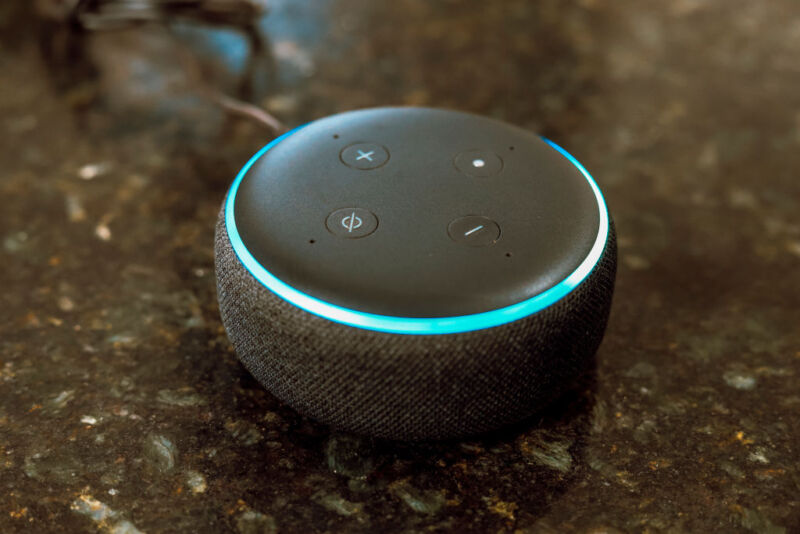
In this photo illustration, Echo Dot smart speaker with working Alexa with blue light ring seen displayed.

The Amazon business unit that focuses on Alexa-powered gadgets lost $25 billion between 2017 and 2021, The Wall Street Journal (WSJ) reported this week.

Amazon claims it has sold more than 500,000,000 Alexa devices, which included Echo speakers, Kindle readers, Fire TV sets and streaming devices, and Blink and Ring smart home security cameras. But since debuting, Alexa, like other voice assistants, has struggled to make money. In late 2022, Business Insider reported that Alexa was set to lose $10 billion that year.

WSJ said it got the $25 billion figure from “internal documents” and that it wasn’t able to determine the Devices business’s losses before or after the shared time period.

“No profit timeline”

WSJ’s report claims to offer insight into how Devices was able to bleed so much money for so long.

For one, it seems like the business unit was allowed some wiggle room in terms of financial success in the interest of innovation and the potential for long-term gains. Someone the WSJ described as being “a former longtime Devices executive” said that when Alexa first started, Amazon’s gadgets team “didn’t have a profit timeline” when launching products.

Amazon is known to have sold Echo speakers for cheap or at a loss in the hopes of making money off Alexa later. In 2019, then-Amazon Devices SVP Dave Limp, who exited the company last year, told WSJ: “We don’t have to make money when we sell you the device.” WSJ noted that this strategy has applied to other unspecified Amazon devices, too.

People tend to use Alexa for free services, though, like checking the weather or the time, not making big purchases.

“We worried we’ve hired 10,000 people and we’ve built a smart timer,” a former senior employee told the WSJ.

An Amazon spokesperson told the WSJ that more than half of people with an Echo have shopped with it but wouldn’t provide more specifics. Per “former employees on the Alexa shopping team” that WSJ spoke with, however, the amount of shopping revenue tied to Alexa is insignificant.

In an emailed statement, an Amazon spokesperson told Ars Technica, in part:

Within Devices & Services, we’re focused on the value we create when customers use our services, not just when they buy our devices. Our Devices & Services organization has established numerous profitable businesses for Amazon and is well-positioned to continue doing so going forward.

Further hindering Alexa’s revenue are challenges in selling security and other services and the limitation of ad sales because they annoy Alexa users, WSJ reported.

Massive losses also didn’t seem to slow down product development. WSJ claimed the Devices business lost over $5 billion in 2018 yet still spent money developing the Astro consumer robot. That robot has yet to see general availability, while a business version is getting bricked just 10 months after release. Amazon Halo health trackers, which have also been bricked, and Luna game-streaming devices were also developed in 2019, when the hardware unit lost over $6 billion, per WSJ.

Amazon has laid off at least 19,000 workers since 2022, with the Devices division reportedly hit especially hard.

https://arstechnica.com/?p=2038688


Intel has finally tracked down the problem making 13th- and 14th-gen CPUs crash

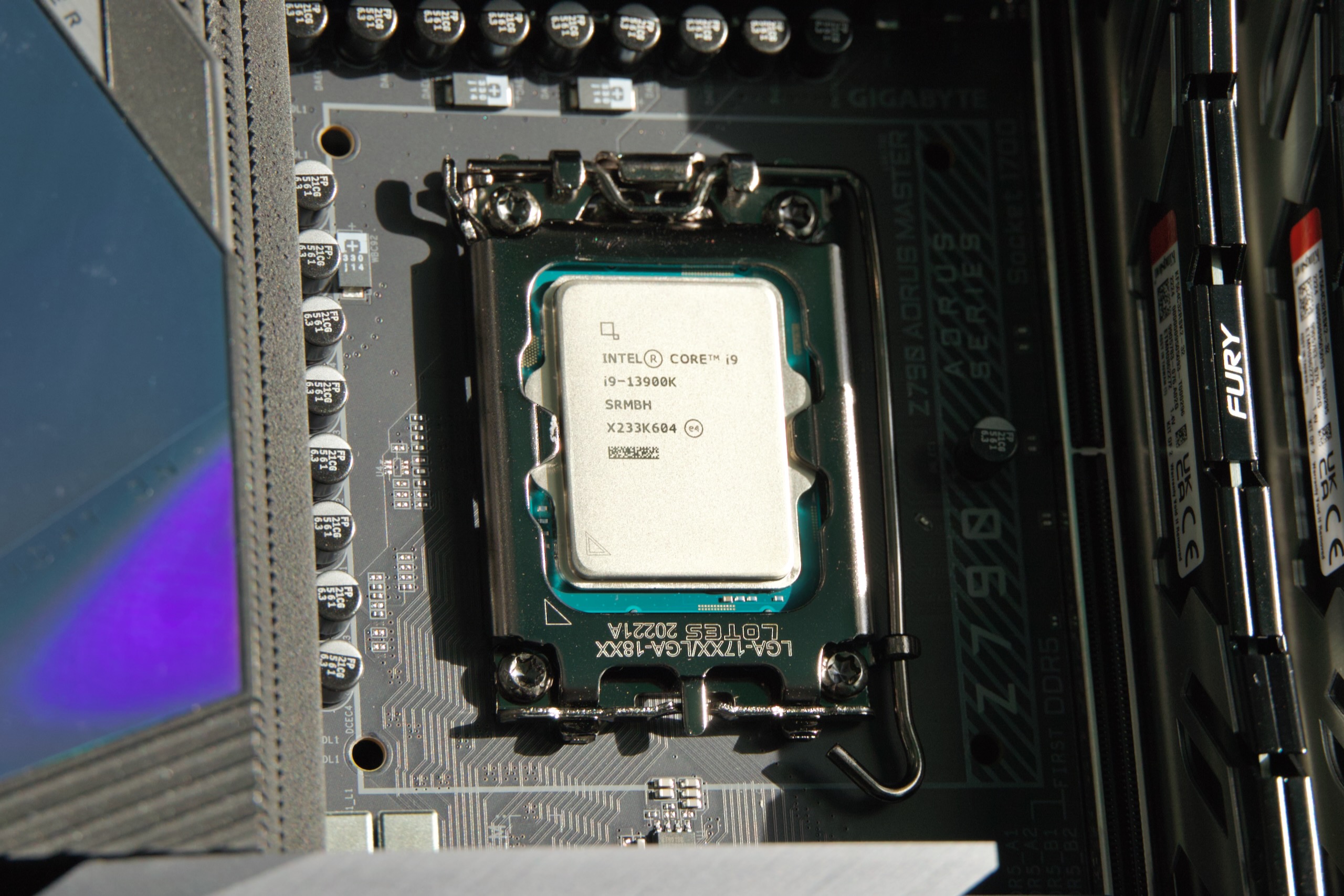
Intel's Core i9-13900K.
Enlarge / Intel’s Core i9-13900K.
Andrew Cunningham

For several months, Intel has been investigating reports that high-end 13th- and 14th-generation desktop CPUs (mainly, but not exclusively, the Core i9-13900K and 14900K) were crashing during gameplay. Intel partially addressed the issue by insisting that third-party motherboard makers adhere to Intel’s recommended default power settings in their motherboards, but the company said it was still working to identify the root cause of the problem.

The company announced yesterday that it has wrapped up its investigation and that a microcode update to fix the problem should be shipping out to motherboard makers in mid-August “following full validation.” Microcode updates like this generally require a BIOS update, so exactly when the patch hits your specific motherboard will be up to the company that made it.

Intel says that an analysis of defective processors “confirms that the elevated operating voltage is stemming from a microcode algorithm resulting in incorrect voltage requests to the processor.” In other words, the CPU is receiving too much power, which is degrading stability over time.

If you’re using a 13th- or 14th-generation CPU and you’re not noticing any problems, the microcode update should prevent your processor from degrading. But if you’re already noticing stability problems, Tom’s Hardware reports that “the bug causes irreversible degradation of the impacted processors” and that the fix will not be able to reverse the damage that has already happened.

There has been no mention of 12th-generation processors, including the Core i9-12900K, suffering from the same issues. The 12th-gen processors use Intel’s Alder Lake architecture, whereas the high-end 13th- and 14th-gen chips use a modified architecture called Raptor Lake that comes with higher clock speeds, a bit more cache memory, and additional E-cores.

Tom’s Hardware also says that Intel will continue to replace CPUs that are exhibiting problems and that the microcode update shouldn’t noticeably affect CPU performance.

Intel also separately confirmed speculation that there was an oxidation-related manufacturing issue with some early 13th-generation Core processors but that the problems were fixed in 2023 and weren’t related to the crashes and instability that the microcode update is fixing.

https://arstechnica.com/?p=2038549