“Disgraceful”: Messy ToS update allegedly locks Roku devices until users give in
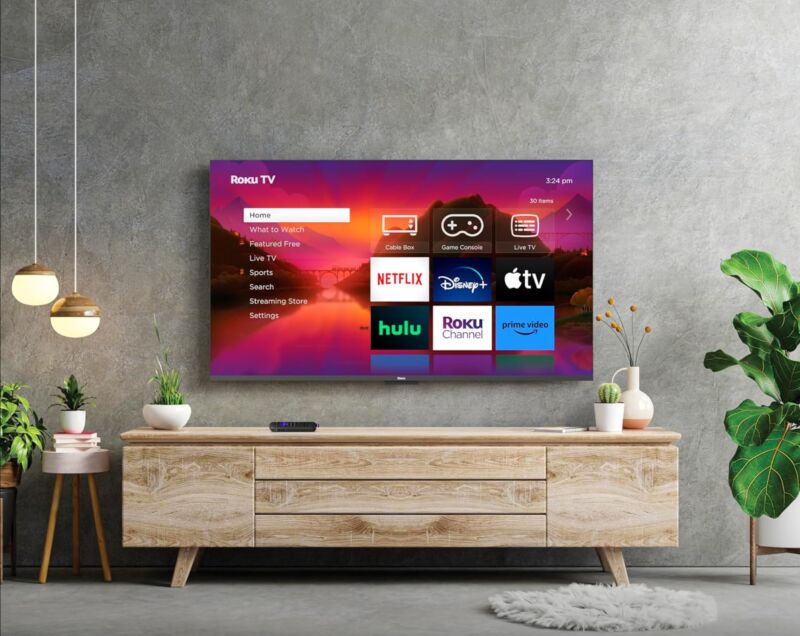
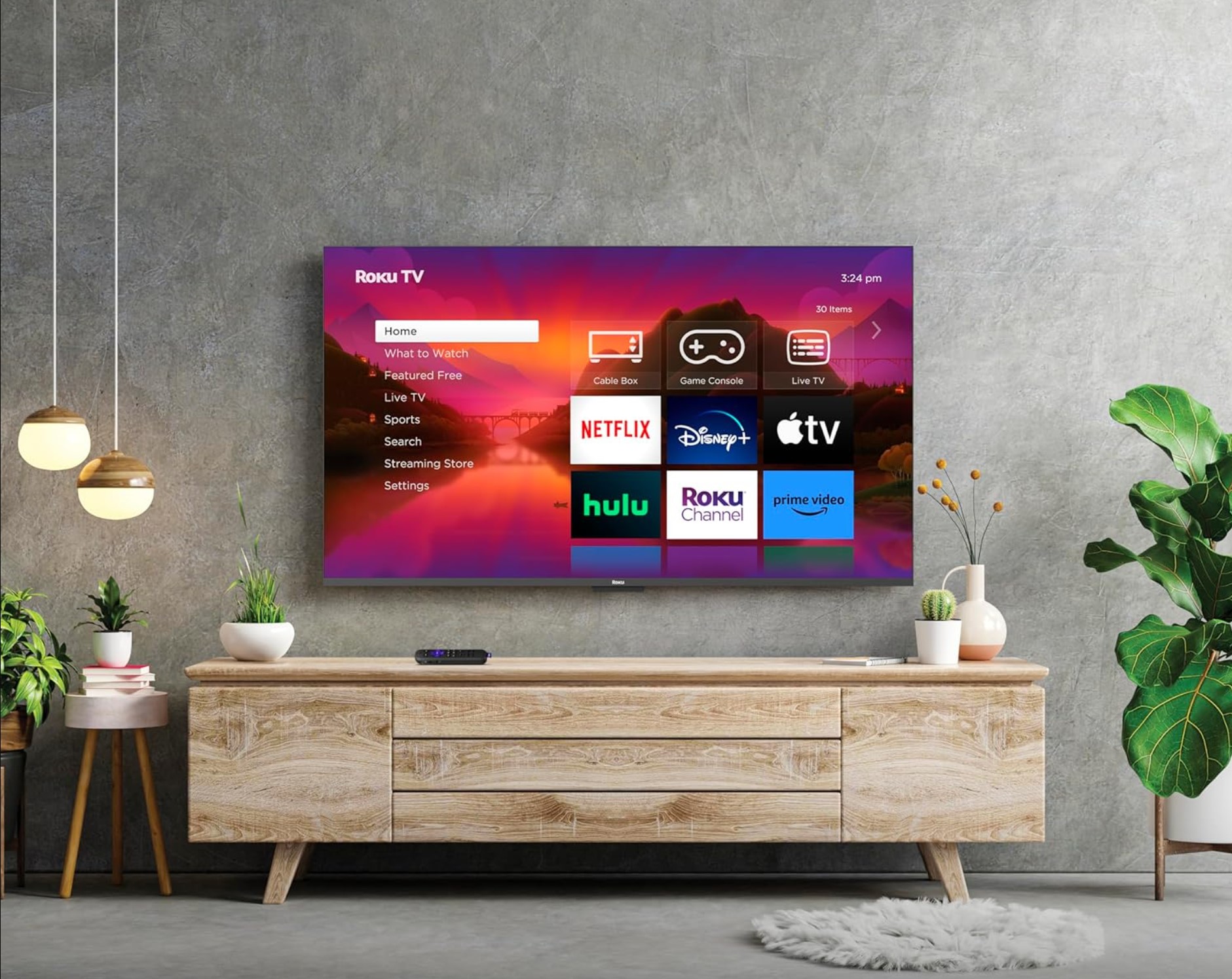
A promotional image for a Roku TV.
Enlarge / A promotional image for a Roku TV.

Roku customers are threatening to stop using, or to even dispose of, their low-priced TVs and streaming gadgets after the company appears to be locking devices for people who don’t conform to the recently updated terms of service (ToS).

This month, users on Roku’s support forums reported suddenly seeing a message when turning on their Roku TV or streaming device reading: “We’ve made an important update: We’ve updated our Dispute Resolution Terms. Select ‘Agree’ to agree to these updated Terms and to continue enjoying our products and services. Press * to view these updated Terms.” A large button reading “Agree” follows. The pop-up doesn’t offer a way to disagree, and users are unable to use their device unless they hit agree.

Customers have left pages of complaints on Roku’s forum. One user going by “rickstanford” said they were “FURIOUS!!!!” and expressed interest in sending their reported six Roku devices back to the company since “apparently I don’t own them despite spending hundreds of dollars on them.”

Another user going by Formercustomer, who, I suspect, is aptly named, wrote:

So, you buy a product, and you use it. And they want to change the terms limiting your rights, and they basically brick the device … if you don’t accept their new terms. … I hope they get their comeuppance here, as this is disgraceful.

Roku has further aggravated customers who have found that disagreeing to its updated terms is harder than necessary. Roku is willing to accept agreement to its terms with a single button press, but to opt out, users must jump through hoops that include finding that old book of stamps.

To opt out of Roku’s ToS update, which primarily changes the “Dispute Resolution Terms,” users must send a letter to Roku’s general counsel in California mentioning: “the name of each person opting out and contact information for each such person, the specific product models, software, or services used that are at issue, the email address that you used to set up your Roku account (if you have one), and, if applicable, a copy of your purchase receipt.” Roku required all this to opt out of its terms previously, as well.

But the new update means that while users read this information and have their letter delivered, they’re unable to use products they already paid for and used, in some cases for years, under different “dispute resolution terms.”

“I can’t watch my TV because I don’t agree to the Dispute Resolution Terms. Please help,” a user going by Campbell220 wrote on Roku’s support forum.

Based on the ToS’s wording, users could technically choose to agree to the ToS on their device and then write a letter saying they’d like to opt out. But opting into an agreement only to use a device under terms you don’t agree with is counterintuitive.

Even more pressing, Roku’s ToS states that users only have “within 30 days of you first becoming subject to” Roku’s updated terms, which was February 20, to opt out. Otherwise, you’re opted in automatically.

Archived records of Roku’s ToS website seem to show the new ToS being online since at least August. But it was only this month that users reported that their TVs were useless unless they accepted the terms via an on-screen message. Roku declined to answer Ars Technica’s questions about the changes, including why it didn’t alert users about them earlier. But a spokesperson shared a statement saying:

Like many companies, Roku updates its terms of service from time to time. When we do, we take steps to make sure customers are informed of the change.

What Roku changed

Customers are criticizing Roku for aggressively pushing them to accept ToS changes. The updates focus on Roku’s terms for dispute resolution, which prevent users from suing Roku. The terms have long forced a described arbitration process for dispute resolution. The new ToS is more detailed, including specifics for “mass arbitrations.” The biggest change is the introduction of a section called “Required Informal Dispute Resolution.” It states that except for a small number of described exceptions (which include claims around intellectual property), users must make “a good-faith effort” to negotiate with Roku, or vice versa, for at least 45 days before entering arbitration.

Roku is also taking heat for using forced arbitration at all, which some argue can have one-sided benefits. In a similar move in December, for example, 23andMe said users had 30 days to opt out of its new dispute resolution terms, which included mass arbitration rules (the genetics firm let customers opt out via email, though). The changes came after 23andMe user data was stolen in a cyberattack. Forced arbitration clauses are frequently used by large companies to avoid being sued by fed-up customers.

Roku’s forced arbitration rules aren’t new but are still making customers question their streaming hardware, especially considering that there are rivals, like Amazon, Apple, and Google, that don’t force arbitration on users.

Based on comments in Roku’s forums, some users were unaware they were already subject to arbitration rules and only learned this as a result of Roku’s abrupt pop-up.

But with the functionality of already-owned devices blocked until users give in, Roku’s methods are questionable, and Roku may lose customers over it. Per an anonymous user on Roku’s forum:

I’m unplugging right now.

https://arstechnica.com/?p=2008691



Nikon buys Red Digital Cinema, will jump into the pro video space

The Red V-Raptor X.
Enlarge / The Red V-Raptor X.

Nikon is buying the ultra-high-end video camera company Red Digital Cinema. Nikon has a press release saying that “RED will become a wholly owned subsidiary of Nikon” for an undisclosed sum. Nikon is typically more of a still-image camera company and wants to use Red to “expand the fast-growing professional digital cinema camera market.”

Red was founded in 2005 by Jim Jannard, founder of the Oakley sunglasses company. The company is a big player in digital film production, and, at the peak of its movie market share in 2016, over 25 percent of the top 100 grossing domestic films were shot on Red cameras. A lot of big YouTubers also use the cameras, so there’s a lot more room for growth there. In the early days, the company was a pioneer in 4K digital filmmaking (see Peter Jackson’s 48 fps film The Hobbit as a famous example), but since then, the competition has caught up. The company also made a terrible smartphone that one time.

“This acquisition marks a significant milestone for Nikon, melding its rich heritage in professional and consumer imaging with RED’s innovative prowess,” Red’s president, Jarred Land, wrote on Facebook. “Together, Nikon and RED are poised to redefine the professional digital cinema camera market, promising an exciting future of product development that will continue to push the boundaries of what is possible in film and video production.“

Red and Nikon just finished suing each other a few years ago. Red has a wide-ranging patent covering compressed RAW video and has been suing everyone under the sun over it. Nikon, Sony, Apple, and Kinefinity were all hit with lawsuits and all ended up either not shipping compressed RAW or signing some kind of agreement (presumably paying royalties or cross-licensing) with Red. It will now be up to Nikon to see how aggressive it wants to be with what is a foundational patent in digital video.

https://arstechnica.com/?p=2008699


Samsung is making it harder to know what type of OLED TV you’re getting

A marketing image for Samsung's 83-inch S90C, its first OLED TV to quietly use an LG Display WOLED panel.
Enlarge / A marketing image for Samsung’s 83-inch S90C, its first OLED TV to quietly use an LG Display WOLED panel.

Samsung rejuvenated the OLED TV market when its display manufacturing subsidiary, Samsung Display, announced QD-OLED two years ago. Quantum dot-infused OLED panels brought the promise of richer color compared to LG Display’s white OLED panels (WOLED) and represented a viable competitor to what had become OLED TVs’ only option. Various OEMs, from Samsung Electronics to Sony, bragged about the purported advantages QD-OLED brought over WOLED. Samsung is not so boastful these days.

Samsung’s 2024 OLED TV lineup will feature TVs that use both QD-OLED and WOLED panels. Samsung started doing this last year with the 83-inch S90C. But this year, it will reportedly be even harder to tell if a new Samsung OLED TV has quantum dots.

Samsung announced the entry-level S85D, the S90D, and the flagship S95D in January, without specifying the type of OLED panel tech(s) involved. But it was still apparent that the S90D would include WOLED options since Samsung said it would come in 42, 48, 55, 65, 77, and 83-inch sizes. QD-OLED doesn’t come in 42, 48, or 83 inches.

But a report this week from Korean news outlet The Elec spotted by FlatPanelsHD said, per a Google translation, that the other S90D screen sizes may be WOLED or QD-OLED.

Vincent Teoh, the display expert behind the HDTVTest YouTube channel, in a video shared Saturday said:

Samsung won’t explicitly advertise any of its 2024 OLEDs as QD-OLED.

Teoh added, though, that at a showcase Samsung recently held in Frankfurt, there was a 55-inch S90D on display that he confirmed was QD-OLED, “based on its subpixel configuration.”

The Elec reported this week, per Google’s translation, that Samsung using both WOLED and QD-OLED for its S90D TVs stems from LG Display requesting that Samsung not position WOLED as lesser than QD-OLED. Notably, though, it’s expected that Samsung’s most expensive 2024 OLED TV, the S95C, will use QD-OLED for all sizes.

Samsung was long resistant to selling OLED TVs, opting to sell LCD panels with quantum dots as its premium TV option instead. However, amid LCD manufacturing partners in China increasing prices, growing consumer interest in OLED, and reported pressure from the South Korean government, Samsung sought to get into OLED and eventually formed a partnership with rival LG.

The Elec also reported that Samsung is considering making its cheapest 2024 OLED TV, the S85D, only available with WOLED but that Samsung hasn’t made a final decision. When checking out a unit on display at CES 2024, Teoh confirmed that that specific unit had WOLED.

https://arstechnica.com/?p=2008256


Huawei rises from the dead, outsells iPhone in China

The Huawei Mate 60 Pro+. It's a phone made without most of the traditional US-allied suppliers.
Enlarge / The Huawei Mate 60 Pro+. It’s a phone made without most of the traditional US-allied suppliers.

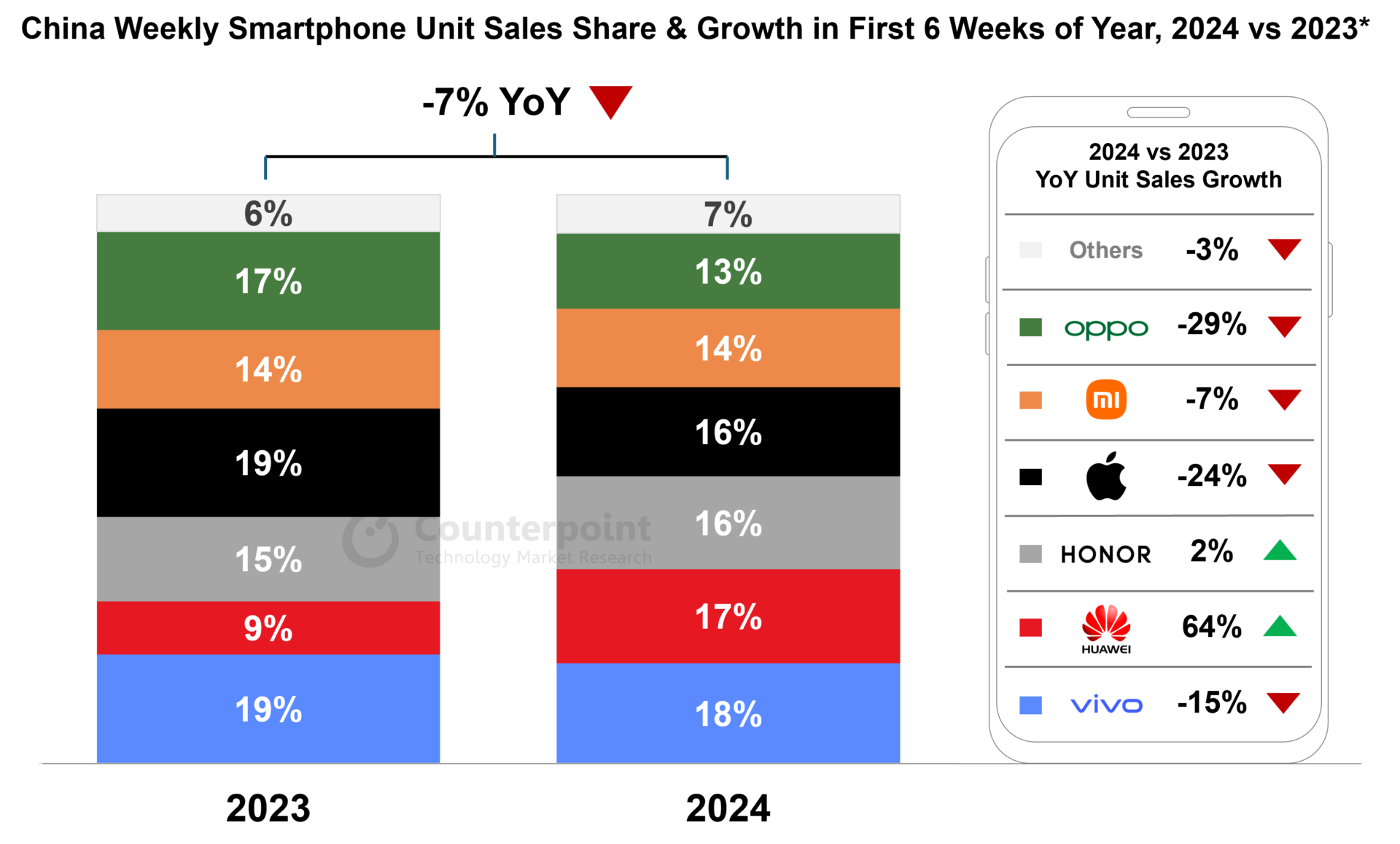
Counterpoint Research has an interesting new report on the return of Huawei in China. Market share for the Chinese government’s favorite tech company has shot up 64 percent for the first six weeks of 2024. Counterpoint says this is thanks to “continued demand for Huawei’s Mate 60 series,” Huawei’s first big smartphone release in its US-sanctions comeback tour.

Counterpoint says the market share for the major US incumbent, Apple, has plummeted 24 percent in 2024, allowing Huawei’s 17 percent market share to beat Apple’s 16 percent. For the early days of the year, Huawei is now the No. 2 smartphone manufacturer in China, Vivo is No. 1, and Apple is tied for third with Honor, a Huawei offshoot. I bet the Chinese government is thrilled.

Huawei was supposed to be dead! For a time, the company was crushed by US sanctions, which really kicked in around 2021. The company mostly retracted to China-only distribution and lost most of its market share thanks to dwindling chip supplies. A few years later, Huawei is getting its homegrown ecosystem back in gear, enough to release the Mate 60 Pro, the company’s post-sanctions flagship.

It’s hard to say too much about it because information on the phone is pretty limited. Huawei has proven not to be a trustworthy narrator, and the phone’s China exclusivity means there’s not much in the way of neutral coverage out there. What we do know is that the Mate60 Pro uses Huawei’s in-house chip, a HISilicon Kirin 9000S. Huawei has been building its own chips and modems forever as an Arm licensee, so the chip’s existence isn’t that much of a revelation. This is the first chip Huawei has built post-US sanctions, but even Huawei doesn’t seem to be bragging too much about it, just based on the model number. The original Kirin 9000 chip was released in November 2020 with the Mate 40 Pro, back before Huawei was feeling the effects of US sanctions. It’s now four years later, and Huawei’s chip is still the “Kirin 9000,” just with an “S” tacked onto the end.

Everything we know about the chip makes the 4-year-old name sound pretty appropriate. The big change in the 9000s is the switch from the Western-aligned TSMC chip fab to China’s SMIC, which is also operating under the yoke of US sanctions. Bloomberg tore the chip down and found it was built on 7 nm technology, a far cry from the 3 nm chips TSMC is shipping today in Apple devices. There were always questions about exactly what the yield would be of these chips, but apparently, it’s high enough to enable volume sales.

As for the chip’s actual performance, it doesn’t seem great. GSMArena has benchmarks of the Kirin 9000s in a Huawei tablet, and even the bigger form factor doesn’t help it much. Single-core performance in Geekbench is on par with 2020’s Snapdragon 888. Multicore is better, in between the Snapdragon 8 Gen 1 (2021) and Gen 2 (2022). The performance of Huawei’s “self-developed” HiSilicon Maleoon 910 GPU is the chip’s weakest area, scoring a tier below the Snapdragon 888.

The US originally wanted to limit China to 14 nm chips, but that obviously didn’t work out, and today Huawei and the rest of China are working on bringing the whole tech ecosystem in-house. TSMC’s move beyond 7 nm required a new manufacturing technique called “extreme ultraviolet lithography,” and exporting those machines to China is banned, so moving forward without the right tools, or having to build your own, will be a challenge for Huawei

https://arstechnica.com/?p=2008275


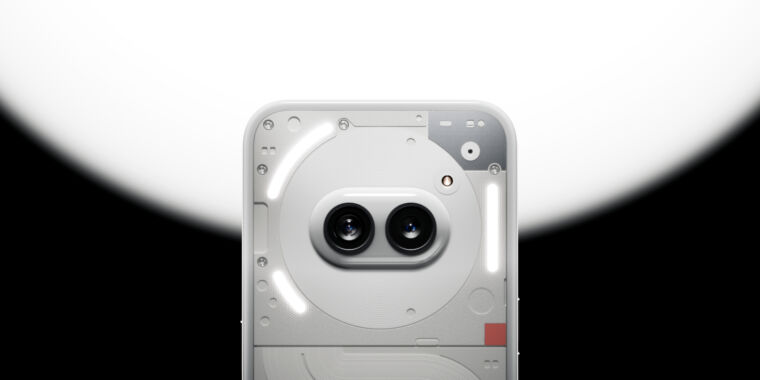
The Nothing Phone 2a is a light-up budget phone for $349

Hot off the embarrassing implosion of its messaging app, the upstart hardware company Nothing is back to making phones again. This time it’s a budget device, the “Nothing Phone 2a,” which is being sold in Europe for 329 euros and sort of coming to the US for $349 on a “Developer program” with limited carrier support.

Just like the bigger Nothing Phone 2, this has a unique rear design full of lights and faux-mechanical cladding embedded under the clear back. On this model, that clear back is plastic, while the front is glass. There is some aluminum somewhere in the mid-frame, but the sides are plastic.

As usual with Nothing phones, it’s very odd to be able to see the screw heads on the back but not access them because of the glued-on rear cover. In a world where everyone, Nothing included, pitches “more sustainable” devices, you could be both good-looking and repairable with a design like this, if you just didn’t entomb the screws under a clear cover. The phone only has IP54 dust and water resistance, meaning it can’t handle much more than rain, so it’s not like the glue construction is doing much. Still, it’s nice to see a budget phone with some design work put into it, even if it is this phony faux-repairable design language.

For specs, we have a 6.7-inch, 120 Hz, 2412×1084 OLED display, powered by a MediaTek Dimensity 7200 Pro SoC. The Mediatek is a 4 nm chip with two Arm Cortex A715 cores and six A510 cores. In a 2023 flagship Arm SoC, these cores would handle the “medium” and “background” processing tasks with a “big” X3 core handling the primary workloads, but the budget chip has the primary core sliced off. So it’s slow, but it’s slow and modern, which is nice. You still get a 5000 mAh battery, which should last a while with the cheaper SoC. Nothing claims “2 days” of battery life, and if you need a recharge, 45 W fast charge is a nice-to-have feature at this price point.

The base model has 8GB of RAM and 128GB of storage, with an option to jump to 12GB of RAM and 256 GB of storage. The phone has Wi-Fi 6E, UFS 3.1 storage, an in-screen fingerprint reader, NFC, and an Arm Mali-G610 MC4 GPU. It ships with Android 14, and Nothing promises three years of major OS updates and four years of security updates.

The rear camera design is a good exercise in restraint: There are only two cameras, a set of 50MP sensors (main and ultrawide) of unknown provenance. Often, Android manufacturers think “more cameras = better,” and these budget phones are loaded with useless 2 MP sensors that are just here to fill out a spec sheet. If we’re here to hit a price point, superfluous rear cameras should be the first thing to go. I would be happy with one!

The US launch situation is kind of sketchy. This doesn’t have the right bands for US carriers, so Nothing is making it available via a “developer program,” and you’ll just have to deal with the limited connectivity. You can view the bands here and what each US carrier needs here, but what really matters is what bands are prevalent in your local area, so we can’t draw too many conclusions other than “you’re winging it.” It’s a shame because this might be a serious budget competitor here otherwise. The main markets seem to be Europe, India, and Singapore, where the phone has more sensible carrier compatibility. Preorders start today.

Listing image by Nothing

https://arstechnica.com/?p=2007892


Linux market share passes 4% for first time; macOS dominance declines

Gentoo Penguins (Pygoscelis papua) climbing snowy hill

Linux reached 4.03 percent of global market share in February, according to data from research firm Statcounter. That takes Linux past the 3 percent milestone it reached in June 2023. While we’re still far from the Year of the Linux Desktop, interest in Linux has somewhat grown lately.

Statcounter says it gets its desktop operating system (OS) usage stats from tracking code installed on over 1.5 million global websites generating over 5 billion monthly page views. The only adjustments the firm says it makes to this data are around removing bot activity and adjusting for Google Chrome prerendering. Note that when Statcounter analyzes desktop OSes, it also includes laptop computers, and Statcounter says it may revise its data within 45 days of publication.

As spotted by Linuxiac, Linux’s reported desktop market share was higher than ever in February. If you count ChromeOS as a Linux OS, then market share totaled 6.34 percent in February, although that number is actually smaller than what Statcounter reported in June: 2 percent.

But if we focus on the Linux numbers alone, we see the nearly 33-year-old OS’s market share growing 31.3 percent from June 2023, when we last reported on Linux market share, to February. Since June, Linux usage has mostly increased gradually. Overall, there’s been a big leap in usage compared to five years ago. In February 2019, Linux was reportedly on 1.58 percent of desktops globally.

Since June, ChromeOS adoption took a bit of a dive, representing 2.27 percent of the worldwide market last month. In October, Google’s Chromebook OS reached 4.01 percent market share but has mostly been declining since.

Windows dominance, meanwhile, mostly increased between June and February, when the Microsoft OS was reportedly on 72.17 percent of computers. From June 2022 to June 2023, there seemed to be a significant drop (from 76.33 percent market share to 68.23 percent). But now, Windows OS usage has seemingly returned to early 2022 levels.

macOS, meanwhile, has seen desktop market share drop from 21.32 percent in June to 15.42 percent in February. However, the Apple OS’s current market share is similar to what we saw in January 2023 (15.33 percent) and February 2023 (16.26 percent).

Statcounter’s global chart above shows macOS adoption taking a dive from November to December 2023. It’s unclear what exactly could have driven that; it’s possible that there’s a margin of error here. Keep in mind that these are just numbers from one firm. It’s also possible that the decline has to do with the “Unknown” category increasing during that same time period. It has been suspected that “Unknown” could account for particularly new or old versions of OSes.

It’s further notable that Apple’s global computer market share went from 8.6 percent in Q2 2023 to 10.6 percent in Q3 2023, and then 8.5 percent in Q4 2023, per IDC. From 2022 to 2023, Apple’s PC market share went from 9.3 percent to 8.4 percent, according to IDC data.

Statcounter’s newest numbers show an uptick in Linux usage over the past months. Ultimately, the big OS players are still, by far, Windows and macOS, which represented 87.59 percent of desktop OSes in February.

In the US specifically, Linux’s desktop market share missed the 4 percent line, hitting 3.85 percent in February. But that’s still an improvement from US usage in June 2023 (1.96 percent).

Despite this growth, we, of course, remain far from any sort of Year of the Linux Desktop, where Linux is the dominant desktop OS. There’s plenty of debate over why; Linux founder Linus Torvalds, for example, has suggested that a lack of a standardized desktop that goes across all Linux distros has held back Linux adoption on desktop.

Still, it’s interesting to watch usage of the open source OS grow, especially as fragmentation and app discovery improve. It’s a slow climb that will likely never result in Linux sitting at the peak of the desktop OS mountain. But big gains—like in India, where Linux has reportedly been the second-biggest desktop OS—highlight the proclivity that certain technologists have toward Linux.

https://arstechnica.com/?p=2007911


Google’s Genie game maker is what happens when AI watches 30K hrs of video games

A collage of some of the "interactive environments" generated by Genie from static images or text prompts.
Enlarge / A collage of some of the “interactive environments” generated by Genie from static images or text prompts.


At this point, anyone who follows generative AI is used to tools that can generate passive, consumable content in the form of text, images, video, and audio. Google DeepMind’s recently unveiled Genie model (for “GENerative Interactive Environment”) does something altogether different, converting images into “interactive, playable environments that can be easily created, stepped into, and explored.”

DeepMind’s Genie announcement page shows plenty of sample GIFs of simple platform-style games generated from static starting images (children’s sketches, real-world photographs, etc.) or even text prompts passed through ImageGen2. While those slick-looking GIFs gloss over some major current limitations that are discussed in the full research paper, AI researchers are still excited about how Genie’s generalizable “foundational world modeling” could help supercharge machine learning going forward.

Under the hood

While Genie’s output looks similar at a glance to what might come from a basic 2D game engine, the model doesn’t actually draw sprites and code a playable platformer in the same way a human game developer might. Instead, the system treats its starting image (or images) as frames of a video and generates a best guess at what the entire next frame (or frames) should look like when given a specific input.

To establish that model, Genie started with 200,000 hours of public Internet gaming videos, which were filtered down to 30,000 hours of standardized video from “hundreds of 2D games.” The individual frames from those videos were then tokenized into a 200-million-parameter model that a machine-learning algorithm could easily work with.

An image like this, generated via text prompt to an image generator, can serve as the starting point for Genie's world-building.
Enlarge / An image like this, generated via text prompt to an image generator, can serve as the starting point for Genie’s world-building.
A sample of interactive movement enabled by Genie from the above starting image (Click "enlarge" if GIF doesn't animate).
Enlarge / A sample of interactive movement enabled by Genie from the above starting image (Click “enlarge” if GIF doesn’t animate).

From here, the system generated a “latent action model” to predict what kind of interactive “actions” (i.e., button presses) could feasibly and consistently generate the kind of frame-by-frame changes seen across all of those tokens. The system limits the potential inputs to a “latent action space” of eight possible inputs (e.g., four d-pad directions plus diagonals) in an effort “to permit human playability” (which makes sense, as the videos it was trained on were all human-playable).

With the latent action model established, Genie then generates a “dynamics model” that can take any number of arbitrary frames and latent actions and generate an educated guess about what the next frame should look like given any potential input. This final model ends up with 10.7 billion parameters trained on 942 billion tokens, though Genie’s results suggest that even larger models would generate better results.

Previous work on generating similar interactive models using generative AI has relied on using “ground truth action labels” or text descriptions of training data to help guide their machine learning algorithms. Genie differentiates itself from that work in its ability to “train without action or text annotations,” inferring the latent actions behind a video using nothing but those hours of tokenized video frames.

“The ability to generalize to such significantly [out-of-distribution] inputs underscores the robustness of our approach and the value of training on large-scale data, which would not have been feasible with real actions as input,” the Genie team wrote in its research paper.

https://arstechnica.com/?p=2007877


Apple’s M3 MacBook Pro is, belatedly, fixing its one-external-display limitation

Apple's M3 MacBook Pro should be able to drive a pair of external displays soon, as long as the lid is closed.
Enlarge / Apple’s M3 MacBook Pro should be able to drive a pair of external displays soon, as long as the lid is closed.

One long-standing limitation of Apple’s most basic Mac chips—the no-adjective M1, M2, and M3—has been their inability to work with more than a single external monitor at a time. This was one of the only ways in which the Apple Silicon era has been a step back from the Intel era, where most Macs supported at least two external displays, plus the screen built into the MacBook Air or Pro you were using. (Would an integrated Intel GPU actually work well with that many screens connected? Usually not. But at least you could try.)

When Apple launched the M3 version of the MacBook Pro last fall, the one-external-display limitation was still in place. But today’s announcement of the M3 MacBook Air came with a small but pleasant surprise for anyone who wants their Mac to do double-duty as a laptop and a desktop—if the laptop’s lid is closed, the M3 can now run a pair of external displays over its Thunderbolt ports. And Apple confirmed to 9to5Mac that the 14-inch M3 MacBook Pro would have the same functionality enabled via a future macOS update (we’ve asked Apple to verify whether it’s coming in the imminent macOS 14.4 update or at some future date).

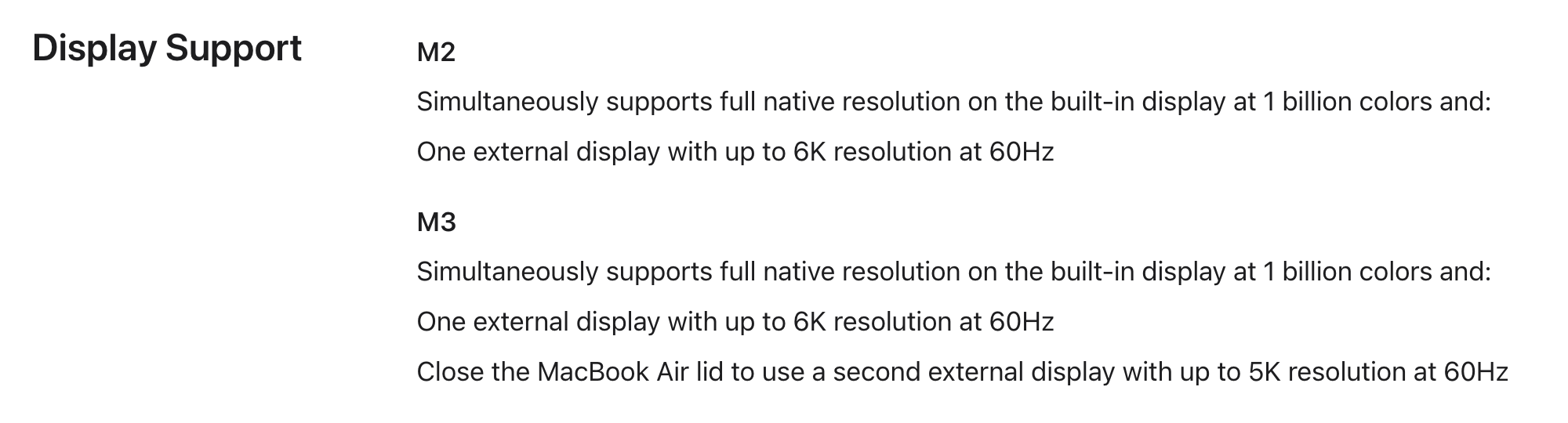
Apple's spec page for the new M3 Airs explains its newfound multi-display support.
Enlarge / Apple’s spec page for the new M3 Airs explains its newfound multi-display support.
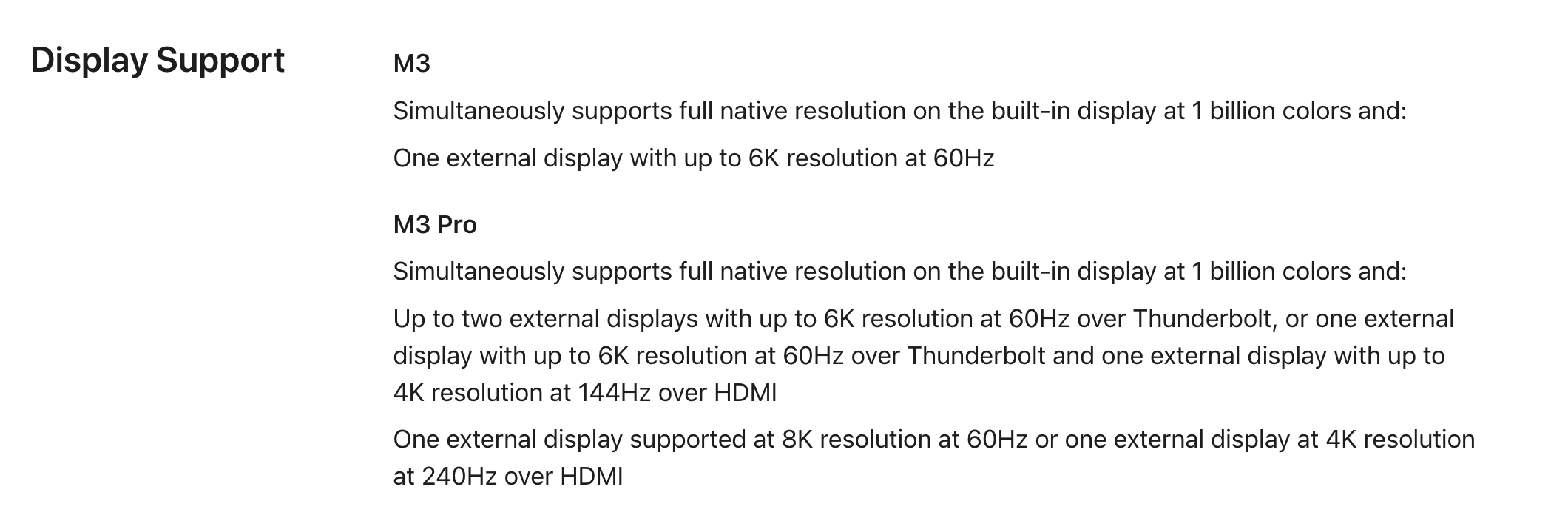
As of this writing, the M3 MacBook Pro's spec sheet still doesn't mention support for a second external display.
Enlarge / As of this writing, the M3 MacBook Pro’s spec sheet still doesn’t mention support for a second external display.

Apple’s spec sheets say that the M3 can drive one 6K display at 60 Hz and one additional 5K display at 60 Hz when your laptop’s lid is closed. The M3 MacBook Pro’s spec sheet still hasn’t been updated as of this writing, but we would expect it to be at some point after the relevant software update is released.

This is a welcome change from the M1 and M2, which can still only work with one external display whether the lid is closed or not. Each of those chips can drive a total of two screens at a time, the same as the M3, but the internal display always counts toward the total whether it’s actually in use or not.

This change makes the M3 MacBook Airs and Pros a bit more like the Mac mini, which has always supported a pair of external displays by virtue of having no built-in screen. The M1 Mac mini supports a single USB-C/Thunderbolt display plus one HDMI display, and the M2 version also adds the ability to use a pair of USB-C/Thunderbolt displays. It’s unlikely that a software update will add support for multiple external displays to the M1 or M2 MacBook Airs, but we’ve asked Apple if it has any news to share one way or the other.

https://arstechnica.com/?p=2007608


HDMI Forum to AMD: No, you can’t make an open source HDMI 2.1 driver

HDMI cables, bundled up and covered in some dust
Getty Images

Any Linux user trying to send the highest-resolution images to a display at the fastest frame rate is out of luck for the foreseeable future, at least when it comes to an HDMI connection.

The licensing group that controls the HDMI standard, the HDMI Forum, has reportedly told AMD that it does not allow an open source implementation of the HDMI 2.1 (or HDMI 2.1+) specification, blocking tools such as AMD’s FreeSync from working over HDMI connections at resolution/rate combinations like 4K at 120 Hz, or 5K at 240 Hz.

Linux blog Phoronix noted in January 2021 that the HDMI Forum did not offer public access to the HDMI 2.1 specification. Alex Deucher, an AMD engineer who has long contributed to the company’s open source offerings, has kept a related bug thread alive for at least two years, only to deliver the negative outcome yesterday.

In February 2023, Deucher reported that he was “working with our [AMD] legal team to sort out what we can deliver while still complying with our obligations to HDMI Forum.” Two months later, he said that AMD got “the basic functionality up and running, now we have to go through each of the features with legal and determine if/how we can expose them while still meeting our obligations.” Summer and fall of 2023 went by, with legal review still underway, and in October, the decision was “in the hands of the HDMI Forum.”

On Wednesday afternoon, Deucher offered the current resolution:

The HDMI Forum has rejected our proposal unfortunately. At this time an open source HDMI 2.1 implementation is not possible without running afoul of the HDMI Forum requirements.

Ars has reached out to the HDMI Forum, AMD, and Deucher for further comment and will update the post with new information. X.org was also reportedly involved in negotiations with the HDMI Forum.

Membership in the HDMI Forum is a minimum of $15,000. While AMD is a listed member, that likely doesn’t extend to offering up an implementation of a specification for public use. The member agreement forbidding such things does not appear to be publicly available, nor does an “addendum” for members linked from the Forum’s site. A source code license found on the Forum’s site does not appear to be particularly flexible.

Phoronix and some commenters have suggested potential interference from media firms concerned about digital video ripping. That would seem like a barn door closed years after the horse’s departure, but it also exists as one explanation, lacking other detail.

This outcome leaves DisplayPort as the likely best option for Linux users needing the best possible output. It also suggests that AMD has to decide whether to implement newer HDMI support inside closed-source Linux drivers or simply point its most demanding customers to other options.

https://arstechnica.com/?p=2006935


2024’s first big Windows 11 update extends Copilot’s capabilities, does other stuff

2024’s first big Windows 11 update extends Copilot’s capabilities, does other stuff

For the third year running, Microsoft is releasing a batch of small- to medium-sized Windows 11 updates in February. This year’s collection of tweaks includes the now-obligatory smattering of generative AI features but also some window-snapping changes, better Android phone integration, and accessibility upgrades, among other things.

Starting with the non-AI features: If you’ve paired an Android phone with your PC in the Your Phone app, Microsoft says that “soon” you will be able to use the phone’s camera as a webcam during video calls. This mirrors a similar Mac-to-iPhone feature that Apple added to macOS a couple of years ago; though most PCs these days are sold with webcams, the camera on any reasonably recent Android phone will be a visual upgrade.

Window snapping is getting some “intelligent suggestions” that Microsoft says will “help you quickly organize open apps based on how you use them.” And the Widgets view gets a new “focused” view and subcategories that will let you easily switch between widget boards if you want different widgets for different contexts (one for home and one for work, for example).

The AI tweaks mostly involve upgrades to Copilot, the still-in-preview chatbot that made it into Windows’ taskbar last year. Copilot’s promised support for third-party plugins is arriving—the first wave revolves around mostly gimmicky shopping and travel plugins from OpenTable, Instacart, Kayak, Shopify, and Klarna, plus “a growing list” of other unspecified services.

The chatbot can also view and change a handful of other Windows settings, like toggling the battery saver, launching most of the operating system’s built-in accessibility tools, and showing information about networking and available storage space. All of these functions will be available “beginning in late March.”

Somewhat more interestingly, Microsoft has also enhanced Windows’ image editing capabilities, adding a “generative erase” feature to the Photos app that can be used to fill in a photo after you’ve removed part of it. The Clipchamp video editor is also getting a silence removal feature, though, like Copilot, this is being labeled as a preview.

On the accessibility front, the most significant change is support for Voice Shortcuts, which allow you to create custom voice commands to perform specific tasks or simulate keyboard and mouse input. Voice commands will also work across multiple displays.

Microsoft says the updates are available to any PCs running Windows 11 versions 22H2 or 23H2—they’ll roll out gradually, but “many” of them should be available through Microsoft Store updates or by manually installing optional updates through the Windows Update screen in Settings. The features should automatically roll out to all Windows 11 PCs by sometime in April.

This batch of updates is separate from the more significant Windows 11 24H2 update that Microsoft began testing earlier this month. That update appears to contain some more substantial under-the-hood improvements, including 80 Gbps USB4 support, a refreshed setup process for doing clean installs from a USB drive, and a version of the Linux/Unix Sudo terminal command for Windows. These updates could come out before 24H2 does, but signs point to it being a more significant change than the low-key 23H2 update was.

https://arstechnica.com/?p=2006578