Forget Habits, Preferences, and Demographics—Tap Into Consumer ‘Modes’


.article-native-ad { border-bottom: 1px solid #ddd; margin: 0 45px; padding-bottom: 20px; margin-bottom: 20px; } .article-native-ad svg { color: #ddd; font-size: 34px; margin-top: 10px; } .article-native-ad p { line-height:1.5; padding:0!important; padding-left: 10px!important; } .article-native-ad strong { font-weight:500; color:rgb(46,179,178); }

With C-suite leaders from iconic brands keynoting sessions, leading workshops and attending networking events, Brandweek is the place to be for marketing innovation and problem-solving. Register to attend September 23–26 in Phoenix, Arizona.

Many marketing strategists believe increasing ad spend is the best way to raise awareness and conversion. This blanket approach to messaging attempts to find the venues with the most eyeballs and tell the most compelling stories. But if there is one lesson to be learned from the last decade, people respond far better to messaging targeted to their needs. And needs arise from the situations people find themselves in.

Let me restate that: People respond far better, purchase more often, and remain more loyal when marketers design campaigns that are targeted to their situations. Not to their personalities. Not to their preferences. And not necessarily to their past purchase behavior.

Consumers today have access to powerful tools that help them manage their situational needs. They also have new behavioral attributes that help them manage their ever-changing situations and powerful tools. They get into “modes.”

A mode is a mindset and a set of behaviors that people get into temporarily. Think mommy mode, work mode, beast mode, and so on. Unlike habits or routines, modes are tailored to the situation at hand. And people use their technologies to help them stay in modes, or, when the mode is negative, to get them out of it. The brands that understand consumer modes can effectively target the mode and support the buying process of anyone who is in that mode.

Ten years ago, Red Roof Inn was completely outmatched in online search advertising. The hotelier’s competitors—Marriott, Hilton, and Hyatt—could outspend the company hands down. With no way to break through using purchase power, the marketers at Red Roof Inn did something extraordinary. They figured out how to target ad spending to situations when people’s flights were canceled.

When your flight is canceled, there is an immediate need that arises from the situation. And almost all people get into negative mode. Crisis mode, wait-and-see mode, and recovery mode—all of which are part of canceled flight mode.

What Red Roof Inn did so effectively was use simple data about flight cancellations to send tailored mobile ads to people who were likely affected, leveraging search data, flight data, weather data, geodata, time of day, and other indicators. Because they were first, the results were incredible.

With far fewer resources, Red Roof Inn reached and converted customers who, by their admission, “would otherwise be unattainable.”

Think about how radical this approach to ad spending is. There was no awareness phase, no interest phase, no consideration phase—there was just an identified need, an understanding of the situation in real-time, and support for the mode that people were in. Now, you might say, that’s because they are in a crisis so decision-making goes out the window. Maybe. But I don’t think so. I think Red Roof Inn tapped into the magic of modes.

More on modes

In 2022, the Oxford Dictionary word of the year was “goblin mode,” a temporary but very intentional way of celebrating a messy bedroom, lifestyle, or social media look. 

Over the past five years, the word “mode” has increased 2000% on Google searches. People use it to refer to a temporary state of engagement that they “get into.” People enter different modes because they help them maximize their impact, effectiveness, or productivity in various situations they encounter. Sometimes, getting into modes is a passive response to situations, such as procrastination mode, but frequently, it is a proactive activity. People take time to think about and plan their modes—they talk openly, often on social media, about the modes they are in and why.

Modes are not habits: While a habit is an almost automatic response to a trigger, a mode is easily adapted to the unique circumstances that a person finds themselves in. Being in vacation mode in Hawaii with the family is likely a different experience than being in vacation mode in Luxembourg between business meetings. Moreover, a habit imposes similar patterns on different situations, while modes are plentiful and easily adapted to the situation.

Modes are not preferences: A preference predicts what the individual will likely desire in the future, but a mode predicts what the individual will likely need the next time they are in a similar situation. This is extremely important. Companies continue to mine data for customer preferences so they can customize experiences. Yet, preference data can only take you so far, and it is often not effective in predicting future buying behavior.

Modes have predictive power preferences that do not. For example, if a person buys a swimsuit, a brand is likely to show similar swimsuits the next time she returns to buy from them. But if the company knows that the customer is buying the swimsuit because she is soon to be in Hawaii vacation mode, then there are all kinds of additional things she may need for the trip. And if the swimsuit is bought while the customer is already in Hawaii vacation mode, she is likely in a mode that is conducive to even more purchases. 

In today’s fast-paced and complex world, where advertisers are looking to build engagement with specific people—and in a marketplace saturated with data—what matters most is being able to align the right message with the right situation. And there is no better way to do that than to understand consumers’ modes, which provide clarity about what data matters. Understanding modes helps marketers understand the real-time (in situ) needs of people. When advertisers focus on areas besides modes (like demographics, preferences, habits, pain points, and moments), the companies they support miss out on an important opportunity to engage people where they need it when they need it.

https://www.adweek.com/brand-marketing/forget-habits-preferences-and-demographics-tap-into-consumer-modes/



5 Marketing Lessons From the ‘It Ends With Us’ PR Saga


.article-native-ad { border-bottom: 1px solid #ddd; margin: 0 45px; padding-bottom: 20px; margin-bottom: 20px; } .article-native-ad svg { color: #ddd; font-size: 34px; margin-top: 10px; } .article-native-ad p { line-height:1.5; padding:0!important; padding-left: 10px!important; } .article-native-ad strong { font-weight:500; color:rgb(46,179,178); }

With C-suite leaders from iconic brands keynoting sessions, leading workshops and attending networking events, Brandweek is the place to be for marketing innovation and problem-solving. Register to attend September 23–26 in Phoenix, Arizona.

As in many break rooms around the world, the film It Ends With Us has taken my team of multi-generational, diverse, and wickedly smart staffers down a rabbit hole of questions, comments and strong responses.

My 16-year-old daughter’s rave review of the film eventually brought me to the TikTok storytimes and Instagram detectives sleuthing out who among the cast had unfollowed whom on social media, and who was the villain of the story about the story.

First, some background for those who haven’t been following the endless updates:

It Ends With Us, originally a novel written by Colleen Hoover, follows the story of Lily Bloom (played by Blake Lively), a young woman working through a cycle of domestic abuse as she navigates grieving her abusive father while entering a relationship with an abuser (played by actor Justin Baldoni, who also directed the film).

The book gained popularity and began selling in massive numbers in 2021 due to the influence of #BookTok, a niche TikTok community that is passionate about books, creating videos to review and discuss them. Their commentary and social traction have proven to impact book sales and the trajectory of book-to-screen adaptations.

During the promotion of the film, Baldoni was often seen discussing the dangers of domestic violence, promoting the nonprofit No More, an organization that raises awareness about domestic violence and worked with Baldoni on the film. Meanwhile, Lively often talked up the film as a lighthearted rom-com, encouraging fans to “grab their friends and wear florals,” earning her backlash from fans who felt that Lively not mentioning the domestic violence aspect was unethical and in poor taste. At the premiere and on the press tour, Baldoni and Lively can be seen avoiding each other.

Here are the five marketing insights that rose to the top of the chatter in our team meeting this week.

Build a community before you need a community

While not as big of a household name as his co-star Lively or her husband, Ryan Reynolds, Baldoni has spent his career building a community of supporters whose loyalty runs deep.

From his TEDWomen talk to his popular Man Enough podcast, Baldoni has spent his life cultivating community, including through his religion, the Baha’i Faith, whose writings extol the equality of men and women and the unity of mankind. Baldoni has implemented the pillars of his faith into every project, and his intentionality shines through.

When promoting the film, he changed his IG bio to direct followers to resources for survivors of domestic violence, hosted open conversations with professionals in the field, and gave CTAs on how to get help and advocate for victims/survivors. And, because Baldoni had intentionally built a community of supporters, his words were met with open, eager ears—and hearts.

Authenticity remains king

This also lends Baldoni some authenticity in the eyes of the viewer that doesn’t exactly match Lively’s journey to becoming one-half of America’s shiny sweethearts.

Lively and Reynolds have served as Hollywood’s proverbial Homecoming King and Queen for over a decade. We watched their fairytale romance (nevermind the plantation wedding) and their family grow to four kids. But the standard to which we hold our stars has changed.

We are fine-tuned to recognize authenticity, and the tools we have to track that have been upgraded massively in the past decade. Social commentary is judge, jury, and executioner.

In this case, Lively’s authenticity was opaque, at best.

Stay flexible

Planning a rollout of a new project takes months of preparation—sleepless nights building narratives, approving artwork, lining up the ideal press coverage—all of which can be upended by an unexpected kink.

When this happens, it’s more important than ever to embrace flexibility and adapt your messaging to the story going on around you instead of becoming the story yourself.

Competing visions

Several of my staff members called out the clear disconnect between the film content and what Lively wanted for herself, goal-wise. It feels like she was attempting to make it a big cultural moment, especially involving her husband and attempting to tie it to Deadpool 3 a al Barbenheimer, as well as keeping the tone of the tour bubbly and lighthearted when the film and book content are anything but. This left audiences feeling blindsided by what can be an incredibly triggering experience for some.

The ethics behind dramatizing trauma

How responsible is the studio, filmmaker, cast, marketing team, etc. for the portrayal of abuse on screen? Where is the invisible line that tells us to stop and make a clear statement about what is true, what is dangerous, and what the viewer should take away? And how do we do it without completely co-opting any other narrative around the film?

The issue here starts in the source material. Hoover’s books are marketed as romance novels, something that doesn’t sit well with a lot of folks. In It Ends With Us, Lily’s relationship is seen as acceptable. The character excuses red flags and the audience could even perceive some of the book and film as romanticizing the “passionate” gestures her abuser is moved to.

Hoover is no stranger to controversy. Last year, she announced the planned release of a coloring book based on It Ends With Us, then canceled the project following backlash from readers who called out her lack of sensitivity in creating a childlike product based on a dark tale of abuse.

The media is also responsible for reporting leading up to the film, not only to care about what Lively was wearing but also to ask the right questions at press junkets and premieres. Only after the very vocal online backlash are we seeing publications add trigger disclaimers and include the National Domestic Violence Hotline in their pieces covering the film and its associated drama.

As one of my colleagues said: The subject matter of domestic violence should never take a back seat to consumerism and cross-promotion.

https://www.adweek.com/convergent-tv/marketing-lessons-it-ends-with-us-pr-saga/


A Call to Action for the Next Olympics and Beyond: Improve AAPI Representation


.article-native-ad { border-bottom: 1px solid #ddd; margin: 0 45px; padding-bottom: 20px; margin-bottom: 20px; } .article-native-ad svg { color: #ddd; font-size: 34px; margin-top: 10px; } .article-native-ad p { line-height:1.5; padding:0!important; padding-left: 10px!important; } .article-native-ad strong { font-weight:500; color:rgb(46,179,178); }

ADWEEK will be all over Cannes. Subscribe to unlock unlimited access to all our coverage and analysis.

When I sat down to watch the prime-time broadcast of the 2024 Paris Olympics Opening Ceremony with my three young children, we were excited. 9% of Team USA, like them, are of Asian Pacific heritage: 22 men and 29 women across 18 sports.

And yet, not once were any of the Asian Pacific athletes featured during the entirety of the four-hour broadcast. What’s more, while the Paris Olympics has eclipsed both Rio and Tokyo combined in total number of advertisers, only one spot starred an Asian Pacific medal contender during the opening ceremony (Eli Lilly featured gymnast Lee in one of their spots about eczema). To add insult to injury, the International Olympic Committee (IOC) announcers also mistakenly announced South Korea (the Republic of Korea) as North Korea (the Democratic People’s Republic of Korea).

What will it take for the Asian Pacific community to be recognized for what we bring? Somehow, while we’re winning on the courts and mats of Olympic competition and in the corridors of Corporate America, our collective brand remains severely undervalued.

While there has been progress in recent years, there is so much opportunity to ensure that all viewers of the next Olympics and beyond are reflected authentically.

So many stories, so many channels to share them

We’ve made strides in Hollywood (demonstrated by the success of Shogun to currently playing coming-of-age story Didi). But just four months ago McKinsey and Gold House launched a study that showed that the lack of Asian Pacific stories being released by studios is leaving billions on the table.

We’ve made strides in leadership—between 2020 and 2023, there was a nearly 60% increase in public Fortune 1000 board seats held by Asians according to a study by Ascend. In government, more Asian Pacific leaders are running for office, led by a South Asian and Black woman running for President.

In The Paris Olympics, we watched and cheered for Olympic Gold Medal gymnast Sunisa Lee; Sunny Choi, representing Team USA in the newly introduced breaking category; Lee Keifer, Gold Medalist in women’s fencing, and three-time fencing Olympian Alexander Massialas.

The truth is the visibility of our community is limited and it’s not for lack of trying. The work many organizations like Gold House, Ascend, the ANA’s 108 AMAM, and more, are doing to bring together brands, agencies, and platforms is critical for more mainstream recognition.

So, how can the ad industry move this forward?

A challenge as complex as this needs all of us to work together. All parts of the ecosystem from agencies to social platforms to networks must make a concerted effort to lift our community from quiet to visible. The marketing/advertising industry is one of the world’s most powerful industries, helping to shape a global consensus on what should be visible. We have the power to make this right, and, in the process, unlock massive business growth avenues for our clients.

For the Asian Pacific community, we need to continue to make our presence felt and heard. This sounds much easier than it is given our upbringing has always valued “heads down, work hard.” In the U.S., following AAPI Heritage Month in May, our community is largely quiet until the following year.

Committing to a year-round content-sharing strategy is critical to keeping our community top of mind. This means doing what we do in May all year round—speaking up about Asian Pacific issues, or even simply speaking up and representing our cultural heritage authentically. More importantly, we’ve rallied our community together but now, together, let’s bring our voices boldly and broadly to the fore.

For brands, agencies, and platforms, inclusivity has always been an imperative to creativity. The rise of Asian Pacific culture(s) as part of a global fabric of culture has become more commonplace. From K-Pop to J-Beauty to a global acknowledgment and celebration of Diwali as the Festival of Lights, there is more global participation in Asian Pacific culture than ever. Yet, there is still such a long way to go. Like the McKinsey report referenced above, which shares what Hollywood is leaving on the table by not engaging this community, imagine what the marketing and advertising community is also leaving on the table.

As the fastest growing community in the U.S., engaging with the Asian Pacific community will unlock a source of growth for brands, but as we saw in the Olympics Opening Ceremony, and throughout the games not many are doing so, whether intentionally or unintentionally. Ultimately, it’s a brand awareness problem that must be solved systemically.

The spirit of the Olympics is all about celebrating inclusion. Asian Excellence hasn’t been celebrated in a way that inspires the next generation to see that winning can look like all of us. But there is hope and a path forward for the Olympics: To bring the Asian Pacific community to the front row where it belongs.

https://www.adweek.com/agencies/a-call-to-action-for-the-next-olympics-and-beyond-improve-aapi-representation/


Not Impossible: The Alternative Protein Category Needs a Rebrand


.article-native-ad { border-bottom: 1px solid #ddd; margin: 0 45px; padding-bottom: 20px; margin-bottom: 20px; } .article-native-ad svg { color: #ddd; font-size: 34px; margin-top: 10px; } .article-native-ad p { line-height:1.5; padding:0!important; padding-left: 10px!important; } .article-native-ad strong { font-weight:500; color:rgb(46,179,178); }

With C-suite leaders from iconic brands keynoting sessions, leading workshops and attending networking events, Brandweek is the place to be for marketing innovation and problem-solving. Register to attend September 23–26 in Phoenix, Arizona.

Beyond Meat, once the darling of the alternative protein category, reported an 18% decline in revenue for 2023, despite heavily discounting prices in the U.S. This sobering downward revenue spiral for Beyond has continued in 2024, a stark contrast to the heyday of astronomical valuations in the plant-based meat industry just a few short years ago.

Now, everyone has an opinion on how alternative protein brands should be marketing (or not) in this time of turmoil—from the recent well-publicized rebrand by Impossible to Beyond’s focus on healthier ingredients with American Heart Association endorsements.

As smaller brands run out of funding, marketing experts like Scott Galloway are advising companies to cut prices and staffing while eschewing brand building altogether. Some media outlets have written off the entire alternate protein category as unviable, while big meat and dairy continue to denigrate us as “ultra-processed foods.”

In an increasingly divided America, alternate proteins seem on the brink of becoming yet another hot political issue. The bottom line: We are at a critical juncture in this space. Brands in the alternative protein category need to take a step back and reassess whether the industry’s current approach can lead to success—or risks turning consumers away altogether.

Shifting 11,000 years of consumer behavior

Expecting consumer behavior to change overnight in food, barring a COVID-like disruption, simply isn’t realistic. For 11,000 years, we’ve consumed the same handful of plants and animals (12 crops and five animals for 75% of our calories, to be precise). Humans truly are creatures of habit when it comes to what we eat.

But smart marketing and creativity can help shift consumer and social norms. In fact, with deference to Galloway, I believe that we don’t need to cut back on marketing—we need to get better at it, especially the consumer insights and 4 P’s.

Product

We’ve forgotten that the 4 P’s include the product, a pretty important driver in food. Marketing for food and beverage has evolved a lot, but one thing hasn’t changed: taste. Much has been written about how alternative proteins have fallen short in this department and, yes, the industry must deliver better-tasting products that consumers want to buy repeatedly. Food has been and always will be highly emotional, not rational, and it’s going to be hard to change how people eat without using creative brand-building.

But the question of “does it need to taste exactly like the animal version (or bleed like it) to be preferred?” is a good one to reconsider. Plant-based milk’s success suggests otherwise, having grown to almost 15% of milk sales today. No one thinks soy, almond, or oat milk is identical to cow’s milk, but they fill a functional and emotional need for a growing segment of consumers. And I would bet that most of us have both dairy and non-dairy milks in our refrigerators today because they meet different occasions or needs for different members of the family. Think of it as “yes, and?”

Promotion

A well-crafted campaign built on deep consumer insights can change behavior and culture. One of my favorite examples is the Always #LikeAGirl campaign I worked on at Leo Burnett. By finding a deep consumer insight that we leveraged creatively, we changed the meaning of doing something “Like a Girl” from an insult to a compliment.

It built the brand’s equity, grew sales and share, and changed culture globally. Similarly, leveraging deep consumer understanding to find communities that share our purpose and goal can also be a smart way to create a social movement in alternative proteins.

Pricing

Providing value for the consumer is another basic expectation that we must deliver on to succeed, and pricing is an important piece of that. Especially in CPG, when we cede this important P of marketing to other functions, we fail. The current pricing for alternative proteins makes them largely inaccessible to a significant portion of the population, especially younger consumers who are key to the future of the category.

Place

Thinking more strategically about distribution for a new category like alternative proteins is also essential. Simply adding retail doors without considering consumer traction has been the kiss of death for some brands in this space.

Believing that if we place it on the shelf, they will come and buy is an unrealistic strategy given that most startups cannot afford to support all those retailer doors with the significant promotional dollars needed to drive awareness and trial. A more disciplined approach that proves out velocities at the right retailers is critical to success before expanding broadly to more conventional retailers.

The most vital ingredient is consumer trust

Pretending alternative proteins are meat or dairy when they aren’t simply doesn’t persuade anyone and is disrespectful to consumers because it assumes we can fool them. As a newer player in this space, we at Nature’s Fynd have chosen to call our foods what they are: fungi-powered. Not plants, not animals. Yes, it’s risky, but it’s also truthful.

Most consumers are appreciative of this kind of transparency and, as a result, are more open. Trust is essential to brand building.

At the end of the day, for those consumers who want a steak or cheese pizza, we probably can’t meet that exact need. However, we all should want alternative proteins to succeed because we need new solutions that will help us feed ourselves and future generations more sustainably in the face of climate change and our growing population. Hopefully, we can all be on the same side of that issue. But we need better marketing to help drive that change.

https://www.adweek.com/brand-marketing/meatless-alternative-protein-category-needs-rebrand/


Awareness Media Is Your Brand’s Not-So-Secret Weapon


.article-native-ad { border-bottom: 1px solid #ddd; margin: 0 45px; padding-bottom: 20px; margin-bottom: 20px; } .article-native-ad svg { color: #ddd; font-size: 34px; margin-top: 10px; } .article-native-ad p { line-height:1.5; padding:0!important; padding-left: 10px!important; } .article-native-ad strong { font-weight:500; color:rgb(46,179,178); }

Join the experts at Mediaweek, October 29-30 in New York City. Stay ahead of the shifts impacting the media landscape and gain fresh strategies to drive platform growth. Save 20% on passes.

Brands are feeling some whiplash these days when it comes to consumer behavior. Where just a handful of years ago consumers were throwing around cash without a care, today they’re much more nuanced and less predictable in their post-Covid, inflation-cautious, anxiety-ridden spending.

Of course, brand performance, alongside consumer behavior, is constantly evolving. But one thing has become startlingly clear: We need to resist the instinct to lean only on the tactics that are easiest to measure, such as conversion-based digital media spends (Google, social media ads, etc.)

#paywall-subscribe { margin:0; padding: 1rem 2.4rem; } #paywall-subscribe .holder { background-color:#eee; border:15px solid #f2f2f2; padding:30px; margin:0 auto!important; text-align:center; } #paywall-subscribe a.underline { color:#000; text-decoration:underline; } #paywall-subscribe img { margin-bottom:10px; width: 140px!important; height: auto!important; } #paywall-subscribe h3 { font-weight:bold; font-size:16px; text-transform:uppercase; width:80%; margin:0 auto; margin-bottom:20px; text-align:center; } #paywall-subscribe h3 span { display:block; font-size:14px; } #paywall-subscribe h2 { font-weight:800; font-size:24px; text-transform:uppercase; } #paywall-subscribe p { font-size: 16px; color:#000; padding: 0; } #paywall-subscribe .cta { margin-top:20px; margin-bottom:10px; font-size:14px; text-transform:capitalize; color: #fff; background-color: #E50000; border:none; padding:12px 28px; text-decoration:none; -webkit-transition: .3s ease; -moz-transition: .3s ease; -o-transition: .3s ease; -ms-transition: .3s ease; transition: .3s ease; } #paywall-subscribe .cta:hover { color: #fff; background-color: #181818; transform: scale(1.02); } #paywall-subscribe .already-a-member { font-size:14px; } @media (max-width: 1024px) { #paywall-subscribe .holder { border:12px solid #f2f2f2; padding:25px; } #paywall-subscribe img { width: 120px!important; } } @media (max-width: 768px) { #paywall-subscribe .holder { border:10px solid #f2f2f2; padding:20px; } #paywall-subscribe img { width: 100px!important; } #paywall-subscribe h3 { font-size:14px; } #paywall-subscribe h3 span { font-size:12px; } #paywall-subscribe h2 { font-size:18px; } #paywall-subscribe p { font-size:14px; } #paywall-subscribe .cta { font-size:12px; padding:10px 24px; } #paywall-subscribe .already-a-member { font-size:11px; } } AW+

WORK SMARTER – LEARN, GROW AND BE INSPIRED.

Subscribe today!

To Read the Full Story Become an Adweek+ Subscriber

View Subscription Options

Already a member? Sign in

https://www.adweek.com/media/awareness-media-is-your-brands-not-so-secret-weapon/


How Sean Wang Used His Google Experience to Revive Early Internet in DiDi


.article-native-ad { border-bottom: 1px solid #ddd; margin: 0 45px; padding-bottom: 20px; margin-bottom: 20px; } .article-native-ad svg { color: #ddd; font-size: 34px; margin-top: 10px; } .article-native-ad p { line-height:1.5; padding:0!important; padding-left: 10px!important; } .article-native-ad strong { font-weight:500; color:rgb(46,179,178); }

With C-suite leaders from iconic brands keynoting sessions, leading workshops and attending networking events, Brandweek is the place to be for marketing innovation and problem-solving. Register to attend September 23–26 in Phoenix, Arizona.

Remember MySpace? If the memory proves to be a bit hazy, don’t fret. Filmmaker Sean Wang vividly brings the user experience to life on the big screen (angst feelings and all) through his coming-of-age film, DiDi.

DiDi marks Wang’s first feature-length directorial debut, first making waves at the 2024 Sundance Film Festival where it won the U.S. Dramatic Audience Award and Special Jury Prize for Best Ensemble Cast. The film immerses viewers into what he calls the “pre-technology technology era,” capturing the original screen experience from the 2000s that has yet to be portrayed in movies. Before Wang went on to become a filmmaker, stacking up accolades that include Academy Award nominations and film festival sweeps, he was a Google Creative Lab 5 alum and USC grad. He credits his work at Google Creative Lab, as well as experiences with his mentors in the ad agency world, with learning how to bring screens and stories to life.

Wang sat down with ADWEEK to discuss the inspiration for the film, including skate culture, his creative work at Google, and what he sees as the biggest shift in user behavior when it comes to the internet.

The era of playground summers

I grew up skating. It was something I kind of picked up and fell in love with. Never stopped skating since I was in seventh grade. And through skating, I got into photography and video, making or filming stuff. I discovered people like Spike Jonze, who I knew through skating. But then I discovered his commercials. And then through Spike, I discovered people like [directors] Michel Gondry and Chris Cunningham. [They were] the sort of directors of the ‘90s who also had a foot in the advertising world, like [David] Fincher. And one thing led to another. But, if we’re tracing one thing from my upbringing to this moment (the making of DiDi), I would say skating played a really big part in it.

The way I described the era in which our movie takes place is the “pre-technology technology era” where kids like me were still going outside and having playground summers. They would go out and have the type of summers that you see in The Sandlot or Stand By Me like messing around with your friends. But then you would come home and go on the internet. You would talk to your crush at night on AIM or go on MySpace or go watch stupid videos on YouTube.

I hope [the viewers] feel something. Whatever it is they feel, I hope they’re moved in however the movie speaks to them. That’s what I always want to get out of movies. I want to be moved in some way, whether it’s to laugh or cry or think about things. Hopefully, they’re moved.

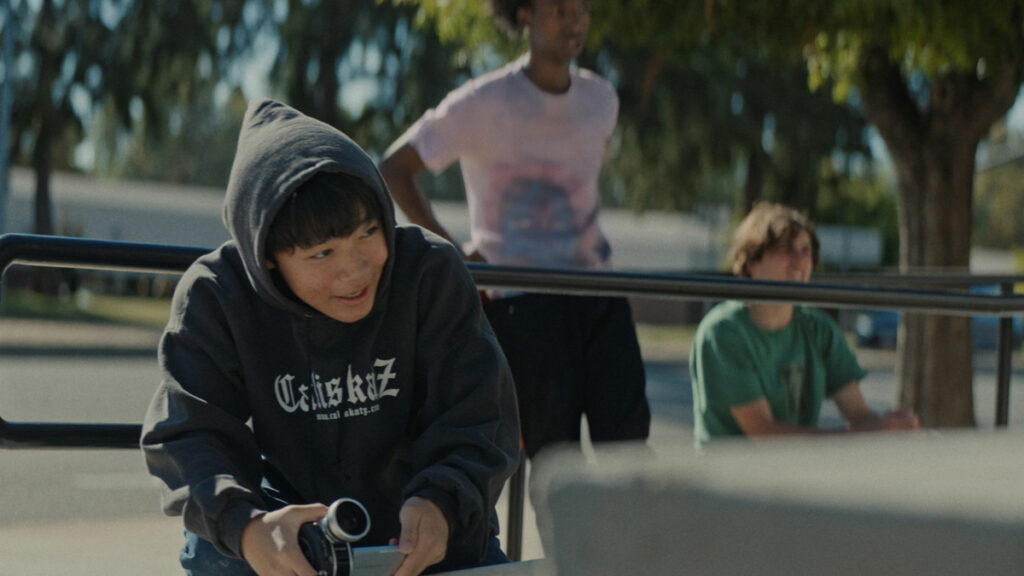
Asian teenage boy outside with friends holding a video camera and smiling.
Izaac Wang stars as ‘Chris Wang’ in writer/director Sean Wang’s DÌDI, a Focus Features release. Focus Features / Talking Fish Pictures LLC

A detour that wasn’t really a detour

[My work at] Google kind of came out of nowhere, in a way. They have a one-year residency program called Creative Lab Five.

[Google] came to the USC career fair, where I was going to school. I knew a little bit about [the program] because of this filmmaker Aneesh Chaganty, who also worked at Google. He left because he sold a pitch for his first feature film, Searching, which takes place entirely on screens. I asked him about the Google thing, and he was like, “If you can get it, you should do it because worst-case scenario is [still] pretty good.” You move to New York and get paid to be a filmmaker and make stuff that the world gets to see and you’re 22 years old. He’s become a great friend and mentor figure.

I applied and the Google team saw this random travel video I had made of 10 days I spent in Taiwan, and they were drawn to that. I interviewed over a couple of months, got the job, and I moved from LA to New York.

All the early Google commercials they made—it wasn’t like selling toothpaste. It was very storytelling-driven. It was taking a very human story but telling it in a way that was different and unconventional at the time, and that was interesting to me. It felt like a unique opportunity that, at the time, felt like a detour. But I was like—this one-year detour of working in New York at Google is not the worst detour. But it ended up not being a detour. It ended up being the bedrock of everything I’ve built since then. It was supposed to be a one-year job. I ended up staying in New York for on and off six years.

From a more holistic perspective, everyone I worked with kind of came from the agency world like 72andSunny, Wieden & Kennedy, and Droga 5. Those were all my bosses, and they made a lot of the seminal ads that I grew up seeing and that I thought [to myself] “Oh, there’s something you can do—interesting things in the advertising space.” A lot of the people who worked on those ads that shaped me were my creative directors and my bosses, so I got to learn directly from them and pick their brains.

It was my first job out of college. So, I learned a lot about how to be an adult there and navigate a professional workplace. But I also learned from a technical level—a lot of the screen stuff that I ended up implementing into DiDi like how to tell a story via screens, how to take these cold interfaces and infuse them with humanity and emotion, what different buttons mean when you put them in the right context.

The internet—a little mundane and extremely emotional

I wanted to portray [the internet] in a way that felt honest to how I remember using the internet, and how I think people use the internet even today.

There’s a lot of emotion to mine through a screen and all these interfaces that we use every day. I wanted to revisit this period that I felt hadn’t been captured accurately in movies because we never knew as filmmakers how to integrate our screens into like stories until the technology completely changed.

And so, it felt like a unique opportunity to try to showcase the internet in a way that was how this kid would have used it. It’s him sitting in front of his computer typing and [it’s] kind of boring. You can hear him breathe. It’s a little mundane and extremely emotional. Friendships are being forged and broken. You’re talking to your crush and it can feel very high stakes. But you zoom out and what is the actual action? He’s sitting at his computer screen hunched over. If you put the camera on the screen where all the action is taking place, then it becomes its canvas. I wanted to put the camera on the computer and make that all come to life and it feel just as human and emotional as an incredible performance on an actor’s face.

The biggest difference is back then, you could sign off of the internet and then go live your life. You didn’t have gnawing anxiety of “Is anybody talking to me? Is anybody liking my photos? Is anybody paying attention to me?” You were not on the internet. But now your internet is just always on. It’s in your pocket. If you are not on Instagram, it’s still there. People can message you, people can like your stuff, and people can comment on it. So, you’re never really offline. You’re chronically online. That is the shift that has happened for a decade and a half.

https://www.adweek.com/creativity/how-sean-wang-used-his-google-experience-to-revive-early-internet-in-didi/


Tech for Good: Using AI to Relieve Chief Household Officers’ Cognitive Load


.article-native-ad { border-bottom: 1px solid #ddd; margin: 0 45px; padding-bottom: 20px; margin-bottom: 20px; } .article-native-ad svg { color: #ddd; font-size: 34px; margin-top: 10px; } .article-native-ad p { line-height:1.5; padding:0!important; padding-left: 10px!important; } .article-native-ad strong { font-weight:500; color:rgb(46,179,178); }

Join the experts at Mediaweek, October 29-30 in New York City. Stay ahead of the shifts impacting the media landscape and gain fresh strategies to drive platform growth. Save 20% on passes.

In today’s workforce, there is a divisiveness around whether AI will benefit or harm jobs. Will it improve productivity? Or will it replace human beings?

What if it did both? And for the greater good?

Enter Sheila Lirio Marcelo. In 2006, Marcelo founded Care.com, an online platform that helps families find care for children, senior family members and more. The entrepreneur is coming through again, leveraging generative AI for families in need of caregiving assistance.

Ohai.ai, a human assistant app, is designed to reduce the cognitive load for the “chief household officer,” who is tasked with coordinating everyday life. The premise of the app was designed with multiple family constructs in mind—nuclear families, divorced families, and even families without children but in need of assistance to juggle it all.

Marcelo sat down with ADWEEK to share more about the inspiration that led her to start Care, the “social responsibilities” of a marketer, and the why behind Ohai’s mission to help solve today’s mental overload with a personal assistant accessible to all.

Her words have been edited for length and clarity.

The chief household officer

[My husband and I] were both raised Filipino. My husband was raised by a single mom, so he saw the strength of a working mom as a role model. My parents were equal partners as entrepreneurs—the Philippines has one of the narrowest gender gaps and has a lot of female leaders. I think that had a lot to do with our belief in equal partnership.

But we definitely felt the pressure around planning play dates. For example, he would often say, “Maybe you should call the other mom to plan the play date instead of me” because of stereotypes and expectations back then.

He and I shared [duties] in our early days caregiving for our kids that allowed me more space to care for my parents, and then as I progressed and started Care.com. We built it together, but then he took a primary role for the caregiving of our kids as they got older. We’ve always had an incredible partnership around that. I came to be the breadwinner eventually, but the family organizer for both of us. This is why I call [the role] the “chief household officer.” I may not necessarily be doing all the tasks, but I was the primary coordinator of the things that needed to be accomplished in our household.

Oxfam put out a report that women still spend, on average, 4.5 hours of unpaid labor at home, while men spend 2.8 hours. So there’s still a delta, and it’s a challenge.

The construct of families continues to evolve, and people play different roles now. But what hasn’t changed is that every family has a chief household officer, and there is someone stressing about the coordination [and] the burden of everyday life. That is a lot. There’s app overload, activity overload, people coordination overload because it takes a village to raise a family. So, there’s still a major gap, whatever the construct, and that’s really who we’re serving at the end of the day: someone who is juggling everyday life coordination with their household, or for a broader household and multiple people.

Families are asking for [help]. They’ve got to coordinate, and here’s something very useful that creates peace of mind for families that have to just administratively coordinate things without getting emotional between two households that may be co-parenting [but perhaps] not in the smoothest relationship. O (the name of the virtual assistant) can facilitate what needs to happen in between.

Mantras of an entrepreneur

One of my mantras is “authentic boldness.” As an entrepreneur, you’ll never answer the question of fulfilling your vision or dream unless you take the plunge. And certainly, you have to have that DNA. But the second thing is, I tend to ground myself in data. So yes, I’m taking the plunge, but with a thesis in mind.

We always have a thesis. It was very similar to Care.com—when we first launched, we never envisioned that we were going to launch housekeeping within the first year of Care. But because the users were really asking for it, we launched it pretty early. We had again, our thesis, and our thesis also for Care.com was that senior care was going to be in demand right away. We were proven wrong— it took 10 years for that to really take off.

What we’ve learned now is really to listen to users and focus. What’s beautiful about building a service and a product of a personal assistant using generative AI is you can get to the data of what families need and what they’re looking for.

Using tech for good

Behind every tech are human beings. 90% of the tasks completed right now on Ohai are [done by] AI, but we have human assistants behind the scenes to ensure a great user experience. And then we have the AI sometimes shadow the human assistants as they’re training the AI to complete a task. But then again, that’s also just 10% of the time.

So, we are really AI-native tech first. But we always believe that the human assistants have a very important role to play: to ensure there’s a great user experience. It allows us to focus and listen in on the users as we continue to leverage the AI for efficiency, get things done, free up time and, again, reduce the cognitive load.

Reducing the cognitive load and stress gives [consumers] more choices to pursue things. This will help the economy by really unleashing productivity—not necessarily to do more, but to be smarter in what people do.

And the thing about Care is it touched so many lives and it was in so many homes. The total addressable market of Ohai is actually larger because for Care; not everybody outsources care, [but] every home has to coordinate everyday life.

The social responsibility of a marketer

It’s super important to me as a leader in tech that we build a two-sided marketplace. We were trying to make sure that there was efficiency for families to get access to care, but we also thought ahead for what was important for caregivers.

We were one of the first platforms that was going to be the largest around the gig economy, and we knew that. So, getting [employees] access to health care, Social Security, and being properly paid, and making sure that every job wasn’t below minimum wage on Care.com. We always thought ahead about our social responsibility.

For Ohai, the big advocacy is to ensure that everyone has access to AI. It’s accessible. It is a price point that allows people to have a personal assistant. Many people have never had an assistant at any level at a company, other than executives.

Growth without equality is not real growth, because embedded in marketing is also a message for social good, and that’s where equality comes in for me. We have a social responsibility around that. And so, it’s two-pronged. It’s a fun job. It’s a big job, but it’s also a big responsibility. I’ve been a marketer. I’ve grown consumer brands. Part of that means there’s a responsibility to ensure that there’s equal access to opportunities of advancing economic benefits for all.

https://www.adweek.com/media/ohai-ai-personal-assistant-chief-household-officer/


GARM’s Shutdown Is an Opportunity to Finally Get Brand Safety Right


.article-native-ad { border-bottom: 1px solid #ddd; margin: 0 45px; padding-bottom: 20px; margin-bottom: 20px; } .article-native-ad svg { color: #ddd; font-size: 34px; margin-top: 10px; } .article-native-ad p { line-height:1.5; padding:0!important; padding-left: 10px!important; } .article-native-ad strong { font-weight:500; color:rgb(46,179,178); }

With C-suite leaders from iconic brands keynoting sessions, leading workshops and attending networking events, Brandweek is the place to be for marketing innovation and problem-solving. Register to attend September 23–26 in Phoenix, Arizona.

It’s been a strange few days for brand safety, from the initial news of Elon Musk’s X lawsuit against the Global Alliance for Responsible Media to the shock that GARM would be shutting down.

What’s surprising is not the fact that it had happened—as a podcast advertising leader, I’ve seen firsthand how the org’s approach to brand safety has served neither advertisers, publishers, creators, nor the medium itself. However, as much as the ad industry needs to find a new path forward, I never expected the collapse to happen so suddenly, or for the reasons stated in the press.

After years of being the default authority for brand safety online, GARM had recently been criticized by right-wing groups for supposedly silencing conservative voices. While I’ve been vocal that GARM is an imperfect mechanism for promoting brand safety, the arguments that conservative groups are making don’t add up.

The GARM framework failed consistently in application, with brand safety tools like Barometer and Sounder producing outputs that were destructive for content on all sides of the political spectrum. This led to shows on the left and right being inappropriately graded, costing both sides vital advertising dollars.

The sad truth is that GARM’s shutdown is the right thing, but possibly not for the right reasons. However, it does present an opportunity to build a new approach to brand safety. First, though, we need to truly understand the nature of GARM’s shortcomings, divorced from the political spectacle surrounding it.

Why everyone loses

Despite the protestations of some conservatives, I trust the intentions of the World Federation of Advertisers (WFA) and the individuals who worked on GARM.

It’s not that its standards are somehow biased, but they are so impractical that they hurt everyone—right, left, and center. Too often, GARM asked the wrong questions, monitoring highly nuanced concepts that are easily misunderstood even with advancements in AI.

Then, their unreliable data is treated as fact without anyone looking under the hood to see if the outputs work. For example, if you use any of the major brand safety measurement tools and compare a podcast’s rating to the transcripts that informed that rating, you’ll see how the GARM system was error-prone.

At the heart of GARM’s brand safety failures is the rise of negative partisanship. The polarization of online discourse is a broad issue, with cultural drivers that are hard to define via contextless keyword automation. GARM’s attempts to use this method have only complicated the issue.

GARM’s framework penalizes content that tackles subjects that would normally be non-issues for most ad placement, including terrorism, spam, and online piracy. And when they address polarization more definitively by tracking relevant metrics like “debated sensitive social issues,” the available market solutions still rely on keyword detection for potentially controversial topics (e.g. Biden, Israel), slapping highly relevant and responsibly produced news items with labels like Medium Risk or High Risk, regardless of how carefully those topics were discussed.

GARM indeed has some roots in politics as a byproduct of Donald Trump’s political success, as well as subsequent claims of misinformation and disinformation. But now, those same accusations are levied against both liberals and conservatives, muddying the waters. GARM tried to address misinformation in their framework but then realized it is not something that any person, organization or tech can do in a way that would be acceptable to a broad group of people.

Ultimately, for marketers who don’t want to get caught in the middle of the culture wars, the choice becomes simple. It’s easier to not advertise on any show or platform that could be unsafe, rather than to risk being the next Harry’s Razors, accused of supporting harmful ideas or political favoritism.

But this hurts the entire market, regardless of political affiliation.

Finding civility

GARM’s thesis began as a positive step in applying nutrition labels to media, a standard the industry still desperately requires. It just needs a different approach.

No one cares about differing opinions when it comes to brand safety. But when personal attacks get involved, brands get caught in the middle. This is where future brand safety efforts should focus—trading measurement of contextless keywords for measurement of these types of ad hominem attacks that degrade civility.

If we can measure personal attacks and make brands aware of the civility levels in environments where their ads may appear, we can rise above accusations of political bias and promote a healthier online discourse while creating a safer, more reliable way for brands to share their messages.

https://www.adweek.com/media/garm-shutdown-brand-safety-right/


The Olympic-sized Consumer Behavioral Shift We Should Talk About


.article-native-ad { border-bottom: 1px solid #ddd; margin: 0 45px; padding-bottom: 20px; margin-bottom: 20px; } .article-native-ad svg { color: #ddd; font-size: 34px; margin-top: 10px; } .article-native-ad p { line-height:1.5; padding:0!important; padding-left: 10px!important; } .article-native-ad strong { font-weight:500; color:rgb(46,179,178); }

With C-suite leaders from iconic brands keynoting sessions, leading workshops and attending networking events, Brandweek is the place to be for marketing innovation and problem-solving. Register to attend September 23–26 in Phoenix, Arizona.

Every Olympic season is a chance to get obsessed with some sport you just learned about, cry over an athlete from a place you didn’t know about winning gold, and generally get worked up at a perfect Simone Biles floor routine. It wasn’t long ago (circa 2010s) when the Olympics meant catching the games at odd hours or watching replays during primetime. While I certainly did my part this year to binge all things Team USA, I couldn’t help but notice the difference in experiences this year.

Conversations between friends and coworkers watching different things at different times shifted from “Are you seeing this?” to “Oh, you have to go watch it, I’ll send a TikTok.” What were once key moments of a shared collective experience, have splintered.

Welcome to the era of solo streaming. As an introvert, I’m fine with this (just kidding). Let’s break down this Olympic-sized behavioral shift and what it means.

RIP to the collective experience of live TV

When people watch sports together, they report a higher rate of fulfillment. It turns out that cheering together helps create a shared identity within a community. The Olympics is the pinnacle of this, a rare time when an entire nation can tap into this kind of shared experience. Then came new viewing options that irrevocably altered behaviors.

This year, Peacock became the definitive hub for complete Olympic coverage, a significant evolution since its attempt at a start when launching in time for the postponed 2021 Olympics. Every event is now available at our convenience in replay and as-it-happens. Watch what you want, when you want. The flexibility is undoubtedly convenient—while coming at the cost of fracturing the sense of collective experience into isolated moments.

Social media crumbs

Adding to this fragmentation are our favorite platforms like TikTok and Instagram. They flood our feeds with the highlights almost instantly, often before events are even aired traditionally or across non-Peacock services. Because of these platforms’ distaste for chronological order, we’d encounter clips out of order, disrupting a sense of real-time, joint viewing, and they often spoiled the results.

Shrinking the gap between event time and online conversation

The gap between a live global event like the Olympics and online conversation has become a crucial metric in understanding modern viewing behaviors. What was typically a chill day-long lag (Olympic location dependent) has compressed into mere minutes. The conversation starts almost immediately, even peaking before an event has finished airing in some time zones. The rapid dissemination of information feeds into a fragmentation of the viewing experience dilutes any sense of collective engagement.

What these shifts are telling us

This isn’t just about the Olympics or viewership rates. It is about loneliness and acknowledging the facilitators of community slipping away. In our drive for individualism, we are seeing a rise in people eager to find their place as part of a collective whole.

For brands and marketers, it means strategies that require innovative approaches to creating engaging, real-time interactions—here are a few examples.

Remember, it’s an ecosystem. There is a real creative opportunity for platforms and media to partner on the future of dual-screen watching. Consider how the live feed functionality of social apps can be leveraged by layering in things like live reactions, games, and more for shared moments and branded content.

Go beyond the comments. NBC and Peacock were able to create an interactive homebase on TikTok to curate those social crumbs and gather higher rates of impressions and engagements. Continue to think about how to pull consumers together as a collective beyond what happens in the comments section.

Become the facilitators of online communities. Dig into the storylines that resonate with different segments, ask why, and inquire about the conversations they will have following their events. Actively listen and encourage their ongoing support, interests, and more.

Oh and, yes, sports is still a smart investment. Despite behavior shifts, live sports remain one of the last bastions of collective experiences, allowing individualized yet collective communities to unite. Hook ‘em horns.

https://www.adweek.com/media/the-olympic-sized-consumer-behavioral-shift-we-should-talk-about/


Netflix House Is Built on Brand Innovation and Cultural Cachet


.article-native-ad { border-bottom: 1px solid #ddd; margin: 0 45px; padding-bottom: 20px; margin-bottom: 20px; } .article-native-ad svg { color: #ddd; font-size: 34px; margin-top: 10px; } .article-native-ad p { line-height:1.5; padding:0!important; padding-left: 10px!important; } .article-native-ad strong { font-weight:500; color:rgb(46,179,178); }

With C-suite leaders from iconic brands keynoting sessions, leading workshops and attending networking events, Brandweek is the place to be for marketing innovation and problem-solving. Register to attend September 23–26 in Phoenix, Arizona.

Since its inception, Netflix has been a challenger brand. A born innovator, creating beyond convention.

Equal parts cultural capital, content development, and category expansion, Netflix sets itself apart as a brand keenly aware of its value proposition. While its actual product may be streaming, its core product is entertainment. What happens off the screen is just as important as what happens on the screen; the brand is meeting people where they are by bringing fans closer to the characters and worlds they love is always at the top of the queue.

From comedy festivals to retail pop-ups, Netflix has spent years cultivating the right mix of brand extensions. Next up? Netflix House. It’s 100,000 square feet of your favorite shows and movies brought to life through immersive and interactive experiences, dining, and merchandise, making it the ultimate fan haven.

Netflix is about to give an entirely new set of competitors in the themed entertainment space a run for their money. It’s a brand-building combination of a flywheel strategy, innovation, and a different lens on competition. Netflix House is more than a marketing move—it’s a strategic investment that gives a clear picture of the blueprint for brand growth: knowing who you’re building for, what you’re building toward, and the competition you’re up against.

Putting consumers and culture at the forefront

If content is king, then culture is its kingdom. Accelerating the flywheel only happens if the kingdom’s infrastructure is built on a rich offscreen ecosystem. Every touchpoint designed to attract, engage, and delight the audience needs to answer these questions: How does this fuel fandom? And how can it deliver in a way that’s unique to Netflix?

Netflix has focused its growth on experiential as the most immersive way for fans to enjoy entertainment as a participant, not a viewer. Until now, fans’ experiences have been successful, but ephemeral. But Netflix House, a permanent installation with rotating experiences, is a destination designed to hold literal space for fans year-round, with on-demand access to dive into the stories they love.

The House is built on a strong foundation of covetable content and cultural cachet. Netflix’s unique place in culture gives it a white space canvas that most brands dream of. It can seamlessly navigate its place in the zeitgeist because it’s not just a part of culture—it’s shaping pieces of it. When The Queen’s Gambit debuted in 2021, orders for chess sets spiked 87%, while sales of chess books went up 603%, per research firm Circana.

The Netflix effect is real. It may be a bit of magic, but it’s mostly strategic rigor. Its fan-centricity and culture-first design means that as audience satisfaction grows, so too does engagement. Additionally, more opportunities arise to expand into new realms and satisfy demand.

Innovation as a practice

Netflix House provides a new opportunity to expand and evolve its entertainment footprint across an out-of-category enterprise. While it’s the first permanent physical experience for the brand, it’s built on years of experimentation. As Netflix CMO Marian Lee said, “We’ve launched more than 50 experiences in 25 cities, and Netflix House represents the next generation of our distinctive offerings. The venues will bring our beloved stories to life in new, ever-changing, and unexpected ways.”

Netflix House will build from and be influenced by learnings from successful predecessors like dining pop-up Netflix Bites, The Bridgerton Ball, and the Squid Games obstacle course. It’s the poster child for innovation; it’s growth by way of testing, inspiration, and iteration.

If you know what you’re building toward, who you’re building for, and what it’s in service of achieving, the patience around progress becomes more palatable. Netflix takes big swings, but it doesn’t swing for the fences on the first at-bat. The brand is methodical and knows that you can’t get to a big win without taking a few losses along the way.

Competition is different when you’re running your own race

For the better part of a decade, we’ve watched streamers go head-to-head. The race to more subscribers runs on a crowded track with premium original content, live sports, and syndicated favorites shoulder to shoulder. Netflix’s competitive advantage is seeing beyond the race of just gaining subscribers; it’s competing in races beyond its industry altogether to become a beloved entertainment brand.

But what of the KPIs? The industry competition? Running your own race doesn’t mean you’re not steadfast in hitting the same performance metrics as the brand in the next lane. It means that there is only one form of competition you’re looking to outpace.

Not quite a theme park but more than a pop-up, this lower-cost option to traditional theme parks will challenge new competition and signal that Netflix’s growth goes far beyond the content pipeline to build more brand equity and affinity with fans.

Netflix leads because it doesn’t follow. It’s focused on growth that is brand-right, audience-right, business-forward, and has yet to be realized by industry competitors because it’s myopically driven to be a category winner.

The bigger brand picture

The House of Netflix is always in build mode. Netflix House’s first two locations in King of Prussia, Penn., and Galleria in Dallas, Texas—set to open in 2025—are just the beginning of what could become a themed experience empire.

For brands seeking differentiation in contracting and saturated industries, Netflix’s approach shows how playing to strengths is the ultimate competitive advantage, innovating is as much about the process as the output, and growing beyond your category is an exercise in getting closer to the consumer and culture.

It means Netflix:

  • Treats its audience as fans
  • Creates with culture at the core
  • Knows who it’s competing against and what it’s competing for
  • Tests and learns to iterate toward a bigger vision
  • Builds beyond its category not as an option, but as an imperative
  • Looks at a strong brand as a catalyst for growth

Netflix’s ability to determine right-fit brand expansion comes from understanding its audience, having a clear vision for its brand, and identifying untapped market opportunities that give it room to grow. Next in the queue? We’ll have to tune in to find out.

https://www.adweek.com/convergent-tv/netflix-house-is-built-on-brand-innovation/