No More Networks and Streamers. In 2024, There’s Only CTV


.article-native-ad { border-bottom: 1px solid #ddd; margin: 0 45px; padding-bottom: 20px; margin-bottom: 20px; } .article-native-ad svg { color: #ddd; font-size: 34px; margin-top: 10px; } .article-native-ad p { line-height:1.5; padding:0!important; padding-left: 10px!important; } .article-native-ad strong { font-weight:500; color:rgb(46,179,178); }

Mark your calendar for Mediaweek, October 29-30 in New York City. We’ll unpack the biggest shifts shaping the future of media—from tv to retail media to tech—and how marketers can prep to stay ahead. Register with early-bird rates before sale ends!

At this year’s TV upfronts, one of the leading players in streaming opened its event with a video set inside its app’s instantly recognizable user interface. One after another, familiar TV characters and talent appeared on screen to flex an impressive catalog of IP across comedies, dramas, theatrical film, news, reality and live sports.

But it wasn’t Amazon, Netflix or YouTube showing off the power of their streaming TV apps—although they shared plenty of exciting content throughout the week. It was Disney, the 100-year-old media giant, putting Hulu at the top of its show, ahead of its extensive collection of successful networks.

And Disney wasn’t the only traditional “network” that prioritized its streaming offerings. Warner Bros. Discovery led with Max during its presentation, NBCUniversal hyped its Peacock originals, Fox made sure attendees knew about the youthful audience assembling on Tubi, and TelevisaUnivision touted 50 million monthly users on its ViX platform.

Just as telling, many of these companies focused almost as much on their tech and data offerings as their upcoming content slates.

As for the so-called “streamers”? They took steps to be more like the networks, announcing more live, ad-supported, mass audience programming—like sports, comedy specials and news—that have long been the bread and butter of traditional TV. And like their network rivals, these companies dialed up the glitz and the glam for their upfronts, trotting out big-time celebrities like Will Ferrell, Cameron Diaz and Billie Eilish.

This year’s upfronts have made clear that the years-long convergence of streaming and linear TV has reached a tipping point. While each presenter had its strengths and weaknesses, rooted partially in how they rose to power, they’re all playing the same game these days. In short, there is no longer a useful distinction between a “streamer” and a “network”—they’re all “convergent TV companies” now.

CTV companies address weaknesses by copying each other’s strengths

This year, upfront presenters addressed their historical weaknesses by bulking up on their competitors’ historical strengths.

For instance, legacy media powerhouse NBCUniversal touted the impact of its technology investments with a presentation on how its One Platform Total Audience helps advertisers engage audiences across screens and measure the actions consumers take after seeing these cross-platform campaigns. TelevisaUnivision also highlighted its growing capabilities in the world of outcomes measurement.

And perhaps nothing highlighted the ascendance of the CTV era better than when WBD chief ad sales officer Jon Steinlauf presented the company’s new data-driven video product. “You don’t have to worry about finding cord-cutters, cord-nevers or overexposure to heavy TV viewers,” he said. “You define your audience one time, and then we find them.”

For their part, the companies that built their businesses on streaming and technology worked hard to prove to advertisers that they have engaging live content that keeps viewers glued to the screen during ad breaks.

Related video

Most notably, we are entering a new phase in the shift of live sports to streaming; to use the popular “crawl, walk, run” metaphor, the companies that began as tech platforms are now entering a light jog when it comes to sports programming.

The NFL’s Christmas Day games are coming to Netflix. Amazon added a playoff game and the second inaugural Black Friday game to its Thursday Night Football slate. And YouTube is complementing its NFL Sunday Ticket package with a new deal to carry local games from the ascendant WNBA.

Already, serious sports fans need at least one or two streaming platforms to follow their favorite teams. Sure, there’s always the option to watch the game at your local watering hole. But we’re reaching a point of critical mass where it makes more sense to sign up for a monthly subscription than to keep shelling out for wings and beer. That’s certainly the logic behind the newly named Venu Sports, a joint venture between Disney, Fox and WBD.

A CTV strategy for a CTV world

From an advertiser and agency perspective, this CTV tipping point means there is no longer utility in thinking about a “linear buy” and a “streaming buy.” Many already have unified video teams, but it’s easier to retool org charts than it is to truly unify strategies, workflows and datasets.

Since so many viewers are consuming content across screens and platforms, advertisers must build truly convergent media buying operations, executing a unified plan across all the different places modern viewers watch TV. While the complexity of this task might tempt some to over-invest in automated audience-based buying (aka programmatic), it’s crucial to remember that reaching the right consumers is only one part of the battle. To generate real business results, marketers need to serve the right creative to the right audience alongside engaging, contextually relevant content.

Indeed, we’ve all heard about the studies detailing how creative contributes to roughly half of a campaign’s performance. And I regularly see examples of clients’ creatives that generate 40-60% more engagement when placed in the right media audience context.

Regardless of where you’re executing or who is your target audience, there is truly no one-size-fits-all solution. Rather, CTV offers nearly infinite permutations of creative-media-audience opportunities for marketers to explore. So go ahead and dream big. Start thinking of how this vast landscape of options can help you get inside and in front of highly engaging content relevant to your target customers and the shows they love best.

Our CTV future has finally and fully arrived. It’s time for all of us to start living in it.

https://www.adweek.com/convergent-tv/upfront-2024-networks-streamers-ctv/



We Need an Open Web Identity Solution to Combat the Opacity of Walled Gardens


“Market dislocation”—though a term most often reserved for economists and Wall Street analysts, it could aptly describe the state of online identity today. 

Recent reports suggest that Apple and Google are considering removing the IP address from their respective devices’ and platforms’ reporting. This move, which also nods to regulators and privacy advocates, comes on top of removing third-party cookies and possibly preventing the use of precise location identifiers. 

In an otherwise poorly articulated reaction to the threat of online tracking, regulators have leaned into legislative actions against one form of identity after another, while market participants, from adtech providers to top brands, lead with privacy and seek to replace the market efficiency that is likely to be lost. But markets are designed to seek efficiency; when programmatic advertising was introduced, it was in response to advertisers seeking to reach the right person at the right time. This, coupled with measurement, introduced efficiency that would dramatically accelerate online advertising, online shopping, startups and small to medium-sized businesses to new heights. 

With the deprecation of cookies, the open internet ecosystem is already beginning to fracture day by day. Major, and now minor, walled gardens are proliferating to protect their businesses’ most valued asset—their claim on first-party data. Perhaps this trend is just “business Darwinism,” evidence that adtech has matured, but there are real risks to be considered. 

Initially, the third-party cookie provided an audit trail for advertisers, and device identifiers filled gaps, as did the IP address, especially as the market shifted from browsers to connected TVs. Brands leveraged programmatic and came to depend upon a formula where objective evidence of their return on media investment could be provided. This has been especially true for emerging and small businesses; programmatic advertising has fueled the long tail of commerce, allowing competition for mind share to occur across the entire economy.

What if that objective evidence was no longer available? And what if the cookie, device and IP were not the problem? 

Reinventing the concept of identity 

Rather than cleansing advertising of the identifiers that fuel qualified audience outreach and campaign measurement, what if all identifiers were managed in a secure environment and required authorized consent? As a practical matter, this may already be happening.

Some brands have leaned into universal IDs and clean rooms; adtech titans now hide their identifiers behind walled gardens; identity solution providers and media platforms have moved to privatize with a closed system of hashed email IDs. In the name of privacy, we increasingly operate in black boxes and bundle our solutions with an agenda of protecting our own business models.

A first-party-centric marketplace will undoubtedly elevate the performance of those with the data, but there is a real danger that it will come at the expense of consumer choice and open markets. What we should not be doing is embracing a protectionist model that eliminates access to all third-party consumers and skews or removes consumer choice. If new brands and businesses can’t transparently identify prospects or prove that their investments are working, they will stop investing and may never even get started.

Related video

Don’t get me wrong. This is not (yet another) plea for free third-party cookies. Our industry should be giving a uniform thumbs-up to data security, clean rooms, and the requirement to protect sensitive data. We should also endorse the use of public data and require consent. We should not abandon, but rather secure, our current identity framework by providing advertisers and consumers with a proper audit trail for the use of IDs.

An identity space that requires both an ID plus a timestamp for onboarding and media activation—secured through an opt-in process and coming with a systemic, assigned expiration date—would dramatically reduce the ability to reuse or abuse identity.

One inherent advantage of an IP address is that it is time-sensitive, systemically protecting users from unauthorized resale and abuse. On April 1, an IP-to-household assignment has a 40% chance of being unusable by May 1st and a near 100% chance of being unusable by June 1st. An IP address is also included and works in parallel with nearly all other forms of ID sharing—devices, emails and media platform IDs—making it fluid and ubiquitous. If an audience is opted-in, then syncing that secure audience with the media exposure by IP promotes full measurement of cross-platform campaign performance with 100% coverage—but only for that specific campaign and application.

So what if IP usage in the adtech ecosystem was encoded and included a “watermark” of a timestamp and the brand or data provider? An actual OpenID that is unusable except for the permissible purpose of a campaign would be better for the industry, the economy and consumer privacy. 

While the fluidity of IP assignments makes it a poor choice as a permanent ID alternative, it also offers the potential to rationalize the pursuit of privacy in the identity space. An IP with a timestamp is potentially the best choice for the open internet, providing secure, verified reach and measurement that is also in the best interests of the advertiser and the consumer at this moment in time. 

https://www.adweek.com/programmatic/we-need-an-open-web-identity-solution-to-combat-the-opacity-of-walled-gardens/


Consumer Brands Are Leaving Trillions of Dollars Behind by Ignoring Women Over 40


.article-native-ad { border-bottom: 1px solid #ddd; margin: 0 45px; padding-bottom: 20px; margin-bottom: 20px; } .article-native-ad svg { color: #ddd; font-size: 34px; margin-top: 10px; } .article-native-ad p { line-height:1.5; padding:0!important; padding-left: 10px!important; } .article-native-ad strong { font-weight:500; color:rgb(46,179,178); }

Introducing the Adweek Podcast Network. Access infinite inspiration in your pocket on everything from career advice and creativity to metaverse marketing and more. Browse all podcasts.

In 2021, when I was 37, I became a first-time car owner, first-time homeowner and first-time parent within a three-month span. After nearly two decades spent living in wildly expensive cities and focusing on my education and career, a global pandemic ushered in the rise of remote work and allowed me to move out of New York City while keeping a job in media. Under these new circumstances, I—and many people in my peer set—finally found myself with the time, resources and appetite to enter the life stages that my parents’ generation entered a decade younger. 

As I met these milestones, I was struck by how much there was to buy to support this drastic lifestyle shift. After relying on public transportation to get around since I was 17, what type of car would I purchase, and who would insure it? After 20 years of only looking as far ahead as each 12-month lease, what kind of home would I buy, and where? What real estate agency would assist me? What bank would handle the loan? Where would I go for renovations, furnishings and upkeep? And in the transition from a “double income, no kids” household to a family of three, the spending opportunities were endless—from prenatal vitamins and maternity clothes to nursery fixtures, kids’ clothes and college funds. And that was before I hit a spendy, post-partum self-image reckoning, with its accompanying skin care, wardrobe, health tech and fitness expenses. 

All of that spending should have been easy. Because I was not in my twenties, with its professional and financial precarity, and instead in my late 30s—15 years into a stable career and well-compensated—I had real money to spend in all these new categories. But as I went to choose a car, furnish a home and prepare for a baby with that cash burning a hole in my pocket (metaphorically speaking—I don’t carry cash, I’m not that old), I realized all the brands that should have been competing for my dollars didn’t seem to care all that much about winning my business.

Working in media, I know that the demographics of a publication’s audience are an incredibly important consideration when wooing advertisers to spend their marketing budgets with you. Media execs are incentivized to pursue a younger generation of users, trying to bolster the percentage of 18- to 34-year-olds in their audience so advertising partners know they’ve captured the trendsetters that marketers are so eager to get their products in front of. Older audiences are thought to be less influential and more set in their ways, not as susceptible to building affinities for or joining fandoms around new products. The (false) thinking goes that these consumers don’t have as much sway over others’ purchasing decisions as 20-somethings do and that they already know what product they’re going to buy and what brand they’re going to buy it from now until the end of time, goodbye.

When you turn 40 (which I recently did), you fall off of marketers’ radars and media plans entirely, into an abyss of invisibility—at least until it’s time to sell you Prevagen.

But what if brands rethought their approach (or lack of approach) to these audiences? What if they examined the fallacy that elder millennial and Gen X women have limited influence, unremarkable spending power, and entrenched brand preferences and, therefore, are no longer worth marketing to—and instead realized that we are among the most valuable audiences out there? These women are entering key spending categories later in life. They are extremely influential culturally and financially, and they are largely ignored by marketers—leaving a huge opportunity for the consumer brands that are smart enough to pay attention to them. 

While the way college-educated knowledge workers like myself reacted to Covid-19 reshaped the housing market and created a subtle baby boom, the trend of meeting life stages later is detached from, and predates, these pandemic shifts. In 1980, the average woman married at 22; today, it’s 28, and the midlife first marriage rate among women has increased by 75% since 1990. In 1980, the median first-time homeowner was 29; now they are 35. In the last 30 years, birthrates among women in their 20s have declined, while they’ve risen for women in their late 30s and early 40s—a trend that is especially prevalent among college-educated, city-dwelling women with high household incomes. The idea that you have to reach women in their 20s in order to capture their entry into new life stages—and therefore their influence in new spending categories—is a dated one. 

Related video

Three of 2023’s most economically powerful people (Beyoncé, Kim Kardashian and Greta Gerwig) are women in their 40s, and Taylor Swift will age out of that coveted 18-34 demo this year—and their power is echoed by this demographic as a whole. When elder millennial and midlife women are ready to spend—whether on entertainment, tech, beauty, travel, groceries, auto or in areas like early parenthood that used to only be the province of younger women—they show up with influence and money. Women drive 70-80% of all consumer purchasing, either through buying power or influence, and women older than 50 drive $15 trillion in spending power—which is 27% of all consumer spending in the U.S. By 2030, women are expected to control much of the $30 trillion in wealth that is soon to transfer from baby boomers to younger generations—namely millennials, who will all be in their mid-30s to late-40s by then.

Despite this current and future financial power, most marketers are ignoring this demographic, and people like me are taking notice. Most women in this demo think consumer brands underestimate their spending power and intellect, and only 5-10% of marketing budgets are earmarked for an over-50 audience. Imagine the opportunity for brands that recognize and respect the power of these audiences and decide to enter this vacuum by marketing to us directly. 

That includes earmarking bigger budgets to put ads in front of these audiences, but that’s not the only way to speak to this demo. Brands must make us feel more represented and supported in their creative campaigns and brand initiatives as well. When more than 90% of people over 40 can’t remember a brand using someone their age in marketing campaigns, casting midlife women can go a long way with customers (see: Bobbi Brown’s Jones Road Beauty). When three-quarters of millennial women say they want brands to speak about current realities with honesty and candor, those that avoid stereotypes and tropes by centering real customer voices and experiences will build trust and affinity (see: Dove’s beloved Real Beauty campaign). When the vast majority of millennial women believe that brands should actively make people’s lives better and hope to see brands advocate for policies that advance women’s rights, marketers should consider what advocacy campaigns align with both their brand value proposition and the pain points of the audience they wish to reach. (See: Bobbie’s Paid Leave For All partnership).

Initiatives designed to capture these audiences pay off. GM focuses on speaking to women’s concerns about car safety, and they’ve built a robust network of female car dealers. Buick has the highest female buyer representation in the U.S. of any automaker. L’Oreal has shifted to casting older models in its campaigns; the world’s biggest beauty company boasted sales up 9.4% in Q1 2024.

As my husband and I add a second child, a second car, and a new kitchen to our household, I have a lot of spending decisions to make, with few brand affinities that are fully entrenched in these areas and an interest in spending with brands that acknowledge my value. A challenge to marketers: Convince me to buy what you’re selling. I’m open to it. 

https://www.adweek.com/commerce/consumer-brands-are-leaving-trillions-of-dollars-behind-by-ignoring-women-over-40/


King Charles’ Bloody Portrait Shows the Royal Brand Is Stale


.article-native-ad { border-bottom: 1px solid #ddd; margin: 0 45px; padding-bottom: 20px; margin-bottom: 20px; } .article-native-ad svg { color: #ddd; font-size: 34px; margin-top: 10px; } .article-native-ad p { line-height:1.5; padding:0!important; padding-left: 10px!important; } .article-native-ad strong { font-weight:500; color:rgb(46,179,178); }

Leaders from Glossier, Shopify, Mastercard and more will take the stage at Brandweek to share what strategies set them apart and how they incorporate the most valued emerging trends. Register to join us this September 23–26 in Phoenix, Arizona.

Much like The Emperor’s New Clothes, where the tailor exposes the vanity of his ruler, the unveiling this week of Jonathan Yeo’s portrait of King Charles III has been very … revealing.

The portrait has been met with both gasps of astonishment and ridicule throughout the world, as well as the expected praise. The dramatic red wash has been the subject of considerable discussion across news outlets and social feeds: Some have suggested the scarlet hue is Dante’s Inferno, the “flesh & blood of all murderd [sic] by the Empire’s bloodlust,” or reminiscent of a literal bloodbath.

The artist insists: “The vivid colour of the glazes in the background echo the uniform’s bright red tunic, not only resonating with the royal heritage found in many historical portraits but also injecting a dynamic, contemporary jolt into the genre with its uniformly powerful hue / providing a modern contrast to more traditional depictions.”

Fair, though it’s easy to understand why so many have been so critical.

The U.K. is currently in a recession, with an ongoing cost of living crisis that’s left people struggling to pay their bills and feed their families. Jobs are being cut, and the British bank has raised interest rates. This week saw the launch of the Labour party’s Six Big Pledges, listing the need for more teachers, shorter NHS waiting lists, a publicly owned energy institution and economic stability.

The royal family costs taxpayers £86.3 million ($109.6 million) each year. How do families struggling to pay their heating bills feel about this portrait? It’s no wonder many are seeing red.

May 2024 marks the first year of the reign of King Charles III—a year marked by illness, the story of his first marriage (fictional or true) being shared to all Netflix subscribers, and his family still working out what to do with their black sheep Prince Andrew, all taking place under the pall cast by Prince Harry and Meghan Markle’s defection.

After this week’s backlash, maybe he should pick up the phone to seek strategic advice from someone outside of the inner circle—as in 1957, when Queen Elizabeth II approached the journalist John Grigg to help her make the British monarchy relevant again after he publicly criticized the institution in his magazine, the National and English Review.

Leaving the past behind

A brand’s strength and reputation is often built on its history, values and story, but it is driven by its vision for the future. What does this painting say about history? What does it say about the future?

Dressed as the head of the armed forces and commander in chief, emerging from a red mist, the royals’ past is on display. And while the King has apologized on behalf of the empire for its colonial “involvement,” has everyone really forgiven and forgotten? Is the royal family so out of touch that they do not see how this image would be interpreted?

A core tenet of good brand strategy is a deep understanding of your audience and a point of view on how your brand can play a meaningful role in their lives. What role are we to understand for the royals in our lives from this painting? If the royals want us to see them differently, then they need to be looking forward, not backward, and offer a clearer vision for the meaningful contribution they can make to the lives of their subjects.

Future-proofing

A common exercise used in brand strategy development is to ask leaders, “What headline do you want to see written about your brand in the future?” This reveals how they want to be known, and gives strategy folk a few clues about where they should try and take the business.

How does Charles want to be remembered? How does he want the royal family to be seen? Charles’ request to include the monarch butterfly as a double metaphor—about his ascent to the throne, as well as his environmental activism—is both awkwardly on the nose and invites criticism about the family’s use of private jets and game hunting. Looking at this portrait doesn’t give us any sense of a changed future.

What it takes to change

The effort to change perception must be equal to the gap between current and future states—a big change requires a big gesture. So, in many ways, expecting this portrait to do or be anything other than a picture is folly. Change for the royals won’t come from a new framing or brave color palette; it must come from genuine changes in behavior.

But what motivation do they have to change? We, as marketers, know that in the business world, a failure to change and adapt to market needs means extinction. But for the royals, there is no threat of extinction. People can’t vote with their wallets or pens, so if there is a drive for change, it is only really about vanity. Which brings us back to the painting.

This isn’t a signal for changed times; it’s simply a fairly predictable display of pageantry—a self-serving celebration of the past without a point of view for the future. Nothing much to see here. As you were.

https://www.adweek.com/brand-marketing/king-charles-bloody-portrait-royal-brand/


What to Do Next When Your Brand Gets Surprise Earned Media


.article-native-ad { border-bottom: 1px solid #ddd; margin: 0 45px; padding-bottom: 20px; margin-bottom: 20px; } .article-native-ad svg { color: #ddd; font-size: 34px; margin-top: 10px; } .article-native-ad p { line-height:1.5; padding:0!important; padding-left: 10px!important; } .article-native-ad strong { font-weight:500; color:rgb(46,179,178); }

Leaders from Glossier, Shopify, Mastercard and more will take the stage at Brandweek to share what strategies set them apart and how they incorporate the most valued emerging trends. Register to join us this September 23–26 in Phoenix, Arizona.

Casual dining classic Applebee’s recently enjoyed a clear and positive brand mention in the finale episode of reality TV juggernaut Vanderpump Rules, wherein the group heads to San Francisco for a glamorous evening celebrating a close friend’s business launch. The magical earned moment happened when spotlight star Ariana Madix and a subsection of the partygoing crew joyously proclaimed their after-party would be at Applebee’s. Their guttural excitement was paired with a botched but deliberate recital of the Applebee’s jingle. The unexpected yet relatable choice by the group to lay low and grub on comfort food and more booze at a casual dining chain, versus the more expected option to continue at a swanky SF haunt, is pure gold for Applebee’s.

So one of the highest-rated shows on cable TV surprises your brand with fashionable, high-exposure figures in your target growth segment, claiming your brand as the trophy moment of the evening and a bona fide source of their elation—what do you do?

As marketers, our first reflex is a good one: React, and react swiftly, by extending an earned moment into an owned brand conversation. But is that all? It shouldn’t be. Extracting both quick and long-lasting returns from these earned moments is truly realized through a curiosity mindset with structured testing and learning.

There are two core factors to consider—how ambitious your experiment is and what aspect of the earned moment you seek to act on. In our strategic checkerboard below, we see that the aspects of the earned moment (on the y-axis) are tiered, representing the actual Direct moment (Madix mentioning Applebee’s on the show) as well as Category, Segment and Context opportunities. Paired with these tiers is the scale of ambition (on the x-axis) with which we can test against each tier, from simple iterations of our current tactics to new, high-investment explorative commitments.

Evan Weiner

Let’s use the cells highlighted in orange as quick examples—and for the sake of simplicity, we’ll remove Applebee’s since we don’t know its exact marketing mix. So, say you are a brand that anchors its marketing activity deeply in social and programmatic channels.

In Box 1 (Direct and Iterative), here you’re using your current competencies to address the exact moment that happened. This could mean engaging Madix or other Vanderpump Rules stars in social conversation as part of your ongoing community management—a strategic but swift and low-lift effort.

In Box 2 (Category and Iterative Plus), we’re activating more advanced tactics within our core competencies to address the category represented by this moment. This could be adding TV gossip portals into your display buys or adding reality TV channels to your programmatic CTV where you hadn’t before. Perhaps you use both existing and new creative when doing this. Your bandwidth and financial commitments are greater, but you’re still working within your wheelhouse and forecast KPIs.

In Box 3 (Segment and Explorative Lite), you’re now testing tactics you haven’t used before, and you may be dealing with some new measures of success. An example here could be experimenting with a live host read in a leading lifestyle podcast for high-income millennials. Or perhaps you test into having one of your leaders or brand partners be a guest on the podcast (and commission an agency to help place you). Resource intensity grows, and you’re gauging success in ways you haven’t before.

In Box 4, we’re in the Context tier and truly Explorative; you’re testing fully outside of your core competencies and taking on marketing KPIs you hadn’t before. In this case, you may be creating a branded series covering nightlife in Los Angeles and San Francisco. Resource intensity is high—potentially even bringing in a new hire. You have little ability to forecast success and have an appetite to discover what success means as you deploy.

Keep in mind that we’ve covered just four of the 16 examples our strategic checkerboard describes and that what is explorative to one brand may be iterative to another. Use these earned moments for a quick return—culture moves fast, after all—but also to inspire tests for months to come—explorations certainly take longer. Earned moments represent both immediate opportunities to capitalize on and market signals to test against. Sometimes these signals will confirm what you already know, and sometimes they will be revelatory around what you didn’t know about your brand.

In the end, we must act on earned media moments through organized logic followed by tactics, versus acting on tactics and backing them into logic.

https://www.adweek.com/brand-marketing/what-to-do-next-when-your-brand-gets-surprise-earned-media/


Retail Media Search Is Where Intent and Discovery Will Merge


.article-native-ad { border-bottom: 1px solid #ddd; margin: 0 45px; padding-bottom: 20px; margin-bottom: 20px; } .article-native-ad svg { color: #ddd; font-size: 34px; margin-top: 10px; } .article-native-ad p { line-height:1.5; padding:0!important; padding-left: 10px!important; } .article-native-ad strong { font-weight:500; color:rgb(46,179,178); }

Introducing the Adweek Podcast Network. Access infinite inspiration in your pocket on everything from career advice and creativity to metaverse marketing and more. Browse all podcasts.

Digital marketers are moving up the funnel—we’re going in-store, the cookies are crumbling—and still, the humble place where it all started, search, is not only surviving but thriving. 

You might think sponsored search ad revenues of Amazon, the giant of retail media, would have slowed down by now. But nope. The market is predicting another double-digit year of growth for them. Other, younger retail platforms like Walmart, Instacart and Kroger still have a lot of room to grow—in part due to consumers increasingly using their platforms for categories that have not historically been online, especially in food, beverage and personal care. 

For any retailer today, including Amazon, sponsored search advertising includes several ad types like sponsored products, videos, ads and brands. The evolution we’re seeing has retail sites branching out not just in category but also in variations of search.

Yes, search is still relevant, but that’s not the headline. The story is how it’s evolving and where it’s headed, and the answer is up—as in up the funnel. Search from here forward will enable retailers and brands to overlap into discovery like never before, thanks to retail media. This is about raising the bar on search to a place outside what we normally expect; consumer expectations are accelerating fast, and search as we know it, everywhere, must innovate along with it. 

Where retail media search is headed 

Think about the kinds of searches you (and your customers) used to do just 10 years ago and where you did them. Now consider what’s happening today—not just with Gen Z, but with Gen Alpha (aged 13 and under), who is growing up with “connected everything,” who “reads” in video and does it at a volume and speed that obliterates the memory of dial-up internet connections. 

These young consumers have already started to make their mark on the world: If you have kids, how much influence do they have on your shopping selection compared to what you may have had yourself as a kid? I bet you heard a lot of “no.” Today, thanks to some research from Paramount, we know that nine in 10 household purchases across categories are influenced by Gen Alpha, who also now represent 15% of the total U.S. population. This is a generation that will expect search results at retailer sites to be much more enhanced in quality and personalization—changing the way a brand may lay out and augment its content online and in physical store displays. 

As such, we need to rethink how a shopper’s online and offline journeys overlap with one another. Search results can and should go beyond a page of links or images and be more helpful, suggestive and concierge-like to enable shoppers to discover the best result for them in that moment. It should be a balance of inspiration and curation.

Recent evolutions in product search results 

Long a leader in innovation, Amazon has rolled out a few noteworthy updates to its standard search functionality over the past year. 

Amazon Lens, found in the search bar, now allows the shopper to search by image and includes the ability to add text to qualify that visual search. Not to be outdone, the View in Your Room feature has been expanded to include augmented reality, placing the item you’re researching onto your table or countertop—consider how personalized and visual this new way of searching compares to just a few years ago. An enhanced More Like This icon brings up a subscreen of additional recommendations for when the result is close but doesn’t quite hit the mark of what the consumer is looking for. 

My favorite upgrade, still in the testing phase, lists variations of the same product (such as color differentiation) in the search results. The world of showing only one product, the hero variant, in the search result is about to become history, and I, like many, won’t miss that narrow view. 

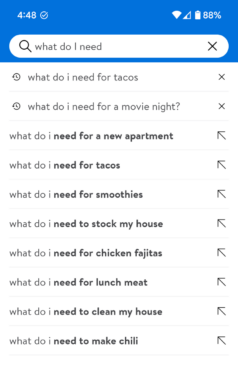
Instacart was early in the game with search enhancements like AI-powered results with their Ask Instacart feature. Queries on Instacart can be as broad as, “What should I make for dinner?” to narrower questions like, “What vegetables are the best to roast?” or my go-to, “What are good snacks for picky kids?” 

For those who might have been plugging in “what to make for dinner” for inspiration (guilty), this could be a game changer for grocery list-building. These personalized and sophisticated queries surface new brands (or variants like flavors or pack sizes) for companies that wouldn’t normally have earned a result from a branded search, bringing visibility to emerging brands that don’t have the budgets for highly competitive keywords like “mac and cheese.” 

And then, of course, Walmart recently debuted generative AI-powered search enhancements that enable use case queries that give relevant cross-category results. Instead of a list of products that are nothing but the exact item as your search but different brands or flavors, you’ll get a curated experience of “Big Game party must-haves,” for example, relevant to your previous baskets. So chips, dip, napkins, beverages—perhaps a new TV?

Walmart has millions of loyal shoppers across an extensive range of geographies whose interaction with the brand can be more utilitarian than inspirational or experiential. Shoppers can keep counting on Walmart for everyday low prices and vast selection and also augment their run-of-the-mill shopping trip, pick-up or delivery with online and in-app experiences to help curate and inspire. 

Walmart

What this all means for advertisers 

Brands need to understand how this AI-driven search revolution, combined with retailer first-party data, is changing their audience’s expectations; shoppers will expect search engines to become recommendation engines, yield better search results in general, include video and AR, and, of course, aid discovery—especially in complementary categories and eventually (less obviously) those based on individual shopping habits and evolving needs.

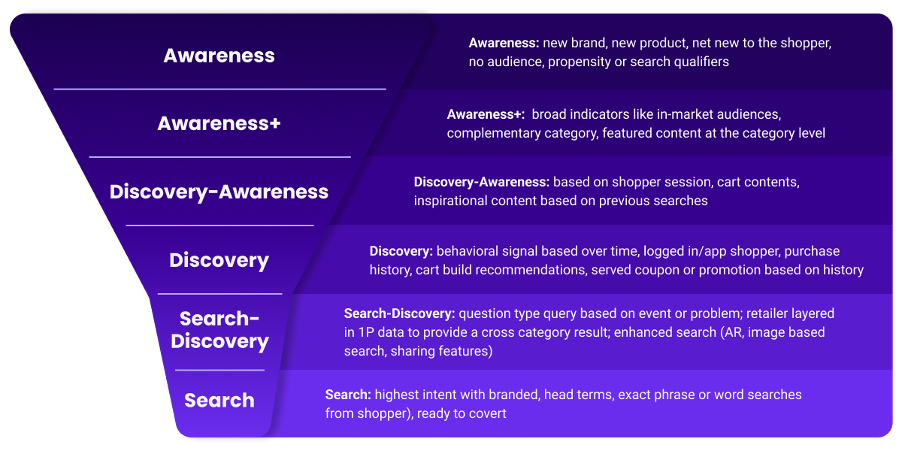
Search isn’t just lower funnel anymore, and the funnel isn’t just awareness, discovery or intent. We’ve evolved to have many more layers, with something that looks less like distinct buckets and more a gradient-like fade into one another. The addition of first-party data signals to models that refresh and change alongside shopper habits creates the ability to be more granular in between shopper journey points, pulling forward discovery and consideration into the search results pages. This puts the shopper in a discovery experience that sits over consideration and conversion.

Tinuiti

So what should your brand start doing now to get a jump on the future?

Reverse engineer your product pages 

Transform your product pages into ultimate recommendation engines by optimizing them for AI-driven search. Instead of merely listing product features, incorporate more attributes, details and videos. Include scenarios where your product can be used—picnics, parties or specific events like the Big Game. Make sure your product detail pages are rich in content and cater to the evolving expectations of consumers, especially those looking for personalized and curated experiences. 

Enhance catalog cleanliness and depth 

Catalog cleanliness is no longer just about basic information. Update your catalog with a focus on sophistication and depth. Include a wide range of use cases and complementary categories. Ensure that your catalog provides a comprehensive overview of your offerings, enabling AI algorithms to better understand and recommend your products to shoppers. 

Leverage solutions-based marketing 

Highlight how your products can solve specific problems or cater to particular needs, such as being suitable for small spaces or ideal for certain occasions. Incorporate these solution-oriented messages not only on your product pages but also in broader marketing efforts, including advertising campaigns and content marketing initiatives. By positioning your brand as a solution provider, you can better resonate with consumers and drive engagement and sales. 

Related video

With the addition of signals in intent, previous behavior, sophistication in prediction models, and of course AI, we are headed for a revolution in search, causing a revision of the marketing funnel as we know it today to best meet the needs of evolving consumer expectations in the places they already frequent and help us be better marketers tomorrow. 

https://www.adweek.com/commerce/retail-media-search-is-where-intent-and-discovery-will-merge/


The Bumble Fumble: Weaponizing Versus Witnessing Consumer Insights


.article-native-ad { border-bottom: 1px solid #ddd; margin: 0 45px; padding-bottom: 20px; margin-bottom: 20px; } .article-native-ad svg { color: #ddd; font-size: 34px; margin-top: 10px; } .article-native-ad p { line-height:1.5; padding:0!important; padding-left: 10px!important; } .article-native-ad strong { font-weight:500; color:rgb(46,179,178); }

Leaders from Glossier, Shopify, Mastercard and more will take the stage at Brandweek to share what strategies set them apart and how they incorporate the most valued emerging trends. Register to join us this September 23–26 in Phoenix, Arizona.

Two weeks ago, Bumble let its audience know a “new Bumble” was forthcoming. They stripped their Instagram of old posts, many of memes and models wearing T-shirts that read “Exhausted.” The teaser was interesting; a dating app leaning into how tired its audience is in a cheeky way. We waited to see where it went.

If you’ve seen my viral TikTok, you know it went straight to every brand’s worst nightmare: getting canceled. 

A campaign with a billboard reading, “You Know Full Well a Vow of Celibacy Is Not the Answer,” next to a Black model in rose-colored glasses was (rightfully) lambasted for insensitivity to women’s bodily autonomy and consent, the asexual community, the 4B movement (a feminist platform that originated in South Korea), reproductive rights in the current political climate including abortion bans, and, as additional viral videos pointed out, through its usage of what felt to many viewers like appropriating AAVE.

Bumble, a brand founded on empowering women on dating apps and allowing them to search for romantic partners or friends, was telling women that choosing not to have sex was “not the answer.” In a play on Nike’s famous slogan, I opened my TikTok by referring to it as the “Just F—k Him” ad.

How disappointing. How reminiscent of claims that women actually “wanted it.” How evident that “inclusive” creative with diverse talent gave no thought to the stories that talent was cast to tell and how it would affect the communities they were cast to represent. And the target audience responded with calls for boycotts, one-star reviews and making their disdain known across social media.

Bumble issued an apology by Monday night—lightning fast when you consider that backlash started over the weekend and the statement would have needed to be contracted, written, approved by legal and pushed out.

Related video

Post-apology, what are the lessons for brands here?

‘Does this reflect our values?’ is the veto question 

Yes, Bumble wanted to be, as they said in their apology, “bringing joy and humor,” but humor can’t come at the expense of dignity and safety.

The copy on Bumble’s About page under “Why Bumble Matters” reads: “Healthy relationships are central to living a positive, productive life. Bumble is designed to help you feel empowered while you make those connections, whether you’re dating, looking for friends, or growing your professional network.” 

When you’re looking to be fresh, edgy and funny, it becomes more—not less—relevant to ask: Does this concept support our mission? Then upvote or downvote accordingly.

How you use what you know about your audience

Nobody said Bumble didn’t know their audience. Dating apps are seen as imperfect, “exhausting” and enough to make users want to “swear off” dating or intimacy. Celibacy is in the conversation. 

The question for any brand is: What are you doing with your consumer insights? Are you witnessing or are you weaponizing? An audience’s pain point is crucial to resonant creative, but the way it’s called through the campaign will impact whether the creative is seen as empathetic or harmful.

Representation does not equate to inclusive marketing

As companies question the role of DEI experts, let this serve as a reminder that representation alone is not inclusion. I imagine the marketing team felt they were “doing everything right” by eschewing homogenous ads for some prominently featuring Black and Brown models. But the stories these models told turned them into caricatures. Creative teams need members of color and marketers trained in inclusive marketing to ensure impact meets intention.

TikTok is still relevant

As someone who leads TikTok strategies, the No. 1 question I’m asked is: In light of the impending ban, is TikTok still relevant? 

The immediate and massive response to this Bumble campaign, alongside other crises in product—like Youthforia being pulled from stores for an improperly developed foundation that offended its supposed target audience—and for influencers—like Haleyy Baylee using the “Let Them Eat Cake” sound dressed as Marie Antoinette for the Met Gala—showcases that the TikTok audience is still incredibly engaged and powerful and can make or break your brand with viral videos.

Brands and thought leaders would be wise to continue (and, I’d argue, redouble) their efforts on TikTok where sentiment calls the shots.

https://www.adweek.com/creativity/the-bumble-fumble-weaponizing-versus-witnessing-consumer-insights/


Molly Baz’s Pregnant Body Is Too Risque for Times Square


.article-native-ad { border-bottom: 1px solid #ddd; margin: 0 45px; padding-bottom: 20px; margin-bottom: 20px; } .article-native-ad svg { color: #ddd; font-size: 34px; margin-top: 10px; } .article-native-ad p { line-height:1.5; padding:0!important; padding-left: 10px!important; } .article-native-ad strong { font-weight:500; color:rgb(46,179,178); }

Mark your calendar for Mediaweek, October 29-30 in New York City. We’ll unpack the biggest shifts shaping the future of media—from tv to retail media to tech—and how marketers can prep to stay ahead. Register with early-bird rates before sale ends!

Times Square is no stranger to women’s bodies, but a particular advertisement recently stirred controversy, reflecting deep societal tensions surrounding motherhood and female sexuality.

The ad promoted lactation cookies in a provocative campaign by breastfeeding startup Swehl in partnership with cookbook author Molly Baz.

Baz, known for her culinary creativity, ventured into the partnership to develop a recipe designed to stimulate milk production. One of the promotional images featured Baz with a visibly pregnant belly and breasts covered by a rhinestone bikini top and cookies. This campaign image, displayed on a 45-foot-tall digital billboard, was marked with the cheeky tagline “Just Add Milk.”

Scheduled to display for a week from Monday through Mother’s Day, the ad celebrated a rite of motherhood. However, it was short-lived, taken down within three days due to purported guideline violations regarding acceptable content.

Clear Channel Outdoor, the company that manages this advertisement space, reportedly flagged the original work for review, which led to its premature removal. The substituted image depicted Baz in more conservative attire in a kitchen, eating one of her cookies—a stark shift from the initial provocative pose.

This incident underscores the enduring societal divide over the depiction of women’s bodies. In the same location, advertisements from brands like Skims and Michael Kors routinely showcase women’s bodies in a decidedly sexual context, particularly through lingerie ads. The stark contrast between the reaction to sexualized images of breasts and the censoring of a lactation-related advertisement highlights a peculiar double standard.

How is the breast acceptable when selling clothing through sex appeal suddenly too provocative when it denotes what the breast is biologically used for? Are pregnant women not allowed to be perceived as sexual beings, where mothers are more than laborers in their kitchens, demure and unassuming? Is a woman’s sexuality suddenly perverse once she becomes a mom?

Once again, women can’t win.

Related video

This view isn’t an isolated one as social media is filled with commentators who can’t wait to rant about how undesirable a woman is once she’s a certain age or has kids. Once a woman’s body is used in service of herself or her children, she becomes devalued. This coupled with women already feeling “unseen” by healthcare providers and marketers is all part of a much larger issue.

Experts point to a persistent taboo surrounding nursing and lactation. While breasts displayed for sexuality meet societal approval and commercial success, their display in the context of motherhood and natural bodily functions often faces backlash and censure.

This dichotomy not only reflects on the advertising standards that prevail in commercial spheres, but also on broader cultural attitudes towards femininity, motherhood and the sexual objectification of women’s bodies.

The Times Square billboard controversy is not just about an ad being replaced; it’s a poignant reminder of the lines women are often not allowed to cross in public. It brings to light important questions about freedom, body autonomy and the very nature of what is considered acceptable in our public spaces.

This debate continues to unfold with minimal progress as women’s bodies continue to be deemed acceptable or taboo by everyone but themselves.

https://www.adweek.com/media/molly-baz-pregnant-body-swehl-lactation-cookies-risque-times-square/


Advertisers Are Still Significantly Under-Investing in the Hispanic Audience, Despite ‘Latin Boom’


.article-native-ad { border-bottom: 1px solid #ddd; margin: 0 45px; padding-bottom: 20px; margin-bottom: 20px; } .article-native-ad svg { color: #ddd; font-size: 34px; margin-top: 10px; } .article-native-ad p { line-height:1.5; padding:0!important; padding-left: 10px!important; } .article-native-ad strong { font-weight:500; color:rgb(46,179,178); }

Mark your calendar for Mediaweek, October 29-30 in New York City. We’ll unpack the biggest shifts shaping the future of media—from tv to retail media to tech—and how marketers can prep to stay ahead. Register with early-bird rates before sale ends!

The Summer of 1999 was a pivotal moment in the U.S. cultural zeitgeist: Latin pop music burst into the mainstream, driven by the crossover success and appeal of artists such as Ricky Martin, Jennifer Lopez and Marc Anthony, to name a few. The “Latin Boom” was so powerful, that it heralded the inception of the Latin Grammy Awards the following year and led the nation’s top marketers to double their efforts in reaching Hispanics.

Before you get too excited, it should be noted that doubling efforts meant going from 1.5% to 3% of their total advertising spend. Baby steps, but steps, nonetheless.

So, it stands to reason that Hispanic ad spend must have experienced similarly explosive growth from that much-heralded leap to 3% in 2000, right?

Only if you consider going from 3% of total advertising spend to 4% over a quarter century an “explosion.” Instead, the explosion was reduced to a spark, its fire extinguished by legacy planning paradigms that kept Hispanics relegated to the “whatever we have leftover” spend column.

Meanwhile, the business imperative of connecting with and winning today’s young and rapidly growing Hispanic consumer segment (which represents 25% of the U.S. population under 30) has become even more critical to brand growth and health for the long term.

In reaching the Hispanic audience, the problem and the solution come down to two words: better data.

The stats

The biggest effect of the “Latin Boom” was the long overdue spotlight on the economic significance of the surging U.S. Hispanic population, which was growing four times faster than the general population by the time the 1990s had come to a close.

Fast forward 25 years later, the U.S. Hispanic population has more than doubled from 31 million (11% of the population) to 63 million. That’s almost 20% of the U.S. population.

As of 2021, their economic clout increased to $3.2 trillion in annual buying power. To put that in perspective, if Latinos were an independent country, their GDP would rank fifth in the world, ahead of the United Kingdom, India and France.

Brands who fail to future-proof their bottom line by connecting to the cultural nuances of Latino communities with authentic insights; and those who fail to make Hispanic spend integral vs. ancillary to their core growth strategies, will find themselves hitting a brick wall with this powerful consumer constituency.

As two of today’s biggest Latina artists, Shakira and Karol G said in their hit collaboration “TGQ,” the Hispanic consumer will tell brands: “I don’t have time for something that doesn’t do anything for me.”

Right audience, wrong impressions

Going into the 2024 upfront season, marketers, agencies and media partners can address this core impediment to increased Hispanic-targeted ad spend by asking four simple questions.

Is the data capturing consumption nuances?

With Hispanics still leading consumption in over-the-air-broadcast (141 index), big data sets must consider all viewing data. This notion was reinforced by a Nielsen report which concluded that Return-Path-Data-capable homes undercounted Hispanics by 33% and Spanish-language dominant Hispanics by 49%.

Additionally, according to a Pew Research Center survey, a quarter of Hispanics are “smartphone-only” internet users, indicating that they own a smartphone but lack traditional home broadband services. By comparison, 12% of non-Hispanic white adults fall into this category.

Does the data capture in-language consumption?

The Spanish language is the common thread among Hispanics. Research tools must be able to collect data in language, to ensure that the Spanish-dominant segment of this group (close to 50% of total) is represented.

How are Hispanic data sets being validated?

Last year, data validation firm Truthset unveiled research detailing how the overall data industry includes just 58% of Hispanic audiences in the U.S. Not only were 42% of Hispanics missing in third-party datasets, but findings also revealed that 70% of targeted Hispanic impressions were not delivered to the designated audience.

How are you building in first-party brand data?

Some media companies such as TelevisaUnivision are establishing their own identity-based data graphs, built by using a mix of its first-party account logins, IP addresses and set-top box data to resolve its user IDs at the household level. It recently joined forces with Omnicom Media Group to match its advertiser first-party IDs within a data clean room environment, validate audience overlaps and target those audiences in scaled programmatic channels.

For years, the Hispanic audience has been chronically underrepresented in audience metrics, and therefore under-addressed. Meaningful investment growth demands an accurate representation of both numbers and behaviors.

https://www.adweek.com/convergent-tv/advertisers-are-still-significantly-under-investing-in-the-hispanic-audience-despite-latin-boom/


Want a Leg Up in the Ad Industry? Start in the Restaurant Business 


.article-native-ad { border-bottom: 1px solid #ddd; margin: 0 45px; padding-bottom: 20px; margin-bottom: 20px; } .article-native-ad svg { color: #ddd; font-size: 34px; margin-top: 10px; } .article-native-ad p { line-height:1.5; padding:0!important; padding-left: 10px!important; } .article-native-ad strong { font-weight:500; color:rgb(46,179,178); }

Don’t miss ADWEEK House at Cannes, June 16-19. Join us as we celebrate our 45th anniversary and explore the industry’s now and next. RSVP.

Growing up, I had little to no idea what I wanted to do when I got older. What I did know from a very young age, however, was that I needed to make money to buy the things I wanted that my parents couldn’t afford. That led me to my first job in the restaurant business at just 15 years old. 

From there, through college, I held almost every position there was to hold across the industry, front-of-house to back. I’ve done it all: barback to bartender, errand runner to delivery driver, long hours on my feet, double shifts into the wee hours of the morning, coming home smelling like grease… Little did I know it was shaping me to be gritty, tenacious, flexible and entrepreneurial in ways not many other jobs could have. 

After graduating with a marketing degree, I finally knew advertising was without a doubt what I wanted to pursue as a career. A couple months into my first agency gig, I started to pick up on things that felt reminiscent of my restaurant days: late nights preparing for pitches, keeping lots of plates spinning simultaneously, managing regular fire drills and juggling mile-long to-do lists. I felt right at home, even if I wasn’t exactly sure why at the time. And although advertising has changed a lot in the last 20 years, one thing hasn’t: The business is nothing short of organized chaos.

But that’s what we love about it, right? The thrill of the ups and downs. The late-night strategy sessions, balling up idea after idea until that magical concept rears its head. Getting to see our hard work manifest itself out in the world. It’s exhilarating and makes the nonstop frenetic pace tolerable, even, dare I say, enjoyable?

College students ask me all the time, “What’s the best way to prepare yourself for an ad job?” Some might answer, “Get an agency internship or two under your belt before you graduate,” or, “Be a student of advertising and build up a strong portfolio.” I’d consider both solid advice—but I answer that question by telling students that the absolute best preparation for a successful career in this industry is to start by cutting your teeth in the service industry, more specifically the restaurant business. And while you probably will never be expected to respond to a dehumanizing, cursing superior with “yes, ECD!”, the parallels and soft skills you will walk away with will perfectly match those required of you to become an incredible advertiser. 

Customer service = client service 

The first and probably most undeniable comparison is the customer-centric nature of both industries. Navigating the sometimes rigid expectations of a persnickety diner can be extremely challenging, requiring patience, tolerance and acceptance of the reality that, after all, they’re paying the bill. 

The same can be said for a tough client. Their expectation is that you will weather the storm of any request, large or small, even if by most definitions those requests could be deemed unrealistic. 

Mastering the art of customer service can be way more challenging to teach than some hard advertising-specific skills. So, this is a great place for any aspiring advertiser to start. 

Wearing many hats—and wearing them well 

Another critical and seamlessly transferable skill garnered in the chaos of a hospitality job is the ability to multitask. Fixing a broken ice machine, managing a slow kitchen that’s down one line cook, or explaining to one of your six tables why their steak is overcooked, all while in the weeds of a 7 o’clock dinner rush, is no small feat. 

In adland, especially in agency work, you’ll likely have a hand on projects across several clients with competing deadlines on a regular basis, and you’ll be prepared to handle it.

Attention to detail 

Even a small error or oversight in advertising work can result in significant consequences—both for your client or brand and for your company’s business. Attention to detail is another skill mastered in a restaurant environment where accuracy and precision are paramount for success. 

Think: taking and preparing orders correctly, perfecting plate presentation and remembering that a guest mentioned it’s their wife’s birthday. The little details matter. And it’s much easier to refine your eye for accuracy when the stakes are, well, steaks—not millions of dollars.

Thinking strategically on your feet

Restaurant work cultivates the ability to see three steps down the road and make strategic decisions quickly based on the information presented to you in real-time. In advertising, it serves you very well to anticipate and get ahead of a reaction or next request of your client or boss. 

If making thoughtful decisions under pressure is a challenge you face, take it from me: Go find yourself a kitchen job at a busy diner. Before long, you’ll be rewiring your brain to make calculated, split-second, strategic decisions on the fly with ease. 

As the list goes on, agency leaders would be hugely mistaken to overlook potential talent with experience rooted in the restaurant business. Advancing diversity in advertising includes creating space for people of all backgrounds who may not have the opportunity or resources to attend an expensive ad school or spend a summer or two on Madison Avenue. Up-and-coming talent should proudly tout these undeniably transferable skills when building a resume or moving through the interview process—it’s these very skills that will quickly catapult them up the advertising ladder. 

The good news is, while it’s certainly possible to have too many cooks in the kitchen, you never have to worry about having too many ideas or too many badass advertisers in the agency.

https://www.adweek.com/agencies/want-a-leg-up-in-the-ad-industry-start-in-the-restaurant-business/