Why We Can’t Stop Talking About Asian Creativity


.article-native-ad { border-bottom: 1px solid #ddd; margin: 0 45px; padding-bottom: 20px; margin-bottom: 20px; } .article-native-ad svg { color: #ddd; font-size: 34px; margin-top: 10px; } .article-native-ad p { line-height:1.5; padding:0!important; padding-left: 10px!important; } .article-native-ad strong { font-weight:500; color:rgb(46,179,178); }

Be among trailblazing marketing pros at Brandweek this September 23–26 in Phoenix, Arizona. Experience incredible networking, insightful sessions and a boost of inspiration at ADWEEK’s ultimate brand event. Register by May 13 to save 35%.

In a globalized, post-colonial world, it’s not easy to define Asian creativity. Creativity made in Asia? Creativity made by Asians, anywhere in the world? Creativity that has Asian inspirations and influences?

Chances are, everyone will have their own definition of what “Asian creativity” is to them. And it could very well be that none of those definitions are wrong. There are several ways to define Asian creativity; the concept could be big and multitudinous enough to encompass them all.

However you choose to define Asian creativity, here’s what we want to say about it: whoever you are, whatever you do and whatever Asian creativity looks like to you, you need to pay attention to it.

If you’re a consumer, share it. If you’re a business, pay for it. And if you identify as an Asian creative, keep doing it simply because the future of creativity demands you to. Here’s why.

You are what you eat

To state the obvious, human culture in the 21st century is overwhelmingly visual. In 2015, the tech analyst Benedict Evans came up with the ready-to-go-viral extrapolation that “more photos will be taken this year than were taken on film in the entire history of the analog camera business.”

Even if we rightfully take that with a grain of salt, consider the steady feed of user-generated imagery we consume through social media. Banner ads slip through our peripheral vision as we shop, work and communicate online. The hours we clock in watching our streaming service of choice at home. Put all that together and there’s no denying the stranglehold of visual imagery on our brains.

As visual culture becomes increasingly globalized, there’s no denying that we have come to subsist on the same pool of references, inspirations and viral videos. For decades, the West has largely dominated this visual diet, leading to a global post-colonial hangover.

For instance, Netflix’s hit series Squid Game was lauded for the originality of its plot and themes. But many viewers also noted the strong visual similarities between the pink jumpsuits worn by the titular game’s guards and the red jumpsuits worn by the robbers on the equally triumphant Money Heist, which had premiered four years earlier.

The cause for the similarity is not just plagiarism, as some armchair critics were quick to say, but points to the ubiquity of the jumpsuit itself—a garment that has served as cinematic shorthand for subversive anonymity since 1969 when a gang of robbers led by Michael Caine chose to disguise themselves with blue work suits to pull off The Italian Job. In a globalized world, where creations from South Korea, Spain and the U.K. all exist about each other, a shared language of what work uniforms look like is creating visual uniformity.

Welcome to the monoculture

It’s not just that our visual references are converging, resulting in more sameness wherever we go. The issue with creative monoculture goes deeper than boredom because visual culture doesn’t just represent the world we live in; it structures the way we think, categorize and communicate.

Take emojis, for example. When you tell yourself to picture “cake,” does a triangle-shaped confection with two yellow sponge layers swathed in white cream appear in your mind? Or a round pastry topped with sprinkles and birthday candles?

If you do, it’s only because these very culturally specific representations of cake have been perpetuated through the visual language of emoji. But what about flower-shaped Chinese mooncakes, or delicately layered Malay Kek Lapis or Vietnamese Banh Bo Nuong, with its intricate, honeycomb structure?

When we allow specific representations to dominate visual culture, we risk creating a homogenous world where anything outside the “norm” becomes obscure or, worse, incorrect. “Cake” would be a lot less interesting if it was only ever just strawberries and cream. And the world would suffer immensely without diversity in our visual culture.

Representation is table stakes

The DEI conversation must go much further than making a live-action Mulan movie and Crazy Rich Asians. For creativity to be sustainable, we need more than diversity in representation. We need diversity in creation.

What that means is giving Asian creators opportunity, but also freedom. Far too often, Asian creators are put in a sandbox of vaguely defined “Asianness” and punished (or just ignored) when they dare to venture out.

Anecdotally, a Korean artist we featured through the Asian Creators Index recently told us a story about how her (in her own words) “Western clients” told her that her illustrated depictions of Asians were “ugly,” “chubby,” “with too-small eyes” and “not representative of Asians.” To which we say: not representative… to whom?

The world doesn’t need more one-size-fits-all cultural stereotypes. Instead, we need Asian creators to be free. Free to move away from the expected and, instead, make work that reflects their lived experiences, however blurred and multicultural it may be. It is precisely that unexpectedness that is special.

There is a pragmatic dimension to this too. More unique and specific Asian creativity isn’t just good for culture, it’s good for business. Today, 55% of the global consumer class lives in Asia. The Asian region, comprising 48 economies, will account for more than 50% of the world’s GDP by 2030.

According to a report by McKinsey, “Asia on the cusp of a new era,” Asia is becoming the world’s new majority, “accounting for more than half of the global total of many key metrics we use to measure the world economy.” Which makes creative diversity more than an issue of artistry. It is now business-critical.

World, meet us where we are

Finally, to Asian creators themselves, we say this: whatever you’re doing, remember, your creativity is essential.

You may feel lost, stifled, overlooked or tired of making the same arguments and giving the same explanations like a broken telephone. But keep showing up. Keep doing you. Keep making the new, weird, ultra-specific stuff that only you can make.

The world is changing, and soon it will meet us where we are.

https://www.adweek.com/creativity/why-we-cant-stop-talking-about-asian-creativity/


The Loneliness Epidemic and Media Consumption: What Marketers Need to Know


.article-native-ad { border-bottom: 1px solid #ddd; margin: 0 45px; padding-bottom: 20px; margin-bottom: 20px; } .article-native-ad svg { color: #ddd; font-size: 34px; margin-top: 10px; } .article-native-ad p { line-height:1.5; padding:0!important; padding-left: 10px!important; } .article-native-ad strong { font-weight:500; color:rgb(46,179,178); }

Mark your calendar for Mediaweek, October 29-30 in New York City. We’ll unpack the biggest shifts shaping the future of media—from tv to retail media to tech—and how marketers can prep to stay ahead. Register with early-bird rates before sale ends!

We are still seeing the effects of the pandemic come to fruition, but one thing is very clear: We are all feeling more disconnected. The resulting epidemic of loneliness is well documented by health professionals, with 52% of Americans reporting that they feel lonely and 47% saying their relationships aren’t meaningful.

According to US Surgeon General Vivek H. Murthy, “Loneliness is far more than just a bad feeling; it harms both individual and societal health. It is associated with a greater risk of cardiovascular disease, dementia, stroke, depression, anxiety and premature death.” The mortality impact of social disconnection is comparable to mortality caused by smoking up to 15 cigarettes a day. There is even greater than that associated with obesity and physical inactivity.

As marketers, we often rely on technology and data to shape our current and future channel planning strategies: programmatic media helps us buy audiences, retail media helps us find people to market for our products and social media helps us target people based upon vast amounts of walled garden data.

But when something as profound as a pandemic occurs, it’s also just as important to take a step out of the minutiae and look at more macro-human trends to inform our media investments.

Bigger than the attention economy

There are several media channels are the channels enjoying steep growth trajectories and they help everyone feel less lonely and more connected.

The channels that are making people feel more connected to human emotion, real and meaningful conversations and shared live experiences are podcasts, live shopping, gaming, Reddit and subscriber-based content platforms like Medium and Substack.

While there has been a lot of industry discussion around using “attention” as a planning KPI for media, marketers don’t need to capture attention; they need to show up and contribute to these environments where people find companionship and connection. The channels beneficial to everyone’s mental health will only continue to scale in reach and popularity as people move away from other channels that don’t have the same benefit.

Podcasts

As our work experience has become more remote and our lives more virtual, who doesn’t miss feeling a part of long and meandering conversations with friends and colleagues? Those conversations make you think and help you to understand the people you are with on a deeper level.

Podcasts often fill that void. They are intimate and inclusive, so it’s no surprise that podcast consumption has exploded. According to Nielsen, the U.S. podcast listener base grew by 40% from 2020 to 2022. There are close to 70 million people who listened to podcasts in 2023 and this number is projected to rise even further, reaching over 110 million listeners by 2029.

Live shopping

Let’s face it, we have all been waiting for live shopping to reach its tipping point in the US. And I think that time has come.

The pandemic drove record increases in online shopping because of its safety and convenience. Live shopping still provides those same functional benefits but also offers the more emotional benefits of having a live host share their expert opinions and being able to engage with other shoppers in real-time.

In the US, where live commerce is still building in popularity, the total value of livestream e-commerce sales is projected to almost double from 2022 to 2026. This is an opportunity that is especially ripe for marketers in top categories like clothing, skincare, fashion accessories, body care and hair care.

Gaming

According to the World Economic Forum, the explosive growth of gaming stems from COVID-19 lockdowns, driven specifically by the millions of social and casual gamers who picked up their controllers to escape boredom and isolation.

And there are no signs of slowing. A recent PwC report said that the growth trajectory is expected to continue. The category is estimated to be worth $321M by 2026.

With global platforms like Twitch’s 30M Daily Active Users (DAU) and Roblox (71.5M DAU) connecting people all over the world, its potential to stave off loneliness and galvanize communities is indisputable.

Reddit

Anyone who has ever entered the world of Reddit knows that there is a subreddit for every imaginable interest or topic. For people who feel isolated, misunderstood or simply out of place, Reddit provides a community of like-minded individuals to have meaningful conversations.

Your brand can become a part of these communities by offering exclusive content, product samples or hosting an Ask Me Anything (AMA). The pandemic triggered Reddit’s extraordinary growth, which directly led to its recent IPO. Reddit’s annual revenue was $188M in 2020 and skyrocketed to $456M just a year later in 2021. In 2023, Reddit’s revenue was $810M and has 1.2B monthly active users.

Medium and Substack

While part of staving off loneliness is feeling like a part of a community engaging with like-minded people and sharing content, sometimes the desire to share an opinion requires more than a simple social post or comment in a thread.

Sharing long-form perspectives with people on platforms like Medium and Stubstack gives the creator access to an opt-in audience and also enables them to make a little money doing it. At the start of 2019, Medium had 400,000 subscribers who paid to access content on the app and that number increased to 700,000 just two years later in 2021. Substack, a similar type of platform where people pay to access content written by other people, saw site traffic grow by 42% from August 2023 to January 2024.

For brands out there looking for an early mover advantage with their media dollars, try investing in some of these platforms that are in high growth mode. To make the most of these platforms, keep in mind the mindset of these audiences and support their quest for more meaningful connections. Do these platforms offer the scale of other more established media channels? No. But they might in the future. Get in now, do some good and generate some key learnings for your brand.

https://www.adweek.com/media/the-loneliness-epidemic-and-media-consumption-what-marketers-need-to-know/


Make Waves—But Make Sure They Propel the Brand Forward


.article-native-ad { border-bottom: 1px solid #ddd; margin: 0 45px; padding-bottom: 20px; margin-bottom: 20px; } .article-native-ad svg { color: #ddd; font-size: 34px; margin-top: 10px; } .article-native-ad p { line-height:1.5; padding:0!important; padding-left: 10px!important; } .article-native-ad strong { font-weight:500; color:rgb(46,179,178); }

Be among trailblazing marketing pros at Brandweek this September 23–26 in Phoenix, Arizona. Experience incredible networking, insightful sessions and a boost of inspiration at ADWEEK’s ultimate brand event. Register by May 13 to save 35%.

The quick-service restaurant business is a sprawling, dynamic space, expected to grow to nearly $1.47 trillion by 2028 at a compound annual growth rate of 6%. It’s a highly competitive category, with more than 420 brands spending more than $3.3 billion combined in yearly advertising. In this environment, QSR brands need to innovate and offer new products and experiences to thrive continually. 

As these brands scramble for the next celebrity partnership or limited-time offer, these short-changing steps often distract QSR marketers from building a marketing model that delivers short-term sales success while also building brand equity and differentiation that compounds to support long-term growth. 

Based on over two decades of experience, I have codified a model to manage a QSR brand for sustained, ongoing business and brand growth—Anchors, Currents and Waves. It’s a practical blueprint for success, from developing a confident understanding of core brand appeal to designing strategies aimed at cultural relevance. The model is designed to deliver the often-mentioned, rarely realized “sales overnight, brand over time.” 

Anchors: What is the brand known for?

The Anchor is ever-present and committed to. Everything the brand does should be tethered to the Anchor, no matter the menu updates, the new promos, the LTOs or the stunts. 

It’s not simply what the brand offers, but what makes it special and unique, often tied to the restaurant’s provenance, hero product, people or process. Burger King lets you “have it your way,” and it’s always flame-broiled; Arby’s will always have “The Meats,” and unique ones at that; Chipotle is committed to real ingredients with real in-store preparation. 

Few QSR brands have true Anchors—most have lost theirs—and among the few that do, fewer commit to reinforcing their Anchors consistently over time. The best QSR brands blaze it on their restaurant, place it on their packaging and put some level of ongoing media spend behind it. 

Currents: The steady reasons why consumers should visit, now 

This is the bulk of a restaurant brand’s communication and media spend. 

On the surface, Currents appear to be the promos and LTOs—the “limited-time free delivery” or “Big Game sweepstakes” kind of thing—but any brand can offer those. The strongest Currents are ones that emanate from the brand’s Anchor: Burger King’s Million Dollar Whopper contest, for example, asks customers, “How will you top your Whopper?”, encouraging them to build an AI Whopper “your way.” It’s an LTO, and yet it also acts as a long-term brand deposit. 

The strongest ripples of a brand’s Currents start from its Anchor and thus make the Anchor stronger.

Waves: Piercing the cultural conversation 

Waves are occasional or opportunistic and often come in the form of “planned” earned impressions. 

Any brand, with the right amount of money, can work with a celebrity, partner with an influencer or pay to be part of an event like the Met Gala; these types of partnerships and stunts are quickly becoming one of the most used tropes of our industry. More often than not, it’s pure borrowed interest—it makes a Wave, yes, but the momentum of the Wave doesn’t necessarily propel the brand forward. 

Again, the best Waves originate from the Anchor. Dunkin’ partnering with Ben Affleck is the perfect pairing, as they share the same Boston DNA. Of course, Chipotle would support the Young Farmers Coalition, the future makers of real food, by partnering with Kacey Musgraves to reimagine Coldplay’s “Fix You” for a short film. Arby’s launched a smoked bourbon with the same hickory they use to smoke their brisket and rib their Meats. Burger King used real images of its restaurants on fire and stamped the photos with “Flame Grilled Since 1954.” 

All these Wave-making stunts emanate from the respective brand’s Anchor, and they propel the brand forward. They aren’t about borrowed interest; they’re about brand equity. 

Anchors, Currents and Waves is a simple tool—it starts as a worksheet-driven exercise, and once committed to (particularly the Anchor), it manifests into a blueprint to guide a brand in all it does. It can be distilled to a single page to guide campaign development, content calendaring, even media allocations and budgeting. It can be used as a filter for judging ideas: Does this Current emanate from the Anchor? Is this Wave tethered to the Anchor? 

The model ensures that the brand can create varied yet consistent content that reinforces the simple shorthand for why a QSR brand is special and, more importantly, why consumers should choose it—now and in the future.

https://www.adweek.com/brand-marketing/make-waves-but-make-sure-they-propel-the-brand-forward/


The Less Obvious Scary Things About Starting an Ad Agency


.article-native-ad { border-bottom: 1px solid #ddd; margin: 0 45px; padding-bottom: 20px; margin-bottom: 20px; } .article-native-ad svg { color: #ddd; font-size: 34px; margin-top: 10px; } .article-native-ad p { line-height:1.5; padding:0!important; padding-left: 10px!important; } .article-native-ad strong { font-weight:500; color:rgb(46,179,178); }

Don’t miss ADWEEK House at Cannes, June 16-19. Join us as we celebrate our 45th anniversary and explore the industry’s now and next. RSVP.

If you inherited your agency or have just won the Powerball and are thinking of starting up, you can stop reading right now. This is for the bootstrappers, the freelancers, the one-man-bands, the scrappy ones.

If you’re going to bootstrap your own thing, you’re going to have to learn to live with fear.

The big, obvious one is leaping from the comfort of a bimonthly paycheck, healthcare and a 401K match. And the further you are in age from the day of your birth, the scarier that leap is. Sometimes you choose to leap, sometimes you’re pushed. I’ve done both, and they’re equally scary.

So, that giant fear is behind you. But there are many less obvious fears you should know about if you are going to embark on this journey.

Straight off the bat, brand identity, company registration, legal contracts, company insurance, IT and banking are all on the very “front edge of your home office seat” stuff. But it’s new and exciting, so there’s a lot of good nervous energy.

Reaching out to your network is a different kind of fear. They loved you when you won those six Cannes Lions together and drank pink wine on the Croisette. But will they like you solo with no company credit card?

Turns out they do. Some of them. But they aren’t shifting their whole account to a one-person band, so you land a tiny project or two that might cover your daughter’s third semester in college, but definitely not your mortgage.

You need freelance help and make some calls. “How much do you charge a day!? OK, I guess. Crap, do you accept Venmo?”

Finding office space and signing a lease with no guaranteed income—that’s a lil scary. Co-working spaces like Industrious and WeWork make it slightly less so.

One expense I never trimmed was my weekly coaching session with Karen Crane; she was a huge help in talking me down when things inevitably got to be a lot and still is very valuable.

Trying to borrow money to make it through the startup months ain’t easy. Pro tip: Borrow money or take an extension on your home loan before you leave that paycheck behind. It’s impossible to borrow any money for your first two years in business.

Paying out all the money coming in for freelance and office space will get your pulse racing, but hiring your first person is truly terrifying. This is at the same time the scariest and most important thing you’ll ever do as a founder. It’ll happen before you can afford it or feel comfortable doing it. Way before.

Know that you cannot grow a successful advertising business alone.

Over 30 days, I interviewed more than 20 people at a local coffee shop, and then the Ad Gods delivered. Alexandra McInnis. A young, energetic, driven, smart woman with six years of experience who I would trust to run SpaceX, never mind a startup ad agency. Alex is the wind beneath our little Murder Hornet wings.

But knowing she had to give up a proper job at a real ad agency to join me—when I couldn’t afford to pay myself—was petrifying.

Together, Alex and I have been on a magical six-month run, doing big projects for global clients like Zoom and Bumble as well as Murder Hornet becoming the creative partner to Fortune 100 Company New York Life and Lipton Teas & Infusions’ Tazo brand.

And we did this while adding a few extremely special people to our “nest” and managing an enormous “swarm” of trusted and invaluable partners.

Everything gets easier with a little money coming in. After nine months, it feels like I no longer sit bolt upright in bed at 2 a.m. and think, “WTF have I done?” … as much.

Now it’s about trying to continually do great work, managing cash flow, choosing your pitches, growing efficiently and keeping the culture.

Thank God I hired Alex.

This article is part of an ongoing Voice series that takes a behind-the-scenes look at new agencies in their first year of business. For more on Murder Hornet, see the previous article, Why Would Anyone Name Their Ad Agency Murder Hornet?

https://www.adweek.com/agencies/scary-things-starting-ad-agency/


Who Wants 228 Big Macs?


Recently, a list of the top McDonald’s loyalty point holders was analyzed on social media. The leader of the pack was an individual with 1,370,044 loyalty points—enough for 913 vanilla cones, 456 medium fries or 228 Big Macs.

While an impressive feat to be sure, this breakdown underscores a critical gap in most loyalty programs—a lack of personalization. Every customer accumulates points toward the same set of rewards regardless of individual preferences—a customer who loves McDonald’s coffee and another who prefers their fries are both navigating the same rewards pathway.

To enhance a restaurant loyalty program, rewards should be tailored to customers’ dining preferences, dietary restrictions, location and behavior. This could include seasonal recommendations catered to individual tastes, options for voting on new items, family-friendly rewards, “surprise and delight” rewards based on order history and incentives for social media engagement, ensuring a personalized and engaging dining experience.

If loyalty points aren’t being redeemed, incremental purchases aren’t being driven, and ultimately, loyalty programs become a cost center for brands—in the case of McDonald’s, it offers a huge number of rewards redemption options, but customers are still out there with thousands of unused points. In reality, consumers respond better to confidence in the choices presented to them over a bouquet of rewards all valued equally by the restaurant.

In today’s ultra-competitive market, where every quick-service restaurant seems to have its loyalty program, customers are increasingly scrutinizing the effectiveness and value delivered by these programs. Many, in response to economic pressures, are scaling back benefits or requiring more points for redemption, leading to customer dissatisfaction. This highlights a crucial moment for brands to rethink loyalty—not as a cost-cutting measure but as a strategic tool for deepening customer relationships. If restaurants control the rewards provided through their programs, they’re able to accurately predict the cost to the business while increasing the likelihood that points get redeemed. 

Personalization stands out as a key differentiator, and with only 22% of customers satisfied with the level of personalization they receive, there’s vast room for improvement. Leveraging AI for predictive analytics and real-time feedback can transform loyalty programs into a tailored, meaningful experience for each customer. On the brand side, focusing on personalization can help lower the costs of offering rewards while increasing redemption rates—in fact, research shows the reward claim rate for personalized rewards, optimized over the customer’s unique order history, is 3.5 times as high as one-size-fits-all rewards. Collecting first-party customer data is invaluable, especially with the eventual phasing out of cookies; an effective loyalty and CRM solution is well-positioned to gather this intel. 

Instead of the one-size-fits-all approach, where each item costs the same number of points but varies greatly in personal value, McDonald’s could ensure that each point holder gets rewards that resonate with their unique preferences, whether that’s fries, burgers or something else entirely. It’s a win-win, not only optimizing the perceived value of rewards for the customer but also maintaining low redemption costs for McDonald’s. Customers would see their points as a tangible pathway to getting more of what they love rather than a generic currency. 

Loyalty programs are not just about rewarding transactions; they’re about rewarding trust, deepening the customer relationship and making every interaction count. By closing the gap between perceived and actual value, brands can transform their loyalty programs from a cookie-cutter model to a dynamic, customer-centric engine driving repeat business. 

https://www.adweek.com/performance-marketing/who-wants-228-big-macs/


Will Retailers Sacrifice Customer Loyalty to Solve Our Returns Problem?


In 2023, $247 billion—17.6% of U.S. online sales revenue—was lost to returns, versus the 14.5% return loss for items bought in stores.

Once seen as an enticing benefit to attract customers (and keep pace with Amazon), free shipping and returns quickly became the norm for ecommerce. There was a cost to keeping these free, of course—a cost that businesses would incur themselves to keep customers happy. For some time, that cost has been worth the reward. Recently, though, that sentiment has begun to shift.

With this shift, many retailers have turned their focus toward improving shipping and logistics costs, leading to stricter policies and new restrictions for consumers. And while this approach often yields the short-term results retailers are looking for, the long-term impact on loyalty could present an even bigger challenge down the road.

Sweeping changes 

New shipping and return policies have been rolling out across major retailers for some time now. Some, like Macy’s and Abercrombie & Fitch, have set higher thresholds for free shipping. Others have begun to charge for returns, made return policies stricter or even banned serial returners entirely. 

These strategies could very well work. After years of free shipping and unrestricted returns, stricter policies will undoubtedly force customers to reconsider their return habits. On the other hand, it could also keep them from buying altogether.

One survey found that 58% of consumers want a hassle-free, no-questions-asked return policy. Will customers abandon a brand that doesn’t offer that? It’s a question worth considering for retailers that introduced free returns to win those customers in the first place.

Middle ground 

Retailers tend to focus on shipping and logistics costs when it comes to tackling returns. Doing so generally results in widespread changes that impact every customer, even the loyal ones making infrequent returns. Yet there’s plenty of middle ground for retailers to explore if they also incorporate profitability optimization into their return strategies.

After all, we frequently find a small percentage of customers are responsible for a majority of returns: For one of our clients, 8% of customers accounted for 70% of the retailer’s returns. A focus on profitability optimization means more targeted strategies, which can help retailers address the source of high return rates with less widespread risk to customer loyalty.

This approach hinges on a business’s marketing department, the team that is arguably closest to the data on your customers’ shopping habits, returns included. With the ability to track return events and segment customers by return rate, they can enact targeted strategies to mitigate impact, such as:

  • Sharing free shipping promotions with your most loyal customers while suppressing similar campaigns and promotions for your frequent returners.
  • Using AI prediction models to identify customers who are most likely to return based on past behavior signals, then excluding those segments from high-cost channels like paid media when building campaign scenarios.
  • Triggering banners that highlight return policies when customers identified as frequent returners arrive on site.

In tandem with merchandising teams, marketers can take their efforts even further, narrowing their focus down to the products themselves. One possibility: Merchandisers can suggest higher-margin products for marketers to include in product recommendation grids in emails. This allows them to optimize for customer lifetime value, offsetting higher customer acquisition costs that free shipping incentives can create.

Marketers can share insights with merchandisers, too. They can monitor frequently returned products, for example, and identify potential opportunities for greater clarity in product descriptions—perhaps they don’t align with customer expectations, or more detailed information about fabric and fit is needed to help shoppers choose the correct size.

In that same vein, marketers can work with merchandisers to help decrease the likelihood of wardrobing—when consumers purchase products in multiple sizes and return the ones that don’t fit. A marketer could create a banner triggered when multiple sizes of the same style are added to cart, offering sizing recommendations or insights based on previous purchases. Engagement with that banner could be shared back with merchandising teams, again helping them understand where updates to product descriptions or sizing charts may help customers in the future.

Marketers and merchandisers don’t always see eye to eye. Despite working toward the success of the same business, they’re often tasked with different goals and success metrics, and that can understandably lead to divides between the teams. But the fight for profitability amid growing return rates is an unbeatable opportunity for collaboration. Bringing together customer knowledge from marketing and product expertise from merchandising can drive results that everyone benefits from, helping businesses see the real impact of these return strategies that live in the middle ground. 

Managing return strategies in the age of astronomical customer expectations is not an easy feat. For retailers, it’s worth considering where more targeted, marketing-driven (and merchandising-supported) changes can help. With a focus on profitability, you can begin to reduce return rates without risking the customer loyalty you’ve worked so hard to build.

https://www.adweek.com/commerce/retailers-customer-loyalty-solve-returns-problem/


Unlock Creative Effectiveness and C-Suite Buy-In With Neurodesign


.article-native-ad { border-bottom: 1px solid #ddd; margin: 0 45px; padding-bottom: 20px; margin-bottom: 20px; } .article-native-ad svg { color: #ddd; font-size: 34px; margin-top: 10px; } .article-native-ad p { line-height:1.5; padding:0!important; padding-left: 10px!important; } .article-native-ad strong { font-weight:500; color:rgb(46,179,178); }

Inspiration meets innovation at Brandweek, the ultimate marketing experience. Join industry luminaries, rising talent and strategic experts in Phoenix, Arizona this September 23–26 to assess challenges, develop solutions and create new pathways for growth. Register early to save.

Selling creativity in large multinational companies can often be a laborious challenge. There is always pressure from the C-suite to maximize return on investment. And that’s before we even get to the age-old subjectivity challenge—everyone in the business feels entitled to an opinion when it comes to a piece of creative work, whereas they’d rarely question their lawyer or accountant’s judgment. There is always the risk of a piece of work being rejected or watered down to the extent that the original idea is entirely lost.

We always look at how best to mitigate against subjectivity in matrix decision-making organizations, moving closer to objectivity. Australia’s Ehrenberg-Bass Institute for Marketing Science, as well as the work of Byron Sharp and Jenni Romaniuk, have led the charge to help remove some of this subjectivity by focusing on the power of distinctive brand assets that businesses need to leverage for brand recognition.

But there’s another powerful tool we can add into the mix to further sharpen brand communication—neurodesign, the application of neuroaesthetics. While there are some elements of neuroscience used within advertising already, this emerging field can add a potent layer in the realm of creativity, amplifying those brand assets and their effectiveness by reaching consumers on a more powerful nonconscious level.

Neuroaesthetics is a subfield of cognitive neuroscience and is traditionally defined as the scientific study of the biological mechanisms involved in our experiences with beauty. By understanding and using neural pathways, neurotransmitters, cognitive processes, memory, perception and emotions, neurodesign can create experiences that resonate instinctively at a nonconscious level with audiences and deliver tangible value.

It removes subjectivity from the equation by grounding decisions in human behavioral science, enabling us to push beyond personal preferences and gut instincts to create work that is not only visually appealing but also strategically sound. This allows us to develop a vocabulary that helps us eloquently articulate the power of our work and compellingly argue for solutions that are not just beautiful on the surface but also effective in achieving brand and commercial objectives. 

Leveraging the subconscious 

Neurodesign needs to reflect five basic human truths: that the brain craves ease and order, that humans have a limited attention span, are visually driven, respond to emotion and are attracted to beauty. There are 16 neuroaesthetic “triggers,” including Cusps & Curves, Orientation, Color, Agitation & Calm, and Anticipation & Tease.

Using neurodesign doesn’t offer a paint-by-numbers template or form a creative straitjacket, which seems to be a common misconception. Looking at a piece of creativity with these sensory triggers in mind allows you to calibrate design assets to resonate with people’s subconscious, convey desired brand attributes and drive desired behaviors and actions. Understanding the principles of visual perception, for example, using Orientation allows us to create communication layouts that are easier to decode, guide the audience’s attention and highlight key messages effectively. 

Some of the neurodesign triggers feel quite logical. Color is one of the most obvious ones, as we have an instinctive sense of what various colors tell us. Take yellow and black, a combination that signals danger in nature (such as on wasps and hornets) and we therefore translate these innate learnings into the world around us on things like high voltage warning signs. 

The Cusps & Curves trigger espouses that sharp and pointy cusps evoke fear, something edgy and dangerous—hence their use in the automotive design of the sharp and angry Lamborghini—while curves are softer, making us feel safe, secure and encourage interaction. Curves are inherently soothing, so we see curves being used in categories like personal care and baby products.

A more abstract trigger, meanwhile, is Error. Our brains are easily hijacked and we are trained to spot things that are out of the ordinary (we get a nice dopamine reward for spotting an error). So, Error can be used to great effect across your communication. U.K. opticians Specsavers, for example, uses it in its communications to underscore its tagline, “Should’ve gone to Specsavers.” Take the brand’s very smart billboards where the poster has been deliberately misapplied to a site—a simple idea, executed brilliantly. The obvious error draws you in, making the message that much more memorable. 

The true litmus test for the success of a CPG design is ultimately on the supermarket shelf or online storefront. The fight for relevance is harder than it’s ever been, and that small piece of packaging or brand communication has to deliver commercial success against ever-increasing competition. If you understand the range of neurodesign triggers and how they can be applied, then your creative work will test better in research and impact more on consumers’ lives.

Professionalizing design 

It feels like a no-brainer (pun intended) to say that knowing how the human mind works and thinks should inform the decisions that creatives and marketing decision-makers take. But one of the most powerful aspects of neurodesign is its ability to bridge the gap between creativity and commercial success.

The advertising industry is increasingly looking to behavioral science and neuroscience to remove the subjectivity and ensure that comms work tests better—System1 is doing a good job leading this market and promoting it with clients as a new business tool. Procter & Gamble and other multinational corporations have also invested in neuroscience to drive more certainty into commercial effectiveness. But there is still a way to go within wider creative roles. 

Creatives and marketers, both agency-side and in-house, should start thinking about integrating neurodesign and how it can make the creative product more commercially effective. The best way is to turn to experts to help embed the principles of neurodesign into your teams’ everyday psyche and practice—but you can start by just being more aware of potential triggers that may be inadvertently built into visual output. You can move gradually toward more deliberate employment of these principles to enhance your work.

Each of the 16 neuroaesthetic triggers help in isolation, though are more often used together when reviewing creative work. They’re sticky and become part of your everyday parlance, helping you focus on objectivity—how the brain reviews and reads the creative stimulus placed in front of it. By aligning creative vision with underlying principles of human psychology, we move a step further to professionalizing the perception of creativity at the highest level—so those sell-ins at C-level become that much easier. 

https://www.adweek.com/creativity/unlock-creative-effectiveness-and-c-suite-buy-in-with-neurodesign/


Camaraderie Over Competition: Newbie Ad Agency Founders, Unite


.article-native-ad { border-bottom: 1px solid #ddd; margin: 0 45px; padding-bottom: 20px; margin-bottom: 20px; } .article-native-ad svg { color: #ddd; font-size: 34px; margin-top: 10px; } .article-native-ad p { line-height:1.5; padding:0!important; padding-left: 10px!important; } .article-native-ad strong { font-weight:500; color:rgb(46,179,178); }

Don’t miss ADWEEK House at Cannes, June 16-19. Join us as we celebrate our 45th anniversary and explore the industry’s now and next. RSVP.

When you’re about to become a parent for the first time, even strangers will go out of their way to offer encouragement and support. Our grizzled general contractor from South Jersey would sit me down daily to discuss what Mona and I were about to experience.

This outpouring of love from unexpected places should serve as a warning to the uninitiated that what they’re about to embark on is so fantastically and universally difficult, that it has the power to create bonds between complete strangers.

I was reminded of this unifying phenomenon when we publicly announced the founding of our ad agency, Bandits & Friends.

Our network mobilized in a chorus of well-wishes along with some incredibly generous and practical help. But it was the support of the other start-up founders that really caught me off guard.

Some we knew, but many were relative strangers. They were so excited and enthusiastic about the prospect of us joining the fray. They were quick to offer tips and bits of wisdom that might pass off as cordial social graces, but then they’d follow up with introductions, recommendations and the kind of help we were in no position to reciprocate as a three-person company squatting in the back of a coffee shop. Or, more often than not, in the back of a music house (thank you New Math, Mr. Bronx and Duotone—we are forever grateful).

At one point I found myself wondering why everyone was being so nice. Part of me thought this could just be that been-there-done-that empathy from the older parents all over again. Even the founder of a company in year two can look at someone with a freshly minted LLC and think, “Oh, you have no idea what you’re in for, little buddy.”

And part of that was probably the case. But the gesture was more than mere empathy; it was real-world help. Help that could accelerate our growth into the kind of agency they might have to compete with for clients and talent and production dinner invites. Weren’t they a little worried about us? Where were the sharp elbows? Where were the cutthroat competitive antics Mad Men had prepared us for?

I’m embarrassed to admit how long it took me to relax and accept that the help wasn’t part of some elaborate ruse. There’s a real sense of camaraderie among the startups that outshines the natural competitiveness.

And embracing that community has made it so much more fun to navigate in year one. We now celebrate every win of our small agency brethren both as friends and fellow little guys. We know every win helps continue the rising tide we’re seeing across the industry.

Every time a big client strays away from a more traditional choice and discovers something amazing and unexpected, we win. We all win. Every time someone takes that leap, it makes it that much easier for the next marketer to tell their boss they’re going with that crazy little agency with the weird name and the Squarespace website. And with that positive momentum, some of the advantages of speed, collaboration and cost that come naturally when you’re small can outshine the doubts about whether or not a small shop can pull off big things. We can. We have. We will again.

So, as we move from being incredibly small to just kind of small, we want to extend the same support shown to us to the next generation of founders trying to slog their way through fear, doubt and the reams of legal documents that stand between them and the beaches of Cannes. Unless of course, we see them in the pitch room. Then we’ll return to our corners and prepare to duke it out like mortal enemies until the decision is made and we can return to our roles as friends, colleagues and occasional drinking buddies.

As we near one year of existence, I’m happy to report that the sense of gratitude is slowly overcoming the buzz of anxiety, and we have a lot of people reading this right now to thank for that.

So, thank you.

This article is part of an ongoing Voice series that takes a behind-the-scenes look at new agencies in their first year of business. For more on Bandits & Friends, see previous articles: The Dangers of Texting While Contemplating Your Future. You Might Just Start an Agency and How to Start an Agency, One Letter at a Time. Or HTSAAOLAAT, for Short.

https://www.adweek.com/agencies/camaraderie-over-competition-newbie-ad-agency-founders-unite/


How to Update Your Consumer Archetypes for Gender Inclusivity


.article-native-ad { border-bottom: 1px solid #ddd; margin: 0 45px; padding-bottom: 20px; margin-bottom: 20px; } .article-native-ad svg { color: #ddd; font-size: 34px; margin-top: 10px; } .article-native-ad p { line-height:1.5; padding:0!important; padding-left: 10px!important; } .article-native-ad strong { font-weight:500; color:rgb(46,179,178); }

Inspiration meets innovation at Brandweek, the ultimate marketing experience. Join industry luminaries, rising talent and strategic experts in Phoenix, Arizona this September 23–26 to assess challenges, develop solutions and create new pathways for growth. Register early to save.

Brands thrive by channeling their creative energies into what works—and away from what doesn’t. Yet many marketers and agencies focused on DEI in marketing aren’t hitting the mark when it comes to widening the aperture of the gender lens. Accordingly, they’re missing the chance to invite people to see themselves in the products and services they promote. 

There’s little argument that gender inclusivity in marketing is essential. Consumers of all generations, especially Gen Zers and millennials, question the traditional two-gender binary. Pew Research reporting indicates that more than half of buyers aged 18 to 29 believe digital forms should include multiple gender choices. Forty-seven percent of those aged 30 to 49 agree. 

However, a March 2023 CreativeX advertising report shows a distinctive imbalance in female representation in marketing content. Though ads represented women more than males, specific female cohorts were not. For example, women of color and women over age 50 were portrayed less often than their lighter-skinned, younger counterparts. Similarly, The Wall Street Journal found that only 1% of ads targeted LGBTQ+ consumers (outside of Pride month) despite more than 7% of people self-identifying as part of the LGBTQ+ community, which has intercorrelations with gender. 

This begs the question: Why are the bevy of marketing personalization strategies not getting DEI in marketing “right” from a gender perspective? It’s not a financially driven decision, because the purchasing power of women and underrepresented genders is high. Nielsen predicts that by 2028, women’s spending will make up 75% of discretionary purchases. Instead, it’s an issue with marketing archetypes and how they’ve conventionally been used to drive diversity and inclusion in marketing.

Time for more inclusive archetypes 

Marketing archetypes—segments, audiences and personas—enable us to empathize and connect with users early in a campaign’s research, strategy and ideation phases. They allow us to look outside our vantage points to what matters to consumers. Often, we construct archetypes based on actual reflected audiences we see in our data. Sometimes, we create fictional characters that match our “ideal customers.” However, we rarely research and include archetypes who do not resonate with our brand because we’ve already—albeit inadvertently—ostracized them. 

Essentially, our archetypes are limited because we can’t see beyond our data and objective biases. Ideally, we would construct future experiences with expansive, inclusive archetypes to provide all audiences with a tailored, bespoke journey. 

To date, one of the most significant challenges getting in the way of gender-based DEI in marketing has been consumer archetypes that haven’t factored in underrepresented gender communities. This means the data pulled from ad campaigns will overlook those same communities. It’s a perpetuating cycle that can harm a brand’s reputation and bottom line. Consumers who don’t see themselves in one brand will look to another. 

It’s our responsibility as marketers to ensure we’re deliberately expanding the scope of our marketing archetypes to encompass as much gender diversity and representation as possible. That’s true even if it means challenging the data at hand. After all, the data can only reflect what’s been done in the past. 

So how can brands, marketers and agency professionals create deeper connections with consumers from all genders? Factor gender-inclusive archetypes into the mix early. If a brand’s marketing personalization strategies don’t recognize gender from the get-go, they’re probably never going to reach comprehensive inclusivity in marketing. Generally speaking, archetypes are laid out in the first phases of the consumer experience discovery. During those pivotal moments, gender discussions should be had. 

Again, this may require bucking existing data to weave gender throughout the conversation. Nevertheless, the outcome should foster an incoming wave of new research to illuminate other ways to reach buyers of all genders. Bringing as many perspectives as possible to the creative table erodes behavioral bias from decision-making and generates a level playing field that promotes building ideation session frameworks that embrace the hive.

To kickstart your journey toward more inclusive advertising, consider these specific tactics designed to weave gender inclusivity into your marketing efforts right from the start. 

Diverse datasets 

Utilizing datasets that reflect diverse gender identities and expressions may require looking beyond your existing customer database. Look to research studies, partnerships with LGBTQ+ organizations and social media trends that offer insights into underrepresented gender communities. By diversifying your data sources, you ensure that your marketing strategies are informed by a broad understanding of gender diversity.

Inclusive market research 

Conduct research that deliberately seeks to understand the experiences, preferences and needs of people across the gender spectrum. This step goes beyond conventional demographic inquiries, diving into gender identity with respect and recognition of its complexity. Surveys, interviews and focus groups are integral, crafted to encompass a broad array of gender identities to ensure the data collected genuinely mirrors audience diversity.

Incorporating insights from a diverse research team, focusing on brand interaction over gender specifics and using tools like social listening when original research isn’t feasible can enrich this process. It’s about understanding key barriers and motivators through the lenses of those different from us, aiming for empathy rather than exhaustive cataloging of the nuances of identity. 

Empathetic messaging 

Craft marketing messages that speak to the universal desire to feel seen and understood. Partnering with forward-thinking agencies is a great way to keep your marketing inclusivity on point; many now use proprietary audience tools that help to understand and map consumer insights, barriers and motivators at a granular level to ensure you’re factoring gender inclusivity into archetypes early. 

https://www.adweek.com/creativity/how-to-update-your-consumer-archetypes-for-gender-inclusivity/


Consumer Relationships Aren’t Built on Financial Incentives


One of the most-discussed topics of 2024 will be the deprecation of third-party cookies, making other sources of data even more important to businesses.

The most valuable of these other data sources is zero-party data, which is proactively provided by customers—typically because that customer actually wants to hear from the brand, and often because there is an incentive for the exchange of that data.

Zero-party data differs in that it’s willingly shared, with clear communication and transparency on how the data will be used, while first-party data is merely collected from customer interactions on-site, in-app, in-store and through other indirect collection methods.

It’s easy to see how zero-party data lends itself to superior quality. Its voluntary nature makes it the most valuable type of data, allowing businesses to personalize customer experiences and deepen loyalty. It respects consumers’ privacy rights and makes it easier for companies to tailor communications while acknowledging right to be forgotten laws.

In our recent data privacy study, which surveyed more than 45,000 people in the U.S. aged 25 and over, we found that only 30% of respondents were willing to exchange data for compensation. Even more interesting is the value that individuals place on their data—for example, 50% of respondents valued their DNA data at more than $500, while 32% of respondents valued their TV viewing data at nothing.

PCH Consumer Insights

The wide range in data values and data types speaks to the larger issue of whether people understand what data they’re sharing and the value they receive for it. This is where zero-party data can provide businesses with a path forward. If the past two decades have taught us anything, it’s that people are concerned about their data and are demanding more accountability from businesses in how it’s being collected and used. 

As we think about the future of data, and zero-party data in particular, there are three primary considerations businesses need to keep in mind. 

The money-for-data model isn’t a recipe for success

There’s an increasing number of tech startups using a model of zero-party data that primarily serves to convince consumers to trade their data for financial incentives. Datacy, for example, compensates individuals for their online browsing behavior in order to resell audience insights to marketers (i.e., by making data available to the highest bidder). Caden, another new company, offers monetary incentives for detailed information about what a person streams, where they travel, what they buy and more.

Despite the belief that data is the new oil, on an individual basis, data holds little monetary value, making it difficult to pay an individual a substantial amount that would make the effort worth their time. Let’s not forget that one of the largest data collection companies in the world, Nielsen, would routinely send $1 bills with their data collection requests to households to incentivize consumers to complete a lengthy questionnaire on what each member of a household watched and when. 

Trying to pay individuals more money is a tricky model to follow and is likely to require a major industry shift. This means that instead of trying to pay users for their data, most companies would be better off providing intrinsic value, such as loyalty points or first-look previews of new product drops.

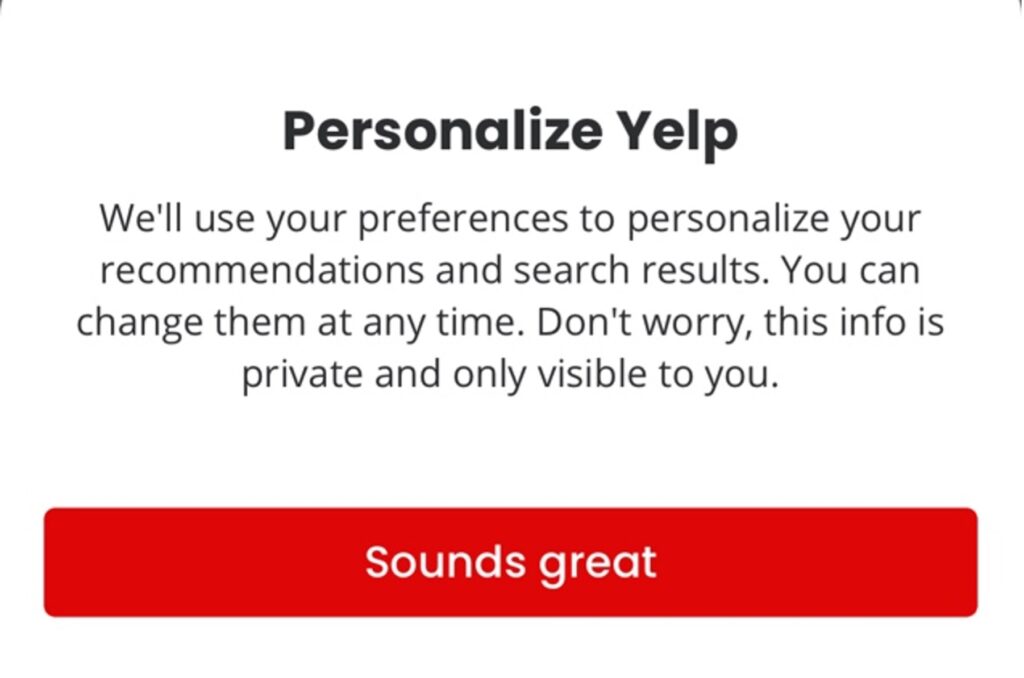
Rather than collecting zero-party data to monetarily compensate individuals, Yelp does so in a transparent way that ultimately improves the customer experience. Customers can disclose category preferences in exchange for a more personalized recommendation engine. At the same time, Yelp clearly communicates how it uses their data and how to control what is shared.

Yelp

Zero-party data is useless if you don’t know how you’ll use it

Companies often set out to collect all the data they can possibly find and figuring out how they’re going to use it after the fact. But collection of data is vastly different from usage of data. Having a defined data roadmap is key to zero-party data success—organizations that are intentional with data reap the benefits of working more effectively. They’re strategically aligned at the outset (i.e., when defining what data to collect and for what purpose) and work with highly relevant and qualified datasets.

When developing a data roadmap, start by identifying business outcomes and consider the data required to evaluate success for each—what analyses will be conducted, what data is needed, where will the data come from, how will it be collected, and what are the measures of success? A simplified data roadmap meant to highlight the zero-party data collected through user-submitted preferences in-app could be as simple as:

  • Business objective: Increase engagement through improved user value.
  • Data usage goal: Enhance user experience through personalized recommendations.
  • Methods for data analysis: Segmentation analysis, machine learning algorithms
  • Data sources: Mobile app analytics, customer profiles
  • Data collection: In-app preference center, in-app events (SDK)
  • Data needed: Zero-party (customer preferences, e.g., dietary restrictions), first-party (behaviors, e.g., search queries)
  • KPIs: Daily active users, session duration, session frequency, retention rate

From the consumer perspective, transparency around the intended use of collected data is paramount to building loyalty. Trust will erode quickly if consented data is used for other purposes without their knowledge and permission.

Trusting your consumer and knowing when to let go

We often use the analogy that poor data collection practices and data misuse are akin to breaking up with someone who refuses to leave your doorstep. No matter how many times you say you aren’t interested, the person refuses to accept that it is over. Companies need to think about their data practices as relationships with their consumers. And no one wants a bad relationship! 

Zero-party data is the most accurate data you’ll collect, as long as consumers are motivated to trust and respect you as well. Create a fair and balanced value exchange, communicate what you’re collecting and how you’ll use the data, and make it abundantly clear (and easy) for customers to make changes or opt out at any time.

Zero-party data has a bright future; it’s a lucrative path for the businesses that want to put in the time and effort needed to get it right. Failure to proceed with diligence comes with a warning, however—58% of consumers surveyed said they are willing to stop doing business with a company that has a bad reputation around data.

The future is promising for companies that understand the importance of data privacy and ethical data use through transparency and choice. 

https://www.adweek.com/performance-marketing/consumer-relationships-financial-incentives-zero-party-data/