3 Major Ways Generative AI Is Redefining Search


.article-native-ad { border-bottom: 1px solid #ddd; margin: 0 45px; padding-bottom: 20px; margin-bottom: 20px; } .article-native-ad svg { color: #ddd; font-size: 34px; margin-top: 10px; } .article-native-ad p { line-height:1.5; padding:0!important; padding-left: 10px!important; } .article-native-ad strong { font-weight:500; color:rgb(46,179,178); }

Check out Commerceweek, Adweek’s destination for retail innovation. Enhance sales strategy across touchpoints with tips from top marketers. February 28-29 in NYC and virtual. Register.

The generative AI race is well underway, and we’re already seeing applications in advertising and marketing for creative ideation and development. This includes one of the key pillars of digital advertising—search. As consumers, we have grown accustomed to being overwhelmed with ads and information in search engines, while being underwhelmed by experiences and results from brands on their own sites. 

In the last six months, the breadth and pace of innovation has been intense. Google has had more core updates and helpful content updates targeting potential misuses of gen AI. At the same time, they’ve expanded their own use of their Search Generative Experience, which is constantly improving and prompting important debates in the SEO community. Microsoft’s Bing has expanded its partnership with OpenAI, and CEO Satya Nadella’s annual shareholder letter could have been called the “Copilot chronicle” expansion. This doesn’t even cover the mind-blowing expansion of image generation and other advancements over this same period of time. 

Brands must recalibrate their approach to harness the potential of these emerging technologies. Gen AI is revolutionizing online search experiences with three pivotal shifts every brand should keenly understand.

Dialogue over monologue 

For over 25 years, people have become accustomed to using shorthand when searching for something online. Searching in keywords is a skill that grows increasingly complex as the amount of available online content skyrockets, and by using more keywords in each query, people have attempted to find more precise or helpful information. This is often termed the “long tail” of search and has also caused a gap between how people normally speak with how they search online.

For instance, if someone’s ankle is hurting, they might type into a search engine, “ankle pain lower heel.” Today, this kind of search will usually return a list of monologues, such as nearby orthopedic surgeons or conditions where pain could be indicative of something serious. Alternatively, conversational AI is now able to begin a dialogue, perhaps by asking basic questions like, “How long has your ankle been hurting?” Instead of just trying to rank with SEO for a string of keywords, gen AI will enable marketers to help people refine their concerns or questions through natural, humanized conversations.

For marketers, these dialogues will drive massive changes in their quest for personalization. With conversational AI as the interface, consumers can share exactly what they want to share, and brands can focus on great responses instead of suboptimal guesses. Once consumers become more comfortable with engaging in a dialogue, the days of creepy targeted ads and invasions of consumer privacy will be over. When a consumer freely offers details on what they seek and why, the brand can leverage that zero-party data to personalize their experience. Trust is built through dialogues, not infinite monologues algorithmically ranked in search engine results.

Most importantly, these AI-driven dialogues open unprecedented opportunities for brands to engage each person individually. AI-powered discussions will meet every consumer where they are in terms of their language, reading level, cadence and more—an entirely new level of cognitive accessibility. 

Offers, not ads 

The future of AI-powered conversations points to sweeping changes in brands’ approach to advertising. Today, significant portions of ad budgets are spent on merely defending objective search questions in top search engines: “What time does [brand] store open?” “Does [brand] have [service] available near me?” These types of questions often require defensive ad expenditure, even though the question is clearly for a particular brand. But competitors bid on these brand terms and similar keywords to try to disintermediate the consumer from their brand.

Instead of defending their brand, marketers will be able to shift from ads to offers with gen AI. 90% of consumers find targeted ads intrusive and annoying—often to the point of depleting the consumer experience. However, if a consumer has a trusted dialogue with a brand, sharing only the information necessary to get the answers they need, then brands can deliver truly individualized offers. For example, a consumer planning a trip could engage with a resort directly by first indicating interest in visiting, and the resort could ask questions such as what dates the consumer wants to travel and who they’ll be traveling with. After gathering specific information, the resort is well-equipped to share offers such as activity and room discounts relevant to the consumer and what they’re looking for.

Where in that exchange is an ad appropriate? Never. Conversations like these build trust and enable the brand to customize an offer that meets the needs of that individual customer. This is the future of offer-based interactions, directly controlled by a dialogue with the customer. 

Moving from privacy-invasive ad models to trust-centric dialogue models will take time. But for objective questions—which often directly precede conversion and purchase decisions—brands will utilize gen AI aggressively to take back the consumer dialogue from centralized search systems that seek to monetize ad spend. 

Subjective data over objective data 

Gen AI’s transformation of search starts with a massive surge of AI or AI-human output. The internet is about to see infinite content growth that will clog classic, centralized search or force it to reconsider its algorithms. This is somewhat inevitable, as marketing monologues are still necessary to attract traffic. Despite cries of resistance from SEO strategists, the use of gen AI to create billions of relatively useless blog posts is well underway. 

With infinite content comes infinite subjectivity and misinformation. However, objective facts about a singular business will only come directly from that business or brand. For instance, when a consumer searches “What time does Wendy’s open?” they don’t want to see irrelevant answers (or ads) from 10 other restaurants. Wendy’s should be known as the authority on this type of objective question, and a competitor shouldn’t spend ad money on these types of scenarios. 

Compare this to subjective questions, where both ads and centralized search have inherent value. With seaches like “best burgers near me,” there is a genuine benefit for centralized search systems. The issue here, however, is that gen AI will cause such an explosion in subjective content that major search engines will need to carefully prioritize how to answer these questions. Reviews and digital opinions already suffer from inauthenticity, but the next wave of AI-generated subjective content will be impossible to prevent. 

Once consumers become more familiar with objective search benefits, gen AI dialogue will create opportunities for brands to have honest conversations and find out what consumers want. A dialogue (through search and chat) powered by gen AI and authoritative knowledge graphs of information is the best way to get started. 

Tech savviness has long been critical for marketers to succeed. And while gen AI’s impact on the industry is just beginning, now is the time for marketers to better understand how it affects and will affect search and chat. By embracing the opportunities AI creates—trust-centric dialogues and personalized offers based on objective data—marketers have more opportunities to personalize their campaigns and build deeper, more trusted relationships with their customers. 

.font-primary { } .font-secondary { } #meter-count { position: fixed; z-index: 9999999; bottom: 0; width:96%; margin: 2%; -webkit-border-radius: 4px; -moz-border-radius: 4px; border-radius: 4px; -webkit-box-shadow: 0 0px 15px 4px rgba(0,0,0,.2); box-shadow:0 0px 15px 4px rgba(0,0,0,.2); padding: 15px 0; color:#fff; background-color:#343a40; } #meter-count .icon { width: auto; opacity:.8; } #meter-count .icon svg { height: 36px; width: auto; } #meter-count .btn-subscribe { font-size:14px; font-weight:bold; padding:7px 18px; color: #fff; background-color: #2eb3b2; border:none; text-transform: capitalize; margin-right:10px; } #meter-count .btn-subscribe:hover { color: #fff; opacity:.8; } #meter-count .btn-signin { font-size:14px; font-weight:bold; padding:7px 14px; color: #fff; background-color: #121212; border:none; text-transform: capitalize; } #meter-count .btn-signin:hover { color: #fff; opacity:.8; } #meter-count h3 { color:#fff!important; letter-spacing:0px!important; margin:0; padding:0; font-size:16px; line-height:1.5; font-weight:700; margin: 0!important; padding: 0!important; } #meter-count h3 span { color:#E50000!important; font-weight:900; } #meter-count p { font-size:14px; font-weight:500; line-height:1.4; color:#eee!important; margin: 0!important; padding: 0!important; } #meter-count .close { color:#fff; display:block; position:absolute; top: 4px; right:4px; z-index: 999999; } #meter-count .close svg { display:block; color:#fff; height:16px; width:auto; cursor:pointer; } #meter-count .close:hover svg { color:#E50000; } #meter-count .fw-600 { font-weight:600; } @media (max-width: 1079px) { #meter-count .icon { margin:0; padding:0; display:none; } } @media (max-width: 768px) { #meter-count { margin: 0; -webkit-border-radius: 0px; -moz-border-radius: 0px; border-radius: 0px; width:100%; -webkit-box-shadow: 0 -8px 10px -4px rgba(0,0,0,0.3); box-shadow: 0 -8px 10px -4px rgba(0,0,0,0.3); } #meter-count .icon { margin:0; padding:0; display:none; } #meter-count h3 { color:#fff!important; font-size:14px; } #meter-count p { color:#fff!important; font-size: 12px; font-weight: 500; } #meter-count .btn-subscribe, #meter-count .btn-signin { font-size:12px; padding:7px 12px; } #meter-count .btn-signin { display:none; } #meter-count .close svg { height:14px; } }

Enjoying Adweek’s Content? Register for More Access!

https://www.adweek.com/performance-marketing/3-major-ways-generative-ai-is-redefining-search/


It’s Not Easy Being Green: Preparing for the FTC’s Updated Green Guides


.article-native-ad { border-bottom: 1px solid #ddd; margin: 0 45px; padding-bottom: 20px; margin-bottom: 20px; } .article-native-ad svg { color: #ddd; font-size: 34px; margin-top: 10px; } .article-native-ad p { line-height:1.5; padding:0!important; padding-left: 10px!important; } .article-native-ad strong { font-weight:500; color:rgb(46,179,178); }

Head to the Retail Media Summit—on November 2 at the Mall of America, MN—to find out how RMNs can work for you by delivering first-party data from customers close to the point of purchase. Register.

Over the past five years, products making environmental, social and governance (ESG) claims have outpaced those that do not, according to a joint McKinsey and NielsenIQ study. ESG products now account for nearly half of all retail sales in examined categories.

Companies that value sustainability also want to deepen brand loyalty with consumers who prioritize purchasing products that have a reduced impact on the environment. Thus, misleading claims about environmental benefits, aka greenwashing, pose a substantial risk to gaining traction with consumers who put their trust in such claims. Advertisers run reputational risks by making misleading environmental marketing claims, as well as substantial regulatory and litigation risks.

As the Federal Trade Commission gears up for its once-a-decade update to the Green Guides, scheduled for release in 2024, advertisers should be paying attention. Updated Green Guides should provide marketers with the tools needed to navigate the environmental marketing landscape with confidence, ensure they maintain consumer trust and comply with up-to-date regulatory standards in an era where such claims significantly shape consumer purchasing decisions. 

The BBB National Programs’ National Advertising Division (NAD)—the independent regulator monitoring for truth in advertising—has referenced and relied upon the FTC’s Green Guides in more than 40 cases spanning diverse product categories, filling gaps and applying the Green Guides to claims we see in marketing today that might not be specifically addressed in the decade-old guidance.

Consumers benefit when advertisers and marketers lean into this guidance when crafting and substantiating their claims because truthful environmental advertising helps consumers better understand the impacts of the products they purchase. Companies large and small also benefit when advertising claim substantiation is held to common standards because it levels the playing field, allowing for fair competition.

Adherence to standards set in the FTC’s guidance builds consumer trust when “sustainable” or “green” marketing claims are used consistently whether a person is buying toothpaste, detergent, soda or even fuel for their cars. Consistent standards similarly protect against litigation risk, as consumers are not misled by green claims that are used consistently across industries.

Approach green marketing with these guardrails in mind to help build consumer trust in green claims.

Specific claims and clear definitions 

“Eco-friendly,” “green,” “sustainable.” Marketers may think these general terms are so broad they don’t require substantiation, or that initial efforts to improve sustainability will back up such claims. However, the Green Guides make clear that the opposite is true: Claims that are subject to multiple interpretations require that the advertiser substantiate all reasonable takeaways.

Take a popular term like “clean beauty.” What does it mean? For most consumers, it is likely seen as vague and subjective. It could mean that no toxic ingredients are used, that the product is vegan or that the brand does not test the product on animals. Or is it referring to labor practices? Consumers need clear and precise definitions in advertising and on product packaging to identify products that align with their values and preferences to make informed choices.

Rather than using vague, broad or easily misunderstood terms, highly specific claims provide clear and tangible information about a product’s environmental benefits. Specific claims also offer consumers a precise understanding of what makes that product environmentally friendly. By stating that a product “reduces water consumption by 50%,” the public can more easily grasp the product’s impact on the environment. Additionally, specific claims are easier to verify, and businesses can provide evidence and data to support their specific claims.

Remember, a brand is responsible for all reasonable takeaways of a vague claim, making them particularly risky. That responsibility extends to influencer marketing, endorsements and PR placements as well. 

Aspirational claims 

Addressing aspirational claims, especially those like “net zero” that go beyond current Green Guide guidance, requires careful consideration. Businesses must have clear and achievable objectives for reaching such goals before advertising them, and set specific targets and timelines together with a plan to reach those milestones. Additionally, these objectives should be realistic and backed by sufficient investment to achieve the target, with robust monitoring to track progress.

Recently, the National Advertising Review Board, NAD’s appellate body, recommended that a major meat producer discontinue certain claims related to its goal of achieving net zero emissions by 2040 because the company was still in the exploratory stage of this effort without a concrete plan in place to achieve the goal. 

Transparent partnerships 

In environmental advertising, transparency about partnerships with environmental groups can be beneficial. Instead of merely mentioning these partnerships, businesses should limit their advertising to the tangible benefits they offer. This transparency not only builds trust but also helps consumers understand the genuine commitment to sustainability. Here, it’s important to position the marketing in such a way that the consumer is not misled as to the extent of the benefits of the partnership.

Recently, NAD assessed claims made by a major beverage corporation regarding its recycling program. While certain claims were supported, others regarding the company’s participation with third-party partners overstated the actual work being done. If the message is intended to convey future plans or goals rather than current work, it must be clearly communicated.

Thriving in the evolving landscape 

The NAD’s advertising self-regulation provides companies with a way to uphold standards for advertising claims and keep competitors accountable for the accuracy of their claims, contributing to the overall integrity of green marketing practices. Advertising that may be misleading or deceptive harms both consumers and fair competition. 

Fostering a fair and transparent marketplace maintains the value that green claims provide to brands and supports their investments in sustainability initiatives. More broadly, however, it builds progress on lofty goals like reducing carbon emissions across industries.

The FTC’s upcoming Green Guides update reminds businesses that environmental marketing strategies should align with updated guidance. By prioritizing accuracy and transparency, companies can build consumer trust, avoid greenwashing risks, potential litigation and penalties, and, hopefully, lessen their impact on the planet.

These updates aren’t just about compliance; they’re an opportunity for businesses to demonstrate their commitment to sustainability, build value for their investments and contribute to a more trustworthy marketplace and a more sustainable future for all.

.font-primary { } .font-secondary { } #meter-count { position: fixed; z-index: 9999999; bottom: 0; width:96%; margin: 2%; -webkit-border-radius: 4px; -moz-border-radius: 4px; border-radius: 4px; -webkit-box-shadow: 0 0px 15px 4px rgba(0,0,0,.2); box-shadow:0 0px 15px 4px rgba(0,0,0,.2); padding: 15px 0; color:#fff; background-color:#343a40; } #meter-count .icon { width: auto; opacity:.8; } #meter-count .icon svg { height: 36px; width: auto; } #meter-count .btn-subscribe { font-size:14px; font-weight:bold; padding:7px 18px; color: #fff; background-color: #2eb3b2; border:none; text-transform: capitalize; margin-right:10px; } #meter-count .btn-subscribe:hover { color: #fff; opacity:.8; } #meter-count .btn-signin { font-size:14px; font-weight:bold; padding:7px 14px; color: #fff; background-color: #121212; border:none; text-transform: capitalize; } #meter-count .btn-signin:hover { color: #fff; opacity:.8; } #meter-count h3 { color:#fff!important; letter-spacing:0px!important; margin:0; padding:0; font-size:16px; line-height:1.5; font-weight:700; margin: 0!important; padding: 0!important; } #meter-count h3 span { color:#E50000!important; font-weight:900; } #meter-count p { font-size:14px; font-weight:500; line-height:1.4; color:#eee!important; margin: 0!important; padding: 0!important; } #meter-count .close { color:#fff; display:block; position:absolute; top: 4px; right:4px; z-index: 999999; } #meter-count .close svg { display:block; color:#fff; height:16px; width:auto; cursor:pointer; } #meter-count .close:hover svg { color:#E50000; } #meter-count .fw-600 { font-weight:600; } @media (max-width: 1079px) { #meter-count .icon { margin:0; padding:0; display:none; } } @media (max-width: 768px) { #meter-count { margin: 0; -webkit-border-radius: 0px; -moz-border-radius: 0px; border-radius: 0px; width:100%; -webkit-box-shadow: 0 -8px 10px -4px rgba(0,0,0,0.3); box-shadow: 0 -8px 10px -4px rgba(0,0,0,0.3); } #meter-count .icon { margin:0; padding:0; display:none; } #meter-count h3 { color:#fff!important; font-size:14px; } #meter-count p { color:#fff!important; font-size: 12px; font-weight: 500; } #meter-count .btn-subscribe, #meter-count .btn-signin { font-size:12px; padding:7px 12px; } #meter-count .btn-signin { display:none; } #meter-count .close svg { height:14px; } }

Enjoying Adweek’s Content? Register for More Access!

https://www.adweek.com/commerce/green-advertising-ftc-2024-guide/


LGBTQ+ Culture Challenges Brands to Set New Goals Beyond Profit


When a campaign focused on LGBTQ+ communities wins on the awards circuit, the reality of industry rainbow-washing forces me to ponder: What was the motivation for entering this work?

Look, for example, to the Effie Awards. For those with an eye on market impact, they set the bar high for whether intended strategies become brand realities. You’d imagine this forum celebrating the proven fulfillment of consumer needs might include LGBTQ+ community representation, as we’ve made plenty of our needs known.

Yet their trends report shows that “more progress is needed,” as only 2% of entrants included LGBTQ+ group members. This is commensurate with the industry, sadly: Less than 2% of mainstream ads include queer people. 

Cast aside the glaring disparity for a moment, given that LGBTQ+ people are a self-reported 7.1% of the country, and that 34% of consumers say they’re more likely to buy from brands supporting LGBTQ+ rights. Then consider this number in the context of expanding marketing visibility: Yes, 2023 brought notable missteps and marketer trepidation, but we’re seeing more LGBTQ+ representation than we did years ago, and we’re being discussed more.

This begs the question: Are brands creating LGBTQ+ campaigns simply to placate the community? When work is put forward for recognition, we know the goal for the brand and agency, but what’s the goal for the community? If we’re actually advancing LGBTQ+ inclusion, but still face this low volume of entered queer cases, there are three scenarios to consider:

  1. Campaigns crafted for LGBTQ+ communities are not being designed with tangible, strategic goals.
  2. Campaigns crafted for LGBTQ+ communities are not created in a way that delivers on those goals.
  3. Both.

I’m going to guess it’s option 3, not out of cynicism but from a perspective that humans aren’t always great at stating objectives. People talk more about buying a house but less about contacting a realtor, more about having abs but less about finding a trainer. We know what we want, but the steps to get there feel daunting.

It’s easier for the humans who make brand decisions to say, “We want to support and uplift the LGBTQ+ community,” than to state a first step: “To do that, we’re ready to create a campaign that provides jobs to 25 underprivileged, young queer people.” Both statements are positive, but the latter makes you accountable.

As a gay man, there’s a mental disconnect between LGBTQ+ absence in advertising effectiveness standards and our community’s proven ability to get things done. We just witnessed a Pride month where celebration and progress advanced without any notable boom in brand support. Our U.K. friends at Outvertising led a worldwide pledge whereby partners held themselves accountable to new actions. But brands weren’t developing or sharing their own standards for proven progress.

LGBTQ+ communities provide prime opportunities to demonstrate excellence in effectiveness because we’re constantly at the forefront of meaningful social change. Because we have to be. If you’re a brand that likes to get shit done, it’s clear that we’re ready to collaborate. And if your creative efforts can engage LGBTQ+ people, you develop advantages in reaching everyone else.

So I ask brands and marketing leaders to consider a future where you specifically redesign and publicly share goals that have mutual business and community benefit to advance ROI conversations past sheer profit. Put the trainer before the abs, and discuss what those goals can look like.

Goals can mean the journey

A meme said it best: While the destination is important, “the journey is usually the part you remember anyways.” And while I’m definitely asking for a proven destination in terms of measured impact for marketers and communities, the consumer journey itself should certainly be a standout element of that impact. Think past well-worn summary goals of exposures, and reflect on the meaning of those interactions. 

Accounting for controversies around its pricing, Gilead is still a prime example of this principle in action. Their public commitments on LGBTQ+ education and transgender justice, and their contributions to help end the HIV epidemic by 2030, demonstrate that they’re working toward a very specific challenge, that they’re in for the long haul, and that the very nature of the work will be led with the community via the HRC.

Beyond coverage and exposure, partnership itself can be a metric if the stated objective is to connect to a community that’s leading progress. The journey will yield interactions, discussions, policy, personal sharing, community engagements, hand-raising and more—all of which can be quantified beyond media impressions relative to spend. Ask yourself and your teams, with an open mind: What elements of the creation and co-creation process are themselves proof of investment in a community?

Goals can mean connection 

While the journey speaks to meaningful interactions along the path to your destination, connection references who you’re with along the way. The Trevor Project, with all of its major brand partners, is a prime example. Connection and community can be a goal, too, and that means a lot to an LGBTQ+ community that still lacks united movements around vital concerns.

Every youth reached, every counselor trained, every story told is a strategic exercise in creating scale and formalizing audience. And relative to many efforts measured by how many people you paid to reach, the impact is measured in how many people step up to help this brand. We use the term “connection” in broad terms in creating our work, but can we envision goals in terms of how we formalize shared passions—connections that endure?

Goals can mean education

As one example, from a past SXSW session I was honored to be part of, sex in advertising has traditionally been a series of heterosexual stereotypes—and as LGBTQ+ people and sex culture are included in marketing, we realized it needed to look less like tropes and more like education. So, a larger question: What are impressions without education? What is brand exposure without learning and the changed behaviors that demonstrate learning?

Grindr has delivered work with local and digital communities to improve mpox education for the health of the larger community, taking steps to ensure key information about mpox reached LGBTQ+ people. A brand that’s all about local networks and discussion took steps to change those discussions and leverage those networks, creating knowledge amid disinformation. If your brand used its information and networks to educate rather than publicize, what would be the impact? What new objectives become possible?

All these efforts lead to impressions, reach, exposures, sponsorship assets and conversions. They build business and revenue. But they’re not architected solely to generate revenue; that’s why they’re effective. Ultimately, there’s a pretty simple solution to your goal: You could publicly commit to creating one LGBTQ+-focused case that is worth entering in the Effies this year. Or you can publicly declare what LGBTQ+ community organization will lead the way in co-creating your objectives in these efforts.

No, awards shouldn’t lead the creative process, but the statement would show that you’re willing to move accountability in new, tangible directions. Consider how few cases it would take to double the 2% status quo. Understand how far this advances you beyond rainbow logo efforts—which present diminishing returns at a time where our community faces greater pressures.

But, as young people say today, eff around and find out. Do it in December, to set yourself up for making a proven difference in the new year. Know that if you fall short, we’ll genuinely be glad you tried. Show that you embrace not only LGBTQ+ communities and their dollars, but that you also embrace our spirit. Show us that you’re ready to get things done for us, with us. 

.font-primary { } .font-secondary { } #meter-count { position: fixed; z-index: 9999999; bottom: 0; width:96%; margin: 2%; -webkit-border-radius: 4px; -moz-border-radius: 4px; border-radius: 4px; -webkit-box-shadow: 0 0px 15px 4px rgba(0,0,0,.2); box-shadow:0 0px 15px 4px rgba(0,0,0,.2); padding: 15px 0; color:#fff; background-color:#343a40; } #meter-count .icon { width: auto; opacity:.8; } #meter-count .icon svg { height: 36px; width: auto; } #meter-count .btn-subscribe { font-size:14px; font-weight:bold; padding:7px 18px; color: #fff; background-color: #2eb3b2; border:none; text-transform: capitalize; margin-right:10px; } #meter-count .btn-subscribe:hover { color: #fff; opacity:.8; } #meter-count .btn-signin { font-size:14px; font-weight:bold; padding:7px 14px; color: #fff; background-color: #121212; border:none; text-transform: capitalize; } #meter-count .btn-signin:hover { color: #fff; opacity:.8; } #meter-count h3 { color:#fff!important; letter-spacing:0px!important; margin:0; padding:0; font-size:16px; line-height:1.5; font-weight:700; margin: 0!important; padding: 0!important; } #meter-count h3 span { color:#E50000!important; font-weight:900; } #meter-count p { font-size:14px; font-weight:500; line-height:1.4; color:#eee!important; margin: 0!important; padding: 0!important; } #meter-count .close { color:#fff; display:block; position:absolute; top: 4px; right:4px; z-index: 999999; } #meter-count .close svg { display:block; color:#fff; height:16px; width:auto; cursor:pointer; } #meter-count .close:hover svg { color:#E50000; } #meter-count .fw-600 { font-weight:600; } @media (max-width: 1079px) { #meter-count .icon { margin:0; padding:0; display:none; } } @media (max-width: 768px) { #meter-count { margin: 0; -webkit-border-radius: 0px; -moz-border-radius: 0px; border-radius: 0px; width:100%; -webkit-box-shadow: 0 -8px 10px -4px rgba(0,0,0,0.3); box-shadow: 0 -8px 10px -4px rgba(0,0,0,0.3); } #meter-count .icon { margin:0; padding:0; display:none; } #meter-count h3 { color:#fff!important; font-size:14px; } #meter-count p { color:#fff!important; font-size: 12px; font-weight: 500; } #meter-count .btn-subscribe, #meter-count .btn-signin { font-size:12px; padding:7px 12px; } #meter-count .btn-signin { display:none; } #meter-count .close svg { height:14px; } }

Enjoying Adweek’s Content? Register for More Access!

https://www.adweek.com/creativity/lgbtq-culture-challenges-brands-beyond-profit/


Building a Generative AI System You Can Trust


.article-native-ad { border-bottom: 1px solid #ddd; margin: 0 45px; padding-bottom: 20px; margin-bottom: 20px; } .article-native-ad svg { color: #ddd; font-size: 34px; margin-top: 10px; } .article-native-ad p { line-height:1.5; padding:0!important; padding-left: 10px!important; } .article-native-ad strong { font-weight:500; color:rgb(46,179,178); }

Media and marketing pros from Warner Bros, YouTube, Tubi and more will share insights, perspectives and advice on how to keep up in this ever-changing industry. Join them in LA at the Convergent TV Summit on October 25.

Working with artificial intelligence can be polarizing. The future possibilities of generative AI create a sense of hope … and fear.

We’ve been working with AI at our creative agency Omelet for a few years now. In early 2020, we started using AI to help automate the mundane parts of the banner localization process. Earlier this year, we released a natural language processing-powered web tool, Hikup, to help anyone be more mindful of the language they use.

#paywall-subscribe { margin:0; padding: 1rem 2.4rem; } #paywall-subscribe .holder { background-color:#eee; border:15px solid #f2f2f2; padding:30px; margin:0 auto!important; text-align:center; } #paywall-subscribe a.underline { color:#000; text-decoration:underline; } #paywall-subscribe img { margin-bottom:10px; width: 140px!important; height: auto!important; } #paywall-subscribe h3 { font-weight:bold; font-size:16px; text-transform:uppercase; width:80%; margin:0 auto; margin-bottom:20px; text-align:center; } #paywall-subscribe h3 span { display:block; font-size:14px; } #paywall-subscribe h2 { font-weight:800; font-size:24px; text-transform:uppercase; } #paywall-subscribe p { font-size: 16px; color:#000; padding: 0; } #paywall-subscribe .cta { margin-top:20px; margin-bottom:10px; font-size:14px; text-transform:capitalize; color: #fff; background-color: #E50000; border:none; padding:12px 28px; text-decoration:none; -webkit-transition: .3s ease; -moz-transition: .3s ease; -o-transition: .3s ease; -ms-transition: .3s ease; transition: .3s ease; } #paywall-subscribe .cta:hover { color: #fff; background-color: #181818; transform: scale(1.02); } #paywall-subscribe .already-a-member { font-size:14px; } @media (max-width: 1024px) { #paywall-subscribe .holder { border:12px solid #f2f2f2; padding:25px; } #paywall-subscribe img { width: 120px!important; } } @media (max-width: 768px) { #paywall-subscribe .holder { border:10px solid #f2f2f2; padding:20px; } #paywall-subscribe img { width: 100px!important; } #paywall-subscribe h3 { font-size:14px; } #paywall-subscribe h3 span { font-size:12px; } #paywall-subscribe h2 { font-size:18px; } #paywall-subscribe p { font-size:14px; } #paywall-subscribe .cta { font-size:12px; padding:10px 24px; } #paywall-subscribe .already-a-member { font-size:11px; } } AW+

WORK SMARTER – LEARN, GROW AND BE INSPIRED.

Subscribe today!

To Read the Full Story Become an Adweek+ Subscriber

View Subscription Options

Already a member? Sign in

https://www.adweek.com/media/building-generative-ai-system-trust/


When It Comes to Ad Copy, Sustainability Is Not Green, It’s Gray


.article-native-ad { border-bottom: 1px solid #ddd; margin: 0 45px; padding-bottom: 20px; margin-bottom: 20px; } .article-native-ad svg { color: #ddd; font-size: 34px; margin-top: 10px; } .article-native-ad p { line-height:1.5; padding:0!important; padding-left: 10px!important; } .article-native-ad strong { font-weight:500; color:rgb(46,179,178); }

Earlier this month, Apple launched its eco-themed campaign, “Mother Nature.” While the initial hype, ranging from fanboying to scrutinizing, has subsided, the implications of the campaign on how sustainability is marketed in the future are just beginning.

In what can be deemed a critical moment for corporate sustainability, prominent early initiatives can shape norms and form habits for marketers and audiences alike. That is why it is important to look deeper at this campaign from all sides—environmental, regulatory and marketing—and apply the learnings moving forward.

Though this is only one campaign, this is bigger than Apple.

The modern version of ‘made with 100% real fruit’

While Apple has made notable sustainability strides, such as using “100% recycled materials in laptop enclosures” and investing in renewable energy projects, the issue lies in the technicalities of the campaign’s sustainability claims and language, like “carbon neutrality,” which are caveated at best.

[embedded content]

Though there was scrutiny in the press, it mostly focused on the old hat issue of Apple’s wasteful business model, centered around planned product obsolescence. America loves a good “based on a true story” narrative, regardless of how small the “true” percentage may be. So it is not surprising that most people, including marketers, bought into the premise of Apple’s campaign.

The brand executed an expertly crafted and beautifully designed assault on our perception, leaving many unaware of the subtle greenwashing. As a result, we tacitly accepted the intended narrative that read: “Thanks to our brilliance, the more stuff we make, the better off the planet will actually be. So go ahead and buy a carbon-neutral watch today.”

Persuasive marketing aside, there is a bigger reason at play here: Sustainability is not green, it is gray. It is a fledgling, highly-complicated field that is still finding its way.

Determining if a sustainability initiative has real impact or merely contributes to the plastic-straw effect, is often challenging, even for experts. Currently, the impact of corporate sustainability is brought to life in self-administered, annual reports. Apple’s campaign is de facto paraphrasing the key points of its 114-page environmental report.

But anyone who has built this type of report, or any board deck for that matter, knows that this is as much an exercise in crafting a narrative and cherry-picking the most advantageous “data” as it is in delivering facts.

So what were some gray areas in the Apple environmental report and subsequent campaign that may not have been seen by the naked eye?

Carbon neutrality is a clever marketing term

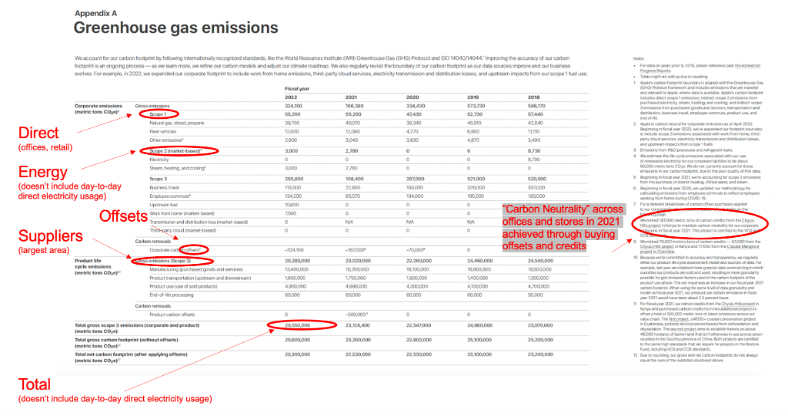
Apple aims for “carbon neutrality” in its supply chain by 2030. However, the term “carbon neutral” is a misnomer, suggesting that a company’s direct emissions can be erased by other actions elsewhere.

According to climate scientist David Ho, “There is no such thing as a carbon-neutral product because more stuff always has an impact.” Production and shipping, responsible for 78% of Apple’s emissions are energy intensive and heavily rely on fossil fuels. Until we exclusively use renewables (i.e.: solar, wind) for energy, any production will have an environmental impact.

100% Renewable electricity… with caveats

Apple has used, “100% renewable electricity for its direct operations since 2018.” But there is fine print.

The brand achieves this by investing in 1.5GW of global renewable energy projects, theoretically displacing the equivalent amount of fossil fuels. However, most Apple facilities still draw power from local grids. And in 2022, 75% of China’s and 60% of the US grid relied on fossil fuels. So in reality Apple’s renewables retroactively offset their annual use, while day-to-day electricity still leans on fossil fuels, releasing carbon.

Offset controversy

Carbon offsets seek to compensate for emissions through investing in projects like reforestation, or methane capture, elsewhere. Offsets have sparked debate with experts viewing them as a workaround for addressing direct emissions.

Even worse, recent studies suggest that offsets don’t work, pushing companies like Delta, Jet Blue and Gucci to abandon offsets. And in May, the European Parliament moved to ban carbon-neutrality marketing claims via offsets.

Hiding behind the trees

In “Mother Nature,” Apple proclaims, “We’ve planted forests to remove carbon from the atmosphere.” However, journalists, like Lisa Song from ProPublica, found that “reforestation offsets often miss pollution targets, with gains quickly reversed.”

Recently, The Guardian reported that over 90% of projects certified by Verra (who also certifies Apple’s projects) had minimal impact. Also, remarkably, this program began in 2015, driven by Apple’s paper usage concerns, a significant pivot from their 2023 “carbon removal” claim.

The path to 2030 is littered with dependencies

Apple’s emissions primarily come from manufacturing, managed by overseas suppliers. Thus to meet their targets Apple will need all 300+ of their suppliers to cooperate. While Apple’s commitment is commendable, cleaning up its entire supply chain by 2030 may prove overly optimistic given the complexity and historical issues involved.

How to read corporate emissions. The Emissions Table is located on Appendix A on Page 77.

Where does this leave us?

Apple is a global leader with immense influence. It’s crucial for the public, and for Apple, to recognize that Apple is not a sustainability company, but the world’s largest electronics manufacturer and that they are driven by profit. As Lisa Jackson, Apple’s vp of sustainability, recently stated: “Tim (Cook) has been really clear … this is not philanthropy. We’re not out just spending money so we can make this claim to make other people feel great. It has to be something that businesses in our supply chain can take on without sacrificing their ability to also make a profit.”

And, this is 100% ok. Sustainability should not be a tax; it needs to be beneficial for businesses. In fact, it already is.

The renewable energy Apple is investing in is actually cheaper than other forms of energy. Shipping goods by boat is more economical than doing it by plane. Recycling minerals can be 13x cheaper than extracting them from, well, Mother Nature. And that tree-hugging program? It’s actually an investment fund called the Restore Fund, in partnership with Goldman Sachs, and it is mandated to generate a profit.

Apple, and other large companies companies, don’t need to portray themselves as world-saving philanthropists or exaggerate their impact. It cheapens their efforts and creates a false narrative around how much more real work still needs to be done.

“Mother Nature” is actually a brilliant piece of creative—to take a drab corporate report and bring it to life with top-notch storytelling is genius. More brands in the space need to do that. If only they had toned down the self-congratulatory bravado and flexing and not used misleading terms like “carbon neutral,” they would have really hit the mark.

The environmental fine print is not open for debate

One could argue that Apple isn’t doing anything wrong, and their sustainable claims are technically legit. However, we should genuinely ask ourselves whether we really want sustainability to be based on technicalities and fine print. Is the world at risk of “burning down” (more rapidly) if we don’t change how we market sustainability? That’s open for debate.

What isn’t up for debate is this: if we fail to market sustainability with expertise and integrity, it will soon become just another gimmick adorning product packaging.

.font-primary { } .font-secondary { } #meter-count { position: fixed; z-index: 9999999; bottom: 0; width:96%; margin: 2%; -webkit-border-radius: 4px; -moz-border-radius: 4px; border-radius: 4px; -webkit-box-shadow: 0 0px 15px 4px rgba(0,0,0,.2); box-shadow:0 0px 15px 4px rgba(0,0,0,.2); padding: 15px 0; color:#fff; background-color:#343a40; } #meter-count .icon { width: auto; opacity:.8; } #meter-count .icon svg { height: 36px; width: auto; } #meter-count .btn-subscribe { font-size:14px; font-weight:bold; padding:7px 18px; color: #fff; background-color: #2eb3b2; border:none; text-transform: capitalize; margin-right:10px; } #meter-count .btn-subscribe:hover { color: #fff; opacity:.8; } #meter-count .btn-signin { font-size:14px; font-weight:bold; padding:7px 14px; color: #fff; background-color: #121212; border:none; text-transform: capitalize; } #meter-count .btn-signin:hover { color: #fff; opacity:.8; } #meter-count h3 { color:#fff!important; letter-spacing:0px!important; margin:0; padding:0; font-size:16px; line-height:1.5; font-weight:700; margin: 0!important; padding: 0!important; } #meter-count h3 span { color:#E50000!important; font-weight:900; } #meter-count p { font-size:14px; font-weight:500; line-height:1.4; color:#eee!important; margin: 0!important; padding: 0!important; } #meter-count .close { color:#fff; display:block; position:absolute; top: 4px; right:4px; z-index: 999999; } #meter-count .close svg { display:block; color:#fff; height:16px; width:auto; cursor:pointer; } #meter-count .close:hover svg { color:#E50000; } #meter-count .fw-600 { font-weight:600; } @media (max-width: 1079px) { #meter-count .icon { margin:0; padding:0; display:none; } } @media (max-width: 768px) { #meter-count { margin: 0; -webkit-border-radius: 0px; -moz-border-radius: 0px; border-radius: 0px; width:100%; -webkit-box-shadow: 0 -8px 10px -4px rgba(0,0,0,0.3); box-shadow: 0 -8px 10px -4px rgba(0,0,0,0.3); } #meter-count .icon { margin:0; padding:0; display:none; } #meter-count h3 { color:#fff!important; font-size:14px; } #meter-count p { color:#fff!important; font-size: 12px; font-weight: 500; } #meter-count .btn-subscribe, #meter-count .btn-signin { font-size:12px; padding:7px 12px; } #meter-count .btn-signin { display:none; } #meter-count .close svg { height:14px; } }

Enjoying Adweek’s Content? Register for More Access!

https://www.adweek.com/creativity/ad-copy-sustainability-is-not-green-its-gray/


Size, Fit, Quality: What Women Over 40 Want From Brands


.article-native-ad { border-bottom: 1px solid #ddd; margin: 0 45px; padding-bottom: 20px; margin-bottom: 20px; } .article-native-ad svg { color: #ddd; font-size: 34px; margin-top: 10px; } .article-native-ad p { line-height:1.5; padding:0!important; padding-left: 10px!important; } .article-native-ad strong { font-weight:500; color:rgb(46,179,178); }

“Ladies, never let anyone tell you you are past your prime,” Michelle Yeoh told the world as she accepted her Oscar, making history as only the second woman of color to win Best Actress in a Leading Role in 87 years and the first Asian woman to win the category in that same time span. 

Fashion brands have made significant strides over the past few years toward greater inclusion, diversity and representation. But they have been slow to shed their fixation on youth and celebrate women of all ages in their marketing. As a marketer of a brand that serves women over 40, I think constantly about how to meet our consumer where she is—to understand more deeply what she wants and what she needs.

At J. Jill, we surveyed women aged 40 to 70 to inform our brand research in 2022 and shed some light on this demographic’s real persona and sentiments. What we found was that brands that talk to her about giving her confidence are getting it wrong.

Women over 40 don’t need affirmation and empowerment; they already have it. They don’t need to derive confidence through a brand’s offerings; they’ve already got that. With a firm sense of self, she is looking for an informed style partner, rather than an authority. At J. Jill, we aptly operate by the maxim: “It’s not the outfit that makes the woman, it’s the woman that makes the outfit.”

What else does she have?

Based on our research, most women have two things that brands must understand: discernment and dimensionality. These two stood out to us because we felt fashion and society were all too often putting women in boxes. Our feelings were then supported by the data—and that was an exciting moment.

  1. Discernment: Women over 40 know what looks good on them—they are selective and choose trends over chasing them, with a particular attunement to fit, style and quality.
  2. Dimensions: Women over 40 today are multifaceted, active members of their communities. Whether they’re at the height of their careers or entering retirement, these women wear many hats and pursue new experiences and discoveries—with the financial means to realize them. 

What does she need? 

  1. Consistency: This group is time-starved as part of the sandwich generation between millennials and boomers, and as such, is juggling myriad responsibilities, interests and desires. With limited time, ease of browsing and the confidence a retailer will have what they’re looking for in terms of size, fit and quality is of upmost importance. Reduce the risk of disappointment, and these customers will stay with the brand. For J. Jill, we accomplish this by remaining customer-obsessed, ensuring that our store associates are informed style partners, not style authorities. 
  2. Versatility: Women over 40 are specifically interested in apparel that can move with them throughout their day and holds many use cases—basics that can be dressed up or down, take them from office to home and season to season. 
  3. Authentic representation: Women over 40 consistently state that they are tired of trying to relate to marketing messages targeted at younger audiences (or conversely, marketing that represents them in a stereotypical and patronizing way). These women respond to realistic, authentic representations of women like them—women who span different ages, shapes, sizes, backgrounds and societal roles. 

If the offering is right, the potential is huge 

In an age of diminishing brand loyalty due to social media, fast fashion and choice overload, this customer will stick with brands they can trust and consistently rely on to meet their needs. To drive the point further, a survey we ran in the first quarter of 2023 found that reliability is one of the key drivers behind women’s purchasing decisions:

  1. Who/what is most influencing your apparel purchases right now? 76% said: The product is made/sold by a brand that I am familiar and comfortable with. (We believe this is tied to trust in the brand and trust that the retailer will have what she is looking for in quality, style and size.)
  2. What would you expect from a retailer that wanted to meet the needs of your dynamic lifestyle and your unique needs? 72% said: They are reliable/I consistently find what I’m looking for.

In short, women over 40 are an unequivocal force in the consumer market. When it comes to marketing, brands would be wise to take note of women’s evolving roles, understand this audience’s expectations and give them attention through marketing that celebrates their totality, honors who they are and the stage of life they’re in and serves their unique needs. 

.font-primary { } .font-secondary { } #meter-count { position: fixed; z-index: 9999999; bottom: 0; width:96%; margin: 2%; -webkit-border-radius: 4px; -moz-border-radius: 4px; border-radius: 4px; -webkit-box-shadow: 0 0px 15px 4px rgba(0,0,0,.2); box-shadow:0 0px 15px 4px rgba(0,0,0,.2); padding: 15px 0; color:#fff; background-color:#343a40; } #meter-count .icon { width: auto; opacity:.8; } #meter-count .icon svg { height: 36px; width: auto; } #meter-count .btn-subscribe { font-size:14px; font-weight:bold; padding:7px 18px; color: #fff; background-color: #2eb3b2; border:none; text-transform: capitalize; margin-right:10px; } #meter-count .btn-subscribe:hover { color: #fff; opacity:.8; } #meter-count .btn-signin { font-size:14px; font-weight:bold; padding:7px 14px; color: #fff; background-color: #121212; border:none; text-transform: capitalize; } #meter-count .btn-signin:hover { color: #fff; opacity:.8; } #meter-count h3 { color:#fff!important; letter-spacing:0px!important; margin:0; padding:0; font-size:16px; line-height:1.5; font-weight:700; margin: 0!important; padding: 0!important; } #meter-count h3 span { color:#E50000!important; font-weight:900; } #meter-count p { font-size:14px; font-weight:500; line-height:1.4; color:#eee!important; margin: 0!important; padding: 0!important; } #meter-count .close { color:#fff; display:block; position:absolute; top: 4px; right:4px; z-index: 999999; } #meter-count .close svg { display:block; color:#fff; height:16px; width:auto; cursor:pointer; } #meter-count .close:hover svg { color:#E50000; } #meter-count .fw-600 { font-weight:600; } @media (max-width: 1079px) { #meter-count .icon { margin:0; padding:0; display:none; } } @media (max-width: 768px) { #meter-count { margin: 0; -webkit-border-radius: 0px; -moz-border-radius: 0px; border-radius: 0px; width:100%; -webkit-box-shadow: 0 -8px 10px -4px rgba(0,0,0,0.3); box-shadow: 0 -8px 10px -4px rgba(0,0,0,0.3); } #meter-count .icon { margin:0; padding:0; display:none; } #meter-count h3 { color:#fff!important; font-size:14px; } #meter-count p { color:#fff!important; font-size: 12px; font-weight: 500; } #meter-count .btn-subscribe, #meter-count .btn-signin { font-size:12px; padding:7px 12px; } #meter-count .btn-signin { display:none; } #meter-count .close svg { height:14px; } }

Enjoying Adweek’s Content? Register for More Access!

https://www.adweek.com/brand-marketing/what-women-over-40-want-from-brands/


Relying On Spanish Alone Does Not Ensure Your Brand Is Making an Impact


.article-native-ad { border-bottom: 1px solid #ddd; margin: 0 45px; padding-bottom: 20px; margin-bottom: 20px; } .article-native-ad svg { color: #ddd; font-size: 34px; margin-top: 10px; } .article-native-ad p { line-height:1.5; padding:0!important; padding-left: 10px!important; } .article-native-ad strong { font-weight:500; color:rgb(46,179,178); }

Editor’s note: In this article, Adweek deviated from its style of using Latinx due to the writer’s preference. Latine is a gender-neutral form of Latino.

Our beloved Spanish language has been used as the be-all-end-all of Hispanic marketing for too long. It’s been used almost exclusively in many cases to justify the marketing spend—a quick fix in a lackluster effort to get the job done.

But what if I told you, agencies and brand managers, that you can no longer target Latine consumers and audiences in Spanish? Could you justify the need without the language difference in your organization? This question is not meant to dismiss language as a powerful connector and an integral part of Latine culture. But it is only one element of the rich Hispanic community.

We all recognize this audience deserves attention. After all, Hispanics accounted for 52% of U.S. population growth between 2010 and 2021. It’s an audience of growing size and spending power that brands can no longer ignore.

Relying on Spanish alone does not ensure your brand is making an impact or driving relevancy and resonance. All it is truly doing is ensuring basic understanding, and if that were all that’s needed to make great marketing work, then every communication would get massive results purely for being in English.

But they don’t, right? So why is Spanish used that way?

Language is not a strategy

If you’ve been part of agency life in the past two decades, either in the diversity space or adjacent to it, you might feel the struggle of using only Spanish as a way to connect with the Latine community.

But language isn’t the only thing that can capture Latines’ attention, and applying Spanish or Spanglish isn’t a one-size solution to engagement. While most Latines speak Spanish, and many are rediscovering Spanish, U.S.-born (who make up two-thirds of the Latine population) and younger Latines are not as fluent (65% say they cannot carry a conversation well in Spanish), and are not as attached to language as a determinant of culture (78% say it’s not necessary to speak Spanish to be considered Latine).

Spanglish use is widespread among Latines (63% speak Spanglish at least sometimes), but relying on that alone in communications can often feel forced and inauthentic because it’s not the same for everyone and it’s not just any word that works if switched to another language.

What the industry needs to focus on is a deeper understanding of Latine consumers as people, not just as Spanish speakers or descendants, but what moves and drives them, in all their dimensionality.

Advancing cultural understanding

The industry has tried to brand things differently, from translating to transcreation (the process of adapting a message from one language to another while maintaining the original messaging), and from representative and inclusive to authentic. It’s tried to reinvigorate the integrated agency teams process to allow for insight sharing and collaboration.

In my personal experience, all agencies have been willing to learn, grow and adapt. All brand managers have been interested and positive about these changes, yet using Spanish continues to be the mainstay and is used in lieu of a deeper understanding of Latines, their culture and what makes them tick.

Meanwhile, marketing efforts fall back on rudimentary insights like “family is important to Hispanics,” and we justify these tactics to check boxes and obtain budget approval. It’s important to note that Latine, Latinx, Latino/a and Hispanic are used interchangeably today for a segment of people who live in the U.S., but that segment is not homogeneous.

More culturally resonant marketing requires advancement in the tactics and insights driving these efforts. It starts with understanding that there are nuances between Latine audience segments and identifying where your brand opportunity lies within the vast spectrum of Latinidad.

Deepen your understanding of who this audience segment is and what they need from your brand to deploy your message in its most effective manner. The first thing you need to do is talk to a vast array of Latines across the socioeconomic spectrum and across generations and backgrounds. Understand the people behind the labels, and then you can understand how to activate your brand’s opportunity within the audience.

As a marketer, immerse yourself in the culture. Listen to the music, eat the food, follow the sports and the athletes that identify as Latine in its many forms. Read books about and written by Latines. Approach the world as one you want to understand rather than one you want to sell your brand to. Understand what they love, and you will understand them as well.

In order to understand us, you need to dive into the culture and appreciate all of it, if you truly want your message to resonate in any language.

.font-primary { } .font-secondary { } #meter-count { position: fixed; z-index: 9999999; bottom: 0; width:96%; margin: 2%; -webkit-border-radius: 4px; -moz-border-radius: 4px; border-radius: 4px; -webkit-box-shadow: 0 0px 15px 4px rgba(0,0,0,.2); box-shadow:0 0px 15px 4px rgba(0,0,0,.2); padding: 15px 0; color:#fff; background-color:#343a40; } #meter-count .icon { width: auto; opacity:.8; } #meter-count .icon svg { height: 36px; width: auto; } #meter-count .btn-subscribe { font-size:14px; font-weight:bold; padding:7px 18px; color: #fff; background-color: #2eb3b2; border:none; text-transform: capitalize; margin-right:10px; } #meter-count .btn-subscribe:hover { color: #fff; opacity:.8; } #meter-count .btn-signin { font-size:14px; font-weight:bold; padding:7px 14px; color: #fff; background-color: #121212; border:none; text-transform: capitalize; } #meter-count .btn-signin:hover { color: #fff; opacity:.8; } #meter-count h3 { color:#fff!important; letter-spacing:0px!important; margin:0; padding:0; font-size:16px; line-height:1.5; font-weight:700; margin: 0!important; padding: 0!important; } #meter-count h3 span { color:#E50000!important; font-weight:900; } #meter-count p { font-size:14px; font-weight:500; line-height:1.4; color:#eee!important; margin: 0!important; padding: 0!important; } #meter-count .close { color:#fff; display:block; position:absolute; top: 4px; right:4px; z-index: 999999; } #meter-count .close svg { display:block; color:#fff; height:16px; width:auto; cursor:pointer; } #meter-count .close:hover svg { color:#E50000; } #meter-count .fw-600 { font-weight:600; } @media (max-width: 1079px) { #meter-count .icon { margin:0; padding:0; display:none; } } @media (max-width: 768px) { #meter-count { margin: 0; -webkit-border-radius: 0px; -moz-border-radius: 0px; border-radius: 0px; width:100%; -webkit-box-shadow: 0 -8px 10px -4px rgba(0,0,0,0.3); box-shadow: 0 -8px 10px -4px rgba(0,0,0,0.3); } #meter-count .icon { margin:0; padding:0; display:none; } #meter-count h3 { color:#fff!important; font-size:14px; } #meter-count p { color:#fff!important; font-size: 12px; font-weight: 500; } #meter-count .btn-subscribe, #meter-count .btn-signin { font-size:12px; padding:7px 12px; } #meter-count .btn-signin { display:none; } #meter-count .close svg { height:14px; } }

Enjoying Adweek’s Content? Register for More Access!

https://www.adweek.com/brand-marketing/spanish-hispanic-marketing-brand-impact/


To Engage Gen Z Latinos, Brands Should Lean Into Music, Spanglish and Tiktok


.article-native-ad { border-bottom: 1px solid #ddd; margin: 0 45px; padding-bottom: 20px; margin-bottom: 20px; } .article-native-ad svg { color: #ddd; font-size: 34px; margin-top: 10px; } .article-native-ad p { line-height:1.5; padding:0!important; padding-left: 10px!important; } .article-native-ad strong { font-weight:500; color:rgb(46,179,178); }

Editor’s note: In this article, Adweek deviated from its style of using Latinx due to the writer’s preference.

The Latino community comprises 19% of the U.S. population and exceeds 25% of Gen Z. This rapidly growing demographic is not only assimilating into America but impacting the broader culture in fascinating ways.

In four of the past five years, the most streamed artist on Spotify was Latino/a. We’re seeing a rapid growth of Hispanic stories told in general market platforms, such as Eva Longoria’s directorial debut film Flaming Hot on Hulu and John Leguizamo’s new series being renewed for a second season on MSNBC. This group is excited about their American future but maintains a stickiness to their Latino past. A whopping 39% of Hispanic Gen Zers report feeling “an amplified affinity to their ancestral legacy,” which is unique for a youth demographic to espouse.

The 2023 proprietary study titled The Latino Mosaic, commissioned by the U.S. Hispanic Chamber of Commerce and Chemistry (my advertising agency) uncovered insights to help brands successfully engage younger generations of multicultural consumers. To reach these dynamic, upwardly mobile trendsetters, brands should lean into three recent trends that have popped: Spanglish in advertising, a passion for music and leveraging the power of TikTok.

Spanglish

One of the most fascinating trendlines in this new paradigm is the fluidity of language. What used to be a binary choice between English and Spanish is now more akin to a spectrum.

Not surprisingly, English as a preferred language has grown exponentially by generation. 50% of first-generation Latinos prefer exclusively Spanish, while the number drops to only 4% of the third generation. However, counter-intuitively the opposite occurs with Spanglish.

Rather than merely having younger generations adopt English, as all immigrant groups did before, a full 20% of Gen Z Latinos prefer Spanglish over either language. In other words, something new and interesting is afoot. Younger gens are not merely assimilating, nor rejecting American culture, but rather inventing something that beautifully melds the two.

This cross-cultural nuance is evident in Spanish-language commercials that are increasingly airing on English-language broadcast television and Spanglish often appearing on previously Spanish-only networks like Univision and Telemundo. Furthermore, the prevalence of digital and social media has made it easier to target by language, helping marketers connect authentically with consumers in the way they communicate with each other.

Music

Another interesting shift is the exponential growth of Latin music. This is not only evident with the popularity of Reggaeton among the general population, but also its impact on Hispanics themselves.

When asked to choose their number one passion point from a list of eight options, a whopping 38% of Gen Z Latinos chose music. To put this in perspective, this was the choice of only 17% of Boomers, for whom sports remains their go-to entertainment. Brands should employ strategies to capitalize on this trend, including deals with up-and-coming Latin artists, experiential activations and weaving chart-topping Spanish-language tracks into creative across paid, earned and owned channels.

Furthermore, marketers should consider partnering with startups focused on Latino music to engage authentically. One celebrated new entrant is Ntertain, a vertically integrated venture launched by music icons Tommy Mottola and Lex Borrero, which includes talent management, label, promotion and concert production.

TikTok

Our Latino Mosaic study also found that 48% of Latinos are daily users of TikTok, as compared to only 36% of the general market. More remarkably, 20% of Latinos go to TikTok to “discover new brands,” which is nearly double the percentage for the broader community. Major brands such as Toyota, ESPN and the NFL have leveraged Spanglish ads with great success, ensuring the trend will only increase.

As the social media paradigm shifts, marketers should follow a few simple guidelines:

  • User-generated content continues to grow exponentially. Rather than “sales marketing,” brands should consider including creator partnerships in their strategy, which combines a product attribute with authentic messaging that originates directly from social influencers.
  • The data is in and crystal clear in telling us that language is fluid for younger generations who toggle back and forth between English and Spanish, sometimes in the same sentence. Brands should artfully adopt this approach to become organic participants in the conversation.
  • The number-one passion point for Gen Z Latinos is music, which is a departure from Gen X and Boomers who favored sports by a wide margin. Brands should turn the volume up and connect with the rhythms of the next generation.

Whether in entertainment, marketing, politics or business, a new way of communicating is emerging. Rather than run away from these rapidly shifting trends, brands should sprint towards engaging this target-rich environment that represents 25% of every birth in America today.

Simply put, it’s time to reframe la conversación.

.font-primary { } .font-secondary { } #meter-count { position: fixed; z-index: 9999999; bottom: 0; width:96%; margin: 2%; -webkit-border-radius: 4px; -moz-border-radius: 4px; border-radius: 4px; -webkit-box-shadow: 0 0px 15px 4px rgba(0,0,0,.2); box-shadow:0 0px 15px 4px rgba(0,0,0,.2); padding: 15px 0; color:#fff; background-color:#343a40; } #meter-count .icon { width: auto; opacity:.8; } #meter-count .icon svg { height: 36px; width: auto; } #meter-count .btn-subscribe { font-size:14px; font-weight:bold; padding:7px 18px; color: #fff; background-color: #2eb3b2; border:none; text-transform: capitalize; margin-right:10px; } #meter-count .btn-subscribe:hover { color: #fff; opacity:.8; } #meter-count .btn-signin { font-size:14px; font-weight:bold; padding:7px 14px; color: #fff; background-color: #121212; border:none; text-transform: capitalize; } #meter-count .btn-signin:hover { color: #fff; opacity:.8; } #meter-count h3 { color:#fff!important; letter-spacing:0px!important; margin:0; padding:0; font-size:16px; line-height:1.5; font-weight:700; margin: 0!important; padding: 0!important; } #meter-count h3 span { color:#E50000!important; font-weight:900; } #meter-count p { font-size:14px; font-weight:500; line-height:1.4; color:#eee!important; margin: 0!important; padding: 0!important; } #meter-count .close { color:#fff; display:block; position:absolute; top: 4px; right:4px; z-index: 999999; } #meter-count .close svg { display:block; color:#fff; height:16px; width:auto; cursor:pointer; } #meter-count .close:hover svg { color:#E50000; } #meter-count .fw-600 { font-weight:600; } @media (max-width: 1079px) { #meter-count .icon { margin:0; padding:0; display:none; } } @media (max-width: 768px) { #meter-count { margin: 0; -webkit-border-radius: 0px; -moz-border-radius: 0px; border-radius: 0px; width:100%; -webkit-box-shadow: 0 -8px 10px -4px rgba(0,0,0,0.3); box-shadow: 0 -8px 10px -4px rgba(0,0,0,0.3); } #meter-count .icon { margin:0; padding:0; display:none; } #meter-count h3 { color:#fff!important; font-size:14px; } #meter-count p { color:#fff!important; font-size: 12px; font-weight: 500; } #meter-count .btn-subscribe, #meter-count .btn-signin { font-size:12px; padding:7px 12px; } #meter-count .btn-signin { display:none; } #meter-count .close svg { height:14px; } }

Enjoying Adweek’s Content? Register for More Access!

https://www.adweek.com/brand-marketing/to-engage-gen-z-latinos-brands-should-lean-into-music-spanglish-and-tiktok/


Why Brand Assets Are So Important in B2B Marketing


.article-native-ad { border-bottom: 1px solid #ddd; margin: 0 45px; padding-bottom: 20px; margin-bottom: 20px; } .article-native-ad svg { color: #ddd; font-size: 34px; margin-top: 10px; } .article-native-ad p { line-height:1.5; padding:0!important; padding-left: 10px!important; } .article-native-ad strong { font-weight:500; color:rgb(46,179,178); }

Oracle is instantly recognizable by its bold red logo. Salesforce has Astro Nomical, its “warm and welcoming” mascot. Intel has that catchy chime. These are all examples of “brand assets,” and they’re increasingly important to B2B marketing success.

At LinkedIn’s B2B Institute, we commissioned one of the biggest studies ever on B2B branding. We partnered with Distinctive BAT, a company that measures and tracks distinctive brand assets, and analyzed more than 300 brand assets from 59 brands across six of the biggest categories in B2B: infrastructure as a service (IaaS), business intelligence (BI), customer relationship management (CRM), cybersecurity, business banking and business insurance.

What we found was startling. Most B2B companies do not have any distinctive brand assets, which is the foundation of effective brand management. We estimate that brand mismanagement is costing B2B firms billions of dollars in potential sales every year.

Why are brand assets so critical? As Jenni Romaniuk—professor, international director at the Ehrenberg-Bass Institute and a leading expert on branding—defines it, brand assets are “non-brand name elements that uniquely trigger the brand name for the vast majority of category buyers.” That’s a big deal for B2B buyers.

Brand assets increase performance in two ways. First, they make buyers more likely to notice—and recall—your marketing efforts, which improves marketing effectiveness and efficiency. Second, they make it easier for buyers to find your brand, online and offline, in a buying situation. They increase mental availability (easy to mind) and physical availability (easy to find), which helps companies grow volumes, prices and margins faster than competitors.

This is why the smartest investors like Warren Buffett buy companies with strong brand assets, which we call “brand moats”—a company’s ability to maintain competitive marketing advantage. In other words, it’s relatively easy for competitors to copy the product features of Coke, Apple and Geico, but you can’t copy their logos, characters and taglines without getting sued. Brand assets are legally protected trademarks, which means that branding may be the deepest moat of all. 

But how deep is the brand moat in B2B? It’s practically a puddle. 

In our research with Distinctive BAT, we surveyed B2B category buyers to calculate the relative recognition and attribution of over 300 B2B brand assets. Recognition is the percentage of buyers who recognize the asset; attribution is the percentage of buyers who then attribute the recognized asset to the correct brand. The best B2C example is likely the Geico Gecko: According to the Ehrenberg-Bass Institute, 87% of consumers recognize the gecko asset, and 98% know that asset belongs to Geico. That’s about as strong as a brand asset can get.

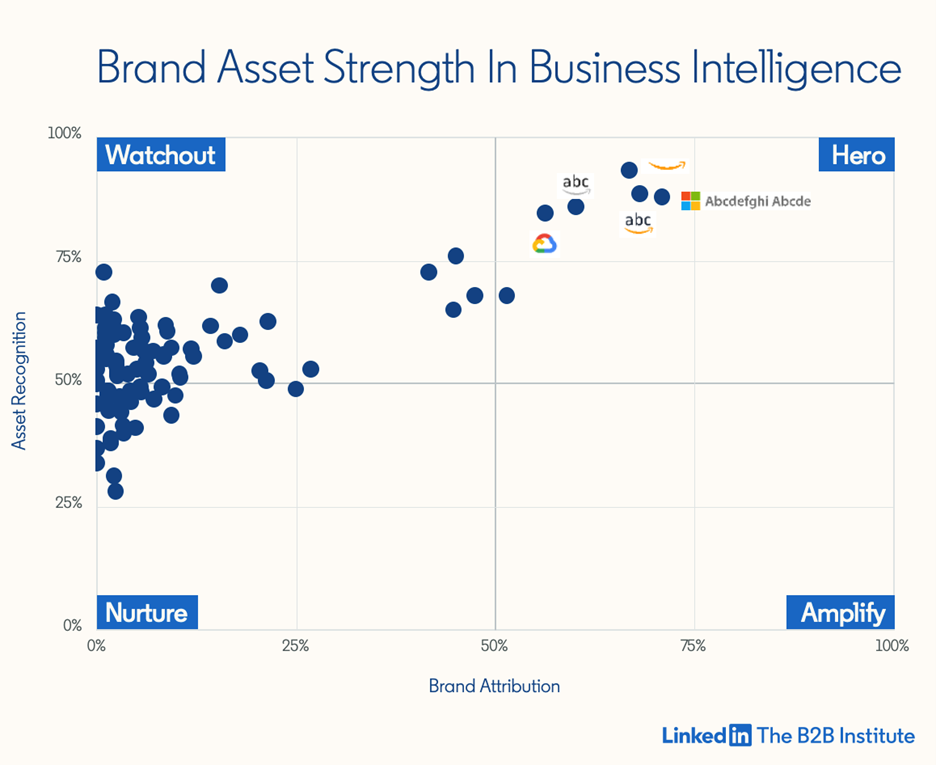
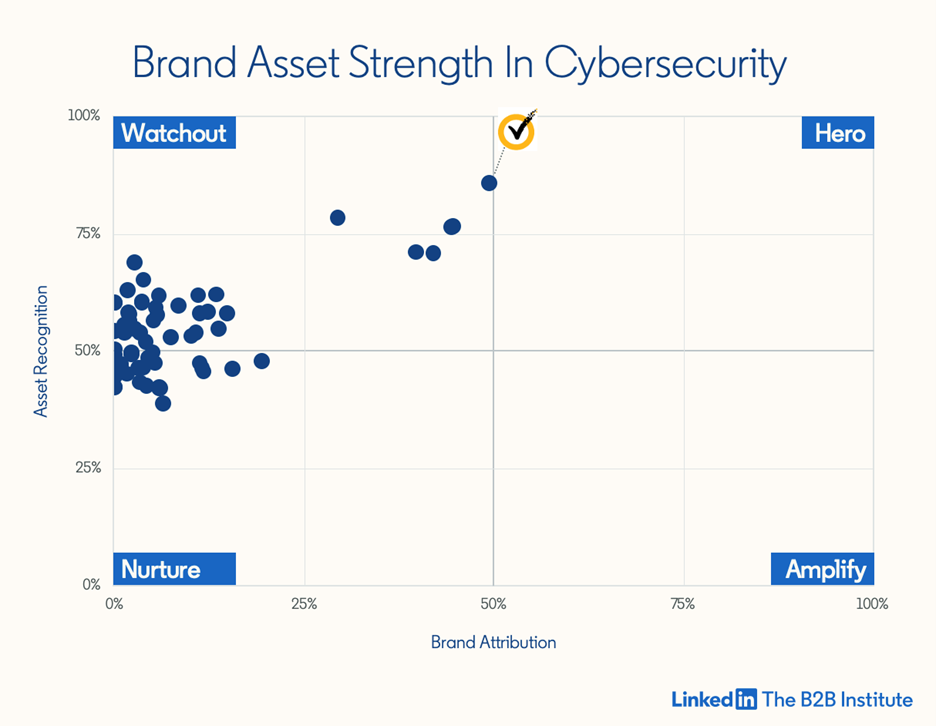
But in B2B, no assets achieve Geico Gecko-level scores. The graphs below show performance for the four biggest B2B tech categories. Each of the dots represent a different B2B brand asset. Dots toward the top score highly on recognition, while dots toward the right score highly on attribution. The most valuable assets are located in the upper right-hand quadrant—those “hero” assets score highly on both recognition and attribution, which is the goal. 

Linkedin
Linkedin
Linkedin
Linkedin

You’ll notice that in all categories, the upper right quadrant is essentially empty. More than 75% of the assets are clustered to the far left. Many category buyers claim to recognize the assets on the left, but almost all these assets score in the single digits when it comes to attribution.

Not all categories are quite as bad as B2B tech. Take a look at the business insurance category, for example. There’s still not many hero assets, but on average, the scores are much higher.

And no one does B2B branding better than the banks. Unlike many B2B tech firms, which are new companies competing in new categories, many B2B banks are old brands competing in old categories. And in branding, age is an advantage. Wells Fargo was founded in 1852, which means its brand assets benefit from 171 years of compounding equity. Financial services marketers are often criticized for being slow to change, but when it comes to brand building, slow-and-steady is a feature, not a bug.

Building a portfolio of brand assets

These banks’ success proves that building brand assets is possible for B2B marketers. Our robust analysis of over 300 brand assets doesn’t just show how big the branding opportunity is in B2B—it also shows marketers how to seize that opportunity. Get started with these five branding best practices.

Choose the right assets

Not all assets are created equal. Characters and logos tend to score highly on both recognition and attribution. In IaaS, for example, the best scoring asset is Amazon’s smile logo. Some 93% of cloud buyers recognize the smile, 67% attribute it to Amazon and only 3% attribute it to an Amazon competitor. In CRM, Salesforce’s lovable character, Astro, increases attribution by 40%. And even these world-famous assets still have room to grow.

Don’t choose the wrong assets

Colors and taglines offer the worst odds. Colors especially tend to score poorly on recognition and attribution. In business intelligence software, IBM is blue—but so is Microsoft Azure and SAS. Almost every tech and finance brand is blue. Blue is the color of the “sea of sameness,” which makes it a weak basis for distinctiveness.

That said, color can increase the attribution scores of a logo. A grayscale version of Microsoft’s logo performs 42% worse than the multi-colored version. But if you rely on color alone to carry the weight of your branding, you’re bound to be disappointed. Most assets are stronger when paired together.

Never abandon strong assets

The strength of a brand asset is closely correlated with how long it’s been in market. Like financial equity, brand equity compounds over time. The Amazon smile, for example, has remained unchanged since 2000, which is one reason why it outperforms Microsoft’s logo, introduced in 2012.

Elon Musk committed one of history’s greatest acts of “brandalism” by abandoning the Twitter logo, which had 90% recognition and 85% attribution. But Elon has lots of company—most B2B marketers can’t resist the temptation to refresh or rebrand their assets for no good reason.

It takes years of consistent investment to build a strong brand asset. Squandering that hard-earned equity is almost always a mistake.

Be concrete but discrete

If there’s an obvious, concrete link between the asset and the brand name, the asset will work better. For example, Liberty Mutual’s logo is the Statue of Liberty, and “emu” sounds like “LiMu” just like “gecko” sounds like Geico. That said, you don’t want to be so concrete that you blend in with competitors. Google Cloud’s logo is shaped like … a cloud. So is the logo for Salesforce and Cloudflare.

You should be concrete vis-à-vis your name, but discreet vis-à-vis your competition. Try to avoid abstract shapes or patterns—if buyers can’t easily describe the asset, the data suggests it will probably score much lower on recognition and attribution.

Nepo brands work harder

Sub-brands are suboptimal. The famous Microsoft logo has 71% attribution, but the Azure “A” has only 14% attribution, and the Dynamics “D” has only 7% attribution. This is in part because Microsoft is also a B2C brand. And sure enough, across categories, B2B brands that also have B2C businesses tend to score higher than pure play B2B brands. Our colleague, Derek Yueh, likens these brands to the “nepo baby” phenomenon. Just like the children of famous actors are more likely to become famous, the children of famous B2C brands are more likely to become famous, too.

Bottom line: Pure play B2B brands will need an even more disciplined approach to brand asset management to compete with both B2B and B2C competitors.

Brand assets are powerful financial instruments, but building them requires smart, systematic asset management. Sophisticated B2B marketers will recognize an opportunity to invest in a brand moat that fends off the competition and increases returns for years.

Our advice: If you want to become a B2B marketing GOAT, build a brand moat.

.font-primary { } .font-secondary { } #meter-count { position: fixed; z-index: 9999999; bottom: 0; width:96%; margin: 2%; -webkit-border-radius: 4px; -moz-border-radius: 4px; border-radius: 4px; -webkit-box-shadow: 0 0px 15px 4px rgba(0,0,0,.2); box-shadow:0 0px 15px 4px rgba(0,0,0,.2); padding: 15px 0; color:#fff; background-color:#343a40; } #meter-count .icon { width: auto; opacity:.8; } #meter-count .icon svg { height: 36px; width: auto; } #meter-count .btn-subscribe { font-size:14px; font-weight:bold; padding:7px 18px; color: #fff; background-color: #2eb3b2; border:none; text-transform: capitalize; margin-right:10px; } #meter-count .btn-subscribe:hover { color: #fff; opacity:.8; } #meter-count .btn-signin { font-size:14px; font-weight:bold; padding:7px 14px; color: #fff; background-color: #121212; border:none; text-transform: capitalize; } #meter-count .btn-signin:hover { color: #fff; opacity:.8; } #meter-count h3 { color:#fff!important; letter-spacing:0px!important; margin:0; padding:0; font-size:16px; line-height:1.5; font-weight:700; margin: 0!important; padding: 0!important; } #meter-count h3 span { color:#E50000!important; font-weight:900; } #meter-count p { font-size:14px; font-weight:500; line-height:1.4; color:#eee!important; margin: 0!important; padding: 0!important; } #meter-count .close { color:#fff; display:block; position:absolute; top: 4px; right:4px; z-index: 999999; } #meter-count .close svg { display:block; color:#fff; height:16px; width:auto; cursor:pointer; } #meter-count .close:hover svg { color:#E50000; } #meter-count .fw-600 { font-weight:600; } @media (max-width: 1079px) { #meter-count .icon { margin:0; padding:0; display:none; } } @media (max-width: 768px) { #meter-count { margin: 0; -webkit-border-radius: 0px; -moz-border-radius: 0px; border-radius: 0px; width:100%; -webkit-box-shadow: 0 -8px 10px -4px rgba(0,0,0,0.3); box-shadow: 0 -8px 10px -4px rgba(0,0,0,0.3); } #meter-count .icon { margin:0; padding:0; display:none; } #meter-count h3 { color:#fff!important; font-size:14px; } #meter-count p { color:#fff!important; font-size: 12px; font-weight: 500; } #meter-count .btn-subscribe, #meter-count .btn-signin { font-size:12px; padding:7px 12px; } #meter-count .btn-signin { display:none; } #meter-count .close svg { height:14px; } }

Enjoying Adweek’s Content? Register for More Access!

https://www.adweek.com/brand-marketing/brand-assets-are-important-in-b2b-marketing/


What’s AI Actually Good for Right Now?


.article-native-ad { border-bottom: 1px solid #ddd; margin: 0 45px; padding-bottom: 20px; margin-bottom: 20px; } .article-native-ad svg { color: #ddd; font-size: 34px; margin-top: 10px; } .article-native-ad p { line-height:1.5; padding:0!important; padding-left: 10px!important; } .article-native-ad strong { font-weight:500; color:rgb(46,179,178); }

It’s been almost a year since the hype surrounding generative AI was unleashed onto unsuspecting creatives across industries. Since then, the questions we’ve needed to ask about the technology have naturally evolved: Rather than debate whether to use it or what we stand to gain, we must now ask, where is it heading? Where does it add value? How much is too much, or not enough? 

Gen AI’s rise in popularity comes at an interesting time, when economic forces find many organizations cash-strapped. With some companies undertaking a trial by fire while others remain on the sidelines, the overall theory-to-practice timeline this year has been staggered and stunted. But that doesn’t mean the advertising and marketing worlds haven’t advanced.

We asked marketing leaders in our network to reflect on what has actually worked, what’s ready for primetime, and where competitive edge has been gained from their implementation efforts.

Much attention has been paid to the creative enhancements offered by gen AI, with thought leadership focusing mostly on its theoretical implications. What we’ve solicited from our contributors aims to answer: Beyond creative, how is the technology transforming business on a practical level? Every organization will, and should, take a different path, but these responses present a sample of the use cases, solution-oriented processes and governance approaches at play in the gen AI trenches. 

Planning and validation

In our engagement with clients, we see predictive AI models being complemented with generative AI, with agencies prioritizing use cases that have the biggest impact on efficiency, precision and automation of time-consuming tasks. Besides applying it for heavy load stages to win and service clients, like creating pitches and campaign assets, translation and personalization, we see agencies starting to apply gen AI for planning and validation stages. 

Part of long-term planning is understanding trends and making predictions about what consumers’ expectations will look like in the future and if brands can meet them. Interpreting data that’s publicly available through retailers’ websites, gathering insights on trending inquiries in Google searches, and social media mentions provide valuable information about consumers’ interests and sentiment about brands and competitors, serving as crucial input for retailers’ long-term product portfolio strategies.

Gen AI complements the validation process by comparing audience engagements with previous, similar campaign assets and recommends ones that can resonate better. It’s essential to establish guidelines to safeguard user data, ensuring inputs and outputs of gen AI are stored on the organization’s private cloud and not utilized for training publicly available solutions like ChatGPT or DALL-E. —Stephen Noble, business development director of ad tech, Star

Social listening 

Traditional first-party data collection is plagued with low response rates and fake responses from bots and survey farms. Gen AI is helping marketers develop questions more likely to engage people and ensure responses are authentic. Many have created “wrappers” or synthetic personas to infuse UX into the technology. And that’s just the front end: Marketers are also using gen AI to parse responses in record time—especially the open-ended questions, since LLMs can find common themes in consumers’ qualitative data and highlight those findings. 

Most data sets LLMs are built on—publicly available internet chatter, for example—comprise the views of a relatively small number of people who discuss brands on social media. It’s especially under-representative of people in marginalized groups. Gen AI can find people in specific demographic groups for first-party data collection: For example, the National Foundation for Credit Counseling reached 2,000 low- and middle-income renters to learn about their experiences with housing insecurity and eviction. Only about a third of respondents felt they fully understood their rights and opportunities, but the analysis of open-ended questions showed a strong undercurrent of hope and a commitment to achieving home ownership, particularly among communities of color. —Neil Dixit, CEO, and Adam Bai, chief strategy officer, Glimpse 

Human impact 

The measurement of outcomes in AI often goes beyond technical metrics, particularly when we bring democratization, empathy and compassion into the conversation. In this context, it’s essential to assess human impact, such as how well AI applications are received and used by diverse sets of users. Tools like user satisfaction surveys and open channels for feedback play a critical role in understanding this dimension. 

One potential solution is to build this framework on core ethical principles such as fairness, inclusivity, transparency and accountability. These form the pillars of regular audits where these principles are used to evaluate the impact of AI systems. As part of our own audit, we assess whether our systems, especially those used in design or content generation, are promoting diverse perspectives and not inadvertently perpetuating stereotypes. We look at the output and judge whether it reflects the tapestry of experiences and ideas we aim to represent. —Joy Fennell, founder and CEO, The Future in Black 

‘Explainability’ 

Explainable AI is the laudable aim of creating models that humans can interpret easily. Without explainability, oversight of models is challenging and ethical governance is almost impossible.

Consider a situation where understanding the rationale behind a decision may change the decision itself. Taking an extreme example, if you fed a model the details of every law in the U.K. alongside every case and the associated ruling in the past, it could make a more consistent and efficient judge in court rulings—but without a clear understanding of the rationale, its rulings are insufficient. Ultimately, explainability is a core tenet of accountability: If you can’t explain why a decision is right, how can you be held accountable for that decision? 

It’s important to consider how much performance degradation you are willing to accept to make the model explainable; you only know a model works by checking results against pre-agreed criteria, which requires sufficient volumes of assets to sense-check the output and can be time-consuming to the point that it negates efficiency savings. We can learn from areas where AI has been successfully implemented over time for automation, like the autonomous driving industry, which uses clear categorized levels of automation—broadly, Levels 0-5, from “no automation” to “steering wheel optional.” If we think about gen AI in marketing with a similar maturity curve, we can start to shift tasks without undue risk. —James Addlestone, chief strategy officer, Journey Further 

Automated testing 

Game-changers like ChatGPT can reduce content production requirements for new campaigns or variations by suggesting engagement strategies, refining drafts or even authoring entire campaigns from outlines. However, it is one thing to hand the keys over to an AI to optimize ads that render on a third-party website; it is quite another to relinquish content control for surfaces inside your own product or in messages to existing customers. This will remain true until gen AI is provably able to respect brand safety, maintain brand voice and cease to hallucinate (an excellent property for creative inspiration but a liability if left unsupervised). 

Efforts to address this challenge are underway, including WPP’s collaboration on a hybrid engine that harnesses Nvidia’s Omniverse technology to render 3D models of real products within settings and backgrounds created automatically with gen AI. We also recently launched a QA tool that aims to streamline new content production for marketers, using prompt engineering on top of OpenAI’s GPT-4 model to check for incorrect grammar, inappropriate tone, offensive language or accidental content in both human and gen AI content. For a global audience, it also flags cultural insensitivity and unintended religious connotations. —Bill Magnuson, CEO and co-founder, Braze 

Programmatic 

After decades of investment and innovation, programmatic has helped solve engineering challenges and provide solutions for targeting, transparency and attribution. What it hasn’t done—that generative AI has the power to fix—is deliver on its initial promise to tell personalized stories at scale.

There is a novelty aspect with generative AI, and some of the effects are new: Aside from the visible styling elements, hundreds of invisible elements are being generated, deciding which variation to show to the user, who only sees the winning design. For example, Cadbury’s ad campaign in India cloned and synthesized Shah Rukh Khan’s face and voice to include local shop names and towns, delivering personalized versions of the ad based on user location.

The application of gen AI, invisible to the consumer, can be implemented in the programmatic ecosystem in several ways, the simplest of which is engineering creative for the runtime using the size of the slot (given screen size and shape), background color, environment and other contextual signals available on the OpenRTB pipe. This is a very repeatable exercise and can be done at scale in 1-3 seconds, but the question is whether variants have the same impact as the original. —Abhay Singhal, co-founder, InMobi Group; CEO, InMobi Marketing Cloud 

Chatbots 

AI chatbots in customer support are only as good as the number of inquiries they can automatically resolve. It’s as simple as that. The North Star measurement should be automated resolutions (AR), which we define as a conversation between a customer and a company that is relevant, accurate, safe and does not involve a human. 

Oftentimes, customer support leaders vetting different AI solutions can get lost in a list of features and capabilities, but these details mean nothing if they aren’t helping you automate more resolutions. Our advice is for them to ask, “How does this product help me increase AR?” —Mike Murchison, CEO and co-founder, Ada

Podcasts 

AI-powered text-to-speech systems have been used to convert written content into natural-sounding audio for some time. It’s being used to create voice clones for podcast hosts and “guest” features; AI-based algorithms can enhance audio quality by reducing noise, eliminating background disturbances and improving overall sound production; platforms can leverage gen AI to deliver recommendations to listeners based on preferences, listening history and behavior. We now leverage tools to produce accompanying transcriptions for every episode, promoting the accessibility of our clients’ podcasts and minimizing human error while boosting SEO performance.

When it comes to value, the three main areas are time-saving, personalization and enhanced creativity. During editing and post-production, gen AI ad insertion saves podcasters time and effort, and personalized recommendations enhance these advertising efforts as well as the listening experience. And gen AI has enabled podcasters to experiment with unique voices, soundscapes and storytelling approaches not previously feasible. —Fatima Zaidi, founder and CEO, Quill 

Music 

Recent data from TuneCore indicates more than half of artists are aware of the influence of gen AI, with approximately 27% integrating it into their creative process. Innovations like Google’s TextFX and ChatGPT are just a few of the many tools providing artists with an enriched way to manipulate language, discover new sounds and create supporting content to market their music. While this could lead to an influx of new songs—further diluting the chances of a single track achieving global prominence—it’s worth noting that it will likely pave the way for more artists to achieve regional and local hits. 

I’m particularly enthusiastic about the prospect of licensing artists’ voices for AI-generated music; reported partnerships between tech powerhouses like Google and labels like Universal Music Group highlight this emerging trend. These potential collaborations could open lucrative licensing channels and, more importantly, hint at a future where fans are deeply involved in the music-making process. —Clayton Durant, director of emerging media and platform strategy, MikeWorldWide 

Messaging 

Much of people’s apprehension when it comes to gen AI stems from two factors: Firstly, the fact that AI has been positioned as something dissociated, machine-focused and artificial; and secondly, how perceptions around the technology are being shaped by conflicting voices and opinions within the industry. To bridge this gap and foster acceptance, it is essential to humanize and centralize the communication of gen AI through a strategic, considered and collaborative framework.

An example of where AI has been successfully positioned can be found in Amazon’s Alexa. Deliberately branded with femininity that creates a sense of proximity, Alexa exemplifies the potential for incorporating human-like qualities. While it could be argued that the product has fallen short in capitalizing on its potential, people have embraced Alexa into their homes, not just as a mere AI assistant but as a companion. The value Alexa adds to people’s lives underscores their openness to this particular AI implementation.

Crucially, to ensure the positive integration of gen AI, positioning plays an equally significant role as regulation. Where regulations will govern the ethical and responsible use of gen AI, positioning focuses on shaping public perception and acceptance. Both aspects are crucial for gen AI’s successful integration as a trustworthy technology into society. —Ashleigh Steinhobel, strategy director, FutureBrand 

.font-primary { } .font-secondary { } #meter-count { position: fixed; z-index: 9999999; bottom: 0; width:96%; margin: 2%; -webkit-border-radius: 4px; -moz-border-radius: 4px; border-radius: 4px; -webkit-box-shadow: 0 0px 15px 4px rgba(0,0,0,.2); box-shadow:0 0px 15px 4px rgba(0,0,0,.2); padding: 15px 0; color:#fff; background-color:#343a40; } #meter-count .icon { width: auto; opacity:.8; } #meter-count .icon svg { height: 36px; width: auto; } #meter-count .btn-subscribe { font-size:14px; font-weight:bold; padding:7px 18px; color: #fff; background-color: #2eb3b2; border:none; text-transform: capitalize; margin-right:10px; } #meter-count .btn-subscribe:hover { color: #fff; opacity:.8; } #meter-count .btn-signin { font-size:14px; font-weight:bold; padding:7px 14px; color: #fff; background-color: #121212; border:none; text-transform: capitalize; } #meter-count .btn-signin:hover { color: #fff; opacity:.8; } #meter-count h3 { color:#fff!important; letter-spacing:0px!important; margin:0; padding:0; font-size:16px; line-height:1.5; font-weight:700; margin: 0!important; padding: 0!important; } #meter-count h3 span { color:#E50000!important; font-weight:900; } #meter-count p { font-size:14px; font-weight:500; line-height:1.4; color:#eee!important; margin: 0!important; padding: 0!important; } #meter-count .close { color:#fff; display:block; position:absolute; top: 4px; right:4px; z-index: 999999; } #meter-count .close svg { display:block; color:#fff; height:16px; width:auto; cursor:pointer; } #meter-count .close:hover svg { color:#E50000; } #meter-count .fw-600 { font-weight:600; } @media (max-width: 1079px) { #meter-count .icon { margin:0; padding:0; display:none; } } @media (max-width: 768px) { #meter-count { margin: 0; -webkit-border-radius: 0px; -moz-border-radius: 0px; border-radius: 0px; width:100%; -webkit-box-shadow: 0 -8px 10px -4px rgba(0,0,0,0.3); box-shadow: 0 -8px 10px -4px rgba(0,0,0,0.3); } #meter-count .icon { margin:0; padding:0; display:none; } #meter-count h3 { color:#fff!important; font-size:14px; } #meter-count p { color:#fff!important; font-size: 12px; font-weight: 500; } #meter-count .btn-subscribe, #meter-count .btn-signin { font-size:12px; padding:7px 12px; } #meter-count .btn-signin { display:none; } #meter-count .close svg { height:14px; } }

Enjoying Adweek’s Content? Register for More Access!

https://www.adweek.com/agencies/whats-ai-actually-good-for-right-now/