Social Media Malpractice: Hijacking a Brand’s Social Account


.article-native-ad { border-bottom: 1px solid #ddd; margin: 0 45px; padding-bottom: 20px; margin-bottom: 20px; } .article-native-ad svg { color: #ddd; font-size: 34px; margin-top: 10px; } .article-native-ad p { line-height:1.5; padding:0!important; padding-left: 10px!important; } .article-native-ad strong { font-weight:500; color:rgb(46,179,178); }

It started with a move that a social media marketing manager (SMM) thought industry peers would rally behind.

The now-former SMM’s post from the NBA account about fair pay and balanced working hours took a turn for the worse when the noble cause that seemed to be behind hijacking the brand account became a vehicle for self-promotion. While his allegations were serious and worthy of the spotlight, what the individual did was commit social media manager malpractice: reveal his full name, contact information and (unserious) professional rates that are a swipe against the profession.

We can hold two truths at the same time: This SMM was right to call out unfair pay and labor practices, but wrong in his approach.

In a perfect world, these types of incidents can be avoided: senior leadership would be conducting regular check-ins and assessments of team morale and bandwidth; boundaries would be created and enforced on the time demands for all SMMs; SMMs would be viewed and respected as front-line brand ambassadors worthy of trust and care.

Initially, the industry call-to-arms was around a cause worth of merit: How do we properly advocate for the fair wages and working conditions that we do not feel we are currently receiving? However, the SMM’s method of calling attention was a Trojan horse for his own personal brand-buildingdestroying. Going rogue from a brand’s account is not only a high-stakes act of impulsiveness, it is damaging to the trajectory of all social media managers.

A bad rep

The NBA has a vested interest in making sure this never happens again. Hopefully, that means they implement some pay and role changes, but for sure it means they will bring down a new, and cumbersome, set of security procedures around league social.

As Chaka Cumberbatch, U.S. social lead at Google Pixel and a decade-plus industry veteran, put it, “This is going to affect everyone on the frontline of social at the NBA. The remaining social team, the copywriters, the creatives and every other team who touches social content, are going to have new layers of work added to their plate because the NBA will rightfully want to ensure this never happens again.” Social media managers are already fighting uphill battles to gain trust and approvals every day—incidents like this set back our collective efforts.

If you’re trying to have a career in social, carving out a niche for yourself as an unreliable and unpredictable contract marketer can be detrimental now and down the road. Advocacy is noble and necessary. Do it from a personal platform or borrow the audience of others. Hijacking a brand account will only put a swift end to any change we wish to see, in addition to possibly your own career.

Before you get on the social soapbox

So what is the right way to advocate for change in the social media marketing industry? If you’re considering taking steps towards advocating for better pay or working conditions, consider the following three questions before taking action.

Will this hurt someone?
The brand, peers and your career trajectory could all potentially be impacted. This type of behavior is hard to scrub off your digital footprint and any hiring manager will see it as a liability.

What change do I want to see happen and is this the best way?
When the action is more radical than the ask, that becomes the story. Had this been expressed from a personal account, it could have still gone viral on LinkedIn and rallied support behind the fight for fair pay and hours.

When trying to drive change, the best course is the one that causes the least collateral damage. Be seen as the hero and not someone having an outburst (even for all the right reasons) on the brand account. And certainly, avoid self-promotional language when making accusations.

Who is going to see this, and what power do they have to enact that change?
Would an NBA fan protest the league over how they treat social media managers? Probably not.

This SMM took to Facebook to voice his outrage, however, this point would have been better made on LinkedIn, where SMMs across the industry gather and discuss these very issues. Without a method to the madness, the crush of views also led to the crush of his own message and career. If the right people saw this, the momentum of this post could have turned it into a movement, but right now it is just another reminder of the uphill battles and downfalls that come with this job.

Nothing the former social media manager wrote about the SMM experience is invalid, especially in an industry like sports, where fans are often hired and then underpaid in the name of sports fandom and dedication.

But when the tactics to highlight common issues in the social media management world turn to corporate sabotage and brandjacking without considering the implications, the result is an ecosystem of greater doubt, rather than respect, for anyone holding the “social media manager” title.

.font-primary { } .font-secondary { } #meter-count { position: fixed; z-index: 9999999; bottom: 0; width:96%; margin: 2%; -webkit-border-radius: 4px; -moz-border-radius: 4px; border-radius: 4px; -webkit-box-shadow: 0 0px 15px 4px rgba(0,0,0,.2); box-shadow:0 0px 15px 4px rgba(0,0,0,.2); padding: 15px 0; color:#fff; background-color:#343a40; } #meter-count .icon { width: auto; opacity:.8; } #meter-count .icon svg { height: 36px; width: auto; } #meter-count .btn-subscribe { font-size:14px; font-weight:bold; padding:7px 18px; color: #fff; background-color: #2eb3b2; border:none; text-transform: capitalize; margin-right:10px; } #meter-count .btn-subscribe:hover { color: #fff; opacity:.8; } #meter-count .btn-signin { font-size:14px; font-weight:bold; padding:7px 14px; color: #fff; background-color: #121212; border:none; text-transform: capitalize; } #meter-count .btn-signin:hover { color: #fff; opacity:.8; } #meter-count h3 { color:#fff!important; letter-spacing:0px!important; margin:0; padding:0; font-size:16px; line-height:1.5; font-weight:700; margin: 0!important; padding: 0!important; } #meter-count h3 span { color:#E50000!important; font-weight:900; } #meter-count p { font-size:14px; font-weight:500; line-height:1.4; color:#eee!important; margin: 0!important; padding: 0!important; } #meter-count .close { color:#fff; display:block; position:absolute; top: 4px; right:4px; z-index: 999999; } #meter-count .close svg { display:block; color:#fff; height:16px; width:auto; cursor:pointer; } #meter-count .close:hover svg { color:#E50000; } #meter-count .fw-600 { font-weight:600; } @media (max-width: 1079px) { #meter-count .icon { margin:0; padding:0; display:none; } } @media (max-width: 768px) { #meter-count { margin: 0; -webkit-border-radius: 0px; -moz-border-radius: 0px; border-radius: 0px; width:100%; -webkit-box-shadow: 0 -8px 10px -4px rgba(0,0,0,0.3); box-shadow: 0 -8px 10px -4px rgba(0,0,0,0.3); } #meter-count .icon { margin:0; padding:0; display:none; } #meter-count h3 { color:#fff!important; font-size:14px; } #meter-count p { color:#fff!important; font-size: 12px; font-weight: 500; } #meter-count .btn-subscribe, #meter-count .btn-signin { font-size:12px; padding:7px 12px; } #meter-count .btn-signin { display:none; } #meter-count .close svg { height:14px; } }

Enjoying Adweek’s Content? Register for More Access!

https://www.adweek.com/social-marketing/social-media-malpractice/



What the Next Short-Form App Will Have to Do to Match Twitter’s Star Power


.article-native-ad { border-bottom: 1px solid #ddd; margin: 0 45px; padding-bottom: 20px; margin-bottom: 20px; } .article-native-ad svg { color: #ddd; font-size: 34px; margin-top: 10px; } .article-native-ad p { line-height:1.5; padding:0!important; padding-left: 10px!important; } .article-native-ad strong { font-weight:500; color:rgb(46,179,178); }

Text-based social media appears to be back in the Wild West. With X, the platform formerly known as Twitter, inching toward obscurity and a number of contenders stepping onto the field, we’ve been left with more questions than answers.

Apps like Threads, Bluesky, Truth Social, Mastodon and Spill are all picking up users, and people are tweeting their new handles like students on the last day of school signing yearbooks.

But will any of them truly be able to match Twitter’s star power? For all the app’s issues, there are four key attributes that kept it in a class of its own for 10 years: anonymity, messiness, commitment to chronology and cultural currency.

Anonymity

Whether you joined Twitter in 2010 or 2020, one constant has been the platform’s unique blend of authenticity, vulnerability, celebrity and anonymity. Twitter was relatively easy and granted users a safe space to post anything from memes to more serious topics without their usernames showing up in their friends’ and family’s suggested contacts. Twitter was a place where you could hide in plain view.

Meta’s competitor app, Threads, also catapulted users over other Twitter knockoffs and their biggest hurdle: building an active following, by allowing signups to import their existing Instagram followers. But that same need for an associated Instagram account has been a setback. In the days after Threads launched, many users expressed regret about the unfiltered thoughts from longtime followers and influencers they had so easily gained and given others access to.

This is not to say that Twitter’s anonymity always worked. Bot accounts, especially during national elections, did plague the app, and certain communities are still relentlessly keyword-targeted by scammers and phishing attempts.

To best contend with Twitter, its imitators must find a way to replicate the feeling of their app being its own world, free of aggressive “People you may know” recommendations and doxable profile information. A place where anonymity doesn’t hurt your content’s visibility and being yourself doesn’t feel risky.

Safety

If you were to ask the public which social media site is the most toxic, Twitter would likely be No. 1 on Family Feud’s big board.

Twitter has been called out repeatedly throughout its history for allowing hate speech and misleading information, especially in the wake of the pandemic. Black creators often expressed irritation at targeted harassment and have always been critical of the platform’s lack of support and transparency when enforcing rule violations and account suspensions.

When Elon Musk took over, his updates to Twitter’s terms of service resulted in hate speech on the platform skyrocketing. Twitter’s vice president of trust and safety, Ella Irwin, resigned from the company alongside other top employees tasked with ensuring platform safety for users and brands alike.

Spill has such stringent policies that The Shade Room was almost immediately kicked off the platform by users, while Bluesky filters let someone join with a handle that was just a racial slur. Competitors need to strike the right balance between allowing users to feel comfortable posting about their thoughts and experiences, while also putting in safety measures that will reassure advertisers that the app isn’t going to be harmful to a brand or service.

Messiness

One of Twitter’s biggest strengths is its imperfections. Where Instagram was a highlight reel, Twitter was seemingly off the cuff. Everything felt very authentic; people posting about their struggles, likes and dislikes, posts riddled with typos and a degree of unhinged “who is also up at 3am?” energy. While other platforms chased short-form video and polished influencer-driven content, Twitter stayed true to itself and remained a platform dictated by its users, not its algorithm.

Because Twitter is so dialogue-driven, its “influencers” felt like your average everyday person with anywhere from 5,000 to 50,000 followers, unlike the 100,000+ accounts that shape the user experience on platforms like Instagram and TikTok. There were no boxes or labels to put on your content. You could be a power user and not be a “content creator.” In a way, Twitter was the place for everything you’d keep far away from your LinkedIn.

The ability to participate in the conversation gave everyone the ability to become the app’s main character for the day and allowed brands and companies to feel more relatable; they were in on the joke. This is one area that will be especially difficult to imitate.

Chronological timelines

Like all the platforms around it, Twitter experimented numerous times with shifting away from chronological feeds and toward a rank-based, algorithm-driven system. But unlike other platforms, Twitter’s users successfully got the platform to keep the chronological feed an option and the main user experience until Musk’s arrival.

A chronological feed is vital for following topics in real time—many used Twitter to join in on sporting events, television premieres, festivals, elections and awards shows. Who could forget instant memes like Bernie Sanders’ mittens or The Slap? Twitter was the loudest town square on the internet, and many of its daily users enjoyed having a seat at the show.

Twitter also invented the hashtag. When combined with chronological timelines, hashtag groupings allowed not only easily following along with live events but were also responsible for catalyzing more than a handful of national and global social uprisings and movements. They are also used by local government and aid groups to quickly convey information in emergencies.

For other platforms to take Twitter’s place, they’ll need to be able to have a similar use value.

Cultural currency

Twitter’s most unique attribute is the countless number of cultural moments the platform has played host to: celebrity clapbacks at fans, The Rock being the second person to break the news that Osama bin Laden had been killed, Wendy’s and other brand accounts becoming human, Trump’s 4 a.m. antics and so on.

Twitter was around for 17 years, and in that time became the de-facto curator of pop culture. The list of moments true and unique to Twitter could go on forever and will be difficult to replicate.

An unforgettable app

So who will emerge victorious and fill Twitter’s big shoes? Who will strike the right balance of essential features and safety measures?

None of these questions can be answered today, tomorrow or next week, but they’ll continue burning up the industry and consuming the minds of everyday social media users. But why do these things matter so much outside our advertising bubble?

That answer is simple: the innate human desire to belong to something. And Twitter, love it or hate it, was and is truly something. It is a collection of memories, communities, safe spaces and inside jokes that so many users, despite disdain for what the platform has become, still refuse to let go and let die at the hand of one overzealous, out-of-touch billionaire. It is a place that can be endlessly imitated but may never be duplicated.

The Twitter experience simply cannot be X’d out.

.font-primary { } .font-secondary { } #meter-count { position: fixed; z-index: 9999999; bottom: 0; width:96%; margin: 2%; -webkit-border-radius: 4px; -moz-border-radius: 4px; border-radius: 4px; -webkit-box-shadow: 0 0px 15px 4px rgba(0,0,0,.2); box-shadow:0 0px 15px 4px rgba(0,0,0,.2); padding: 15px 0; color:#fff; background-color:#343a40; } #meter-count .icon { width: auto; opacity:.8; } #meter-count .icon svg { height: 36px; width: auto; } #meter-count .btn-subscribe { font-size:14px; font-weight:bold; padding:7px 18px; color: #fff; background-color: #2eb3b2; border:none; text-transform: capitalize; margin-right:10px; } #meter-count .btn-subscribe:hover { color: #fff; opacity:.8; } #meter-count .btn-signin { font-size:14px; font-weight:bold; padding:7px 14px; color: #fff; background-color: #121212; border:none; text-transform: capitalize; } #meter-count .btn-signin:hover { color: #fff; opacity:.8; } #meter-count h3 { color:#fff!important; letter-spacing:0px!important; margin:0; padding:0; font-size:16px; line-height:1.5; font-weight:700; margin: 0!important; padding: 0!important; } #meter-count h3 span { color:#E50000!important; font-weight:900; } #meter-count p { font-size:14px; font-weight:500; line-height:1.4; color:#eee!important; margin: 0!important; padding: 0!important; } #meter-count .close { color:#fff; display:block; position:absolute; top: 4px; right:4px; z-index: 999999; } #meter-count .close svg { display:block; color:#fff; height:16px; width:auto; cursor:pointer; } #meter-count .close:hover svg { color:#E50000; } #meter-count .fw-600 { font-weight:600; } @media (max-width: 1079px) { #meter-count .icon { margin:0; padding:0; display:none; } } @media (max-width: 768px) { #meter-count { margin: 0; -webkit-border-radius: 0px; -moz-border-radius: 0px; border-radius: 0px; width:100%; -webkit-box-shadow: 0 -8px 10px -4px rgba(0,0,0,0.3); box-shadow: 0 -8px 10px -4px rgba(0,0,0,0.3); } #meter-count .icon { margin:0; padding:0; display:none; } #meter-count h3 { color:#fff!important; font-size:14px; } #meter-count p { color:#fff!important; font-size: 12px; font-weight: 500; } #meter-count .btn-subscribe, #meter-count .btn-signin { font-size:12px; padding:7px 12px; } #meter-count .btn-signin { display:none; } #meter-count .close svg { height:14px; } }

Enjoying Adweek’s Content? Register for More Access!

https://www.adweek.com/social-marketing/social-media-twitter-successor/


Marketers Need to Get Subconscious With Their Data


.article-native-ad { border-bottom: 1px solid #ddd; margin: 0 45px; padding-bottom: 20px; margin-bottom: 20px; } .article-native-ad svg { color: #ddd; font-size: 34px; margin-top: 10px; } .article-native-ad p { line-height:1.5; padding:0!important; padding-left: 10px!important; } .article-native-ad strong { font-weight:500; color:rgb(46,179,178); }

Don’t miss Brandweek, Adweek’s ultimate experience for marketers, September 11-14 in Miami. Connect with peers and gain insights and inspiration from top brand marketers and industry icons at Glossier, Coca-Cola, Taco Bell and more. Register.

With industries and legal systems increasingly siding with users when it comes to control over their personal data and how it’s shared, the spotlight on zero-party data has only intensified.

Recently deemed by Forbes as “the new oil,” zero-party data is defined by Forrester as “data that a customer intentionally and proactively shares with a brand.” This contrasts with data that is collected and shared on an individual’s behalf. Inherently self-reported information, zero-party data boasts value beyond first- and third-party data because it can include non-observable information like emotions, sentiment and verified intent. 

This becomes incredibly valuable when surrounded by contextual signals that map to deeper patterns. For example, I launched a zero-party data survey, asking more than 100,000 people, “What are you seeking from this app experience?” The survey question appeared during key actions within more than 3,000 mobile apps spanning games, productivity, sports, fitness, social networking, entertainment and lifestyle.

The in-app actions that triggered a survey were precategorized as moments relative to each in-app experience, including music, food, travel, DIY, cleaning and self-improvement. This approach revealed which of the desired emotions was most prevalent in which moments.

A survey question asking "What are you seeking from this app experience?" and a drop-down menu with options.
Aki Technologies

When responses like “belonging,” “power” and “reassurance” were mapped back to the context in which the survey ran, it highlighted insightful correlations—for example, music as the content of choice for belonging-seekers, cleaning and organizing utility apps as the go-to for reassurance-seekers, and gaming apps for control-seekers.

There are companies out there doing zero-party data right: Stitch Fix has a style quiz, and Kiehl’s has an Instant Skin Reader, both of which deliver participants personalized product recommendations adjusted for the data they voluntarily share. ViralGains makes it easy for brands to transform their ads and web content into interactive, dynamic experiences that ask consumers questions and then respond with content related to their answers. 

But as powerful as zero-party data can be, there’s already a better option for marketers.

What is subzero-party data? 

Advertisers’ ability to capitalize on self-reported emotion requires levels of honesty and self-awareness that humans aren’t reliably capable of.

Enter subzero-party data, a term I’ve created to describe the ideal data set: subconscious or otherwise undetectable data that a customer discovers and shares with a brand. I’m talking about putting customers in touch with their own subconscious minds by helping them measure and interpret their unique neural or otherwise unfiltered responses to messages and experiences.

Subzero-party data is essentially data that’s not consciously known or apparent to the subject before it’s mutually discovered by the subject and the “data miner.” Methods of uncovering subzero-party data include: 

  • Eye tracking, which monitors the positions and movements of the eyes to better inform visual system research, marketing, human-computer interaction and product design 
  • Biometric testing, which measures responses to stimuli such as perspiration or changes in heart rate, blood pressure and cortisol levels
  • Facial coding, which analyzes facial expressions in reaction to stimuli to understand human emotion

Some brands are already paving the way in advance of subzero-party data as a term for industry adoption. Kimberly-Clark puts neuroscience at the heart of its market research by testing marketing stimuli on people who opt into subconscious reaction studies. The Asics Mind Uplifter tool is designed to benefit customers’ workouts by visually showing how sports impact their wellbeing. At Adobe Max, technology gave people a look into how their brains reacted while creating. 

Currently, a leading CPG brand is looking to subzero-party data as a pre-campaign optimization approach. This study leverages electroencephalogram (EEG) brain wave data to measure the emotional engagement consumers have in response to video, interstitial and banner ads that have been personalized for new, lapsed, loyal and competitive customers of a snack brand in advance of its Q3 campaign launch. The brand intends to use the results to optimize the campaign creative in order to maximize emotional connection with its target audiences.

Brands are not the only ones looking to stake their claim in the subzero-party data frontier. Major investment in subzero-party data collection is gaining momentum tied to cultural advertising moments, like the Super Bowl, agnostic of brand investment—for example, a 2022 study that leveraged bioinformatics to measure viewer receptivity to Super Bowl 56 game events, commercials and Halftime Show.

Zero-party data is powerful, but as conversations around it continue, we also need to talk about its primary limitation: Humans can only self-report the information we’re aware of and willing to admit. Zero-party data—like oil—is a valuable resource to mine. But subzero-party data represents the underlying well from which it springs, and there’s so much more beneath the surface. 

Web3 growth and capabilities such as the Meta Quest Pro’s face and eye tracking are a strong indicator that this is where data sets are headed and will be the key to tapping into this type of data at scale. Meanwhile, companies like AgileBrain are aspiring to achieve this without equipment through photo-based sentence completion surveys that move so quickly they command a subconscious response.

Beyond these technologies, panels and focus groups that leverage neuroscience tools—like EEG headsets that map brain signals to human emotions—can help brands optimize everything from products, branding and packaging to advertising creative, websites and in-store experiences.

Going forward, we’re going to see applications of subzero-party data beyond marketing and advertising. For example, as techniques are enhanced and adopted, employers will be able to scale subzero-party data to understand employee engagement and motivation, supporting new ways to optimize their work, tools and systems. As an early adopter, Dell was able to prove the importance of providing employees with functioning technology in an EEG study that found faulty technology produced 29% more cognitive stress than being asked to sing a song in public. 

For marketers, conversations about zero-party data need to go deeper. Subzero-party data boasts the promise of a similarly consensual data approach, with a more unfiltered, instinctive human insight that enables customers to enjoy the benefit of their own self-discovery alongside brands.

.font-primary { } .font-secondary { } #meter-count { position: fixed; z-index: 9999999; bottom: 0; width:96%; margin: 2%; -webkit-border-radius: 4px; -moz-border-radius: 4px; border-radius: 4px; -webkit-box-shadow: 0 0px 15px 4px rgba(0,0,0,.2); box-shadow:0 0px 15px 4px rgba(0,0,0,.2); padding: 15px 0; color:#fff; background-color:#343a40; } #meter-count .icon { width: auto; opacity:.8; } #meter-count .icon svg { height: 36px; width: auto; } #meter-count .btn-subscribe { font-size:14px; font-weight:bold; padding:7px 18px; color: #fff; background-color: #2eb3b2; border:none; text-transform: capitalize; margin-right:10px; } #meter-count .btn-subscribe:hover { color: #fff; opacity:.8; } #meter-count .btn-signin { font-size:14px; font-weight:bold; padding:7px 14px; color: #fff; background-color: #121212; border:none; text-transform: capitalize; } #meter-count .btn-signin:hover { color: #fff; opacity:.8; } #meter-count h3 { color:#fff!important; letter-spacing:0px!important; margin:0; padding:0; font-size:16px; line-height:1.5; font-weight:700; margin: 0!important; padding: 0!important; } #meter-count h3 span { color:#E50000!important; font-weight:900; } #meter-count p { font-size:14px; font-weight:500; line-height:1.4; color:#eee!important; margin: 0!important; padding: 0!important; } #meter-count .close { color:#fff; display:block; position:absolute; top: 4px; right:4px; z-index: 999999; } #meter-count .close svg { display:block; color:#fff; height:16px; width:auto; cursor:pointer; } #meter-count .close:hover svg { color:#E50000; } #meter-count .fw-600 { font-weight:600; } @media (max-width: 1079px) { #meter-count .icon { margin:0; padding:0; display:none; } } @media (max-width: 768px) { #meter-count { margin: 0; -webkit-border-radius: 0px; -moz-border-radius: 0px; border-radius: 0px; width:100%; -webkit-box-shadow: 0 -8px 10px -4px rgba(0,0,0,0.3); box-shadow: 0 -8px 10px -4px rgba(0,0,0,0.3); } #meter-count .icon { margin:0; padding:0; display:none; } #meter-count h3 { color:#fff!important; font-size:14px; } #meter-count p { color:#fff!important; font-size: 12px; font-weight: 500; } #meter-count .btn-subscribe, #meter-count .btn-signin { font-size:12px; padding:7px 12px; } #meter-count .btn-signin { display:none; } #meter-count .close svg { height:14px; } }

Enjoying Adweek’s Content? Register for More Access!

https://www.adweek.com/performance-marketing/subconscious-marketing-subzero-party-data/


It’s Time to Dispel the Multicultural Media Scale Myth


.article-native-ad { border-bottom: 1px solid #ddd; margin: 0 45px; padding-bottom: 20px; margin-bottom: 20px; } .article-native-ad svg { color: #ddd; font-size: 34px; margin-top: 10px; } .article-native-ad p { line-height:1.5; padding:0!important; padding-left: 10px!important; } .article-native-ad strong { font-weight:500; color:rgb(46,179,178); }

TV isn’t what it used to be. Join the Convergent TV Summit in LA this October 25 with media, technology and marketing leaders to prepare for new trends and make industry connections.

Over the past few years, there has been an industrywide rallying cry about the yawning investment gap between the general market and minority-owned media.

Nearly every marketer and media buyer agency has pledged a more diversified spending approach. At the same time, major investors including Tyler Perry, Robert Smith and Byron Allen, as well as entrepreneurs such as Lynnwood Bibbens of ReachTV, Albert Thompson of Mnumonic and Christian Facey of AudioMob, are looking to not only create unique content but actually own, operate and compete in multiple points of the media value chain to deliver value to customers.

Yet progress in terms of investment in multicultural and diverse media has been painfully slow, in large part due to persistent myths regarding the scale of these properties. These myths are so widespread that in many cases it is not only hurting minority-owned businesses but causing marketers to leave significant revenue on the table.

When it comes to dispelling the scale myth, the macro problem is fourfold:

Categorization: Many marketers continue to insist on placing minority-owned media properties in a silo, which places an arbitrary ceiling on growth. When publishers are placed in a specific category, this tends to feed the perception that they are only valuable for certain types of campaigns, or that they should “wait in line” when media spending is being allocated.

Naturally, this limits these publishers’ chances at landing on media plans. Unfortunately, this experience is all too common for minority-owned media brands, which often find themselves waiting for “multicultural” budgets to be deployed.

Budget allocation: Decisions to spend dollars on minority-owned and targeted media are frequently made based on a relatively small percentage basis, which is typically not reflective of population growth. Indeed, even as more brands make larger commitments to minority-owned media, few have truly closed the gap between spending and population distribution.

An unfortunate side effect of this slow shift is a small handful of minority-targeted media companies end up capturing the lion’s share of dollars, rather than the pie being made bigger for all.

Ad tech: Increasingly, in an effort to simplify the digital advertising supply chain, agencies and brands are striking deals with a preferred (and thus limited) set of partners, which has the effect of cutting out minority-owned companies. The more that advertisers look to cut down on the number of partners they work with, the more they end up cutting direct deals with a small handful of large publishers, partners and adtech firms.

The result is that, in the name of efficiency, minority-owned or targeted players end up being eliminated from consideration before they even have a chance to make their pitch.

Ad buyer misperceptions: Many media teams are known to inaccurately label minority-owned properties as “small” or subscale, despite evidence to the contrary. In an ecosystem that is already dominated by a few tech giants, the majority of digital media companies struggle to stand out. This becomes even harder for minority-aimed publishers, which are perhaps lesser known to many ad buying teams and are compared to the walled garden partners.

That said, many of these publishers boast of large and growing audiences, despite the lingering view that they can’t deliver the reach on the level of “general market” properties.

Doing the right thing for the bottom line

To be sure, this lingering scale perception challenge isn’t just about a lack of equity, but one of lost opportunities for marketers. That’s because reaching diverse audiences is vital to driving business results for modern brands, while ignoring these groups can prove even more costly.

In fact, nearly 7 out of 10 multicultural consumers say that brands purposely investing ad dollars with media that is owned or focused on them strongly demonstrates support for their communities.

Moreover, the same research shows that almost 90% of multicultural consumers report taking action because of a company investing in their community, including telling others about the brand, sharing their support on social media or even switching away from a competitor brand.

Simply put, ignoring these communities, particularly while using scale as an excuse, is bad business.

It is important to also note that investment in minority-owned media is not limited to minority-targeted campaigns, as the depth and breadth of minority-owned media brands is vast. Consider Tyler Perry’s multiplatform empire, which ranges from movies to sitcoms. The Allen Media Group has a longstanding TV syndication and distribution business, while also owning The Weather Channel and its digital arm. Ironically, brands that ignore these properties are missing out on significant scale while failing to further their diversity goals.

If nothing else, the business argument for diversity would seem to trump any scale concerns.

A call for more profound change

There has been some positive momentum in the industry, as many businesses have fashioned dedicated efforts toward supporting social justice and a more egalitarian approach to marketing spending. Yet too often, minority-owned media vehicles are left fighting against both structural obstacles and institutional biases.

As a result, business progress is lagging behind sentiment and rhetoric. Again, this is not about fostering equality, but the vital importance of targeting upwards of two-fifths of the U.S. market in a way that demonstrates understanding and ultimately winning more customers.

Therefore, the ad industry needs to fundamentally rethink its approach to minority-owned media in all of its variants within the value chain. This will require a mixture of education and a thorough examination of our processes.

It is of paramount importance that we work toward eradicating the scale myth in order to drive toward equitable media allocation and investment. This is mission critical for any brand looking to drive revenue and garner a larger market share.

.font-primary { } .font-secondary { } #meter-count { position: fixed; z-index: 9999999; bottom: 0; width:96%; margin: 2%; -webkit-border-radius: 4px; -moz-border-radius: 4px; border-radius: 4px; -webkit-box-shadow: 0 0px 15px 4px rgba(0,0,0,.2); box-shadow:0 0px 15px 4px rgba(0,0,0,.2); padding: 15px 0; color:#fff; background-color:#343a40; } #meter-count .icon { width: auto; opacity:.8; } #meter-count .icon svg { height: 36px; width: auto; } #meter-count .btn-subscribe { font-size:14px; font-weight:bold; padding:7px 18px; color: #fff; background-color: #2eb3b2; border:none; text-transform: capitalize; margin-right:10px; } #meter-count .btn-subscribe:hover { color: #fff; opacity:.8; } #meter-count .btn-signin { font-size:14px; font-weight:bold; padding:7px 14px; color: #fff; background-color: #121212; border:none; text-transform: capitalize; } #meter-count .btn-signin:hover { color: #fff; opacity:.8; } #meter-count h3 { color:#fff!important; letter-spacing:0px!important; margin:0; padding:0; font-size:16px; line-height:1.5; font-weight:700; margin: 0!important; padding: 0!important; } #meter-count h3 span { color:#E50000!important; font-weight:900; } #meter-count p { font-size:14px; font-weight:500; line-height:1.4; color:#eee!important; margin: 0!important; padding: 0!important; } #meter-count .close { color:#fff; display:block; position:absolute; top: 4px; right:4px; z-index: 999999; } #meter-count .close svg { display:block; color:#fff; height:16px; width:auto; cursor:pointer; } #meter-count .close:hover svg { color:#E50000; } #meter-count .fw-600 { font-weight:600; } @media (max-width: 1079px) { #meter-count .icon { margin:0; padding:0; display:none; } } @media (max-width: 768px) { #meter-count { margin: 0; -webkit-border-radius: 0px; -moz-border-radius: 0px; border-radius: 0px; width:100%; -webkit-box-shadow: 0 -8px 10px -4px rgba(0,0,0,0.3); box-shadow: 0 -8px 10px -4px rgba(0,0,0,0.3); } #meter-count .icon { margin:0; padding:0; display:none; } #meter-count h3 { color:#fff!important; font-size:14px; } #meter-count p { color:#fff!important; font-size: 12px; font-weight: 500; } #meter-count .btn-subscribe, #meter-count .btn-signin { font-size:12px; padding:7px 12px; } #meter-count .btn-signin { display:none; } #meter-count .close svg { height:14px; } }

Enjoying Adweek’s Content? Register for More Access!

https://www.adweek.com/media/multicultural-media-scale-myth-diversity-equity-inclusion/


The Influencer Scandal Flurry: What It Means for Crisis Comms’ Future


.article-native-ad { border-bottom: 1px solid #ddd; margin: 0 45px; padding-bottom: 20px; margin-bottom: 20px; } .article-native-ad svg { color: #ddd; font-size: 34px; margin-top: 10px; } .article-native-ad p { line-height:1.5; padding:0!important; padding-left: 10px!important; } .article-native-ad strong { font-weight:500; color:rgb(46,179,178); }

Don’t miss Brandweek, Adweek’s ultimate experience for marketers, September 11-14 in Miami. Connect with peers and gain insights and inspiration from top brand marketers and industry icons at Glossier, Coca-Cola, Taco Bell and more. Register.

In an ever-evolving social media age, it can feel as if there’s always a new celebrity or influencer scandal that commands public attention. In August alone, notable celebrities and influencers entered career-damaging lawsuits, accidentally started a riot and were brought back to life. And that’s just the tip of the iceberg—drama on maximalism-design-Tok likely ended an influencer’s career this month.

Social media is creating layer upon layer of drama that, in some cases, has real-life consequences. And if you’re particularly unlucky or careless, what seems like an online attack could have legal ramifications.

We’re at an apex of crisis response and reputation management. Here are some key insights into the future of crisis communications and what we, as the professionals shaping the brands of public figures, should be doing about it.

A response should be months, not days, in the making

If you’re putting together a crisis response after the reporter reached out to ask for your statement, you’re already too late. Planning for a crisis should always start well before the issue comes up. This way, you can work with the brand to manage the story as soon as possible. This will help mitigate the backlash and rumors that will inevitably start once the public is made aware of the issue.

For instance, when it came out that there were allegations made against Lizzo by former dancers, she didn’t release a statement until nearly 24 hours after the fact. By then, the damage was already done. Negative opinions were already formed and condemnations circulated widely on TikTok, Threads, X (formerly Twitter), Reddit, Instagram—you name it. A concert festival got canceled and Lizzo is no longer in the running for the Super Bowl 2024 halftime show because of the backlash.

Regardless of how the case turns out, Lizzo’s reputation will likely never be the same. While the potential harm caused might have meant damage to Lizzo’s public image regardless of when a statement was made, we’ll never truly know given the amount of time it took for her to speak up.

It’s impossible to predict the future, yet it isn’t impossible to be prepared. Whether it’s a public callout, viral criticism on social media, being made into an unflattering meme, being linked to a problematic influencer or a number of other crises, it’s important to plan for any and all scenarios that could possibly arise.
Hire a crisis management team before you have a crisis. Part of their expertise should lie in identifying concerns and potential crises. If your brand has all the pieces in place before a crisis hits, then it’s more likely you’ll be able to ride the wave instead of getting swallowed up by it.

Be prepared for the court of public opinion

Whether you’re representing a celebrity selling out arena shows or an influencer on their way to one million subscribers, not a single person or brand is immune to the court of public opinion. Information is traveling faster and faster via social media and, at the same time, public patience is thinning when it comes to wrongdoing. Public figures must be aware of how their perceived brand can shift in a mere moment’s notice.

That said, it’s crucial that you don’t allow the public’s response to dictate and muddle your plan forward. Public opinion is increasingly reactionary, however, that does not mean brands can afford to be reactionary as well.

Yes, every celebrity should do their research, know what people are saying and be aware of the discourse while working through a crisis. However, what people are saying shouldn’t affect your brand response in such a way that it drives an impulse decision—making things worse, or elicits an uncontrolled, unintended emotional response. You and the brand you represent should be mentally prepared for what the public could say before they say it. Most of all, don’t let what the public says tarnish an unused, valuable crisis tactic.

Genuinely apologize

While it isn’t in your brand’s best interest to react or lash out due to poor public perception, when appropriate in a crisis, a public figure should be able to offer a genuine apology. Admitting full ownership of wrongdoing can go a long way to earning forgiveness and repairing damage.

A recent example of an apology that could have gone better is the one made by Kai Cenat’s PR team after the influencer incited a riot in New York’s Union Square. While Cenat’s team, AMP Group, did own up to wrongdoing, Cenat didn’t take responsibility.

A better, more powerful apology would’ve been Cenat himself saying those words. Coming from his PR team, the apology seems disingenuous. Since then, Cenat has lost followers and has been unseated as Twitch’s most-followed account.

If the brand or public figure you’re working for is moving forward with a prepared apology, it has to be sincere and come from a place of genuine understanding. From there, that apology should be followed by meaningful, appropriate action. In a world where the public’s perception can change at the drop of a hat, anyone who considers themselves a brand should be able to effectively plan and execute a genuine apology.

Keep building and learning

Social media is fluctuating constantly, and so should the crisis communications strategies you choose to implement. Staying stagnant in an age driven by technology means falling behind. It’s not hard to pinpoint potentialities, and investing in a crisis plan will always pay off.

No brand is untouchable and there is always an opportunity to learn and implement a better crisis strategy. Do the research, watch trends and be on top of it. When a brand is properly prepared, a crisis can be handled, remedied and put behind it instead of it becoming their reputation forever.

.font-primary { } .font-secondary { } #meter-count { position: fixed; z-index: 9999999; bottom: 0; width:96%; margin: 2%; -webkit-border-radius: 4px; -moz-border-radius: 4px; border-radius: 4px; -webkit-box-shadow: 0 0px 15px 4px rgba(0,0,0,.2); box-shadow:0 0px 15px 4px rgba(0,0,0,.2); padding: 15px 0; color:#fff; background-color:#343a40; } #meter-count .icon { width: auto; opacity:.8; } #meter-count .icon svg { height: 36px; width: auto; } #meter-count .btn-subscribe { font-size:14px; font-weight:bold; padding:7px 18px; color: #fff; background-color: #2eb3b2; border:none; text-transform: capitalize; margin-right:10px; } #meter-count .btn-subscribe:hover { color: #fff; opacity:.8; } #meter-count .btn-signin { font-size:14px; font-weight:bold; padding:7px 14px; color: #fff; background-color: #121212; border:none; text-transform: capitalize; } #meter-count .btn-signin:hover { color: #fff; opacity:.8; } #meter-count h3 { color:#fff!important; letter-spacing:0px!important; margin:0; padding:0; font-size:16px; line-height:1.5; font-weight:700; margin: 0!important; padding: 0!important; } #meter-count h3 span { color:#E50000!important; font-weight:900; } #meter-count p { font-size:14px; font-weight:500; line-height:1.4; color:#eee!important; margin: 0!important; padding: 0!important; } #meter-count .close { color:#fff; display:block; position:absolute; top: 4px; right:4px; z-index: 999999; } #meter-count .close svg { display:block; color:#fff; height:16px; width:auto; cursor:pointer; } #meter-count .close:hover svg { color:#E50000; } #meter-count .fw-600 { font-weight:600; } @media (max-width: 1079px) { #meter-count .icon { margin:0; padding:0; display:none; } } @media (max-width: 768px) { #meter-count { margin: 0; -webkit-border-radius: 0px; -moz-border-radius: 0px; border-radius: 0px; width:100%; -webkit-box-shadow: 0 -8px 10px -4px rgba(0,0,0,0.3); box-shadow: 0 -8px 10px -4px rgba(0,0,0,0.3); } #meter-count .icon { margin:0; padding:0; display:none; } #meter-count h3 { color:#fff!important; font-size:14px; } #meter-count p { color:#fff!important; font-size: 12px; font-weight: 500; } #meter-count .btn-subscribe, #meter-count .btn-signin { font-size:12px; padding:7px 12px; } #meter-count .btn-signin { display:none; } #meter-count .close svg { height:14px; } }

Enjoying Adweek’s Content? Register for More Access!

https://www.adweek.com/brand-marketing/the-influencer-scandal-flurry-crisis-comms-future/


Take a Page From the Motion Identity Playbook


.article-native-ad { border-bottom: 1px solid #ddd; margin: 0 45px; padding-bottom: 20px; margin-bottom: 20px; } .article-native-ad svg { color: #ddd; font-size: 34px; margin-top: 10px; } .article-native-ad p { line-height:1.5; padding:0!important; padding-left: 10px!important; } .article-native-ad strong { font-weight:500; color:rgb(46,179,178); }

Don’t miss Brandweek, Adweek’s ultimate experience for marketers, September 11-14 in Miami. Connect with peers and gain insights and inspiration from top brand marketers and industry icons at Glossier, Coca-Cola, Taco Bell and more. Register.

It’s no secret that the social media landscape is changing at a breaking speed. Instagram and TikTok are placing evermore emphasis on video, tweaking their algorithms to favor moving content over static images. Reels are drawing the lion’s share of attention in people’s feeds, and we’re yet to see the full impact of Generative AI on content creation.

Add to all this our ever-reducing attention spans and the challenge is clear: It is now harder than ever for brands to engage audiences without video. The necessity for creating a consistent cadence of content that incorporates motion design and animation is driving a very real need for brands to enhance their visual identities by adding motion identity guidelines.

Beyond ubiquitous phone screens, the sustained benefit of establishing a robust motion identity is that it can add memorability and meaning for a brand in virtually every space and place. While a visual identity system provides the essentials—logo, colors, typography, imagery, icons, patterns—a motion identity expands this toolbox into the realm of video with principles, behaviors, guidelines and templates that establish new dimensions of the brand, such as timing, pacing and rhythm. A library of animation styles can be set for the most-used applications, while flexible guidelines encourage inventive play for special occasions. A great motion identity not only helps engage people in new ways, but also empowers brand teams to be creative, consistent and cohesive anywhere video is essential—which, arguably, is everywhere now.

Here’s how to evolve your design ecosystem to continually captivate your intended audience without investing the time and resources required for a full rebrand. 

The motion identity playbook

The entertainment industry pioneered the practice of establishing an ownable motion identity for each distinct sub-brand, especially in television. Every TV channel since the 1950s has used motion graphics as the “glue” that lets viewers know what they’re watching, what’s next and what’s new.

As social media platforms prioritize video, screens replace billboards and 5G internet reaches more people, it is vital for all business sectors to learn from the entertainment brand design playbook. The good news is, most established brands already have an extensive visual system and the foundational elements to help establish a motion behavior in place. Pinterest, for example, elevated its existing identity system through motion last year; usage of a motion behavior system that nods to user habits—the tactility of pinning on cork and the process of collaging ideas—brought the brand to life.

The need for distinguishable motion design far exceeds basic functionality: Motion is inherently emotional. It enables a brand to communicate to audiences with a unique style and personality that is emblematic of its brand position. Today, it’s not just entertainment brands that need motion design—every company needs the ability to engage, excite and entertain audiences across all the platforms where video thrives. With so many brands, from Accenture to Zoom, now creating animation and incorporating motion graphics into social posts, the question is how to draw the eye in a way that ties all your brand elements together.

Entertainment brands may have written the book, but what are the translatable rules that any brand can lift from its pages?

Understand your brand essence

To create a cohesive brand experience that resonates with your intended audience, you need to know your brand’s personality, values and target audience inside out. This foundational brand strategy inspires the principles and attributes that can be translated into motion. For example, Sesame Workshop’s approach to education and philanthropy is all about putting children on a positive path. To visually bring that promise to life, the nonprofit’s new motion identity is anchored by an ecosystem of streets and intersections that expand the brand’s visual vernacular.

Think beyond logos

While animated logos are a crucial aspect of a motion identity, we all know there is so much more to a brand design than its logo. A strong, enduring brand needs a flexible identity that can extend into motion on every screen. What are those touch points that matter most—websites, social and video platforms, retail environments, events? Each is an opportunity to create a more meaningful interaction with new and prospective customers. Consider how brand elements such as animated typography, iconography, illustrations or video can combine to underscore the larger brand story. A landscape audit of your brand’s touch points alongside other leaders across the cultural landscape can provide immediate insight into where a motion identity will provide a more cohesive and exciting brand experience.

Create clear guidelines

While off-the-shelf templates are excellent for budding video creators, purpose-built animation toolkits and motion identity guidelines—rules and specifications around position, scale, rotation, easing, depth and layering—are necessities for established brands. These toolkits are designed to connect a brand’s strategy to an ownable style of motion design that differentiates and elevates the brand experience. This supports more emotional brand storytelling and empowers internal teams to implement motion across platforms.

Consistency is key

Maintaining consistency across all motion elements establishes a unified brand identity. This calls for congruous use of color schemes, typography and visual style to ensure a brand is recognizable and travels well across digital platforms. I’m a particular fan of DixonBaxi’s on-screen graphics work for the Premier League—it transfers seamlessly from TV broadcasts to match day marketing, to EA Sports’ FIFA video game.

Test and iterate

One of the best ways for brands to stay culturally relevant and meaningful is to continually evolve. This is the realm of strategic design optimization, where modest investments in evolving a brand offer immediate impacts. Regularly test and refine your motion identity to ensure it aligns with changing audience preferences and platform trends, collecting and analyzing engagement metrics to make informed decisions for further optimization.

Set for success

A motion identity has become a necessity for brands aiming to stay competitive. It helps capture attention, differentiate from competitors and create memorable brand experiences that build both immediate and lasting relationships. What better tool than motion graphics to tell Uber’s evolving story as a platform for global mobility? The company’s 2018 rebrand came at a time of significant change, with new leadership and a strategic shift from growth-focused rideshare company to people-centered platform helping the world move. A new visual identity and motion system tied all the new brand elements together. Five years later, the identity is still going strong. 

By carefully designing and evolving a motion identity, any brand can ensure it stays relevant in today’s video-driven landscape. Go one step further—reverse the typical branding process to make motion identity the primary driver, as entertainment brands do—and you’ll edge ahead of the curve.

.font-primary { } .font-secondary { } #meter-count { position: fixed; z-index: 9999999; bottom: 0; width:96%; margin: 2%; -webkit-border-radius: 4px; -moz-border-radius: 4px; border-radius: 4px; -webkit-box-shadow: 0 0px 15px 4px rgba(0,0,0,.2); box-shadow:0 0px 15px 4px rgba(0,0,0,.2); padding: 15px 0; color:#fff; background-color:#343a40; } #meter-count .icon { width: auto; opacity:.8; } #meter-count .icon svg { height: 36px; width: auto; } #meter-count .btn-subscribe { font-size:14px; font-weight:bold; padding:7px 18px; color: #fff; background-color: #2eb3b2; border:none; text-transform: capitalize; margin-right:10px; } #meter-count .btn-subscribe:hover { color: #fff; opacity:.8; } #meter-count .btn-signin { font-size:14px; font-weight:bold; padding:7px 14px; color: #fff; background-color: #121212; border:none; text-transform: capitalize; } #meter-count .btn-signin:hover { color: #fff; opacity:.8; } #meter-count h3 { color:#fff!important; letter-spacing:0px!important; margin:0; padding:0; font-size:16px; line-height:1.5; font-weight:700; margin: 0!important; padding: 0!important; } #meter-count h3 span { color:#E50000!important; font-weight:900; } #meter-count p { font-size:14px; font-weight:500; line-height:1.4; color:#eee!important; margin: 0!important; padding: 0!important; } #meter-count .close { color:#fff; display:block; position:absolute; top: 4px; right:4px; z-index: 999999; } #meter-count .close svg { display:block; color:#fff; height:16px; width:auto; cursor:pointer; } #meter-count .close:hover svg { color:#E50000; } #meter-count .fw-600 { font-weight:600; } @media (max-width: 1079px) { #meter-count .icon { margin:0; padding:0; display:none; } } @media (max-width: 768px) { #meter-count { margin: 0; -webkit-border-radius: 0px; -moz-border-radius: 0px; border-radius: 0px; width:100%; -webkit-box-shadow: 0 -8px 10px -4px rgba(0,0,0,0.3); box-shadow: 0 -8px 10px -4px rgba(0,0,0,0.3); } #meter-count .icon { margin:0; padding:0; display:none; } #meter-count h3 { color:#fff!important; font-size:14px; } #meter-count p { color:#fff!important; font-size: 12px; font-weight: 500; } #meter-count .btn-subscribe, #meter-count .btn-signin { font-size:12px; padding:7px 12px; } #meter-count .btn-signin { display:none; } #meter-count .close svg { height:14px; } }

Enjoying Adweek’s Content? Register for More Access!

https://www.adweek.com/brand-marketing/take-a-page-from-the-motion-identity-playbook/


The CMO’s Guide to the Current and Future State of Retail Media Networks


.article-native-ad { border-bottom: 1px solid #ddd; margin: 0 45px; padding-bottom: 20px; margin-bottom: 20px; } .article-native-ad svg { color: #ddd; font-size: 34px; margin-top: 10px; } .article-native-ad p { line-height:1.5; padding:0!important; padding-left: 10px!important; } .article-native-ad strong { font-weight:500; color:rgb(46,179,178); }

You’re not imagining the influx of brand advertisements when buying groceries online at Target.com or seeing sponsored options in the search results when surfing Amazon Prime for a new bathing suit. Those are retail media networks (RMNs) at work.

New RMNs are popping up left and right every day. As of 2022, National Retail Federation (NRF) found that 9 of the top 10 retailers worldwide (by dollar revenue) offer media and advertising opportunities for brands, often promising the capability to target shoppers using full-funnel data they collect through their point-of-sale interactions.

RMNs present an opportunity for CMOs to boost brand awareness, drive conversion and increase revenue, especially those in the consumer goods space. In Gartner’s 2023 CMO Strategy and Spend Survey, consumer products CMOs allocated 7.4% of digital paid media budgets to retail media networks, affiliates and co-op advertising. The benefits of retail media such as first-party data sourcing, precision targeting and quantifiable ROI are apparent, supported by sufficient budget allocation to optimize conversion rates (see Figure 1). As new retail networks launch, more first-mover advantages will occur for brands that invest early and often in these new networks.

Figure 1. CPG Budget Growth Bounces Back

Graph chart.

Concurrently, the rapid expansion of retailers launching retail media advertising networks requires CMOs to navigate many siloed systems to optimize media buys. Previously, retail media advertising only supported on-site sponsored search results to improve product page visibility on retailer websites. However, it has since expanded to include everything from social media to over-the-top (OTT) advertising of retailer websites.

Networks provide unique insights to brands based on consumer purchase history. Networks are highly valuable now due to recent privacy law restrictions, and the planned Google deprecation of third-party cookies makes for an uncertain digital media landscape. Retail media advertising has expanded outside of brands that only sell products on retailer websites, as other industries are able to target highly valuable retail customers with their own services.

CMOs must be the driving force to develop their organizations’ retail media advertising capabilities and strategy, especially as the need for differentiation continues as the market gets saturated. Prioritizing retailers, establishing internal team responsibilities and having proper agency support will enable retail media advertising to become a reliable growth channel.

Retailers are running toward RMNs, but challenges persist

Retail media offers greater purchase conversion tracking advantages compared to mass media, but it can be more difficult to scale. Retail media audience size is limited to each retailer’s customer database, which pales in comparison to the audience that mass media sources can provide.

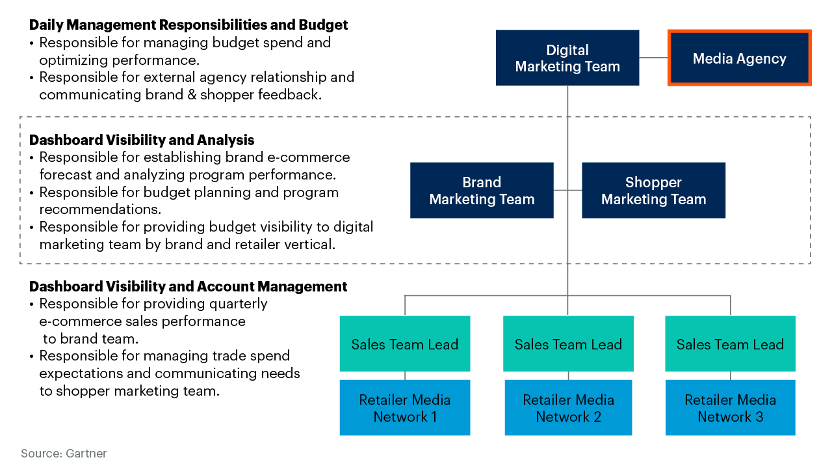
From agency partners to ad buyers to creative marketers and more, there are a lot of hands in the pot. Retail media can be complicated to manage because more cross-functional teams are involved in retail media decisions (e.g., sales teams, shopper marketing, etc.) compared to traditional paid media strategic decisions (see Figure 2).

Figure 2. Example Retailer Media Workflow Structure

Flow chart and text.

Staffing and upskilling an organization to effectively leverage retail media networks has its challenges. Only 19% of marketing leaders stated retail media advertising is an effective sales driver in the last year for physical third-party sales channel partners, according to the 2023 Gartner Multichannel Marketing Survey. The same survey revealed that almost half of multichannel marketing leaders said that not having the right mix of specialists and generalists is a major impediment to successfully executing retail media advertising.

Retail media advertising is also new for media agency partners. Gaining new skills to evaluate performance by retailers and navigating a fragmented network ecosystem take time to learn. Consumer goods organizations can support their agencies by establishing clear internal processes and workflows on retail media advertising that make adding or removing an RMN more seamless.

Then there’s the complication of measurement. Cookie deprecation is driving indirect consumer brands to seek new sources of ad targeting and measurement data from channel partners closer to the point of sale. RMNs are structured to operate differently than marketers’ traditional channels. At present, there is no standard RMN measurement mechanism for brands to leverage, with every RMN operating as a walled garden. Concerns over walled garden power provide brands with incentives to explore media alternatives even when they can’t match the scale and efficiency of the largest retailers.

A consumer goods perspective

RMNs create expensive digital shelves for consumer goods companies, requiring more resources and budget.

Paid media took up the majority of consumer product goods’ (CPG) brand budgets in 2023; adding retail media to the mix requires multiple decision-makers, which complicates the process even further. Many consumer goods companies could use outside help, yet agencies and services receive the lowest percentage of the budget.

Many CPGs are having trouble scaling RMNs. CPG marketing teams will need forward-thinking strategies to become better stewards. Identifying the retailers most critical to supporting organizational goals with their corresponding media spend can help consumer goods CMOs make strategic investment decisions on what retail networks to use and how much resources (both personal and budget) are required to support them.

RMNs primarily benefit CPGs by reaching consumers on retailer websites at the point of purchase, yet more off-site media capabilities will continue to emerge as retailers seek to monetize their own channels. Placement in retailer emails or special programs like holiday promotions will challenge consumer goods leaders to determine what programs offer the best results.

RMNs appeal significantly to the CPG industry because products are sold directly on the retailer websites, but other industries are beginning to test media on networks. Industries ranging from automobiles to insurance providers are testing ads on these networks to reach valuable consumers. As retail media capabilities scale and improve, it will become easier for non-CPG brands to participate in these networks for improved targeting and audience-building.

Retailers try to grow private-label brands and retail media networks

Retailers must endure the push-pull challenge to grow private labels (aka, store brands) while continuing to support national brands that consumers covet. The growth of private-label brands can clash with initiatives that retailers have to grow retail media. On one hand, the increased competition of store brands encourages national brands to increase investments in retail media.

RMNs also provide new tools to show store brand ads to consumers. However, the downside results in fewer advertisers if store brands replace national brands. Multibrand retail CMOs who oversee RMNs in addition to private-label brands have the advantage of setting clear goals for both. CMOs who do not have responsibility over RMNs must work together with their counterparts to ensure the company’s overarching goals supersede any specific department goals.

Private-label brands are critical for many retailers to differentiate their offerings and keep their pricing competitive as many consumers are trading down to combat inflation and higher pricing.

How CMOs can get started on leading their teams through the realities of RMNs

CPG CMOs can lead their marketing teams by engaging with cross-functional team leaders to better define the roles and responsibilities each has in retail media.

To more efficiently spend and effectively structure your organization to participate in retail media advertising, CMOs should evaluate their organization’s current maturity level. Do this by assessing the current state across five dimensions: retailer prioritization, team and role structure, media measurement, budget optimizations and audience segmentation.

Start this exercise at the senior leadership level and obtain cross-functional team feedback in your discovery assessment. Include key internal stakeholder teams responsible for media advertising types like social, programmatic display advertising and OTT. External agency partners can be looped in after your organization has defined budget and strategic objectives for your agency to help build your retail media advertising strategy.

Different steps are required, depending on your organization’s internal and external retail media maturity. For example, if your organization’s internal RMN knowledge is low but your media agency’s RMN experience and ad-targeting capabilities are high, focus on internal organization buy-in and strategic direction before building an RMN priority list.

This story is part of Adweek’s Beyond the Transaction special feature, which spotlights the people and strategies driving business growth and brand awareness.

.font-primary { } .font-secondary { } #meter-count { position: fixed; z-index: 9999999; bottom: 0; width:96%; margin: 2%; -webkit-border-radius: 4px; -moz-border-radius: 4px; border-radius: 4px; -webkit-box-shadow: 0 0px 15px 4px rgba(0,0,0,.2); box-shadow:0 0px 15px 4px rgba(0,0,0,.2); padding: 15px 0; color:#fff; background-color:#343a40; } #meter-count .icon { width: auto; opacity:.8; } #meter-count .icon svg { height: 36px; width: auto; } #meter-count .btn-subscribe { font-size:14px; font-weight:bold; padding:7px 18px; color: #fff; background-color: #2eb3b2; border:none; text-transform: capitalize; margin-right:10px; } #meter-count .btn-subscribe:hover { color: #fff; opacity:.8; } #meter-count .btn-signin { font-size:14px; font-weight:bold; padding:7px 14px; color: #fff; background-color: #121212; border:none; text-transform: capitalize; } #meter-count .btn-signin:hover { color: #fff; opacity:.8; } #meter-count h3 { color:#fff!important; letter-spacing:0px!important; margin:0; padding:0; font-size:16px; line-height:1.5; font-weight:700; margin: 0!important; padding: 0!important; } #meter-count h3 span { color:#E50000!important; font-weight:900; } #meter-count p { font-size:14px; font-weight:500; line-height:1.4; color:#eee!important; margin: 0!important; padding: 0!important; } #meter-count .close { color:#fff; display:block; position:absolute; top: 4px; right:4px; z-index: 999999; } #meter-count .close svg { display:block; color:#fff; height:16px; width:auto; cursor:pointer; } #meter-count .close:hover svg { color:#E50000; } #meter-count .fw-600 { font-weight:600; } @media (max-width: 1079px) { #meter-count .icon { margin:0; padding:0; display:none; } } @media (max-width: 768px) { #meter-count { margin: 0; -webkit-border-radius: 0px; -moz-border-radius: 0px; border-radius: 0px; width:100%; -webkit-box-shadow: 0 -8px 10px -4px rgba(0,0,0,0.3); box-shadow: 0 -8px 10px -4px rgba(0,0,0,0.3); } #meter-count .icon { margin:0; padding:0; display:none; } #meter-count h3 { color:#fff!important; font-size:14px; } #meter-count p { color:#fff!important; font-size: 12px; font-weight: 500; } #meter-count .btn-subscribe, #meter-count .btn-signin { font-size:12px; padding:7px 12px; } #meter-count .btn-signin { display:none; } #meter-count .close svg { height:14px; } }

Enjoying Adweek’s Content? Register for More Access!

https://www.adweek.com/commerce/cmo-guide-to-current-and-future-retail-media-networks/


May the Fourth Era of Advertising Be With You


.article-native-ad { border-bottom: 1px solid #ddd; margin: 0 45px; padding-bottom: 20px; margin-bottom: 20px; } .article-native-ad svg { color: #ddd; font-size: 34px; margin-top: 10px; } .article-native-ad p { line-height:1.5; padding:0!important; padding-left: 10px!important; } .article-native-ad strong { font-weight:500; color:rgb(46,179,178); }

TV isn’t what it used to be. Join the Convergent TV Summit in LA this October 25 with media, technology and marketing leaders to prepare for new trends and make industry connections.

In a rapidly evolving landscape, accurately predicting the future of online advertising is no easy task.

Four years ago, I wrote an article for Adweek outlining the emergence of the fourth era of online advertising, characterized by media transactions on online platforms with a focus on data privacy. Looking back, some predictions were on point, while others require reassessment.

In this updated and improved article, we will examine the progress made in online advertising, the unexpected advancements in AI, the changing media consumption habits and the evolving landscape of privacy and identity.

From AOL to ad networks

The first era of advertising was the portal era. Yahoo and AOL dominated in an era of high CPMs. The second era started after the .com crash in 2001 where we then had the direct response era. Paid search generally and Google particularly became dominant players.

Affiliates thrived on new tracking technologies. In display, high CPMs for brand campaigns turned into performance ad networks.

The third era followed the 2009 financial crash: the platform era. This saw the rise of multiple ad platforms and walled gardens (led by Facebook Audience Network, programmatic display and video) and the mass use of data.

As you can see each era brought new dimensions and followed a period of disruption. As we head into the fourth era, that disruption has been constant for a few years from the pandemic, regulators’ changes and economic uncertainty.

The fourth era of online advertising

In the past four years, most media transactions have indeed shifted to online platforms. The rise of Connected TV (CTV) has significantly contributed to this transformation, especially with the acceleration of this shift due to the pandemic.

However, despite these changes, data privacy has not progressed as rapidly as expected. The delay in Google’s sunsetting of third-party cookies, for instance, has temporarily alleviated concerns in the advertising industry. Nevertheless, privacy remains an essential aspect of the future of advertising.

The rise of AI

AI has become the most significant story in the marketing industry. Chat GPT, in particular, has rapidly gained popularity as the fastest-growing software application in history.

Its impact on progressive marketers is already evident, with AI assisting in tasks such as creative development, content production and media bidding. Major tech players like Google, Facebook and Amazon have also rolled out AI marketing tools, increasing adoption rates. This surge in AI adoption has been driven not only by technological advancements, but also by a shortage of available talent and the need for improved productivity in the wake of the pandemic.

The democratization of AI techniques

While AI and machine learning techniques have been utilized in marketing for over a decade, the growth of content-generating AI and the democratization of AI techniques have revolutionized the field. Previously, leveraging these technologies required advanced computer engineering capabilities.

However, the availability of user-friendly, natural language query-based AI technologies has opened doors for anyone to utilize AI tools. Although computer engineering expertise remains advantageous, the accessibility of AI applications will accelerate adoption even further.

Disruption in media consumption

The integration of AI into search engines poses a potential disruption not only to the dominant media platform but also to the amount of time spent browsing websites. If consumers can obtain the content they need directly from AI-powered sources, the need for extensive web browsing may diminish.

Consequently, advertising strategies will need to adapt, with ads integrated into AI outputs and video feeds instead of search results or web banners. This shift will give rise to new advertising opportunities while potentially rendering some traditional avenues obsolete. Furthermore, legal battles over content ownership are likely to emerge as the industry adjusts to this evolving landscape.

Privacy and identity in an AI-driven world

The industry’s attention is focused on Google’s plans to sunset third-party cookies, following in the footsteps of Apple devices and browsers. However, broader disruptions may overshadow this transition, making the loss of cookies a mere sideshow.

Privacy will undoubtedly remain a critical concern for the future, but it is essential to consider limiting how sensitive data can be utilized by AI tools and technologies. Striking a balance between privacy and AI-driven innovation will be vital to ensure ethical and responsible practices.

Look back to progress forward

As the online advertising landscape continues to evolve, it is crucial to reflect on past predictions and adapt to emerging trends. The fourth era of online advertising has seen significant progress, with media transactions predominantly occurring through online platforms.

The rapid advancement of AI has revolutionized the marketing industry, democratizing access to powerful tools. Media consumption habits are shifting, necessitating the integration of advertising into AI outputs and video.

.font-primary { } .font-secondary { } #meter-count { position: fixed; z-index: 9999999; bottom: 0; width:96%; margin: 2%; -webkit-border-radius: 4px; -moz-border-radius: 4px; border-radius: 4px; -webkit-box-shadow: 0 0px 15px 4px rgba(0,0,0,.2); box-shadow:0 0px 15px 4px rgba(0,0,0,.2); padding: 15px 0; color:#fff; background-color:#343a40; } #meter-count .icon { width: auto; opacity:.8; } #meter-count .icon svg { height: 36px; width: auto; } #meter-count .btn-subscribe { font-size:14px; font-weight:bold; padding:7px 18px; color: #fff; background-color: #2eb3b2; border:none; text-transform: capitalize; margin-right:10px; } #meter-count .btn-subscribe:hover { color: #fff; opacity:.8; } #meter-count .btn-signin { font-size:14px; font-weight:bold; padding:7px 14px; color: #fff; background-color: #121212; border:none; text-transform: capitalize; } #meter-count .btn-signin:hover { color: #fff; opacity:.8; } #meter-count h3 { color:#fff!important; letter-spacing:0px!important; margin:0; padding:0; font-size:16px; line-height:1.5; font-weight:700; margin: 0!important; padding: 0!important; } #meter-count h3 span { color:#E50000!important; font-weight:900; } #meter-count p { font-size:14px; font-weight:500; line-height:1.4; color:#eee!important; margin: 0!important; padding: 0!important; } #meter-count .close { color:#fff; display:block; position:absolute; top: 4px; right:4px; z-index: 999999; } #meter-count .close svg { display:block; color:#fff; height:16px; width:auto; cursor:pointer; } #meter-count .close:hover svg { color:#E50000; } #meter-count .fw-600 { font-weight:600; } @media (max-width: 1079px) { #meter-count .icon { margin:0; padding:0; display:none; } } @media (max-width: 768px) { #meter-count { margin: 0; -webkit-border-radius: 0px; -moz-border-radius: 0px; border-radius: 0px; width:100%; -webkit-box-shadow: 0 -8px 10px -4px rgba(0,0,0,0.3); box-shadow: 0 -8px 10px -4px rgba(0,0,0,0.3); } #meter-count .icon { margin:0; padding:0; display:none; } #meter-count h3 { color:#fff!important; font-size:14px; } #meter-count p { color:#fff!important; font-size: 12px; font-weight: 500; } #meter-count .btn-subscribe, #meter-count .btn-signin { font-size:12px; padding:7px 12px; } #meter-count .btn-signin { display:none; } #meter-count .close svg { height:14px; } }

Enjoying Adweek’s Content? Register for More Access!

https://www.adweek.com/media/the-fourth-era-of-advertising/


3 Key Themes That Incapsulate the Evolution of Influence


.article-native-ad { border-bottom: 1px solid #ddd; margin: 0 45px; padding-bottom: 20px; margin-bottom: 20px; } .article-native-ad svg { color: #ddd; font-size: 34px; margin-top: 10px; } .article-native-ad p { line-height:1.5; padding:0!important; padding-left: 10px!important; } .article-native-ad strong { font-weight:500; color:rgb(46,179,178); }

Don’t miss Brandweek, Adweek’s ultimate experience for marketers, September 11-14 in Miami. Connect with peers and gain insights and inspiration from top brand marketers and industry icons at Glossier, Coca-Cola, Taco Bell and more. Register.

In today’s interconnected world, social media platforms are the new town squares where creators and influencers hold court. And even in the relatively short amount of time that influencers have been around, the dynamics of influence have undergone a profound transformation. Power has shifted from traditional gatekeepers to everyday individuals who have mastered the art of audience captivation.

Examined through the lenses of digital culture, the nature of influence—the people who influence, the platforms they use and the ways in which they participate—is evolving into something very different from what we have experienced in the past. Three key themes encapsulate this evolution and define what it means for brands.

Collective influence

Creators and influencers have been working on their content in isolation. In the increasingly saturated field in which they operate, this is leading to burnout.

As a result of this, influencers are banding together in collectives to share the burden of the creative process. This also helps them to have a greater shared impact in a very crowded space.

Be it hype houses or media collectives, influencers create economic, emotional and creative alignment between collaborators. Rather than everyone competing for the same pie, thanks to these collectives, they are now engaging in co-opetition.

They are pooling their skills, audiences and resources in support of a larger creative vision or purpose. This is described as “creativity in multiplayer mode.” For example, Radar, a gated private community, has its core squad commanding a strong presence and influence among other members. Another case in point is MSCHF, which is an art collective set up to parody culture. MSCHF has a shared vision and is focused on making a statement through art and disruptive culture.

Human only > human extended

Advances in technology inevitably lead to questions about how it will negatively affect humans and their influence on the world (the typical Black Mirror reference). In this particular case, it is whether AI, which now gives anyone with a device and internet connection the power to create anything from their imagination, will drown out creators. We are already seeing influencers harnessing new technology, creating alternative revenue streams and extending their influence beyond the typical means of human life into different elements of the Web3 world.

We see this in Grimes getting ahead of the fakery and splitting royalties with creators who use her voice, and Hybe, the Korean music giant behind BTS, using voice AI to launch its latest artist, Midnatt, in multiple languages simultaneously.

New patronage

Creators have major cultural clout with large, dedicated communities that have helped shape their careers and make them who they are. However, creators know they’ve built their kingdoms on rented land and are at the mercy of the algorithms. Even the biggest of creators are small fish compared to the platforms. In a saturated IM market—one dogged by demonetization—there’s a recognition to rethink revenue streams and find a healthier way to turn a profit on their terms.

Having built a fandom from scratch, as well as learning a variety of desirable skills along the way and having an entrepreneurial spirit, they’re moving away from endorsement and taking creative control by launching their own creator brands.

Creators big and small are taking creative control, whether that’s Logan Paul and KSI launching their own energy drink or the D’Amelio family’s new management company, DamGood Mgmt, setting up to provide consultancy to other creators or Kat and Latisha Clark (TikTok’s Top Creator of 2022) moving medium with their “Basically Besties” podcast and a live tour.

The implications of this are vast. In the future, brands will not be competing with their established rivals, but with multiple, niche, creator-led brands.

As creators and influencers continue to work together in collectives to support a greater vision and harness new technology to open revenue streams and extend their influence, they will no longer be reliant on brands for patronage. They might possibly eliminate them from the equation altogether. This means that the communities that influencers have built will become an even more valuable commodity and a lot harder for marketers to tap into.

.font-primary { } .font-secondary { } #meter-count { position: fixed; z-index: 9999999; bottom: 0; width:96%; margin: 2%; -webkit-border-radius: 4px; -moz-border-radius: 4px; border-radius: 4px; -webkit-box-shadow: 0 0px 15px 4px rgba(0,0,0,.2); box-shadow:0 0px 15px 4px rgba(0,0,0,.2); padding: 15px 0; color:#fff; background-color:#343a40; } #meter-count .icon { width: auto; opacity:.8; } #meter-count .icon svg { height: 36px; width: auto; } #meter-count .btn-subscribe { font-size:14px; font-weight:bold; padding:7px 18px; color: #fff; background-color: #2eb3b2; border:none; text-transform: capitalize; margin-right:10px; } #meter-count .btn-subscribe:hover { color: #fff; opacity:.8; } #meter-count .btn-signin { font-size:14px; font-weight:bold; padding:7px 14px; color: #fff; background-color: #121212; border:none; text-transform: capitalize; } #meter-count .btn-signin:hover { color: #fff; opacity:.8; } #meter-count h3 { color:#fff!important; letter-spacing:0px!important; margin:0; padding:0; font-size:16px; line-height:1.5; font-weight:700; margin: 0!important; padding: 0!important; } #meter-count h3 span { color:#E50000!important; font-weight:900; } #meter-count p { font-size:14px; font-weight:500; line-height:1.4; color:#eee!important; margin: 0!important; padding: 0!important; } #meter-count .close { color:#fff; display:block; position:absolute; top: 4px; right:4px; z-index: 999999; } #meter-count .close svg { display:block; color:#fff; height:16px; width:auto; cursor:pointer; } #meter-count .close:hover svg { color:#E50000; } #meter-count .fw-600 { font-weight:600; } @media (max-width: 1079px) { #meter-count .icon { margin:0; padding:0; display:none; } } @media (max-width: 768px) { #meter-count { margin: 0; -webkit-border-radius: 0px; -moz-border-radius: 0px; border-radius: 0px; width:100%; -webkit-box-shadow: 0 -8px 10px -4px rgba(0,0,0,0.3); box-shadow: 0 -8px 10px -4px rgba(0,0,0,0.3); } #meter-count .icon { margin:0; padding:0; display:none; } #meter-count h3 { color:#fff!important; font-size:14px; } #meter-count p { color:#fff!important; font-size: 12px; font-weight: 500; } #meter-count .btn-subscribe, #meter-count .btn-signin { font-size:12px; padding:7px 12px; } #meter-count .btn-signin { display:none; } #meter-count .close svg { height:14px; } }

Enjoying Adweek’s Content? Register for More Access!

https://www.adweek.com/brand-marketing/themes-that-incapsulate-the-evolution-of-influence/


Do Your Homework: The Strategy Behind Effective Creator Marketing


.article-native-ad { border-bottom: 1px solid #ddd; margin: 0 45px; padding-bottom: 20px; margin-bottom: 20px; } .article-native-ad svg { color: #ddd; font-size: 34px; margin-top: 10px; } .article-native-ad p { line-height:1.5; padding:0!important; padding-left: 10px!important; } .article-native-ad strong { font-weight:500; color:rgb(46,179,178); }

Don’t miss Brandweek, Adweek’s ultimate experience for marketers, September 11-14 in Miami. Connect with peers and gain insights and inspiration from top brand marketers and industry icons at Glossier, Coca-Cola, Taco Bell and more. Register.

One aspect of the marketing industry that I love the most is its unwavering ability to constantly evolve and change with culture, consumer behavior and the overall digitization of the world we live in. Nothing we do today is done the same way we used to do it, and influencer marketing is certainly no exception.

In 2023, influencer marketing is expected to grow into an astonishing $21.1 billion industry, a 1,200% increase from $1.7 billion just seven years ago. This growth is being driven by a number of factors, including social media ad fatigue, brand marketers who need to attract their next generation of consumers, streamlined workflows that make it easier to engage influencers, and increased measurability and attribution.

As the industry evolves and the world around us changes, so must our influencer marketing strategies. Brand mishaps with influencers are nothing new, but this time the stakes are higher: two-thirds of U.S. consumers say their social values shape their shopping choices.

In addition, for brands that want to attract their next generation of fans, it’s critical to take a stance on the issues vital to them: 75% of Gen Z consumers want the brands they support to involve themselves in social and political issues.

With all this momentum in the creator economy and the increased pressure on brands to play a role in social and cultural conversations, it’s time to evolve the way we develop influencer marketing strategies. Brands have a real opportunity to be a galvanizing force for good, but it requires reimagining the planning process.

Dig deep into consumer passion and pain points

Brands must understand the core values of their target audience—and I don’t mean their fleeting reactions to the news cycle of the day.

Core values are what people care about most and are an enduring part of who they are, i.e. helping those in need, taking care of the earth, ending poverty, reproductive justice, and creating a more diverse and equitable society.

Oftentimes, our customers’ core values are topics that specific influencers discuss in their content. Conduct a custom market research panel study to get these insights. Understanding what your customers care about should be foundational to developing your strategy.

Influencers are people, too

When seeking influencers to partner with, look for those who share the core values of your brand and audience. This is important because you are all on the same team. Brand partnerships are a two-way street and are most successful when they are long-term relationships.

While there are some occasions when short-term campaigns are the right tactic—like amplifying a cultural moment or driving a time-sensitive call to action—the vast majority of the time a brand will see better results from a meaningful long-term partnership.

To begin establishing these kind of relationships, start with the influencers you have partnered with in the past who drove the results you were looking for and were a pleasure to work with. Think through your business needs for, at minimum, the next six months and build a content framework that can be activated by your influencer partners with a designated cadence or in support of specific campaign moments.

If you are just getting started and don’t have historical performance to learn from, let the influencers know that you are looking to structure longer-term partnerships or a future ambassador program, but would like to start the relationship slowly by engaging them to create a few posts on behalf of your brand.

Plan for archetypes, not individuals

It is often tempting to begin the search for your perfect influencer partners by looking for individuals or accounts that you believe are a good fit for your brand.

Instead, start by identifying three or four influencer archetypes first. For example, a brand that needs to better communicate its product efficacy should consider using influencers who can help credential their claims. In this scenario, your archetypes could be category experts or power users of your product.

Another example could be a brand that wants to drive brand relevance with an emerging younger target. To achieve this objective, your archetypes should be aspirational tastemakers or peers of the target audience.

This approach will help ensure you are clearly defining the role of the influencers you are selecting and that they will help you accomplish your marketing objectives.

Do your homework

Once your archetypes are set, it’s time to start searching for those individuals to approach for a potential partnership. Begin your search by either using the native tools provided by the social platforms or an influencer network to help generate a list of candidates.

During your search, look for influencers who share your core brand values, fall within one or more of your archetypes, have healthy historical engagement rates, and create high-quality and brand-appropriate content.

Once you have a robust list, begin a deep vetting process to ensure they meet your brand’s standards. Use a combination of reviewing their past content for red flags or competitive issues, and conduct searches for more general background information. Typical red flags include previous offensive, discriminatory or highly political content; criminal history; drug use; public influencer-to-influencer spats; or instances of trashing brands in their content (aka de-influencing).

These are general guidelines, and some exceptions can be made. For instance, the criminal activity could have been many years in the past and the influencer has shared their journey publicly about overcoming personal challenges. Everything should be viewed in the context of your brand and audience.

Write a thorough brief

We want influencers’ creativity and personal storytelling to shine through while ultimately helping to tell the brand or product narrative. This is where writing a brief for influencer partnerships becomes a fine science. The brief should include the key messages you want to be conveyed through the content. These messages could also be validated during the market research you conducted to better understand your customers’ core values.

The most important aspect of brief writing is designing a flexible messaging framework that includes deliverable mandatories. These mandatories can include things like content format, deadlines, language do’s and don’ts, tagging, calls to action and brand or product inclusion. By providing the messaging framework that enables creative freedom and the specific brand mandatories that instill confidence, both parties will feel empowered and safe.

As with any marketing channel that experiences continuous growth and market maturity, we need to evolve our planning approaches. This is even more critical when our marketing activities have the potential to create a healthier online dialogue and make both partners and consumers feel seen, heard and appreciated.

.font-primary { } .font-secondary { } #meter-count { position: fixed; z-index: 9999999; bottom: 0; width:96%; margin: 2%; -webkit-border-radius: 4px; -moz-border-radius: 4px; border-radius: 4px; -webkit-box-shadow: 0 0px 15px 4px rgba(0,0,0,.2); box-shadow:0 0px 15px 4px rgba(0,0,0,.2); padding: 15px 0; color:#fff; background-color:#343a40; } #meter-count .icon { width: auto; opacity:.8; } #meter-count .icon svg { height: 36px; width: auto; } #meter-count .btn-subscribe { font-size:14px; font-weight:bold; padding:7px 18px; color: #fff; background-color: #2eb3b2; border:none; text-transform: capitalize; margin-right:10px; } #meter-count .btn-subscribe:hover { color: #fff; opacity:.8; } #meter-count .btn-signin { font-size:14px; font-weight:bold; padding:7px 14px; color: #fff; background-color: #121212; border:none; text-transform: capitalize; } #meter-count .btn-signin:hover { color: #fff; opacity:.8; } #meter-count h3 { color:#fff!important; letter-spacing:0px!important; margin:0; padding:0; font-size:16px; line-height:1.5; font-weight:700; margin: 0!important; padding: 0!important; } #meter-count h3 span { color:#E50000!important; font-weight:900; } #meter-count p { font-size:14px; font-weight:500; line-height:1.4; color:#eee!important; margin: 0!important; padding: 0!important; } #meter-count .close { color:#fff; display:block; position:absolute; top: 4px; right:4px; z-index: 999999; } #meter-count .close svg { display:block; color:#fff; height:16px; width:auto; cursor:pointer; } #meter-count .close:hover svg { color:#E50000; } #meter-count .fw-600 { font-weight:600; } @media (max-width: 1079px) { #meter-count .icon { margin:0; padding:0; display:none; } } @media (max-width: 768px) { #meter-count { margin: 0; -webkit-border-radius: 0px; -moz-border-radius: 0px; border-radius: 0px; width:100%; -webkit-box-shadow: 0 -8px 10px -4px rgba(0,0,0,0.3); box-shadow: 0 -8px 10px -4px rgba(0,0,0,0.3); } #meter-count .icon { margin:0; padding:0; display:none; } #meter-count h3 { color:#fff!important; font-size:14px; } #meter-count p { color:#fff!important; font-size: 12px; font-weight: 500; } #meter-count .btn-subscribe, #meter-count .btn-signin { font-size:12px; padding:7px 12px; } #meter-count .btn-signin { display:none; } #meter-count .close svg { height:14px; } }

Enjoying Adweek’s Content? Register for More Access!

https://www.adweek.com/brand-marketing/effective-creator-marketing-strategy-influencer-partners/