3 Digital Marketing Trends to Come in 2021

A global pandemic, widespread social unrest and polarizing political events. With 2020 almost in the rearview mirror, is it wise to predict what next year holds? I think it’s worth a shot! Here are three big industry predictions, based on all that went down this year and overall trends we’re already seeing.

Digitization & diversification continues

Following widespread cuts to ad budgets earlier this year, a rebound is anticipated in 2021, with Zenith forecasting that ad spend will recover by 5.8% globally. Brands will no doubt continue to move their advertising and marketing spends from traditional media into the digital sphere, which is expected to account for 51% of 2020 ad spending. Some brands may still be wary of losses as the second wave of the pandemic takes hold so we can expect to see big portions of these budgets go toward influencer marketing, where brands can get a lot of bang for their buck, compared to native ads on social media.

Media buying has become incredibly accessible. Editing tools and open-source software programs make it easy for anyone to run a creative campaign themselves, without oversight or advice from agencies. However, the smartest brands will choose to keep agencies and professionals in the mix so as to not compromise on quality. Likewise, agencies will need to embrace some brand’s desires to “DIY” campaigns and offer solutions that mix traditional management with more hands-off, advisory approaches. Agencies who try to pretend that this diversification of media buying isn’t happening and carry on with their typical approach won’t appeal to brands looking for more creative control and accessibility and could therefore suffer in 2021.

Synthetic media will muddy the waters

Synthetic media covers everything from face-swaps and AI-engineered stock photos to CGI influencers and deep fake videos. Synthetic media is on the rise and 2021 could bring more of this content to consumers’ everyday lives through social media advertising and marketing campaigns. These tools can offer brands safe, cost-effective ways to develop content while remaining mindful of public health restrictions. Conversely, they have the potential to become weapons of disinformation, causing serious problems for users seeking accurate, authentic content and resulting in a dystopian social media experience.

These tools can have their benefits, when used appropriately. For instance, through a combination of AI and facial deep fake technology, brands can quickly and easily dub videos into thousands of languages, making content that much more personalized and relatable for global audiences. However, choosing to go all-in on synthetic media across all facets of a marketing campaign could be a risky move for brands in the long term. It’s not worth turning off potential customers with videos and images they find unsettling or untrustworthy. Not to mention the risk of having a synthetic video manipulated for nefarious means. For these reasons, we can expect to see brands who are most attune with their audiences and broader trends double down on content and marketing plans led by real, relatable ambassadors and influencers instead of getting involved in synthetic media.

More platforms and features come and go

Every technology or platform has its moment until something else comes along. Yes, some have more staying power than others, but there’s almost always a “next best thing” waiting in the wings. Right now, we’re experiencing a renaissance of social platforms and apps, particularly as users seek out new and engaging ways to connect virtually. Brands and users can take their pick, and many have specific use cases and benefits to offer. However, in 2021, as more platforms emerge and we inch closer to critical mass, keep an eye on the biggest players to see how they cement their position in the ecosystem.

https://www.adweek.com/performance-marketing/3-digital-marketing-trends-to-come-in-2021/



Finding the Right Ingredients for Your Agency’s Multicultural and DEI Strategies

You’ve probably seen him on Netflix’s Chef’s Table. Globally recognized Mexican chef Enrique Olvera has made mole the flagship of his iconic and colorful culinary palette. 

This delicious dark sauce is emblematic of Mexican cuisine, a fusion of essentials that blend Baroque influences with the intense flavors of delicious complexity. 

Olvera, a chef trained at New York’s Culinary Institute of America who has made the ranks of The World’s 50 Best Restaurants every year since 2012, relies on history to better forge a contemporary culinary identity. What is worth noting is that Olvera chose to craft this mixture of cocoa, chili, sesame, peanuts, tomatoes and a range of spices in such a way that it keeps evolving over time. Rather than using a single recipe each morning, he starts with a base left over from the day before and adds available seasonal products, never in the same combination. 

In the end, this Mole Madre, as he has named it, has had dozens of different ingredients added to it over time. To date, that’s nearly 1,400 days of uninterrupted cooking with fresh products added to the existing base, giving the blend lively and slightly different character each day. The mole never stops evolving, continually becoming more complex. It has become a living, breathing ingredient.

Diversity needs to be nourished, continuously enhanced and celebrated.

I find this to be a fascinating analogy to what culture really is, especially as it relates to the notions of diversity, equity and inclusion (DEI). Just like with the mole, we continuously shape the flavors and colors of a culture that evolves and becomes more subtle yet more complex. And a deep understanding of the evolution of culture takes upbringing, inherited traditions and formal education, but it also combines constant learning, social interaction and shared life experiences.

Now that everyone is talking about DEI, it’s important to acknowledge the enormous value that derives from a wide range of cultural backgrounds and diverse perspectives relating to origin, race and gender. The more diverse a team is, the more it creates a blend of tasty and colorful creative output.

Actually, one of the most compelling arguments for DEI from a business standpoint is innovation. Just as biological diversity leads to evolution, diverse perspectives in the workplace lead to business innovation.  

Diversity “tastes” good. It’s good for business and pays off, but diversity needs to be nourished, continuously enhanced and celebrated. And brands can reap the benefits of the rich blend of insights and freshness. 

However, DEI is not the same as multicultural marketing.

The last few months, the conversation around DEI has become the flavor of the month in corporate America. Of course, this is great news. The not-so-great news is that for some corporations, DEI may be implemented in lieu of multicultural marketing programs, at least from a resource allocation perspective. The risk of treating them as the same thing could damage a brand’s bottom line.

A committed DEI program is a must for corporations to build an organization that better reflects the society and the marketplace. Diversity helps bring the right representation; equity is the recognition of everyone’s value in their difference, and inclusion is a must in order to have these voices heard at the decision-making level. 

An effective DEI program can serve as a springboard for an inclusive approach across all stakeholders, including suppliers, retailers and consumers. And precisely because retailers and consumers should be engaged in this effort, a multicultural marketing discipline with specialized expertise is required.

https://www.adweek.com/media/finding-the-right-ingredients-for-your-agencys-multicultural-and-dei-strategies/


A Handful of Tips for Advertisers Who Want to Capture the Rise of Gaming Streamers

In 2020, over 14 million streamers produced 650 million hours of content. Audiences are spending up to 95 minutes a day watching streams. Alexandria Ocasio-Cortez’ gaming debut on the platform peaked at 435,000 viewers.

This advertising potential mainly remains untapped for younger audiences. The space is fairly new and the playbook doesn’t exist. This leaves room for experimentation and greatness, but also a lot of mistakes. 

The rule of thumb is: Fit into the world of streamers and viewers and you’ll be fine. Here are my five tips for working with streamers.

Be honest

The Gen Z audience is sensitive to irrelevant noise—but informal, unregulated encounters and actions are also why live streaming appeals to them. Being live for multiple hours makes it hard to have everything staged and perfect; this is where true personality stands out. The same for your brand. You cannot lull stream viewers into believing in perfect advertising. Be honest about what value your product gives. 

Be open to change 

Trends in live streaming come and go. The craze of the Fall Guys game that took over the gaming world in August is nowhere to be found in November. If you want to plan in advance stick to evergreen categories like League of Legends, CS:GO, IRL or Fortnite. If you want to hop on a trend, be ready to keep up with it and change your plan on a whim.  

Put the community first 

Streaming is rarely only about the streamer. What makes it great is the relationship built between the chat and the streamer. Viewers are even happy about brands appearing on stream because they know that this helps the creator grow. Have your brand be a part of it. Show that you support the streamer and appreciate the viewers. Don’t do anything that takes advantage of them or disrupts watching. 

Trust the streamer

Streamers know their audience best. They spent hours interacting with them, so they know what is entertaining and what is cringe-worthy. Treat it as a collaboration, or a talk, and plan the activation with the streamer as a partner. Many of their suggestions will lead to satisfying viewers—and satisfied viewers can treat ad segments as something worth watching instead of a necessary evil. Sometimes counter-intuitive decisions lead to the best results. 

“For gamers” stickers won’t work 

Gamers and stream viewers are normal people. Most of them do not treat playing games as a personality trait. So do not treat “for gamers” as a product attribute when it’s not justified. The gaming or streaming setting is a space you can show your product in. Use it to show its best values. Your brand is cool enough by choosing to support streamers; you can only mess it up by pushing too hard. 

For example, how do you showcase a shaver product on a stream without showing the streamer’s face? Influencer Lirik, a variety streamer, usually streams without a webcam. But in this case, he used streaming to unbox the shaver and show off his beard only. During the stream, his viewers posted photos of their faces with a #KingCGillette hashtag. Lirik showed the photos on stream and advised what beard style the viewers should get. Results: 20,000 average viewers on sponsored stream with no drop in viewership while promoting the product. It worked because it was natural, with paced reviews between games. There was natural interaction with a way for fans to be noticed.

https://www.adweek.com/media/a-handful-of-tips-for-advertisers-who-want-to-capture-the-rise-of-gaming-streamers/


Why We Need a ‘Bye Week’ in Corporate America

2020 has stretched individuals and organizations to their full capacity.

Unfortunately, the countless challenges won’t disappear when Dec. 31 rolls over into Jan. 1, 2021. The issues exposed over the last year will require new answers as individuals and organizations are held to a higher standard. The bright side of 2021 rests on the abundant opportunity for individuals and organizations who self-select to add value and solve real-life problems. These matters are every bit as advertised: complex, demanding and numerous. It’s unrealistic to address all these struggles while continuing business as usual. There needs to be a practical

As the world moves more quickly, individuals and organizations believe they have to take immediate action with no time to slow down. This is false. This is precisely the time to take an intentional corporate “bye week” to make sure they’re strategically positioning themselves for the best moving forward.

A bye week is a sports term where teams have a mandatory, preplanned week away from competition during the middle of the season. High-performance athletes and sports teams use this time to accurately evaluate what they need to correct for the remainder of the season, rest to heal any mental or physical ailments, and prepare to close out the season at the highest form of their potential. Since bye weeks are planned and mandatory, everyone in the organization is in sync at the same time. During a typical regular season, NFL teams get one week off during a 17-week season which runs from the second week in September to the first week in January. Using this analogy, organizations would have three corporate bye weeks to model out a full calendar year. Scaled down to realistic terms, this would be a four-day weekend running from Thursday to start back Monday.

It may seem unrealistic to carve out time away from work, but there are no pre-established rules or best practices moving forward. Every organization is tasked with rewriting the rules that give them the best chance of success. External industries often provide answers to internal challenges by revealing alternative solutions.

Slow down and course correct

It’s hard to carve out time when there’s always another project, another fire to put out, endless pressures. There’s always something. The daily grind rarely allows for time to slow down in deep thought for an accurate assessment to course correct. It’s crucial to stay up-to-date on what’s essential. Slowing down helps individuals and organizations take inventory to discover hidden opportunities while others miss them with their heads down racing forward. The time spent is never wasted. That time is strategically positioning individuals and organizations to change their trajectory. Course correction is increasingly vital because missteps are magnified and extremely difficult to repair.

Address wellness

It isn’t normal for the human body to power through everything. Resilience (the 2020 buzzword) has its place, but so does the ability to stop and recharge. Burnout, mental health struggles, Zoom fatigue and work-life imbalance are common themes from 2020, but the reality is they’ve always been there. Many people are working harder with less structure than pre-pandemic. No one is immune to it.

Oftentimes, people avoid sharing their troubles for fear of being judged, burdening or showing weakness. Resources are often underutilized. It’s hard to visually identify who needs help. Yes, employees are free to take sick days and personal time off, but teams rarely recharge simultaneously. As a result, employees peak and crash at different times. This staggered recovery is problematic for individuals required to work in teams. The ability to think at a high level for strenuous work diminishes when employee wellness lags. Individuals can’t compartmentalize and perform when their minds and bodies are not at full capacity.

https://www.adweek.com/brand-marketing/why-we-need-a-bye-week-in-corporate-america/


To Reach Gamers, Advertisers Must Look Beyond Twitch

While most media companies struggled through 2020, gaming was one sector that experienced a breakthrough. For marketers, the gaming channel went from being the slightly awkward teenage cousin at Thanksgiving to the cool uncle taking the kids on spins around the block in his brand-new sports car in a very short period of time.

Speaking of the holidays, this year at your socially-distanced/Zoom Thanksgiving, do me a favor and ask the younger adults what they’re streaming these days. It’s likely Twitch, Amazon’s gameplay streaming service where average viewers can watch other (sometimes professional) gamers.

It’s not just within families that gaming has become more mainstream. Advertisers have started to look at the gaming audience with newfound respect. Iconic brands like BMW, Levi’s, Puma and Samsung have stepped up and into sponsorships, and even partnered on gaming-themed products like Gucci’s Fanatic X watch.  And if anything will make an advertiser sit up and take notice, it’s the 12.3 million live viewers of Travis Scott’s Fortnite concert earlier this year. The numbers are there, and marketers are starting to see that “gamers” represent their target audience, too.

Now that marketers seem to be more sold on this concept, where do they go to reach gamers? The obvious channel is Twitch—the livestreaming platform with 15 million daily active users consuming user-generated content from 3 million monthly broadcasters. While the user base is a fraction of that of TikTok, for instance, Twitch makes more money from advertising alone ($300 million) than TikTok. 

Historically, Twitch has done a great job of looking out for its broadcasters, understanding they are the lifeblood of the platform. To date, Twitch has been pretty friendly with marketing efforts for brands and games as well. Look at how InnerSloth, a small developer, leveraged Twitch to generate massive buzz for its game Among Us and took its place among the political noise when Rep. Alexandria Ocasio-Cortez (D-NY) joined the platform to play. 

Then, Twitch’s advertising M.O. suddenly changed. Before September, streamers could manually run mid-stream ads, which would get served to their subscribers. Not anymore: now, mid-stream ads will show up everywhere for non-paying users, no matter what. And because the ads are part of the steam itself, ad blockers no longer work. 

As former Overwatch pro and massive streamer Brandon “Seagull” Larned noted, “If I don’t play enough ads, Jeff Bezos will literally come to my stream and push the ad button.” 

The internet was ablaze with criticism at this ruined experience. Case in point: while the ads utilize the “picture-by-picture” function, where the stream minimizes into a smaller window while the ad plays, the streamer is muted. Given the impact this has on the Twitch user experience, they wouldn’t have risked the change if it wasn’t worth it. Amazon doesn’t make major product decisions or monetization shifts willy-nilly. Backlash from users aside, I have to wonder if they realized that the same issues that affect CTV platforms are at play here, too. 

There’s the well-known problem with frequency capping, and of course, the ease in which users can skip ads when using platforms like Apple TV or Fire TV, or glance at their phone during the ad break. When viewing on desktop, users can and will open up another tab, effectively making the ad disappear. 

Also, there’s the issue brand safety. Unlike YouTube, which has specific guidelines, Twitch streamers are pretty much on their own—and not all are family-friendly. Plus, there’s the fact that the streams are live. All that adds up to even more of a brand safety nightmare. 

https://www.adweek.com/digital/to-reach-gamers-advertisers-must-look-beyond-twitch/


Inclusion Is the Gift in These Heartfelt Holiday Ads

Rebecca? Roberta?

Welcome to my everyday dialogue with baristas, receptionists, shopkeepers alike, when I have to apologetically announce my name five times and spell it out letter by letter until they get it right.

R-o-b-e-c-t-a.

I suppose I was never asked to question how normal this situation is for people with quirky names until I saw Etsy’s latest holiday spot “Shiori.” It is about a girl’s journey to own her unique name via a necklace gifted by her mother. The authentic spot even ended with a sprinkle of conversational Japanese in the end. In short, I have never felt so seen through an ad.

[embedded content]

This holiday season is unlike any other we have experienced before. Gone are the usual presents or fantasy-filled holiday TV spots. For once, it seems like brands want to tell realistic, heartwarming and most importantly, inclusive stories for all. 

For the first time, Disney U.K. created a Christmas ad about a Filipino immigrant family as the main protagonist, honoring heartfelt traditions (e.g., the star lantern scene was magical) and a priceless relationship between a grandmother, or lola, and her granddaughter. The spot had since been watched by many around the world, and were applauded for its originality and authentic depiction of Filipino immigrant families. 

Even in the much anticipated annual Christmas spot from John Lewis, the retail giant’s ad centers around the theme of paying it forward by featuring a diverse range of moving art formats, from animation and claymation, to CGI and cinematography.

In the end, there are a few commonalities:

A resonant festive narrative doesn’t have to be about escapism or extravagance

Hedonistic ways of spending the holidays are no longer applicable this year. Grounding stories in realistic, varied scenarios allows the audience to feel more human. Whether it’s portraying lola’s intimate bond with her granddaughter, a blond girl helping a brown boy get his ball or a group of hip street pigeons befriending a hedgehog, the anchored theme of inclusivity resounds consistently in all the stories told. 

Gentler, kinder attitudes are core characteristics displayed in all spots

All the spots highlight how generosity and kindness can benefit everyone. Even Tesco, a U.K. grocery chain, is using humor to diffuse this year’s emotional weight.

Warmer tones, melodious vocals and childlike animations remind the audience the beauty of small things

From the background Japanese dialogue between a mother and a daughter, Griff’s soft voice as an anchor to adorable claymations, the sum of all these creative nuances shine light on loving narratives between family, friends and communities. 

For many, this holiday season will not be one that is festive, but one burdened with complex emotions. These ads are a tender reminder to us all that even during the continuing Covid-19 crisis, nothing can take away the priceless pleasures in life: self-worth, empathy, kindness, laughter, connections with friends and family and many more. 

https://www.adweek.com/digital/inclusion-is-the-gift-in-these-heartfelt-holiday-ads/


Ad Tech Needs More Women at the Top

Ad tech needs more women in leadership roles.

Every female executive in our field has had the experience of being the only woman seated at a professional dinner or on stage at an industry event. In technology businesses, there is a dearth of women in leadership and ad tech. The STEM field of advertising continues to suffer from a lack of diversity among women and, in particular, women of color.

The benefits of gender diversity are self-evident. Researchers find that companies with women on their boards outperform more male-dominated rivals with 66% better return on invested capital, 53% higher return on equity and a 42% increase in sales. Why would you not have an equal- or even overrepresentation of women on your leadership team, especially in advertising? Women make 75% of purchasing decisions and over index on many of the most popular apps and websites where marketers find customers.

In order to find women for leadership roles, companies need to be intentional about it. That means men have to be proactive allies. So many of the sectors in ad-tech — DSPs, measurement apps, technology vendors, and analytics tools, to name a few — are dominated by men in executive ranks. We need to systemically overcome the natural bias of sameness in order to make room for women to hold seats around the table as well.

The first step is to focus internally. Companies have a responsibility to consider all possible homegrown candidates in a very practical way. We need to consider who has the potential to be elevated. Sometimes, that means scouring the talent pool, asking ourselves if someone can expand into a role. We should be willing to give internal employees a little longer than we otherwise might and to support them as they grow. There are usually great employees who are a few months shy of being ready for the next level and need that final growth push.

Let’s say you have three absolute “must-have” criteria for a senior position you’re filling. There’s a female candidate who checks two of the boxes, and you believe you can help her fill the gap on the third. Can you give her executive coaching, mentorship, and educational resources? Rather than write off an internal female candidate who might not check every box, imagine if more time was invested in mentorship, bolstering knowledge, skills, and opening paths to advancement for female candidates within the company. 

Sometimes you do have to look externally. The more senior the role, the smaller the candidate pool, and in the high-pressure, fast-moving world of advertising technology it can be tempting to hire from resumes that come in most quickly. But being purposeful in creating a diverse leadership team requires an extra measure of commitment and more time dedicated to making the right hiring decision. Get buy-in from your executive team and add DEI volume targets for the number of candidates rather than focusing solely on time limits to hire. We need to purposefully and measurably hire women into senior roles, particularly women of color. Real change won’t happen until we hold ourselves accountable to those targets. Being intentional means leaving no stone unturned, internally or externally, when hiring for leadership positions.

Let’s also make industry events more inviting. Too often, tech conferences suffer from a culture of heavy drinking, golf outings, and, in Nevada, fervid gambling. That kind of atmosphere is designed to appeal to an exclusive group of professionals rather than an inclusive group of existing leaders and emerging talent. We ought to provide more group activities everyone can enjoy, where attendees can share and learn together. Given what we know about the success of companies led by women, it’s safe to assume that networking opportunities created by women are likely to succeed at creating enjoyable experiences as well as an inclusive environment for diverse talent.

https://www.adweek.com/programmatic/ad-tech-needs-more-women-at-the-top/


4 Ways Independent Marketing Consultants Will Change the Post-Pandemic Industry

A recent Forrester report just predicted that an additional 17,000 agency jobs will be eliminated next year, on top of the already staggering 35,000 jobs that were eliminated in 2020. This will lead to an extraordinary number of uniquely skilled people entering the job market. And it is already having a significant impact on how and where brands look to fill their creative, media and communications needs.

A large number of the roles that were eliminated were senior agency folks who have years of experience working across multiple disciplines. Even though there will be less seasoned talent found within traditional agencies, these people don’t simply vanish, and neither does the need for the type of higher order strategic work they perform.

Looking ahead—and to steal the phrase of the moment—what does this “new normal” look like for the marketing industry?

I found myself at a crossroads in my own career about a year ago. Knowing that I was ready to move on from agency life, I began to explore how I could do the work that I loved within a different, more autonomous setting. What I discovered was a thriving counterculture of independent consultants that had set out to change the way the industry operates and how marketing gets done.

The new normal is not one where brands diversify their agency roster. Rather, it’s one that diversifies who they choose to partner with to solve some of their most critical marketing challenges.

Independent consultants, often with decades of diverse and integrated experience, bring fresh perspective, flexible engagement structures and an innate desire to solve complicated problems to the table. They are highly adaptable and make excellent partners to brands and agencies alike.

Now take into consideration that there is the potential for an additional 50,000 of these self-employed marketing ninjas available to companies of all shapes and sizes, and you can’t help but imagine that a systemic shift is on the horizon.

Team structure

Partnerships are born out of mutual admiration, not convenience.

The nature of consulting work is not permanent. The terms and duration are based upon the exact need to be filled.

When consultants become part of a team within a brand or agency—or even with multiple other consultants—it is because all parties have identified that they want to produce work and solve challenges together. They recognize and respect each individual’s contribution and know that they will only work together as long as they are forwarding their mutual goals.

Mutual admiration and respect will guide the structure of teams and should result in happier team members and greater cost efficiencies.

Integration

The marriage of data and creativity becomes reality.

Most marketing consultants have been around long enough to have seen the pendulum of the “next big thing” swing in wildly different directions. They know what the job of exceptional creative, strategic and targeted communications and data-driven insight and activation actually are.

This integrated understanding makes them well-suited to develop processes and practices to truly bring data and creativity together for the benefit of consumers and brands alike.

Compensation

The agency multiplier is an endangered species.

Consultants have very little overhead, and time is their most valuable asset. When brands are assessing fee structures, the use of the agency multiplier as a way to compensate for the employee and cover overhead will fall under even greater scrutiny.

If a brand can secure a senior level consultant, sans agency markup, it will begin to rethink what types of partnerships it wants to leverage. The industry will likely move toward value-based pricing where brands compensate all partners based upon the market value of the deliverable or service, signaling a short future for negotiating based upon an overall multiplier.

https://www.adweek.com/brand-marketing/4-ways-independent-marketing-consultants-will-change-the-post-pandemic-industry/


Why Kamala Harris’ Win Is So Meaningful for Minorities, Immigrants and Women


Today, history was made in the United States and I hope every single one of you remembers this moment. I was at a workout this morning, started celebrating at the gym. Senator Kamala Devi Harris just became the first female vice president, the first Black vice president and the first Indian vice president in American history. This is a special moment.

Let’s be real for a second. This election was so much more than just picking between Democratic and Republican parties. After four years of the Trump administration, it became clear that many minorities and women were battling for their human rights with their vote. These groups historically are often ignored, underrepresented and a product of a system that fails them over and over again.

I can’t speak on how meaningful this is for women, the Black community or even most Americans (as I’m a Canadian), but I can only imagine what many of you are feeling. What I can say, is that this is incredibly important to me. As a son of immigrants and a person of Indian descent, I can’t help but look on with excitement. 

Shyamala Gopalan, Kamala’s mother, was born in Chennai, India and immigrated to the U.S. to attend The University of California—Berkeley to become a breast cancer researcher. She died of breast cancer in 2009. That alone, tears me up inside.  

My mother, who passed away this month from cancer, had done the exact same thing. She moved from India to North America to make that better life for her family. She taught me to take pride in our Indian culture, and to not be ashamed. That’s easier said than done, when you’re an 11-year old kid trying to play ball hockey and kids are shouting “Osama” at you. 

My mom taught me to live life with integrity, be honest and to find ways to be resilient. These are the same characteristics that I see in Kamala Harris as she gets ready to enter the White House. Just like my mom, Kamala’s mother instilled those same values in her: to take pride in your culture, live life honestly and to find ways to uplift your community to help inspire those around you.

Growing up, I’ve never seen a person in the highest office of politics coming from an Indian background. I’ve mainly seen stereotyped characters like Apu from the Simpsons or Raj from How I Met Your Mother, but never anything in a leadership role like this. With that in mind, the first thing I felt this morning was the excitement of knowing that young minorities and young women growing up can see a leader that looks like them. They can aspire for greatness, just like Kamala did, despite the systemic societal challenges that many of them still face.  

As a marketer of color, this is just as special. We’re often underrepresented in boardrooms, meetings and decision-making roles, and to see someone like Kamala take on this new challenge, should inspire us all. It tells me that despite being one of the only BIPOC professionals in that meeting, I’m unknowingly setting the stage for many others to join.

It’s telling young minorities and young girls that this is your story to shape, not someone else’s. Don’t ever stop dreaming big, because this is possible. No matter your ambition, there’s a stage waiting for you.

In regards to Joe Biden and Kamala Harris taking office, the work starts now in bringing forward change, equality and justice for (every) person in the United States. It’s a long road ahead, but you can’t help but be excited about what’s next. This was a battle for hope that was won today, especially for many of those who might never have had it. 

@avishsood Avish Sood is a brand manager at The Clorox Company and is the founder of The Sponsorship Space.


https://www.adweek.com/brand-marketing/why-kamala-harris-win-is-so-meaningful-for-minorities-immigrants-and-women/


A Closer Analysis of the Presidential Email Marketing Campaigns


Integrated campaigns such as these are one of the most exciting areas of marketing to dig into. There are even some great marketing psychology lessons, too.

With record-breaking budgets of an estimated $10.8 billion combined, the Trump and Biden campaigns should have driven the most intricate and innovative marketing campaigns of their time. And yet, they revealed lackluster tactics that left us wanting, with only occasional hints of genius.

Splitting the differences

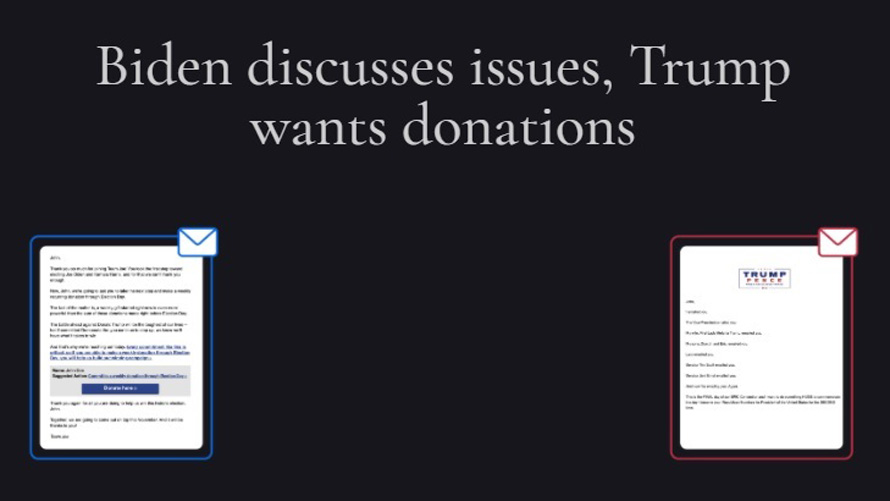
Trump’s campaign was much like his persona: broad, bold, and aggressive. Biden’s digital campaign was also somewhat predictable: focused on beating Donald Trump and somewhat more diligent about focusing on policy specifics.

Donald Trump will say what he wants to say and will doggedly stay on message, driving his point home through repetition. So, when mapping out his email marketing funnels, it’s no surprise to see that an average user can expect almost 3 emails a day. In fact, the Trump team ran a post-debate fundraising push where subscribers saw 12 emails in a single day. That kind of frequency is undoubtedly excessive, but it’s also indicative of the Trump brand. That campaign was catering to a crowd where frequent, repetitive emails with loud subject lines (that don’t always deliver on the promised content) might be landing in an eager inbox. 

The Biden campaign is milder and less aggressive about seeking campaign donations. For example, the Biden campaign generally takes a gentler approach to ads and messaging, using phrases like the more folksy “chip in” instead of the commanding “donate now.”

There are two important digital marketing areas that will be the most impactful in the election campaigns: digital ads, and email.

How each camp prioritized ad messaging and placement

Biden’s ads prioritized swing states, considered a smart tactical move. Trump used Facebook ads to send users to one-sided polls and to reinforce ideals by sending surveys, which ensures total control over the messaging he relates.

Ad channels have significant control over the messaging and the user experience of their platforms. However, by sending users to a survey, Trump is able to obtain total direction over the messaging he relates. It’s a strategy we’ll probably see used again. 

Early list-building (and compliant list sharing with partisan allies) will be critical in future elections. In this election campaign, Trump’s team apparently didn’t bother to set up an email funnel for those who signed up but didn’t donate, preferring instead to focus entirely on those who had already donated. This was probably an unintentional error or oversight. 

Trump’s strategy has likely produced burnout among Trump donors. The campaigns’s strategy is not one I would recommend to marketers seeking long-term loyalty, as evidenced by Biden’s late-game decision to increase spending habits. Lists can be segmented and targeted accordingly.

Completely dropping an entire section of your list simply because the recipients did not respond with funds is a big flop—and it probably resulted in some significant proceeds being untapped. Future candidates who best segment, target and own their lists will find themselves in a better position to create deep and personal relationships with their audiences.

Meantime, voters are anxiously waiting official results.

https://www.adweek.com/brand-marketing/a-closer-analysis-of-the-presidential-email-marketing-campaigns/