When It Comes to Brands, ‘Cancel Culture’ Is the Right Approach

It wasn’t Kanye’s announcement that he was running for president that led to this defense of cancel culture, but it could have been.

Nor was it Facebook’s role in the demise of democracy and perpetuation of hate or the empty and performative stance against racism of any kind by so many brands over the last weeks, but it could have been.

We’ve begun conflating the cancelling and breaking up with brands with intolerance, when it’s the most modern illustration and exercise of consumer power, today. (I’m looking at you, Goya.)

I’m not defining cancel culture as the president has done so flippantly, because I think it’s more important than that, especially because it is the exercise of consumer power. I’m defining it as a filter on what brands we bring into our lives, and on what and who we choose to buy from. If I were to sum up why I defend cancel culture in four words they would be: because life’s too short.

This isn’t about an intolerance for a difference of opinion. It’s about an impatience for a better world.

This isn’t about an intolerance for a difference of opinion. It’s about an impatience for a better world. I can accept that brand X has a different opinion and set of values than I do. But in a world torn asunder like ours is, why would I pay them heed, let alone dollars?

Breaking up with people, institutions and brands that don’t fundamentally share our values is a good kind of cancel culture, and a brand’s fair warning. Again, life’s too short.

In a world where product and service commoditization and alternatives abound, why give a moment’s thought to those whose positions we cannot abide or those who neither stand with us nor for us, especially when there is so much else to choose from?

On June 18, the New York Times opinion writer Elizabeth Bruenig tweeted that “there’s just something unsustainable about an environment that demands constant atonement but actively disdains the very idea of forgiveness.” There is, and there must be room for legitimate second acts, the atonement and forgiveness Bruenig refers to.

I don’t think, as popular press would have it, that this is a bad thing, allowing that we leave room for both atonement and then forgiveness. We all vote with our wallets, ears, eyes and attention—and we are surrounded by worthy alternatives, or at least even trade-offs.

And in this world populated as it is by increasingly conscious consumers, brands need to be more worthy and authentically prove that worthiness across a broader spectrum of actions than ever before. Why? Because people are paying attention like never before, and they will not pay for that and those who do not stand with them.

The time for brand fence sitting is over. The fence sitter’s concerns that taking a stand is complicated or a risk that notes the brand is not perfect, that “Republicans buy shoes too”—those days are gone and no longer stand as a reason to not do what’s right, at least as you see it.

Fence sitting is the new moral equivalence and will lead almost as quickly to being cancelled as sitting on the wrong side of said fence, irrespective of whether your fence leans left or right.

In these times, when normalcy has been shed like a snake’s skin and when all kinds of status quo are up for grabs, we the people are impatient (perhaps desperate) for a better world. So we too are equally impatient with those brands (human and otherwise) who stand between us and that by their actions or inactions.

Life is short and the shelves are stocked aplenty with good enough alternatives. So why compromise when you can cancel? That’s how we can influence change, and that’s a good thing.

I have but one life to give and I will not give it to Kanye, nor to brands that don’t recognize what’s expected of them in a world like ours.

https://www.adweek.com/brand-marketing/why-compromise-with-brands-when-cancel-culture-is-thriving/


What Cannabis Brands Can Do to Navigate Trump’s Social Media Executive Order

At this moment, the entire country is engaged in digesting the daily chaos of multiple crises. With everything that’s going on, it’s easy to miss some impactful changes. These changes could lead to difficult outcomes for those in the cannabis industry. In order to fully understand how to adapt, it’s important to understand the backstory.

On March 5, Twitter instituted a policy intended to curtail “synthetic and manipulated media.” The initiation of these new guidelines led Twitter to provide additional context on content deemed misleading. One of the conditions Twitter chose to monitor are messages that can be construed as voter suppression or intimidation. Notably, cannabis-related content is not a target of Twitter’s new policies.

If Trump’s new executive order isn’t disregarded by the FCC or defeated in court, online spaces like Twitter may become legally akin to publishers.

Over the last decade, President Donald Trump has become the unofficial face of Twitter, given his frequent use of the social media platform. However, his relationship with Twitter and other leading social media outlets has been contentious, with Trump often alleging an anti-conservative bias. Back in May, Trump tweeted two messages with claims about the potential for election fraud via mail-in ballots. Deeming the claims spurious, Twitter placed a notification underneath both tweets allowing users to “get the facts about mail-in ballots.” Two days after these fact checks, Trump issued an executive order ostensibly intended to prevent speech restrictions on political or other types of online discourse. More recently, Twitter put a label on one of Trump’s tweets for “glorifying violence” following protests in Minneapolis.

Fundamental to Trump’s executive order on preventing online censorship is the distinction between online spaces with nonexistent or minimal oversight of user content, like Twitter, and those with curated content screened through an editorial process by a publisher. This distinction was codified into law in section 230 of the 1996 Communications Decency Act, which protects platforms like Twitter from liability for content created by their users.

For example, when dispensaries post pictures of flowers or edibles on their social media pages, it has been established that companies like Twitter weren’t responsible for or seen as endorsing this material. However, if Trump’s new executive order isn’t disregarded by the FCC or defeated in court, online spaces like Twitter may become legally akin to publishers, incentivizing social media companies to regulate speech on their platforms even further.

This presents a major challenge for cannabis marketers who have been harnessing the immense reach of channels like Twitter or Instagram.

At present, social media abounds with large cannabis companies and smaller mom and pop shops that use these platforms to share cannabis-related content. Given that cannabis remains illegal at the federal level, Trump’s executive order may potentially silence cannabis-related businesses from using these platforms to connect with customers. Many small businesses in the cannabis space will take a massive financial hit because of this reduced capacity to connect with customers.

Morris Beegle, co-founder and president of We Are for Better Alternatives, said in a recent conversation that this order will not only have a negative impact on his small businesses but that “further restrictions on cannabis- or hemp-related content due to this executive order will absolutely obstruct and impact the potential growth of this industry.”

Brands and savvy marketers in the cannabis space may need to begin exploring novel approaches to advertising their products in case Trump’s order becomes entrenched as the law of the land. Direct mail approaches through postcards or other marketing collaterals are an excellent option for businesses in the cannabis space with an existing customer base.

Prospective customers can also easily be acquired through purchasing customer lists and leads from a data company. These results are likely to yield an excellent ROI; according to the United States Postal Service, direct mail recipients purchased 28% more items and spent 28% more money than people who did not receive direct mail and patronized the same business.

https://www.adweek.com/brand-marketing/what-cannabis-brands-can-do-to-navigate-trumps-social-media-executive-order/


We Need to Uproot Racism From the Top. It’s the Right Thing to Do

Confronting systemic racism must start at the top.

Otherwise, it will persist with every leader who looks the other way. Every leader who checks a box. Every leader who thinks it’s their company’s responsibility to address it—and not their own.

As leaders, this is not the time to stay silent. It’s about action that starts from the top. Action that’s fueled by the centuries of injustice, indignity and atrocities that have targeted the Black community. The hate, the violence, the murder of men, women, transgender people and children. We must be saddled with the killing of George Floyd, Breonna Taylor, Tony McDade and others whose names and stories we do not know and not rest until we have played a significant part in eradicating racism.

It’s time to shatter that complicit posture and summon all the influence, power and funding we have as industry leaders to take meaningful action to bring an end to systemic racism.

It’s time to shatter that complicit posture and summon all the influence, power and funding we have as industry leaders to take meaningful action to bring an end to systemic racism.

As the leader of David&Goliath, it begins with me.

The only way for me to respond to systemic racism is to go within myself and examine my own complicity and evolve from there. Not just with words, but actions that come from a fierce desire to create immediate, impactful and sustainable change.

To that end, my commitment is as follows:

To begin to dismantle systemic racism, we acknowledge the barriers that have prevented Black talent from thriving in our industry. Therefore, to disrupt this pattern, we are pledging to accelerate our recruiting efforts on hiring Black talent at every level to attempt to achieve equal representation within the next six months and provide even greater opportunity for Black talent on an ongoing basis.

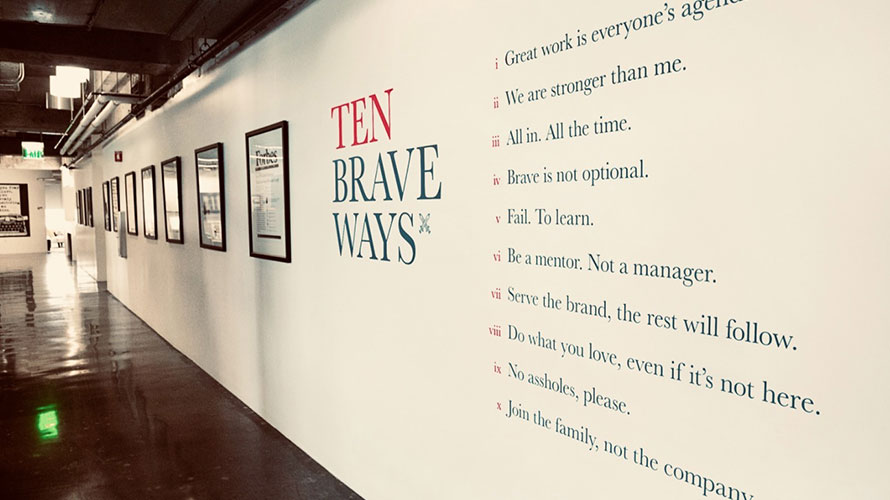
Painted on the wall of our agency is the “Ten Brave Ways” that inspire us daily. No. 2 is We are stronger than me. In the spirit of this brave way, we have assembled a diverse group of employees called the Braver Together Culture Team. They will help ensure that we exceed all our goals for creating a more unified agency with specific attention to elevating our current Black employees as well as continuing to provide greater opportunities for people of color on an immediate and sustained basis.

We will continue to strengthen our alliances with community partners including Year Up!, Light Bringer Project, Film2Future, Dynamic Girls, AEF MADE and the 4A’s MAIP. And for our Bravehearts internship program, we will identify and hire underrepresented young talent, including an equal representation of Black youth, and continue to help in their development of personal and professional growth.

I will be speaking on panels about racism and serving as an advisor for Allyship & Action. We will be donating $100,000 to further its cause for sustainable, scalable, systemic change.

As members of 600&Rising, D&G is participating in the #CommitToChange campaign to help the organization in their mission to rid our industry of systemic racism.

As a board member of the 4A’s, I will be leading the charge in encouraging other CEOs to confront racial injustice and inequalities head-on by acting from empathy and implementing practices within their companies.

Juneteenth has not only been added as one of our company holidays, but also will be our annual day of service to Black communities.

I have started an unlearning and learning process, partnering with DE&I experts and consultants. Our president has begun this process as well. This will be an ongoing dialogue as we are learning to unlearn by the minute, inclusive of any microaggressions or past actions rooted in racism. Our managers will begin shortly, and then the rest of the agency will follow.


Fastest Growing Agencies

Standout amongst the industry’s best and give your employees something to celebrate. Become an Adweek Fastest Growing Agency and gain industry recognition for your success over the past three years (2017-2019). Submit today.

https://www.adweek.com/agencies/we-need-to-uproot-racism-from-the-top-its-the-right-thing-to-do/


How to Stay Legally Compliant in an Altered Age of Advertising Production

When the global pandemic hit, attention was focused on the agreements among parties: advertisers, agencies, production companies, talent and rights holders. Conversations focused on termination rights, contingency provisions, insurance and force majeure.

To restart advertising production, new agreements and provisions have been drafted. While the parties negotiate and debate, there remains an almost insatiable need for new advertising content that both fits the needs of the moment—a world of stay-at-home orders and the needs of tomorrow—and the drive to increase sales and growth.

In the quest for new advertising materials, policies and procedures have been developed to allow for advertising production where groups of people come together. On a parallel pathway, there has been a heightened focus to create new advertising from the materials and content already produced, whether it is by simple use of clips or edited footage or photography, or more advanced digital manipulation. An interesting example is State Farm’s commercial used in ESPN’s high-profile documentary The Last Dance featuring doctored footage of SportsCenter anchor Kenny Mayne.

Make sure you follow the rules—whether they relate to social distancing and masks, or third-party rights and advertising laws—as they are all extremely important.

Advertising and creative materials, once produced, may be viewed as a tangible product—the property of the advertiser suitable for mining to create new work. Avoiding the problems of advertising creation amid Covid-19 is possible only if the path chosen provides an effective creative and business solution with fewer, not more, legal risks.

Here are some of the legal considerations when creating new advertising from already produced advertising materials:

Talent

What is in the talent agreement? Does SAG apply? If SAG does not apply, what do the releases or contracts provide? What is the allowed scope of any future use: term, territory and time periods?

Photography and music

The most likely scenario is a limited-use license. What are the terms of the license? Even if the brand is the copyright owner, consider whether there are still payment obligations and use limitations.

Third-party rights

Rights holders to artwork, logos, graffiti, tattoos, trademarks and copyrighted works will usually be subject to comprehensive agreements or written permissions. A core element of such documents is a limitation to the original intended use. As such, any further use will require negotiation and agreement.

Exclusivity

Even assuming use rights exist or are secured, if the use is for a different product category or brand, what about exclusivity? Does the advertiser have and/or want exclusivity? Are the talent and third-party rights now tied to a competitor?

Use or digital manipulation

Even if use rights beyond the term, territory or product exist, what about rights to digitally change, manipulate and/or sample the original work?

Assuming all use rights have been secured, the advertiser must consider another area of concern: advertising law regulatory issues. Advertising law is based on the fundamental legal principle that advertising must be truthful, not misleading and not deceptive. Further, there must be substantiation for all claims made at the time the advertising is run, not when it was created. Consider the following:

Use of clips or scenes from currently existing advertising approved as compliant with the existing advertising law rules at the time must be reviewed again for the new use. This applies to new product claims and substantiation of such claims as well as legal issues that arise out of a specific type of advertising—demonstrations.

A demonstration makes a claim about what a product can do (e.g., how much liquid spill a paper towel can absorb) and then shows the viewer that the product is doing it (e.g., the actual spill is being wiped up and absorbed). If content, by editing or manipulation, is changed in a material way but presents this to a consumer as a real demonstration, then there may be a need to add a disclosure or not use the manipulated footage. The facts will determine the action needed to ensure legal compliance.

As you seek to avoid the risks that could arise out of in-person advertising productions during this time, you must be sure that your action does not cause other damage, claims or injures. The last thing you want is a litigation by a third-party alleging failure to secure all necessary rights or a claim by a regulator that the new advertising created is false, deceptive or misleading.

Make sure you follow the rules—whether they relate to social distancing and masks, or third-party rights and advertising laws—as they are all extremely important.


NexTech, July 27-30, 2020

Don’t miss Adweek NexTech July 27-July 30th, to explore the future of video convergence, ATV and CTV. Save your virtual seat.

https://www.adweek.com/tv-video/how-to-stay-legally-compliant-in-a-altered-age-of-advertising-production/


TikTok Hashtag Challenges Could Be the Next Recruitment Power Tool

TikTok, the video sharing social network service, has experienced tremendous growth during the Covid-19 pandemic. Although initially aimed at teens and tweens, TikTok has started attracting older users. It provides an online venue for lip dubbing and dance contests where participants can engage with other users around the world. Recently, TikTok users have gained media attention by harnessing the power of the network for political and social movements with support from other users.

Recently, TikTok launched TikTok for Business, a new platform aimed at marketers with a slogan urging people to make TikToks rather than ads.  TikTok’s platform provides brands the ability to manage their own accounts, partner with TikTok influencers and create differentiated hashtag challenges. It offers augmented and virtual reality features that can be used to create immersive content.

Although still in its nascency in terms of campaign targeting and measurement features, TikTok offers an environment to capture authentic experiences that may be difficult to visualize in a static frame or with textual description. This is critically important for organizations that, prior to Covid-19, relied on in-person experiences as part of their marketing and recruitment strategy. There are, arguably, other platforms that can be used to share video content (e.g., Instagram Stories, Snapchat). But the unique aspects of TikTok are the playfulness of videos and novel hashtag challenges that garner participation. This content provides authentic perspectives about a place, its people and their personalities. Thus, three areas where TikTok may offer value are employee, student and donor recruitment.

Employee recruitment

A few months ago, many hiring processes started with a phone screening of a candidate and ended with a round of interviews at an office. This allowed a candidate to get a better perspective of the day-to-day environment of an organization, and a hiring team could observe the candidate interact in that space.

However, to adhere to health and safety guidelines, many final interviews are now taking place on Zoom or Skype. Photos of an office space or a short statement in a recruitment video do not fully capture banter between colleagues across cubes. TikTok provides a way to humanize and capture such elements of organizational culture.

For example, Klinikum Dortmund, a hospital in Germany, has effectively used TikTok to recruit new nursing talent. Through unorthodox and whimsical content, the hospital has been able to capture the day-to-day activities of its staff in entertaining ways. Other sectors could similarly leverage TikTok in their own recruitment efforts. Imagine the dance challenge after a successful debugging effort by a software development team.

TikTok provides a way to humanize and capture such elements of organizational culture.

Student recruitment

While universities provide digital content to capture their campus experiences, campus visits retain their own significance. It is where a prospective student may witness current students huddled at a table studying for an exam or a freshman building an ice cream sundae for breakfast. For many high school students, the college campus visit is a rite of passage with campus tours and swag collected across different institutions.

However, such visits may not be possible in the current environment, and tours have been modified to accommodate social distancing requirements. TikTok offers universities a way to demonstrate the feel of a campus—whether it is through videos capturing students at an event or in class.

The University of Florida was one of the first institutions to use TikTok, but now other universities are adopting the platform. Since use of TikTok is relatively new in higher education, having designated student TikTok ambassadors may be a useful way for colleges and universities to get started.

Donor recruitment

Many nonprofits are struggling to manage their day-to-day operations with a lack of visitors and patrons. Zoos and museums across the United States have endured major layoffs. Coupled with this problem are the challenges faced by nonprofit development teams, which struggle to maintain their current donor base while attracting new donors.

https://www.adweek.com/digital/tiktok-hashtag-challenges-could-be-the-next-recruitment-power-tool/


Actually, People Are Not Delaying Holiday Plans. They’re Already Thinking About Christmas Gifts

[unable to retrieve full-text content] https://www.adweek.com/digital/actually-people-are-not-delaying-their-holiday-plans-theyre-thinking-about-christmas-gifts/


What Success for LGBTQIA+ Representation Looks Like Outside June

Earlier this month, SCOTUS outlawed employment discrimination against LGBTQIA+ people–a joyous moment as we honor Pride. However, this fight is far from over. We still need protections in housing, public spaces, education, federal funding and more so we can truly be equal and feel safe living authentically. Until then, society will keep missing out on our true value and potential. In marketing, this means creativity and innovation are lost.

Today’s crucial discussions of systemic racism have made it painfully clear: In most companies, diversity and inclusion efforts haven’t been adequate. Now, big brands, media companies and agencies are responding by doubling down on D&I efforts, promising more sizable and accountable progress, and throwing tens or even hundreds of millions of dollars at the problem.

These efforts are paramount to achieving equality, and yet, we find ourselves absent of information, which is desperately needed for more transparent data on representation.

How can we freely express ideas when we can’t even be seen as ourselves?

Acknowledging our intersectional world as this work begins, we’d be remiss not to call for better data on LGBTQIA+ representation, too. There’s no reliable data set about LGBTQIA+ representation specific to our industry, nor how we fare in leadership or other spaces where we can make a positive impact on the work. Now is the time to plan a holistic data strategy for your company’s talent and target audiences so that you can expand creativity with inclusive and relevant marketing.

Companies have D&I programs because they know top talent insist on working in inclusive environments. And truthfully, many companies have been safe havens and true vanguards in the LGBTQIA+ civil rights movement by implementing policies like domestic partner benefits and transgender healthcare inclusions long before our legislatures and courts have caught up.

Not all companies are so progressive, of course, and even in the best workplaces queer people are still in hiding. The Human Rights Campaign’s latest figures (2018) show that fewer than half of LGBTQIA+ people are out at work. We’re estimated to be 4.5% of the U.S. population and growing as more of us feel safe reporting our identity. However, we’re not 4.5% of marketing budgets, of families depicted in advertising and certainly not of boardrooms.

Nearly 15 million Americans are LGBTQIA+, but for most marketers, we’re still considered a niche or special-interest category. Think about it. The entire population of Ohio is 11.7 million. If we’re special interest, what are they?

This comes at a cost, not just to the people working so hard to hide their authentic selves, but also to their employers. Aaron Walton, co-founder and CEO of Walton Isaacson, underscored the problem perfectly: “Innovation happens when you bring in people with different viewpoints and open up to possibilities. When team members feel they can’t be authentic, they put energy into covering and code switching, and creativity and innovation are lost. That’s not good in our business as I’ve never met a client who didn’t want to be innovative.”

There’s a connection between the micro-level personal interactions and macro-level business dynamics. As an industry, we state creativity is the most essential resource to advance client business, but we represses creativity when our leaders don’t acknowledge our pronouns or allow us to fully present our gender identity at client presentations. How can we freely express ideas when we can’t even be seen as ourselves?

Data-driven insights we do have reveal that marketers are missing out. Because seeing ourselves in brand content outside of June is rare. And when we do see ourselves represented, we may view it as tokenistic. A study last year found that a whopping 72% of queer Brits thought ads featuring them were just that. Still, brands investing to be relevant to LGBTQIA+ consumers can reap benefits, being viewed as “progressive and inclusive,” garnering 44% higher purchase intent and generating better brand recall to name a few. 


Fastest Growing Agencies

Standout amongst the industry’s best and give your employees something to celebrate. Become an Adweek Fastest Growing Agency and gain industry recognition for your success over the past three years (2017-2019). Submit today.

https://www.adweek.com/brand-marketing/what-success-for-lgbtqia-representation-looks-like-outside-june/


How the LGBTQ Community Is Supporting One Another Virtually This Pride Month

Covid-19 has affected everyone, but some groups have been more negatively impacted than others. Beyond health indicators and the factors that seem to affect its severity, socioeconomic inequality is as consistent with the novel coronavirus as it is with job security.

Research shows that the trans and gender nonconforming (GNC) communities are more affected by the virus, especially people of color within these groups. The way inequality and power structures work, those in minority groups are often the most vulnerable, including during major disasters and pandemics. As such, the LGBTQ community finds itself in a precarious position on many levels.

But adversity often inspires creativity, community and action. Though Pride festivals around the world may be splintered, Covid-19 has brought our community together in new ways.

Though Pride festivals around the world may be splintered, Covid-19 has brought our community together in new ways.

Being queer and online during quarantine

The queer community has needed to be resilient over the years in order to combat forces like homophobia, transphobia and racism. With a large creative community and many that work as part-time or contract employees or in an informal economy, this has been a time of adaptation and survival.

Based on unemployment, the entertainment and service industries have been hardest hit by Covid-19, and those who work in these fields have flocked to social media and digital outlets in order to offset lost income. This has led to a series of virtual LGBTQ events in the lead-up to Pride, including Instagram Live drag shows like Brigitte Bidet’s Tossed Salad performance, ticketed Twitch performances like the Sickening Drag Event, ticketed Zoom club parties like Susanne Bartsch’s On Top, morning coffee sessions with trans actress Angelica Ross, Bingo fundraisers with drag queen Alyssa Edwards, the Corona Kitchen cooking show fundraiser with trans activist Feroza Syed and queer-hosted live talk shows like Legendary Talks with Legendary Damon.

The virtual drag show has been one of the most innovative and, hopefully, lasting concepts of quarantine. This format is consistent and provides access to everyone. Performers announce a lineup, drive an audience to a live platform and then provide tip information for electronic payment such as Cash App and Venmo. Dozens of drag shows have popped up every week, and especially for RuPaul’s Drag Race fans, this has been an exciting opportunity to watch some favorites on a regular basis. Virtual cash tips are essential in keeping this new type of event alive.

Virtual Pride of 2020

As Pride month and June’s Stonewall celebrations creep up, these national events face a major question: How will they pivot in the time of Covid-19?

Many, like Los Angeles’ Pride, have chosen a virtual format. A virtual Gayborhood Pride Phoenix Edition occurred on April 18. It was an exciting translation of the real-world format into a virtual experience, complete with a star-studded main stage and an exhibitors hall that had sponsors and nonprofits.

Without a hallmark moment to gather around, many Pride celebrations are expanding typical programming throughout the year, allowing for extended activities and access for folks who are not local and may not have been able to attend physical events.

Additionally, nonprofits will miss out on landmark dates to fundraise for their annual budgets. It will be important for leaders to remember these organizations and instead ensure that they are woven into new events and content platforms.

Brands and Pride in 2020

Pride will also be different for brands. With no Main Street to march down and no pool parties to sponsor, brands must find new ways to connect with the LGBTQ community.

It’s as important as ever for brands to recognize that Pride is not just a celebration but a moment that has deep meaning for the LGBTQ community. In 2020, there is a reflective tone to Pride as we face some large hurdles, not the least of which it being an election year that will determine the fates of many in our community. This year, brands must step up to support causes, protect the livelihood of the queer and trans creative community, find a deeper connection to the movement and extend with new ways of connecting.

We are seeing activists continue to speak up and performers finding new ways to connect with audiences around the world. As we continue to (virtually) congregate and, most importantly, while the LGBTQ community continues to echo the phrase “Pride is year-round,” the year 2020 will reflect that mentality.

Editor’s note: This article was written before the Black Lives Matter protests.

Fastest Growing Agencies

Standout amongst the industry’s best and give your employees something to celebrate. Become an Adweek Fastest Growing Agency and gain industry recognition for your success over the past three years (2017-2019). Submit today.

https://www.adweek.com/brand-marketing/how-the-lgbtq-community-is-supporting-one-another-virtually-this-pride-month/


The System of Oppression in Our Workplace Is Limiting All of Us

It’s time for all of us to look inward to our industry and begin the conversation about diversity and inclusion. In my experience, at most agencies and companies in Los Angeles, most creatives are white, a few are Asians, but only one or two, if not zero, are Black or brown people. And many leaders are men with one or two that are women—usually white. The systemic oppression is not only in criminal justice, education, financial institutions, etc.—it’s in our work and our workplace.

Take a look at the company roster: co-workers’ races, genders and roles. Is it balanced? Is it diverse? During the hiring process, we could say they weren’t qualified for the role either by lack of experience or skills. And we could say their personality wasn’t a good fit, but what culture are we basing that off of? Looking at education, we’d prefer a bachelor’s degree over an associate degree, Ivy League over state school. All of what we could say to deny a candidate can be a reflection of the overall oppression that’s kept women and minorities from a quality education that snowballed up to this very moment.

When you work with different genders and races, you press against your own stereotypes and comfort zones.

When we work with different genders and races, we press against our own stereotypes and comfort zones. It will shift the team dynamic. We learn empathy, compassion, teamwork, acceptance and, most importantly, we will learn humanity. And we learn that the creative genius has no gender or race. Having a balance of genders and races represented, we become connected to who we are as human beings—and who we are advertising to. In the absence of balance, we are limited to mirrors of our own culture and the rest remain unrelatable and unimportant.

Ideating scenarios and scenes

Based on what we’re selling and who we’re selling to, we devise our plans and our narratives. But so often we default to white people and their lives—that’s what’s upheld as the ideal American Dream. This is the low hanging fruit; it’s a dead horse we’ve been beating for decades. The dream shouldn’t be to be white. While inclusion of minorities can be found in ads and movies as supporting characters and some as leads in recent years, somehow it still doesn’t seem balanced because it’s often posed as a token.

We as advertisers have the power to create new stories and visions—we have agency to set the new ideal. We have so much impact on viewers and consumers. We help shape and define what’s popular, what’s in fashion and what’s desired. We bring to the front and exploit insecurities—insecurities that are defined by white standards. We are accountable for reinforcing these subliminal notions. With new views and angles contributed by different genders and races, creativity itself is challenged, and we can finally stop treating minorities as PR props. We can build new visions of the American ideal, the standard, the life.

With recent events, a few brands have posted content in support of the Black Lives Matter movement on their social channels. This corporate solidarity content likely came from one of us. Some clients will ask for it, some agencies will pitch it and some will choose to avoid it from either or both ends. Is it not weird that Covid-19 is worthy of compassionate content but standing beside the fight against injustice isn’t? Many brands remain silent, fearing backlash, from entering political conversations, but their silence is its own political statement. And this silence is grotesque.

We must tell ourselves and our clients: Don’t fear the conversations becoming messy and heavy. And while most people in our industry seem progressive, it’s in moments like these that it’s revealed to us that many actually uphold conservative views or superficial stances by choosing to remain silent and declining to take action in our work and workplaces. Jumping on the bandwagon for our clients and for our own social reputations is dishonest and disingenuous when internally, we’re still abetting the problem. How dare we take part in these conversations and show “solidarity” when we’re also guilty of being complicit, when we ourselves are not hiring minorities and female creatives, the subjects of the conversations we’re having?

Recruiters are doing their jobs in following the description and the parameters defined by a creative lead, and neither factors systematic oppressions into the criteria. We must look beyond education—at their portfolio and their creative genius, seeking their potential, their talent. The blame falls on all of us for not wanting and creating the balance in diversity within our own walls.

Are we doing absolutely everything to hire and empower women and minorities? Are we actually invested in change? Are we offering tools, classes, internships and mentorships to help prepare and advise them? Are we donating not just our money but also our time and knowledge? Are we offering them jobs? Give them not only a chance but our trust and faith. Empower them. Believe in them. Our society can change when we are also invested in the change. Be a part of this creative solution. Don’t just tweet, check the box and think we’ve done the part. Don’t be satisfied with empty words. Be a part of the change, and be a part of the new era of advertising.

Fastest Growing Agencies

Standout amongst the industry’s best and give your employees something to celebrate. Become an Adweek Fastest Growing Agency and gain industry recognition for your success over the past three years (2017-2019). Submit today.

https://www.adweek.com/agencies/the-system-of-oppression-in-our-workplace-is-limiting-all-of-us/


Weathering the Economic Downturn Storm so Your Brand Emerges Intact

Warren Buffett once said, “Only when the tide goes out do you discover who’s been swimming naked.” And with the economic downturn upon us, low tide has arrived.

The good news: If your brand is looking pretty exposed at the moment, taking decisive action now can help ensure it survives this economic storm and is better prepared for growth in sunnier times.

Ingenio and our flagship advice brand Keen.com were founded in 1999 when Silicon Valley was thriving. Since then, we’ve weathered not one but two catastrophic economic downturns: the dot-com bubble and the Great Recession in 2008. When the dot-com bubble burst, we were fortunate to be one of the few VC-backed tech companies of Silicon Valley to survive. Then during the Great Recession, despite slackening revenue, we emerged with a larger, stronger customer base.

A company’s survival can be attributed to various factors, but two for us proved key: the evergreen nature of our product and the deliberate, decisive actions taken by leadership.

Making the tough calls early, focusing of your critical customer needs and continuing to build customer loyalty can benefit any brand in a downturn.

Not every brand has the option of offering a product or service that can be leveraged in both economic downturns and upswings. Making the tough calls early, focusing on your critical customer needs and continuing to build customer loyalty can benefit any brand in a downturn.

So what can you do to help your brand weather an economic storm? Here are some strategies that have worked for us:

Cut early, cut deeply

Making the tough calls early is key. Take a long, hard look at your business strategy and supporting cost structure, then determine if they need to change and how. This may require reallocating some budget dollars to higher priority areas and making some tough decisions around cost reductions.

Be aggressive in paring down nonessential expenses to ensure your brand’s survival. Remember, you can’t unspend a dollar. Live to fight another day, and you can always reinvest during an economic upswing.

Break through the marketing clutter 

Just as businesses are looking to cut costs in a recession, consumers are as well, so it’s critical to make sure your brand stays relevant and breaks through the marketing clutter.

During a recession, consumers likely will be looking for brands to provide more value for their dollars as they try to stretch them further. The market will become saturated with deals, discounts and promotions to address at home cost-cutting measures.

But what if your customer is looking for something more? Reach out to your current customers and stakeholders to better understand what’s currently top of mind for them. Then tailor your consumer messaging to directly address their needs, allowing you to carve out your own niche and rise above the din.

Build and nurture customer loyalty for the long haul 

Developing deep and lasting customer relationships requires steady investment over time, during good times and bad. In fact, customers are more likely to remember how brands treat them during the tough times, which can impact how those same brands are then perceived in the long run.

Be clear on what elements of your brand consumers value most, and prioritize those. Continue to invest in those areas, and you’ll reap dividends in customer loyalty. Having a strong, loyal customer base can help weather many an economic storm.

Ultimately, a brand’s ability to survive a recession depends on many factors, not the least of which is a little luck. However, taking decisive action early and remaining focused on the customer are just a couple of ways to help your brand survive during the low tides.

https://www.adweek.com/brand-marketing/weathering-the-economic-downturn-storm-so-your-brand-emerges-intact/