The Biggest Customer Brands Are Missing Out on the Asian American Consumer

A surprising number of brands write off the Asian American and Pacific Islander (AAPI) consumer as a 5.6% niche and not a worthy investment.

It is true that certain obstacles exist from a marketing perspective: our dozens of ethnicities, hundreds of dialects, a disparity in income and dispersion of cultures render engagement a unique challenge. But our population will double by 2060, and we’re on track to become the second largest minority in the next 15 to 20 years as the fastest-growing immigrant and ethnic group in the country. According to Nielsen, we wield over $1 trillion in annual buying power, make up the largest segment of online shoppers and out-index every other demographic in smartphone ownership (91%) and internet access (95%).

As shelter-in-place norms continue, these attributes become advantages. Brands are forced to rely on digital content consumption, online purchasing and word-of-mouth to engage customers, all of which happen to be things the next generation of Asian consumers are well-equipped for. As my mother would say, we are tiny giants.

Over the past year, I’ve witnessed several lessons that our supposedly niche Asian brands have employed to catapult themselves into the mainstream.

Niche is the next mainstream

Branding is storytelling, which naturally points us to the storytelling capital: Hollywood. The most lucrative creative franchises in history—Pokémon and Marvel—started as niche video games and comics. Despite their eccentricity, both are 11-figure businesses today.

In tech, we call this the “first 1,000 customer” phenomenon where you’d rather have 1,000 customers pay $1,000 each than 1 million who each pay $1. If the math sums the same, why does this matter? Because the former is substantially more loyal and will become brand evangelists that ultimately win you heightened lifetime value.

In the game of what wants to be the next mass-market brand, being specific to a niche makes you much more likely to walk away with the prize.

Despite representing just 11% of all businesses that received venture funding in the food sector, Asian founders across categories are responsible for 30% of the emerging unicorn ($500 million-plus valuation) and unicorn ($1 billion-plus valuation) companies in the last decade.

Interests are the new identity

In addition to capitalizing on consumers likely to be loyal to your brand, it’s important to be mindful about the way you segment your audience. The identities and labels that allow us to uniquely represent ourselves are necessary, but sometimes branding comes down to the values and interests that bring us together: We all want to live longer, happier and more successful lives.

‘And’ over ‘or’

With second- and third-generation Asian Americans accounting for an increasing share of disposable income, we must look to young buyers to understand demand. The next generation of Asian Americans simultaneously conforms to American consumer norms, while still seeking connections to their cultural roots. As both Asians and Americans, we’re hybrids of two customs, two languages and two nations, and the degree to which we relate to one or the other is in a constant state of flux. For businesses hoping to keep up, the question becomes figuring out how to strike the right balance.

Whether due to a strong grassroots sense of community, nostalgia for traditions or social behavior instilled through upbringings, Asians, like any cultural diaspora, will want to consume products that remind them of home. Before brands made youth-preserving skincare rituals mainstream, AAPI and American audiences had little interaction with the now-massive Korean beauty care (K-beauty) category. By positioning themselves as educators rather than sellers, K-beauty platforms brought toners, serums and sheet masks to the U.S., easing customers into multi-step beauty routines and empowering them with the knowledge necessary to make the products their own.

As the American consumer grows more diverse, brands may choose to keep pace or not. But one thing is certain: The Asian American consumer is becoming a monolith within the U.S. economy, and for those able to capture this audience’s attention, what was once a niche might prove to be a golden ticket.

https://www.adweek.com/retail/the-biggest-customer-brands-are-missing-out-on-the-asian-american-consumer/




Key First-Quarter Media Stats of This Epic 2020

Editor’s note: Adweek worked with Matthew Scott Goldstein, a consultant with a deep knowledge of the media industry, to craft his quarterly newsletter into an Adweek article. Through his findings on various industry earnings calls, we’re bringing you insights about how your favorite brands, agencies, media companies, publishers and tech companies are performing on a quarterly basis. His goal was to go past what the trades were focusing on, which mostly revolved around revenue, and tap into the nitty-gritty data shared on these calls.

This iteration focuses on media companies in the 2020 first quarter.

Q1 2020 earnings analysis and outlook 

Insight into the new normal/abnormal, covering a wide range of companies and categories, not just media. Focused entirely on the Q2 outlook, as January through March 11 is meaningless. Strong evidence that the media landscape has changed forever, especially the TV upfront. Focus is now on the recovery and opening of businesses with advertising as the fuel that drives demand. The broad reassessment by marketers on all spending is occurring. Cautiously optimistic that the worst is behind us, though still a tremendous amount of macro uncertainty. We have all learned to live with things we never thought we could live without, as consumer habits are changing forever. The future is being accelerated to a more digital economy.

Q2 media outlook

Q2 advertising for publishers is down 25-30% year over year, some even down 50-55% year over year; companies that did not use figures used terms like “materially weaker” and “significantly down.” Though a handful like Facebook, Roku, Snap, Dotdash and J2 are seeing Q2 revenue flat or up slightly year over year.

For Google, in March, revenues began to decline and entered the month at a mid-teens (15%) percentage decline in year-over-year revenues; although search activity increased, their interest shifted to less commercial topics. In addition, there was also reduced spending by our advertisers. International TV ad sales are down 30-50% yer over year. DR [direct response]/performance ads are strong, and advertising for purely brand/awareness building is decreasing. On a relative basis, broadcast is strongest followed by cable, then digital. Local is weakest driven by decreased spending of small- and medium-sized businesses. Declines in demand from industries like movie studios, restaurants, travel, tourism, retail, auto and luxury. Some advertisers are opportunistically increasing their spend like financial services/insurance, technology, telecom, streaming services, CPG, ecommerce, and APP downloads, especially games. Gaming and streaming seem to be the two categories that are most poised to permanently take more share of our time and wallets. New marketing budgets moving to streaming from traditional TV given cancellation of high-profile, live sports and entertainment events. Impressions/ratings up across the board, especially for the Triopoly. Programmatic revenue seems to be down 40-50% year over year so far in Q2, though CTV is up year over year. Revenue has stabilized in the second half of April for most companies; the worst was the five-week period from March 11 to April 15. Many companies expect to benefit from political advertising later in 2020. The last marketing dollar cut is usually the best-performing dollar. Many businesses are simply pausing campaigns, not canceling them to refresh the messaging. Triopoly may not need publishers’ inventory as much, since they are seeing significant traffic increase on their owned and operated properties. CPMs may be down 50%+ year over year (yes, 50%+), so all advertisers are getting huge bargains. New and existing advertisers are trying to acquire customers at a reduced lifetime value. With no commuting, many consumers have shifted their days one hour.

The TV upfront will be postponed until September/October, helping CTV thrive. Audiences want their entertainment on demand and their news, sports and events live. Holding companies/agencies are in a world of hurt, especially in Q2. They say they are down 15-20%—I don’t buy it; I think it will be much worse. The large agencies will be most hurt by the shift away from the TV upfront. Attribution from marketers is now easier since most sales are online and not in store. Easier for marketers to deal with/pause digital vs. linear. Programmatic is flexible and agile. Animation should be robust in Q3 and Q4. Cable subscribers will go down because live sports are paused.

Most media companies seem to be operating with 90-95% of employees working at home—what does that mean long term for the office? Can work at home continue as we hit the fall? Is this pace sustainable? Starting a new job with all new people will be very hard as the personal interaction is removed from the process. CMOs more than ever have to defend their spending to CFOs, that’s best done in data-driven advertising with trackable ROAS. Land grab and white space out there; companies just need to take the risk, especially as we emerge from this.

Advertisers historically try new advertising approaches, post-recessions 

  • Gulf War recession (July 1990-March 1991): Ad-supported cable TV networks start to grow.
  • Dot-com recession (March 2001-November 2001): Google emerges and the portals start to lose power.
  • The Great Recession (December 2007-June 2009): Facebook emerges and print advertising decline accelerates.
  • The coronavirus recession (March 2019): Broadcast TV advertising decreases and maybe Google search revenue also decreases, so other advertising mediums grow such as connected TV; advertisers bypassing agencies; private deals/PMPs replacing the open exchange needs to be reinvented—maybe we call it the Publisher Dow 30 or the Publisher S&P 500; ads in video games; ads in video conferencing.

Best listens 

Media companies

  • The Trade Desk: For a brief period of time, programmatic was hurt by one of its greatest features, its agility. You can easily start and stop programmatic campaigns in ways that are not possible in most other mediums, like linear television. In early April we saw more advertisers slow spend or hit the pause button, across every channel. Some verticals cut most of their budgets, such as the travel vertical. Of course, some did remain active, particularly in health and fitness, technology and computing, and home and garden. However, many businesses were simply pausing campaigns, not canceling them to refresh the messaging. The way a CPG or pharma company planned to message in January had to be redone. Overall, by mid-April the year-over-year spend decline stabilized. And as April progressed, we started to see stabilization and even some improvement. Advertisers started to adapt to the current environment. For example, restaurants shifted their messaging to “we are open,” or “we deliver.” Consumer products companies turned their focus to pantry-loading products. And some travel companies started to message that they would waive all change or cancellation fees for bookings. And beyond the present, many advertisers started to strategize about how they emerge on the other side of this pandemic. Flexibility and agility are super important for advertisers. But overall, there will be a massive land grab opportunity. And I expect that marketing will be a critical success factor in that land grab. Think about it. If you’re Uber or Lyft, for example, your business is largely on pause. And you’re not advertising much right now. But as we start to emerge from this, companies will start marketing more heavily because that’s the moment a company can gain awareness, loyalty and share. Whichever of those two companies markets more effectively, will gain share. And that same scenario will play out across every industry. Marriott versus Hilton. Domino’s versus Pizza Hut, Toyota versus Ford. All of these companies, and every other company out there is figuring out, right now, how they use advertising to connect with consumers and gain share once the gears of the economy start cranking again. What will they advertise, using what kind of creative, to what kinds of audiences, in precise locations, using what kind of channel, it’s all being strategized right now. CMOs more than ever have to defend their spending to CFOs; that’s of course best done in data-driven advertising. I believe that the media landscape has changed forever starting in the middle of March. Every channel and every participant is in a different position today versus a few months ago, because of one dramatic shift. Linear TV’s shelf life has shortened as viewers have moved, en masse, to CTV. The biggest loser in all of this is traditional, linear TV. And CTV is without a doubt the biggest winner. For advertisers, the cancellation of the upfront can be liberating. I hear it from brands and agencies every day. For them, the upfronts are a bit of a burden. They’re asked to commit billions of dollars to content they don’t know much about, chasing audiences they can’t measure. Now they have the freedom to be more deliberate, agile and data-driven in their TV ad investments.
  • Viacom: Audiences want their entertainment on demand and their news, sports and events live. Now with respect to Q2 specifically, on a relative basis, broadcast is strongest, then cable, then digital; local is weakest. Interestingly, though, the weakness is dominated by five categories, and they’re categories you would expect: auto, restaurants, retail, travel, movies. At this point, we know there will be a significant impact on ad sales in Q2. But based on what we’re seeing today, we believe there will be an improvement in advertising in the third and fourth quarters, assuming businesses begin to reopen at scale. In terms of the upfront, we expect it to be later and longer than normal, but we’re ready whenever our clients are, and deals will get done. In fact, we invited more than 5,000 agency and marketing executives to our virtual presentation on May 18 and 19. We believe Q3 ad sales will be better than Q2. And, again, right now, May and June scatter looked better than April. So that’s a good sign. We do see categories active in the market; again, pharma, CPG, financial services and tech. We do see categories continuing to be active in the market: pharmaceuticals, CPG, financial services, tech. Importantly, we continue to expect to benefit from political advertising later in 2020.
  • J2 Global: In any downturn, the first expense cuts happened within the marketing and advertising budgets of companies. It’s the easiest thing to turn off as there are few long-term noncancellable contracts. There are few penalties or costs associated with canceling and the revenue impact is felt in future periods. In this particular market, we have another factor, which is the explosion of ad inventory based on significant increases in media consumption that are causing compression on advertising rates. As a result of all of these trends, a number of the largest sellers of advertising in the world have reported significant, sudden and steep declines in revenue. At J2, however, we are cautiously optimistic that our $510 million annual ad business can perform better in relative terms. Our advertising business has little local retail exposure in terms of customers. We have roughly 1,100 advertisers who are mostly big companies, while many of the social media companies have millions of advertisers, a good number of them, local businesses that have been hit hardest by the pandemic. Little exposure to the hardest hit ad category so far: travel, retail, food and auto. In fact, roughly 40% of our ad revenues fall into the health category, where we are seeing growth from pharma marketers. As a point of reference through April, everyday health has seen organic ad revenue growth of 5%. The last marketing dollar cut is usually the best performing dollar, and as you know, about half of our ad business is performance-based, meaning cost per click, cost per lead or cost per acquisition; the other half, which is impression-based display, is usually measured and optimized on performance outcomes. Believe that video game play will only grow and establish itself as a leading form of entertainment. The spikes in consumption are evident. Now, a few words about M&A: We are pleased to have consummated two transactions in Q1. During this pandemic, we are very reluctant to close on transactions without visiting companies. Right now, we are planting a ton of seeds and when the clouds lift, we think we are going to be very well positioned strategically and financially to act on some very interesting opportunities. April revenues are also relatively healthy coming in flat year over year. In Q1 of 2020, performance-based marketing slightly eclipsed display advertising.
  • Snapchat: Thus far in Q2, year-over-year revenue growth to be 15% through April 19. And our estimated growth rate in the most recent week is 11%. Today, we have less visibility into Q2 results, because so much depends on factors beyond our control. While it’s extremely challenging for the world to stay at home, it does accelerate the move to a digital economy where people are buying and discovering new brands. Pivoted our sales teams and product teams to focus on categories that are best positioned in the current environment, such as gaming, home entertainment, ecommerce and CPG. Continue to help industries that have experienced outsized impacts to build a long-term roadmap to recovery with them as our partner. Like everyone, we’re hearing from advertisers that the global outbreak has dramatically shifted the way that they’re thinking about marketing. Some have paused while they’re rethinking their messaging and others are cutting funding to save jobs. It’s a tough time for the industry. But we are very fortunate to have a well-diversified business across both brand and VR. In fact, VR now accounts for over 50% of our overall revenue. Right now, we’re focused primarily on the partner needs and helping them craft thoughtful messages and create valuable experiences. App is one of the areas in which we are seeing this level of success. That includes apps that are about in-home entertainment, apps that are about gaming, apps that are about at home fitness, and really anything that you can do, when you do not need to physically leave your home. We built this very big DR business, and that’s really an important driver of the growth at this moment. Doubling of the upfronts year over year really tells you that in addition to a very solid DR business, we’re becoming more of a core part of folks always on business. The price per impression has dropped. But that is allowing both our existing advertisers as well as new advertisers to see highly performing advertising and really strong ROI. So while we are seeing new advertisers come in, we are actually really focused on growing the categories on which we’ve doubled down during this period.
  • Roku: The pandemic is accelerating the shift to streaming by both viewers and the industry. People are spending more time at home and so TV viewing is increasing. Viewers are selecting streaming because of its excellent content and value. Increased unemployment and a likely recession are making value more important than ever. These factors have driven dramatic increases in our new account growth rate since the pandemic took hold. In the short-term, the pandemic is slowing the growth of Roku’s video advertising business. While advertisers are spending less, reduced budgets mean marketers are looking for ways to invest more effectively and this should accelerate the shift to streaming. Acceleration in new accounts and viewership have continued in April. Active accounts grew roughly 38% year over year, driven by an increase in new accounts of more than 70% year over year. Streaming hours grew approximately 80% year over year in April driven by an increase in streaming hours per account of roughly 30%. On the other hand, our advertising business has seen cancellations as some marketing budgets have declined. But this has been partially offset by new marketing budgets moving to Roku from traditional TV given cancellation of high profile, live sporting and entertainment events. Ad cancellation levels were most pronounced in late March and have since decreased in early to mid-April. We anticipate that our ad business will continue to grow substantially on a year-over-year basis, albeit at a slower pace and lower gross profit than we originally expected for the year. We believe the behavioral changes by TV ad buyers are likely positive for us in the longer term and that with more time spent at home in many households curtailing spending in light of economic hardships, cord cutting and the shift to streaming will continue to accelerate.
  • Facebook: After a strong start to the quarter, we saw a significant impact on our business as a consequence of the pandemic from the second week of March onward. This impact has not been felt evenly. We’ve seen strong growth in gaming and relative stability in technology and ecommerce, which is one of our largest sectors. There are few contributing factors here.  First, as people stay at home, these sectors are seeing more use of their products and services. Second, advertisers in these sectors tend to optimize for measurable objectives, and we are generating sales at lower prices due to the overall reduction in ad demand. Seen significant declines in travel and auto as these industries have been hit particularly hard. These trends are continuing in the first two weeks of Q2. Revenue was strong from the beginning of the quarter through the first week of March, when we began to see a steep slowdown in our ads business, particularly in countries that implemented shelter-in-place measures to reduce the spread of the virus. During the last three weeks of March, travel and auto were our weakest verticals, and we saw relative strength in gaming technology and ecommerce. These trends have continued into Q2. We’ve seen relatively comparable pullbacks among large and small advertisers. In Q1, the total number of ad impressions served across our services increased 39% and the average price per ad decreased 16%. The decline in average price per ad was largely attributable to the reduction in advertiser demand during the last three weeks of March. The growth of impressions was primarily driven by Facebook Mobile newsfeed, due to product optimizations we made prior to the pandemic as well as from increased engagement.Given the increasing uncertainty in our business outlook, we are not providing specific revenue guidance for the second quarter or full year 2020; rather, I would like to provide a snapshot of revenue performance in the second quarter thus far. There is a tremendous amount of macro uncertainty. So it’s difficult to extrapolate performance based on a small sample of data. After an initial steep decrease in ad revenue in March, we have seen signs of stability reflected in the first three weeks of April. Ad revenue has been approximately flat compared to the same period a year ago, down from the 17% year-over-year growth in the first quarter of 2020. The April trends reflect weakness across all of our user geographies, as most of our major countries have had some sort of shelter-in-place guidelines in effect.
  • Fox: In April, Tubi generated a total viewing time of over 200 million hours, which is up more than 150% versus prior year. Categories that have moved spending into Fox News to reach our expanded and engaged audiences include insurance, fast-service restaurants, telecom, streaming and tech. Where the impact of the pandemic is most apparent in our business is at our local stations across the country, where despite viewership gains for our local news programming. Fiscal fourth-quarter advertising revenues are pacing down around 50% from year ago levels. The local auto, local retail, local travel and local entertainment categories are leading this decline for us and the rest of the local TV market. We’ll only see the pattern of how these categories will return after states and municipalities open back up for business. We have seen a slowdown in the active political advertising spend. Canceled our advertising upfront, which would otherwise have taken place [May 11]. The most immediate impact has been on advertising revenue at our local television stations, where inventory is sold essentially on a spot basis and many of our advertising partners operate in sectors most displaced by Covid-19. If pacing continues at current levels, we would expect our local advertising to be down by approximately 50% vs prior year. Meanwhile, our news and entertainment businesses are expected to be more insulated in the immediate term. News is being supported by strong ratings, the growth of its digital properties, the category mix of its core advertisers, along with the new advertising clients it is attracting that help partially offset decline from the legacy advertising base. At entertainment, we are already substantially through the broadcast season with our advertising revenues well supported by inventory that was sold during last year’s upfront and until recently, a strong scatter market. So before we get to our sports business, the impact of weaker advertising demand at our local TV stations, national news, and entertainment businesses is anticipated to be around $200 million to $240 million or 25% to 30% compared to prior year. The categories that you would expect are being affected significantly worse by Covid-19; they’re pacing 50% below. So travel, entertainment, restaurants are all pacing worse than 50%. But that’s offset by many categories that are down significantly less than that. Professional services, insurance and some categories frankly that are up like pharmaceutical. So, it’s a real mix.
  • Dotdash: At Dotdash, we’ve been pleasantly surprised by how well Dotdash is holding up here. We’ve seen a big surge in traffic and—as more people are spending more time on devices. But the advertising revenue has held up, in particular the performance revenue. The fundamental thing of Dotdash is our traffic is about intent. Our audience is trying to get something very specific done on our properties like learning to cook new things or what to stock in the pantry or things that you could imagine that demonstrate a level of intent that advertisers would want to reach in a moment like this. You can see that playing out even more in the performance marketing where that advertising revenue is specifically related to performance, so a user taking a specific action and the advertiser paying only when that specific action happens. And obviously, that’s doing really well right now. Still going to make investments to continue to capture share against the bigger brands in which we compete against. In healthcare, we can be multiples bigger than we are right now. In finance, with Investopedia and The Balance, we could be multiples bigger in each of those areas. In home, same story. In each of those areas, we have a much bigger competitor, and that’s what we’re going after to build that business. Display advertising revenue -7% in April and performance marketing revenue +115% in April.
  • Google: Many parts of the economy are also able to continue with some semblance of normalcy. Thanks to advances in remote work, online shopping, delivery options, home entertainment and telemedicine. In March, we experienced a significant and sudden slowdown in ad revenues. The timing of the slowdown correlated to the locations and sectors impacted by the virus and related shutdown orders. As we saw after 2008, one of the strongest features of Search is that it can be adjusted quickly, so it’s relatively easier to turn off and then back on, and marketers see it as highly cost effective and ROI based. At the inception of the crisis, the increase in user interest was for information about Covid-19 and related noncommercial topics. Although we have seen some very early signs of recovery and commercial search behavior by users, it is not clear how durable or monetizable this behavior will be. As of today, we anticipate that the second quarter will be a difficult one for our advertising business. Google Search and other advertising revenue generated $24.5 billion in revenues in the quarter that was up 9% year over year. This reflects strong year-on-year growth for the first two months of the quarter. In March, revenues began to decline and entered the month at a mid-teens percentage decline in year-on-year revenues, although, users’ search activity increased, their interest shifted to less commercial topics. In addition, there was also reduced spending by our advertisers. YouTube advertising revenues were $4 billion, up 33% year on year. Significant YouTube revenue growth persisted until late in the first quarter with different performance trajectories for the brand and direct response components. Direct response continued to have substantial year-on-year growth throughout the entire quarter. Brand advertising growth accelerated in the first two months of the quarter, but began to experience a headwind in mid-March. As a result by the end of March, total YouTube ads revenue growth had decelerated to a year-on-year growth rate in the high-single-digit. Network advertising revenues were $5.2 billion, up 4% year-on-year with healthy year-on-year growth for the first two months of the quarter. We ended March at a year-on-year percentage decline in network revenues in the low-double-digits.
  • Criteo: Now I acknowledge these assumptions carry a lot of uncertainty. There are still many things we don’t know today and things are rapidly changing. Taking all of these considerations into account and as of today, we believe our business in Q2 will decline by 32% to 35% year-over-year on a revenue ex-TAC basis. Traditionally, our business mix is about 70% retail, 10% travel, 10% classified and the remaining 10% a collection of verticals including auto, finance and gaming. Spend in the travel vertical decreased by around 95%, compared to pre-Covid-19 levels, while spending classifieds decreased by 40% or more. Retail, by far our biggest vertical, has held up well with spend reductions in our core solutions limited to about 10%. Going into Q2, we’ve seen our April performance declined by about 25% year over year on a global Revenue ex-TAC basis.
  • Amazon Advertising: On advertising what we’ve seen is it’s been a very strong quarter in ad revenue. Advertising growth rate has stayed consistent with last quarter. And we’re very happy with the progression of that offering for not only sellers, authors, vendors and the positive impact it’s had on customer selection. In March, some pullback from advertisers and some downward pressure on price. It wasn’t as noticeable maybe as with what some others are seeing, and it’s probably offset a bit by the continued strong traffic we have to the site. So it’s a bit of a mixed bag. We have again seen a downward pressure a bit on pricing. A large portion of our advertising relates to Amazon sales, not things like travel and auto, which offsite may have been disproportionately impacted at least early on here in the Covid-19 crisis. And I think our advertising will prove to be very efficient as well. And it can be directly measured. So even as people are cutting back perhaps on advertising, or are their costs, I think this will be one area that will prove its value. It has in the past.
  • News Corp.: In April, advertising revenues at Dow Jones was down more than 20% with digital down modestly. Advertising revenues in Australia and the UK were down more than 45% on a reported basis, or around 40% in local currency. In Q1, digital advertising at Dow Jones rose 25% year over year, despite the challenges we faced with ad sales later in March. This is in strikingly marked contrast to the performance of The New York Times, where digital ad revenue actually declined 8%. In terms of advertising, clearly, traffic has been particularly strong. There had been, as you may well be aware, some concerns early in the Covid-19 crisis about blocking of ads related to Covid-19 crisis coverage. Gradually, that problem has diminished. And so we are noticing that the amount of advertising we’re getting is matching, not quite, but to some extent, the significant increases in traffic we’ve had across The Wall Street Journal and MarketWatch. We noticed that tech advertising has increased. Custom advertising is also on the rise, and to a certain extent, programmatic. And they want to deal directly with us rather than necessarily through an advertising agency.
  • Twitter: Ad revenue from March 11 to March 31 declined approximately 27% year over year. Increased focus on DR. An improved MAP product and more direct response ad formats would increase our addressable market with more exposure to advertising demand that may be more resilient through an economic downturn, while building on our strengths and helping brands launch something new and connect with what’s happening. I’m also pleased to share that cost per engagement (CPE) decreased 19%, driven by like-for-like price decreases across most ad formats and lower demand in March.
  • Comcast: Looking ahead, we anticipate advertising revenue will materially weaken from the first quarter due to the continued postponement of sports as well as the shape of the economic recovery as it reopens from Covid-19 shutdowns.
  • Spotify: Ads are a very, very small portion of our business. It’s about 10% of our overall revenues. So, to the extent that were impacted by ads, we’re likely a lot less impacted than many other businesses. So long term, we believe this is a great opportunity for us, as the trend line of moving from linear to on demand will likely be accelerated by the Covid-19 crisis. And we suspect that our advertisers will shift from pure reach to more measurable ad formats, of which ad formats are obviously a lot better compared to analog ad formats. So our suspicion both on the advertising front, as well as the consumption front, is that this will play into the tailwinds of what’s already been happening of linear moving to digital.
  • Discovery: For U.S. ad sales, predictably seen higher cancellations and deferrals in Q2. And based on preliminary results, April is down around 20% year over year. And based on business booked for the remainder of the quarter, both May and June are looking slightly better than April. Based on preliminary results, international ad sales for April are down about 40% in aggregate across all international regions. Depending on the market, the range is anywhere from down 30% to down 50%. The number of Discovery’s largest advertising categories are holding up nicely, such as certain CPG verticals like food and cleaning products, pharmaceuticals, insurance, financials and ecommerce companies, while travel, movie studios and some autos and retailers understandably cut back significantly.
  • Rubicon: The impact continued to worsen through the first half of April, before showing signs of stabilizing in the second half, with total April revenue down roughly 30% year over year. On a more positive note, CTV has continued to grow, albeit at a lower rate with a year-over-year increase in April of approximately 10%, and has also stabilized in the last several weeks. As an omnichannel SSP, we have significant diversity across ad categories and even more so post merger with Telaria. As you can imagine, certain verticals have been significantly impacted, such as travel in media and entertainment, whereas others have benefited such as ecommerce, technology, direct-to-consumer and performance advertising. Post-Covid-19 CTV ad slot availability grew roughly 25% when compared to pre-Covid-19 volumes. Upfront deals have been and are expected to be canceled, shifting more spend from linear to the spot market that programmatic serves. Seeing an increase in direct-to-consumer and performance advertisers, who really never had an opportunity to get in to CTV.
  • Microsoft: Significant reduction in advertising spend, which impacted our Search and LinkedIn businesses. Search revenue ex-TAC increased 1%, below our expectations, driven by significantly reduced advertising spend. We assume advertising spend levels from March do not improve in Q2, which will impact Search and LinkedIn.
  • Apple Advertising: Advertising, which is comprised of third-party agreements, our App Store search ads, and Apple News ads has been impacted by overall economic weakness and uncertainty on when businesses will reopen. The other business, which we think is going to be impacted by the overall economic weakness and the uncertainty on when businesses will reopen is advertising, which is the sum of our advertising business on the App Store, on Apple News, and the third party agreements that we have on the advertising front. So, these are two things that during the June quarter will create a headwind for the Services business.
  • Disney: Obviously this whole Covid-19 pandemic has had a significant impact on our ad sales. I think that’s fair to say for anyone in the advertising business on one side or the other. And it’s really due to the lack of live sporting events and the pullback from advertisers in categories that are most impacted. So we have seen declines in demand from industries like movie studios, restaurants, travel, tourism, retail, domestic auto, those are all the things that have—we are seeing pullbacks in. But on the other hand, we’ve seen some advertisers opportunistically increasing their spend and some of those industry groups are things like financial services, tech, telecom, the DTC/streaming services and also consumer packaged goods. When you net out all of that, the net impact is what we are expecting as a significant decline in ad sales. And we will see it more at ESPN because of the lack of live sporting events than we will at the broadcast network.
  • iHeart: Let me start with the consumer. We know advertising is driven by consumer engagement, and engaged audiences are the key to strong sustainable revenue. I know that’s not the case right now given this temporary downturn in advertising, but it will be when it returns. We know the reopening of businesses and brands depends on consumer demand, and advertising has always been the fuel that drives that demand. Importantly, we’re now focused on recovery. Advertising overall and most of our advertising streams have seen a major drop, and the reasons are obvious. Many businesses are shut down. Businesses and brands needed time to rebuild their messages to be relevant in a completely changed world. And companies needed to save money, and many did so by reducing or eliminating ad spend. Characterize April as probably the worst monetization month I’ve ever seen. Most of our morning shows added an hour and now end at 11 a.m. instead of the traditional 10 a.m. Our listeners have shifted their days.
  • Gannett: But as the pandemic significantly affected the U.S. in March, we also saw a spike in advertising cancellations and a slowdown in new sales across both print and digital. Results are still preliminary for April; however, our initial view is that same store revenue was down approximately 30%. In response, we’ve adjusted our new sales focus around business segments that are better positioned during the crisis. We’re also working with our existing clients, particularly our small businesses, to make sure their digital presence is strong. We’re able to shift messaging for them, emphasizing features that build online presence, ecommerce capabilities and also to implement digital marketing programs to help them be discovered online. Given the range of advertisers we touch, from the very smallest local business to the largest advertisers in the world, we expect to have a front row seat on the recovery. We’re ready to adjust resources, messaging and products as opportunities present themselves. Obviously, we’ve seen the biggest hit during the crisis come to print advertising, which is down more than 30%. Our digital business has definitely held up better. It’s been more resilient than print advertising. Cautiously optimistic that the worst is behind us.
  • Pinterest: Working with advertisers as they adjust to this new economic climate. The quarter began with a continuation of the strength we’ve seen in Q4, but the pandemic began to impact our business during March. As offline stores closed around the world, many advertisers slowed or paused their advertising spending on Pinterest. For those advertisers that paused, we’re sharing our insights to help them plan and eventually reaccelerate and reactivate their spend. Pinterest is where consumers have always looked for ideas and plan their lives, and we’re offering CMOs valuable insights to help them decide how to spend their 2020 budgets. For those advertisers that continue to spend, we’ve seen a shift away from awareness campaigns and towards highly performant ads, an area we’ve invested heavily in over the past year.
  • The New York Times: We saw advertising fall rapidly toward the end of the quarter and believe that advertising in the second quarter will fall between 50% and 55% compared to a year ago with limited visibility beyond that. We believe that the company will emerge from this global crisis with a distinctive and valuable advertising revenue stream to complement a digital news subscription business which is now by far the largest and most successful in the world. The revenue from those subscriptions give us real confidence, not just that we can remain financially sound through the pandemic, but also that we can safely invest in our digital growth strategy and continue to hire new talent to help execute it. Q2 digital advertising revenue expected to decrease approximately 40-45%, largely due to the impact from the Covid-19 pandemic. Print advertising revenue decreased as the Covid-19 pandemic further accelerated secular trends, largely impacting the luxury, media, entertainment and financial categories. One of the trends we have talked about for a while is just the idea that we will have a larger concentration of advertisers and a smaller number of categories. And I think it is fair to say, in both print and digital we saw more pressure in our legacy categories. And I think we can assume that that will continue through the crisis.
  • Verizon: In Verizon Media, we are experiencing a decline in advertising and search revenue as advertisers pause, hold back or cancel campaigns during this time and users are searching for fewer commercial terms providing us with less opportunity for monetization. As a result, advertising revenues declined by nearly 10% in the month of March with Covid-19 mostly impacted in the second half of the month and that rate of decline has increased in April. A number of industry forecasts expect a 20-30% decline in digital media revenues in Q2 and Verizon Media’s results are likely to be similar to those experienced in the broader industry. Seeing some staggering numbers like over 200% up on gaming, 10 times up on collaboration tools, 40% up on video. 800 million calls a day, which is twice the amount of what we have on Mother’s Day, which is the biggest day a year.
  • Netflix: Increase in subscriber growth in March. It’s essentially a pull forward of the rest of the year. So our guess is that subs will be light in Q3 and Q4 relative to prior years. When it comes to production, almost all filming has now been stopped globally, with the exception of a few countries like Korea and Iceland. We’ve taken on another 2,000 customer service agents (all working remotely), so our customer service levels are almost fully restored despite the increased demand. Within two weeks of the shelter-in-place orders coming into effect in Los Angeles, most of our animation production team was back up and running, working from home. On the post-production side, we’ve been able to get 200+ projects going remotely. Most of our series writers rooms are operating virtually. Over the years, we’ve invested heavily in Open Connect, a pioneering caching system that puts our library of content as close to members’ homes as possible. This enables ISPs to run their networks more efficiently and at a lower cost. However, given the surge in internet use, networks in some countries have struggled to cope.
  • Meredith: With April complete, we see Q2 pacing for local television nonpolitical advertising and National Media Group digital advertising revenues down approximately 40% and print advertising revenues down approximately 30%. On the national side, not a surprise, the categories that are feeling pressure: automotive; entertainment; obviously, luxury, retail and travel are the categories where we’re seeing the most pressure. On the positive side, the areas that are holding up well: pharma, pets, home and food early on. We’re seeing a little decline in food now because some food advertisers don’t have enough inventory and have actually paused a little bit in the current month.
  • AT&T: Covid-19 impact of ~$600M, mostly from lower sports related advertising and lower wireless equipment sales. WarnerMedia revenues reflect lower advertising due to March Madness cancellation along with comparisons to strong 1Q19 theatrical results. Covid-19 uncertainty limits visibility for now. The most disconcerting troublesome area that we are seeing is what’s happening in small business. There is no sports content, one of the best yielding pieces of inventory that we have access to.
  • Omnicom: We don’t collect weekly revenue numbers by agency and roll them up at the Omnicom level. But the expectation is that year-over-year revenues will be down in the month of April. Looking at a Q2 downfall, which could be double digits. I don’t think it’s going to be rosy, but we do fully expect to bring many of those people back as we get later and later into the year.
  • Interpublic: The second quarter is not going to be pretty, hard to predict where this is going. The second quarter should be the worst of the quarters. The conversations we’ve had with the clients range from, yes, we think it’s coming back in the later part of the third quarter or some clients don’t think it’s coming back until the first part of the next year. Sectors that are basically come to a standstill and particularly in the events side and in the sectors like airlines and cruise ships and things like that, our model dictates staffing reductions in those environments. Much more flexible to deal with digital than linear. Many of the senior teams are reporting that the intensity of what we are living through is leading to very deep engagement with clients, which could mean over time even stronger and more productive relationships with our clients. Clients understand the value of our services and the importance of work for their long-term competitiveness and growth.

https://www.adweek.com/retail/key-first-quarter-media-stats-of-this-epic-2020/


Without Sports We’re Missing the Camaraderie and Hope They Usually Provide

For most Americans, there were two events that helped indicate that this pandemic was a real thing. One was when Tom Hanks contracted Covid-19. And the second was when Adam Silver had the good sense and great foresight to shut down the NBA season. Sadly, when we look back in history, we may find we have the commissioner of the NBA to thank more than any other public official for waking America up to our new reality, one without basketball, baseball, golf, tennis, soccer, hockey, the Olympics and possibly even football.

For millions of us, even in the best of times, sports are a welcome escape from our everyday lives, something that lifts away our anxieties, burdens and responsibilities if only for a few hours. The games are a comfort; they mark the passage of time and seasons. Even if we’re not watching, the sounds of the game playing on the TV or the Friday night lights at the local high school give us a sense of place and being.

In hard times, sports can provide a necessary symbol that life goes on. That we will be OK. Baseball returned six days after 9/11. Two weeks after JFK was assassinated, Army played Navy in football at Jackie Kennedy’s insistence, following a one-week delay. Sports provide a platform for us to come together as communities to heal after trauma. Right now, the nation is being brought together by a 10-part documentary series on the Chicago Bulls from the late ’90s. And while it’s riveting TV, in some ways it is a painful reminder of what used to be.

Sports provide a platform for us to come together as communities to heal after trauma.

We are missing the games. We are missing the excitement. We are missing falling asleep watching the Masters to the dulcet tones of Jim Nantz. But right now in this hard time, we are missing having a game to rally around. We are missing the public address announcer asking the crowd for a moment of silence to honor the fallen. Though admirable, NFL commissioner Roger Goodell doing so from his basement in Bronxville, New York to open the NFL Draft isn’t quite the same.

Imagine if after Kobe Bryant died, no one had been allowed to gather at the Staples Center. What if there had been no next game? No memorial service with Shaq and Michael Jordan. No moment of catharsis. How much harder would that have made the stunning, shocking loss of Bryant?

We have lost many more people in the last few weeks, and we are sadly going to lose many more. We don’t know when this is going to end, and we don’t know how many more people will lose their jobs. But one thing we do know is that we don’t have sports to help us through it. And because we don’t, in many ways, we are more isolated than ever.

Sports are communal. They bind us together as families, schools, communities, states and even nations. During WWII, Franklin D. Roosevelt realized the importance that baseball, in particular, would play a role in helping America cope with the war and wrote in his Green Light letter, “I honestly feel that it would be best for the country to keep baseball going. There will be fewer people unemployed and everybody will work longer hours and harder than ever before. And that means that they ought to have a chance for recreation and for taking their minds off their work even more than before.”

We have endured and will continue to endure immense hardships throughout the foreseeable future. So, while we’re missing the divine distraction of sports, what we’re also missing is the reflection of who we are. Those of us of a certain age remember a group of American kids who came together on a cold night in Upstate New York to stun the best hockey team in the world. They were us.

https://www.adweek.com/tv-video/without-sports-were-missing-the-camaraderie-and-hope-they-usually-provide/


Purpose-Driven Brands Need to Change Their Approach Post-Covid

For all the times marketers have used this battle-tested brief, surely none could have imagined a world like the one we’re in now. Plans and budgets have been slashed. Consumer needs have entirely shifted. Survival is what matters, above all else. That may come off as a bit dark, but the world as we know it has changed forever. Not only for consumers, but especially for the brands that serve them.

Before the pandemic, the expectation of value and trust was fairly one-sided, with the onus put squarely on the consumer. As the virus made its way across the world, brands had to put plans on hold, business stopped and traffic to websites slowed to a trickle. Within what seemed like minutes, the brands we believed were going to support us through anything started to shift their messages, and brands we felt were too big to care showed us why we were always loyal to them.

With that pivot came an immense responsibility and, more importantly, it has ushered in a new era of brand marketing. This time will be less focused on what the consumers can give us but what we as brands can provide to our consumers.

Purpose vs. purpose-driven

Covid-19 has created a philosophical dilemma: If your brand isn’t your products and your products are not your purpose, then what are you?

If anything positive comes out of the pandemic, it’s that the veil of purpose has been lifted. Brands that talked about putting the consumer first or waxed poetic about their treatment of employees pre-Covid-19 are suddenly fighting for survival. Their previously benevolent sheen gave way to the blurry face of profits and survival. Admittedly, you can’t blame these brands for shifting their messaging to discounts and sales; however, it does expose the lack of purpose and identity these brands have failed to authentically cultivate or build.

You can’t create purpose out of shilling cheaper direct-to-consumer goods. Good products are a cost of entry. Purpose is born out of servicing a need for a group of consumers: parents, kids, athletes, students, etc. Once you’ve found that purpose, the brand is the vehicle for it through the creation of experiences that provide value and instill trust. Your brand is not your products and your marketing does not create your purpose. With the DTC boom, too many companies have fallen into this trap.

And so, Covid-19 has created a philosophical dilemma: If your brand isn’t your products and your products are not your purpose, then what are you? The brands that have an answer to this are the ones that will be around long after the pandemic.

Company lifetime value

This could be as easy as a shift in focus.

For years, brands have focused heavily on defining customer lifetime value or how much value a brand extracts from the consumer throughout their lifetime. But if we’re agreeing that Covid-19 has leveled the playing field, then it’s no longer about what you can get out of the customer. Rather, the focus should be on what can you as the brand can do for the customer.

It’s this shift that will force brands to begin thinking about their own company lifetime value, or the value a brand brings to the customer. In an era of access and an abundance of choice, Covid-19 has acted as a great filter. Consumers don’t need to go far to see which brands have always been about community-building and value creation. Put another way, it’s the brands that have focused on building strong, mutually beneficial relationships and not one-sided value extractions.

Brands should lean in hard to this approach with their customers. Once the pandemic ends, consumers will look to brands that align with their needs more than ever. They’ll choose the brands that made them feel seen in this time of crisis, not the ones that asked them to buy.

But will we remember?

The biggest question we have to understand as marketers and as an industry is if we will remember. Will we look back after this is all done and remember which brands faltered on delivering their purpose and which brands delivered it in full during our time in need?

When the “stay at home, stay together” commercials finally stop and the world starts to spin again, we hope we recall the brands that did good during this time: brands that understand their role in good and bad times, brands that took action, brands that understood the value between customer lifetime value versus company lifetime value.

https://www.adweek.com/brand-marketing/purpose-driven-brands-need-to-change-their-approach-post-covid/


5 Tips for Protecting Brands From Preying Covid-19 Counterfeiters

As with any supply and demand scenario where official channels are unable to provide all needed goods, the void is capitalized on by sellers—including fraudulent sellers.

This is what we are witnessing amid the Covid-19 economic crisis. Opportunistic sellers are buying home, health and hygiene-related products in bulk and selling them online at a markup. Counterfeiters are taking advantage of the opportunity to sell untested and potentially dangerous products, making bogus claims on trusted marketplaces.

Many of the infringers are agile. They examine and react to market trends. They use proven go-to market strategies, as legitimate businesses do, leveraging advertising and marketing tactics, such as SEM, SEO and social media marketing. Facebook, for instance,  has had to remove millions of ads promoting the sale of fake masks, hand sanitizer, disinfecting wipes and Covid-19 test kits.

Online marketplaces like Amazon are also known to contain counterfeit products. A recent report cites a 272% increase in listings of non-genuine hand sanitizer and anti-bacterial wipes on ecommerce marketplaces in the first quarter of 2020 as compared to the equivalent period in 2019. Online marketplaces are trusted by consumers, which means that the uptick in counterfeit hygiene products contributes to serious public health risks due to consumers believing they are protecting themselves when the products are likely ineffective.

The current increases in counterfeit goods are not limited to hygiene and health products. With the massive surge in online shopping due to retail closures and lockdowns, there has also been an increase in counterfeit activity overall. Even unrelated sectors such as household goods, sporting goods, luxury shoes are seeing spikes in knockoffs.

Fraudsters can easily access consumer audiences online to peddle fake products that not only eat into the rights owners’ revenues but also erode authentic brands’ reputations.

As many consumers turn almost entirely to online shopping, it’s imperative for marketers to support brand health. The Covid-19 pandemic has amplified an already existing problem for brands. Fraudsters can easily access consumer audiences online to peddle fake products that not only eat into the rights owners’ revenues but also erode authentic brands’ reputations.

Brand marketers can help protect consumer safety and defend brand trust. Some strategies to consider are the following: 

Prioritize platforms you are monitoring for counterfeit goods 

Spreading resources across too many online platforms will have a negative impact on protecting consumers from the increased risk of unsafe, non-genuine products. Instead, focus on tracking down knockoffs on platforms where your customers shop most. Prioritize these platforms based on where your brand and authorized sellers operate and where customer confusion is most likely. Push for enforcement on the infringing sellers appearing on the first pages of the online platform’s search results to remove them from visibility of the customer, thereby driving the legitimate results to the top. The goal is to keep these pages clear of infringing products that divert your customer’s attention.

Temporarily refocus offline resources in the online space 

While lockdowns and stay home orders are in place, organizations can leverage some of their offline resources for the online space to protect their consumers and support their online programs. For instance, a freed up employee who is a brand expert can help identify infringing products online and audit online sellers.

Track changes in seller behavior

Sellers adapt to changing consumer trends and online platform enforcement measures. Throughout the pandemic, Amazon and other online platforms have been making an effort to prevent sales of items associated with certain description terms, such as “coronavirus.”

Meanwhile, counterfeiters have been getting around these efforts by making false Covid-19 claims in images (as opposed to text) to avoid detection, thereby making these listings more difficult to track down through search and automation techniques. Closely monitor how seller behavior is evolving and how counterfeiters are tricking systems to counteract them in relation to your brand.

Don’t just look for IP infringements 

There are many enforcement mechanisms that can protect consumers from dangerous counterfeit product listings beyond focusing on IP claims. For instance, regulatory compliance is another way to stop unauthorized third parties from selling products outside the regulated guidelines. Many products such as cosmetics, food and medical devices are regulated so a seller is prohibited from selling products that are tampered with or expired.

Another way that brands can tackle infringing behavior that falls outside of straightforward IP infringements is by reporting listings that violate the platform’s terms and conditions. An example of this is an ad that falsely claims a product is compatible with a branded product. This type of ad confuses the consumer into thinking that they are buying a genuine item. Identify the enforcement techniques that work best for your brand and be sure to include them in your monitoring and reporting plan.

Involve your customers 

Research has shown that some consumers are tricked into purchasing knockoffs while others do so willingly. Consumers can be educated about the harm of buying counterfeit goods, such as how these products often fund criminal networks and terrorism, as a result of intervention by rights holders. Allow your customers to report knockoffs through your website or another channel to empower consumers to help and support your brand.

As consumers spend more time online during the pandemic, it’s vital for brands to proactively monitor key channels and report counterfeiters. Brands that are most effective at protecting themselves online work on proactively identifying entire networks of counterfeiters as opposed to reactively enforcing individual listings. Not only will this help contain leaks from the digital funnel, but most importantly, it will protect the public along with your brand’s reputation, ensuring that online consumer experiences reflect brand values.

https://www.adweek.com/retail/5-tips-for-protecting-brands-from-preying-covid-19-counterfeiters/


Covid-19 Advertising Has Had a Glaring Lack of Disability Inclusion

Before Covid-19, disability in advertising was on a positive upward trend, with creative recognition at Cannes and brands formalizing inclusive efforts for the 2020 summer Paralympics Games.

But over the past several weeks, the exponential upward trajectory of Covid-19 cases, state lockdowns, stay-at-home orders, industry furloughs and layoffs have seemed to create a downward spiral in momentum for disability in advertising, and it couldn’t come at a worse time.

Most, if not all, of the precautionary measures we are taking—from simple handwashing to sheltering in place and social distancing to facemasks—help prevent the spread of the virus to populations that may be more susceptible to contracting it. This group includes millions of people with disabilities, yet among the PSAs and brand messages of hope, disability is somehow not part of creative considerations.

Advertisers such as Campbell’s Soup have captured society’s collective moment in what many see as heartfelt commercials celebrating everyone together staying apart. But these attempts at unity are framed from an ableist viewpoint, vacantly inconsiderate of audiences with disabilities. We are comfortable documenting the wine toasts in Zoom meetings and social sing-alongs among the 80% of the population the virus is least likely to impact and at the same time are oblivious to the erasure of disability and those in the 20% that are most susceptible.

This acknowledgment of a lack of disability visibility in advertising’s current state isn’t a nudge to suggest the industry do better someday down the road in a new normal. It’s a plea for immediate action. Alarmingly, when news headlines suggested hospitals may not be able to handle the surge of patients, the disability community had to fight for their voices to be heard in literal life and death scenarios, where based on medical guidelines, some may have been passed over for treatment. Many are feeling like society, including brands, have disregarded them as second-class citizens in this crisis.

Among the PSAs and brand messages of hope, disability is somehow not part of creative considerations.

As we plan advertising’s roadmap forward, where will disability fit in? We are all isolating, but that does not mean we need to forgo inclusion in recognizing the value and voice disability brings to brands and society.

Here are six tips for implementing immediate disability inclusion in advertising:

Include user-generated content from brand ambassadors with disabilities

People with disabilities are sheltering, working and parenting from home just like everyone else. If you’re capturing content by reaching out to brand ambassadors, consider connecting with someone in the disability community.

Consider disabled influencers and actors

There are amazing disabled influencers and talent available to work with. Blind influencer Molly Burke and Paralympian Amy Purdy are just two examples among thousands of talented disabled influencers, actors and athletes ready to add their voice to your brand message.

Use appropriate disability stock photography 

If you don’t have the budget for influencers or the time to research brand ambassadors, consider using stock photography featuring authentic disability representations from Getty’s Disability Collection.

Ensure your digital ecosystem is accessible 

During these challenging times more than ever, people are embracing social media and getting information online. Digital accessibility needs to extend beyond your brand’s website to social media and email to ensure that people with disabilities can connect with your brand and important information where and when you need.

Be informative to everyone

Brands that are essential businesses and organizations need to be informative to all audiences, including those with disabilities. If there is a press conference, video or other messaging platforms, be sure to incorporate alternate forms of messaging. Interpreters and closed captioning allow D/deaf to connect; live text across digital platforms support screen readers; audio captions allow blind and visually impaired users to gain information; and alternate forms beyond digital, such as phone messages, support those that may not have internet access.

Plan ahead  

As creative teams, agencies and advertisers look ahead, everyone needs to ensure strategic planning efforts as we emerge from the crisis include diversity and disability representation. Just because the Paralympics are postponed for a year doesn’t mean disability in advertising should be postponed. If your is brand trying to better understand the mood and momentum of customers, bring people with disabilities into that research.

We all know that advertising can’t cure Covid-19, but it can be curative. Advertising has an opportunity to be a powerful voice of support and solidarity during this challenging time.

As a service to our community, much of our coronavirus-related coverage is available to everyone with a free Adweek membership. Never miss a key story by signing up for our daily First Things First newsletter  and consider gaining full access and supporting our journalism with an Adweek Pro Subscription.

https://www.adweek.com/agencies/covid-19-advertising-has-had-a-glaring-lack-of-disability-inclusion/


Lessons Marketers Can Learn From a Recovering Chinese Market

After months of extreme disruption, normality appears to be slowly returning to China’s cities.

It’s rare to be excited about traffic, but in China, gridlocked roads are a welcome sign that people are resuming their lives. Commuters are beginning to restart their daily public transport commutes and stores are flipping their signs to open. And according to China’s National Health Commission, people can even stop wearing masks if they’re at home or in well-ventilated outdoor spaces.

So, what has the pandemic changed for the Chinese? And what can businesses around the world, waging their own battles again Covid-19, learn from the post-outbreak recovery phase in China?

Here are some lessons business leaders can take away from China’s experience:

Purpose takes a back seat to pragmatism

In a world where we’ve all suddenly become germaphobes, giving people a sense of control will go a long way to ensuring brand loyalty.

Each year, our research into meaningful brands shows the increasing expectations that Chinese consumers have of brands. Brands need to go above and beyond great products. However, these expectations have been brought into sharp focus by the outbreak. The Chinese demand now is as urgent as it is clear: less talk, more action. So much so that 77% of Chinese consumers expect brands to use their advertising to talk about how they’re helpful now.

Brands around the world need to address two simple questions: What is your brand doing to help ease people’s everyday problems? And how quickly can you make your impact felt?

A generational divide in post-outbreak attitudes

In late March, 70% of Chinese consumers told researchers that they planned to increase their consumption as soon as the lockdown eased. This has certainly been the case, with consumption now running at -6% versus a colossal -52% during the peak of the outbreak.

But while the toplines suggest that normal business has resumed, a deeper look into generational attitudes suggests otherwise, with Chinese consumers split on their post-outbreak outlooks.

Younger audiences are embracing it with an enjoy while we can attitude to all things consumption, while older, middle-class buyers are showing signs of being more selective in what they buy. They are leaning toward items of better quality that can be used for a longer duration.  

Short-term isolation, long-term behavior change

The lockdown might be over, but the attitudes and impact are set to remain. Ecommerce is an obvious winner, with 89% of Chinese consumers saying they will be more willing to buy online once the epidemic is over.

But the outbreak has had a more profound impact on Chinese behaviors. Take food, for example, where self-sufficiency is key in a post-outbreak world. Sales of sandwiches have risen 1,500% so people can make paninis at home as restaurants struggle to attract their customers back. Likewise, sales of heated lunch boxes have risen almost 350%. In a world where we’ve all suddenly become germaphobes, giving people a sense of control will go a long way to ensuring brand loyalty.

Another area that has come to the fore is fitness, with nearly one-third of Chinese consumers intending to spend more on fitness activities. It’s a clear opportunity for brands to consider jumping on a new, healthier bandwagon.

China gives us a glimpse into post-outbreak life. For consumers around the world and the brands that seek to serve them, Covid-19 will continue to deliver disruption for the foreseeable future. China has seen firsthand that while “business as usual” is not an option, there are ways to continue to serve your customers while staying afloat.

The businesses that can quickly and efficiently address their needs have the unique opportunity not only to protect their business but to redefine the role they play in people’s lives.

https://www.adweek.com/brand-marketing/lessons-marketers-can-learn-from-a-recovering-chinese-market/


Aggressive News Demonetization Is Harming the News Industry When We Need It Most

Throughout modern history and in times of immense uncertainty, pain and fear, news media has always served as a source of comfort, triumph and resiliency. We’ve been able to depend on them to deliver information that somehow made the unimaginable digestible and the complex simple, a source of truth when we weren’t sure which way was up or down.

Over the last decade, algorithmically driven social platforms have led to a mass exodus of advertising revenue from the pages of many online and print publications. And as people continue to use social platforms as virtual newsrooms and advertising investment follows them, it’s severely impacting access to quality journalism. The migration of consumers to digital has caused many news outlets, especially local ones, to fold up shop, merge with other publications or severely reduce their reporting staff.

Now for fear of appearing adjacent to grim news related to Covid-19, advertisers are using avoidance technology to ensure that their brands do not show up next to any news related to the virus. But since most news today is about the pandemic, this only compounds the problem.

The problem with avoidance technology

Aggressive use of avoidance technology has taken much of the blame for news demonetization. This technology ensures that when ads are bought programmatically, there are parameters in place to safeguard brand safety because adjacency to controversial news is an emotionally charged issue and marketers, understandably, want to protect their brands. But since the majority of stories for credible publications are now focusing on the pandemic, this has led to decreased revenue for publishers at a time we need them most.

This crisis has shown us that the marketing and media community are concerned about news. The industry should use that awareness and build on it.

Semantic avoidance technology is not the enemy. These technologies can actually make it easier for advertisers to support news by enabling each marketer to identify their own sense of brand suitability. The issue is how this technology is being used.

There are simple ways to advertise in news without compromising brand safety, but to avoid hard news, or even bad news, flies in the face of the facts.

What readers want

The reality is that, in these unfamiliar times, news consumption goes up. The Guardian claimed their digital traffic has increased over 50% compared to this time last year. They have also had nine of their busiest 12 days of all time in the past two months, with video views up 60%. Comscore data reinforces this by showing consumption grows as governments introduce new measures to fight Covid-19.

Recent IAS research suggested that most people do not think negatively of brands for advertising in a hard news space, provided the creative messaging is appropriate. Additionally, Newsworks’ research showed the average time a person spends looking at an ad, called dwell time, is 1.4 times higher in a hard news environment. And that same research showed there is 50% higher engagement rate on premium editorial sites than during free browsing.

Beyond the increased audience rationale, credible media outlets are inherently safer for brands. News publishers with journalists plugged into their local communities that fact check and use technology to manage quality and safety offer a brand safe, high viewability, low ad fraud advertising environment.

Reconsider news blocking

Outside of articles focused solely on death, death tolls, miracle cures and virus-related disinformation, there may only be minimal risk associated with advertising in today’s news environments. Most marketers agree, but sensitivities will always exist.

Marketers should reconsider blocking news. Your agency can help determine your appetite for news scale. If hard news is a worry, there are viable alternatives. However, news may be fine with a light level of support for hard news. Also, evaluate the large and loyal audiences drawn by sections like entertainment, food and sport.

https://www.adweek.com/digital/aggressive-news-demonetization-is-harming-the-news-industry-when-we-need-it-most/


Consumers Are Looking to the Future—Brands Need to Do the Same

Last week, my daughter invited me to a Pinterest board called “Things for our puppy.” Except we don’t have a dog. We have no plans to get one.

But for a girl who effectively had her 13th birthday canceled due to Covid-19, things are turning around. She’s ready to plan for the future again and—at least in her mind—it includes a new four-legged friend.

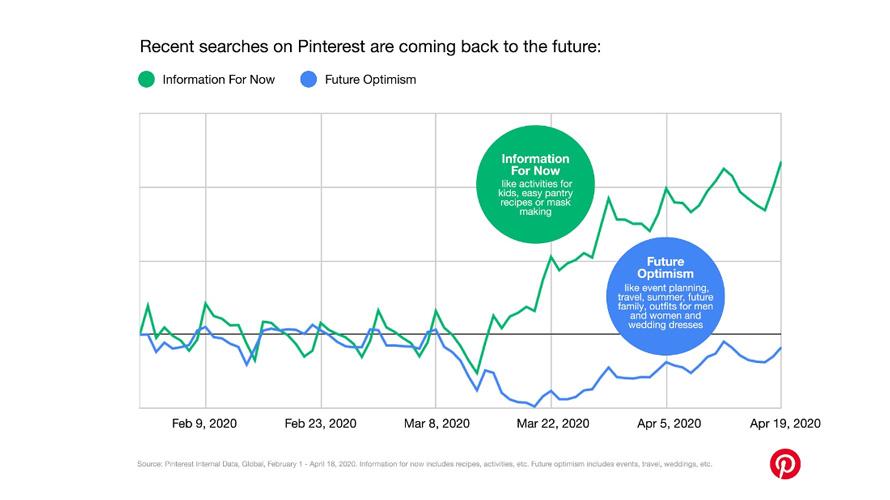
My daughter’s not alone. We’re seeing searches like “future home,” “future wedding” and “summer party” make a comeback. After a sudden dip in future-oriented searches immediately after isolation began, they’ve been slowly climbing in recent weeks.

a line graph

People on Pinterest have started to come back to the future. It makes sense; we’ve always been a platform where people plan for what could happen rather than scroll through what already did. That’s proven uniquely helpful in the face of such an unpredictable time. When the pandemic hit and isolation began, most people needed immediate help. Searches like “pantry recipes” and “how to entertain bored kids” spiked. But then, surprisingly quickly, people are getting back to future optimism. They’ve returned to searches about travel, event planning, summer, weddings and more.

Consumers are ahead of advertisers right now. While consumers look forward, most messaging looks back. Consider the four phases we’ve outlined below. Most brands are in phase one or two, but most consumers are securely in phase three, with some even moving to phase four. Check your media and messaging mix against what consumers actually want right now. 

Phase 1: Triage and information

Your audience is disoriented. They need immediate help. They want information for right now. Whether it’s “setting up a home office” (up 150%) or “DIY haircuts” (up 400%).

Almost all advertisers start here, but many are staying too long. Actions in this stage should include auditing in-market messages for anything insensitive or off-putting and moving media dollars online to take advantage of cheaper than usual auctions due to the massive influx of users, especially since OOH doesn’t make much sense while we’re in our homes.

Phase 2: Empathy and relevance

Your audience is worried. They’re grieving the loss and pain of the situation. As you evaluate your messaging, keep in mind what might be surrounding your content. Your audience might be receiving solemn news of loved ones in their feeds. If you have an inspiring or positive message, put it where people go to feel inspired, not to see the latest updates. Consider shifting messages from “Blowout sale” to “Supporting our customers—take 25% off.”

Phase 3: Escapism and optimism

Your audience is starting to get restless, bored or lonely. People are escaping the present by turning to the future. It might surprise you to realize that we think much of the U.S. is already here, joining users in some European and Asian countries who’ve been in this stage for longer. Shift messages from support to inspiration and give people something to look forward to tomorrow, like future travel and ideas related to postponed life events.

Phase 4: Recovery and rebound

Consumers are rebuilding. Their habits may have changed permanently, so they’ll expect brand habits to change, too. Show them how you’ve changed with them.

For example, consider how the upcoming holiday season will be different. Third and fourth quarter holiday media should embrace more conscious family gatherings, rituals and moments. As purse strings tighten, consumers will prioritize brands that align to their values. Share your values. Share the values-driven actions you’ve taken. You’ll stand out when you stand up for something.

Media planning for the future starts now

One of my favorite quotes is “The best way to predict the future is to create it.” It feels particularly prescient in this moment. We all have a role in envisioning what’s next—including brands. Be part of the tomorrow they looked forward to today.

https://www.adweek.com/brand-marketing/consumers-are-looking-to-the-future-brands-need-to-do-the-same/


3 Ways Covid-19 Has Pushed Brands to Reevaluate Social Strategies

For years, social media teams for brands all over the world advocated for resources to be more than just a distribution channel for marketing assets. They presented data, they touted growth numbers, and they elevated the best of their community content to executives to show just how powerful these channels were.

How do I know this? I was one of them. And I work with these types of organizations every day still as a consultant.

Up until a few months ago, the teams looking after these social channels were managing brands. Distributing brand messaging from a larger campaign, maintaining a presence on social to check a box or operating on a shoestring budget to build their social-first strategy inch by inch. Then Covid-19 hit; their brands started pulling advertising spend from out of home, TV, radio and all of the other traditional avenues a brand would allocate money to. Agencies were put on notice, and we collectively entered an entirely new space as marketers.

With everyone sheltered in place, where would attention turn? In that moment, every brand’s social media strategy went from nice to have to a necessity.

Acknowledge reality

In the first two weeks of the pandemic, channels went dark. Those that posted (some of which was likely scheduled posts) felt the wrath of Twitter, but most brands took a step back and assessed the chaos that had engulfed our world. Then brands, in the trusty hands of their social media organizations, started to emerge. They acknowledged the crisis, offered to help, pointed their communities toward government messaging and reiterated the messages we were seeing everywhere: shelter in place, social distance, wash your hands, stay safe.

Building a creative muscle that will rely less on the creation of content but instead on curation of content will serve every marketing team, not just the social team.

In that moment brands reflected the reality their communities of followers faced without hyper produced imagery, influencers, fictional storylines—just reality. We didn’t need the fluff; we needed acknowledgment. And brands did their best to support us in this new reality.

With every executive now increasing their focus on one of their only active channels (social), another big shift emerged from the chaos: comment sections and replies needed to be addressed and were exposed as underutilized or underfunded. With everyone in an organization now focused on these posts, brands increased their presence in finally treating these connections as conversations, ranging from how they can help or be of service to content creation. 

Curation versus creation 

The evolution of content hasn’t happened slowly during the pandemic. It felt like it happened overnight, and honestly, it’s still evolving.

Just take a look at your favorite brands. For many, you can visibly see where the shutdown started. One day they were posting beautiful product imagery, then—boom!—it’s all information on how to wash your hands, how they’re here for you during shelter in place, how they’re creating PPE.

Then something interesting happened. As creative agencies and brands wrestled with not being able to go into a studio and produce the beautiful imagery we were accustomed to, many brands looked inward. We don’t know how long we’ll socially distance or when we can even go back into the office. Building a creative muscle that will rely less on the creation of content but instead on curation of content will serve every marketing team, not just the social team.

The pandemic has prioritized the need for community content and also the executive attention necessary to make sure this continues on through the global recovery and beyond in the brand’s plans for marketing. 

Shattering the social ceiling

As social media teams within each brand have adjusted to this new normal they face heightened visibility from the organization, an increased pressure to post, scrutiny normally saved for a TV campaign (for a single post), more executive communication to show what’s working and what’s not. While this is all an adjustment, it’s also an opportunity to up-level the internal awareness and showcase the discipline of what it takes to run a social media team.

These teams will come out of the pandemic highly experienced and with a newfound respect from peers within a marketing organization and across the leadership ranks. They kept the brand going, they engaged the people that the brand serves, and they evolved the brand.

As we continue our journey sheltered in place and wait for the pandemic to give us a glimpse of a light at the end of the tunnel, I encourage everyone to continue to learn, evolve and share insights with your teams and those across our industry.

https://www.adweek.com/digital/3-ways-covid-19-has-pushed-brands-to-reevaluate-social-strategies/