10 Steps to Smoothly Win a Virtual Pitch

In this era of Covid-19, we’re settling in for the long road ahead. Given the uncertainly of tomorrow, doing our best in new business has never mattered more. Stuck inside and working from home, the ad business is learning how to perfect the virtual meeting. Whether it’s Zoom, Google Hangouts, Microsoft Teams or a different platform, all agencies have been forced to drastically change the manner in which we pitch new business. The goal, of course, is to run a pitch where they get to know you and leave the final meeting feeling that you did your best.

We just finished our first virtual pitch, and I wanted to share our learnings:

Test, test, test

We use Zoom at our agency. But when we learned the prospect preferred Google Hangouts, we started using it for our internal reviews. We also did a test run with the client the day before. The key is to work out the kinks before showtime. One of us kept getting kicked out of Hangouts, so as a backup, that person also dialed in on his cell to be safe. No need to let Comcast decide your fate.

It is still possible to have great engagement, almost like everyone’s in the same room.

Rehearse the pace

I’m not usually a fan of actual rehearsals because I think you lose some of the magic. But in a virtual world, you need to be crystal clear about hand-offs and who will say what. You need to cull the banter and chime-ins. Not that it isn’t fun hearing you all talk over each other, but you need to make a tight plan. And since you aren’t able to pass the clicker, you should get really specific about transitions. This is key for whoever is driving the screen share. They will love you for letting them learn the presenter’s pacing before the show and the clients will love that you don’t have to say “next slide” 100 times.

Manage headcount

Everyone is important, but this is not the time to have everyone present. Limit the talking team to limit the chaos. Some prospects are asking agencies to limit their team to only three people, which feels a bit extreme. Six or less seems right. Have the non-talkers dial-in. You don’t want them taking up valuable on-screen video space.

Set the stage

Since you can’t read the room, it’s critical to be clear right out of the gate about exactly how the video is going to work. Letting the prospective client know what’s expected of them goes a long way toward a great meeting. Avoid too many yes/no questions unless it’s a simple one like “Can you hear us OK?” It is still possible to have great engagement, almost like everyone’s in the same room.

Rid distractions

Turn off all pings, dings and rings. No one cares that your friend finally got that Amazon Fresh order and won’t stop texting you about it. Unruly roommates? That’s why headphones were invented. And if your camera is turned on, look up. Don’t get caught multitasking. You wouldn’t do it in person, so don’t do it virtually.

Pause, and pause again

Don’t all talk at once. You’re excited about the work, but be patient or your smart points will be lost. Pausing translates into listening, and clients like partners who listen.

Mute

I almost listed this twice. You should become one with your mute button. As soon as you are done talking, mute, even if you are using headphones. Your noise cuts off the speaker. Place a Post-it Note that says mute on your screen. In our rehearsal, a certain someone was having a big issue with a huge online booze order. They didn’t realize we were all listening while they struggled with the delivery service that couldn’t find anyone to pick up the order.

Get fancy

Channel your inner TikToker. You’re looking for followers, too. Backdrops, lighting and wardrobe all count. Don’t sit with your back to a window, unless you are in the witness protection program. If the platform allows, have your designers create a specific backdrop for this meeting. Have fun with it, but don’t let it distract from the meeting.

Step back

Not even your loved ones want to be that close to your face. If you can’t get your hands on a good webcam, put your computer upon those marketing books you are never going to read. Even when we get back to some kind of normal, these video calls aren’t going away. Consider a monitor and keyboard for the long haul.

Be human

Your kid running through the frame or cat jumping on your keyboard is endearing. Don’t freak out about it; own it. We’re all in this together.

I had a prospective client say to me the other day that he really feels like he’s getting to know us and that he can’t believe we haven’t actually met in person. I hope in a few years we all look back and see how strong the relationships from these virtual wins have become. It’s a special time, for sure. We can’t let this virus dictate how we do this crazy thing called advertising.

https://www.adweek.com/agencies/10-steps-to-smoothly-win-a-virtual-pitch/



The Right Way to Do Influencer Marketing During Covid-19

Brands and organizations need to prioritize responsible outreach during these uncertain times, and one of the best ways of doing so is with influencer marketing. Influencer marketing during Covid-19 is not only a fast and effective way of reaching target audiences, many consumers believe brands can help with navigating this crisis.

Not surprisingly, in-home data usage has been rising in recent weeks. From seeking out pandemic updates online to pursuing various forms of entertainment from music to memes, this amplified demand means that brands have more opportunities than ever before to engage with audiences.

With the right planning and execution, influencers are the ideal partners for the kind of tactful, empathetic and mindful marketing programs that can help businesses and consumers alike during this particular cultural moment. Now more than ever, it’s critical to show audiences that you are in tune with their needs.

Prioritize information and value

Obviously, influencer campaigns should never be about capitalizing on a crisis—the goal is to provide value, deliver relevant messaging and forge connections. This is a time for proactive brand communications regarding the Covid-19 safety measures your business may be taking, or related updates such as store closures and policy changes. However, keep in mind that many consumers are being inundated with these messages, so make sure yours includes useful information.

Beyond basic updates, ask yourself how your brand can best provide value right now, and who can benefit from your products or services. If you’re asking for people’s attention during a stressful time, you need to be able to say how you can support their lives.

Some possibilities to consider: How can your brand help people stay entertained or productive at home? Do you offer online purchase and/or delivery services for those in quarantine? Does your brand help people who are suddenly working remotely? Can your brand help drive inspiration or keep spirits lifted? What are your customer’s biggest needs right now, and how can you pivot to help?

By investing in the right kind of social campaigns in this moment, you can help maintain brand affinity over time.

Pursue authenticity

Influencers have the ability to tell your brand story in a way that truly resonates, as long as there is authenticity behind their words and images. Audiences know when an influencer is genuine with their recommendations and this type of sponsored content serves to strengthen influencer credibility and impact. When the opposite is true, and influencer content is nothing more than a lackluster repost of brand party lines, audiences lose interest, and trust is eroded.

This is a time for organic partnerships that make sense: fabric brands partnering with crafters to showcase mask-making instructions, home improvement stores working with DIY enthusiasts to share home-based projects, recipe bloggers showcasing grocery-stretching meal creations that incorporate food brands and so on.

In order to avoid triggering skepticism instead of positive audience receptions, brands need to steer clear of inauthentic partnerships and inflexible creative prompts.

Be wary of public backlash

High profile influencers can be prone to scandal, simply by the nature of their public personas. Ideally, by taking time to evaluate influencer values, interests and lifestyle choices prior to forming a partnership, brands can avoid being linked to influencer controversy—but there are always unexpected developments that can arise.

Influencer content often provides a sense of escapism for scrolling social media users. Beautifully-curated images and videos can offer entertainment and reassurance, a respite from the endless onslaught of pandemic news and updates. While it’s okay to share lighthearted, aspirational content, it’s important to do so without coming across as insensitive.

For instance, popular fashion influencer Arielle Charnas recently came under fire for leaving New York City while Covid-19 positive, while Instagram influencer Skye Wheatley received a slew of angry backlash for sharing a photo of empty supermarket shelves to promote a prize giveaway.

As a service to our community, much of our coronavirus-related coverage is available to everyone with a free Adweek membership. Never miss a key story by signing up for our daily First Things First newsletter  and consider gaining full access and supporting our journalism with an Adweek Pro Subscription.

https://www.adweek.com/brand-marketing/the-right-way-to-do-influencer-marketing-during-covid-19/


6 Steps to Take So You Can Start Meaningful Marketing

With the vast majority of businesses on hold, marketers are struggling with what to say, if anything at all. Spending against working media has been brought to a virtual standstill, and there is very little in-market activity that resembles anything before COVID-19. None of this will likely change until public health, governmental and medical innovation begins to materialize and forget a path forward.

But that doesn’t mean that we can’t begin to ready and evolve our own organizations. Now can actually be a great time to look internally and give ourselves a little operational TLC. While none of us really know what the world will look like after COVID-19 has been mitigated, there are a number of assumptions we can make based upon what we have learned so far. When the future is unclear, well-founded assumptions are a good place to start when developing an approach to organizational change.

While we are all holding our breath, here is a little food for thought on how to start.

Relearn consumer insights

Assumption: What we knew about our consumers’ behaviors, lifestyle and priorities will likely change.

When the future is unclear, well-founded assumptions are a good place to start when developing an approach to organizational change.

People want their lives to be safer, easier and cheaper. All that audience data we collected and market research we have done in the past will likely need to be reexamined and, at times, rerun.

Location data providers have been instrumental in tracking people’s behaviors during the pandemic and have significantly assisted the medical community in understanding virus spread. They can also play an important role for consumer insights teams moving forward.

Immediately, we can begin thinking through what we want to relearn about our consumers and what key questions we want to ask about where, when and how they are living their lives. Begin vetting location data partners now with a careful eye to accuracy, recency and update frequency. By developing our approach now, we can begin to learn about how our consumers are changing their behaviors as soon as stay-at-home orders begin to get lifted.

Make marketing more meaningful

Assumption: Traditional marketing tentpoles like back-to-school season, Labor Day and holidays will now carry an emotional weight.

We may be entering the golden age of functional benefit marketing. The raw human emotion that people will feel when they go back to school, honor the dedicated workers who kept our country going on Labor Day weekend and reunite with family members to celebrate the holidays will far overshadow any emotional benefit a brand will be able to deliver.

Assuming that people want their lives to be safer, easier and cheaper, how can your brand deliver on those three needs in a functional way? Let’s start planning how our products, services or locations can deliver what consumers are looking for in a meaningful way and begin shaping messages and channel choices to bring that to life.

Lean into legal

Assumption: Consumers will expect greater transparency from brands about where their products are made and how they are handled.

Now is the time to work with our legal teams to figure out how to satisfy the increased appetite consumers will have for information on where and how products are made, the safety considerations implemented for employees and how products are distributed and handled. These new and more transparent claims should be easy to access and available at each relevant stage in the consumer journey.

If we begin to do this work now, we will be in a much better position to quickly implement this information using paid and organic search and on brand or ecommerce sites, social channels, CRM communications, packaging and in-store signage.

Be sensitive in your communications

Assumption: Businesses will begin to reopen before people have emotionally recovered from COVID-19.

As a service to our community, much of our coronavirus-related coverage is available to everyone with a free Adweek membership. Never miss a key story by signing up for our daily First Things First newsletter  and consider gaining full access and supporting our journalism with an Adweek Pro Subscription.

https://www.adweek.com/brand-marketing/6-steps-to-take-so-you-can-start-meaningful-marketing/


5 Tips for Onboarding a New Hire During Quarantine

Two weeks ago, right when schools, restaurants, gyms, parks and offices of nonessential businesses closed, I started my new role as an account director for Exponent PR in Minneapolis.

That’s for Exponent, not at Exponent. I haven’t spent a day at my new office yet. Physically being there will have to wait, unfortunately.

During my interview process in early March, the magnitude of the COVID-19 pandemic began to come into full view. While the dread was palpable, I don’t think many of us had the imagination to foresee how dramatically daily life would change.

It’s been a strange time to start a new job in agency land, but no one in my position should feel sorry for themselves. Economic volatility—a woefully inadequate euphemism if ever there was one—has forced many agencies to batten down the hatches and enter survival mode. I am grateful to even have a new job.

The chaos in our industry and the abrupt change to exclusively working from home has in no way diminished the quality of my onboarding experience. A few days prior to my first day, I received my laptop and an HR packet by courier along with a handwritten note from our CEO. In a few short sentences, she thanked me for my flexibility and patience while adjusting to working from home. That level of thoughtfulness and concern has been present in each step of the onboarding process, and it’s had the effect of empowering me to jump in and contribute to the agency right away.

As conditions improve, hiring is likely to restart before agencies can fully reoccupy their offices, which means more new hires will start out working from home. Here are steps based on my experience that can be taken to ensure smooth onboarding for new hires in these anything but smooth times.

IT should stand for introduction team

Information technology is a common day one stop at most agencies, but when new hires are remote, it should be the very first. My first hour at my new job was spent with IT remotely booting up the laptop and software I received by mail a few days prior. Getting a solid grip on all the apps and services that make working from home possible is critical to a successful start.

Pack the first week (or two) with meetings 

You would think it would be more challenging to meet my new colleagues when not in an office. The opposite has been true. Off the bat, my schedule included a welcome lunch, daily check-ins with my manager and a virtual buddy, daily integrated team meetings, onboarding meetings with our account teams and a new hire meeting with our CEO and CCO, all conducted via video chat. I have gotten more face time with more colleagues than may have been possible in a physical office setting.

Extend the agency culture to the home office 

When an agency is known for its award-winning culture, you should feel it even when you’re not at the office. Extending culture to new employees is vital to making them feel welcome and allowing them to integrate better. Since staff left the office, the agency has facilitated lunchtime support meetings for all employees, from working parents to singles isolated at home. There are weekly yoga sessions, Friday happy hours complete with a live DJ and several chats dedicated to interests including books, music, movies, cooking and—perhaps most relevant to these times—bourbon.

Regular communication from leadership is its own brick and mortar

It’s been essential to hear updates from leaders throughout the agency on a daily basis. Even if the updates are short and meant to provide a bit of good news or encouragement, they serve to create a sense of agency unity, even when we’re spread across 200-plus locations. 

Embrace the discomfort

Whether an employee has been at the agency for 15 years or 15 minutes, working from home in the social distancing era is a major adjustment riddled with inconveniences. There will be spotty Wi-Fi, crying babies, barking dogs and noisy roommates. Extend grace and good humor to new hires to erase the pressure to be perfect. These are very imperfect times, after all.

https://www.adweek.com/agencies/5-tips-for-onboarding-a-new-hire-during-quarantine/


How Agencies Can Foster More Trans-Inclusive Workplaces and Elevate the Conversation

Being a transwoman can be a daunting challenge. Many of us struggle to find consistent employment at all, let alone one with a living wage.

While we want to believe discrimination is no longer an issue in the workplace, according to the Human Rights Commission nearly 50% of people who identify as lesbian, gay or bisexual remain closeted at work. While 90% of Americans now personally know someone who is nonheterosexual, there’s still enough fear of discrimination that hiding is often preferable to living out and proud in the workplace.

Transgender people often don’t have the luxury of hiding in plain sight. Once we come out and transition, we’re often easily identifiable by our shapes, sizes or even simply the sounds we make when we cough. When you consider that, according to research compiled by the Public Religion Research Institute, only 24% of Americans claim to personally know someone who is transgender, you begin to recognize a sad truth. Today’s culture hasn’t been exposed to us enough to consider transgender people as a normal part of society. It’s why we’re thrown out of the military and why states like South Dakota have worked to criminalize the support and affirmation of trans youth.

Today’s culture hasn’t been exposed to us enough to consider transgender people as a normal part of society.

This is why visibility is important, and the marketing industry has the ability to play a major role in that visibility. We can cast trans talent in ads and, more specifically, we can hire transgender employees. Normalizing the trans community makes it more likely that the general public will be supportive and protect trans people from discrimination. This will normalize pronoun usage, the importance of properly gendering a person and our ability to safely use a restroom both in and out of the office.

Truly, though, it’s unfortunate that in 2020 we are still talking about pronouns and restrooms. These should be basic table stakes for operating any business. While less than 1% of Americans identify as transgender, things are shifting. Researchers at the Williams Institute at UCLA School of Law and the UCLA Center for Health Policy Research are reporting that 27% of California teens no longer identify with their birth gender. The general population is evolving, and the workplace will have to evolve along with it.

It’s time for us to advance the conversation to the next level. It’s time for us to begin talking about inclusive healthcare policies, hiring practices and transition policies that protect and empower employees to help them know they’re protected and that it’s safe to be themselves. Unfortunately, according to MedCity News, only 647 of the more than 100,000 companies with over 100 employees offer inclusive benefits. My company, for instance, has empowered our business resource group to write guidelines for transitioning employees. Every company should be a safe space, and you’ll want to ask yourself: Is yours?

Hiring trans employees is important for a number of reasons, but what often isn’t considered are the trans employees living in the closet that you may already have in your company. I was 33 when I began my transition and already well into my career in the industry. Even though the company worked to show support, many continued to use my wrong name and misgender me. Often it felt as if they were looking through who I was to see who I used to be. It ultimately meant having to change jobs.

As we can all hopefully recognize, losing talent isn’t just hard but it’s expensive. The Society for Human Resource Management has reported that it costs, on average, $4,129 to hire a new employee and takes more than 40 days to fill a position. Then you have to consider the lost time spent during onboarding.

At this point you may be asking how to get started. There are a lot of great places. Most importantly, you should consider bringing any trans employees you may already have on staff into the conversation. Their POV will provide perspective to those who have never had to live the trans experience. Another great option is to hire a consultant who is in the community. Many great ones exist and can provide assistance to help you pull together everything you need for an inclusive workspace.

These are all key items that need to be addressed in the ever-evolving workplace. It won’t just make a transgender employee feel comfortable within your company, but it’ll help create a culture of acceptance for all employees regardless of their minority status. It’s what it’ll take to help your business go from good to great. It may seem like a daunting challenge, but if transgender employees can face our challenges, then I’m confident that your company can face its own challenges, too.

https://www.adweek.com/agencies/how-agencies-can-foster-more-trans-inclusive-workplaces-and-elevate-the-conversation/


4 Things I Learned From Medical Quarantine to Offer Hope to Those Struggling

As we head into the next weeks and month, one can’t help but feel a sense of worry, dread and exhaustion. To those of us in the advertising and marketing community, this may hit even harder.

Advertising is a people business, a giant service industry built to squeeze the most out of each employee. This adds up to long hours, constant anxiety and an always-on mentality. A survey in 2019 found that about 40% of people who work between 50 and 59 hours a week said they were worried about their mental health. This is a pre-COVID-19 stat, when the market was hitting its peak.

As a group of people who run high on stress and anxiety, we are asked to constantly outthink a situation and use creativity to solve problems. It’s a fiercely dichotomous situation to put our brains and emotions in.

While I have no experience in a global crisis like this, I did go through two bone marrow transplants that required quarantine at Massachusetts General Hospital for over 60 days in one hospital room. (Anyone who has been through this procedure knows this protocol, and I applaud you). Additionally, upon return home after both transplants, I underwent what they call “the first 100 days,” where you stay home and can’t go to stores or restaurants until you are off immunosuppression.

We are spending so much time helping our brands respond, we must take time to think about how we are responding and feeling.

This six-month quarantine led to some learnings about what I could expect from my brain, my heart and my soul during crisis and confinement. I offer these tips of self-care in hopes that our advertising community can come through this with self-worth, a sense of purpose and, above all, hope instead of fear.

Respect that you are in fight or flight mode

As Melanie Greenberg in Psychology Today wrote, “When your brain perceives a threat, the amygdala hijacks the brain into emergency mode.” We are receiving new “threats” daily, from counts of ill or dead to new restrictions.

From personal experience, I can tell you that this is a unique environment to be creative/insightful in. Some of us may feel inspired to think our way out of this, some may feel totally frozen. No matter how you feel, know that it is not just you. Your evolutionary history is trying to keep you safe from this threat. And if it’s affecting your work or passion project, embrace that and go easy on yourself.

Understand that unemployment will not last forever

I was out of work for a year, and it is terrifying and sad. Like a loss of a limb. Not only is your income stream different but your self-worth comes into massive question. What I can tell you is that this is not about you specifically. This is a global coin flip—a bad one. But it is a coin flip that went wrong. This is not about your performance or your abilities. Additionally, what I can say is that work will come back. It may look different, but it will come back because your skills are needed and most likely will be needed sooner than later.

Explore your feelings of grief

Did something on a call make you feel afraid? Did something make you feel excited to engage in work? Did a call with a friend feel odd? As Harvard Business Review reported, these are all feelings of collective grief. Take the time to explore what those feelings were and honor them. This helps alleviate that fight or flight response and pays homage to your reactions and response to this crisis. We are spending so much time helping our brands respond, we must take time to think about how we are responding and feeling.

Project yourself into the future

Allow yourself to see yourself on the other side of this pandemic curve. Allow yourself to hear the clinking of silverware at a restaurant and having to talk loud enough so the person on the other side of the table can hear you. Allow yourself to see a moment where you work in the same room with others and present work in person that you are proud of. Allow yourself to imagine a day when you get up and feel confident you know what the day will hold. It will come.

As a service to our community, coronavirus-related articles are available to everyone with a free Adweek membership. Never miss a key story by signing up for our First Things First newsletter  and consider gaining full access and supporting Adweek journalism with an Adweek Pro Subscription.

https://www.adweek.com/agencies/4-things-i-learned-from-medical-quarantine-to-offer-hope-to-those-struggling/


3 Lessons Learned From Marketing Through Coronavirus so Far

I have personally drawn much strength, solidarity and inspiration from the local businesses in my community. So intrinsically interwoven with the fabric of the people they serve, they can’t help but be empathetic to new norms and emerging needs, flexing their models, operations and communications on a dime.

Big business has had some impressive acts, too, often much harder to pull off at scale. We see them supporting their employees with new policies, protecting their workers on the frontlines and pivoting mass messaging and media strategies for a new normal.

As we navigate how to behave, it can be overwhelming. But perhaps we should channel timeless Maya Angelou and her advice: “At the end of the day, people won’t remember what you said or did. They will remember how you made them feel.”

Here are a few of the things I have loved, not loved and learned over the past two weeks that can be lessons to us all:

Even if your message is still valid, tone matters

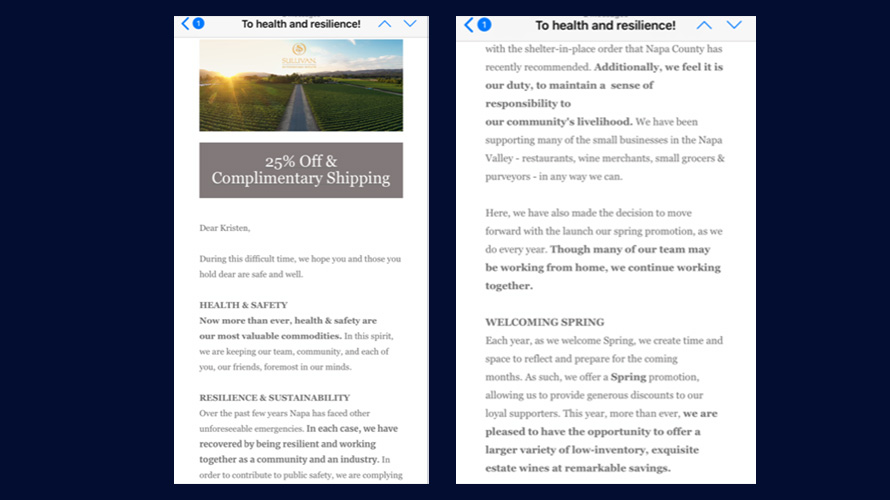
We have seen this lesson on tone most significantly in retail. Under significant business pressure, promotions and offers flood our inboxes. But a shift in how they are delivered is the difference between unexpected delight and distaste.

Consider dialing down typical retail urgency in your offer. Don’t use clichés like “friends and family” verbiage that conjures new and negative meaning. Don’t overplay the work from home and quarantine scenarios, which are a tough adjustment for all and should be treated with sensitivity.

Email screenshots

Be sensitive when communicating with consumers 

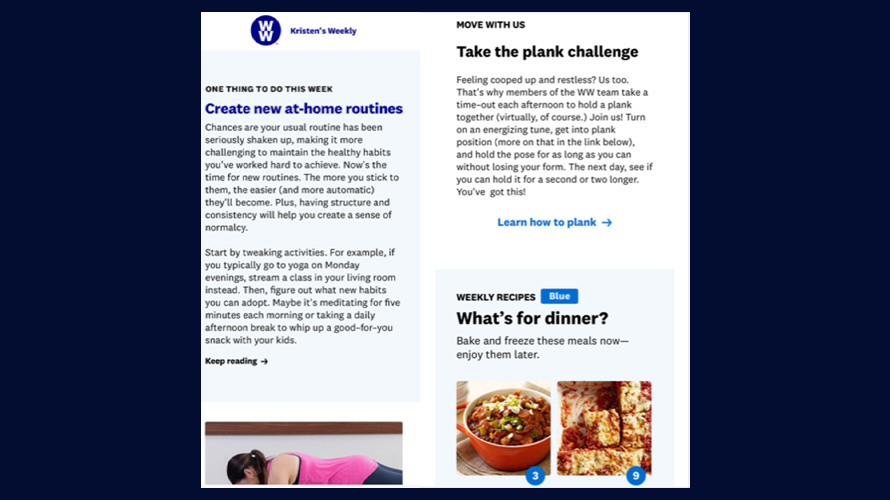
Brands whose mission naturally intersects with our current condition have an easier road to authentic connection. But all can play their role. Sensitivity has manifested in so many ways: from large QSRs shifting messaging on a dime to drive-thru and delivery to health and wellness brands offering tips and tools for staying physically and mentally well to the hospitality industry wishing us well, reminding us of better times and letting us know we shall see one another again.

The common thread is consumer, not conversion, first. Re-assess all planned CRM, paid and owned content strategy in light of a new consumer reality that is mid-crisis, one that needs help and support. This consumer fragility requires some of us to say nothing at all.

A screenshot from WW

Encourage and empathize even when you don’t know what to do

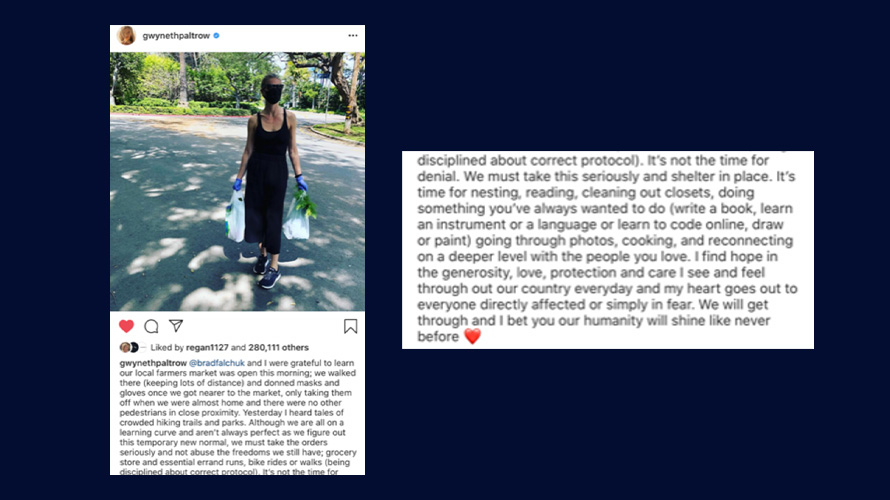
The pandemic we are confronting has revealed a host of challenges beyond the virus, exposing vulnerability in our supply chains, healthcare systems and governments. Those fighting to keep us safe from these vulnerabilities can only do so much. In a global crisis that is impacting us all and where people are in desperate need of solutions and solidarity, every brand, celebrity and influencer can do their part. Reinforce the guidance of our experts, set a good example through your own behavior and empathize.

An Instagram screenshot

As a service to our community, coronavirus-related articles are available to everyone with a free Adweek membership. Never miss a key story by signing up for our First Things First newsletter  and consider gaining full access and supporting Adweek journalism with an Adweek Pro Subscription.

https://www.adweek.com/brand-marketing/3-lessons-learned-from-marketing-through-coronavirus-so-far/


Finding the Right Takeaways From CCPA for Brands

The California Consumer Privacy Act (CCPA) was signed by California Governor Jerry Brown on June 28, 2018. That should have been a wake-up call for the advertising industry. The CCPA officially went into effect on Jan. 1, 2020 and that should have been the next wake-up call for the industry.

Currently, we are in a pre-enforcement grace period with CCPA, which will allow for operational adjustments. Hopefully this final grace period will allow for what is really happening in this country and across the world to take root with marketers. Consumers have had enough. They do not want their personal data to be leveraged without their consent, and they want creepy advertising practices to stop.

I’m being overly dramatic for a reason. Over the past few months, I’ve been disturbed that some players in the digital advertising ecosystem are not drawing the right lessons from CCPA. I recognize that our industry has had a historical fixation with leveraging personally identifiable information (PII). It has been the bedrock from which the clever algorithms at the heart of the programmatic digital ad movement were formed, and many people seem to be having a hard time with moving on. I witnessed this separation anxiety at the most recent CES in Vegas, where some folks were having animated discussions about the best way to be compliant without compromising their existing data practices.

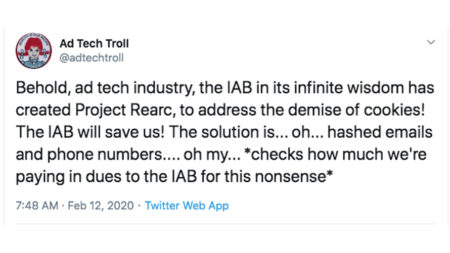
Most recently, the IAB announced Project Rearc, which promised to find an appropriate, responsible solution to data collection. At the annual IAB Leadership Summit, it was suggested that this new responsible direction of data collection involves hashed emails and phone numbers as identifiers. The only appropriate response to such a suggestion came from the sardonic Ad Tech Troll on Twitter.

A Twitter screenshot

This collective delusion by the industry, which continues to hurt the brand marketing ecosystem, is disturbing for two reasons.

Number one, it is dubious from an ethical standpoint. According to a recently cited BritePool study, 88% of consumers now place great value on how their data is used. The CCPA and GDPR are signals of this larger sea change in data use, and clever workarounds aren’t sustainable. Number two, and more significantly, applying resources—both technological and human—against gaming the system creates a harmful opportunity cost. Those same resources could rather be applied to innovating around new targeting methodologies that don’t infringe upon consumer privacy. Today, completely anonymized universal IDs are brought forward in clean rooms where data can be extracted in a manner that promotes consumer protection and comfort. In this way, car brands could still effectively reach auto intenders without having access to previous purchase data.

Our ecosystem would be better served if companies focused on building for brand marketers needs, rather than using the same mouse trap with new cheese.

So instead of trying to come up with a clever hack for CCPA, our ecosystem would be better served if companies focused on building for brand marketers needs, rather than using the same mouse trap with new cheese. It would be in the best interest of brand marketers to encourage their technology partners to embrace the true spirit of CCPA and take seriously the general public’s clarion call of not wanting their data leveraged for purposes they don’t know about.

By honoring that ethos, each and every one of us will be challenged to innovate to create new models that don’t have the stain of previously non-compliant methodology. Google’s decision to sunset cookie-based tracking on its leading Chrome browser should be interpreted as a sincere acknowledgment that consumer privacy is an important issue that should never again be taken for granted. And, of course, they will endeavor to dominate and monetize the next phase.

Digital advertising, like all industries, evolves and adapts. It’s a mistake to develop tunnel vision around the notion that PII is the end-all be-all for digital ad targeting. If you recall, at the dawn of digital advertising, we were perfectly happy with just having IP addresses and zip codes, but then we got our hands on PII, which was always controversial, thus the current backlash.

Unlike Europe, which has been historically much more sensitized to privacy concerns, the U.S. has only paid it lip service. Therefore, I can understand why voices in some quarters find it difficult to truly embrace the spirit of the regulation that has emerged. But once you make that philosophical pivot and then operationalize it in your organization, greater opportunity and progress is possible, all the while keeping consumers protected and happy about their data.

There are currently 30 state ballots with privacy regulation on tap. This movement is being driven bottom up by consumer advocacy groups and not by some opportunistic politician. For brand marketers, this marks a great opportunity to rebuild your digital strategy for today’s climate without leveraging personally identifiable information. Privacy compliance is here to stay, and it’s in everyone’s best interest to truly comply.

https://www.adweek.com/programmatic/finding-the-right-takeaways-from-ccpa-for-brands/


7 Ways Consumers Are Getting Innovative on Social Platforms

This new reality has come on quickly. Depending on the country we call home, we are weeks or maybe months into this new normal. I speak to colleagues in Hong Kong and Singapore who have been working remotely for more than eight weeks. On Mothering Sunday in the U.K., the prime minister’s message was: “Don’t visit your parents.” Who could’ve imagined?

As we all adapt to this new reality of social distancing and physical isolation, many business leaders ask us about how people are using our apps. What we are seeing is that people are using technology and companies like ours to check-in on their families, send photos, share and forward information (and of course, jokes) and video chat. In many of the countries hit hardest by the virus, we’ve seen that total messaging across our apps has increased more than 50% over the last month.

For businesses, whatever marketing campaigns were poised and ready before COVID-19 might not be anymore. Now we must reassess our plans, our strategies and our deployment of resources.

The first thing we need to do is understand what people are hiring companies for right now. What are people looking for when they go online, shop or chat? Here are some examples.

Provision of comfort and connection

We all have a greater desire to be as present as we can with our families, friends and loved ones, and we’re seeing that people all over the world are coming together and rallying using technology. In Italy alone, time spent across our apps is up 70% since the crisis started.

People are using technology to connect with their communities virtually. In one group, neighbors in Kent, England are finding ways to coordinate help among each other. In a recent social media post, writer and author Tricia Lott Williford wrote an open letter to teachers titled “The Sadness Is Real,” which said, “I miss my kids. Plain and simple. I miss our routines, our inside jokes, our end of the day high fives and everything in between.” It has been shared 38,000 times as of time of publication.

Education and sharing of health information

With the situation at the local, national and regional level changing daily, people are using technology to consume large volumes of news content including videos, op-eds and expert analysis. Popular topics of interest include facts on hand-washing, symptom analysis or how to self-quarantine.

We’re also seeing that people are creatively sharing this information for audiences of all ages, like the lighthearted post from Mrs. Woods for her third graders, shared almost 89,000 times when school was still in session. And people around the globe are electing to display the new Stay at Home Instagram sticker (used over 100 million times in the first week) and profile frames like Quaran-Team to encourage others to stay inside.

Support for donations and fundraisers

People want to offer and demonstrate their help in ways that they can. We’re seeing this support showing up through fundraisers and donations.

Less formally, in the U.K. for example, the hashtag #HitTheAmbulance has amassed 70,000 followers in the last few weeks, allowing users to “hit” ambulance staff with a small gesture of appreciation such as sweets, toilet paper or a just a simple thank you selfie.

Resources and suggestions on homeschooling

With schools closed, people are using groups to share links to online resources, feedback on what parents are finding effective and photos of games and family activities. One homeschooling group in Australia, which provides online resources for parents, effective teaching strategies and other ways to make the best of the new normal, saw 10,000 members join in the last 30 days.

https://www.adweek.com/digital/7-ways-consumers-are-getting-innovative-on-social-platforms/


The 4 Types of Sports Fans and How Marketers Can Catch Their Attention Without Live Sports

Live sports, like most industries, have been drastically affected by the impacts of COVID-19. In the month of March alone, the NCAA canceled March Madness entirely and several professional leagues including the NBA, MLB and NHL postponed their seasons. The impact of the pandemic on sports has now reached a global level, with the IOC most recently deciding to postpone the 2020 Summer Olympics.

Given the unprecedented cancellation of live sports programming, fans are naturally shifting to other forms of media to fill gaps in content. But not all fans are created equal. In reality, there are four unique types of sports viewers who will turn to alternative content to fill the void of regular sports programming.

Advertisers should now consider classic games, esports or even content completely outside of sports when looking to shift their previously allocated ad spend and continue to reach highly coveted sports fans.

Here’s how to identify each type of fan and where to find them in during this live sports pause.

The avid fan

This fan never misses a game and is constantly in tune with the performance of their favorite teams. Their closets are filled with apparel from their favorite teams, including jerseys and hats. They may even have a piece of signed memorabilia. For this type of fan, live sports are difficult to replace as part of their media diet. To cope, these viewers will instead turn to the next best thing: reruns of classic games that sports channels like ESPN, NBC Sports and CBS are airing in place of previously scheduled games. Avid fans will also revisit older games that are saved on their DVR and tune into sports newscasts for the latest updates on players, teams and leagues during the lapse in live play.

For advertisers to successfully navigate this change, they must shift their ad spend, similarly to how fans are shifting their viewing habits.

Where can advertisers reach this subtype? The avid fan will stick to sports-related content primarily on their usual channels for reruns but will also spend time on streaming platforms where sports reruns are available.

The multitasker

These fans can’t get enough of sports, period. Managing fantasy leagues is more than just a hobby, and they are attracted to any sport where point scoring is involved. This type of fan doesn’t necessarily always follow a specific team or sport but is interested in anything sports related.

Multitaskers will now divulge their attention to sports-centric films and sports documentaries, like ESPN 30 for 30. In addition to these films and sports specials, multitasker fans will miss the competitive nature of sports and might take up video games or esports as a result to curb their appetite for competition. Games like NBA 2K and Madden NFL allow these fans to get their dose of sports, even when the live games aren’t happening.

To reach these fans, advertisers should shift spend to networks airing sports movies and OTT platforms that have these content rights.

The fair-weather fan

Fair-weather fans don’t watch sports for the competition or results; instead, they are attracted to the overall social experience that comes with it. This means that their commitment to sports viewership is far more casual than other fans. Since their motive for watching isn’t tied to the sport itself, these types of fans might now find themselves gravitating toward non-sports related content.

Fair-weather fans will miss live sports but will adjust and spend their time watching cooking shows, reality television or classic sitcoms. In fact, Nielsen released a report stating that staying home might lead to a 60% increase in the amount of content watched overall. Without live sports on the table, fair-weather fans will be upping their consumption in other areas.

https://www.adweek.com/brand-marketing/the-4-types-of-sports-fans-and-how-marketers-can-catch-their-attention-without-live-sports/