Watching the Dismissive Nature That Helps Spread Disinformation Firsthand

Last week I sat with my friends to count our blessings and rejoice in the season of winter festivals.

It will not surprise you to learn that we had some unexpected guests: the president of the United States along with the speaker of the house, the Senate majority leader, several sitting senators and congressional representatives (particularly judiciary and intelligence committee members) and most of the Democratic candidates for president. Not in person, of course, but trust me—they were in the house.

I am the product of a mixed marriage (my mother is a Democrat, and my father was a Republican), so when I was growing up, there were good reasons that politics were not discussed at the table. I resisted all temptation for as long as I had the strength. I tried to change the topic to singledom, potential engagements, delayed weddings, old family scandals, weight loss, inheritance issues, the quality of the holiday food, people’s portion sizes, child-rearing advice, clothing choices, pet problems, someone’s multilevel marketing scheme, all to no avail. Thank you, Mr. President.

I won’t bore you with the general split because you already know everything you need to know about the topic and what each side believes.

But here’s what I didn’t know. The people who are most influenced by sockpuppet, bot-influenced, social media-infused, AI-generated, deepfake content are the ones who are the most certain that they are not influenced at all.

“I’m not on social media!” claimed one individual.

I nodded and asked, “Do your friends or colleagues use the internet?”

“Oh, I use the internet,” she replied. “I use it every day.”

Advertising works, but confirmation bias reinforcing content works better, and it is practically free to propagate.

I’m sure you know where this is going. She went on to tell me about what she reads and how she doesn’t believe any of it. Then she went on to defend a specific political conspiracy theory that a 10-year-old could fact check in 30 seconds. When I pointed this out to her with actual facts from my smartphone from a source that she would trust, she said, “That’s what you think. I know what I know.”

Where did her facts come from? Forensically speaking, both direct and indirect network effects packaged in a self-reinforcing echo chamber designed to fuel confirmation bias.

Until this particular evening, I believed that we could figure out how to deal with tribal digital warfare, fake news, deepfakes and all of the insanity that is bubbling up around us. Now, I have some doubts.

You cannot begin to solve a problem unless the problem has a name, the problem can be described and people admit to having it. None of those conditions are met, which is unfortunate because this is a pandemic problem. The narrative that makes you the most comfortable and the ability to filter everything else out is forever woven into our informational DNA. There may not be a way to separate it.

Let me be clear: The concept that perception is reality is not new. Neither is the idea that people will believe what they want to believe. These truisms are as old as civilization. What is new is the relative ease with which you can exert influence at scale.

It took hundreds of millions of dollars to get you to associate “Whassup” with Budweiser, “Just do it” with Nike or “The most interesting man in the world” with Dos Equis. Today, it takes just a few hundred thousand dollars to spread enough information to drive any agenda home. In case you’re wondering, advertising works, but confirmation bias reinforcing content works better, and it is practically free to propagate.

You don’t buy ads. You create bots and sockpuppets and use machines to generate a gigantic amount of content. It’s down and dirty, direct, transactional and easy to measure, and it is so amazingly effective that people don’t believe they are affected by it.

My key takeaway from my dinner had nothing to do with politics. Our conversation was respectful; everyone came and left as friends. After all, this is America. You have the absolute right to believe anything you want and to think and say anything you’d like. The full spectrum of political positions espoused at our house probably matched tens of thousands of households across the nation.

What I am now sure of is that the real divide is between those who understand the power of data and those who have absolutely no idea how it is being used to influence their lives. This isn’t new, either, but considering the newly lowered barrier to entry, it is newly relevant and more than a little scary.

https://www.adweek.com/digital/watching-the-dismissive-nature-that-helps-spread-disinformation-firsthand/


Sharing Data Could Save Lives as Healthcare Tech Booms in 2020

We’d all like to be able to predict the future, but some long-range forecasts are a matter of life and death.

Imagine your doctor could predict that you’re going to have a fatal heart attack five years before it strikes. Or suppose they could, in just 30 seconds, spot that you’re at risk of irreversible blindness long before the tell-tale signs of diabetic retinopathy emerge.

These are crystal balls of incalculable value. If we can predict the surprises that await us tomorrow, we can take steps to prevent them from hurting us today. Incredibly, the innovations to help us see into the future are no longer steeped in science fiction. This isn’t Westworld; it’s the real world. And thanks to artificial intelligence and pervasive technology, the futuristic machinery of predictive health readily exists. It’s time we made the most of it.

says adweek 2019 in review in a blue sparkly diamond

Click here to read more.

The tools of prediction are all around us. We are all too aware how technology can predict the boxsets we’ll watch, the content we’ll read and the products we’ll purchase. Predictive analytics is everywhere, helping diverse industries identify profitable segments, forecast behaviors and remodel experiences. However, its application in health has the potential to become the most transformative of all.

Of course, some people may feel nervous about giving their personal data to health organizations or doctors. That’s entirely understandable. The concept is not dissimilar to the vast amounts of data we already share through everyday apps. However, the difference in health, where companies are bound by strict privacy regulations, is pronounced: sharing data could save our life.

It’s not surprising then that predictive technology is the new battleground for global health. As data science makes it easier to identify people at risk of disease, healthcare AI is surging. Deep learning techniques are helping doctors spot the early signs of Alzheimer’s, eye disease and major cancers. And they’re accelerating the detection of advanced kidney injuries that lead to transplantation or death. Alongside them, emerging med tech is preventing diseases from happening in the first place. Nanobots are unblocking coronary ventricles in at-risk patients so heart attacks can’t occur. And nanotechnology is destroying pre-cancerous cells in people with a genetic predisposition to cancer.

If we’re going to make the most of predictive tech and reap the human and economic benefits of more proactive approaches to health, we must harness the power of creativity.

These developments and many more like them are finally helping us deliver on the promise that prevention is better (and cheaper) than a cure. Until now, our health services have been set up to treat disease rather than avert it. But technology is rewriting the rules. Predictive innovation is laying the foundation for proactive health management and personalized prevention, and it’s creating a new frontier for healthcare.

However, technology alone won’t solve all our problems. If we’re to get to the disease before the disease gets to us, creative communications will be key. Innovation—no matter how good—doesn’t find its users by accident. We can’t just build it and hope that they will come; we need to signpost tomorrow’s world.

For proof that change is afoot, look no further than the current resurgence in measles, a regression largely propelled by misinformation about vaccinations and lapsed engagement because we thought the battle was won.

Everyone remembers the “Don’t Die of Ignorance” campaign that transformed attitudes, behaviors and, ultimately, outcomes around HIV and AIDS. Today, campaigns like Royce Lingerie’s work to raise awareness of the signs and symptoms of breast cancer and Movember for men’s cancers and mental health are saving lives, too. UNICEF’s 30-year campaign to eradicate polio in children has helped reduce the number of global cases by 99% and is on track to make Africa a polio-free region by 2020. Creative communications is also a key part of solutions to tackle the mental health epidemic. These examples underline the point: Communication is as much a factor in preventing disease as it is in helping to cure it.

So if we’re going to make the most of predictive tech and reap the human and economic benefits of more proactive approaches to health, we must harness the power of creativity. As technology forges a new battleground for healthcare, the innovations that shape tomorrow will depend on brilliant communications to nudge us in the right direction. In a world of surprises, that’s the safest prediction of all.

https://www.adweek.com/digital/sharing-data-could-save-lives-as-healthcare-tech-booms-in-2020/


3 Things We Can Expect to See in the Content World in 2020

It was a headline-grabbing year for technology, from massive IPO failures, congressional testimony on data privacy and ad practices to the much-anticipated streaming wars. Many of these issues as well as unrealistic business practices set the stage for 2020 and the wave of disruption that’s likely to shakeup technology, media and advertising.

Here are my three predictions for what the new year has in store for the tech.

Netflix will become ad supported

says adweek 2019 in review in a blue sparkly diamond

Click here to read more.

My belief is that every company that is reaching tens of millions of people will inevitably get into the $600 billion advertising business, including Netflix.

A lot has been written about this: Disney+ and Amazon are getting stronger, offering loads of quality content that only make it harder for Netflix to keep its subscribers.

Disney is offering a bundle package of its streaming services: Disney+, Hulu and ESPN+ for $12.99, which will include the standard ad-supported tier of Hulu. Amazon, already the third largest advertising company in America with $18 billion in revenue, has a major advantage with Prime, a service now being used by more than 100 million people.

There is a good chance Disney and Amazon are already in most of our homes in some capacity, and they will continue to use advertising as a strong bridge to further penetrate into our lives.

As successful as Netflix is, they’re facing a whole new type of competition on all fronts, from quality of original content to distribution to price. While Netflix said they won’t go the advertising route, I think it is their destiny. And with their reach, data, technology capabilities and opportunity to reach users and TV advertising being such a successful vehicle for advertisers, I predict they will become one of the largest advertising companies in the world—and they will never turn back.

Apple will have its first failure with iTunes on other TVs

Apple’s success rests in the hands of the well-respected and visionary Eddy Cue’s ability to make Apple a services company across music, payments, health and content. But to succeed in a services strategy, Apple must become ubiquitous and offer its content/services everywhere, which is something the company has not done successfully to date.

For example, can Apple truly succeed partnering with Samsung, delivering content through iTunes? I remind you that Spotify’s app on Apple Watch is still just a remote to your phone, but not a standalone app like it is on any other smartwatch. Apple’s biggest conflict is bringing the magic we all love to use in the Apple kingdom outside of their walls by partnering with others.

So, can Apple partner? This will be the year we’ll need to either see Apple evolve into a whole new company culturally under Eddy’s leadership or fail in this new world of services we’re all heading toward.

From Roku to Samsung, physical devices will help save journalism

In 2019, we saw the origin of news as a service, where began expanding into the news business, aggregating news and surfacing articles to their users to drive engagement. Next year, this trend will continue to breathe new life into platforms like Fire TV, Roku and even legacy providers like TiVo.

Amazon debuted a news aggregator app that rolled out to its 37 million active users, Roku added more standalone apps from news organizations to its devices and Samsung alone sells about 700 million devices a year, having created a massive opportunity to surface news that matters to consumers and bring people back to the open web. More access to news is a great service for readers. Platforms and devices that offer quality journalism and video content in a brand safe manner or in ways that actually drive traffic to publishers’ sites or OTT apps by putting more control at the hands of the publisher will rise to the top.

When you think of billions of devices sold a year (smartphones, TVs), the opportunity for the physical world to collectively save journalism is massive, and we’ll see a lot more of that in 2020.

The rapid evolution of the content space in 2020, which is demanding fast growth and fighting hard for users’ attention (and dollars), will force companies to break out of their comfort zone and evolve past their traditional approaches to this market. That includes unconventional partnerships, new types of business models and perhaps even a newly evolved culture that is better prepared for the future. Things are about to move even faster, which is an exciting time for us all in the content space.

https://www.adweek.com/digital/3-things-we-can-expect-to-see-in-the-content-world-in-2020/


How These Brands Used to Design to Create Brand Relevance

Back in February, Marshmello played a concert in Fortnite for over 10 million people. Despite the many records shattered that morning and the more than $30 million generated in merchandise alone, the traditional industry players in concert promotion and merch were nowhere to be found.

And then, just a few weeks ago, Elon Musk tweeted “250k,” touting the soaring number of pre-orders for Tesla’s recently announced pickup truck that had amassed in just five days. Here, too, the traditional industry players watched from the sidelines as they began to go through the motions of their annual slate of holiday advertising.

While seemingly unrelated, both of these moments are glimpses as the fundamental changes that are upturning the world of marketing. The scale and speed of these stories and the way in which they emerged all evidence the imminent obsolescence of so much of what guides marketing decisions today. And underscoring it all, these examples join the ranks of marketing case studies that did not involve one dollar spent on paid advertising.

These examples spotlight an ever-increasing pace of culture and ever-changing evolution in expectations, including how brand trust is established. These disruptive shifts are human at the core, and as such, demand a human-centered response that can become a new compass for decision-making.

We believe that this new compass is design.

Many of the core components of strategic design may seem familiar to marketers, such as leading with empathy and an obsession with the customer experience. But the true implications of building brands by design run far deeper than a semantic update to a mental model that has been in place for generations.

Using design as a compass demands a fundamental rewrite to how brands are defined, customers are understood and media is approached. Through a series of three articles, we will explain each of these three pillars of marketing by design that we believe forge a path for sustainable success in today’s contemporary cultural landscape.

Brand definition by design

The traditional linchpin of brand positioning is identification of your category and resultant frame of reference. The thinking was that, in order to win the game, you had to first define where you play.

As logical as this may seem, in a world where product categories are increasingly irrelevant, defining your brand by its category creates dangerous strategic tunnel vision. When customers compare your brand experience to that of every brand (not just those in the category you believe you inhabit), you can’t segment consumer expectations. You can only ignore the breadth of expectations that consumers truly have.

A properly defined frame of reference for Live Nation leads them to schemes like failed forays into the secondary ticket market instead of realizing that their greatest emergent threats are, in fact, Fortnite and TikTok. Likewise, if the Tesla Cybertruck had begun with a diligently defined frame of reference, it would have led Tesla into an unwinnable battle with the F150 rather than the creation of what is effectively an entirely new market.

Define your brand by what experience you redefine

Contrast that traditional approach with Netflix, which has defined themselves by their desire to constantly redefine what an “amazing entertainment experience” can become. With this category-defying focus, Netflix isn’t centered on a specific consumer, technology or entertainment product. Rather, they are defined by the change they continually create in what entertainment can become. Through this lens, Netflix appropriately sees Fortnite as a massive threat in the competition for attention, rather than myopically focusing on Disney+ in the rapidly escalating but still narrowly defined streaming wars.

Likewise, Tesla’s mission to accelerate the world’s transition to sustainable energy doesn’t just allow for breakthrough bets like the Cybertruck; it demands them. With a series of product launches that transform what we expect from various forms of transportation (be that a sedan, an SUV or a pickup truck), there is no way that Tesla would have made a dent in the already saturated automobile industry.

https://www.adweek.com/brand-marketing/how-these-brands-used-to-design-to-create-brand-relevance/


Don’t Stress About AI Taking Your Job—Humans Will Do That Instead

Machine intelligence (also known as artificial intelligence) is going to have both an awesome and unfortunate impact on our posterity. Let’s explore one possible way AI may impact the future of work and how it may dramatically change how we train our workforce.

The graphic arts department

A brand manager needs an advertisement. So, the brand manager sends a brief to the senior art director (in-house or at an agency) and asks for something amazing to be created. On or before the deadline, the brand manager and the art director meet to review the work. The brand manager is presented with three approaches, and after a number of meetings, a number of revisions and revelations, they agree on a final product.

This is a process that has repeated itself for more than a century, and AI is not going to stop it.

After getting approvals from senior management, the art director must execute the work and deliver all of the versions and variations required. A list of deliverables can have hundreds of variations, each requiring subtle compositional changes, revised typography and resizing of images.

Today, the senior art director hands this project to a group of junior art directors and graphic artists. This work is not tough; it’s just tedious, and there is a lot of it. Anywhere from a few hours to a few days to a few weeks later (depending on the length of the deliverables list), the junior art directors submit their finished work to the senior art director for final approval.

There is only one thing you can do about this: Become the very best AI coworker you can become.

The senior art director makes some subtle changes to the deliverables that are not quite right, and the junior art directors are taught why the changes had to be made. Of course, some of the work is perfect, and it takes only a second for the senior director to approve those. All in, a major campaign might take a 10-person art department a week or so to deliver.

The AI-assisted graphic artist

Now, let’s imagine the same process in a slightly different way where the senior art director has an AI coworker (an AI system designed and trained to version graphic artwork). Instead of harnessing a team of junior art directors to build the deliverables, the senior art director clicks a button and the AI coworker builds every required deliverable in seconds.

Unlike handing the work to a junior team and waiting hours, days or weeks, the work is ready immediately for review. The senior art director will still have to page through each version to give its final approval and might even have to tweak a few of the versions to get them just right. But the basic work—the work of 10 junior art directors—will be eliminated, and so will their jobs.

From a fiscal management point of view, the senior art director’s productivity has increased exponentially. The ROI is easy to calculate, too. Remove 10 junior people from payroll who earn between a quarter and a half of the wages their supervisor earns. The unit will enjoy a three- to five-fold reduction in annual payroll expense, maybe more. This is an excellent path to value creation (for the shareholders).

Some things won’t change for a while

The process between the brand manager and the senior art director will remain unchanged for a while. Creativity and collaboration are human traits that have a magical quality. Hits are a mystery. And while this may not always be true, today we rely on inspired, talented, uncompromising humans to create groundbreaking graphic art.

But what about the junior art directors? They will be deprived of the mentorship, remediation and education. In a world filled with senior art directors that are augmented with AI coworkers, junior art directors need not apply.

https://www.adweek.com/digital/dont-stress-about-ai-taking-your-job-humans-will-do-that-instead/


What We Can Expect From Voice Devices in 2020

What even is conversational commerce? If you feel like you’ve been hearing this term thrown around for years now, that’s probably because you have.

Its origins can be traced to January 2015, when Chris Messina (who you may also know as the inventor of the hashtag) coined it in a post on Medium, describing the evolved manner in which he foresaw people shopping online. “No more tapping and swiping—it’s easier to just hand-off to someone with a computer that’s set up for complex information tasks like online shopping or research,” the post read.

To be clear, tapping and swiping were to be replaced by talking and typing in the same sort of natural language one would use to talk or text with a fellow human. Only these conversations would be carried out by virtual agents (or chatbots), which would, of course, become vital components in any brand’s digital toolkit. Chatbots were poised to take over the world—or, at least, replace your website.

So, how has that worked out?

Today, five years later, smart speakers from Amazon, Google and Apple are in 200 million homes in the U.S. alone. And while iPhone users also have Siri, Google Assistant comes pre-installed in Pixel devices.

says adweek 2019 in review in a blue sparkly diamond

Click here to read more.

Voice assistants are everywhere, and it’s not hard to understand their appeal. Whether you’re a senior citizen or a small child, using your words to ask for stuff is most likely a cornerstone of your existence. With that in mind, why does it still feel like these tools are so basic in the utility they offer? And why are they most widely used for simple tasks like weather updates or playing music? Where’s this age of conversational commerce we were made to believe was imminent?

The barrier here is twofold. First, the technology itself is limited. What’s behind the vast majority of ecommerce chatbots and voice bots is some natural language understanding (if you’re lucky!). They also have a set of directed flows, which are designed to funnel users toward a small and finite handful of desired outcomes and, really, not much else.

If you think about it, decision trees and rigid lanes along these lines are inherently at odds with the idea of allowing people to interact with your brand using natural language. Because of that, the chatbots and voice bots that rely on them, at least in the context of shopping, were destined to fall short of user expectations (which, it’s worth pointing out, tend to be quite high for these products). Second, consumers need what they need to make purchase decisions, and for a lot of categories, that means visuals. It’s one thing to ask Alexa to reorder your paper towels and laundry detergent, but it’s quite another to expect “her” to effectively convince you to buy a pair of designer shoes or new lipstick.

What we’ve come to realize over the past couple of years is that our initial ideas around conversational commerce were flawed. In hindsight, we were wrong to assume that chatbots and voice bots would naturally slide into their role as autonomous shopping tools.

We were also kind of foolish not to embrace a far more obvious application of this kind of technology, as a means to make existing ecommerce experiences on owned properties, like brands’ websites and mobile apps, faster, easier and more user-friendly. To see “short black dresses under $100 in size small” requires no fewer than 16 clicks on the Nordstrom website. But asking for the same by talking or typing into a search bar? It gets no easier than that.

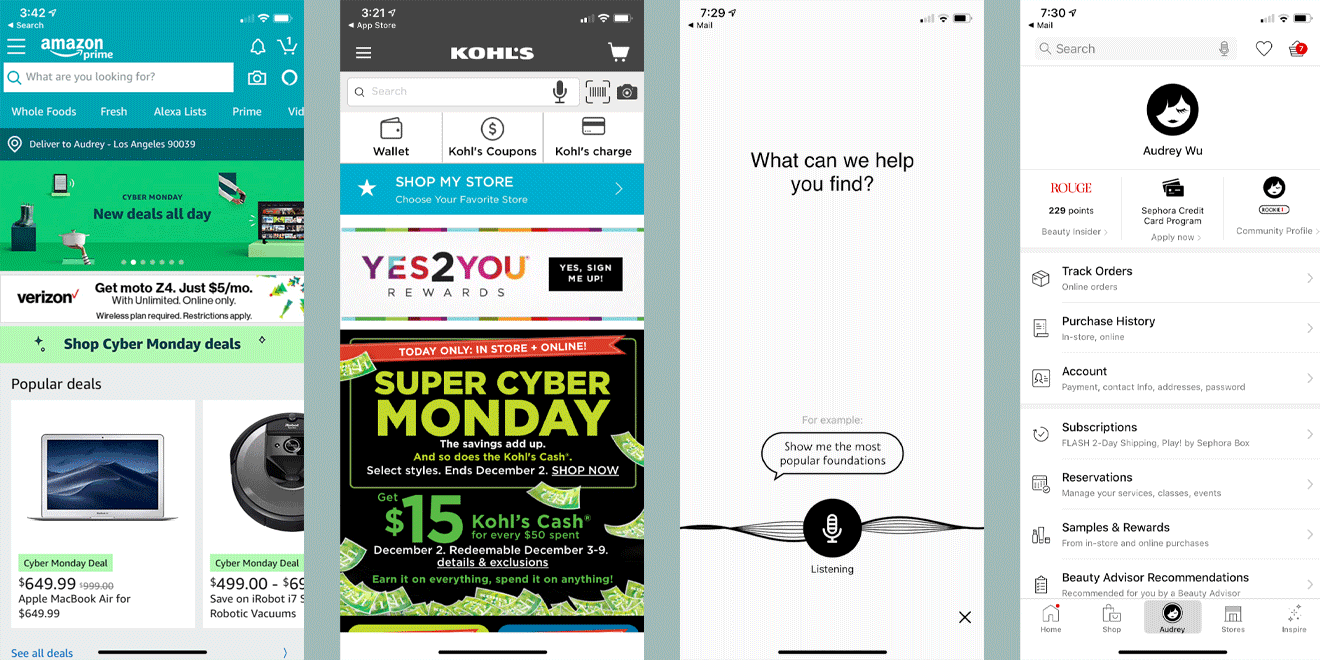
So, the ease of use is one reason brands like Spotify, Sephora and Kohl’s now offer voice-enabled search in their mobile apps. Aside from that, this functionality is attractive to brands because it requires no middleman. Given the absence of a third-party platform like Facebook, Amazon or Google, the data that’s received through these conversations is kept within the confines of the brand itself, and consumers who avoid these platforms are not precluded from chatting.

four images of screenshots of deals on a phone

Likewise, discovery, which has long been one of the most significant pain points for brands that deploy conversational experiences in places other than their owned properties, is solved for. Everyone wins, so long as the AI powering the experience does a good job not only understanding what the users wants but making precise recommendations accordingly.

https://www.adweek.com/digital/what-we-can-expect-from-voice-devices-in-2020/


How to Recalibrate Programmatic in 2020 With Renewed Purpose

When the concept of programmatic advertising was emerging in 2007, there were high hopes for its transformative power in advertising. Now, after years of development, the industry has major concerns about what the next decade holds for this technology.

If programmatic falls short of its promise of precision, automation, effectiveness and data enrichment, the advertising ecosystem that has capitalized on its growth could face severe consequences.

Economic and market factors have diminished programmatic’s growth 

The 4As and 614 Group recently collaborated on a qualitative and quantitative study, which revealed what marketers expect from programmatic advertising. Marketers want programmatic to deliver messaging with precision and opportune timing for the right person. They want it to automate processes and simplify workflow. They want it to drive higher-level decisioning and quality data. And they want it to deliver messages that dynamically optimize.

Numerous entrepreneurs and established businesses have tackled these problems and progressed on solutions. But the barrage of challenges facing the industry is threatening to stall innovation. The major gatekeepers of internet access and web navigation are blocking cookies. Emerging regulations like GDPR and CCPA are hamstringing consumer data collection. And all the while marketers are expressing their desire to pay less for advertising services and technology.

While the programmatic train seems to be rolling along fine—eMarketer shows that $57 billion will be spent programmatically in digital display ads in the U.S. in 2019—growth has been slowing. Furthermore, 62% of this spending is going to three companies: Google, Facebook and Amazon. In short, programmatic advertising’s momentum is slowing, with just three entities cornering the market.

Growing complexity in marketing makes programmatic less effective

To be clear, programmatic is groundbreaking technology. It has brought new capabilities to our industry, it has allowed marketers to purchase data-driven, granular audiences at scale, and it has enabled brands to compete for customers. But programmatic is also leading the industry down a path that runs counter to what marketers want.

Marketers still want to reach audiences in quality environments. But now they want to automate this process to bypass the roadblocks presented by cookies, regulations and reduced agency fees. To achieve this, programmatic ad platforms would need to reduce the complexity of buying directly with vendors or even reduce the complexity of other related ad tactics, such as search and social.

Digital media was already increasing in complexity even before programmatic advertising was conceived. Marketers are continually dealing with new needs around KPIs, measurements, cost types, platforms and mediums. Today, this complexity verges on chaos, as there are more new channels to manage now than ever before, including AR, digital out of home, audio and voice search.

Programmatic technology in its current state cannot automate any of this. As an industry, the only goals we’re achieving are frustrating marketers, upsetting people who work alongside us and annoying consumers.

Programmatic advertising’s momentum is slowing, with just three entities cornering the market.

True automation, which is what the industry was originally looking for from programmatic technology, should be increasing productivity, decreasing labor costs, accelerating speed to market and reducing errors. Because programmatic advertising has driven up the number of platforms required, the ad tax, labor costs and more, it’s having the exact opposite effect as automation.

A better model is on the horizon

What could the new model for programmatic look like—that is, one in which agencies reach targeted audiences, perform better and keep clients happy?

The best HR systems are a good example. An effective HR department wouldn’t pursue separate vendors for payroll, stock options, benefits and time tracking. It’s not prudent to manage these functions individually. Instead, tech providers have found a way to assemble all these parts neatly into single systems. Programmatic could follow this model and integrate with the crucial functions of digital media, like direct buying, social and search buying, vendor management, collaboration and billing reconciliation.

As a standalone tool, like a hammer, programmatic functions fine today. But agencies need entire toolkits to run their business. If the industry recalibrates programmatic as the nucleus from which to run all-encompassing systems for advertisers and agencies, it could have a lasting impact on campaign effectiveness, workplace happiness and business profitability. This would put the shine back on programmatic advertising.

https://www.adweek.com/programmatic/how-to-recalibrate-programmatic-in-2020-with-renewed-purpose/


Voice search optimization: The why and how

Voice search optimization: The why and how

Voice search optimization is a hot topic in the digital marketing industry. A few years ago, voice search seemed like a far fetched idea that was limited to some science fiction movies. But today, its popularity is increasing day by day.  

If you’re a Star Trek fan, you would definitely recall the scenes when actors used to speak to computers for answers. It all looked like something that would never come into existence. Yet here we are.

Today, voice search has become so common that, according to Google, it is the fastest-growing form of online search. 

So what does this new search trend mean to marketers and business owners? Why should business owners focus on building voice-search-optimized websites? Let’s see. 

The rise of voice search in numbers

Voice search basically allows users to say their queries out loud rather than typing them into the search box to get the results. 

The speech-recognition technology precisely understands what users are saying and then delivers the best-matching results orally. 

Reports estimate that about 41% of adults perform at least one voice search every day. According to ComScore, 50% of the total searches will be voice searches by 2020. 

Let’s check out some of the critical voice search statistics:

  • 61% of 25-64 and 57% of 18-24 age groups say they’ll use voice search more actively in future (PwC Research)
  • Almost one-third of 3.5 billion searches performed on Google every day are voice searches (TheeDesign Research)
  • More than 30% of the web browsing will be done without a screen by 2020 (Gartner)
  • 55% of households will own smart speaker devices by 2022 (OC&C Strategy Consultants)
  • More than 53% of smart speaker owners say that it feels natural talking to smart devices (Google) 

Well, stats don’t lie. It is quite clear that consumers are getting more and more familiar with voice search and using it for day-to-day online searches.

Google Now, Alexa from Amazon, Siri from Apple, and Cortana from Microsoft are some of the major trendsetters in the voice search. Considering the increasing popularity, Google and other tech giants are investing heavily in voice-operated digital assistants. 

How voice search impacts your website’s ranking?

So how does voice search affect your rankings (and ultimately the business bottom line)? 

You see searchers want faster answers to their queries, and Google heavily values user experience. 

Voice search improves user experience by delivering faster and more accurate search results at convenience. This is the main reason why Google has started really emphasizing voice search optimization. 

Although the search engine giant hasn’t officially confirmed it yet, it’s just a matter of time until Google adds voice search to their algorithm, and starts prioritizing websites that incorporate the voice technology.

The role of SEO and voice search optimization 

The primary goal of SEO is to rank a website for specific search terms so that users can get the best information as fast as possible. However, you need to understand that voice search SEO and conventional SEO are quite different. 

Optimizing your website and content for voice search can help you increase your website’s visibility and credibility. This ultimately improves your website’s ranking and traffic through Google. 

How to optimize your website for voice search?

Users who perform voice searches typically want to complete a particular action such as playing a song, finding a restaurant, or finding information on a specific subject.

When people use voice search on mobile, Google will only deliver one top result. This top result is known as “position zero” or “featured snippet” or “answer box”.

Reports estimate that half of the searches will be voice searches. It means that roughly 50% of your potential customers won’t be able to see your website even if you’re ranking in the third or fourth position.

The solution here is to rank for number one and secure position zero. 

How to secure position zero, so your website appears in voice search results? Here’s how. But, before we start, here’s a pro tip for you.

Pro-Tip

In addition to the tips mentioned below, here’s an alternative way you can try to feature in the answer box. 

It’s lately noticed that Google favors websites that provide interactive web tools such as BMI calculators, recipe guides, price estimators, etc to the users. If you’re an enterprise business, you can develop an interactive web app for your corporate website to increase your chances of hitting the answer box. 

1. Implement Structured Data

Structured data or schema markup is one of the ranking factors used by Google search algorithm to determine the relevancy and position of a page in the search results.

It’s a code or metadata that’s added to the website’s source code. This code helps search engines better understand your content and classify it accordingly. 

It also gives you more control over how you provide specific blocks of information to search engines and how machines interpret it.

Implementing structured data doesn’t guarantee top ranking, but it gives you a competitive advantage for sure. It increases your chances of getting into the answer box or featured snippet, and thus in voice search results.

Here’s an example of how a rich snippet looks like. The highlighted sections of the search are automatically picked up by Google with the help of schema and shown in the search results.

How do you implement structured data? If you’re using WordPress, search for “schema” plugins, and you’ll see hundreds of plugins that enable structured data functionality in WordPress. 

You can also implement structured data manually on your website using specific schemas from the schema.org library.

2. Improve the page speed

You might find this tip in almost every SEO guide out there. 

Page speed is one of the most significant ranking factors. It decides whether or not your page will rank in the top search results. 

If you want to rank for position zero and appear into the voice search results, you need to ensure that your website loads quickly. 

People use voice search to get faster results; thus, Google gives high importance to page speed when it comes to voice search. 

Use Google’s PageSpeed Insights tool to check your website’s loading time. The best thing about this tool is that it gives numerous suggestions on how to improve the page speed. 

Make sure you

  • Minify HTML & CSS
  • Prioritize visible content
  • Optimize images
  • Remove unwanted theme elements and plugins
  • Enable data compression
  • Implement browser caching

One way to drastically increase your mobile website speed is by implementing an AMP (Accelerated Mobile Pages) feature. It helps your mobile pages to load instantly by pulling only a few necessary blocks of content.

3. Understand the user’s search intent

Optimizing your content around user intent is crucial for ranking high in voice search results. 

You need to understand whether people are looking to buy something or want some information when they type in a search query. User intent or search intent helps you understand why the person typed a specific question in the search engine. 

The user intent is often clearly expressed in queries using words such as “price,” “buy,” “download,” “how to,” “what is,” and so on. Other times, the intent is not clearly expressed at all.

But, thanks to the Hummingbird update, Google can now find out the context behind a search query and then deliver the best matching results. 

For example, when a user searches for “Oscar winners,” he/she is most likely interested in the latest award ceremony, not the one that happened ten years back. Google understands this context and ranks the websites that provide information about the most recent award ceremony and news from the latest Oscars.

Therefore it’s crucial to structurize your content around the user intent. It increases the relevancy of your page for specific search queries. 

So how do you write and optimize your content around user intent? Ask yourself the following questions: 

  • Do you provide the most accurate and immediate answer?
  • Is the answer structured in a proper format? 
  • Is the content on your website easily accessible by Google?
  • Is your website credible enough?

If you work towards the outcome of the above questions, it might help you increase your chances of getting into the answer box for specific search terms.

4. Target long-tail keywords in the content

Long-tail keywords are quite specific in nature. As the name suggests, these are the search terms and phrases that are longer than a typical search query. 

People act like they’re talking to real humans when they perform a voice search. They’ll naturally ask longer questions rather than short keywords. For example, while typing a search query, a person might use highly relevant words and enter something like – “best pizza in NYC”

Whereas to perform the same search using voice, a person might ask – “Hey Siri (or Ok Google), where can I eat the best pizza?” 

Therefore, it’s important to find out and use the conversational search terms that people would use while speaking. You need to treat these terms as the long-tail keywords and incorporate them into your content. 

You can use tools like Answer the Public or KeywordTool.io to find out long-tail search terms and questions. 

Targeting long-tail keywords is one of the effective strategies for voice search optimization. 

The fun fact is that 70% of all search queries are long-tail, yet the majority of the sites tend to overlook these keywords while chasing shorter and more competitive search terms. Long-tail keywords are less competitive, yet they are equally important.

Again, make sure you answer the searcher’s question as accurate and direct as possible. You can create H2 or H3 headings of the questions (long-tail search terms) and provide answers in the body text.

To wrap up

Voice search is slowly becoming mainstream. People have already started using it, and more will join this trend soon. 

The potential of voice search is yet to be fully uncovered. 

There are many ways marketers and business owners can take advantage of voice search, build and optimize a voice-friendly website, and drive traffic and increase sales. Whatever you do, make sure that voice search is included in your SEO and website campaigns going forward.

Michael Georgiou is the CMO and co-founder of Imaginovation, a full service, turn-key digital solutions company serving Raleigh, NC and Charlotte, NC. 

Whitepapers

Related reading

Top eight SEO trends for 2020

The UK election and SEO games: Search, scandal, and big promises

Seven iron-clad methods to drive traffic to your website

Five steps to generate tons of backlinks using infographics

https://www.searchenginewatch.com/2019/12/26/voice-search-optimization-why-and-how/


What We Can Expect From Audio Marketing in 2020

The importance of brand experience has jumped from a low-ranking priority straight to top of mind. Brands are now asked to tap into their audience’s subtle and shifting feelings while showcasing their own. It’s the kind of stage, where everything is set up for audio branding to steal the show.

There are hardly any common touchpoints in the modern marketing scene where sound isn’t either the leading sensory element or at least an eloquent side character sparking emotions. However, since we are living in an omnichannel world, cultivating the same experience at different settings is where the plot thickens. Creating effective and consistent audio is more important than ever.

Luckily, tons of new research emerged on sound and its influence in an advertising and marketing setting. Using them as a reference, I’m making the following predictions on how to script an audio strategy that will turn your brand into a multisensory masterpiece come the new decade.

says adweek 2019 in review in a blue sparkly diamond

Click here to read more.

Audio in social media stories will deliver

As far as digital touchpoints go, Facebook and Instagram stories are the high streets for driving ad engagement with audio. A Facebook study confirmed that 80% of stories with voice-over or music propelled better lower-funnel results than ads without sound.

Not only does this underline the value of audio with a heavy marker, but the nature of the beast that is the social media calls for poise and penmanship. It’s a fast-paced environment, where attention is won or lost in a matter of milliseconds and the dollars spent can vanish in vain with one casual decision.

In such a cluttered space, ads that ripple and resonate in canon will have the best chance of standing out. The sonic elements in your ad must be designed with similar vigilance and intent as the visuals. Melodic syncopation, intensity and voice-overs in conjunction with visual hooks allow you to steer the viewer’s attention to the key messages.

Brand context will make or break an audio ad

This time next year, brands who manage to turn their offering from a scripted punchline into an instrument for the listening experience will be the talk of the town.

The findings from Radiocentre’s study Hear and Now stated that listeners are able to assimilate the details of radio ads in the middle of their chores. In fact, advertising that directly relates to tasks they are participating in, builds engagement and long-term memory encoding.

Ads which are bespoke to the audience’s surroundings will make a big difference. The creative starting point should be: ‘At what moment and place will the message resonate the most and how does our brand apply there?’ Crystallizing audience segmentation based on their activities and can help audio advertisers change their course of campaigns on a dime.

Whereas paying attention to audio’s relationship with other senses smoothens the delivery of the message, the way your brand is introduced puts the exclamation mark on it. This will be especially important for those looking to tune up their voice marketing.

Didactic use cases for smart speakers will deliver

The voice shopping trend is waning. In fact, purchasing with smart speakers experienced a significant drop from last year, as 24% of respondents in this year’s Dashbot survey said they have bought something through their device compared to 43% in 2018.

The sonic elements in your ad must be designed with similar vigilance and intent as the visuals.

When you think about it, the user interface of voice shopping doesn’t deliver much information for buying a new product as quickly and intuitively as shopping on a screen does. You need to do your research before buying. Increasing privacy and security concerns aren’t actually helping, either.

This isn’t just a challenge for the manufacturers, brands need to do their bit, too. New use cases should be designed to amplify trust toward the company and its offering.

https://www.adweek.com/brand-marketing/audio-marketing-predictions-2020/


Essential Third-Quarter Stats for Ad Tech and Platforms

Editor’s note: Adweek worked with Matthew Scott Goldstein, a consultant with a deep knowledge of the media industry, to craft his quarterly newsletter into an Adweek article. Through his findings on various industry earnings calls, we’re bringing you insights about how your favorite brands, agencies, media companies, publishers and tech companies are performing on a quarterly basis. His goal was to go past what the trades were focusing on, which mostly revolved around revenue, and tap into the nitty-gritty data shared on these calls.

This iteration focuses specifically on ad tech and platforms in the 2019 third quarter.

a blue and green background with a dollar sign that says ad tech

  • Criteo: Revenue ex-TAC, our key metric to monitor the business, was flat at constant currency at $221 million. New client business drove our performance, especially in the midmarket, offsetting a limited decline in our existing client business, despite continued adoption of our new solutions across the client base. Among the third-quarter highlights, our quarterly net client additions were again positive, with 240 net new clients, in line with our expectations. As in the prior quarter, this was again driven by focused execution and productivity improvements in our midmarket sales teams. Most exciting result for the third quarter is the momentum of our new solutions, which, as a reminder, include all our solutions outside of retargeting. They grew 57% on a revenue ex-TAC basis and now account for 11% of our total business, up from 7% a year ago. Over the past year, identity graph has also grown both in size—we have over 2 billion unique Criteo IDs—and in density: Over 95% of our Criteo IDs now contain long-term persistent identifiers rather than just basic cookies. Announced a new partnership with LiveRamp on IdentityLink. By combining LiveRamp’s identity solution with ours, we offer marketers additional capability to reach their customers in a privacy-by-design manner. We believe this enhanced identity solution is quite unique in the industry and very competitive compared to walled gardens’ own proprietary approach. This combination also broadens our reach by providing access to additional cookieless inventory, including connected TV. Over 4,200 publishers now connect to our direct bidder both on the web and app inventory. Regarding our legacy retargeting business, we saw a decline in the mid-single-digit range on a revenue ex-TAC basis. The softness was mainly concentrated in the large customer segment and is driven by two main factors: first, the much higher penetration we have reached here compared to midmarket; and, second, their delayed investment in mobile app marketing that doesn’t fully compensate for the slow erosion of browser usage yet. As discussed about retail media, we are seeing some of our most sophisticated retailers seek more control over their ad-tech stack. Sometimes, this appetite for control becomes even more important than campaign performance itself.  Google’s first-price: This is important. Google was the last large exchange, plus at a speed to move from second-price to first-price. And we were very well equipped for this transition, because we’ve been developing first-price bidding engines for a long time now. And as a result, their overall impact was likely positive for us because as we believe our first-price bidder is, all things equal, relatively speaking, better than the competition. We could take advantage of this change of Google to first-price to increase our bidding competitiveness. So, all in, it’s been a positive change for us. Second, to evolve from what was perceived as a narrow point solution to an actual tech platform, we made huge efforts migrating our managed services into self-service tools that can be operated directly by our clients, large and small, and their agencies. Regarding CTV, it’s an early market. It’s a very fragmented market today. And it’s a bit like the web, I would say, 15 years ago. So eventually one day it might consolidate into a handful of a super strong walled gardens—where was the web landscape 15 years ago? You had no walled gardens at all. You had a bunch of publishers that are all trying to better monetize inventory. And you mentioned Roku and others: They all looking to increase the value of their inventory and maximize the opportunities to monetize the inventory. And this is high-quality inventory, where you don’t have the typical flow that you have on the web. So this is what it’s promising. Right now, it’s a small market. We are testing the waters there, but I mentioned that as a midterm area of interest for us.
  • Rubicon: Revenue of $37.6 million, reflecting year-over-year revenue growth of 27%. Realized the first, albeit small, revenue from Demand Manager in the fourth quarter. Header bidding caused an explosion in ad requests over the past few years, and we’re focused on ingesting as many impressions as possible to really understand the new market dynamics of header. The third quarter started strong, followed by some volatility, which included: first, Google’s move to a first-price unified auction structure that included Google’s removal of last-look advantage, which had historically hurt win rates of others. Our long-term growth drivers remain unchanged: supply path optimization, video and Demand Manager. We are very pleased with our Demand Manager customer engagement with the additions of Business Insider, L.A. Times and Everyday Health among others. Fourth-quarter guidance: expect to post year-over-year revenue growth of approximately 25%. The year-over-year increase in revenue was once again driven by solid growth in both take rate and ad spend. Mobile revenue grew 26%, our desktop revenue grew 28% and video and audio revenue continued to be growth drivers in the quarter. Not updating our take rate guidance, but, at the beginning of the year, we talked about take rate being in the mid-13s and so we’ll stick with that. For the federal privacy initiative, which frankly we welcome, although we haven’t seen any details—I should be careful—but it sure beats having to do 50 different ones or in the states. Demand Manager: Instead of winning a small portion of a publisher’s inventory in our auction, we’re able to monetize 100% of their inventory, albeit at a much lower take rate. So we’re very excited about it; the traction has been terrific. Who’s their biggest competitor in market: Prebid itself.
  • Telaria: Revenue grew 23% year-over-year to $16.6 million with CTV growing 115%. CTV revenue grew to $7.3 million for the quarter and represents nearly 45% of our revenue, up from 39% of our revenue last quarter. CTV momentum has also driven an impressive 27% increase in platform eCPM, up year over year to $15.68 from $12.32. A recent report from advertising analytics and cross-screen media estimates political ad spend for the next election cycle could reach $6 billion in the U.S. with approximately $1.6 billion of that projected for digital video. With over 30% of U.S. households who are no longer reachable through traditional TV, CTV is becoming essential to reach and engage voters. Roku is a venue for which the vast majority of their ad sales have been direct, a pretty strong validation of that thesis around programmatic driving the future of CTV advertising. EMarketer came out with stats for CTV this year that grow at 40% for the year. The desktop business sees the most negative pressure on it. So if you look at industry statistics, desktop video will actually shrink over the next several years. Reaching a point of subscription fatigue, which we’ve talked about since day one, and there’s going to be a limited portfolio of subscription-based services that people are going to be willing to pay for and the rest of their viewing portfolio will really be made up of AVOD players. And I think that even with rumored transitions of even such things as the Peacock Network, which was supposed to be a fully SVOD network coming out as potentially an AVOD opportunity as well, you’re seeing the increase in advertising-supported platforms out there, actually creating a greater proliferation of opportunities for us as a company to help those guys monetize that inventory. So, again, I think these are great market tailwinds for us.
  • The Trade Desk: Revenue grew 38% year-over-year. Revenue was $164.2 million. Spend on our platform and connected TV was up 145% from Q3 of last year. We have seen strong growth in available CTV inventory, especially in live events. CTV is the most strategically important focus of our business going into 2020. Audio spend was up a stunning 162% year-over-year. Like CTV, audio is a large and growing market, about $3 billion according to PwC digital radio estimates. CTV and audio are two of the most effective forms of advertising because of high audience engagement. In the third quarter, almost half our revenue came from ads on mobile devices, which includes mobile video. In the third quarter, data was up 63% year-over-year. Content providers are not our direct customers. They are our partners. More and more, they are asking to work with us. It’s not just Amazon and Disney, as it’s other major global providers worldwide, including Channel 4 in England, ProSieben in Germany, TF1 in France and pretty much every other significant network and content providers. Seeing game-changing progress from other partners. For example, FreeWheel, the largest ad server in the CTV space, launched their version of header bidding, unified yield. With Amazon, the number of impressions on our platform increased 21 times during the quarter. 95%-plus retention rates. As the worldwide advertising market moves towards $1 trillion, The Trade Desk is perhaps the best-positioned company to win the largest share of the programmatic portion of that market, which is the fastest-growing segment. It’s an interesting move that Roku buys Dataxu. To just give a little bit of context in terms of size, this year, just round numbers, we’ll control a little over $3 billion in spend. They’ll do a little over $100 million in spend at dataxu. On the linear side, figures from Leichtman Research Group shows that the entire traditional linear TV industry lost about 1.53 million subscribers in the second quarter of 2019. Linear broadcasters are fighting for fewer viewers while content costs are going up. That’s a ticking time bomb. For advertisers, that means their ad-to-viewer ratio is worse than ever. Until recently, there’s been a sense that they have nowhere else to go. Expect CTV growth of over 100% again in 2020. Our investment also includes areas such as measurement, as advertisers look for the most precise information on campaign performance. Our measurement tools allow any agency or advertiser to use third parties for verification. This helps the ecosystem become more transparent and avoid the “grading your own homework” syndrome that advertisers experience with walled gardens.

blue and green background with a blue dollar sign on the left and text that says Platforms/Aggregators

  • Netflix: Grew revenue to $5.2 billion, up 31% year-over-year. No mention of advertising. Some churn following price increases in the U.S. Five million net adds in the U.S. in 2018 and this year will be about 2.6 million. Focused on providing amazing value to members. Hulu, YouTube and Amazon Prime in 2007, 2008, in the market have been competing heavily with linear TV. Streaming is relatively small compared to linear TV. Compete broadly for entertainment time, believe less than 10% of TV screen time in the U.S. Uniquely positioned with a $15 billion cash content budget in 2019. On a very competitive show, there’s probably been 30% price escalation from this time last year. About 2 billion active users of Facebook, 2 billion active users of YouTube. There are 6 billion active mobile phones in the world. Netflix is a fraction of those figures. Established IP, like Disney+, has a leg up with consumers. They know what they’re getting into. There’s a pre-built-in excitement. It makes the marketing a little easier. No plans to announce doing something differently for password sharing. Looking to expand presentation of the top 10, so that people can come to Netflix and see the top 10 most popular things in different categories. Been moving increasingly to original content both because of the anticipated pullback of second-run content from some studios and because our original content is working in the form of member viewing and engagement. Very large increase in our marketing spend last year. This year, will spend at similar levels to last year, because we learned a lot. Continue to test and learn and find new and different ways to reach members every day. Just like the evolution from broadcast TV to cable, these once-in-a-generation changes are very large and open up big, new opportunities for many players.
  • Verizon: Verizon Media Group revenue was $1.8 billion, which was down 2.0% versus the prior year. Great takeup on our NFL that we have now with Yahoo! Sports. So all in all, our Verizon Media Group is executing on the strategy we laid out one year ago in a really good way. Gains in native and mobile advertising continue to be offset by declines in desktop advertising, though the business is building momentum in key areas. Migrating customers to our recently integrated native and demand-side advertising platforms with double-digit growth year-over-year. For the first time, seeing mobile traffic increases outpace desktop traffic declines in core owned and operated products, including sports, finance, news, entertainment, home and mail. Although it’s early in the NFL season, customer engagement has doubled over a year ago in terms of minutes watched as more and more fans are using their mobile devices to watch games on Yahoo! Sports. Diversifying monetization streams in Media Group, including additional customer engagement opportunities on Yahoo! Sports and fantasy platforms and the launch of new integrated content-to-commerce capabilities. Verizon Media Group over-the-top with of Yahoo! Finance, Yahoo! Sports, Yahoo! Entertainment, Yahoo! News: All of that is over-the-top services. Get engagement; learn how content is working. Have the advertising platform with owned and operated content that drives the flywheel of the advertising platform. Executing on the 5G strategy, and now up to 15 markets deployed our 5G Ultra Wideband. For Disney+, partner with the best partners, and it’s actually a win-win.
  • Twitter: Third-quarter revenue was $824 million, up 9% year-over-year. Total advertising revenue was $702 million, an increase of 8% year-over-year. During the quarter, encountered a number of unexpected headwinds in the ads business. Data licensing and other revenue totaled $121 million, an increase of 12% year-over-year. U.S. advertising revenue was $385 million, an increase of 11% year-over-year. Seventeen percent year-over-year increase of daily usage to bring us to 145 million product-related issues. By sales channel, large to mid-tier customers continue to represent a sizable majority of our advertising revenue, while our self-serve channel continues to deliver growth off a smaller base. By product, video ad formats continued to show strength, particularly our video website card and in-stream video ads. In aggregate, issues relating to revenue products reduced the year-over-year growth. Discovered and took steps to remediate bugs that largely affected our legacy MAP product. These bugs affected ability to target ads and share data with measurement and ad partners. Also discovered that certain personalization and data settings were not operating as expected. Still have more than half of our video ads being served at longer than 15 seconds. As you’d imagine on a service like Twitter, the completion rates for video ads that are six seconds are much better: They are much more effective for the advertiser; they’re much more compelling for the person watching them. CPMs have been up for the last period of time here because of the product-related issues that we’ve talked about; it should be no surprise that CPMs were actually down this quarter. Still feel like more demand constrained and supply constrained when across the service. Twenty percent or so headcount growth/expense growth for this year—those are going against things like rebuilding the ad server, going against coming out with a new version of MAP, things that should help us address the product-related issues that came up over the course of the quarter. Let me give you a couple of examples, which can help them come to life.  The first is we asked people a series of questions before we put you into a timeline when you are new to Twitter. Among the questions, we asked if we can use your device settings to figure out the best ads to show you. It turns out that that setting wasn’t working as expected and we were using device settings even if people had asked us not to do so. So when we discovered that, we tweeted about it, which we often do to try to be transparent with people when things aren’t working as expected. And two, we turned off the setting, so that it would work as expected. That has a negative impact to revenue, because it’s one less input you’ve got, when you are figuring out which ads to show people. So instead of getting a partial-quarter impact, you get a full-quarter impact in the fourth quarter. A second example is specific to MAP, where we typically will share data with measurement partners who will then share with advertisers, so that they can see the effectiveness of their campaigns, not just on Twitter, but across platforms. And another one of the questions that we ask people before we put them into a timeline is if we can share their data with measurement partners. That setting also was not working as expected and we were passing on data, which we have not intended to. So, we stopped doing that, and, although we are working on remediation, there isn’t remediation yet in place, and so the effects of that will continue into the fourth quarter. As you can imagine, the remediation would be sharing aggregated data, as opposed to personalized data when people have asked us not to share their data. So those are two good examples which hopefully helped the issues come to life a little bit, but this wasn’t one thing; there were things that we found out over the course of the quarter and then when you get a full quarter’s impact of them even if you’re working to remediate there can be negative impact to revenue.
  • Snapchat: Revenue increased 50% year-over-year to $446 million. Community grew to 210 million daily active users, an increase of 13% year-over-year. Today, each daily active user opens Snapchat 30 times per day on average. Remain extremely undermonetized relative to audience and engagement and underpenetrated in terms of advertiser budgets. More than 100 Discover channels reaching a monthly audience of over 10 million viewers. Obsessively focused on ensuring ad products are innovative and performant, self-service marketplace is delivering ROI at scale and that team is operationally set up for success. In the U.S., reached 90% of 13- to 24-year-olds and 75% of 13- to 34-year-olds. Extended the maximum length of video ads, allowing advertisers to leverage videos up to three minutes in length. Added this capability to unskippable commercials as well, transitioning to a skippable video after the first six seconds. As an example, for entertainment partners, added new measurement tactics and direct-to-ticketing calls to action so they can not only ascertain how a film is tracking but also how they can directly attribute advertising on Snapchat to ticket sales. Continue to see success from our Shopify partnership, allowing ecommerce brands to reach incremental audiences at scale and efficiently gain new customers. Across beauty, beverage, grocery and more, advertisers are turning to Snap to win the hearts and minds of the world’s 13- to 34-year-olds. Saw cost per impression decline modestly, down 6% sequentially. Continue to have ample supply and lots of room to grow ARPU through both improved sell-through rates and higher yields over time. The way the calendar falls this year, there’s one fewer week of activity between those Thanksgiving and Christmas holidays, and so that’s potential for a headwind. At a high level, looking at TikTok, definitely consider them a friend. They’re a developer partner. With Snap Kit, they’re an advertising partner. Most importantly, the value they provide to their community is very different from the value Snap provides. On Snap Select, continuously hearing from advertisers that they want Snap to win. They’re seeking more options with performant and innovative assets. Snap Select is a cornerstone to the winning strategy.
  • Microsoft/LinkedIn: Saw record levels of engagement again this quarter across the LinkedIn platform. Linked Marketing Solutions remains the fastest-growing segment, up 44% year-over-year, as marketers leverage the community-based tools to connect with LinkedIn. Nearly 660 million members. Continue to innovate across our talent portfolio, including Talent Solutions, Talent Insights, Glint and LinkedIn Learning, to help every organization attract, retain and develop the best talent. LinkedIn Skills Assessment is a new way for members to showcase their proficiency and become more discoverable to recruiters. LinkedIn revenue increased 25% year-over-year. LinkedIn sessions increased 22% as engagement again reached record levels.
  • AT&T: Turner revenues were up on subscription revenue growth, partly offset by lower advertising and content licensing and other revenues, but operating income was up almost 3%. HBO revenues and operating income saw double-digit growth, thanks to strong content sales driven by international licensing. HBO’s third quarter is even more impressive when you consider the DISH carriage dispute and Game of Thrones finale both occurred in the second quarter. Direct customer relationships, we have about 170 million of them across mobile, pay TV and broadband. That number reaches 370 million when you include our digital properties such as cnn.com, Bleacher Report and Otter Media. As we prepare to launch HBO Max, our direct customer relationships are an asset that any streaming company would love to have. Expect to see significant incremental growth during the planning period from HBO Max and targeted advertising from Xandr. Warner Media, $7.8 billion in revenue, down 4.4% year-over-year, primarily driven by lower Warner Bros. revenues, partially offset by gains at Home Box Office and Turner. Turner, $3 billion, up 0.6% year-over-year, due to a 3.9% increase in subscription revenues, partially offset by a 3.3% decline in advertising revenues and an 11.6% decline in content licensing and other revenues. Turner Advertising: decrease due to lower audience delivery at Turner’s domestic entertainment networks that was partly offset by higher pricing. HBO, $1.8 billion in revenue, up 10.6% year-over-year, reflecting an increase in content and other revenues and a 1.1% increase in subscription revenues. Content increased because of higher international licensing revenues. Subscription increased year-over-year because of digital and international growth, partially offset by lower domestic linear subscribers. Xandr, $504 million, up 13.3% year-over-year; without AppNexus, revenues were up 5% year over year.
  • Amazon: Total sales increased 24% to $70 billion in the third quarter, compared with $56.6 billion in third quarter 2018. Other revenue of $3.6 billion, which is principally advertising, grew 45% this quarter, up from 37%. Very happy with the progress in the advertising business, continuing to focus on advancing advertising experiences there, helpful for customers, helping them to see new products. Want to empower businesses to find, attract and engage these customers, and it’s increasingly popular with vendor sellers and third-party advertisers. So it’s still early; focus at this point is relevancy, making sure that the ads are relevant to our customers, helpful to our customers, and to do that, we use machine learning and that’s helping us to drive better, better and better relevancy. On the advertising side, the opportunity continuing to see some increased adoption. You know one of our areas of focus is expanding video and OTT offerings for brands. It’s still early in this space, but a few things with IMDb TV, live sports, things like adding more inventory through Fire TV apps, IMDb TV, adding more OTT video supply through Amazon Publisher Services or APS integrations and streamlining access for third-party apps and really just making it easier for advertisers to manage their campaigns and provide better results.
  • Facebook: For the third quarter, total revenue was $17.7 billion, up 29%. Mobile ad revenue was $16.4 billion, contributing approximately 94% of total ad revenue. As I indicated on our second-quarter call, we continue to expect a more pronounced deceleration of our revenue growth rate in the fourth quarter. We expect our fourth-quarter reported revenue growth rate will decelerate by mid- to high-single-digit percentage compared to our third-quarter rate. Ad impressions served across our services increased 37%, and the average price per ad decreased 6%. Impression growth was primarily driven by ads on Facebook News Feed, Instagram Stories and Instagram feed. The year-over-year decline in average price per ad was primarily driven by the ongoing mix shift towards geographies and Stories ads, which monetize at lower rates. Now around 2.8 billion people using Facebook, Instagram, WhatsApp or Messenger each month and around 2.2 billion people using at least one of our services daily. Estimate that more than 140 million businesses, mostly small businesses, are using our services each month to grow, create jobs and become social hubs in their communities. Estimate that these ads from politicians will be less than 0.5% of our revenue next year. Now last year, you’d probably remember that we made a series of changes that emphasized friends and family and reduced time spent on our services. The one change removed 50 million hours of viral video watching a day, and we did this knowing that it would mean that people spend less time on our apps. From the biggest brands in the world to the local barber, we are committed to leveling the playing field for businesses of all sizes. We give businesses free tools that previously only the largest companies could access. But we know this is not enough. We also need to ensure that small businesses have the digital skills to use those tools effectively. But on the Instagram shopping product itself, it is still very early days, and we’re working to improve the product, and it’s quite small. We started testing in third-quarter shopping ads, the idea that shoppers can tap on an ad, see a product description page and purchase from the business’s mobile site. Of our more than 7 million advertisers, we already have 3 million advertising across Facebook, Instagram and Messenger Stories. Stories does not monetize at the same rate as a News Feed right now. So, we’re keeping an eye on that.
  • Spotify: For the ad-supported business, revenue growth of 20% year-over-year underperformed our expectations in the third quarter. Roughly 80% of the miss was related to self-inflicted implementation and integration issues we experienced with the rollout of a new order-management software to replace Google’s Doubleclick Sales Manager which was sunset in July. This resulted in a combination of lost orders and underdelivery of other orders totaling about €9 million (almost $10 million) of “lost” revenue. The balance of the revenue shortfall ris elated to a slowdown in programmatic growth from 65% year-over-year in the second quarter to 48% in the third quarter, mostly related to a slowdown in video PMP revenue. Programmatic revenue was sluggish early in the quarter but regained momentum. Podcasting revenue outperformed expectations with strong year-over-year growth but is still a relatively small slice of the total ad-supported business at less than 10% of total ad revenues. We continue to see exponential growth in podcast hours streamed (39% quarter-over-quarter for the third quarter), albeit off of a small base. Podcast adoption has reached almost 14% of total monthly active users. The U.S. accounts for the largest share of podcast streams, but share of listening is higher and growing faster in several European countries. Podcast engagement is clearly a growing global phenomenon. For music listeners who do engage in podcasts, we are seeing increased engagement and increased conversion from ad-supported to premium. Some of the increases are extraordinary, almost too good to be true. We’re working to clean up the data to prove causality, not just correlation. Still, our intuition is the data is more right than wrong and that we’re onto something special. So expect us to lean into our early success with podcasting and to share more insights with you when we’ve established causality.
  • Apple: Make adequate investments in marketing and advertising to raise the awareness of the new products and new services and that is what you’re seeing for example in the guidance that we provided for the first quarter as we’re launching new services right now, and so we’re making investments both in engineering and in advertising to support the new launches. We’ve also expanded the reach of Apple News+ beyond the United States and Canada to readers in Australia and the United Kingdom, bringing together popular publications, such as the Times of London, the Australian and Hello Magazine, in addition to major publications like The Wall Street Journal, The L.A. Times, The New Yorker, People, GQ and much more. We now have 450 million paid subscriptions across the services on our platform compared to over 330 million just a year ago, and we are well on our way to our goal of surpassing the 500 million mark during 2020. We continue to put user privacy at the center of everything that we do, and we know that Apple is strongest when our commitment to diversity and inclusion brings all voices to the table.
  • Google: Total revenues of $40.5 billion were up 20% year-on-year. Once again, our results were driven by ongoing strength in mobile search, YouTube and Cloud. In terms of dollar growth, results were led again by mobile search with a strong contribution from YouTube followed by desktop search. Network revenues were $5.3 billion, up 8% year-on-year, continuing to reflect the performance as primary drivers of growth within network, namely, Google Ad Manager followed by AdMob. Evolved from a company that helps people find answers to a company that helps you get things done. As we’ve often discussed, manage the business for the long term and not on a quarterly basis, and remain very-focused on continuing to enhance the experience for users and advertisers over the long term. On to YouTube. Keeping YouTube safe for users, creatives and partners, while preserving the openness of the platform, is the top priority. This quarter, continued to update community guidelines and enforcement to protect users from harmful content and will keep doing this work. In September, YouTube launched its new fashion and beauty destination called YouTube/Fashion. It’s designed to meet the growing demand from consumers for better ways to explore and connect with some of YouTube’s biggest fashion and beauty creatives. Now, moving on to how we are helping advertisers. We are bringing our strengths in machine learning to help advertisers build their ad campaigns. Machine learning power tools like search autobidding are gaining traction. In fact, more than half of advertisers’ search spend is now optimized via full autobidding. We now have more than 1 million advertisers using responsive search apps, and ad format, we launched a year ago that use machine learning to create the right ad for each search queries. And our new Video Reach campaigns allow marketers to upload multiple video ads into a single campaign. From there, we use machine learning to serve the most efficient combination of these ads to help brands reach audiences at scale. It’s also important for advertisers to have standardized measurement that’s fair across all media and that delivers insights in a way that fully protects user privacy. We are making it easier for businesses to do just that. Our next generation of Google Analytics unifies web and app measurement reporting for the first time to help businesses understand which channel is driving the best result. Headcount was up 6,450 from the second quarter. And, consistent with prior quarters, the majority of new hires were engineers and product managers. So, in terms of desktop, I described it as a solid contributor to revenue growth. And what we see is that desktop does remain an important form factor for certain more complex tasks. So, things like planning vacations or assessing insurance options, what we see is users continue to go back to desktop, notwithstanding the growing utility of mobile. And I think one of the things that we’ve been very focused on is that innovations that benefit mobile also enhance the desktop experience for users and advertisers. Subscription is an area we are different definitely excited about. We are pleased with our options so far across both YouTube Music and YouTube Premium. They’re now available in 71 countries from five markets at the start of 2018. So, we are definitely scaling that up and we’re seeing great traction. YouTube TV is also doing well.
  • Roku: Total net revenue of $260.9 million, up 50% year-over-year. Platform revenue of $179.3 million, up 79% year-over-year. Active accounts 32.3 million, a net addition of 1.7 million over last quarter; streaming hours increased 0.9 billion hours over last quarter, to 10.3 billion. Recently announced an agreement to acquire Dataxu, a demand-side advertising platform. While we work with many leading DSPs and will continue to do so, we believe the Dataxu acquisition will accelerate our OTT advertising road map and enable Roku to provide marketers a single data-driven software solution to plan, buy and optimize their ad spend across TV and OTT. Business momentum and competitive differentiation make Roku an essential partner for content publishers and advertisers. This is evident in the launch of major new streaming services on our platform and by the growth in the number of advertisers who work with Roku. According to eMarketer, around 56 million households in total will have canceled cable or satellite TV subscriptions by 2023. Approximately 1.7 million consumers cut the cord in the third quarter alone. Our own research indicates that roughly 50% of U.S. cord-cutters are Roku customers, and cord-cutters who choose Roku products are highly satisfied with the decision and extremely unlikely to consider returning to a traditional pay TV subscription. During the third quarter, we saw strong unit sales for both Roku TV and players. We continue to lead in smart TV operating system licensing as the No. 1 licensed TV OS in North America. We believe that Roku TV represented more than one in three smart TVs sold in the U.S. during the first nine months of the year. According to Magna Global, OTT accounts for 29% of U.S. TV viewing, but so far has only captured 3% of TV ad budgets. That gap is starting to close. For example, Magna Global forecasted $5 billion OTT ad spend for 2020. We believe that we are well positioned to benefit from this trend. Roku monetized video ad impressions more than doubled again year-over-year. The Roku Channel contributed to this growth as impressions within the channel are growing faster than our impressions within the overall platform. Our ad clientele continues to diversify and now also includes a wider range of small- and medium-sized businesses as well as local, direct-to-consumer, midmarket, performance, programmatic and direct-response advertisers. Average annual advertiser spend is increasing on our platform and we are bringing in new advertisers. This includes strong interest in increasing ad effectiveness with anonymized first-party data and audience guarantees. Our sponsorships business—an ad product within the consumer user experience, such as a home screen takeover—is also growing faster than the overall business. Consumers are reaping the benefits as the biggest and best names in TV programming embrace the transition to streaming. Investment in content is soaring, and free options are proliferating. Just as advertisers are hungry to reach consumers who no longer watch linear TV, they want to measure campaigns and have access to tools that automate them. Roku is well positioned as a neutral party that helps the whole ecosystem build value in OTT. We make it easy for our large and highly engaged TV audience to find the content they love. We are taking the strengths that have made us the leading TV streaming platform in the U.S. and laying the groundwork for enlarging our international footprint.
  • Pinterest: In the third quarter, we saw significant progress in the company. Revenue grew 47% year-over-year; monthly active users grew 28% to 322 million people. Total U.S. revenue was $251 million, an increase of 39% year-over-year. U.S. revenue growth was largely driven by ARPU expansion and also supported by growth in MAUs. Our highest-growth advertisers were CPG and direct-to-consumer businesses. Growth was also driven by small- and medium-sized advertisers. Expanded our international footprint in the third quarter. Global MAUs grew 28% year-over-year to 322 million, driven by double-digit growth in nearly all international countries. Now sell ads in 28 countries, up from 19 at the end of the second quarter. Continue to enhance our products for advertisers, specifically around bidding, targeting and measurement. On bidding, added a video-view objective in August, and already seen very strong adoption by advertisers. On targeting, improved dynamic retargeting to better capture immediate conversions and launched region targeting. Rolled out age targeting to international advertisers (an extension of the age targeting option we rolled out in the U.S. in the fourth quarter of 2018). On measurement, continue to make progress helping merchants integrate the Pinterest Tag into their ecommerce sites. Tag adoption from tag integrations has increased 10 times since May. Launched several SMB-friendly features in the third quarter, including simplified reporting to support Quick Promote, SMB-friendly budget suggestions and an expansion of our ad credit program. Smaller businesses are less likely to have experienced marketing teams, so we launched Pinterest Academy, a free elearning tool we designed for businesses new to Pinterest. It can help businesses get started on our unique visual discovery platform, discover the benefits of all our ad products and leverage our advanced targeting and other features. There are three kinds of generally positive themes that we’re hearing from advertisers. One comes down to sales impact. We’re driving net new customers and new occasions to buy more top-line sales. Second, we hear advertisers are especially excited about insights, especially about early intent and finding early signal on some of the coming end market. Finally, we hear advertisers universally saying that they want to appear on platforms where the general tone is positive. Across the board, we’re also hearing that increase in the number of buying tools and targeting options is making it easier to spend. On the flip side, we see a bunch of opportunities to continue improving our product offering. One on ad expenditure: We want to bring in even more advanced features to manage campaigns, things like custom reporting and simplifying workflows. On the measurement side, want to do more sophisticated measurement modeling like incrementality testing. And on the creative side, we want to make sure it’s easy for brands to bring their creatives on to Pinterest and reduce the amount of bespoke work they have to do to appear on the platform. So those are the major themes in the U.S. This quarter, we increased our SMB offerings. So we added things like click insights to complement the mobile ad manager that we’ve already built, and we’re seeing great traction from advertisers. Two new product areas that we’ve been focused on now and talked about for some time but will scale going forward, they will drive advertiser diversification: shopping and SMB.

https://www.adweek.com/programmatic/essential-third-quarter-stats-for-ad-tech-and-platforms/