How Marketers Can Create More Comprehensively Inclusive Strategies
[unable to retrieve full-text content] https://www.adweek.com/brand-marketing/how-marketers-can-create-more-comprehensively-inclusive-strategies/
[unable to retrieve full-text content] https://www.adweek.com/brand-marketing/how-marketers-can-create-more-comprehensively-inclusive-strategies/
[unable to retrieve full-text content] https://www.adweek.com/digital/how-privacy-is-moving-away-from-being-optional-for-brands/
[unable to retrieve full-text content] https://www.adweek.com/brand-marketing/creating-a-language-for-cannabis-brands-starts-with-looking-at-the-industry-with-fresh-eyes/
[unable to retrieve full-text content] https://www.adweek.com/brand-marketing/the-appetite-for-gender-equality-is-there-now-men-need-to-step-up-as-allies/
[unable to retrieve full-text content] https://www.adweek.com/brand-marketing/perhaps-its-time-for-brands-to-avoid-taking-a-stand/
[unable to retrieve full-text content] https://www.adweek.com/digital/using-emotion-ai-to-spark-a-new-type-of-brand-experience/
[unable to retrieve full-text content] https://www.adweek.com/brand-marketing/the-5-truths-needed-to-create-a-sustainable-brand/

Voice assistants are growing in popularity, but the technology has been experiencing a parallel rise in concerns about privacy and accuracy. Apple’s Siri is the latest to enter this gray space of tech. This week, The Guardian reported that contractors who review Siri recordings for accuracy and to help make improvements may be hearing personal conversations.
One of the contract workers told The Guardian that Siri did sometimes record audio after mistaken activations. The wake word is the phrase “hey Siri,” but the anonymous source said that it could be activated by similar-sounding words or with the noise of a zipper. They also said that when an Apple Watch is raised and speech is detected, Siri will automatically activate.
“There have been countless instances of recordings featuring private discussions between doctors and patients, business deals, seemingly criminal dealings, sexual encounters and so on,” the source said. “These recordings are accompanied by user data showing location, contact details, and app data.”
Apple has said that it takes steps to protect users from being connected with the recordings sent to contractors. The audio is not linked to an Apple ID and less than 1% of daily Siri activations are reviewed. It also sets confidentiality requirements for those contract workers. We reached out to Apple for further comment and will update the story if we receive it.
Apple, along with Google and Amazon, all have similar policies for the contract workers it hires to review those audio snippets. But all three voice AI makers have also been the subject of similar privacy breaches, either by whistleblowers going to the press or through errors that give users access to incorrect audio files.
The tech companies have also all been the subject of inquiries around voice platforms recording conversations they weren’t supposed to. Amazon recently outlined its policies for keeping and reviewing recordings in response to queries from Sen. Chris Coons (D-Delaware). A whistleblower report from a Google contractor said that workers had heard conversations between parents and children, private and identifying information, and at least one possible case of sexual assault.
These cases bring up a series of questions. What can Apple and its colleagues do to better protect user privacy as they develop their voice systems? Should users be notified when their recordings are reviewed? What can be done to reduce or eliminate the accidental activations? How should the companies handle the accidental information that its contractors overhear? Who is responsible when dangerous or illegal activity is recorded and discovered, all by accident?
Voice assistants appear to be yet another instance where a technology has been developed and adopted faster than its consequences have been fully thought-out.
https://arstechnica.com/?p=1542479

Invoca, an AI-powered call tracking platform, published their Call Tracking Study Guide in March of this year. The in-depth guide demystifies call tracking technology and reviews how call tracking tools help marketers connect digital campaign data to inbound customer phone calls.
Call tracking is a powerful way for marketers to understand exactly where phone calls are coming from with granularity that, for the most robust tools, can extend down to the keyword level. This data helps reveal what platforms, publishers, keywords, and channels drive high-intent customers to call and can help marketers create a more informed media allocation strategy.
Content produced in collaboration with Invoca.
Invoca uses a snippet of JavaScript code placed on your website to track calls. After the code snippet is placed on the landing page, it swaps out your standard business phone number with a trackable, dynamic phone number which is unique to each website visitor.
The tag also captures various referrer elements such as utm source, medium, paid search keyword and Google click ID—this is what enables Invoca to connect user data to phone calls.

Example of dynamic tracking phone numbers on a landing page—source: Invoca
When the tracking number is called, the platform can also route the caller to the appropriate person or call center depending on what marketing content they are viewing, reducing time on hold and call transfers. Data is collected based on the specific call number which can include caller information, keyword, referrer type (e.g., banner ad, search ad, or social media ad) and referral source (e.g., Google, Facebook, etc.) which can also be used to inform the call center and create a highly personalized experience for the caller.

Example of referral data info in Invoca
There is a large selection of call tracking tools on the market that range from basic to advanced in terms of features and functionality.
Basic tools provide limited data to marketers, but they ignore the larger customer journey and tend to focus on last-touch attribution (e.g., making it difficult or impossible to determine where the call came from).
Some metrics a basic tool might track include:
These tools provide some sense of campaign performance, but fail to tell the full story that can be gleaned when connecting analytics platforms (e.g. Google Analytics) to call information.
More advanced AI-powered call tracking tools like Invoca aim to bridge that gap, while also automating some marketing actions after the call takes place.
Advanced capabilities that AI-powered call tracking tools provide include:
The end result—and key benefit—of implementing an advanced call tracking tool is to gain valuable insight about campaign performance and attribution.
Martech companies are increasingly powering their technology with AI-driven platforms. AI enables marketers to gain intelligence quickly and make better-informed decisions. This trend bridges multiple industries, as shown in the graphic below.
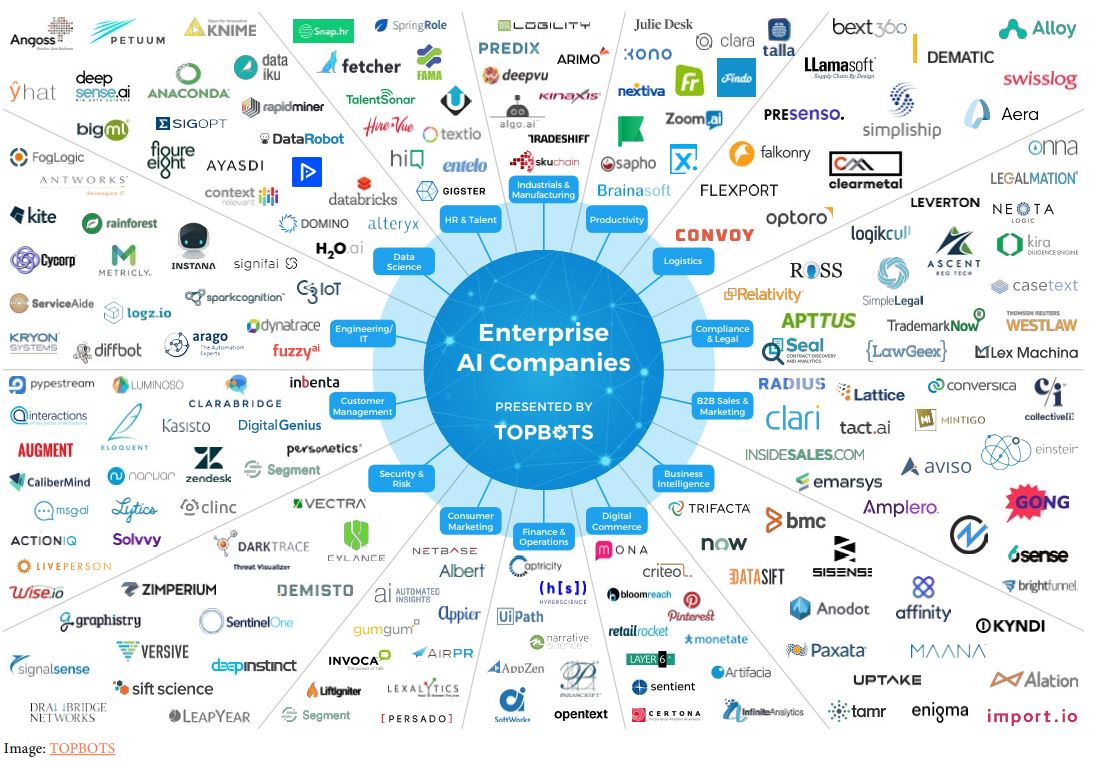
Companies that utilize or provide AI technology—source: TOPBOTS
Invoca uses Signal AI to help measure and attribute online conversions by mining data from the phone conversations themselves, freeing up valuable time for marketers who no longer have to listen to every call.
Signal AI uses AI to detect intent and patterns in language to provide actionable insights and conversion data (sale made, appointment set, etc.) for marketers. This is accomplished through a series of steps that start with the recorded conversation, transcribing the call into text which can then be analyzed by an algorithm, identifying key patterns, phrases, and actions, and pushing these insights to your marketing stack. Here’s a visual of what that looks like. Note that Invoca does not save call transcripts and is HIPAA and PCI compliant, an important distinction for marketers concerned with data privacy.

Image source: Invoca
Signal AI uses machine learning, an application of AI, which gives machines access to the data so that they can learn from it. AI works in conjunction with machine learning to provide actionable and accessible data to marketers—but marketers still need to review this data and make decisions based on their own observations and conclusions.
Invoca offers two versions of Signal AI to their call tracking clients. Pre-trained AI uses industry-based predictive models that have been “pre-trained” using thousands of hours of call data.
Custom AI is more appropriate for certain businesses, such as those with high volumes of calls or sophisticated data needs. This more complex option takes longer to create and implement, however, it can help certain businesses predict call outcomes with a higher degree of accuracy.
Skeptics may think that humans can classify calls more efficiently and accurately than AI, but the truth is the opposite. AI learns over time and it never gets tired, so it’s an effective and accurate way to classify calls without bias. Here are some other call tracking myths, debunked:
The true power of AI-based call tracking is, in a word, attribution. It’s the ability to unify call data across multiple sources and attribute it to all consumer touchpoints.
Invoca does this by collecting data from multiple sources: campaign and website data, first-party data (e.g., pulled from your CRM), third-party demographic data, call data such as length, time and location of call, and conversational data (derived from speech analysis).
Once all the available data is unified, Invoca’s technology determines the value of the call by analyzing the spoken conversations within the calls. Invoca’s AI synthesizes various word patterns (e.g., “I’m almost ready to buy, but I’m waiting for XYZ to happen”) and then classifies them into useful datasets.
Signal AI helps predict the type of call (e.g., sales, service, complaint) which allows marketers to optimize media placements, ad content, and more. This level of analysis can also help inform the call experience itself by identifying issues that may frustrate callers.
Connecting call data to campaign data can help in other ways too. For example, marketers can use call information for ad suppression, making sure customers don’t see offers for something they’ve already purchased or retargeting ads to people who called but didn’t make a purchase.
One of the most powerful features of the more robust, high-end call-tracking tools like Invoca is the ability for them to integrate with existing marketing platforms like Google Analytics, Adobe Experience Cloud, and Salesforce.
This gives marketers a clear picture of where their customers are at every step of the journey. It closes the attribution loop, allowing you to demonstrate what’s working from an ROI standpoint, a metric that’s key when it comes time for approval and budget allocation.
When considering implementing a tool like Invoca, the bottom line is always the top priority—will we make money with this martech investment?
Invoca customers have seen up to 60% increase in conversions when implementing the tool (without any additional media spend), an important consideration when factoring in ROI.
The Invoca Call Tracking Guide covers all this including what questions to ask vendors when considering a new tool and what to consider when shopping for a call tracking solution.
To learn more about call tracking technology from functionality to implementation and how call tracking can help with campaign optimization and attribution, download Invoca’s whitepaper, “The Call Tracking Study Guide for Marketers.”

Now, the free tool “automatically generates top competing sites that it uses as the basis for a more in-depth competitive analysis report,” Alexa.com President Andrew Ramm told SEW.

Traffic forecasting is one of a CMO’s best resources to allocate marketing spend across the most useful tactics. Here’s how traffic forecasting could mean smarter ad spend.

Tools that can help benchmark your clients’ link quality against competitors, monitor backlinks, and discover partnership opportunities with other websites.

Marketers are choking under a data avalanche. Is there a tool that cuts through the data noise, ignores vanity metrics, and focuses on numbers that matter?
https://searchenginewatch.com/2019/07/26/guide-call-tracking/
[unable to retrieve full-text content] https://www.adweek.com/brand-marketing/its-time-brands-add-genuine-consciousness-into-their-marketing-mix/