How to Leverage Emotional Intelligence to Improve Upon Marketing Strategies

There is no shortage of leadership profiling tools available. From the DiSC Profile to Myers & Briggs to John Maxwell’s Leadership Assessment, it is tempting to over-analyze your leadership style and areas of opportunity. As a business leader, you likely also spend time studying the great business leaders of our time–Jeff Bezos, Marc Benioff, Mary… https://www.adweek.com/brand-marketing/how-to-leverage-emotional-intelligence-to-improve-upon-marketing-strategies/


How to optimize your local business for voice search

Voice search is growing, a statement appearing time and time again throughout the web. It has fundamentally changed the way people search and it’s here to stay.

With a simple command, users can conduct searches for information, products, services and local businesses.

It’s such a hot topic that our Head of Search and Strategy Stuart Shaw spoke at one of the UK’s largest SEO conferences a few weeks ago to talk about the details of voice search and why it’s important for brands.

While voice isn’t likely to surpass traditional search any time soon, it has spurred us to explore how local businesses can optimize, adjust their marketing strategies and understand the potential voice search could have on their bottom lines.

The opportunity for local businesses

To get information about a local service near to us, we pull out our phones and we search for it:

  • ‘Plumbing services near me’
  • ‘Local pizza delivery’
  • ‘What are the opening times for…’
  • ‘Is so and so open today?’ etc.

In fact, a recent study by Brightlocal highlighted that 53% of people owning smart speakers such as Amazon’s Alexa & Google Home are performing searches like these for local businesses every day in the US:

Putting that in context for the UK

A recent YouGov study showed that people in the UK owning a smart speaker had doubled between Q3 2017 and Q1 2018 to 10% of the total population.

A study by radiocentre predicted that this growth could reach as high as 40% by the end of 2018.

Looking a little deeper, we could say that per household there is more than one occupant. In fact on average there’s actually 2.3 people per household, according to the most recent UK gov statistics:

Source: Office of national statistics

So, if the 40% of UK households prediction is correct, that is potentially 11 million households exposing voice search content to 25 million people in the UK.

Who’s leading the smart speaker market?

Three-quarters of the market share in the UK in Q1 2018 was taken up by Amazon’s Alexa. This, of course, will change but right now this is where the biggest opportunity lies for local businesses optimizing for smart speakers in the UK:


Source: Office of national statistics

Although voice search is still in a stage of infancy, and we have only talked about smart speakers, it’s clear to see just how relevant this technology is to brick and mortar businesses.

And, it’s constantly evolving…

Here’s a timeline from Stuart’s presentation, highlighting significant changes in voice search, and it’s becoming increasingly accessible for more and more people to conduct a voice search every day:

3 Biggest steps to optimize your local business for voice search

1. Take ownership of your digital footprint

Although voice assistants seem all-knowing, they rely heavily on information they can find around the web about your business.

A big part of optimizing for local SEO is ‘citations’ which are online references to your business name, address and phone number (NAP).

Voice assistants use these citations from trusted sources to provide information to users that are conducting local search queries.

So, where should I cite my business?

Each voice assistant relies on different and sometimes multiple data aggregators for answers to local search queries:

  • Siri
    • Search: Google
    • Business listings: Apple maps
    • Reviews: Yelp
  • Alexa
    • Search: Bing
    • Business listings: Yelp and more recently Yext
    • Reviews: Yelp
  • Google Assistant
    • Search: Google
    • Business listings: Google my Business
    • Reviews: Google my Business
  • Cortana
    • Search: Bing
    • Business listings: Bing
    • Reviews: Yelp

So, these data sources are the most important places to make sure your business is correctly cited, up-to-date and optimised:

2. Utilize schema markup

Schema is a type of on-page data markup that allows webmasters to provide search engines with data about their business in a more structured way.

The structured format allows search engines to understand the contents and context of web pages much easier (less algorithmic interpretation) and, subsequently, the engines can better understand the relevance of pages to particular search queries and present richer results.

Schema is only going to play a bigger part in ranking for rich results and featured snippets which are heavily used in for voice search content.

What does schema markup do?

Search engines experiment with how they display rich results all the time and by having your site marked up, you have the opportunity to be featured in new rich results.

For example, Google experimented with a ‘prominent knowledge panel card’ shown on mobile devices which displays when users conduct a branded search for the business. In the knowledge card you can see ‘place actions’ such as ‘find a table’ or ‘book an appointment’ which would direct searchers into an appropriate webpage to conduct the action.

These rich results went on to influence the structure of Google My Business which is now heavily used by local businesses. The point here is that the business websites shown in the example image below were ‘future proofed’ and optimal which qualified them for this rich result.

In other words, as Gary Illyes – web trends analyst at Google puts it:

“If you want your sites to appear in search features, implement structured data.”

The biggest benefit and ‘thing it does’ is help Google understand relevance much more fluently. Another few quotes from Gary Illyes helps explain this:

“Add structured data to your pages because, during indexing, we will be able to better understand what your site is about.”

“And don’t just think about the structured data that we documented on developers.google.com. Think about any schema.org schema that you could use on your pages. It will help us understand your pages better, and indirectly… it leads to better ranks.”

Why it’s important for local businesses

Schema is a tool which search engines and subsequently voice assistants are using to paint a clearer picture of a business website’s central topic and the services the site can offer users.

With structured data present, it is much more likely that your business (if relevant) will be identified as a good candidate for answering local voice search queries.

Using local business schema will:

  • Future-proof your website for richer search features (which voice search content is heavily influenced by)
  • Reinforce your online digital footprint
  • Bolster relevancy signals & geographic accuracy
  • Help drive more conversions both online and offline
  • Indirectly help your website rank better (important for voice)

So how do you take control?

There are hundreds of schema types which can be utilised for hundreds of business and content types.

There are also multiple ways of marking up schema in your page source code. By far the easiest is using JSON-LD. Using the example from above the marked up code looks something like this:

The best way to get your code ready is to go to SchemaApp.com, follow the instructions or use this tutorial and locate the schema types that are most relevant to you and your business.

Types of local business data that can be marked up:

  • Business name
  • Address
  • Phone number
  • Main email address
  • Business opening hours
  • Geo-location information (latitude and longitude)
  • Reviews
  • Company logo
  • Business description
  • Social profile links
  • Site name

Bear in mind there are guidelines for usage summarized below:

  • ‘Data must not deceive or mislead experience for search users’
  • ‘Use only the most specific types and property names defined by schema.org’
  • ‘Marked-up content must be visible on the page where the script is added’

See Google’s policies for structured data for more information.

Once you’ve gone through SchemaApp, copy and paste the output code into relevant pages before your closing </head> tag or, if it’s content specific schema (such as the review rating above), paste the code before the closing </body> tag in the HTML of your page.

Finally, check your mark up with this structured data testing tool which will highlight any errors once implemented.

Note: Avoid using Google Tag Manager for this markup, apply the code natively where possible.

3. Produce content relevant to voice search needs

There are great ways of optimizing specifically for voice search using your on-site content.

The simplest is to explore the realm of user intent and uncover the types of questions people may want answering, when it comes to your business.

That doesn’t mean you need to create 1000s of pages that are optimized specifically for voice search terms. Instead, search engines such as Google pulls answers to voice queries directly from page content, even if it is a snippet that makes up a small section of the content.

Work long tail queries into long-form content

Conduct some long tail keyword research and look for questions people ask about your local business and work them into your content, where it is relevant to do so. I highly recommend Answer the Public to scale your efforts here.

Here’s an example of what I mean.

This is a query I searched recently that could be relevant to any local business:

‘Does tesco take american express?’

Here’s what was shown at the top in a featured snippet (the content that will be read out if conducting a voice search with Google Home):
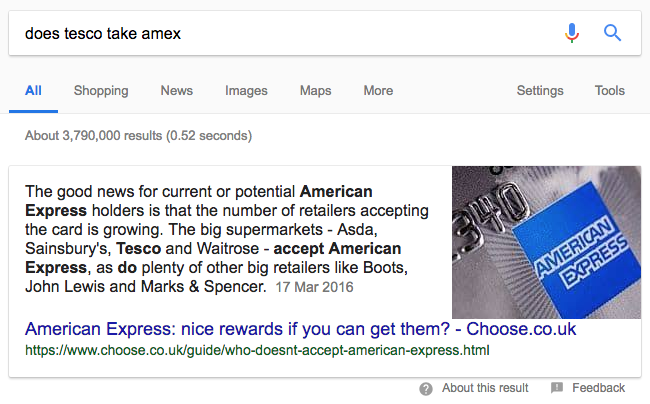
And here’s the content that Google has pulled out from halfway down the page from choose.co.uk:

FAQ pages can be perfect for voice search

Written correctly, an FAQ page can serve voice search queries really effectively and if you struggle to work in your long tail optimisation into relevant pages, an FAQ page is a great way to get around it:

  • People use voice search conversationally, which you can naturally replicate on an FAQ page without the content appearing out of place
  • It appeals to long tail voice & traditional searches which widen your reach
  • Voice search often seeks concise information, under 30 words, which an FAQ page can clearly communicate
  • Creating a dedicated page specifically with this key information in mind could help with higher placement in SERPs for voice searches, which is vital for capturing that first click/interaction

Conclusion

However, you look at SEO, voice is the future and it’s growing exponentially and it’s being integrated into more and more of our everyday tech. Local business marketers should be making specific efforts to capitalize on voice search to maximize their online and offline conversion.

The caveat here is not to let your standard SEO practice fall behind. Having a fully mobile responsive website, fast site speed and good quality local backlinks, among many other optimizations, are still, and will remain, vital for ranking in local search and will greatly impact your voice search efforts.

Get a deeper dive to voice search or get help with your voice search strategy.

The post How to optimize your local business for voice search appeared first on Search Engine Watch.

https://searchenginewatch.com/2018/11/20/optimize-local-business-voice-search/


How an Open Approach Can Help Independents Survive as Walled Gardens Decline

Facebook and Google’s share of online ad spend is slowly eroding, but that’s mainly due to another walled garden: Amazon. But how can independents get a larger share of the action amid demand for a more diverse marketplace? Despite ongoing concerns over trust and transparency in digital advertising, CMOs are still willing to invest more… https://www.adweek.com/programmatic/how-an-open-approach-can-help-independents-survive-as-walled-gardens-decline/


Voice search and local SEO: How to get started?

There were over a billion voice searches a month, as of January 2018 and 40% of those mobile searches had local intent. This strongly suggests that local SEO now requires optimizing for voice.

The human brain is wired to love convenience. Voice search is enabling people to search with the help of their voice and search engines have become accurate enough to provide direct answers to their voice commands.

As an SEO, how should you revamp your strategy in order to gain an edge over your competitors?

In this guide, I’ll tell you what you can do to make your clients’ local business websites the superstars of voice search.

Focus On Long-Tail And Localized Keywords

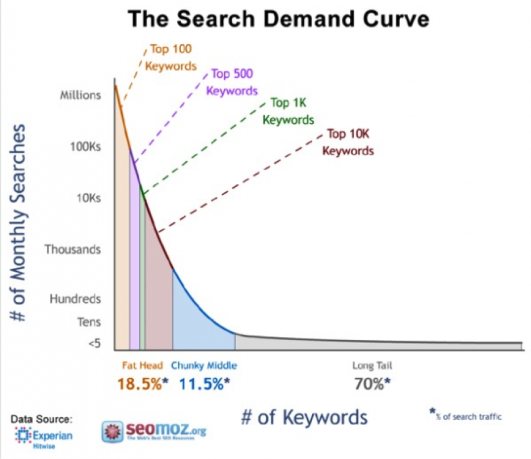
Purely voice focused SEO requires you to research and find out long-tail keywords. More than 70% global searches, in fact, are for long tail keywords.

Purely local SEO requires, of course, the localization of keywords by adding geographic indicators to them. Geo-local indicators include; Brooklyn espresso, 18th, and Broadway french fries.

These two research strategies need to be integrated to get the best traction from voice and local SEO as a single channel. Here’s how you can do this:

  • Using any of your favorite keyword research tools:
    • Run queries for your website’s main keywords, appended with your business geographical indicator (city/region/country/etc.)
    • Find out a list of keywords three or more words long
    • Arrange them in decreasing order of search volume and increasing the order of competitiveness
    • Extract the top 100 (or 50) from both lists, and find out the ones common to both lists (means high search volume and low competition keywords)

This, however, is a manually time-consuming method.

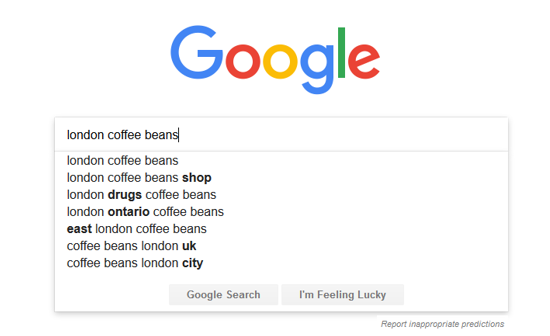
  • Use Google Autocomplete: This one’s much easier and quicker to execute. For starters, type in your local search query into Google’s search box, and wait. The trick here is to:
    • Either write your primary keyword only (and add the city name to suggested keywords later), or

  • Start with the city name followed by your primary keyword, if you also want more versions of city name based keywords

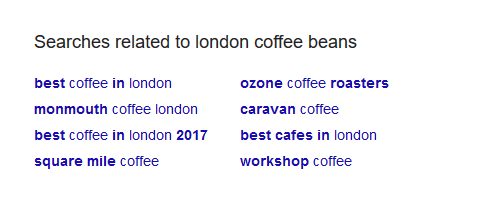
  • Use Google Related Search words: Check out the related searches keywords at the bottom of the search page.

I would add all these long tail localized keywords into an Excel sheet, and then run them through a keyword research tool to identify the ones with the right balance of search volume and keyword difficulty.

Latch On To The Micro Moments

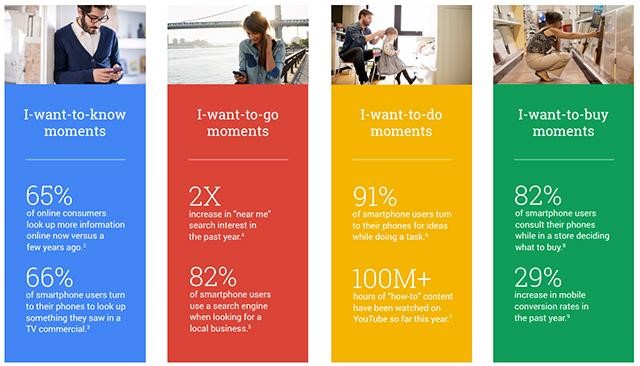
For a marketer, a micro-moment is a crucial fraction of the buyer’s pre-purchase journey. Hence, micro-moments need to be tapped correctly as these can nudge the buyer into purchasing from your business.

At the core of each of these moments is a question. For a local business, all these questions can be translated into question-form keywords, which makes their content highly contextualized and valid as answers to these questions. Here’s an infographic to help you understand the micro-moments, and the questions that arise in the buyer’s mind at these moments.

For instance, consider these questions for the four micro-moments:

  • I want to know: What are healthy breakfast choices?
  • I want to go: restaurants near me?
  • I want to do: how to decorate your bedroom?
  • I want to buy: best place to buy fresh vegetables

I’ll tell you more on optimizing your local website to tap these micro-moments in the next section.

Let Your Business Be The First To Answer

Shoppers have questions before they buy; the brands that can answer the quickest will get their business. From a local + voice SEO perspective, this boils down to optimizing your local website for the queries that users will ask their mobile phones’ voice search assistants. To build a list of question form keywords, I recommend these two tools.

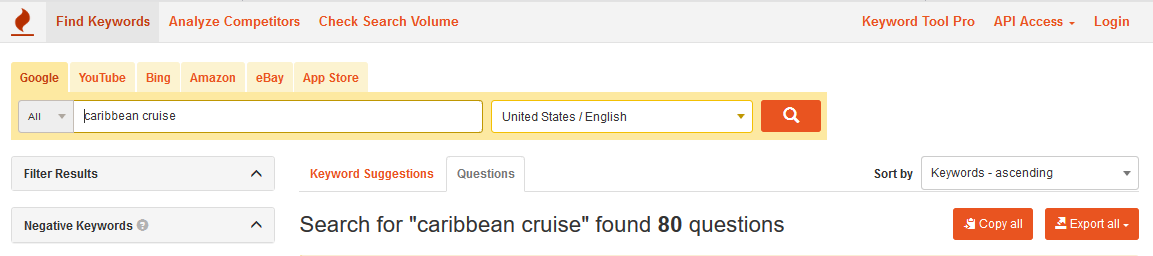
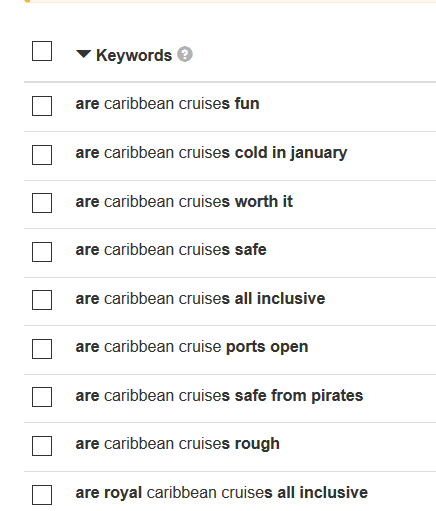
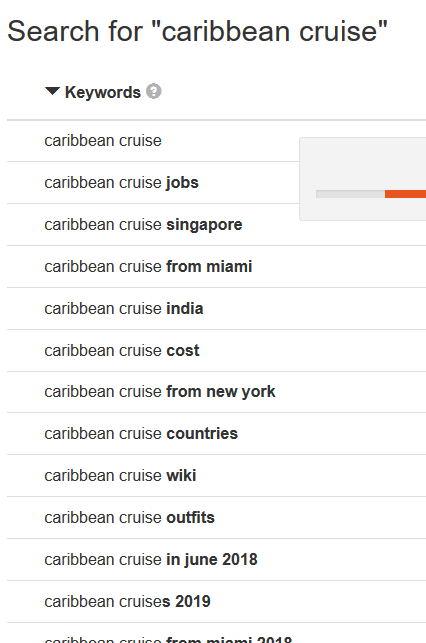
  • Keyword.io: Nothing better than this neat little tool to find question-form local keywords quickly. Just type in a generic keyword related to your business/brand/product, and choose the ‘questions’ button on the dashboard to filter down to question-form keywords.

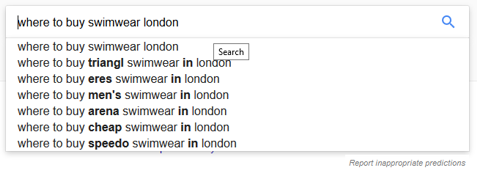
  • Google Auto Suggest; Yes, it works for question keyword research too. Type in your local variation main keyword by adding a question word in front of it (see the example), and you’ll get important, related, and high search volume question form keywords.

  • Apart from these, you might also want to check out Answer The Public, a free tool that offers a visually enriching interface and dozens of question-form keywords related to your input keywords.

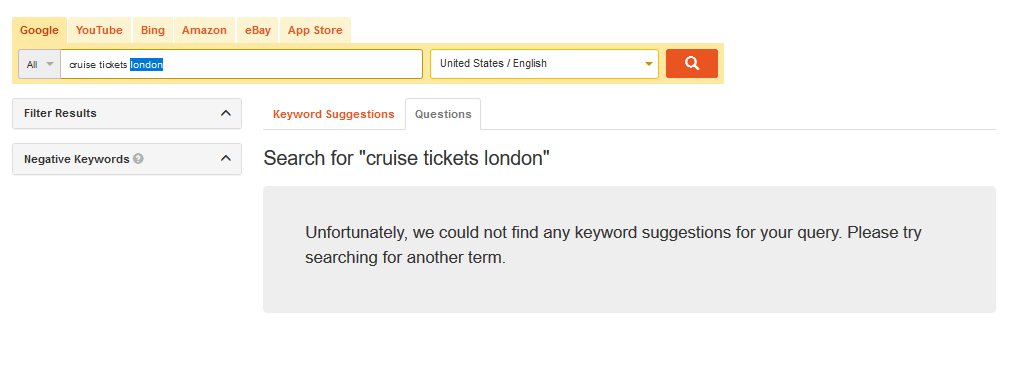
Note: If entering local keywords such as ‘cheap cruise tickets in London’ does not return any question keywords, remove the local element, re-do your questions search, and add the local element to these questions on your own.

Get The ‘Context’ Perfectly Right For Your Local Business Website

To make your local business website get Google’s love for relevant voice searches, you need to communicate its context comprehensively. After all, Google doesn’t want to be embarrassed by showcasing irrelevant search results for voice queries. To make your local website’s context clear to Google’s algorithm, do this:

  • Claim your Google My Business listing, complete your profile, and categorize your business correctly.
  • Work towards building up your local business’ citations (also called NAP – name, address, and phone number) online.
  • Claim and complete your listings on the major business directories online.
  • Consult Google’s Structured Data Markup Helper to identify the different content types you can markup.
  • Research LSI keywords and weave your web content around them, so that search algorithms are 100% certain that your website offers the right content to be shown in a voice search query
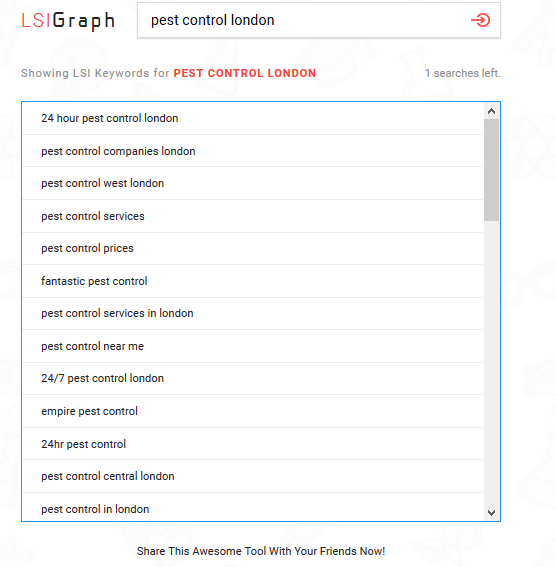
    • Use LSIGraph; a free and easy to use tool to generate contextual and topically related keywords
    • Key in your main local keyword, and extract the list of LSI keywords

What to do with Long Tail, LSI, and Question Keywords?

Now that you have a massive library of a long tail, LSI, and question keywords, all localized to your target geography, it’s time to bring out their SEO juice and use it to make your local business website super visible for voice searches. Here are the best practices to stick to:

  • Add all your keywords in an MS Excel (or equivalent) document.
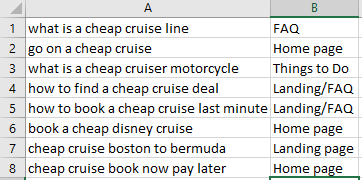
  • Categorize your keywords; this is as simple as adding a generic tag in the column next to your keyword. I have taken a few examples from the ‘cheap cruise’ example.

  • Even if you have 500 keywords, this exercise won’t take more than a couple of hours, and you will have ample artillery to manage your voice + local SEO for several months to come.
  • Once done, sort them into the categories you assigned them, and ask your copywriters to create content, ensuring that:
    • The keywords are used in the page title, meta description tag, and image tags
    • Keywords are used naturally in the content
    • The page content is structured into short paragraphs with subheadings containing keywords

Concluding Remarks

The unsaid rule of digital marketing is – find your niche. The same can be extended to understand how voice search and local SEO’s overlapping nature can enable brands significantly improve their online visibility. Don’t wait, because your competitors are coming for you. Get started with the methods I’ve put together in this guide.

The post Voice search and local SEO: How to get started? appeared first on Search Engine Watch.

https://searchenginewatch.com/2018/11/15/voice-search-local-seo-guide/


It’s Time for Marketers to Stop Misrepresenting Fathers in Marketing as Bumbling and Inept

Being a positive male role model is a more nuanced endeavor than in previous generations–and for good reason. With the gender pay gap continuing to dissolve, cracks in the glass ceiling finally starting to splinter and women’s empowerment gaining new visibility via the #MeToo movement, traditional gender roles feel as though they’re crumbling in real… https://www.adweek.com/brand-marketing/its-time-for-marketers-to-stop-misrepresenting-fathers-in-marketing-as-bumbling-and-inept/


The Future of Television Will See Massive Waves of Digitization and Data Usage

Media history is repeating itself, and paying attention will pay off. In the 1990s when the internet hit computer screens, content came first. Ads and the data to optimize those ads soon followed, quickly blossoming into a multi-billion-dollar industry. Today, nearly 30 years later, it’s happening again–this time with the digitization of TV. Again, content… https://www.adweek.com/tv-video/the-future-of-television-will-see-massive-waves-of-digitization-and-data-usage/


How Agencies Can Appeal to and Retain Veteran Employees

Each year roughly 250,000 veterans leave active duty to join the civilian workforce. Companies across industries actively recruit veterans for their unique skill sets, including work ethic, integrity, leadership, team building and diversity. Yet veterans remain a tough target for recruiters. Active duty service members and their families live on 280-plus installations globally and are… https://www.adweek.com/agencies/how-agencies-can-appeal-to-and-retain-veteran-employees/


How Brands Are Taking Control of Their Narratives and Reinventing Storytelling

In the old days, brands, businesses and anyone else with a message needed a network that captured millions of eyeballs or listeners to help get their word out. They relied on what we now call “interruptive advertising” to air during the most popular programs, be it radio or television. A confluence of changes has flipped… https://www.adweek.com/digital/how-brands-are-taking-control-of-their-narratives-and-reinventing-storytelling/


3 Benefits for Creatives Using AI to Refine Artistic Processes

There’s something about artificial intelligence that stirs up a low-grade panic in most people. It might be because AI represents an existential threat to human supremacy. Despite this, the use of AI will only be growing and brought to more industries. A 2017 McKinsey Global Institute study of 800 occupations across 46 countries found that… https://www.adweek.com/digital/3-benefits-for-creatives-using-ai-to-refine-artistic-processes/


How to Execute a Successful Sponsorship Without Wasting Time and Money

Managing a holistic marketing budget is all about making trade-offs across channels. Of all the marketing tools in your arsenal, are sponsorships the right way to spend your limited budget? Maybe. Brands spent over $62 billion globally on sponsorships in 2017, a number that is projected to keep growing. Sponsorships can be an effective way… https://www.adweek.com/brand-marketing/how-to-execute-a-successful-sponsorship-without-wasting-time-and-money/