How Marketers and Telcos Can Collaborate Despite a Constantly Fluctuating Market

Verizon, AT&T and Sprint have all decided to stop providing location data to third-parties. While some onlookers are declaring that “the party is over” for marketers using telco data, that’s really not the case. While this decision appears to be mostly about privacy, in the coming months, these companies can continue to help marketers–and profit… https://www.adweek.com/digital/how-marketers-and-telcos-can-collaborate-despite-a-constantly-fluctuating-market/


How to Turn Creative Tension Into an Inspired Creative Product

Fifty years ago, Bill Bernbach had the bright idea to pair copywriters up with art directors, and creative teams have been the backbone of the advertising industry ever since. These relationships require as much trust, understanding and emotional dexterity as any marriage, and they hold a huge influence over the trajectory of a creative’s career…. https://www.adweek.com/agencies/how-to-turn-creative-tension-into-an-inspired-creative-product/


3 Ways to Craft a Successful Influencer Marketing Campaign

It’s no surprise that influencer marketing is important in today’s marketing mix for brands, advertisers and agencies to consider and plan for. Where the challenge comes in is how to discern its place in the overall funnel and investment strategy. What is an influencer, anyway? An influencer is defined as an individual who has the… https://www.adweek.com/brand-marketing/3-ways-to-craft-a-successful-influencer-marketing-campaign/


The comprehensive guide to voice search keyword research

Informational keyword research is a subject that has been covered thousands of times across every SEO blog, publication, and web design company.

However, with voice becoming a more prominent way of searching, it’s important that it’s now taken into consideration. With voice usage growing, marketers need to understand how their audience is using this technology, and how they can adapt to this. Keyword research has been advancing dramatically over the last couple of years. No longer are the days of simply sorting by the highest search volume and creating a page; it comes down to much more than that. Semantics, categorisation, ranking difficulty vs reward, questions, featured snippets, people also ask. The list goes on.

A straightforward task has now become much more complex as well as time-consuming, and it’s important that it’s right the first time as keyword research will tend to influence your strategy, projections and, in some cases, KPIs.

We’ll be using a variety of paid and free tools within this guide. However, even without the paid tools it will give you a large dataset but will require a little more manual work.

Keyword Set

We’re going to be basing this on you already having a website that is established in some form or another, meaning you already have some rankings which can be used as an initial starting point. However, if this isn’t the case you’ll be able to simply skip these steps, although in some cases it could cause you to miss out on some smaller keywords.

Search Console

Underrated a lot of the time and critiqued heavily, however it’s a free tool that does give you lots of data, especially with recent updates; you’re able to obtain 16 months’ worth. It can sometimes be slightly inaccurate, however that’s much more data that you will be able to get from many paid tools.

To get the most out of this it’s best to try and filter down to the pages which are informational on your site – for example, your blog, a hub or guides.
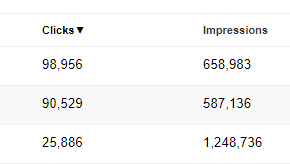
This will give you a top list of URLs which you can then dig into and provide you with a list of keywords to expand on. We suggest taking a list of the main subjects you find here to be able to dig into them further later on.

Autocomplete

Another free tool that we can take advantage of? Autocomplete, or Google Suggest, has been around for 14 years now, which simply seems insane. The feature, created on a bus by Kevin Gibbs, has given us bundles of joy throughout the years as well as causing controversy in other instances but it does give us a great research tool.

This is something that we have created in-house tools to take care of, simply due to the nature of the task. However it’s something you can carry out manually by adding your keyword into the search box and grabbing the suggestions.

It’s worth noting here that the monthly search volumes, as well as CPC estimates, are all generated by the keywords everywhere tool which is a must have as it can give you instant feedback on how many people are searching for the keyword as well as commercial intent.

This is something that will work well for some industries but not all. Again, take down all of the keyword suggestions you find and place them into your list of ideas generated from Search Console.

Now, this is where we start to look at voice in more detail. We know that voice search is mainly used for asking questions – the whos, wheres and whats of the world. Having a list of these question modifiers allows you to take the Google Suggest keyword data even further.

  • Where
  • Should
  • Which
  • Is
  • Do
  • Can
  • What
  • Does
  • Why
  • Have
  • When
  • Was
  • Will
  • Are
  • How
  • Who

These question modifiers allow us to really dig down into the questions people are asking, as these may not always have a lot of search volume and be easily find-able. By using wildcards in the search queries alongside the main subject, you will expand the keyword set even further.
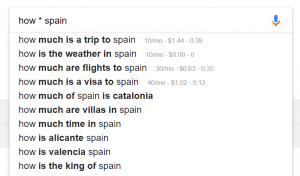
Some questions may not make sense and may not be keywords you want to go after. But, doing this for all of the questions modified, along with your key subjects, will give you a great starting position for your voice focused keyword research.

Related Queries & People Also Ask

Yes, we’re still on the same page yet there are more sections where we can continue to expand the keyword set. Related queries and people also ask are great free sources to further expand on what you already have.
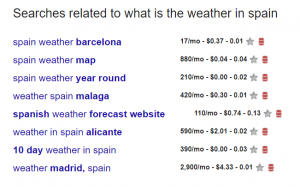
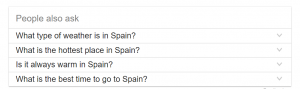
If you do this with all of the question queries you have obtained from the initial search console and suggested search data, you will then have a huge list of questions people are asking about your chosen areas. This gives you a great starting point for targeting people searching via voice as well as normal typed searches.

Competitors

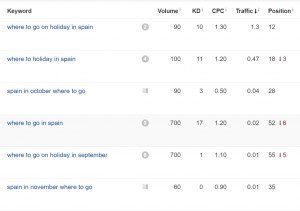
This isn’t anything new but is an important step in making your data set as fool-proof as possible. Entering your competitors into Ahrefs or SEMrush, filtering down by their informational areas, or simply anything with one of the question-related modifiers and adding this to your list is a very quick and simple way of making sure you aren’t missing anything the competition is doing.
Ahrefs

This is one of our favorite tools right now. It’s been proven to be one of the best at backlink exploration but is also great for keyword data, especially when building up a keyword set.

Creating a keyword list

First of all, you’ll need to set up your keyword list, based on the previous data you have gathered. This will then automatically pull through the search volumes, clicks, difficulty and many more data points.

It’s important to note that some of the data may not have been updated in some time. If this is the case you’ll need to use your credits to re-run this to gather new data.

Questions

As we know, voice search is all about questions. This is where we can further expand on the keyword set by using Ahrefs’ questions section.
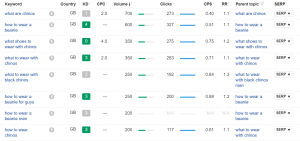
This is going to be one of the most important areas of the keyword research. Ahrefs does only take the first 10 keywords from the keyword list though, so it may be worth inputting the main categories, to begin with, to find questions around those and gradually digging deeper once you have the main questions.

There are going to be a lot of long tail questions with very little search volume, depending on the niche. It’s worth filtering through these to see if they are in fact useful. If so keep them, if they don’t make sense, get rid.

Other data gathering tools

As well as the ‘normal’ keyword research tools there are many other places you can find data on questions people are searching for. Again, depending on the niche this may or may not be useful to you. Quora is a great place for gathering information around voice-based searches as it’s a platform for exactly that – asking questions.
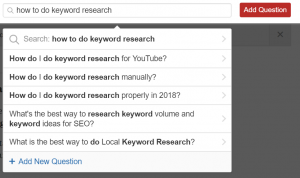
This is simply the top five results for that seed keyword in the search bar. Search for some of your main topics, grab the lists of results and again feed them into your keyword set, either on Ahrefs or your excel sheet.

The same can be said for Pinterest. This is great for lifestyle and retail websites as Pinterest is, of course, a very visual platform.

This search has very quickly given me another list of suggested searches, which I can then take, expand on using the variety of different techniques already outlined and again add to the already extensive data set we have collated. Pinterest is great platform to find keyword ideas for retail, to inform both offline and online strategies.

Local intent keywords

Voice search is not only about content driven informational terms. Sometimes it may be as simple as asking for opening times, contact details or business history. It’s important that these are factored into your keyword sets. Also, if you aren’t a business with a lot of branded search volume it may be difficult to find specific keywords with tools.

However, data from GSC may still provide you some great insight. We would suggest having a separate document to make sure that any questions around your specific brand are answered. This may mean making sure your structured data is up to scratch, Google Local Listings are complete or the content on your site includes what people are looking for.

The Final Keyword Set

Doing a keyword research for voice is not much different to how you would normally carry out a keyword research for informational. However, there is much more of a focus on questions – not only high-volume questions but ones which could have 0-10 searches a month simply due to the long tail nature.

Running through this process multiple times, with your different seed keywords, will help build out an extensive list of questions and informational terms people are searching for. This will not only help influence your content strategy but your sales strategy – knowing what people are looking for is the first step in understanding your user or customer base.

https://searchenginewatch.com/2018/10/18/guide-voice-search-keyword-research/


How IT and Marketing Can Avoid Becoming History’s Next Big Rivals

Crunchy peanut butter versus smooth. Vanilla ice cream versus chocolate. In the grand scheme of things, some of history’s biggest competitors have more in common than not. The same goes for marketing and IT, even though these departments struggle to see eye-to-eye at many businesses today. In particular, the migration of web content (e.g., outreach… https://www.adweek.com/digital/how-it-and-marketing-can-avoid-becoming-historys-next-big-rivals/


Brands—Even Those in ‘Boring’ Industries—Can Use Humor in Their Marketing

Most people would probably describe me as a fairly serious person. In fact, the night I met my future wife, an ex-girlfriend cautioned her, claiming I “wasn’t any fun.” Seriously. That happened. I only provide that tidbit as fair warning that if you keep going, you’re about to read about humor from a guy who’s… https://www.adweek.com/agencies/brands-even-those-in-boring-industries-can-use-humor-in-their-marketing/


How voice queries are showing up in search data

The rise of voice search is no secret, and many companies are still wondering how to address it. When it comes to search data, how can we monitor which queries are from voice? In this article, Jason Tabeling shows how he finds insights into voice search from his own company’s data.

Alpine.AI estimates that there will be more than 1 billion voice searches completed in 2018.

At this point I’m sure that everyone has seen or done a voice search, even if you just saw an example in a Google Home or Amazon Alexa ad. The power of what can be completed with a voice command is growing by the day. This trend is already having a massive impact on consumer behavior and therefore needs to be a consideration when monitoring or optimizing our search accounts.  

Right now Google doesn’t provide specific information on how a search was started. For example, was it a Google home search, from the app, done via typing or voice.

However, I wanted to take a recent dive into our own search data from our company, BrandMuscle. I used Google Ads client data across all verticals, comparing the first nine months of last year with this year, dates 1/1/17-9/30/17 versus 1/1/18 – 9/30/18.

The data revealed some interesting trends that give insight into how voice searches might be showing up in the data we currently have available.

Looking at the length and type of queries

To start, I looked at the length of search queries. The thought is with voice search consumers are using a more natural language. So instead of searching for “car insurance” consumers might search for “cheapest car insurance for Toyota Camry.” Our data shows the average number of words in each query has increased for both mobile and desktop queries year over year. Desktop queries are up 7% year over year to 4.3 words per query. Mobile has increased 9% year over year to 4.14 words per query. With mobile increasing more rapidly I think this shows the impact voice is having, as well as larger devices enabling consumers to input longer queries.  

The other area I wanted to dig into was what types of search queries are consumers using. I think voice search has brought an increase of consumers asking questions in a more natural language. Therefore I looked into question modifiers like who, what, where, when, why, and how. The use of these terms indicate more conversational tones. Our data has shown an increase in these terms of 118%, and a majority of that change coming on mobile phones which is up 178%.  

So what actions should you take with the increase in voice search? Here are 3 considerations:

1. Build experiences for question based queries

One of the reasons why search is such a great marketing tactic is consumers are giving you specific clues as to what they want. This is even more true when a question modifier is included. For example the implications behind what type of information a consumer is looking for when they are searching for “Where” + Running Shoes vs. “What” + Running Shoes is very important. “Where” would indicate the consumer wants map or location information, where “what” indicates more research based content is needed. Having ad copy and landing page experiences that meet these specific demands will help increase conversion rates. 

2. Monitor your search query data

Some of you might be reading these and questioning if this data matches your own search accounts. I bet it’s directionally correct, but might vary significantly. The only way to know is to dig into your own data. See what insights you can derive. Are any queries that your ad appeared where it should not have? This should be a part of regular account maintenance as you update match types and negatives. 

3. Test voice queries that are important to your business

Putting yourself into the shoes of one of your customers is still a very helpful lens for account managers. We often take our eyes off what the consumer experience is considering how much focus and attention we put into the details of a good search program. However, sometimes it’s just as simple as seeing what the search query results look like as a consumer. Try a search on Google Home. Does it provide an answer? Is it an answer that was taken from your organic listing? What opportunities can you uncover with this information?  

Voice search is having a major impact on our lives as consumers and marketers. This change is happening quickly and will continue to evolve as the technology continuously gets better and better. Following a few of these quick tips to keep an eye on your data will be very helpful to staying ahead of this trend. 

https://searchenginewatch.com/how-voice-queries-show-up-search-data


How Voice Apps Can Help Brands Connect With Consumers When They’re Really Needed

Just when marketers were getting accustomed to developing a multi-screen strategy across TV and digital interfaces, they now also have to begin strategizing for no screens at all. Here’s why: Purchases made through voice-powered devices such as Amazon Echo and Google Home are projected to explode from $2 billion now to $40 billion by 2022…. https://www.adweek.com/digital/how-voice-apps-can-help-brands-connect-with-consumers-when-theyre-really-needed/


Why Brands Need to Shift the Focus on Putting the Right Ad in the Right Channel

It may seem obvious, but too often people get trapped looking at performance metrics of marketing channels and forget the importance of the actual advertisements–the message and creative–they are using in those channels. During the past 60 years or so, hundreds of tools and approaches have been developed to evaluate advertising concepts and determine their… https://www.adweek.com/brand-marketing/why-brands-need-to-shift-the-focus-on-putting-the-right-ad-in-the-right-channel/


Why the Future Belongs to CMO Collaborators

The changing role of the chief marketing officer has been the talk of the proverbial town for nearly a decade. But given the frenetic pace of change in our industry under the influence of data and technology, the role of senior marketers is only just beginning to evolve. The digital era changed the game forever,… https://www.adweek.com/digital/why-the-future-belongs-to-cmo-collaborators/