Vulnerability Allowed Fortnite Account Takeover Without Credentials

Hacking game accounts is a popular — and enriching — pastime. The rise of in-game marketplaces that can be used for buying and selling game commodities has attracted hackers who break into gamers’ accounts, steal their game commodities (and anything else they can find from personal data to parents’ bank card details) and sell them on for cash. 

The traditional route has always been to phish the gamers’ credentials — and obviously the bigger and more popular the game, the bigger the pool for phishing. Checkpoint recently discovered a vulnerability (now fixed) in the biggest game of all that allowed criminals to gain access to users’ accounts without requiring credentials. 

The Target was Fortnite, an online video game developed by Epic Games and released in July 2017. It was played by nearly 80 million people in August 2018, and boasts something like 125 million accounts. It accounts for nearly half of Epic Games’ $5 to $8 billion estimated company value. Fortnite’s in-game currency is the ‘V-Buck’, which can be earned within the game, can be used to purchase game commodities from other users, and sold for fiat cash outside of the game.

The vulnerability came to light when Check Point researchers realized the Epic Games login page, accounts.epicgames.com, had not been validated and was susceptible to a malicious redirect. The also discovered a separate unused and flawed Epic subdomain, where they identified an XSS attack to load their own JavaScript.

The usual method for gamers to authenticate themselves for Fortnite is to employ Facebook, Google or X-Box SSO capabilities. Users would visit the Epic login page and choose ‘login with, say, Facebook’. Epic would then request and receive an access token from Facebook, and the user would gain access to his or her account.

However, with the flaw discovered by Checkpoint, the redirect URL would send the gamer to the login page and then be redirected to the compromised sub-domain. Here, the attacker’s JavaScript would send a second request for the user credentials from Facebook, receive them, and send them to the attacker.

“All a victim needs to do is click on the malicious phishing link the attacker sends them, either in Fortnite chat, or via social media,” writes Check Point. This link has the advantage of starting with the official EPIC login domain, and ending with another EPIC domain. “To increase the likelihood of a potential victim clicking on this link,” continues Check Point, “it could be sent with an enticement promising free game credits. Once clicked, with no need even for the user to enter any login credentials, their Fortnite authentication token would immediately be captured by the attacker.”

With that information, the attacker can access the user’s account, steal personal information, listen in to in-game conversations, and buy and steal V-Bucks using the victim’s own bank details. The V-Bucks could then be exchanged for real money in the real world.

In this instance the vulnerability arose because of EPIC’s failure to employ proper validation checks on the login page (allowing the redirect) exacerbated by leaving an unused, insecure sub-domain to provide the redirect destination and house the script used to steal the gamers’ credentials. This has now been fixed by EPIC.

But users can help themselves simply by employing two-factor authentication (as EPIC recommends). Users should, writes Check Point, “enable two-factor authentication. By doing so, and when logging into their account from a new device, the user is required to enter a security code that is then sent via email to the account owner.” 2FA is not an automatic panacea for security, and can be by-passed in certain circumstances. That, however, would require considerably more effort from the attacker, where exploitation of this vulnerability requires no user hacking at all.

Related: Epic Games Resets Passwords Following Forum Breach 

Related: Epic Games Forums Hacked Again 

Related: Rockstar Games Launches Public Bug Bounty Program 

<iframe width=”720″ height=”405″ src=”https://www.youtube.com/embed/poQmRWWh45s” frameborder=”0″ allow=”accelerometer; autoplay; encrypted-media; gyroscope; picture-in-picture” allowfullscreen></iframe>

view counter

Kevin Townsend is a Senior Contributor at SecurityWeek. He has been writing about high tech issues since before the birth of Microsoft. For the last 15 years he has specialized in information security; and has had many thousands of articles published in dozens of different magazines – from The Times and the Financial Times to current and long-gone computer magazines.

Previous Columns by Kevin Townsend:

Tags:

http://feedproxy.google.com/~r/Securityweek/~3/OpjUgSLAlNg/vulnerability-allowed-fortnite-account-takeover-without-credentials


Researchers Invited to Hack a Tesla at Pwn2Own 2019

Researchers can earn up to $300,000 and a car if they manage to hack a Tesla Model 3 at this year’s Pwn2Own competition, Trend Micro’s Zero Day Initiative (ZDI) announced on Monday.

Pwn2Own 2019, scheduled to take place on March 20-22 alongside the CanSecWest conference in Vancouver, Canada, introduces an automotive category for which a Tesla Model 3 will be brought on site.

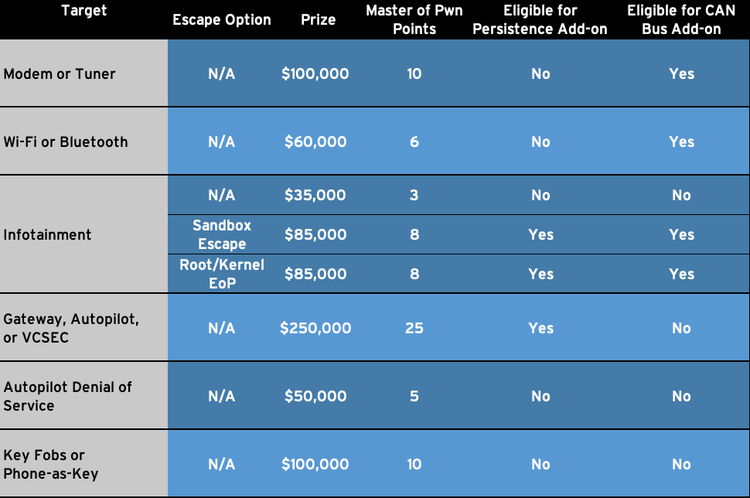
White hat hackers can earn between $50,000 and $250,000 for demonstrating an exploit against a Tesla’s modem or tuner, Wi-Fi or Bluetooth components, infotainment system, gateway, autopilot, security system, and key fob (including the phone used as a key). Some of the targeted components are also eligible for a bonus of $50,000 or $100,000 for persistence and a CAN bus hack, respectively.

“Along with the prize money, the first-round winner in this category will win a Tesla Model 3 mid-range rear-wheel drive vehicle,” ZDI said.

Prizes for hacking Tesla

In the virtualization category, Pwn2Own participants can target Oracle VirtualBox, VMware Workstation and ESXi, and Microsoft Hyper-V Client. The highest prize is for Hyper-V – up to $250,000 and a $30,000 bonus for a privilege escalation on the host.

In the web browsers category, hackers can earn tens and even hundreds of thousands of dollars for sandbox escapes, Windows kernel privilege escalations, and VM escapes. The targets are Chrome, Edge, Safari and Firefox.

The enterprise category includes Adobe Reader, Microsoft Office 365, and Microsoft Outlook. Finally, the server-side category’s only target is Windows RDP, for which hackers can earn $150,000.

“Most of our server side targets moved to our Targeted Incentive Program, so they no longer need to be included in Pwn2Own,” ZDI explained.

The prize pool for this year’s event exceeds $1 million, and that does not include the money offered for hacking a Tesla.

At last year’s Pwn2Own, participants only took home less than $300,000 of the $2 million prize pool.

Related: IoT Category Added to Pwn2Own Hacking Contest

Related: Samsung Galaxy S9, iPhone X Hacked at Pwn2Own Tokyo

view counter

Eduard Kovacs (@EduardKovacs) is a contributing editor at SecurityWeek. He worked as a high school IT teacher for two years before starting a career in journalism as Softpedia’s security news reporter. Eduard holds a bachelor’s degree in industrial informatics and a master’s degree in computer techniques applied in electrical engineering.

Previous Columns by Eduard Kovacs:

Tags:

http://feedproxy.google.com/~r/Securityweek/~3/dIat3_-zvyc/researchers-invited-hack-tesla-pwn2own-2019


Firefox 69 to Disable Adobe Flash by Default

Mozilla will soon disable Adobe Flash by default in Firefox, the first step toward completely removing support for the plugin in the browser. 

The change will be initially made in Firefox 69 Nightly, and will then get through the entire release cycle, the Internet organization says. 

“We are now scheduled to completely disable Flash in Firefox 69 which moves to the Stable release on August 3rd,” Mozilla notes on the browser’s roadmap page. 

In July 2017, Adobe announced plans to completely kill Flash and stop providing security updates for it by the end of 2020. 

The company’s decision was motivated by the large number of Critical vulnerabilities found in the plugin over the past several years, including flaws that were being actively exploited in malicious attacks. 

Companies such as Apple, Facebook, Google, Microsoft, and Mozilla fully backed Adobe’s decision to end Flash, and support for the plugin has been gradually deprecated from numerous popular products.

With the release of Firefox 55 in August 2017, Mozilla made Flash click-to-activate by default, requiring users to select which sites they wanted to activate the plugin on. 

Now, the company is ready to move forth with the deprecation of support for Flash, and wants to disable it by default before the end of the year. 

Early next year, Flash support will be completely removed from consumer versions of Firefox, though it will remain in the Firefox Extended Support Release (ESR) until the end of 2020. 

“When Adobe stops shipping security updates for Flash at the end of 2020, Firefox will refuse to load the plugin,” Mozilla notes on the Firefox plugins roadmap. 

While Flash continues to be used in numerous applications and websites, developers and content creators are encouraged to migrate from Flash to open standards such as HTML5, WebGL and WebAssembly, which are already supported by all major web browsers.

Related: Senator Urges Federal Agencies to Ditch Adobe Flash

Related: Adobe Patches Flash Zero-Day Exploited in Targeted Attacks

Related: Firefox Makes Adobe Flash Click-to-Activate by Default

view counter

Ionut Arghire is an international correspondent for SecurityWeek.

Previous Columns by Ionut Arghire:

Tags:

http://feedproxy.google.com/~r/Securityweek/~3/pmUvyEipSpQ/firefox-69-disable-adobe-flash-default


Unpatched Flaws in Building Access System Allow Hackers to Create Fake Badges

Researchers discovered that a popular building access control system made by IDenticard contains vulnerabilities that can be exploited to create fake badges, disable door locks, and obtain or modify user data.

IDenticard is a US-based provider of ID, access and security solutions. On its website, the company says it has tens of thousands of customers around the world, including Fortune 500 companies, educational institutions, medical centers, factories, and government agencies.

PremiSys is an access control and photo ID solution that provides organizations a wide range of features for a comprehensive access control program, including for granting or restricting access to specific doors, locking down facilities, controlling door alarms, viewing integrated surveillance video, and creating detailed reports.

Researchers at Tenable discovered that the product is affected by several potentially serious vulnerabilities. One of them is related to the existence of a hardcoded backdoor account that can give an attacker admin access to the service. This access can be leveraged to enter the badge system database and modify its content.

The cybersecurity firm’s experts also discovered that PremiSys stores credentials and other sensitive data using a hashing method that is known to be weak.

They also noticed that backups and the database installed by the IDenticard service are protected by default passwords that are easy to obtain and which cannot be changed by the user.

The CVE identifiers CVE-2019-3906 through CVE-2019-3909 have been assigned to these vulnerabilities.

Tenable warned that an attacker could exploit these security holes to covertly enter buildings by creating fake badges and disabling door locks. An attacker could also download the entire content of the user database, and modify or delete data.

However, the company has clarified for SecurityWeek that conducting an attack requires access to the network housing the badge system as these servers are unlikely to be accessible directly from the Internet.

“If an attacker needed physical access to a building, they could theoretically add themselves to a badge system to get past security, and either disable locks on demand or simply give themselves entry rights to things they otherwise wouldn’t have,” Tenable’s research team said via email.

Tenable says it has been attempting to report its findings to the vendor since early October, including through CERT/CC, but received no response. Since more than 90 days have passed since the first attempt, Tenable has made its findings public, even if there don’t appear to be any patches.

Tenable has tested its findings on version 3.1.190 of the PremiSys software. Version 3.2 was released in May 2018, but the cybersecurity firm believes the latest versions of the product are affected as well.

SecurityWeek has reached out to IDenticard for comment and will update this article if the company responds.

Related: Sauter Quickly Patches Flaw in Building Automation Software

Related: Critical Flaws Expose ABB Door Communication Systems to Attacks

Related: Hotel Rooms Around the World Susceptible to Silent Breach

Related: Flaw in Fingerprint Access Devices Could Make It Easy to Open Doors

view counter

Eduard Kovacs (@EduardKovacs) is a contributing editor at SecurityWeek. He worked as a high school IT teacher for two years before starting a career in journalism as Softpedia’s security news reporter. Eduard holds a bachelor’s degree in industrial informatics and a master’s degree in computer techniques applied in electrical engineering.

Previous Columns by Eduard Kovacs:

Tags:

http://feedproxy.google.com/~r/Securityweek/~3/qu-l1nAth-A/unpatched-flaws-building-access-system-allow-hackers-create-fake-badges


Rapid7 Releases Metasploit 5.0

Rapid7 on Friday announced the release of Metasploit 5.0. The latest major version of the popular penetration testing framework introduces several new important features, improved performance, and its developers say it should be easier to use.

According to Rapid7, Metasploit 5.0 brings significant changes in terms of database and automation APIs, improving the way the platform interacts with data and other tools. Metasploit has been using the PostgreSQL database system, but the latest version also allows users to run the database as a RESTful service, enabling interaction with Metasploit consoles and external tools.

There is also a new JSON-RPC API that should make it easier to integrate the framework with new tools and languages. In addition, Metasploit’s own automation protocol is now complemented by a common web service framework for the database and automation APIs.

Metasploit 5.0 releasedAnother significant improvement in Metasploit 5.0 is related to evasion modules and libraries. Penetration testers can now generate their own evasion modules more easily using the C programming language.

The latest version also enables the execution of an exploit module against multiple targets at a time.

Other improvements include faster and more advanced search functionality for modules, a new metashell feature, and support for three new languages – Go, Python and Ruby – for external modules.

Metasploit 5.0 is currently available from its official GitHub project. Rapid7 says it’s in the process of informing third-party developers that Metasploit 5.0 is stable – Linux distributions such as Kali and ParrotSec are shipped with Metasploit.

“Metasploit 5.0 offers a new data service, introduces fresh evasion capabilities, supports multiple languages, and builds upon the Framework’s ever-growing repository of world-class offensive security content,” wrote Brent Cook, engineering manager for Metasploit at Rapid7. “We’re able to continue innovating and expanding in no small part thanks to the many open source users and developers who make it a priority to share their knowledge with the community. You have our gratitude.”

Related: NSA-Linked Hacking Tools Ported to Metasploit

Related: Rapid7 Adds Hardware Testing Capabilities to Metasploit

Related: Vulnerable Services Emulator Released for Metasploit

Related: New Encrypted Downloader Delivers Metasploit Backdoor

view counter

Eduard Kovacs (@EduardKovacs) is a contributing editor at SecurityWeek. He worked as a high school IT teacher for two years before starting a career in journalism as Softpedia’s security news reporter. Eduard holds a bachelor’s degree in industrial informatics and a master’s degree in computer techniques applied in electrical engineering.

Previous Columns by Eduard Kovacs:

Tags:

http://feedproxy.google.com/~r/Securityweek/~3/JEJWRiORoEw/rapid7-releases-metasploit-50


Juniper Networks Patches Over 60 Flaws in Junos, ATP Products

Juniper Networks this week released patches for more than 60 vulnerabilities in its Juniper Advanced Threat Prevention (ATP) appliance, Junos OS operating system, and Junos Space network management platform. Many of the security holes impact third-party components.

In Juniper ATP appliances, the company addressed 13 flaws, including persistent cross-site scripting (XSS), arbitrary command execution, hardcoded credentials, information disclosure, and unprotected credentials issues.

Three of the vulnerabilities fixed in ATP devices have been rated “critical,” including ones related to the existence of hardcoded credentials and the storage of Splunk credentials in a file that can be accessed by authenticated local users.

Another three flaws have been assigned a CVSS score between 7.0 and 8.9, which puts them in the “high” severity category. The list includes issues related to the insecure storage of keys used for critical operations in the WebUI interface, the logging of secret passphrase CLI inputs in clear text, and a remote command execution weakness in the XML-RPC server.

In the Junos OS operating system, which powers many of Juniper’s appliances, the company addressed eight vulnerabilities disclosed in the past three years in the libxml2 library, which is used for parsing XML documents. Many of these libxml2 flaws have been assigned “critical” and “high” severity ratings. They can be exploited for denial-of-service (DoS) attacks and other purposes.

Also in Junos OS, the company fixed two OpenSSL vulnerabilities patched by the OpenSSL Project last year.

Finally, Juniper patched nearly 40 vulnerabilities in Junos Space. Nine security holes – one rated “high” and the rest “medium” – have been resolved in version 18.3R1.

The rest were fixed in version 18.4R1, including one critical bug that can lead to privilege escalation and arbitrary code execution. A majority of the vulnerabilities addressed in this version have a high severity.

A majority of the Junos Space vulnerabilities impact third-party components and they have been disclosed in 2017 and 2018. The impacted components include QEMU, the Linux kernel (including SegmentSmack), Intel CPUs (LazyFP and L1TF vulnerabilities), the glibc library, procps-ng utilities, libvirt, GnuPG, Samba, BIND, the Web-Dorado Instagram Feed WD plugin, yum-utils tools, the GlusterFS network filesystem, and Mozilla NSS (Network Security Services) libraries.

In addition to the patches released this week, workarounds and mitigations are also available for some of the impacted products.

Related: Juniper Patches Serious Flaws in Junos OS

Related: Juniper Confirms Leaked Implants Target Its Products

Related: DoS Vulnerability Affects Cisco, Juniper Products

view counter

Eduard Kovacs (@EduardKovacs) is a contributing editor at SecurityWeek. He worked as a high school IT teacher for two years before starting a career in journalism as Softpedia’s security news reporter. Eduard holds a bachelor’s degree in industrial informatics and a master’s degree in computer techniques applied in electrical engineering.

Previous Columns by Eduard Kovacs:

Tags:

http://feedproxy.google.com/~r/Securityweek/~3/JXW9ZSKu9eE/juniper-networks-patches-over-60-flaws-junos-atp-products


Facebook and Google Launch Asia-Pacific Bug Hunting Conference

Facebook and Google have partnered to launch a new conference for the researchers interested on discovering and reporting vulnerabilities.

Called BountyCon and mainly aimed at helping the two better identify new researchers in the Asia-Pacific region, as well as on incentivizing their existing bug bounty community, the conference is scheduled for March 30-31 in Singapore. 

The two-day event is invitation-only and will feature some of the top bug hunters from the programs run by both Facebook and Google, who will “share practical tips for discovering and reporting high-quality vulnerabilities.” A live hacking event on the Internet companies’ respective platforms will also be hosted.

The concept of the event is to help build a better relationship with the security community, while also welcoming broad participation from new researchers.

Researchers interested in attending can participate in a Capture the Flag competition (CTF) that runs on both Facebook and Google through February 20. Hidden flags have been placed throughout both platforms for interested researchers to discover. 

The CTF competition is meant to determine the top 20 bug ‘hunters’ to be invited to attend the conference. Flags can be discovered “by means of general bug hunting reconnaissance techniques” and no cooperation between participants is allowed, Facebook says. 

Those who discover flags on either platforms can report them to Facebook on this page, to earn points. The complete set of rules for the competition is available on this page. Flags can be submitted until 11:59:59 pm Pacific Time on February 20, 2019.

“As with most CTF challenges, the more flags a researcher finds, the higher the score will be. We will invite people to attend BountyCon from among the highest scoring researchers, and we will cover airfare and accommodations in Singapore. In the event of a tie, the researchers with the lowest cumulated submission time will be selected,” Facebook notes. 

The conference is mainly aimed at researchers from the Asia-Pacific region, but anyone interested can participate “for a few reserved spots that we are holding for the top worldwide participants who earn the most points,” Facebook says. 

The two-day conference will take place just two weeks before SecurityWeek’s 2019 Singapore ICS Cyber Security Conference, an event that will take place on April 16-18, dedicated to serving critical infrastructure and industrial Internet stakeholders in the APAC region. 

Related: EU to Run Bug Bounty Programs for 14 Free Software Projects

Related: Singapore Government Announces Second Bug Bounty Program

view counter

Ionut Arghire is an international correspondent for SecurityWeek.

Previous Columns by Ionut Arghire:

Tags:

http://feedproxy.google.com/~r/Securityweek/~3/N-pR8g2bsmA/facebook-and-google-launch-asia-pacific-bug-hunting-conference


Hyatt Hotels Launches Public Bug Bounty Program

Hyatt Hotels Corporation on Wednesday announced the launch of a public bug bounty program that covers its websites and mobile applications.

Hyatt and its affiliates operate over 750 hotels in more than 55 countries. The Chicago-based hotel operator disclosed two payment card breaches in the past years: one in 2016, which impacted 250 properties worldwide, and one in 2017, which hit over 40 hotels in the Americas and Asia.

Hyatt Hotels launches bug bounty programFollowing these data breaches, the company teamed up with bug bounty platform HackerOne for a private program. It has now decided to open its bug bounty program to the public.

Hyatt’s program covers the hyatt.com and world.hyatt.com domains, along with its Hyatt Hotels mobile applications for iOS and Android. Researchers have been invited to find and report various types of vulnerabilities, including authentication bypass, backend system access, origin IP discovery, container escape, data exposure, SQL injection, cross-site scripting (XSS), firewall bypass, cross-site request forgery (CSRF), and automated account checking issues.

Critical vulnerabilities can earn bounty hunters up to $4,000, while high severity issues can fetch up to $1,200. Medium and low severity flaws can be worth a maximum of $600 and $300, respectively.

The hotel has promised to respond to reports and triage them within one business day. Payouts should be expected within 30 days for critical vulnerabilities, 60 days for high severity bugs and 90 days for medium severity weaknesses.

“At Hyatt, protecting guest and customer information is our top priority and launching this program represents an important step that furthers our goal of keeping our guests safe every day,” said Benjamin Vaughn, CISO at Hyatt. “As one of the first global hospitality brands to launch this type of program, we extend the ways we care for our guests and deepen our commitment to protecting their sensitive information.”

Related: Singapore Government Announces Second Bug Bounty Program

Related: GitLab Launches Public Bug Bounty Program

Related: EU to Run Bug Bounty Programs for 14 Free Software Projects

Related: Grammarly Launches Public Bug Bounty Program

view counter

Eduard Kovacs (@EduardKovacs) is a contributing editor at SecurityWeek. He worked as a high school IT teacher for two years before starting a career in journalism as Softpedia’s security news reporter. Eduard holds a bachelor’s degree in industrial informatics and a master’s degree in computer techniques applied in electrical engineering.

Previous Columns by Eduard Kovacs:

Tags:

http://feedproxy.google.com/~r/Securityweek/~3/1miGSRbNqo4/hyatt-hotels-launches-public-bug-bounty-program


Cisco Patches Serious DoS Flaws in Email Security Appliance

Cisco this week patched two serious denial-of-service (DoS) vulnerabilities that can be exploited remotely without authentication in its Email Security Appliance (ESA) products.

One of the flaws, tracked as CVE-2018-15453 and classified as “critical,” has been described as a memory corruption issue caused by improper input validation in emails signed with Secure/Multipurpose Internet Mail Extensions (S/MIME). An attacker can cause appliances to reload and enter a DoS condition by sending a specially crafted S/MIME email.

When the software resumes, it continues processing the same email, resulting in a permanent DoS condition. Manual intervention is required to restore the appliance.

The second DoS vulnerability affecting Cisco’s email security appliances is related to the message filtering feature of AsyncOS software. Tracked as CVE-2018-15460 and rated “high severity,” the flaw allows an attacker to cause a DoS condition by getting CPU usage to increase to 100%.

A remote attacker can exploit the security hole by sending an email containing a large number of whitelisted URLs.

Both ESA vulnerabilities were discovered by Cisco itself and there is no evidence of malicious exploitation.

Cisco this week also released 16 other advisories describing “medium severity” flaws affecting ASR routers, Webex, IOS, TelePresence, Prime, IP Phone, Jabber, Identity Services Engine, Firepower, Unified Communications Manager, and Policy Suite products.

The IP Phone vulnerabilities were identified by a researcher from SEC Consult. He discovered an arbitrary script injection flaw, hardcoded credentials, undocumented debug functionality, and the use of outdated components containing known security holes.

However, Cisco’s advisory only informs users that a remote and unauthenticated attacker can execute arbitrary scripts and obtain sensitive information. While the networking giant has assigned a “medium” severity rating to its advisory, SEC Consult has classified the flaws as having “high” impact. The security firm has disclosed details of the vulnerabilities and published proof-of-concept (PoC) code.

Related: Cisco Warns of Zero-Day Vulnerability in Security Appliances

Related: Default Account Exposes Cisco Switches to Remote Attacks

Related: Cisco Patches Privilege Escalation Vulnerability in Adaptive Security Appliance

view counter

Eduard Kovacs (@EduardKovacs) is a contributing editor at SecurityWeek. He worked as a high school IT teacher for two years before starting a career in journalism as Softpedia’s security news reporter. Eduard holds a bachelor’s degree in industrial informatics and a master’s degree in computer techniques applied in electrical engineering.

Previous Columns by Eduard Kovacs:

Tags:

http://feedproxy.google.com/~r/Securityweek/~3/1IzpMVzyAEk/cisco-patches-serious-dos-flaws-email-security-appliance


Google Patches Critical Vulnerability in Android

Google this week released its first set of security patches for Android in 2019, with fixes for more than two dozen vulnerabilities. 

The most important of the security bugs is CVE-2018-9583, a Critical remote code execution vulnerability addressed in System and included in the 2019-01-01 security patch level. 

A total of 13 security issues were addressed as part of this patch level, with only two components impacted, namely Framework and System. 

The only flaw that was addressed in Framework was an elevation of privilege issue. Tracked as CVE-2018-9582, it features a High severity rating and impacts Android versions 8.0, 8.1, and 9. 

All of the remaining 12 vulnerabilities impact System: 1 Critical remote code execution bug, 4 High risk elevation of privilege issues, and 7 High severity information disclosure vulnerabilities. Impacted Android versions include 7.0, 7.1.1, 7.1.2, 8.0, 8.1, and 9.

The second part of Google’s new set of security fixes, the 2019-01-05 security patch level, addresses 14 vulnerabilities in Kernel components, NVIDIA components, Qualcomm components, and Qualcomm closed-source components. 

Most of these security bugs feature a High severity rating, except for CVE-2018-11847, a Critical bug addressed in a Qualcomm closed-source component. Most of the flaws were elevation of privilege issues.

According to Google, the most severe of these vulnerabilities could allow local malicious applications to execute arbitrary code within the context of a privileged process.

Also this week, Google released a security update for Pixel/Nexus devices, to address two Moderate risk vulnerabilities in Kernel components. Tracked as CVE-2018-13098 and CVE-2018-13099, both bugs are information disclosure issues. 

The Pixel Update Bulletin—January 2019 also includes a functional patch for Pixel 3 and Pixel 3 XL devices, meant to improve the audio quality when recording videos. 

Related: Android 9 Brings Significant Security Advancements

Related: Google ASPIRE to Boost Android Security and Privacy

view counter

Ionut Arghire is an international correspondent for SecurityWeek.

Previous Columns by Ionut Arghire:

Tags:

http://feedproxy.google.com/~r/Securityweek/~3/lVmcWs5Ab0U/google-patches-critical-vulnerability-android