Drupal Sites Targeted With Backdoors, Miners in Drupalgeddon2 Attacks

The recently patched Drupal vulnerability tracked as CVE-2018-7600 and dubbed Drupalgeddon2 has been exploited in the wild to deliver backdoors, cryptocurrency miners and other types of malware.

While much of the online activity targeting CVE-2018-7600 still appears to represent scanning (i.e. attempts to find vulnerable systems), attackers have also started exploiting the flaw to install malware.

The SANS Internet Storm Center has spotted attempts to deliver a cryptocurrency miner, a simple PHP backdoor that allows attackers to upload more files to the targeted server, and an IRC bot written in Perl.

One of the attacks observed by SANS delivers the XMRig Monero miner. In the same attack, the hackers have also downloaded a script that kills competing miners on the compromised system.

Drupalgeddon2

Data from Imperva shows that 90% of activity is associated with scanning, 3% with backdoors, and 2% with miners. A vast majority of the attacks seen by the company originated from the United States (53%) and China (45%).

Researchers at Volexity have also been monitoring Drupalgeddon2 attacks and they have linked one of the Monero miner campaigns to a cybercrime group that last year exploited a vulnerability in Oracle WebLogic Server (CVE-2017-10271) to infect systems with cryptocurrency malware. Volexity identified some of the wallets that had stored the group’s cryptocurrency and found more than $100,000 in Monero.

The Drupalgeddon 2 vulnerability can be exploited for remote code execution and it allows malicious actors to take complete control of websites. The flaw affects Drupal 6, 7 and 8, and it was patched with updates released in late March.

Experts expected to see exploits almost immediately, but the first attacks were spotted only two weeks later, after a technical analysis and a proof-of-concept (PoC) exploit were made public.

“It appeared every one of the black hats was waiting for someone else to do the research and share the exploit. Perhaps most hackers don’t care for the actual work of finding ways to exploit a vulnerability. They just wait until something is public and then use it to attack. Before that, we saw almost no traffic whatsoever!” Imperva said.

Now, based on the volume of attempts to exploit CVE-2018-7600, researchers at both Sucuri and SANS warn that users should assume their Drupal websites have been compromised if the patches have not been installed.

Related: Flaw in Drupal Module Exposes 120,000 Sites to Attacks

Related: Several Vulnerabilities Patched in Drupal

view counter

Eduard Kovacs (@EduardKovacs) is a contributing editor at SecurityWeek. He worked as a high school IT teacher for two years before starting a career in journalism as Softpedia’s security news reporter. Eduard holds a bachelor’s degree in industrial informatics and a master’s degree in computer techniques applied in electrical engineering.

Previous Columns by Eduard Kovacs:

Tags:

http://feedproxy.google.com/~r/Securityweek/~3/4nHrMq2P30s/drupal-sites-targeted-backdoors-miners-drupalgeddon2-attacks


IBM Releases Open Source AI Security Tool

IBM today announced the release of an open source software library designed to help developers and researchers protect artificial intelligence (AI) systems against adversarial attacks.

The software, named Adversarial Robustness Toolbox (ART), helps experts create and test novel defense techniques, and deploy them on real-world AI systems.

There have been significant developments in the field of artificial intelligence in the past years, up to the point where some of the world’s tech leaders issued a warning about how technological advances could lead to the creation of lethal autonomous weapons.

Some of the biggest advances in AI are a result of deep neural networks (DNN), sophisticated machine learning models inspired by the human brain and designed to recognize patterns in order to help classify and cluster data. DNN can be used for tasks such as identifying objects in an image, translations, converting speech to text, and even for finding vulnerabilities in software.

While DNN can be highly useful, one problem with the model is that it’s vulnerable to adversarial attacks. These types of attacks are launched by giving the system a specially crafted input that will cause it to make mistakes.

For example, an attacker can trick an image recognition software to misclassify an object in an image by adding subtle perturbations that are not picked up by the human eye but are clearly visible to the AI. Other examples include tricking facial recognition systems with specially designed glasses, and confusing autonomous vehicles by sticking patches onto traffic signs.

AI adversarial attack - Credit: openai.com

IBM’s Python-based Adversarial Robustness Toolbox aims to help protect AI systems against these types of threats, which can pose a serious problem to security-critical applications.

According to IBM, the platform-agnostic library provides state-of-the-art algorithms for creating adversarial examples and methods for defending DNN against them. The software is capable of measuring the robustness of the DNN, harden it by augmenting the training data with adversarial examples or by modifying its architecture to prevent malicious signals from propagating through its internal representation layers, and runtime detection for identifying potentially malicious input.

“With the Adversarial Robustness Toolbox, multiple attacks can be launched against an AI system, and security teams can select the most effective defenses as building blocks for maximum robustness. With each proposed change to the defense of the system, the ART will provide benchmarks for the increase or decrease in efficiency,” explained IBM’s Sridhar Muppidi.

IBM also announced this week that it has added intelligence capabilities to its incident response and threat management products.

Related: The Malicious Use of Artificial Intelligence in Cybersecurity

Related: The Role of Artificial Intelligence in Cyber Security

Related: Privacy Fears Over Artificial Intelligence as Crimestopper

Related: Bot vs Bot in Never-Ending Cycle of Improving Artificial intelligence

view counter

Eduard Kovacs (@EduardKovacs) is a contributing editor at SecurityWeek. He worked as a high school IT teacher for two years before starting a career in journalism as Softpedia’s security news reporter. Eduard holds a bachelor’s degree in industrial informatics and a master’s degree in computer techniques applied in electrical engineering.

Previous Columns by Eduard Kovacs:

Tags:

http://feedproxy.google.com/~r/Securityweek/~3/RznlhuQiFTY/ibm-releases-open-source-ai-security-tool


US, UK Detail Networking Protocols Abused by Russian Cyberspies

A joint technical alert issued on Monday by the United States and the United Kingdom details how cyberspies believed to be working for the Russian government have abused various networking protocols to breach organizations.

According to the Department of Homeland Security (DHS), the Federal Bureau of Investigation (FBI), and the United Kingdom’s National Cyber Security Centre (NCSC), the hackers targeted routers, switches, firewalls, and network-based intrusion detection systems (NIDS). Their main targets have been government and private-sector organizations, critical infrastructure operators, and their Internet service providers (ISPs).

“FBI has high confidence that Russian state-sponsored cyber actors are using compromised routers to conduct man-in-the-middle attacks to support espionage, extract intellectual property, maintain persistent access to victim networks, and potentially lay a foundation for future offensive operations,” the report reads.

The first technical report from the DHS and FBI accusing Russia of cyberattacks was the GRIZZLY STEPPE report published in December 2016. Another technical report blaming Russia for cyber operations was published in March, when the U.S. accused Moscow of campaigns targeting the energy and other critical infrastructure sectors. The alert on critical infrastructure attacks was first released in October 2017, but the attacks had not been openly attributed to Russia at the time.

The latest technical alert focuses on the tactics, techniques, and procedures (TTPs) used by Russian threat actors, specifically the networking protocols they have abused in their attacks. According to authorities, the attackers identify vulnerable devices, extract their configuration, map internal network architectures, harvest login credentials, and use them to gain access to the system as privileged users. The hackers then modify the targeted device’s firmware, operating system and configuration so that the victim’s traffic is redirected through their own infrastructure.

In the reconnaissance phase of their campaign, the attackers scan the Web for devices that have Internet-facing ports and services. The targeted protocols include Telnet, HTTP, the Simple Network Management Protocol (SNMP) and Cisco’s Smart Install (SMI).

Data collected during these initial scans can help the cyberspies obtain information about the devices and the organizations using them.

In the weaponization and delivery phases of the attack, hackers send specially crafted SNMP and SMI messages that cause the targeted device to send its configuration file to an attacker-controlled server via Trivial File Transfer Protocol (TFTP). The configuration file can contain password hashes and other information that can be useful to the threat actor.

Legitimate credentials can also be obtained through brute-force attacks and other methods, and they ultimately allow the hackers to access the device via Telnet, SSH, or its web management interface.

The Cisco Smart Install Client is a legacy utility that allows no-touch installation of new Cisco switches. Attackers can abuse the SMI protocol to modify the configuration file on switches running IOS and IOS XE software, force the device to reload, load a new OS image, and execute high-privilege commands.

Hackers have been abusing insecurely configured SMI installations since 2016 when an exploitation tool was made public. Researchers also discovered recently that Smart Install is affected by a critical vulnerability (CVE-2018-0171) that can be exploited for remote code execution, but there is no indication that this flaw has been used in attacks.

Cisco has warned organizations about the risks associated with Smart Install since 2016 and it recently issued a new warning following the discovery of CVE-2018-0171. The networking giant says the protocol has been abused in critical infrastructure attacks by the Russia-linked threat group known as Dragonfly (aka Crouching Yeti and Energetic Bear).

Once they access a device with compromised credentials or via a backdoor planted by uploading a malicious OS image, attackers can mirror or redirect the victim’s traffic through their own network, the agencies said in their report. One other protocol cyberspies have abused while in a man-in-the-middle (MitM) position is Generic Routing Encapsulation (GRE), a tunneling protocol developed by Cisco.

“Cyber actors are not restricted from modifying or denying traffic to and from the victim,” the technical alert reads. “Although there are no reports of this activity, it is technically possible.”

The report from the FBI, DHS and NCSC also includes recommendations on how organizations can defend themselves against these types of attacks.

Related: Cisco Switches in Iran, Russia Hacked in Apparent Pro-US Attack

Related: Sofacy Targets European Govt as U.S. Accuses Russia of Hacking

Related: Unprotected Switches Expose Critical Infrastructure to Attacks

view counter

Eduard Kovacs (@EduardKovacs) is a contributing editor at SecurityWeek. He worked as a high school IT teacher for two years before starting a career in journalism as Softpedia’s security news reporter. Eduard holds a bachelor’s degree in industrial informatics and a master’s degree in computer techniques applied in electrical engineering.

Previous Columns by Eduard Kovacs:

Tags:

http://feedproxy.google.com/~r/Securityweek/~3/e8PST2BPBi4/us-uk-detail-networking-protocols-abused-russian-cyberspies


Android Vendors Regularly Omit Patches in Security Updates

There is a good chance that your Android phone doesn’t have all of the security patches that it should, as vendors regularly omit some vulnerability fixes, security researchers have discovered.

After looking at the firmware of devices from tens of device makers, Germany-based Security Research Labs researchers discovered that not all relevant patches are included in the monthly updates that Android phones receive.

After the Stagefright vulnerabilities were found to impact nearly one billion devices three years ago, Google started releasing monthly security updates for the Android platform, to improve its overall security stance. Many vendors followed suit, announcing plans to keep up with Google and regularly deliver patches to their users.

However, only 17% of Android devices were found to run the most recent patch level in June 2016, and fixes were arriving slow in October that year. While many vendors have improved their patching frequency and phones started receiving monthly security updates, not all issues are addressed accordingly, the security researchers have discovered.

“Installing patches every month is an important first step, but is still insufficient unless all relevant patches are included in those updates. Our large study of Android phones finds that most Android vendors regularly forget to include some patches, leaving parts of the ecosystem exposed to the underlying risks,” Security Research Labs says.

The security researchers analyzed the firmware of devices from over twenty vendors, looking for Critical and High severity patches they might be missing. They analyzed some phones multiple times, with different firmware releases and only considered phones patched from October 2017 or later.

The analysis revealed that most vendors forgot to deliver at least one patch to their users, while a handful of them didn’t deliver 4 or more patches. Given that not all patches were included in the tests, the actual number of missing patches could be much higher, the researchers say.

Missing patches don’t necessary imply that the phones are vulnerable, considering the security improvements in modern operating systems, such as ASLR and sandboxing, which typically prevent hacking, the security researchers argue.

This means that a few missing patches don’t usually render a device prone to remote compromise. A hacker would need to chain together multiple bugs for a successful attack, the researchers note, adding that cybercriminals do understand these challenges.

“Instead criminals focus on social engineering users into installing malicious apps, often from insecure sources, and then granting excessive permissions to these apps. In fact, hardly any criminal hacking activity has been observed around Android over the past year,” Security Research Labs says.

Those willing to invest into hacking Android devices are state-sponsored and other persistent threats. Operating stealthily and well-funded, these hackers normally leverage zero-day vulnerabilities in attacks, though they may also use known bugs to build exploit chains.

With monthly security updates arriving on many Android devices, it is important that these updates include all relevant patches. Users should start verifying their vendor’s claims about the security of their devices, and can measure their patch levels using free apps.

“As Android is ever increasing in popularity, the hacking incentives will only keep growing, as does the ecosystem’s responsibility for keeping its users secure. No single defense layer can withstand large hacking incentives for very long, prompting “defense in depth” approaches with multiple security layers. Patching is critically important to uphold the effectiveness of the different security layers already found in Android,” Security Research Labs concludes.

Related: Google Patches 9 Critical Android Vulnerabilities in April 2018 Update

view counter

Ionut Arghire is an international correspondent for SecurityWeek.

Previous Columns by Ionut Arghire:

Tags:

http://feedproxy.google.com/~r/Securityweek/~3/HrLzoq7xL9E/android-vendors-regularly-omit-patches-security-updates


Severe Flaws Expose Moxa Industrial Routers to Attacks

Cisco’s Talos intelligence and research group has reported identifying a total of 17 vulnerabilities in an industrial router from Moxa, including many high severity command injection and denial-of-service (DoS) flaws.

The security holes have been identified in Moxa EDR-810, an integrated industrial multiport secure router that provides firewall, NAT, VPN and managed Layer 2 switch capabilities. According to the vendor, the device is designed for controlling, monitoring and protecting critical assets, such as pumping and treatment systems in water stations, PLC and SCADA systems in factory automation applications, and DCS in oil and gas organizations.Moxa industrial router vulnerabilities

Several of the problems found by Cisco have been described as high severity command injection vulnerabilities affecting the web server functionality of this Moxa router. The flaws allow an attacker to escalate privileges and obtain a root shell on the system by sending specially crafted HTTP POST requests to the targeted device.

The industrial router is also impacted by several high severity DoS flaws that can be exploited by sending specially crafted requests to the device.

There are also four medium severity issues related to the transmission of passwords in clear text, information disclosure involving the Server Agent functionality, and the use of weakly encrypted or clear text passwords. Cisco has made available technical details and proof-of-concept (PoC) code for each of the vulnerabilities.

Learn More at SecurityWeek’s ICS Cyber Security Conference

The vulnerabilities have been reproduced on Moxa EDR-810 v4.1 devices, and they have been patched by the vendor with the release of version 4.2 on April 12. The issues were reported to Moxa in mid and late November 2017, which means it took the company roughly 150 days to release a fix – this is the average patching time for SCADA systems, according to a report published last year by ZDI.

This was not the first time Talos researchers found vulnerabilities in Moxa products. Last year, Talos published advisories describing more than a dozen security holes uncovered in Moxa access points.

This is also not the first time security experts find weaknesses in Moxa’s EDR routers. Back in 2016, researcher Maxim Rupp identified multiple high severity vulnerabilities that could have been exploited for DoS attacks, privilege escalation, and arbitrary code execution.

Related: Hundreds of Moxa Devices Similar to Ones Targeted in Ukraine Power Grid Hack Vulnerable to Remote Attacks

view counter

Eduard Kovacs (@EduardKovacs) is a contributing editor at SecurityWeek. He worked as a high school IT teacher for two years before starting a career in journalism as Softpedia’s security news reporter. Eduard holds a bachelor’s degree in industrial informatics and a master’s degree in computer techniques applied in electrical engineering.

Previous Columns by Eduard Kovacs:

Tags:

http://feedproxy.google.com/~r/Securityweek/~3/rs2TWuJdQKs/severe-flaws-expose-moxa-industrial-routers-attacks


Illumio, Qualys Partner on Vulnerability-based Micro-Segmentation

Vulnerability management has two major components: discovering vulnerabilities, and mitigating those vulnerabilities. The first component is pointless without the second component. So, for example, Equifax, WannaCry, NotPetya, and many other breaches — if not most breaches — are down to a failure to patch, which is really a failure in vulnerability management. 

In these examples the vulnerabilities were known, but not mitigated. Patches were available, but not implemented. It’s a hugely complicated problem, because although there are vulnerability management platforms, immediate patching is not always possible (for fear of breaking essential applications); and the ramifications of not patching are not easily understood.

“Everyone does vulnerability management,” says Illumio’s VP of product management, Matthew Glenn. “It’s like motherhood and apple pie — it’s just something you have to do.” So, companies have a vulnerability team that scans for and locates vulnerabilities, and then that team tries to persuade the app team to patch the vulnerable application. 

“This creates a really interesting tension,” he continued, “because app teams really just want to make sure that their apps are running without interruption, while patching can create an unknown outcome. It takes time to get a patch installed. So, if they can’t install a patch, they look for some form of compensating control.”

Micro-segmentation firm Illumio is now seeking to provide that compensating control to this problem via a relationship with the Qualys vulnerability platform. Illumio already has a dependency mapping capability, called Illumination, as part of its Adaptive Security Platform. This shows dependencies and connections between different applications, even when spread across multiple data centers or in the cloud. It highlights whether connections are within policy, allowing companies to micro-segment the infrastructure to increase security.
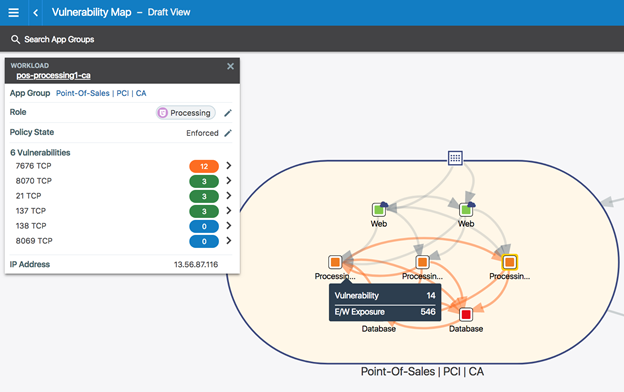
network dependency maps.

“What we’ve now added,” explains Glenn, “is the ability to import vulnerability scans from Qualys. This creates a new capability we call vulnerability maps.” The vulnerability map is color-coded from the Qualys data and overlaid on the app dependency map: green is low and informational; orange is medium risk; and red is critical.

But this doesn’t just show the location of the vulnerabilities — added to the app dependency map it shows the potential ramifications of that vulnerability across the network through open ports and connecting and communicating links, and with the internet. These are the paths that an intruder, having exploited a vulnerability, would seek out for lateral movement through the network.

“What we do,” said Glenn, “is combine the Qualys vulnerability data with our application dependency map to let organizations do something they’ve never been able to do before — which is just literally see the data paths within and between data centers in the way a bad actor does, and show the exposure of the vulnerabilities on the hosts. We think this is a transformational moment because traditionally the vulnerability management team and the application team are two different groups. This new approach allows them to collaborate together to do something they haven’t been able to do before: to see how exposed those vulnerabilities actually are.”

Patching individual vulnerabilities may not be immediately possible — but micro-segmenting the network to isolate the vulnerability as far as possible, is possible. Operators can locate the vulnerability, can see the level of criticality, can see and measure paths open to an attacker (something Illumio calls the ‘East-West’ exposure score), and can automatically impose mitigating micro-segmentation controls that limit exposure without breaking any apps.

“Digital transformation leads to an explosion of connected environments where perimeter protection is no longer enough. The focus now needs to shift from securing network perimeters to safeguarding data spread across applications, systems, devices, and the cloud,” says Philippe Courtot, CEO and Chairman of Qualys. “The new Illumio integration with Qualys helps enterprises get visibility across hybrid environments and implement appropriate controls to protect assets from cyber threats, whether on premises or in the cloud.”

If a company has a high value application with a vulnerability that cannot be patched, but the vulnerability management team knows there is a 0-day exploit in the wild (all information courtesy of Qualys), the question becomes, what can be done? “You can use micro-segmentation,” suggests Glenn, “as a way of creating compensating controls to reduce the exposure of the vulnerability. Arbitrarily blocking vulnerabilities is the pathway to breaking applications. So, we’ve created a very nuanced approach, where we look at the connectivity paths that allow us to reduce the exposure without breaking the applications. 

“We use the connectivity paths to fine-tune a micro-segmentation policy. It can automatically block or constrain applications. Blocking only ever happens automatically if the ven [Illumio’s virtual enforcement nodes, installed on each host] has never seen traffic on the pathway — perhaps a developer left a port open months ago. Constraining, however, can use micro-segmentation to reduce the effect of a vulnerability without breaking the application. The visible map allows the operator to see the effect of any new policy rules that, once written, will be pushed out to effect the micro-segmentation.”

“Vulnerability management is an invaluable tool in every security team’s arsenal. With our Qualys Cloud Platform integration, organizations can see a map of how active, exposed vulnerabilities can potentially be exploited by a bad actor,” adds Andrew Rubin, CEO and co-founder of Illumio. “By adding vulnerability maps to our Adaptive Security Platform, security teams can see potential attack paths in real time and immediately implement micro-segmentation to prevent the spread of breaches.”

Sunnyvale, Ca-based Illumio raised $100 million Series C financing in April 2015, followed by a further $125 million Series D funding in June 2017. 

Related: The Truth About Micro-Segmentation: It’s Not About the Network (Part 1) 

Related: The Truth About Micro-Segmentation (Part 2) 

Related: The Truth About Micro-Segmentation: Healthy Heterogeneity (Part 3)

view counter

Kevin Townsend is a Senior Contributor at SecurityWeek. He has been writing about high tech issues since before the birth of Microsoft. For the last 15 years he has specialized in information security; and has had many thousands of articles published in dozens of different magazines – from The Times and the Financial Times to current and long-gone computer magazines.

Previous Columns by Kevin Townsend:

Tags:

http://feedproxy.google.com/~r/Securityweek/~3/8k7rf1WZ4Dg/illumio-qualys-partner-vulnerability-based-micro-segmentation



Hackers Start Exploiting Drupalgeddon2 Vulnerability

Attempts to exploit a recently patched vulnerability in the Drupal content management system (CMS) were spotted by researchers shortly after someone published a proof-of-concept (PoC) exploit.

In late March, Drupal developers rolled out an update to address CVE-2018-7600, a highly critical remote code execution flaw that can be exploited to take full control of a site. The security hole affects Drupal 6, 7 and 8, and patches have been released for each of the impacted versions – Drupal 6 is no longer supported since February 2016, but a patch has still been created.

Drupalgeddon2

Experts warned at the time that exploitation of the vulnerability, dubbed Drupalgeddon2, was imminent. However, it took roughly two weeks for a proof-of-concept (PoC) exploit to become publicly available.

Researchers at Check Point and Drupal experts at Dofinity worked together to uncover the vulnerability and on Thursday they published a detailed technical analysis.

“In brief, Drupal had insufficient input sanitation on Form API (FAPI) AJAX requests,” they explained in a post on the Check Point blog. “As a result, this enabled an attacker to potentially inject a malicious payload into the internal form structure. This would have caused Drupal to execute it without user authentication. By exploiting this vulnerability an attacker would have been able to carry out a full site takeover of any Drupal customer.”

Shortly after Check Point and Dofinity published their analysis, Vitalii Rudnykh published a PoC on GitHub for “educational or information purposes,” which others confirmed to be functional. Once the PoC was made public, Sucuri and the SANS Internet Storm Center started seeing attempts to exploit Drupalgeddon2.

At the time of writing, there are no reports of websites being hacked via CVE-2018-7600. Attackers are apparently scanning the web in search for vulnerable servers. The payloads spotted by SANS researchers use simple commands such as echo, phpinfo, whoami and touch.

Web security services, including Cloudflare’s Web Application Firewall (WAF), should be able to block attacks exploiting the vulnerability.

“The exploit attempts are currently arriving at a pretty brisk pace,” said ISC handler Kevin Liston. Sucuri founder and CTO Daniel Cid also warned that the number of exploit attempts is expected to grow.

The original Drupalgeddon vulnerability, disclosed in October 2014, was first exploited just 7 hours after a patch was released and it was leveraged by cybercriminals for at least another two years.

Related: Flaw in Drupal Module Exposes 120,000 Sites to Attacks

Related: Several Vulnerabilities Patched in Drupal

view counter

Eduard Kovacs (@EduardKovacs) is a contributing editor at SecurityWeek. He worked as a high school IT teacher for two years before starting a career in journalism as Softpedia’s security news reporter. Eduard holds a bachelor’s degree in industrial informatics and a master’s degree in computer techniques applied in electrical engineering.

Previous Columns by Eduard Kovacs:

Tags:

http://feedproxy.google.com/~r/Securityweek/~3/HXi-IfHSXWs/hackers-start-exploiting-drupalgeddon2-vulnerability


LimeSurvey Flaws Expose Web Servers to Attacks

A couple of vulnerabilities affecting the popular online survey tool LimeSurvey can be exploited by remote attackers to execute malicious code and take control of web servers with little or no user interaction, researchers warn.

LimeSurvey is a free and open source tool that allows users to create online surveys. The software is downloaded roughly 10,000 times every month and is used by individuals and organizations worldwide.

Researchers at RIPS Technologies discovered two potentially serious flaws in LimeSurvey version 2.72.3.

One of the security holes is a persistent cross-site scripting (XSS) issue that affects the “resume later” feature, which allows users to save partially completed surveys and reload them by providing an email address and password.

The email address field was not properly sanitized, allowing an attacker to inject malicious JavaScript code that would get executed when a user visited a specific web page – the attacker can lure a victim to this web page – or when an administrator viewed the partially saved data in the control panel.

The attacker can exploit the vulnerability to perform various actions on behalf of the authenticated user.

The second vulnerability is an arbitrary file write issue that allows an attacker to upload a malicious file by abusing LimeSurvey’s template editor. Exploiting this flaw requires authentication, but that can be achieved using the XSS bug.

According to RIPS researchers, the vulnerabilities can be chained into a single payload that gives the attacker control over the targeted web server.

“The vulnerability chaining […] yields a single final exploit which would add malicious JavaScript code to the admin panel through the Continue Later functionality of a public survey,” explained RIPS researcher Robin Peraglie. “As soon as the JavaScript payload is executed in the administrator context it can exploit the arbitrary file write vulnerability to give the adversary persistent shell access to the operating system remotely to maximize impact.”

LimeSurvey developers patched the vulnerabilities in November 2017 with the release of version 2.72.4, just two days after the issues were reported. However, RIPS has advised users to update LimeSurvey to the latest release of version 3.

Related: Over 8,800 WordPress Plugins Have Flaws

Related: Joomla Login Page Flaw Exposes Admin Credentials

view counter

Eduard Kovacs (@EduardKovacs) is a contributing editor at SecurityWeek. He worked as a high school IT teacher for two years before starting a career in journalism as Softpedia’s security news reporter. Eduard holds a bachelor’s degree in industrial informatics and a master’s degree in computer techniques applied in electrical engineering.

Previous Columns by Eduard Kovacs:

Tags:

http://feedproxy.google.com/~r/Securityweek/~3/cXuzi5ivI5Y/limesurvey-flaws-expose-web-servers-attacks


AMD, Microsoft Release Spectre Patches

AMD and Microsoft on Tuesday released microcode and operating system updates that should protect users against Spectre attacks.

When the existence of the Spectre and Meltdown vulnerabilities was brought to light, AMD downplayed their impact on its processors, but the company did promise to release microcode updates and add protections against these types of attacks to its future CPUs.

Meltdown attacks rely on a vulnerability identified as CVE-2017-5754, while Spectre attacks are possible due to CVE-2017-5753 (Variant 1) and CVE-2017-5715 (Variant 2). In the case of AMD, the company’s processors are not affected by Meltdown thanks to their design, and Spectre Variant 1 can be addressed with software patches – just like in the case of Intel processors.AMD releases microcode updates to patch Spectre

Mitigating Spectre Variant 2 attacks requires a combination of microcode and operating system updates, which AMD and Microsoft released on Tuesday.

“While we believe it is difficult to exploit Variant 2 on AMD processors, we actively worked with our customers and partners to deploy the above described combination of operating system patches and microcode updates for AMD processors to further mitigate the risk,” said Mark Papermaster, senior vice president and chief technology officer at AMD.

Microcode updates, which users can obtain from device manufacturers via BIOS updates, have been developed for AMD processors dating back to the first Bulldozer core products launched in 2011. The chip giant has published a document detailing the indirect branch control feature designed to mitigate indirect branch target injection attacks such as Spectre Variant 2.

Windows 10 updates released by Microsoft on Tuesday include Spectre Variant 2 mitigations for AMD devices. The patches are also expected to become available for Windows Server 2016 after they are validated and tested.

Microsoft started releasing Spectre patches for devices with AMD processors shortly after the CPU vulnerabilities were disclosed in early January. However, the company was forced to temporarily suspend the updates due to instability issues.

As for Linux devices, AMD said mitigations for Spectre Variant 2 were made available earlier this year.

While AMD processors appear to be less impacted compared to Intel products, lawsuits have still been filed against the company over the Spectre vulnerabilities.

Related: Intel Shares Details on New CPUs With Spectre, Meltdown Protections

Related: AMD Chip Flaws Confirmed by More Researchers

Related: Intel Will Not Patch Spectre in Some CPUs

view counter

Eduard Kovacs (@EduardKovacs) is a contributing editor at SecurityWeek. He worked as a high school IT teacher for two years before starting a career in journalism as Softpedia’s security news reporter. Eduard holds a bachelor’s degree in industrial informatics and a master’s degree in computer techniques applied in electrical engineering.

Previous Columns by Eduard Kovacs:

Tags:

http://feedproxy.google.com/~r/Securityweek/~3/wcYTiG6VSBY/amd-microsoft-release-spectre-patches


Microsoft Patches Two Dozen Critical Flaws in Windows, Browsers

Microsoft’s Patch Tuesday updates for April 2018 resolve a total of 66 vulnerabilities, including nearly two dozen critical issues affecting Windows and the company’s web browsers.

None of the flaws patched this month appear to have been exploited in the wild, but one privilege escalation vulnerability discovered by a Microsoft researcher in SharePoint has been disclosed to the public.

A majority of the critical flaws affecting Internet Explorer and Edge are related to scripting engines and they allow remote code execution.

A remote code execution flaw affecting the VBScript engine has also been rated critical. The security hole can be exploited via malicious websites or documents. Trend Micro’s Zero Day Initiative (ZDI) noted that while this is similar to browser bugs, the attack surface is broader due to the possibility of exploitation using Office documents.

Several critical vulnerabilities that allow remote code execution have also been found in graphics components, specifically font libraries and how they handle embedded fonts.

“Since there are many ways to view fonts – web browsing, documents, attachments – it’s a broad attack surface and attractive to attackers. Given the history of malicious fonts, these patches should be high on your test and deployment list. This is also a good time to remind you to not do day-to-day tasks as an administrator,” ZDI’s Dustin Childs explained in a blog post.

Microsoft also informed customers that its Wireless Keyboard 850 is affected by a security feature bypass vulnerability that can be exploited to simulate keystrokes and send malicious commands to the targeted computer. An attacker could also exploit this flaw to read keystrokes, which can include sensitive information, such as passwords.

“[The vulnerability] could allow an attacker to reuse an AES encryption key to send keystrokes to other keyboard devices or to read keystrokes sent by other keyboards for the affected devices. An attacker would first have to extract the AES encryption key from the affected keyboard device. The attacker would also need to maintain physical proximity – within wireless range – of the devices for the duration of the attack,” Microsoft said.

Adobe’s Patch Tuesday updates address a total of 19 vulnerabilities across six products. Six flaws have been fixed in Flash Player, which Microsoft also resolved in Windows.

Earlier this month, Microsoft announced the release of an update for its Malware Protection Engine to patch a critical vulnerability that could have been exploited to take control of a system by placing a malicious file in a location where it would be scanned.

Related: Microsoft Patches for Meltdown Introduced Severe Flaw

Related: Microsoft Releases More Patches for Meltdown, Spectre

Related: Microsoft Patches for CPU Flaws Break Windows, Apps

view counter

Eduard Kovacs (@EduardKovacs) is a contributing editor at SecurityWeek. He worked as a high school IT teacher for two years before starting a career in journalism as Softpedia’s security news reporter. Eduard holds a bachelor’s degree in industrial informatics and a master’s degree in computer techniques applied in electrical engineering.

Previous Columns by Eduard Kovacs:

Tags:

http://feedproxy.google.com/~r/Securityweek/~3/Lj3GrFiQtjM/microsoft-patches-two-dozen-critical-flaws-windows-browsers