Adobe Patches Vulnerabilities in Six Products

Adobe has patched a total of 19 vulnerabilities across six of its products, including Flash Player, Experience Manager, InDesign CC, Digital Editions, ColdFusion and the PhoneGap Push plugin.

A total of six flaws rated critical and important have been fixed in Flash Player with the release of version 29.0.0.140, including use-after-free, out-of-bounds read, out-of-bounds write and heap overflow bugs that can lead to remote code execution and information disclosure.

Four of the vulnerabilities have been reported to Adobe by researchers at Google Project Zero. While some of the issues have been rated critical, Adobe says there is no evidence of malicious exploitation and the company does not believe exploits are imminent.

The number of vulnerabilities fixed in Flash Player has dropped significantly since Adobe announced its intention to kill the application in 2020. However, malicious actors have not given up trying to find security holes they can exploit. In February, Adobe issued an emergency update to address a zero-day used by North Korean hackers.

The April Patch Tuesday updates from Adobe also cover Experience Manager, in which the company patched three moderate and important cross-site scripting (XSS) flaws.

An update has also been released for Adobe InDesign CC to fix a critical memory corruption that allows arbitrary code execution via specially crafted .inx files, and an untrusted search path issue in the installer that can lead to privilege escalation.

The latest version of Adobe Digital Editions resolves an out-of-bounds read vulnerability and a stack overflow, both of which can result in disclosure of information.

ColdFusion version 11 and the 2016 release have also received security updates. A total of five flaws have been patched, including local privilege escalation, remote code execution and information disclosure issues.

Finally, the Adobe PhoneGap Push plugin has been updated to address a same-origin method execution bug that exposes apps built with the affected plugin to JavaScript code execution.

Related: Adobe Patches 39 Vulnerabilities in Acrobat and Reader

Related: Adobe Patches Critical Code Execution Flaws in Dreamweaver, Flash

view counter

Eduard Kovacs (@EduardKovacs) is a contributing editor at SecurityWeek. He worked as a high school IT teacher for two years before starting a career in journalism as Softpedia’s security news reporter. Eduard holds a bachelor’s degree in industrial informatics and a master’s degree in computer techniques applied in electrical engineering.

Previous Columns by Eduard Kovacs:

Tags:

http://feedproxy.google.com/~r/Securityweek/~3/E0m33iG5EmI/adobe-patches-vulnerabilities-six-products


Facebook to Offer ‘Bounty’ for Reporting Data Abuse

Facebook said Tuesday it would begin offering rewards to people who report misuse of private information from the social network, as part of an effort to step up data protection in the wake of a firestorm.

The new program “will reward people with first-hand knowledge and proof of cases where a Facebook platform app collects and transfers people’s data to another party to be sold, stolen or used for scams or political influence,” product security chief Collin Greene said in a statement.

Greene said the new offer was inspired by the “bug bounty” offered by Facebook and other online services to reward people who find security flaws.

The reward will be “based on the impact of each report,” Greene said, with a minimum of $500 for verified cases of abuse affecting 10,000 people or more.

“While there is no maximum, high impact bug reports have garnered as much as $40,000 for people who bring them to our attention,” he added.

The announcement comes with Facebook chief Mark Zuckerberg set to begin testimony at congressional hearings Tuesday and Wednesday on abuse of private data collected by the social network.

RelatedWould Facebook and Cambridge Analytica be in Breach of GDPR?

Facebook is under fire in the United States and around the world following disclosures of private data hijacked by the consultancy Cambridge Analytica, which was working for Donald Trump’s 2016 campaign.

“We’ll review all legitimate reports and respond as quickly as possible when we identify a credible threat to people’s information,” Greene said of the new program.

“If we confirm data abuse, we will shut down the offending app and take legal action against the company selling or buying the data, if necessary. We’ll pay the person who reported the issue, and we’ll also alert those we believe to be affected.”

view counter

© AFP 2018

Previous Columns by AFP:

Tags:

http://feedproxy.google.com/~r/Securityweek/~3/JtEE9Kh34bM/facebook-offer-bounty-reporting-data-abuse


SirenJack: Hackers Can Remotely Trigger Warning Sirens

Sirenjack attack targets sirens

Researchers at Bastille, a company that specializes in detecting threats through software-defined radio, have uncovered a new method that can be used to remotely hack emergency warning systems.

Sirens are used worldwide to alert the public of natural disasters, man-made disasters, and emergency situations, including tornadoes, hurricanes, floods, volcanic eruptions, nuclear accidents, chemical spills, and terrorist attacks. False alarms can cause widespread panic and annoyance.

Researchers say they have discovered a new attack method that allows hackers to remotely trigger sirens. This type of attack, dubbed SirenJack, is possible due to a vulnerability found in emergency alert systems made by ATI Systems, a company whose products are used by major cities, universities, military facilities, and industrial sites.

According to Bastille, the vulnerability, related to the use of insecure radio protocol controls, was initially found in the system used by the city of San Francisco and later confirmed at a second installation.

Bastille researcher Balint Seeber started analyzing the city’s outdoor public warning system in 2016 after noticing that it had been using RF communications. An analysis of the system showed that commands were sent without being encrypted, allowing a malicious actor to forge commands.

Attackers need to identify the radio frequency used by the targeted siren and send the system a specially crafted message that triggers an alarm.Sirenjack

“A single warning siren false alarm has the potential to cause widespread panic and endanger lives,” said Chris Risley, CEO of Bastille Networks. “Bastille informed ATI and San Francisco of the vulnerability 90 days ago, to give them time to put a patch in place. We’re now disclosing SirenJack publicly to allow ATI Systems’ users to determine if their system has the SirenJack vulnerability. We also hope that other siren vendors investigate their own systems to patch and fix this type of vulnerability.”

ATI Systems has been made aware of the vulnerability and it has created a patch that adds an additional layer of security to the packets sent over the radio. The company says the patch is being tested and will be made available shortly, but noted that installing it is not an easy task considering that many of its products are designed for each customer’s specific needs.

While Bastille has made it sound like an attack is easy to launch due to the unencrypted protocol, ATI Systems told customers not to panic, pointing out that the cybersecurity firm monitored its product for months before figuring out how to launch an attack.

ATI noted that its current products no longer use the old control protocols that often allowed malicious actors and pranksters to trigger false alarms. However, the company admitted that the system used in San Francisco was installed 14 years ago and acquiring a highly secure system, such as the ones used on military bases, can be too expensive for a city.

This is not the only interesting wireless attack method discovered by researchers at Bastille. The company has also targeted home networks (CableTap), wireless keyboards (KeySniffer), and mouse/keyboard dongles (MouseJack).

Related: Hackers Can Disrupt 911 Services With Small Smartphone Botnet

Related: Teen Arrested for Cyberattack on 911 Emergency System

Related: New Global Initiative Aims at Securing Smart Cities

view counter

Eduard Kovacs (@EduardKovacs) is a contributing editor at SecurityWeek. He worked as a high school IT teacher for two years before starting a career in journalism as Softpedia’s security news reporter. Eduard holds a bachelor’s degree in industrial informatics and a master’s degree in computer techniques applied in electrical engineering.

Previous Columns by Eduard Kovacs:

Tags:

http://feedproxy.google.com/~r/Securityweek/~3/uYqicAXKHOg/sirenjack-hackers-can-remotely-trigger-warning-sirens


Schneider Electric Patches 16 Flaws in Building Automation Software

Schneider Electric informed customers last week that the latest version of its U.motion Builder software patches a total of 16 vulnerabilities, including ones rated critical and high severity.

U.motion is a building automation solution used around the world in the commercial facilities, critical manufacturing and energy sectors. U.motion Builder is a tool that allows users to create projects for their U.motion devices.

Researchers discovered that the Builder software is affected by 16 vulnerabilities, including path traversals and other bugs that can lead to information disclosure, and remote code execution flaws via SQL injection.

A majority of the security holes have been classified as medium severity, but some of them are more serious based on their CVSS score.

The most severe, with a CVSS score of 10, actually impacts the Samba software suite. The flaw allows remote code execution and it has been dubbed “SambaCry” by some members of the industry due to similarities to the WannaCry attack. The vulnerability, tracked as CVE-2017-7494, has been found to impact devices from several major vendors, including Cisco, Netgear, QNAP, Synology, Veritas, Sophos and F5 Networks.

Another serious vulnerability in U.motion Builder, identified as CVE-2018-7777, allows an authenticated attacker to remotely execute arbitrary code by sending specially crafted requests to the targeted server. One of the SQL injection flaws, CVE-2018-7765, has also been classified as high severity.

Learn More at SecurityWeek’s ICS Cyber Security Conference

Most of these weaknesses were reported to Schneider by researcher Andrea Micalizzi, also known as “rgod,” and one was disclosed to the company by Constantin-Cosmin Craciun.

The issues affect U.motion Builder versions prior to 1.3.4, which Schneider released in early February. In addition to providing patches, the company has shared some recommendations for mitigating potential attacks.

This is not the first time Micalizzi has been credited for finding vulnerabilities in U.motion Builder. Last year, ICS-CERT reported that the researcher had found half a dozen types of flaws in this software. Those issues were disclosed in late June 2017 before patches were made available by Schneider as they were reported to the vendor via Trend Micro’s Zero Day Initiative (ZDI) more than one year earlier.

Related: Schneider Electric Patches Flaws in Pelco Video Management System

Related: Schneider Electric Patches Several Flaws in IGSS Products

view counter

Eduard Kovacs (@EduardKovacs) is a contributing editor at SecurityWeek. He worked as a high school IT teacher for two years before starting a career in journalism as Softpedia’s security news reporter. Eduard holds a bachelor’s degree in industrial informatics and a master’s degree in computer techniques applied in electrical engineering.

Previous Columns by Eduard Kovacs:

Tags:

http://feedproxy.google.com/~r/Securityweek/~3/AUJdJXCSzcc/schneider-electric-patches-16-flaws-building-automation-software


Vulnerabilities Found in Linux ‘Beep’ Tool

Several vulnerabilities have been found in the Linux command line tool Beep, including a potentially serious issue introduced by a patch for a privilege escalation flaw.

For well over a decade, Beep has been used by developers on Linux to get a computer’s internal speaker to produce a beep. What makes Beep useful for certain programs is the fact that it allows users to control the pitch, duration and repetitions of the sound. The open source application has not received any updates since 2013.

An unnamed researcher discovered recently that Beep versions through 1.3.4 are affected by a race condition that allows a local attacker to escalate privileges to root.

The security hole has been assigned CVE-2018-0492 and it has been sarcastically described as “the latest breakthrough in the field of acoustic cyber security research.” Someone created a dedicated website for it (holeybeep.ninja), a logo, and named it “Holey Beep.”

The individual or individuals who set up the Holey Beep website have also provided a patch, but someone noticed that this fix actually introduces a potentially more serious vulnerability that allows arbitrary command execution.

“The patch vulnerability seems more severe to me, as people apply patches all the time (they shouldn’t do it as root, but people are people),” Tony Hoyle explained in a post on the Debian bug tracker. “It’s concerning that the holeybeep.ninja site exploited an unrelated fault for ‘fun’ without apparently telling anyone.”

Furthermore, reports of other security issues affecting Beep emerged over the weekend, along with claims that the fix is incomplete. Beep is also said to be affected by some integer overflow bugs, and a vulnerability that can be exploited to obtain information about files on a system and conduct unauthorized activities.

“I question whether beep should be saved. It would require someone carefully reviewing the code and effectively become the new upstream. And all that for a tool talking to the PC speaker, which doesn’t exist in most modern systems anyway,” said German researcher and journalist Hanno Böck. “Instead distros should consider not installing it as suid or just killing the package altogether. I heard some distros (suse) replace beep with a simple ‘printf ‘\a’ which seems also a safe solution. (although it obviously kills all frequency/length/etc features of original ‘beep’).”

Related: Many Vulnerabilities Found in Linux USB Subsystem

Related: Two-Year Old Vulnerability Patched in Linux Kernel

Related: Google Researcher Details Linux Kernel Exploit

view counter

Eduard Kovacs (@EduardKovacs) is a contributing editor at SecurityWeek. He worked as a high school IT teacher for two years before starting a career in journalism as Softpedia’s security news reporter. Eduard holds a bachelor’s degree in industrial informatics and a master’s degree in computer techniques applied in electrical engineering.

Previous Columns by Eduard Kovacs:

Tags:

http://feedproxy.google.com/~r/Securityweek/~3/clleQp4wijA/vulnerabilities-found-linux-beep-tool


Cisco Switches in Iran, Russia Hacked in Apparent Pro-US Attack

A significant number of Cisco switches located in Iran and Russia have been hijacked in what appears to be a hacktivist campaign conducted in protest of election-related hacking. However, it’s uncertain if the attacks involve a recently disclosed vulnerability or simply abuse a method that has been known for more than a year.

Cisco devices belonging to organizations in Russia and Iran have been hijacked via their Smart Install feature. The compromised switches had their IOS image rewritten and their configuration changed to display a U.S. flag using ASCII art and the message “Don’t mess with our elections…”

The hackers, calling themselves “JHT,” told Motherboard that they wanted to send a message to government-backed hackers targeting “the United States and other countries.” They claim to have only caused damage to devices in Iran and Russia, while allegedly patching most devices found in countries such as the U.S. and U.K.

Iran’s Communication and Information Technology Ministry stated that the attack had impacted roughly 3,500 switches in the country, but said a vast majority were quickly restored.

Cisco switch hacked via Smart Install

Kaspersky Lab reported that the attack appeared to mostly target the “Russian-speaking segment of the Internet.”

While there are some reports that the attack involves a recently patched remote code execution vulnerability in Cisco’s IOS operating system (CVE-2018-0171), that might not necessarily be the case.

The Cisco Smart Install Client is a legacy utility that allows no-touch installation of new Cisco switches. Roughly one year ago, the company warned customers about misuse of the Smart Install protocol following a spike in Internet scans attempting to detect unprotected devices that had this feature enabled.

Attacks, including ones launched by nation-state threat actors such as the Russia-linked Dragonfly, abused the fact that many organizations had failed to securely configure their switches, rather than an actual vulnerability.

Cisco issued a new warning last week as the disclosure of CVE-2018-0171 increases the risk of attacks, but the networking giant said it had not actually seen any attempts to exploit this vulnerability in the wild. Cisco’s advisory for this flaw still says there is no evidence of malicious exploitation.

There are hundreds of thousands of Cisco switches that can be hijacked by abusing the Smart Install protocol, and Cisco Talos experts believe attackers are unlikely to bother using CVE-2018-0171.

Cisco expert on CVE-2018-0171 exploitation

The Network Security Research Lab at Chinese security firm Qihoo 360 says the data from its honeypot shows that the attacks have “nothing to do with CVE-2018-0171” and instead rely on a publicly available Smart Install exploitation tool released several months ago.

While none of the major players in the infosec industry have confirmed that the attacks on Iran and Russia rely on CVE-2018-0171, technical details and proof-of-concept (PoC) code have been made available by researchers, making it easier for hackers to exploit.

Hamed Khoramyar, founder of Sweden-based ICT firm Aivivid, said the attacks exploited CVE-2018-0171. Kudelski Security also reported seeing attacks involving both CVE-2018-0171 and another recently disclosed IOS vulnerability tracked as CVE-2018-0156. However, Kudelski’s blog post also lists Khoramyar as one of its sources.

view counter

Eduard Kovacs (@EduardKovacs) is a contributing editor at SecurityWeek. He worked as a high school IT teacher for two years before starting a career in journalism as Softpedia’s security news reporter. Eduard holds a bachelor’s degree in industrial informatics and a master’s degree in computer techniques applied in electrical engineering.

Previous Columns by Eduard Kovacs:

Tags:

http://feedproxy.google.com/~r/Securityweek/~3/dUM-IaqFH4w/cisco-switches-iran-russia-hacked-apparent-pro-us-attack


Critical Flaws Expose Natus Medical Devices to Remote Attacks

Researchers at Cisco Talos have identified several critical vulnerabilities that expose Natus medical devices to remote hacker attacks. The vendor has released firmware updates that patch the flaws.

The vulnerabilities allow remote code execution and denial-of-service (DoS) attacks and they impact the Natus NeuroWorks software, which is used by the company’s Xltek electroencephalography (EEG) equipment to monitor and review data over the network.

According to Cisco, an attacker with access to the targeted network can remotely execute arbitrary code on the device or cause a service to crash by sending specially crafted packets. An attack does not require authentication.

“Vulnerable systems are searched for by attackers as points of ingress and persistence within computer networks. A vulnerable system can be compromised by threat actors, used to conduct reconnaissance on the network, and as a platform from which further attacks can be launched,” Talos warned.

Remote code execution on vulnerable Natus devices is possible due to four different functions that can cause a buffer overflow. All of the code execution flaws have been rated “critical” with CVSS scores of 9 or 10. The DoS vulnerability, rated “high severity,” is caused by an out-of-bounds read issue.

Cisco said it reported the vulnerabilities to Natus in July 2017, but the bugs were only confirmed in October. The flaws have been tested on Natus Xltek NeuroWorks 8 and they have been patched with the release of NeuroWorks 8.5 GMA2.

Healthcare facilities that use the affected products have been advised to install the update as soon as possible. The risk of attacks involving these vulnerabilities is relatively high considering that the devices are widely deployed – Natus was recently reported to have a 60 percent share in the global neurodiagnostic market. Furthermore, Cisco has made available technical information for each of the vulnerabilities.

The healthcare industry has been increasingly targeted by malicious actors, including in attacks involving ransomware and theft of sensitive information. The infosec community and authorities have issued numerous warnings, and recent reports show that there are plenty of healthcare product vulnerabilities that hackers could exploit in their operations.

Related: Healthcare’s Unique Cyber Risk Management Challenges

Related: Why Healthcare Security Matters

Related: “Philadelphia” Ransomware Targets Healthcare Industry

view counter

Eduard Kovacs (@EduardKovacs) is a contributing editor at SecurityWeek. He worked as a high school IT teacher for two years before starting a career in journalism as Softpedia’s security news reporter. Eduard holds a bachelor’s degree in industrial informatics and a master’s degree in computer techniques applied in electrical engineering.

Previous Columns by Eduard Kovacs:

Tags:

http://feedproxy.google.com/~r/Securityweek/~3/oBogsuzoNgA/critical-flaws-expose-natus-medical-devices-remote-attacks


Unprotected Switches Expose Critical Infrastructure to Attacks: Cisco

Cisco has advised organizations to ensure that their switches cannot be hacked via the Smart Install protocol. The networking giant has identified hundreds of thousands of exposed devices and warned that critical infrastructure could be at risk.

The Cisco Smart Install Client is a legacy utility that allows no-touch installation of new Cisco switches. Roughly one year ago, the company warned customers about misuse of the Smart Install protocol following a spike in Internet scans attempting to detect unprotected devices that had this feature enabled. It also made available an open source tool for identifying devices that use the protocol.

Attackers can abuse the Smart Install protocol to modify the configuration file on switches running IOS and IOS XE software, force the device to reload, load a new IOS image, and execute high-privilege commands. These attacks rely on the fact that many organizations fail to securely configure their switches, rather than an actual vulnerability.

According to Cisco, sophisticated nation-state groups have also abused Smart Install in their campaigns, including the Russia-linked threat actor tracked as Dragonfly, Crouching Yeti and Energetic Bear, which has been known to target critical infrastructure.

Cisco has decided to once again warn organizations of the risks associated with Smart Install following the disclosure of a critical vulnerability discovered recently by researchers at Embedi.

The flaw, tracked as CVE-2018-0171, allows a remote and unauthenticated attacker to cause a denial-of-service (DoS) condition or execute arbitrary code by sending specially crafted Smart Install messages to an affected device on TCP port 4786. Researchers said they had identified roughly 250,000 vulnerable Cisco devices with TCP port 4786 open.

Cisco’s own Internet scans revealed 168,000 systems potentially exposed due to their use of the Cisco Smart Install Client. The company says the number of impacted devices has decreased considerably since 2016, when security firm Tenable identified more than 250,000 exposed systems.

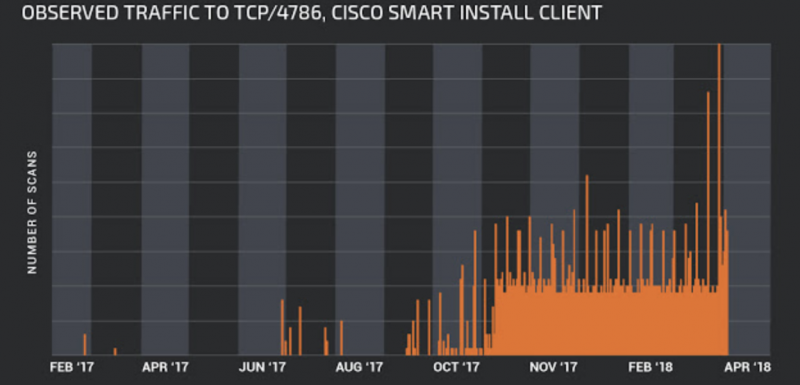
Throughout the end of 2017 and early 2018, Cisco’s Talos group noticed attackers increasingly looking for misconfigured clients. Now that CVE-2018-0171 has been found, the risk of attacks has increased even more, especially since Embedi has released technical details and proof-of-concept (PoC) code.

There is no evidence that CVE-2018-0171 has been exploited in malicious attacks. Cisco also noted that much of the activity it has seen is likely not malicious, but the company says the sharp increase in scanning is noteworthy.

Cisco Smart Install scanning

The vendor has provided recommendations for preventing potential attacks and advised customers to remove the Smart Install Client from devices where it’s not needed. Smart Install is enabled by default on switches that have not received a recent update that automatically disables the feature when it’s not in use.

While it’s unclear if Smart Install was involved, Cylance reported recently that the Dragonfly cyberespionage group had hijacked a core Cisco router at a major state-owned energy conglomerate in Vietnam and abused it to obtain credentials that were later leveraged in attacks targeting energy companies in the United Kingdom.

Related: US Accuses Russian Government of Hacking Infrastructure

Related: DHS, FBI Warn of Ongoing APT Attack Against Critical Infrastructure

view counter

Eduard Kovacs (@EduardKovacs) is a contributing editor at SecurityWeek. He worked as a high school IT teacher for two years before starting a career in journalism as Softpedia’s security news reporter. Eduard holds a bachelor’s degree in industrial informatics and a master’s degree in computer techniques applied in electrical engineering.

Previous Columns by Eduard Kovacs:

Tags:

http://feedproxy.google.com/~r/Securityweek/~3/JIi2vCOXnz0/unprotected-switches-expose-critical-infrastructure-attacks-cisco


Intel Discontinues Keyboard App Affected by Critical Flaws

Serious vulnerabilities have been found in Intel’s Remote Keyboard application, but the company will not release any patches and instead advised users to uninstall the app.

Introduced in June 2015, the Intel Remote Keyboard apps for Android and iOS allow users to wirelessly control their Intel NUC and Compute Stick devices from a smartphone or tablet. The Android application has been installed more than 500,000 times.

Researchers discovered recently that all versions of Intel Remote Keyboard are affected by three severe privilege escalation flaws.

The most serious of them, rated “critical” and identified as CVE-2018-3641, allows a network attacker to inject keystrokes as a local user. The vulnerability was reported to Intel by a UK-based researcher who uses the online moniker trotmaster.

Another vulnerability, tracked as CVE-2018-3645 and rated “high severity,” was reported to Intel by Mark Barnes. The researcher discovered that Intel Remote Keyboard is affected by a privilege escalation flaw that allows a local attacker to inject keystrokes into another keyboard session.

The third security hole is CVE-2018-3638, which allows an authenticated, local attacker to execute arbitrary code with elevated privileges. Intel has credited Marius Gabriel Mihai for finding this vulnerability.

Intel does not plan on releasing patches for these vulnerabilities. The company has decided to discontinue the product and advised users to uninstall the apps at their earliest convenience. Intel Remote Keyboard has been removed from both Google Play and the Apple App Store.

Intel also published a security advisory this week to warn customers of an important denial-of-service (DoS) vulnerability affecting the SPI Flash component in multiple processors. The flaw was discovered by Intel itself and mitigations are available.

The company also informed users of a privilege escalation flaw in 2G modems, including XMM71xx, XMM72xx, XMM73xx, XMM74xx, Sofia 3G, Sofia 3G-R, and Sofia 3G-RW. The issue impacts devices that have the Earthquake Tsunami Warning System (ETWS) feature enabled.

A network attacker can exploit the vulnerability to execute arbitrary code. “Devices equipped with an affected modem, when connected to a rogue 2G base station where non-compliant 3GPP software may be operational, are potentially at risk,” Intel said.

Related: Intel Will Not Patch Spectre in Some CPUs

Related: Intel Offers $250,000 for Side-Channel Exploits

Related: SSL Flaw in Intel Crosswalk Exposes Apps to MitM Attacks

view counter

Eduard Kovacs (@EduardKovacs) is a contributing editor at SecurityWeek. He worked as a high school IT teacher for two years before starting a career in journalism as Softpedia’s security news reporter. Eduard holds a bachelor’s degree in industrial informatics and a master’s degree in computer techniques applied in electrical engineering.

Previous Columns by Eduard Kovacs:

Tags:

http://feedproxy.google.com/~r/Securityweek/~3/StIpAJeLaOI/intel-discontinues-keyboard-app-affected-critical-flaws


Critical Vulnerability Patched in Microsoft Malware Protection Engine

An update released this week by Microsoft for its Malware Protection Engine patches a vulnerability that can be exploited to take control of a system by placing a malicious file in a location where it would be scanned.

The Microsoft Malware Protection Engine provides scanning, detection and cleaning capabilities for security software made by the company. The engine is affected by a flaw that can be exploited for remote code execution when a specially crafted file is scanned.

The malicious file can be delivered via a website, email or instant messenger. The Malware Protection Engine will automatically scan the file (if real-time protection is enabled) and allow the attacker to execute arbitrary code in the context of the LocalSystem account, which can lead to a complete takeover of the targeted system.

On systems where real-time scanning is not enabled, the exploit will still get triggered, but only when a scheduled scan is initiated.

The vulnerability, tracked as CVE-2018-0986 and rated “critical,” affects several Microsoft products that use the Malware Protection Engine, including Exchange Server, Forefront Endpoint Protection 2010, Security Essentials, Windows Defender, and Windows Intune Endpoint Protection.

While the flaw is dangerous and easy to exploit, Microsoft believes exploitation is “less likely.” The company pointed out that the patch for this vulnerability will be automatically delivered to customers within 48 hours of release – users and administrators do not have to take any action.

Google Project Zero researcher Thomas Dullien, aka “Halvar Flake,” has been credited for finding CVE-2018-0986. The details of the vulnerability have yet to be disclosed, but considering that the patch is being delivered automatically to most systems, the information will likely become available soon.

This is not the first time Google Project Zero researchers have discovered critical vulnerabilities in Microsoft’s Malware Protection Engine. While Google may occasionally disclose flaws in Microsoft products before patches become available, in the case of the Malware Protection Engine, Microsoft typically releases patches within a few days or weeks.

A similar flaw in the Malware Protection Engine was also found recently by employees of UK’s National Cyber Security Centre (NCSC).

Related: Microsoft Releases More Patches for Meltdown, Spectre

Related: Microsoft Patches for Meltdown Introduced Severe Flaw

Related: Microsoft Patches 50 Flaws in Windows, Office, Browsers

view counter

Eduard Kovacs (@EduardKovacs) is a contributing editor at SecurityWeek. He worked as a high school IT teacher for two years before starting a career in journalism as Softpedia’s security news reporter. Eduard holds a bachelor’s degree in industrial informatics and a master’s degree in computer techniques applied in electrical engineering.

Previous Columns by Eduard Kovacs:

Tags:

http://feedproxy.google.com/~r/Securityweek/~3/euIzaFzYPfw/critical-vulnerability-patched-microsoft-malware-protection-engine