IoT Security Firm Red Balloon Raises $22 Million

Red Balloon Security, a provider of embedded device security solutions, announced on Wednesday that it has secured $21.9 million through a Series A funding round led by Bain Capital Ventures.

This latest round of funding brings the company’s total funding to $23.5 million.

The company’s flagship Symbiote Defense technology helps customers to detect and defend against emerging threats targeting embedded devices. The technology behind Symbiote was originally developed within Columbia University’s Intrusion Detection Systems Lab, with support of the Defense Advanced Research Projects Agency (DARPA) and the Department of Homeland Security Science and Technology Directorate (DHS S&T). 

Symbiote, Red Balloon explains, “defends devices without requiring changes to source code or hardware design, all without impacting the functionality or performance of the device,” adding that the solution has “demonstrated the ability to defend against both n-day and zero-day attacks on embedded devices, even if the attacker has succeeded in bypassing traditional cybersecurity measures.”

Red Balloon claims that Symbiote technology has operated for more than 15 billion continuous hours without a single failure, protecting millions of endpoints around the world. 

“Symbiote Defense is a critically important technology for today’s businesses because it is able to prevent malware and other cyber attacks from hijacking, disrupting or corrupting any embedded device,” said Ang Cui, PhD, founder and CEO of Red Balloon Security. “This technology has considerable commercial potential because it is highly effective within any type of embedded device environment, from consumer electronics to factories, connected cars and even power plants. Thanks to the strong support of our investors, we will now be able to make this advanced technology more widely available to commercial users across all major industries.”

Greycroft, American Family Ventures and Abstract Ventures also participated in the funding round.

Related: Mocana Receives Strategic Investment from GE Ventures

view counter

For more than 10 years, Mike Lennon has been closely monitoring the threat landscape and analyzing trends in the National Security and enterprise cybersecurity space. In his role at SecurityWeek, he oversees the editorial direction of the publication and is the Director of several leading security industry conferences around the world.

Previous Columns by Mike Lennon:

Tags:

http://feedproxy.google.com/~r/Securityweek/~3/zYuJAqc7JL8/iot-security-firm-red-balloon-raises-22-million


New Bill in Georgia Could Criminalize Security Research

A new bill passed by the Georgia State Senate last week deems all forms of unauthorized computer access as illegal, thus potentially criminalizing the finding and reporting of security vulnerabilities.

The new bill, which met fierce opposition from the cybersecurity community ever since it first became public, amends the Georgia code that originally considered only unauthorized computer access with malicious intent to be a crime.

“Any person who intentionally accesses a computer or computer network with knowledge that such access is without authority shall be guilty of the crime of unauthorized computer access,” the bill reads (Senate Bill 315).

“Any person convicted of computer password disclosure or unauthorized computer access shall be fined not more than $5,000.00 or incarcerated for a period not to exceed one year, or both punished for a misdemeanor of a high and aggravated nature,” the bill continues.

The original code only made a crime out of the access of a computer or computer network without authority and with the intention of tampering with applications or data; interfering with the use of a computer program or data; or causing the malfunction of the computer, network, or application.

The main issue with the bill is that it does little to protect security researchers who find and responsibly disclose vulnerabilities.

In fact, it is possible that the new bill was created because a security researcher discovered a vulnerability in the Kennesaw State University election systems last year. The flaw was reported ethically and the researcher came clean after being investigated by the FBI.

However, the breach made it to the news and, because the state felt very embarrassed by the incident, the attorney general’s office apparently asked for law that would criminalize so-called “poking around.”

“Basically, if you’re looking for vulnerabilities in a non-destructive way, even if you’re ethically reporting them—especially if you’re ethically reporting them—suddenly you’re a criminal if this bill passes into law,” Scott M. Jones from Electronic Frontiers Georgia pointed out.

The Electronic Frontier Foundation has already called upon Georgia Gov. Nathan Deal to veto the bill as soon as possible. The foundation also points out that S.B. 315 doesn’t ensure that security researchers aren’t targeted by overzealous prosecutors for finding vulnerabilities in networks or computer programs.

EFF also points out that, while Georgia has been a hub for cybersecurity research until now, that it all might change with the adoption of the new bill. Cyber-security firms and other tech companies might no longer find Georgia welcoming and could consider relocating to states that are less hostile to security research.

“S.B. 315 is a dangerous bill with ramifications far beyond what the legislature imagined, including discouraging researchers from coming forward with vulnerabilities they discover in critical systems. It’s time for Governor Deal to step in and listen to the cybersecurity experts who keep our data safe, rather than lawmakers looking to score political points,” EFF notes.

The infosec community has already reacted to the passing of the bill, calling for a veto and pointing out not only that search engines such as Shodan could become illegal in Georgia, but also that security talent is highly likely to migrate to other states.

Others, however, suggest that some researchers could turn to “irresponsible disclosure” instead.

Related: Georgia Tech’s $17 Million Rhamnousia Project and the Difficulty of Attribution

view counter

Ionut Arghire is an international correspondent for SecurityWeek.

Previous Columns by Ionut Arghire:

Tags:

http://feedproxy.google.com/~r/Securityweek/~3/vtV2KqA40yU/new-bill-georgia-could-criminalize-security-research


Apple Patches Dozens of Vulnerabilities Across Product Lines

Apple this week released a new set of security patches to address tens of vulnerabilities impacting macOS, iOS, watchOS, and tvOS, as well as Windows software.

Over 40 security bugs were fixed with the release of iOS 11.3 on Thursday. The bugs affect iPhone 5s and later, iPad Air and later, and iPod touch 6th generation.

WebKit was affected the most, with a total of 19 issues resolved. Components such as CoreFoundation, CoreText, File System Events, iCloud Drive, Kernel, Mail, PluginKit, Safari, Security, and Storage were impacted as well.

Exploitation of these flaws could result in an attacker being able to run arbitrary code on the vulnerable device, in malicious applications elevating their privileges, user interface spoofing, data exfiltration, interception of encrypted email contents, denial of service, keylogging, the disabling of features on the device, or in causing device restarts.

Multiple memory corruption issues discovered in WebKit could lead to arbitrary code execution when processing maliciously crafted web content. The bugs, 16 in total, were addressed with improved memory handling.

Apple resolved 35 vulnerabilities with the release of macOS High Sierra 10.13.4, Security Update 2018-002 Sierra, and Security Update 2018-002 El Capitan. The issues impact OS X El Capitan 10.11.6, macOS Sierra 10.12.6, and macOS High Sierra 10.13.3.

Affected components include Admin Framework, APFS, CoreFoundation, CoreText, CoreTypes, Disk Images, Disk Management, File System Events, iCloud Drive, Intel Graphics Driver, Kernel, LaunchServices, Mail, Notes, PluginKit, Security, System Preferences, and Terminal.

Exploitation of these issues could lead to exposed passwords, disclosed user information, elevation of privilege, denial of service, arbitrary code execution, reading of restricted memory, code signing enforcement bypass, interception and exfiltration of encrypted email contents, arbitrary command execution spoofing, and keylogging.

Released on Thursday for OS X El Capitan 10.11.6, macOS Sierra 10.12.6, and macOS High Sierra 10.13.4, Safari 11.1 patches 23 flaws that could lead to address bar spoofing, exfiltration of autofilled data without explicit user interaction, arbitrary code execution, cross-site scripting, ASSERT failure, denial of service, and websites exfiltrating data cross-origin.

Of the 23 vulnerabilities, 2 were found in Safari, 1 in Safari Login AutoFill, while the remaining 20 impact WebKit.

A total of 28 bugs were resolved with the release of tvOS 11.3, impacting Apple TV 4K and Apple TV (4th generation). Affected components include WebKit, Kernel, CoreFoundation, CoreText, File System Events, NSURLSession, Quick Look, Security, and System Preferences.

watchOS 4.3 fixes 22 vulnerabilities in CoreFoundation, CoreText, File System Events, Kernel, NSURLSession, Quick Look, Security, System Preferences, and WebKit. All Apple Watch models are impacted by the bugs.

The tech giant also addressed multiple issues in LLVM with the release of Xcode 9.3. The bugs impact macOS High Sierra 10.13.2 or later.

iCloud for Windows 7.4 patches 20 vulnerabilities, 19 of which impact WebKit, the same as iTunes 12.7.4 for Windows does. The bugs could lead to arbitrary code execution, elevation of privileges, ASSERT failure, denial of service, or malicious websites exfiltrating data cross-origin.

Related: macOS High Sierra Logs External Volume Passwords in Plaintext

Related: Apple Fixes Indian Character Crash Bug in iOS, macOS

view counter

Ionut Arghire is an international correspondent for SecurityWeek.

Previous Columns by Ionut Arghire:

Tags:

http://feedproxy.google.com/~r/Securityweek/~3/9y-_MSDZgLs/apple-patches-dozens-vulnerabilities-across-product-lines-0


Critical Flaw Exposes Many Cisco Devices to Remote Attacks

Cisco has patched more than 30 vulnerabilities in its IOS software, including a critical remote code execution flaw that exposes hundreds of thousands – possibly millions – of devices to remote attacks launched over the Internet.

A total of three vulnerabilities have been rated critical. One of them is CVE-2018-0171, an issue discovered by researchers at Embedi in the Smart Install feature in IOS and IOS XE software.

An unauthenticated attacker can send specially crafted Smart Install messages to an affected device on TCP port 4786 and cause it to enter a denial-of-service (DoS) condition or execute arbitrary code.

Cisco pointed out that Smart Install is enabled by default on switches that have not received a recent update for automatically disabling the feature when it’s not in use.

Embedi has published a blog post detailing CVE-2018-0171 and how it can be exploited. Researchers initially believed the vulnerability could only be exploited by an attacker inside the targeted organization’s network. However, an Internet scan revealed that there are roughly 250,000 vulnerable Cisco devices that have TCP port 4786 open.

Furthermore, Embedi told SecurityWeek that it has identified approximately 8.5 million devices that use this port, but researchers have not been able to determine if the Smart Install technology is present on these systems.

Another IOS vulnerability patched by Cisco and rated critical is CVE-2018-0150, a backdoor that allows an attacker to remotely access a device. This security hole is introduced by the existence of an undocumented account with a default username and password. The credentials provide access to a device with privilege level 15, the highest level of access for Cisco network devices.

The last critical security hole is CVE-2018-0151, which affects the quality of service (QoS) subsystem of IOS and IOS XE software. The flaw can allow a remote an unauthenticated attacker to cause a DoS condition or execute code with elevated privileges by sending malicious packets to a device.

The networking giant has patched a total of 17 high severity flaws in IOS and IOS XE software. The list includes mostly DoS issues, but some of the vulnerabilities can be exploited for remote code execution and privilege escalation.

Cisco also patched over a dozen IOS vulnerabilities rated “medium severity.” A majority of the bugs were discovered by the company itself and there is no evidence that any of them have been exploited for malicious purposes.

Related: Cisco Patches Hard-coded Password in PCP Software

Related: Cisco Reissues Patches for Critical Firewall Flaw

Related: Cisco Patches Flaws in Email Security, Other Products

view counter

Eduard Kovacs (@EduardKovacs) is a contributing editor at SecurityWeek. He worked as a high school IT teacher for two years before starting a career in journalism as Softpedia’s security news reporter. Eduard holds a bachelor’s degree in industrial informatics and a master’s degree in computer techniques applied in electrical engineering.

Previous Columns by Eduard Kovacs:

Tags:

http://feedproxy.google.com/~r/Securityweek/~3/4Q4ROpCwsY0/critical-flaw-exposes-many-cisco-devices-remote-attacks


Microsoft Fixes Windows Flaw Introduced by Meltdown Patches

Microsoft has released out-of-band updates for Windows 7 and Windows Server 2008 R2 to address a serious privilege escalation vulnerability introduced earlier this year by the Meltdown mitigations.

Researcher Ulf Frisk reported this week that the patches released by Microsoft in January and February for the Meltdown vulnerability created an even bigger security hole that allows an attacker to read from and write to memory at significant speeds.

Frisk disclosed details of the bug since Microsoft’s security updates for March appeared to have addressed the issue. However, an investigation conducted by the tech giant revealed that the flaw had not been properly fixed.

Microsoft informed customers on Thursday that a new patch has been released for Windows 7 x64 Service Pack 1 and Windows Server 2008 R2 x64 Service Pack 1 to fully resolve the problem. “Customers who apply the updates, or have automatic updates enabled, are protected.” a Microsoft spokesperson said.

The vulnerability, tracked as CVE-2018-1038 and rated “important,” has been patched with the KB4100480 update. Users are advised to install the update as soon as possible, particularly since some Microsoft employees believe it will likely be exploited in the wild soon.

“An elevation of privilege vulnerability exists when the Windows kernel fails to properly handle objects in memory. An attacker who successfully exploited this vulnerability could run arbitrary code in kernel mode. An attacker could then install programs; view, change, or delete data; or create new accounts with full user rights,” Microsoft said in an advisory.

Frisk explained in a blog post that while the Meltdown vulnerability allows an attacker to read megabytes of data per second, the new flaw can be exploited to read gigabytes of data per second. In one of the tests he conducted, the researcher managed to access the memory at speeds of over 4 Gbps. The security hole can also be exploited to write to memory.

Exploiting the flaw is easy once the attacker has gained access to the targeted system. A direct memory access (DMA) attack tool developed by Frisk can be used to reproduce the vulnerability.

Related: Windows Updates Deliver Intel’s Spectre Microcode Patches

Related: Microsoft Disables Spectre Mitigations Due to Instability

Related: Microsoft Will Not Deliver Security Updates to Devices With Incompatible Antiviruses

view counter

Eduard Kovacs (@EduardKovacs) is a contributing editor at SecurityWeek. He worked as a high school IT teacher for two years before starting a career in journalism as Softpedia’s security news reporter. Eduard holds a bachelor’s degree in industrial informatics and a master’s degree in computer techniques applied in electrical engineering.

Previous Columns by Eduard Kovacs:

Tags:

http://feedproxy.google.com/~r/Securityweek/~3/boGos8xOxM4/microsoft-fixes-windows-flaw-introduced-meltdown-patch


Severe Vulnerabilities Expose MicroLogix PLCs to Attacks

Rockwell Automation has released patches and mitigations for several potentially serious vulnerabilities discovered by Cisco Talos researchers in its Allen-Bradley MicroLogix 1400 programmable logic controllers (PLCs).

According to Cisco Talos, the vulnerabilities can be exploited for denial-of-service (DoS) attacks, modifying a device’s configuration and ladder logic, and writing or removing data on its memory module.

Since these controllers are typically used in industrial environments, including in critical infrastructure organizations, exploitation of the flaws could result in significant damage, Talos said.Vulnerabilities found in MicroLogix controllers

The most serious of the flaws, based on their CVSS score of 10, are a series of access control issues that have been assigned a dozen CVE identifiers. A remote and unauthenticated attacker can exploit these vulnerabilities to obtain sensitive information, modify a device’s settings, or change its ladder logic – all by sending specially crafted packets.

While exploiting many of these flaws requires that the controller’s keyswitch is in REMOTE or PROG position, reading the master password and the master ladder logic works regardless of the keyswitch setting.

Learn More at SecurityWeek’s ICS Cyber Security Conference

Another potentially serious flaw is CVE-2017-12088, which allows a remote attacker to cause the controller to enter a fault state and potentially delete ladder logic by sending specially crafted packets to the Ethernet port.

DoS vulnerabilities also exist in the device’s program download and firmware update functionality, but these have been assigned only a “medium severity” rating.

Other issues considered less serious include a file-write vulnerability affecting a memory module, and a DoS flaw related to the session connection functionality.

While a CVE identifier has been assigned to the session communication bug, Rockwell says the system actually works as intended and no patches or mitigations are required.

Rockwell Automation has released firmware updates that address some of these flaws. The company has also proposed a series of mitigations that include migrating to more recent series of the MicroLogix 1400 controller, setting the keyswitch to “Hard Run” to prevent unauthorized changes to the device, and disabling impacted services.

Cisco has published technical details and proof-of-concept (PoC) code for each of the vulnerabilities. Rockwell Automation has also released an advisory, but it can only be accessed by registered users.

This is not the first time Cisco Talos researchers have found vulnerabilities in MicroLogix 1400 PLCs. In 2016, they reported discovering a weakness that could have been exploited to modify the firmware on these devices.

Related: Rockwell Automation Patches Serious Flaw in MicroLogix 1400 PLC

Related: Several Vulnerabilities Found in Rockwell Automation PLCs

Related: Flaws in Rockwell PLCs Expose Operational Networks

view counter

Eduard Kovacs (@EduardKovacs) is a contributing editor at SecurityWeek. He worked as a high school IT teacher for two years before starting a career in journalism as Softpedia’s security news reporter. Eduard holds a bachelor’s degree in industrial informatics and a master’s degree in computer techniques applied in electrical engineering.

Previous Columns by Eduard Kovacs:

Tags:

http://feedproxy.google.com/~r/Securityweek/~3/DbcesdZDlKw/severe-vulnerabilities-expose-micrologix-plcs-attacks


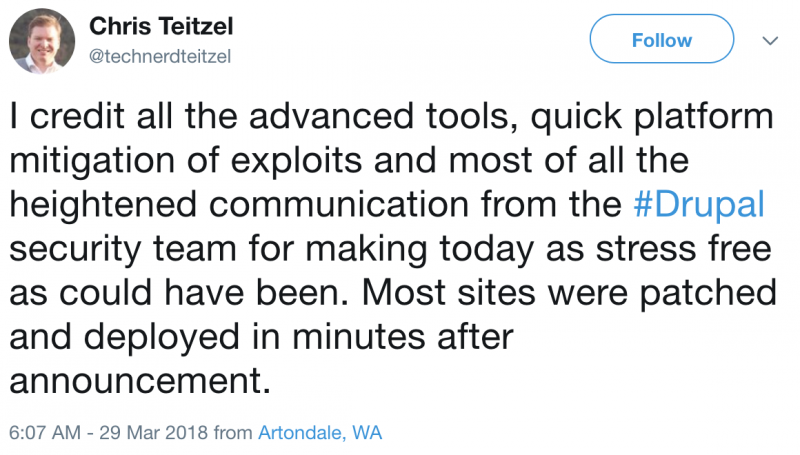
Drupalgeddon: Critical Flaw Exposes Million Drupal Websites to Attacks

All versions of the Drupal content management system are affected by a highly critical vulnerability that can be easily exploited to take complete control of affected websites in what may turn out to be Drupalgeddon 2.0.

While analyzing the security of Drupal, Jasper Mattsson discovered a serious remote code execution flaw that impacts versions 6, 7 and 8. This represents more than one million websites that can be hacked by a remote and unauthenticated attacker.

The security hole, tracked as CVE-2018-7600 and assigned a risk score of 21/25, can be exploited simply by accessing a page on the targeted Drupal website. Once exploited, it gives the attacker full control over a site, including access to non-public data and the possibility to delete or modify system data, Drupal developers warned.

The vulnerability has been patched with the release of Drupal 7.58, 8.5.1, 8.3.9 and 8.4.6. While Drupal 6 has reached end of life and it’s not supported since February 2016, a fix has still been developed due to the severity of the flaw and the high risk of exploitation.

Besides updating their installations to the latest version, users can protect their websites against attacks by making some changes to the site’s configuration. However, the required changes are “drastic.”

“There are several solutions, but they are all based on the idea of not serving the vulnerable Drupal pages to visitors. Temporarily replacing your Drupal site with a static HTML page is an effective mitigation. For staging or development sites you could disable the site or turn on a ‘Basic Auth’ password to prevent access to the site,” Drupal developers said.

Cloudflare also announced that it has pushed out a rule to its Web Application Firewall (WAF) to block potential attacks.

While no technical details have been made public, Drupal believes that exploits targeting the vulnerability will be created within hours or days, which is why it alerted users of the flaw and an upcoming patch one week in advance. This appears to have been a good strategy, but many websites may still remain vulnerable for extended periods of time.

Drupal patches critical remote code execution vulnerability

In the case of the notorious Drupalgeddon vulnerability, hackers had used it to take control of websites nearly two years after a patch was released.

While there haven’t been many reports of Drupal flaws being exploited in the wild since Drupalgeddon, one of the vulnerabilities patched in June 2017 by the developers of the CMS had been leveraged in some spam campaigns.

Related: Flaw in Drupal Module Exposes 120,000 Sites to Attacks

Related: Several Vulnerabilities Patched in Drupal

view counter

Eduard Kovacs (@EduardKovacs) is a contributing editor at SecurityWeek. He worked as a high school IT teacher for two years before starting a career in journalism as Softpedia’s security news reporter. Eduard holds a bachelor’s degree in industrial informatics and a master’s degree in computer techniques applied in electrical engineering.

Previous Columns by Eduard Kovacs:

Tags:

http://feedproxy.google.com/~r/Securityweek/~3/Vo9k44R8cho/drupalgeddon-critical-flaw-exposes-million-drupal-websites-attacks


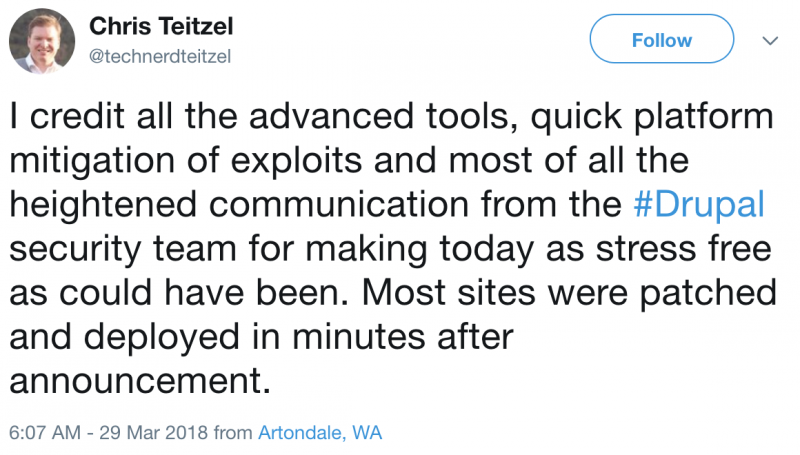
Drupalgeddon: Highly Critical Flaw Exposes Million Drupal Websites to Attacks

All versions of the Drupal content management system are affected by a highly critical vulnerability that can be easily exploited to take complete control of affected websites in what may turn out to be Drupalgeddon 2.0.

While analyzing the security of Drupal, Jasper Mattsson discovered a serious remote code execution flaw that impacts versions 6, 7 and 8. This represents more than one million websites that can be hacked by a remote and unauthenticated attacker.

The security hole, tracked as CVE-2018-7600 and assigned a risk score of 21/25, can be exploited simply by accessing a page on the targeted Drupal website. Once exploited, it gives the attacker full control over a site, including access to non-public data and the possibility to delete or modify system data, Drupal developers warned.

The vulnerability has been patched with the release of Drupal 7.58, 8.5.1, 8.3.9 and 8.4.6. While Drupal 6 has reached end of life and it’s not supported since February 2016, a fix has still been developed due to the severity of the flaw and the high risk of exploitation.

Besides updating their installations to the latest version, users can protect their websites against attacks by making some changes to the site’s configuration. However, the required changes are “drastic.”

“There are several solutions, but they are all based on the idea of not serving the vulnerable Drupal pages to visitors. Temporarily replacing your Drupal site with a static HTML page is an effective mitigation. For staging or development sites you could disable the site or turn on a ‘Basic Auth’ password to prevent access to the site,” Drupal developers said.

Cloudflare also announced that it has pushed out a rule to its Web Application Firewall (WAF) to block potential attacks.

While no technical details have been made public, Drupal believes that exploits targeting the vulnerability will be created within hours or days, which is why it alerted users of the flaw and an upcoming patch one week in advance. This appears to have been a good strategy, but many websites may still remain vulnerable for extended periods of time.

Drupal patches critical remote code execution vulnerability

In the case of the notorious Drupalgeddon vulnerability, hackers had used it to take control of websites nearly two years after a patch was released.

While there haven’t been many reports of Drupal flaws being exploited in the wild since Drupalgeddon, one of the vulnerabilities patched in June 2017 by the developers of the CMS had been leveraged in some spam campaigns.

Related: Flaw in Drupal Module Exposes 120,000 Sites to Attacks

Related: Several Vulnerabilities Patched in Drupal

view counter

Eduard Kovacs (@EduardKovacs) is a contributing editor at SecurityWeek. He worked as a high school IT teacher for two years before starting a career in journalism as Softpedia’s security news reporter. Eduard holds a bachelor’s degree in industrial informatics and a master’s degree in computer techniques applied in electrical engineering.

Previous Columns by Eduard Kovacs:

Tags:

http://feedproxy.google.com/~r/Securityweek/~3/Vo9k44R8cho/drupalgeddon-critical-flaw-exposes-million-drupal-websites-attacks


macOS High Sierra Logs External Volume Passwords in Plaintext

In macOS High Sierra, the passwords used for Apple File System (APFS)-encrypted external drives are logged and kept in on-disk log files, a security researcher has discovered.

The APFS file system was introduced by Apple with the release of macOS High Sierra and is automatically applied to the startup volume when the platform High Sierra is installed on a computer with a solid-state drive (SSD).

According to Apple, APFS provides strong encryption, fast directory sizing, space sharing, and improved file system fundamentals.

The newly discovered vulnerability, Sarah Edwards reveals, impacts macOS 10.13 platform versions. Initially found when creating a new APFS volume, the bug appears to occur when encrypting previously created but unencrypted volumes as well.

What the expert observed was that the password used for a newly created APFS-formatted FileVault Encrypted USB drive via Disk Utility could be found in unified logs in plaintext.

“The newfs_apfs command can take a passphrase as a parameter using the mostly undocumented “-S” flag. It is not documented in the man page. However when run without parameters, it will show it,” Edwards notes.

The vulnerability was initially discovered on a system running macOS High Sierra 10.13.1. To reproduce it, one would have to create a “clean” flash drive using Disk Utility.app.

The researcher formatted the drive “Mac OS Extended (Journaled),” but the issue appears with other base formats as well.

Next, one would have to create an Encrypted APFS volume on the drive, using the menu option “Erase” and wait for the process to complete.

Keeping an eye on the unified logs in the Terminal while the operation is being performed reveals the selected password in plaintext.

The issue appears to have been fixed in High Sierra 10.13.2, but only for newly created volumes. Thus, the vulnerability can still be triggered when encrypting an already existing unencrypted APFS volume in macOS 10.13.3, the researcher says.

By exploiting this issue, an attacker could view the encryption password of encrypted APFS external volumes on USB drives, portable hard disks, and other external drives.

In October last year, a developer in Brazil discovered that macOS High Sierra leaked the passwords for encrypted APFS volumes via the password hint. The developer discovered the bug after using the Disk Utility to add a new encrypted APFS volume to the container.

Related: macOS High Sierra Leaks APFS Volume Passwords via Hint

Related: Patch for macOS Root Access Flaw Breaks File Sharing

view counter

Ionut Arghire is an international correspondent for SecurityWeek.

Previous Columns by Ionut Arghire:

Tags:

http://feedproxy.google.com/~r/Securityweek/~3/DJg9p5qcu8c/macos-high-sierra-logs-external-volume-passwords-plaintext


Critical Flaws Found in Siemens Telecontrol, Building Automation Products

Siemens informed customers this week that critical vulnerabilities have been found in some of its telecontrol and building automation products, and revealed that some SIMATIC systems are affected by a high severity flaw.

One advisory published by the company describes several critical and high severity flaws affecting Siveillance and Desigo building automation products. The security holes exist due to the use of a vulnerable version of a Gemalto license management system (LMS).

The bugs affect Gemalto Sentinel LDK and they can be exploited for remote code execution and denial-of-service (DoS) attacks.

The vulnerabilities were discovered by researchers at Kaspersky Lab and disclosed in January. The security firm warned at the time that millions of industrial and corporate systems may be exposed to remote attacks due to their use of the vulnerable Gemalto product.

Siemens warned at the time that more than a dozen versions of the SIMATIC WinCC Add-On were affected. The company has now informed customers that some of its building automation products are impacted as well, including Siveillance Identity and SiteIQ Analytics, and Desigo XWP, CC, ABT, Configuration Manager, and Annual Shading.

The German industrial giant has advised customers to update the LMS to version 2.1 SP4 (2.1.681) or newer in order to address the vulnerabilities.

Learn More at SecurityWeek’s ICS Cyber Security Conference

A separate advisory published by Siemens this week informs customers of a critical vulnerability affecting TIM 1531 IRC, a communication module launched by the company nearly a year ago. The module connects remote stations based on SIMATIC controllers to a telecontrol control center through the Sinaut ST7 protocol.

“A remote attacker with network access to port 80/tcp or port 443/tcp could perform administrative operations on the device without prior authentication. Successful exploitation could allow to cause a denial-of-service, or read and manipulate data as well as configuration settings of the affected device,” Siemens explained.

The company said there had been no evidence of exploitation when it published its advisory on Tuesday.

A third advisory published by Siemens this week describes a high severity flaw discovered by external researchers in SIMATIC PCS 7, SIMATIC WinCC, SIMATIC WinCC Runtime Professional, and SIMATIC NET PC products.

The vulnerability allows an attacker to cause a DoS condition on the impacted products by sending specially crafted messages to their RPC service. Patches or mitigations have been made available by Siemens for each of the affected systems.

Related: Siemens Patches Flaws in SIMATIC Controllers, Mobile Apps

Related: Siemens Releases BIOS Updates to Patch Intel Chip Flaws

Related: Oil and Gas Sector in Middle East Hit by Serious Security Incidents

view counter

Eduard Kovacs (@EduardKovacs) is a contributing editor at SecurityWeek. He worked as a high school IT teacher for two years before starting a career in journalism as Softpedia’s security news reporter. Eduard holds a bachelor’s degree in industrial informatics and a master’s degree in computer techniques applied in electrical engineering.

Previous Columns by Eduard Kovacs:

Tags:

http://feedproxy.google.com/~r/Securityweek/~3/i1VMrC6JN3I/critical-flaws-found-siemens-telecontrol-building-automation-products