First OpenSSL Updates in 2018 Patch Three Flaws

The first round of security updates released in 2018 for OpenSSL patch a total of three vulnerabilities, but none of them appears to be serious.

OpenSSL versions 1.1.0h and 1.0.2o patch CVE-2018-0739, a denial-of-service (DoS) vulnerability discovered using Google’s OSS-Fuzz service, which has helped find several flaws in OpenSSL in the past period.

The security hole, rated “moderate,” is related to constructed ASN.1 types with a recursive definition.

“Constructed ASN.1 types with a recursive definition (such as can be found in PKCS7) could eventually exceed the stack given malicious input with excessive recursion,” the OpenSSL Project said in its advisory.

Another moderate severity flaw, which only affects the 1.1.0 branch, is CVE-2018-0733. This is an implementation bug in the PA-RISC CRYPTO_memcmp function, and it allows an attacker to forge authenticated messages easier than it should be.

The OpenSSL Project learned about this vulnerability in early March from IBM. Only HP-UX PA-RISC systems are impacted.

Finally, OpenSSL 1.1.0h fixes an overflow bug that could allow an attacker to access TLS-protected communications. The vulnerability, CVE-2017-3738, was first disclosed in December 2017, but since an attack is not easy to carry out the issue has been assigned a low severity rating and it has only been patched now.

Four rounds of security updates were released for OpenSSL last year, and only one of the eight fixed vulnerabilities was classified as high severity.

view counter

Eduard Kovacs (@EduardKovacs) is a contributing editor at SecurityWeek. He worked as a high school IT teacher for two years before starting a career in journalism as Softpedia’s security news reporter. Eduard holds a bachelor’s degree in industrial informatics and a master’s degree in computer techniques applied in electrical engineering.

Previous Columns by Eduard Kovacs:

Tags:

http://feedproxy.google.com/~r/Securityweek/~3/lDXRblL_tHQ/first-openssl-updates-2018-patch-three-flaws


New “ThreadKit” Office Exploit Builder Emerges

A newly discovered Microsoft Office document exploit builder kit has been used for the distribution of a variety of malicious payloads, including banking Trojans and backdoors, Proofpoint reports.

The exploit builder kit was initially discovered in October 2017, but Proofpoint’s researchers have linked it to activity dating back to June 2017. The builder kit shows similarities to Microsoft Word Intruder (MWI), but is a new tool called ThreadKit.

In June 2017, the kit was being advertised in a forum post as being able to create documents with embedded executables and embedded decoy documents, and several campaigns featuring such documents were observed that month. The documents would perform an initial check-in to the command and control (C&C) server, a tactic also used by MWI.

The documents were targeting CVE-2017-0199 and were focused on downloading and executing a HTA file that would then download the decoy and a malicious VB script to extract and run the embedded executable. The payload was Smoke Loader, which in turn downloaded banking malware.

In October, ThreadKit started targeting CVE 2017-8759 as well, but continued to use the initial C&C check-in and the HTA file to execute the embedded executable, Proofpoint says. However, changes were made to the manner in which the exploit documents operate and new exploits were integrated as well.

In November, ThreadKit was quick to incorporate exploits for new Microsoft Office vulnerabilities, and started being advertised as capable of targeting CVE 2017-11882 too. Soon after, campaigns that featured the previously observed check-in already started to emerge.

In February and March 2018, the kit was embedding new exploits, targeting vulnerabilities such as an Adobe Flash zero-day (CVE-2018-4878) and several new Microsoft office vulnerabilities, including CVE-2018-0802 and CVE-2017-8570.

At the same time, the researchers noticed a large spike in email campaigns featuring ThreadKit-generated Office attachments packing these exploits. The exploits appear copied from proofs of concept available on a researcher’s GitHub repo.

As part of these attacks, the attachments would drop the contained packager objects into the temp folder, then the exploits would execute the dropped scriptlet file, thus leading to the execution of the dropped batch files, which in turn run the executable.

Proofpoint found that not all ThreadKit documents contain a valid URL for the statistics check-in (some contain placeholder URLs). Furthermore, not all documents followed the same execution chain, with some scripts modified to perform other actions, a customization that may be provided as a service by the kit author.

“In 2017, several new vulnerabilities entered regular use by threat actors and the first months of 2018 have added to that repertoire. Document exploit builder kits like ThreadKit enable even low-skilled threat actors to take advantage of the latest vulnerabilities to distribute malware. Organizations and individuals can mitigate the risk from ThreadKit and other document exploit-based attacks by ensuring that clients are patched for the latest vulnerabilities in Microsoft office and other applications,” Proofpoint concludes.

Related: Microsoft Patches Zero-Day Vulnerability in Office

Related: Microsoft Manually Patched Office Component: Researchers

view counter

Ionut Arghire is an international correspondent for SecurityWeek.

Previous Columns by Ionut Arghire:

Tags:

http://feedproxy.google.com/~r/Securityweek/~3/7de3m_eM7i8/new-threadkit-office-exploit-builder-emerges


The Top Vulnerabilities Exploited by Cybercriminals

Cybercriminals are shifting their focus from Adobe to Microsoft consumer products, and are now concentrating more on targeted attacks than on web-based exploit kits.

Each year, Recorded Future provides an analysis of criminal chatter on the dark web in its Top Ten Vulnerabilities Report. It does this because it perceives a weakness in traditional vulnerability databases and scanning tools — they do not indicate which vulnerabilities are currently being exploited, nor to what extent. Reliance on vulnerability lists alone cannot say where patching and remediation efforts should be prioritized. 

“We do this analysis because the sale and use of exploits is a for-profit industry,” Recorded Future’s VP of technical solutions, Scott Donnelly told SecurityWeek. This means that exploit developers have to sell their products, while other criminals have to buy them — and this leads to the chatter that Recorded Future analyzes. 

“If you’re a cybercriminal trying to make money, you have to discuss it. If you hold back too much you’re not going to make any money; so, there’s a necessity for the criminals to stick their heads up a little bit — and we can take advantage of that and call out some of the big conversations.” It assumes a correlation between chatter about a vulnerability with active exploitation of that vulnerability — an assumption that common sense rather than science suggests is reasonable.

Donnelly is confident that his firm’s knowledge of and access to the dark web is statistically valid. Nation-state activity is specifically excluded from this analysis, because, he says, “If you’re a nation-state with an exploit, or if you’re a third-party supplier of exploits to a nation state, you’re less likely to talk about it in a general criminal forum.”

At the macro level, this year’s analysis highlights a move away from Adobe vulnerabilities towards Microsoft consumer product vulnerabilities. While Flash exploits have dominated earlier annual reports, seven of the top ten (including the top five) most discussed vulnerabilities are now Microsoft vulnerabilities. “As Adobe Flash Player has begun to see its usage significantly drop, this year we find that it’s a lot of Microsoft consumer products that are seeing heavy exploitation,” says Donnelly.

The three most used vulnerabilities are CVE-2017-0199 (which allows attackers to download and execute a Visual Basic script containing PowerShell commands from a malicious document), CVE-2016-0189 (which is an old Internet Explorer vulnerability that allows attackers to use an exploit kit to drop malware, such as ransomware), and CVE-2017-0022 (which enables data theft).

A second major takeaway from the analysis is that 2017 has seen a significant drop in the development of new exploit kits. “This has been noticed before,” Donnelly told SecurityWeek, “but mainly because researchers simply haven’t seen them in action. This is now evidence that the criminals themselves aren’t talking about or trying to sell that many new kits.”

In raw numbers, Recorded Future’s analysis noted 26 new kits in 2016, but only 10 new kits in 2017 (from a total list of 158 EKs). “The observed drop in exploit kit activity,” suggests Donnelly, “overlaps with the rapid decline of Flash Player usage. Users have shifted to more secure browsers, and attackers have shifted as well. Spikes in cryptocurrency mining malware and more targeted victim attacks have filled the void.”

At the micro level, the big takeaway from this report is the anomalous position of CVE-2017-0022. It is the third most discussed vulnerability on the dark web forums, yet in relation to just two pieces of malware: exploit kits Astrum (aka Stegano) and Neutrino. This is the lowest number of associated malware in the top ten vulnerabilities — both of the two more popular vulnerabilities are associated with ten different peices of malware. CVE-2017-0199 is associated with malware including Hancitor, Dridex and FinFisher, while CVE-2016-0189 is associated with nine different exploit kits and the Magniber ransomware.

But it’s not just in malware associations that CVE-2017-0022 is anomalous. It has a Common Vulnerability Scoring System (CVSS) rating of just 4.3. The next lowest rating in the top ten vulnerabilities is 7.6, while the top two are rated at 9.3 and 7.6. CVSS defines a 4.3 score as medium risk; and yet Recorded Future’s research shows it to be the third most exploited vulnerability, commenting, “‘In the wild’ severity does not always correlate with the Common Vulnerability Scoring System (CVSS) score.”

This is a prime example of the reason for the analysis. Security teams could check the CVSS score and conclude on this evidence alone that the vulnerability does not require expedited remediation or patching. As the third most exploited vulnerability, Recorded Future’s latest threat analysis suggests otherwise.

Boston, Mass.-based Recorded Future raised $25 million in a Series E funding round led by Insight Venture Partners in October 2017 — bringing the total funding raised to $57.9 million.

Related: Use of Fake Code Signing Certificates in Malware Surges 

Related: Researchers Warn Against Knee-Jerk Attribution of ‘Olympic Destroyer’ Attack

view counter

Kevin Townsend is a Senior Contributor at SecurityWeek. He has been writing about high tech issues since before the birth of Microsoft. For the last 15 years he has specialized in information security; and has had many thousands of articles published in dozens of different magazines – from The Times and the Financial Times to current and long-gone computer magazines.

Previous Columns by Kevin Townsend:

Tags:

http://feedproxy.google.com/~r/Securityweek/~3/LZdKf59wwhs/top-vulnerabilities-exploited-cybercriminals


Intel CPUs Vulnerable to New ‘BranchScope’ Attack

Researchers have discovered a new side-channel attack method that can be launched against devices with Intel processors, and the patches released in response to the Spectre and Meltdown vulnerabilities might not prevent these types of attacks.

The new attack, dubbed BranchScope, has been identified and demonstrated by a team of researchers from the College of William & Mary, University of California Riverside, Carnegie Mellon University in Qatar, and Binghamton University.

Similar to Meltdown and Spectre, BranchScope can be exploited by an attacker to obtain potentially sensitive information they normally would not be able to access directly. The attacker needs to have access to the targeted system and they must be able to execute arbitrary code.

Researchers believe the requirements for such an attack are realistic, making it a serious threat to modern computers, “on par with other side-channel attacks.” The BranchScope attack has been demonstrated on devices with three types of Intel i5 and i7 CPUs based on Skylake, Haswell and Sandy Bridge microarchitectures.

Experts showed that the attack works even if the targeted application is running inside of an Intel SGX enclave. Intel SGX, or Software Guard Extensions, is a hardware-based isolated execution system designed to prevent code and data from getting leaked or modified.

BranchScope is similar to Spectre as they both target the directional branch predictors. Branch prediction units (BPUs) are used to improve the performance of pipelined processors by guessing the execution path of branch instructions. The problem is that when two processes are executed on the same physical CPU core, they share a BPU, potentially allowing a malicious process to manipulate the direction of a branch instruction executed by the targeted application.

The BPU has two main components – a branch target buffer (BTB) and a directional predictor – and manipulating either one of them can be used to obtain potentially sensitive data from the memory. Intel recently published a video providing a high level explanation of how these attacks work.

Researchers showed on several occasions in the past how BTB manipulation can be used for attacks, but BranchScope involves manipulation of branch predictors.

“BranchScope is the first fine-grained attack on the directional branch predictor, expanding our understanding of the side channel vulnerability of the branch prediction unit,” the researchers explained in their paper.

The researchers who identified the BranchScope attack method have proposed a series of countermeasures that include both software- and hardware-based solutions.

Dmitry Evtyushkin, one of the people involved in this research, told SecurityWeek that while they have not been tested, the microcode updates released by Intel in response to Meltdown and Spectre might only fix the BTB vector, which means BranchScope attacks could still be possible. However, Intel told the researchers that software guidance for mitigating Spectre Variant 1 could be effective against BranchScope attacks as well.

“We have been working with these researchers and we have determined the method they describe is similar to previously known side channel exploits,” Intel said in an emailed statement. We anticipate that existing software mitigations for previously known side channel exploits, such as the use of side channel resistant cryptography, will be similarly effective against the method described in this paper. We believe close partnership with the research community is one of the best ways to protect customers and their data, and we are appreciative of the work from these researchers.”

BranchScope is not the only CPU side-channel attack method uncovered following the disclosure of Meltdown and Spectre. One of them, dubbed SgxPectre, shows how Spectre can be leveraged to defeat SGX.

Researchers have also demonstrated new variants of the Meltdown and Spectre attacks, which they have named MeltdownPrime and SpectrePrime.

*Updated with statement from Intel

Related: Intel Offers $250,000 for Side-Channel Exploits

Related: More Chrome OS Devices Receive Meltdown, Spectre Patches

Related: Intel Shares Details on New CPUs With Spectre, Meltdown Protections

view counter

Eduard Kovacs (@EduardKovacs) is a contributing editor at SecurityWeek. He worked as a high school IT teacher for two years before starting a career in journalism as Softpedia’s security news reporter. Eduard holds a bachelor’s degree in industrial informatics and a master’s degree in computer techniques applied in electrical engineering.

Previous Columns by Eduard Kovacs:

Tags:

http://feedproxy.google.com/~r/Securityweek/~3/lbh0ulc5wTg/intel-cpus-vulnerable-new-branchscope-attack


Watering Hole Attack Exploits North Korea’s Flash Flaw

An attack leveraging the compromised website of a Hong Kong telecommunications company is using a recently patched Flash vulnerability that has been exploited by North Korea since mid-November 2017, Morphisec warns.

The targeted vulnerability, CVE-2018-4878, first became public in early February, after South Korea’s Internet & Security Agency (KISA) issued an alert on it being abused by a North Korean hacker group. Adobe patched the flaw within a week.

By the end of February, cybercriminals were already abusing the vulnerability. The newly observed incident, Morphisec notes, is a textbook case of a watering hole assault. As part of such attacks, which are mainly focused on cyber-espionage, actors plant malware on websites their victims are likely to visit.

The newly observed incident revealed advanced evasive characteristics, as it was purely fileless, without persistence or any trace on the disk. Furthermore, it used a custom protocol on a non-filtered port.

“Generally, this advanced type of watering hole attack is highly targeted in nature and suggests that a very advanced group is behind it,” the security researchers note.

The Flash exploit used in this assault was highly similar to the one detailed in the previous analysis of the CVE-2018-4878 vulnerability, albeit it employs a different shellcode executed post exploitation.

The shellcode executes rundll32.exe and overwrites its memory with malicious code. This malicious code was designed to download additional code directly into the memory of the rundll32 process.

The security researchers also discovered that the command and control (C&C) server uses a custom protocol over the 443 port to communicate with the victim.  

The additional code downloaded into the memory of rundll32 includes Metasploit Meterpreter and Mimikatz modules. Most of the modules were compiled on February 15, less than a week before the attack.

“As our analysis shows, this watering hole attack is of advanced evasive nature. Being purely fileless, without persistence or any trace on the disk, and the use of custom protocol on a non-filtered port, makes it a perfect stepping stone for a highly targeted attack chain. This clearly suggests that very advanced threat actors are responsible for it,” Morphisec says.

Despite these advanced evasive features, the attack used basic Metasploit framework components that were compiled just before the attack and lacked any sophistication, obfuscation or evasion, which creates confusion and makes it difficult to pinpoint the attack to an actor.

According to Morphisec, this attack, the exploit kits that were updated to target CVE-2018-4878, the campaign observed a few weeks ago, the vulnerability’s abuse by nation-based groups, all creates a certain sense of déjà vu.

“It is like the anarchy of 2-3 years ago when we had new exploits targeting a particular vulnerability discovered every week. Each one different enough to evade detection for those crucial first moments and security solutions always racing to catch up,” the security firm concludes.

Related: North Korea’s Flash Player Flaw Now Exploited by Cybercriminals

Related: Adobe Patches Flash Zero-Day Exploited by North Korean Hackers

view counter

Ionut Arghire is an international correspondent for SecurityWeek.

Previous Columns by Ionut Arghire:

Tags:

http://feedproxy.google.com/~r/Securityweek/~3/7f4KoeGOFVM/watering-hole-attack-exploits-north-koreas-flash-flaw


One Year Later, Hackers Still Target Apache Struts Flaw

One year after researchers saw the first attempts to exploit a critical remote code execution flaw affecting the Apache Struts 2 framework, hackers continue to scan the Web for vulnerable servers.

The vulnerability in question, tracked as CVE-2017-5638, affects Struts 2.3.5 through 2.3.31 and Struts 2.5 through 2.5.10. The security hole was addressed on March 6, 2017 with the release of versions 2.3.32 and 2.5.10.1.

The bug, caused due to improper handling of the Content-Type header, can be triggered when performing file uploads with the Jakarta Multipart parser, and it allows a remote and unauthenticated attacker to execute arbitrary OS commands on the targeted system.

The first exploitation attempts were spotted one day after the patch was released, shortly after someone made available a proof-of-concept (PoC) exploit. Some of the attacks scanned servers in search of vulnerable Struts installations, while others were set up to deliver malware.

Guy Bruneau, researcher and handler at the SANS Internet Storm Center, reported over the weekend that his honeypot had caught a significant number of attempts to exploit CVE-2017-5638 over the past two weeks.

The expert said his honeypot recorded 57 exploitation attempts on Sunday, on ports 80, 8080 and 443. The attacks, which appear to rely on a publicly available PoC exploit, involved one of two requests designed to check if a system is vulnerable.

Bruneau told SecurityWeek that he has yet to see any payloads. The researcher noticed scans a few times a week starting on March 13, coming from IP addresses in Asia.

“The actors are either looking for unpatched servers or new installations that have not been secured properly,” Bruneau said.

The CVE-2017-5638 vulnerability is significant as it was exploited by cybercriminals last year to hack into the systems of U.S. credit reporting agency Equifax. Attackers had access to Equifax systems for more than two months and they managed to obtain information on over 145 million of the company’s customers.

The same vulnerability was also leveraged late last year in a campaign that involved NSA-linked exploits and cryptocurrency miners.

This is not the only Apache Struts 2 vulnerability exploited by malicious actors since last year. In September, security firms warned that a remote code execution flaw tracked as CVE-2017-9805 had been exploited to deliver malware.

Related: Actively Exploited Struts Flaw Affects Cisco Products

Related: Oracle Releases Patches for Exploited Apache Struts Flaw

view counter

Eduard Kovacs (@EduardKovacs) is a contributing editor at SecurityWeek. He worked as a high school IT teacher for two years before starting a career in journalism as Softpedia’s security news reporter. Eduard holds a bachelor’s degree in industrial informatics and a master’s degree in computer techniques applied in electrical engineering.

Previous Columns by Eduard Kovacs:

Tags:

http://feedproxy.google.com/~r/Securityweek/~3/bwhNGEstI4A/one-year-later-hackers-still-target-apache-struts-flaw


Energy Sector Most Impacted by ICS Flaws, Attacks: Study

The energy sector was targeted by cyberattacks more than any other industry, and many of the vulnerabilities disclosed last year impacted products used in this sector, according to a report published on Monday by Kaspersky Lab.

The security firm has analyzed a total of 322 flaws disclosed in 2017 by ICS-CERT, vendors and its own researchers, including issues related to industrial control systems (ICS) and general-purpose software and protocols used by industrial organizations.

Of the total number of security holes, 178 impact control systems used in the energy sector. Critical manufacturing organizations – this includes manufacturers of primary metals, machinery, electrical equipment, and transportation equipment – were affected by 164 of these vulnerabilities.

Other industries hit by a significant number of vulnerabilities are water and wastewater (97), transportation (74), commercial facilities (65), and food and agriculture (61).

Many of the vulnerabilities disclosed last year impacted SCADA or HMI components (88), industrial networking devices (66), PLCs (52), and engineering software (52). However, vulnerabilities in general purpose software and protocols have also had an impact on industrial organizations, including the WPA flaws known as KRACK and bugs affecting Intel technology.

Learn More at SecurityWeek’s ICS Cyber Security Conference

As for the types of vulnerabilities, nearly a quarter are web-related and 21 percent are authentication issues.

A majority of the flaws have been assigned severity ratings of medium or high, but 60 weaknesses are considered critical based on their CVSS score. Kaspersky pointed out that all vulnerabilities with a CVSS score of 10 are related to authentication and they are all easy to exploit remotely.

Kaspersky said 265 of the vulnerabilities can be exploited remotely without authentication and without any special knowledge or skills. It also noted that exploits are publicly available for 17 of the security holes.

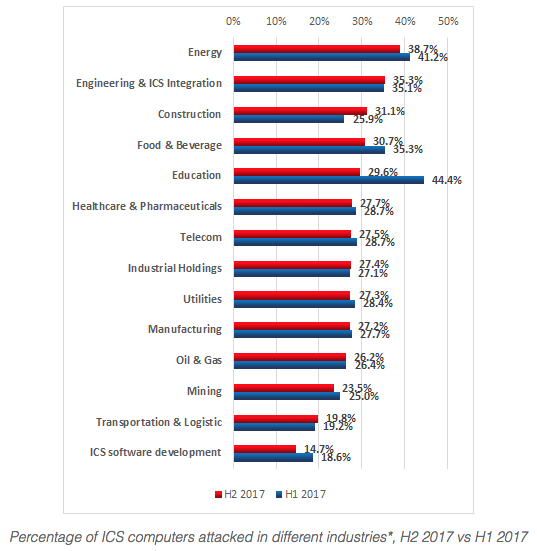
The company has also shared data on malware infections and other security incidents. In the second half of 2017, Kaspersky security products installed on industrial automation systems detected nearly 18,000 malware variants from roughly 2,400 families. Malware attacks were blocked on almost 38 percent of ICS computers protected by the company, which was slightly less than in the second half of the previous year.

Again, the energy sector was the most impacted. According to the security firm, roughly 40 percent of the devices housed by energy organizations were targeted.

ICS devices attacked in various industries in 2017

“In the vast majority of cases, attempts to infect ICS computers are accidental and are not part of targeted attacks,” Kaspersky said. “Consequently, the functionality implemented in malware is not specific to attacks on industrial automation systems. However, even without ICS-specific functionality, a malware infection can have dire consequences for an industrial automation system, including an emergency shutdown of the industrial process.”

One example was the WannaCry attack, which, according to Kaspersky, in some cases resulted in temporary disruptions to industrial processes.

Researchers noted that botnet agents can also pose a significant threat, including by stealing sensitive data and by causing disruptions to industrial processes as a side effect of coding errors and incompatibility. Kaspersky reported that last year more than 10 percent of the systems it monitored were targeted by botnet agents.

Related: Oil and Gas Sector in Middle East Hit by Serious Security Incidents

Related: Increasing Number of Industrial Systems Accessible From Web

Related: Non-Targeted Malware Hits 3,000 Industrial Sites a Year

view counter

Eduard Kovacs (@EduardKovacs) is a contributing editor at SecurityWeek. He worked as a high school IT teacher for two years before starting a career in journalism as Softpedia’s security news reporter. Eduard holds a bachelor’s degree in industrial informatics and a master’s degree in computer techniques applied in electrical engineering.

Previous Columns by Eduard Kovacs:

Tags:

http://feedproxy.google.com/~r/Securityweek/~3/PwUdPbEYHAo/energy-sector-most-impacted-ics-flaws-attacks-study


Drupal to Patch Highly Critical Vulnerability This Week

Drupal announced plans to release a security update for Drupal 7.x, 8.3.x, 8.4.x, and 8.5.x on March 28, 2018, aimed at addressing a highly critical vulnerability.

The Drupal security team hasn’t provided information on the vulnerability and says it won’t release any details on it until the patch arrives. An advisory containing all the necessary information will be published on March 28.

Before that, however, the team advises customers to be prepared for the update’s release and to apply it immediately after it is published, given its high exploitation potential.

“The Drupal Security Team urges you to reserve time for core updates at that time because exploits might be developed within hours or days,” Drupal announced.

The highly popular content management system (CMS) powers over one million sites and is used by a large number of e-commerce businesses.

Due to the widespread use of Drupal, currently the second most used CMS after WordPress, the security update will be released for Drupal versions 8.3.x and 8.4.x as well, although they are no longer supported.

“While […] we don’t normally provide security releases for unsupported minor releases, given the potential severity of this issue, we are providing 8.3.x and 8.4.x releases that include the fix for sites which have not yet had a chance to update to 8.5.0,” Drupal says.

The Drupal security team urges customers to update to the appropriate release for their CMS version as soon as it is made available on March 28.

Thus, sites on 8.3.x should be updated to the upcoming 8.3.x iteration and then to the latest 8.5.x security release in the next month, while sites on 8.4.x should apply the next 8.4.x release and then upgrade to 8.5.x as well.

All sites on Drupal versions 7.x or 8.5.x should immediately apply the update when the advisory is released, using the normal update methods.

All of the appropriate version numbers for the impacted Drupal 8 branches will be listed in the upcoming advisory.

“Your site’s update report page will recommend the 8.5.x release even if you are on 8.3.x or 8.4.x, but temporarily updating to the provided backport for your site’s current version will ensure you can update quickly without the possible side effects of a minor version update,” Drupal also notes.

 Related: Several Vulnerabilities Patched in Drupal

Related: Access Bypass Vulnerabilities Patched in Drupal 8

Related: Drupal Patches Flaw Exploited in Spam Campaigns

view counter

Ionut Arghire is an international correspondent for SecurityWeek.

Previous Columns by Ionut Arghire:

Tags:

http://feedproxy.google.com/~r/Securityweek/~3/9d_830EtPI0/drupal-patch-highly-critical-vulnerability-week


GitHub Security Alerts Lead to Fewer Vulnerable Code Libraries

GitHub says the introduction of security alerts last year has led to a significantly smaller number of vulnerable code libraries on the platform.

The code hosting service announced in mid-November 2017 the introduction of a new security feature designed to warn developers if the software libraries used by their projects contain any known vulnerabilities.

The new feature looks for vulnerable Ruby gems and JavaScript NPM packages based on MITRE’s Common Vulnerabilities and Exposures (CVE) list. When a new flaw is added to this list, all repositories that use the affected version are identified and their maintainers informed. Users can choose to be notified via the GitHub user interface or via email.

When it introduced security alerts, GitHub compared the list of vulnerable libraries to the Dependency Graph in all public code repositories.

The Dependency Graph is a feature in the Insights section of GitHub that lists the libraries used by a project. Since the introduction of security alerts, this section also informs users about vulnerable dependencies, including CVE identifiers and severity of the flaws, and provides advice on how to address the issues.

The initial scan conducted by GitHub revealed more than 4 million vulnerabilities in over 500,000 repositories. Affected users were immediately notified and by December 1, roughly two weeks after the launch of the new feature, more than 450,000 of the flaws were addressed either by updating the affected library or removing it altogether.

According to GitHub, vulnerabilities are in a vast majority of cases addressed within a week by active developers.

“Since [December 1], our rate of vulnerabilities resolved in the first seven days of detection has been about 30 percent,” GitHub said. “Additionally, 15 percent of alerts are dismissed within seven days—that means nearly half of all alerts are responded to within a week. Of the remaining alerts that are unaddressed or unresolved, the majority belong to repositories that have not had a contribution in the last 90 days.”

GitHub was recently hit by a record-breaking distributed denial-of-service (DDoS) attack that peaked at 1.3 Tbps, but the service was down for less than 10 minutes.

Related: GitHub Enforces Stronger Encryption

Related: Slack Tokens Leaked on GitHub Put Companies at Risk

view counter

Eduard Kovacs is a contributing editor at SecurityWeek. He worked as a high school IT teacher for two years before starting a career in journalism as Softpedia’s security news reporter. Eduard holds a bachelor’s degree in industrial informatics and a master’s degree in computer techniques applied in electrical engineering.

Previous Columns by Eduard Kovacs:

Tags:

http://feedproxy.google.com/~r/Securityweek/~3/1M_6ViOCidk/github-security-alerts-lead-fewer-vulnerable-code-libraries


More Chrome OS Devices Receive Meltdown, Spectre Patches

The latest stable channel update for Google’s Chrome OS operating system includes mitigations for devices with Intel processors affected by the Spectre and Meltdown vulnerabilities.

Meltdown and Spectre attacks exploit design flaws in Intel, AMD, ARM and other processors. They allow malicious applications to bypass memory isolation mechanisms and gain access to sensitive data.

Meltdown attacks are possible due to CVE-2017-5754, while Spectre attacks are possible due to CVE-2017-5753 (Variant 1) and CVE-2017-5715 (Variant 2). While Meltdown and Variant 1 can be addressed with software updates, Variant 2 also requires microcode updates from the manufacturers of the impacted processors. Software mitigations include kernel page-table isolation (KPTI/KAISER) and a technique developed by Google called Retpoline.

Meltdown and Spectre were discovered independently by three teams of researchers. Google Project Zero researcher Jann Horn was one of the experts who found the flaws, which meant the company had enough time to work on patches before the details of the vulnerabilities were disclosed.

In the case of Chrome OS, Google rolled out the first Meltdown mitigations with the release of version 63 in mid-December, more than two weeks before public disclosure.

At the time, Google rolled out the KPTI/KAISER patch to roughly 70 Intel-based Chromebook models from Acer, ASUS, Dell, HP, Lenovo, Samsung and others.

Google released Chrome OS 65 on Monday and informed users that it includes the KPTI mitigation against Meltdown for additional Intel devices with version 3.14 of the kernel.

A status page created by Google to help users track the availability of Meltdown and Spectre patches for Chrome OS shows that all older Chromebooks with Intel processors, including with kernel versions 3.14 and 3.8, should get the KPTI mitigation for Meltdown with the release of Chrome OS 66, which is currently scheduled for release on April 24.

Chrome OS 65 also brings the Retpoline mitigation for Spectre Variant 2 to all devices with Intel processors. Google noted that Variant 2 can be exploited using virtualization, and while Chrome OS devices don’t use this type of feature, some measures have been taken to proactively protect users.

In the case of Spectre Variant 1, the eBPF feature in the Linux kernel can be abused for exploitation, but Chrome OS is not impacted as it disables eBPF, Google said.

The tech giant informs customers that Chrome OS devices with ARM processors are not affected by Meltdown. As for the Spectre vulnerabilities, Google says it has started integrating the firmware and kernel patches supplied by ARM, but release timelines have not been finalized.

Related: Intel Shares Details on New CPUs With Spectre, Meltdown Protections

Related: Microsoft Releases More Patches for Meltdown, Spectre

view counter

Eduard Kovacs is a contributing editor at SecurityWeek. He worked as a high school IT teacher for two years before starting a career in journalism as Softpedia’s security news reporter. Eduard holds a bachelor’s degree in industrial informatics and a master’s degree in computer techniques applied in electrical engineering.

Previous Columns by Eduard Kovacs:

Tags:

http://feedproxy.google.com/~r/Securityweek/~3/GblQCUJarZ4/more-chrome-os-devices-receive-meltdown-spectre-patches