Over $100,000 Paid Out in ‘Hack the Air Force 2.0’

HackerOne on Thursday announced the results of a bug bounty challenge run by the U.S. Air Force on its platform. More than $100,000 were paid out for over 100 vulnerabilities reported during Hack the Air Force 2.0.

The challenge ran between December 9 and January 1. The U.S. Department of Defense paid out a total of $103,883 for 106 valid vulnerability reports submitted by 27 hackers from the U.S., Canada, U.K., Sweden, Netherlands, Belgium and Latvia.

The largest single payout, which is also the highest reward in any federal bug bounty program to date, was $12,500.

Of the 106 flaws, 55 were discovered on the first day of Hack the Air Force 2.0 during a live hacking event at the WeWork Fulton Center inside the Fulton Center subway station in New York City.Hack the Air Force 2.0

Seven U.S. Airmen and 25 civilians earned a total of over $26,000 on the first day, including $10,650 by Mathias Karlsson and Brett Buerhaus, who demonstrated how malicious actors could have breached an unclassified DoD network by exploiting a vulnerability in the Air Force’s website.

“We continue to harden our attack surfaces based on findings of the previous challenge and will add lessons learned from this round,” said Air Force CISO Peter Kim. “This reinforces the work the Air Force is already doing to strengthen cyber defenses and has created meaningful relationships with skilled researchers that will last for years to come.”

The first edition of Hack the Air Force paid out more than $130,000 for 207 valid vulnerability reports. The bug bounty challenges run by the Pentagon on the HackerOne platform since 2016 led to the discovery and patching of more than 3,000 vulnerabilities, with a total of over $400,000 awarded to white hat hackers.

The Pentagon also has a vulnerability disclosure policy that aims to provide guidance to researchers on how to disclose security holes found in the organization’s public-facing websites. While no monetary rewards are being offered, the policy provides a legal avenue for reporting flaws.

Related: HackerOne Offers Free Service to Open Source Projects

Related: General Services Administration Launches Bug Bounty Program

view counter

Eduard Kovacs is a contributing editor at SecurityWeek. He worked as a high school IT teacher for two years before starting a career in journalism as Softpedia’s security news reporter. Eduard holds a bachelor’s degree in industrial informatics and a master’s degree in computer techniques applied in electrical engineering.

Previous Columns by Eduard Kovacs:

Tags:

http://feedproxy.google.com/~r/Securityweek/~3/nSc4GYvNdW4/over-100000-paid-out-hack-air-force-20


Intel Offers $250,000 for Side-Channel Exploits

Intel Opens Bug Bounty Program to All Researchers, Offers up to $250,000 for Flaws Similar to Meltdown and Spectre

Intel on Wednesday announced major changes to its bug bounty program, including that it’s now open to all researchers, and significant rewards for exploits similar to Meltdown and Spectre.

Researchers who find critical hardware vulnerabilities that allow software-based side-channel attacks – just like Meltdown and Spectre – can earn up to $250,000. Flaws classified as high severity are worth up to $100,000, while medium- and low-risk issues are worth up to $20,000 and $5,000, respectively. The severity of a flaw is determined based on its CVSS base score, adjusted depending on the security objectives and threat model of the targeted product.

The part of Intel’s bug bounty program covering side-channel exploits will run until December 31, 2018.

Intel also announced that its bug bounty program is now open to all researchers – it was invitation-only until now. When the company launched this initiative back in March 2017, the maximum reward for hardware vulnerabilities was $30,000, but it has now been increased to $100,000 for critical flaws.

The maximum amount the company is prepared to pay for firmware vulnerabilities has increased from $10,000 to $30,000, and for software flaws from $7,500 to $10,000.

The list of hardware products covered by Intel’s bug bounty program includes processors, chipsets, field-programmable gate array (FPGA) integrated circuits, networking and communications equipment, motherboards, and solid-state drives.

“We believe these changes will enable us to more broadly engage the security research community, and provide better incentives for coordinated response and disclosure that help protect our customers and their data,” said Rick Echevarria, vice president and general manager of Platform Security at Intel.

Intel was made aware of the Spectre and Meltdown attack methods several months before researchers disclosed them, but many are unhappy with the way the company handled the situation.

While Spectre and Meltdown also affect processors from AMD, ARM and IBM, Intel was hit the hardest. The company started releasing microcode updates shortly after the existence of the vulnerabilities was brought to light, but the first round of patches introduced stability problems. Intel started releasing a second round of updates, which should address these issues, only last week.

The company says its future CPUs will include protections against attacks like Meltdown and Spectre.

Related: Intel Tests Performance Impact of CPU Patches on Data Centers

Related: Industry Reactions to Meltdown, Spectre Attacks

view counter

Eduard Kovacs is a contributing editor at SecurityWeek. He worked as a high school IT teacher for two years before starting a career in journalism as Softpedia’s security news reporter. Eduard holds a bachelor’s degree in industrial informatics and a master’s degree in computer techniques applied in electrical engineering.

Previous Columns by Eduard Kovacs:

Tags:

http://feedproxy.google.com/~r/Securityweek/~3/zlEbBn4HhIM/intel-offers-250000-side-channel-exploits


Windows Analytics Helps Assess Risk of Meltdown, Spectre Attacks

Microsoft is stepping up its efforts to help IT professionals better assess whether their Windows devices are protected against the industry-wide Meltdown and Spectre attack techniques.

Publicly detailed in the beginning of this year, the two attacks allow malicious applications to bypass memory isolation mechanisms and access potentially sensitive data. Residing in the processors themselves, the bugs affect billions of devices.

Tech companies were informed on the bugs last year and worked hard on releasing both software and firmware mitigations, but some of the patches added instability and their delivery was stopped. Microsoft too decided to disable mitigations for one Spectre attack variation as systems became unstable.

After halting the initial patches several weeks ago, Intel recently rolled out new microcode updates to address one of the Spectre vulnerabilities in its Skylake processors. IBM, Oracle, and many other vendors rushed to push out patches for the bugs as well, and malware that abuses the vulnerabilities emerged as well.

Being hardware-based security vulnerabilities, Meltdown and Spectre represent a challenge for the entire industry, Microsoft says. Not only are updates required for both CPU microcode (firmware) and the operating system, but the anti-virus has to be compatible with the patches as well, at least on Windows.

To help IT professionals assess whether the Windows devices in their networks are protected against Spectre and Meltdown, Microsoft has added new capabilities to its free Windows Analytics service.

With the help of these new features, admins can access reports on the status of all Windows devices they manage, Terry Myerson, Executive Vice President, Windows and Devices Group, explains.

Now, admins can learn whether the anti-virus (AV) software is compatible with the required Windows OS updates, thus knowing whether it is safe or not to install the patches.

Furthermore, information on which Windows security update is running on a managed device and if any of these updates have been disabled is now available (IT administrators have the option to install the security update but disable the fix).

Now, Windows Analytics also offers details on the firmware installed on the device, providing information on whether the firmware includes the specific protections required. This insight, however, will be initially limited to the list of approved and available firmware security updates from Intel.

“We will be adding other CPU (chipset) partners’ data as it becomes available to Microsoft,” Myerson points out.

Windows Analytics is currently running on millions of devices, Microsoft says. The newly included capabilities will be available on all Windows 7 SP1, Windows 8.1 and Windows 10 devices running the service.

Related: Intel Releases New Spectre Patches for Skylake CPUs

Related: Malware Exploiting Spectre, Meltdown Flaws Emerges

view counter

Ionut Arghire is an international correspondent for SecurityWeek.

Previous Columns by Ionut Arghire:

Tags:

http://feedproxy.google.com/~r/Securityweek/~3/JI9LW3DjDw0/windows-analytics-helps-assess-risk-meltdown-spectre-attacks


Nine Remotely Exploitable Vulnerabilities Found in Dell EMC Storage Platform

Nine remotely exploitable vulnerabilities have been found in Dell EMC’s Isilon OneFS platform, a scale-out NAS storage platform that combines modular hardware with unified software to harness unstructured data.

“Multiple vulnerabilities were found in the Isilon OneFS Web console that would allow a remote attacker to gain command execution as root,” warns an advisory released today.

The vulnerabilities were discovered by researchers Ivan Huertas and Maximiliano Vidal from CoreLabs, the research center of Core Security, and disclosed to Dell in September 2017. A range of Isilon OneFS versions from 7.1.1.11 to 8.0.1.2 were found to be affected by two or more of the vulnerabilities. “Other products and versions might be affected, but they were not tested,” states the advisory.

The Isilon web console contains several features that are vulnerable to cross-site request forgery. Since there are no anti-CSRF tokens in any forms on the web interface, an attacker can submit authenticated requests when an authenticated user browses an attacker-controlled domain. If social engineering can convince an authenticated user or administrator to visit a malicious website, embedded code could be executed to create a new user with elevated privileges, or execute arbitrary commands in the target system.

This is the first (CVE-2018-1213) of the nine vulnerabilities. Two privilege escalation vulnerabilities could then be used, once initial access has been achieved, to allow the attacker to run shell commands or arbitrary Python code with root privilege. 

The first of these (CVE-2018-1203) is possible because of incorrect sudo permissions. “The compadmin user can run the tcpdump binary with root privileges via sudo,” explains the advisory. “This allows for local privilege escalation, as tcpdump can be instructed to run shell commands when rotating capture files.”

The second (CVE-2018-1204) is privilege escalation via remote support scripts. “As a cluster administrator or compadmin, it is possible to enable the remote support functionality, hence enabling the isi_phone_home tool via sudo,” explain the researchers. “This tool is vulnerable to a path traversal when reading the script file to run, which would enable an attacker to execute arbitrary python code with root privileges.”

The remaining six vulnerabilities are persistent cross-site scripting errors: in the cluster description; the Network Configuration page; the Authentication Providers page; the Antivirus page; the Job Operations page; and the NDMP page.

All nine vulnerabilities were responsibly disclosed to Dell EMC on 25 September 2017. At first (about one month later), Dell proposed an update schedule including June 2018. CoreLabs replied that this was unacceptable given “given current industry standards.”

Dell reviewed its schedules, and confirmed that they would have a fix available by February 12, 2018. The two parties agreed to release details of the vulnerabilities and fixes on February 14. Dell’s fixes are available from its support site today. Dell’s own advisory will be posted to the Full Disclosure mailing list today. It had not been done at the time of writing this article.

Dell completed the acquisition of data storage firm EMC in September 2016 in a record $67 billion deal. In the same deal, Dell also acquired RSA.

Core Security merged with SecureAuth and raised more than $200 million from K1 Investment Management and Toba Capital in September 2017.

view counter

Kevin Townsend is a Senior Contributor at SecurityWeek. He has been writing about high tech issues since before the birth of Microsoft. For the last 15 years he has specialized in information security; and has had many thousands of articles published in dozens of different magazines – from The Times and the Financial Times to current and long-gone computer magazines.

Previous Columns by Kevin Townsend:

Tags:

http://feedproxy.google.com/~r/Securityweek/~3/eSdETU7wjBA/nine-remotely-exploitable-vulnerabilities-found-dell-emc-storage-platform


SAP Resolves High Risk Flaws with February 2018 Patches

SAP this week released its monthly set of security updates for its products, addressing a total of 11 new vulnerabilities, including two considered high severity.

Adding the number of patches released after the second Tuesday of January and before the second Tuesday of this month, along with updates to previously released patches, totals 26 Security Notes (5 high-, 19 medium- and 2 low-risk).

The Security Notes SAP released as part of the February 2018 Security Patch Day fix three cross-site scripting (XSS) flaws, two directory traversal issues, two missing authorization checks, two information disclosure bugs, one unrestricted file upload, and four other vulnerabilities, SAP says in an advisory.

The 11 new notes impact Internet Graphics Server (IGS), NetWeaver System Landscape Directory, HANA Extended Application Services, ABAP File Interface, SAP CRM, ERP Financials Information System, Netweaver Portal, Netweaver Java Web Application, CRM WebClient UI, BI Launchpad, and SAP HANA.

The updates for previous Security Notes include an incorrect authorization check in ERP Logistics, a cross-site request forgery (CSRF) vulnerability in SAP Sybase, and an issue related to the handling of digitally signed notes in SAP Note Assistant.

When all of the Security Notes released since the second Tuesday of January are taken into consideration, missing authorization check emerges as the most common vulnerability type, with seven occurrences, followed by XSS at five. SAP also addressed four implementation flaws, three directory traversals, two SQL injections, one SSRF, one cross-site request forgery, and one denial-of-service.

The most severe of the issues is a missing authentication check in SAP NetWeaver System Landscape Directory (CVE-2018-2368), with a CVSS base score of 8.3. An attacker exploiting it could access a service without any authorization procedures, which could lead to information disclosure, privilege escalation and other attacks, explains ERPScan, a company specialized in securing SAP and Oracle products.

Another critical bug (CVE-2018-2395) addressed this month impacted SAP IGS, had a CVSS base score of 8.3, and consisted of several vulnerabilities: unrestricted file upload (CVE-2018-2395), DoS (CVE-2018-2394, CVE-2018-2396, CVE-2018-2391, CVE-2018-2390, CVE-2018-2386, CVE-2018-2385, CVE-2018-2384), XML external entity (XXE) (CVE-2018-2393, CVE-2018-2392), log injection (CVE-2018-2389), and information disclosure (CVE-2018-2382, CVE-2018-2387).

SAP also resolved several information disclosure bugs (CVSS base score: 7.1) in HANA Extended Application Services: CVE-2018-2374, CVE-2018-2375, CVE-2018-2376, CVE-2018-2379, CVE-2018-2377, CVE-2018-2372 and CVE-2018-2373. These could lead to sensitive data leaks, including HANA database usernames and passwords, reveals Onapsis, the company that reported the flaws.

“Two high Priority notes have been published in tandem this month (notes #1584573 and #1977547). These notes are a re-release of an old note published as far back as 2011. It concerns an SQL-injection vulnerability in the component BC-UPG,” Onapsis explains.

Other bugs addressed this month included a directory traversal (CVE-2018-2380) in SAP Internet Sales (CVSS base score: 6.6), a directory traversal (CVE-2018-2367) in SAP ABAP File Interface (CVSS base score: 6.6), and an information disclosure (CVE-2018-2369) in SAP HANA (CVSS base score: 5.3).

Related: SAP Publishes Light Patch Day for January 2018

Related: SAP Becomes CVE Numbering Authority

view counter

Ionut Arghire is an international correspondent for SecurityWeek.

Previous Columns by Ionut Arghire:

Tags:

http://feedproxy.google.com/~r/Securityweek/~3/Yfpz48qyXkw/sap-resolves-high-risk-flaws-february-2018-patches


Critical Code Execution Flaws Patched in Android

Google this month addressed several critical severity remote code execution (RCE) vulnerabilities in the Android operating system.

Split in two parts, the Android Security Bulletin for February 2018 resolves only 26 vulnerabilities in the mobile operating system, most of which are rated high severity. The vast majority of the security issues are elevation of privilege (EoP) bugs.

A total of 7 issues were addressed with the 2018-02-01 security patch level, including 6 flaws in Media Framework and one vulnerability in the System component.

This month, Google addressed two critical RCE bugs in Media Framework: CVE-2017-13228, which impacts Android 6.0 and newer, and CVE-2017-13230, which impacts Android 5.1.1 and later (it is considered a high risk denial-of-service (DoS) flaw on Android 7.0 and newer).

Other issues addressed in Media Framework included an information disclosure vulnerability, an elevation of privilege bug, and several denial-of-service flaws.

By successfully exploiting the most severe of these vulnerabilities, an attacker could achieve remote code execution in the context of a privileged process. The issues could be abused via email, web browsing, and MMS when processing media files.

The vulnerability addressed in System (CVE-2017-13236) was an EoP bug that could allow a local malicious application to execute commands normally limited to privileged processes, Google explained in an advisory.

The 2018-02-05 security patch level includes fixes for 19 vulnerabilities in HTC, Kernel, NVIDIA, Qualcomm, and Qualcomm closed-source components.

The most severe of these issues are two remote code execution vulnerabilities in Qualcomm components (CVE-2017-15817 and CVE-2017-17760).

Except for an information disclosure in HTC components (bootloader) and an undisclosed bug type on Qualcomm closed-source components, the remaining issues were elevation of privilege vulnerabilities impacting components such as Media Framework, WLan, Graphics, Kernel, and Bootloader.

Google also released a separate set of patches to address 29 vulnerabilities as part of the Pixel / Nexus Security Bulletin for February 2018.

While most of these bugs were rated moderate severity, one critical remote code execution bug and one high risk denial-of-service issue (both only on Android 5.1.1, 6.0, and 6.0.1 releases and medium severity on Android 7.0 and up) slipped among them.

Impacted components included Media Framework, System, Kernel and Qualcomm. Most of the bugs were elevation of privilege and information disclosure vulnerabilities.

In addition to these security patches, Google included a series of functional improvements in the software updates for the Pixel devices.

Related: Google Patches 22 Critical Android Vulnerabilities

Related: Android’s December 2017 Patches Resolve Critical Flaws

view counter

Ionut Arghire is an international correspondent for SecurityWeek.

Previous Columns by Ionut Arghire:

Tags:

http://feedproxy.google.com/~r/Securityweek/~3/ql99raSXQ6o/critical-code-execution-flaws-patched-android


Pepperl+Fuchs HMIs Vulnerable to Meltdown, Spectre Attacks

Pepperl+Fuchs has informed customers that some of its human-machine interface (HMI) products are vulnerable to the recently disclosed Meltdown and Spectre attack methods.

The Germany-based industrial automation company said its VisuNet and Box Thin Client HMI devices rely on Intel CPUs, which makes them vulnerable to Meltdown and Spectre attacks. The list of affected products includes VisuNet RM, VisuNet PC, and Box Thin Client BTC.

Pepperl+Fuchs told [email protected], the German counterpart of ICS-CERT, that the impacted devices are designed for use on industrial control systems (ICS) networks, and they should be isolated from the enterprise network and not directly accessible from the Internet.

“Additionally, VisuNet HMI devices use a kiosk mode for normal operation. Within this mode access policies of thin client based VisuNet Remote Monitors and Box Thin Clients are restricted, such that users can only access predefined servers,” [email protected] said in its advisory. “This implies that outgoing connections and local software installations have to be configured by administrators. Hence, operators are restricted in a way such that they can only use the system as configured by administrators.”

The vendor says these measures should greatly reduce the risk of attacks. However, if direct Internet access is allowed and a user is tricked into visiting a malicious website, an attacker may be able to execute arbitrary code and obtain data from the HMI device’s memory, including passwords.

Pepperl+Fuchs has released some updates that include the Windows patches for Meltdown and Spectre provided by Microsoft. However, the vendor has warned customers that the fixes could have a negative impact on performance and stability.

Both the patches from Intel and Microsoft have been known to cause problems, but the companies have been working on addressing existing issues.

Pepperl+Fuchs is not the only ICS vendor to inform customers that its products are vulnerable to Meltdown and Spectre attacks. Shortly after the flaws were disclosed, Rockwell Automation, Siemens, Schneider Electric and ABB published advisories on the topic.

More recently, advisories were also published by General Electric and Emerson, but the information is only available to customers that have registered an account on their websites.

The Meltdown and Spectre attacks allow malicious applications to bypass memory isolation mechanisms and access sensitive data stored in memory. Researchers warned recently that malicious actors appear to have already started working on malware designed to exploit the flaws.

Related: Pepperl+Fuchs Ecom Rugged Devices Exposed to KRACK Attacks

Related: HP, Dell Halt BIOS Updates Over Buggy CPU Patches

Related: IBM Releases Spectre, Meltdown Patches for Power Systems

Related: Industry Reactions to Meltdown, Spectre Attacks

view counter

Eduard Kovacs is a contributing editor at SecurityWeek. He worked as a high school IT teacher for two years before starting a career in journalism as Softpedia’s security news reporter. Eduard holds a bachelor’s degree in industrial informatics and a master’s degree in computer techniques applied in electrical engineering.

Previous Columns by Eduard Kovacs:

Tags:

http://feedproxy.google.com/~r/Securityweek/~3/7jUCcX6dOYM/pepperlfuchs-hmis-vulnerable-meltdown-spectre-attacks


Schneider Electric Patches Several Flaws in IGSS Products

Schneider Electric informed customers recently that several vulnerabilities have been found in its IGSS automation product, including in the SCADA software and mobile applications.

Ivan Sanchez of Nullcode discovered that the IGSS SCADA software is affected by a configuration issue that leads to Address Space Layout Randomization (ASLR) and Data Execution Prevention (DEP) mitigations not being implemented properly.

The flaw, tracked as CVE-2017-9967 and classified as high severity, affects version 12 and earlier of the IGSS SCADA software. The issue has been addressed with the release of version 13.

Another advisory published recently by Schneider Electric describes two medium severity vulnerabilities discovered by researchers in the IGSS Mobile applications for Android and iOS.

One of the flaws, CVE-2017-9968, is related to the lack of certificate pinning when the apps establish a TLS/SSL connection, which makes it easier to launch man-in-the-middle (MitM) attacks.

The second weakness, CVE-2017-9969, allows an attacker to obtain app passwords and other potentially sensitive data from a configuration file, where the information is stored in clear text.

Learn More at SecurityWeek’s ICS Cyber Security Conference

The security holes affect IGSS Mobile for Android and iOS versions 3.0 and prior, and they have been patched by Schneider with the release of version 3.1.1.

The IGSS Mobile vulnerabilities were discovered by researchers at IOActive and Embedi as part of a project that targeted SCADA mobile apps from 34 vendors.

In a report published last month, the companies revealed that flaws had been identified in a vast majority of the tested SCADA applications, including issues that can be exploited to influence industrial processes.

The project focused on Android applications, but Schneider Electric apparently determined that the iOS version of its IGSS app was also impacted by the vulnerabilities discovered by IOActive and Embedi researchers.

Schneider Electric also informed customers last week of a high severity remote code execution vulnerability affecting its StruxureOn Gateway product.

“Uploading a zip which contains carefully crafted metadata allows for the file to be uploaded to any directory on the host machine information which could lead to remote code execution,” the vendor said in its advisory.

The flaw, tracked as CVE-2017-9970, affects StruxureOn Gateway 1.0.0 through 1.1.3 and it has been patched with the release of version 1.2.

Schneider Electric admitted recently that the Triton/Trisis malware, whose existence was brought to light in mid-December, exploited a zero-day vulnerability in the company’s Triconex Safety Instrumented System (SIS) controllers.

Related: Schneider Electric Patches Critical Flaw in HMI Products

Related: Schneider Electric Patches Flaws in Pelco Video Management System

Related: Unpatched Flaws in Schneider Electric U.motion Builder Disclosed

view counter

Eduard Kovacs is a contributing editor at SecurityWeek. He worked as a high school IT teacher for two years before starting a career in journalism as Softpedia’s security news reporter. Eduard holds a bachelor’s degree in industrial informatics and a master’s degree in computer techniques applied in electrical engineering.

Previous Columns by Eduard Kovacs:

Tags:

http://feedproxy.google.com/~r/Securityweek/~3/IJSTwXuozeo/schneider-electric-patches-several-flaws-igss-products


Critical Telegram flaw under attack disguised malware as benign images

Makers of the Telegram instant messenger have fixed a critical vulnerability that hackers were actively exploiting to install malware on users’ computers, researchers said Tuesday.

The flaw, which resided in the Windows version of the messaging app, allowed attackers to disguise the names of attached files, researchers from security firm Kaspersky Lab said in a blog post. By using the text-formatting standard known as Unicode, attackers were able to cause characters in file names to appear from right to left, instead of the left-to-right order that’s normal for most Western languages.

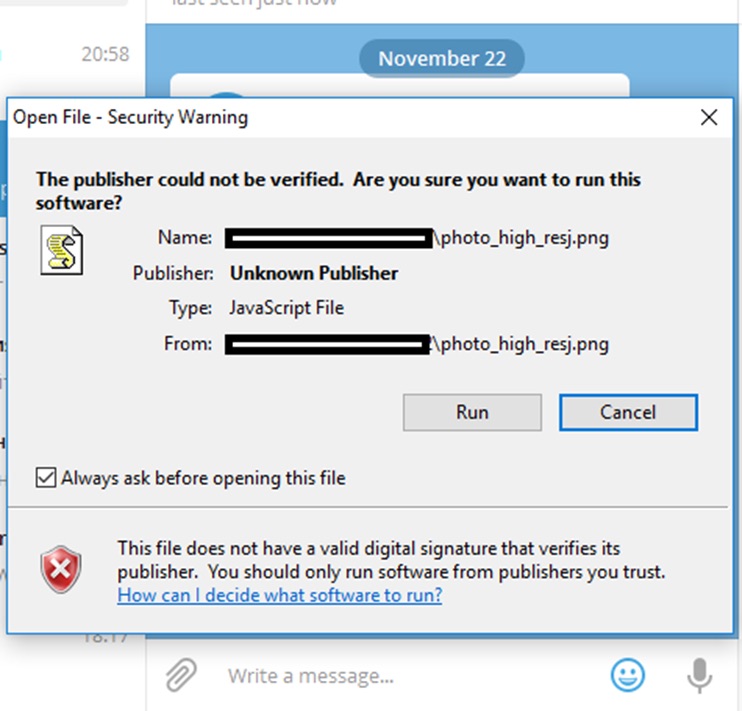
The technique worked by using the special Unicode formatting *U+202E*, which causes text strings following it to be displayed from right to left. As a result, Telegram for Windows converted files with names such as “photo_high_regnp.js” to “photo_high_resj.png,” giving the appearance they were benign image files rather than files that executed code.

Malware that uses right-to-left formatting dates back to at least 2009. Four years ago, the right-to-left Unicode trick made a reappearance with malware that targeted computers running both Windows and macOS.

Kaspersky Lab said hackers with ties to Russian crime gangs were exploiting the Telegram vulnerability to install two types of malware on vulnerable computers. One type of malware acted as a persistent backdoor that gave the attackers complete control over the compromised computer. The other malware mined cryptocurrency. It’s not clear when Telegram fixed the vulnerability. To be exploited, targets would have to click through a Windows warning similar to the one pictured above. Kaspersky Lab said the flaw affected only the Windows version of the app.

https://arstechnica.com/?p=1259755


Microsoft Patches 50 Flaws in Windows, Office, Browsers

Microsoft’s Patch Tuesday updates for February 2018 address 50 vulnerabilities in Windows, Office and the company’s web browsers, but this time the list does not appear to include any zero-day flaws.

Fourteen of the security holes have been rated critical, including an information disclosure flaw in Edge, a memory corruption in Outlook, a remote code execution vulnerability in Windows’ StructuredQuery component, and several memory corruptions in the scripting engines used by Edge and Internet Explorer.

One vulnerability, CVE-2018-0771, was publicly disclosed before Microsoft released patches. The issue is a Same-Origin Policy (SOP) bypass that exists due to the way Edge handles requests of different origins.

“An attacker who successfully exploited the vulnerability could force the browser to send data that would otherwise be restricted,” Microsoft said. The company believes it’s unlikely that this flaw, which it has rated “important,” will be exploited in attacks.

Two of the most interesting issues patched this month are Outlook vulnerabilities discovered by Microsoft’s own Nicolas Joly. One of the flaws, CVE-2018-0852, can be exploited to execute arbitrary code in the context of a user’s session by getting the target to open a specially crafted file with an affected version of Outlook.

“What’s truly frightening with this bug is that the Preview Pane is an attack vector, which means simply viewing an email in the Preview Pane could allow code execution,” explained Dustin Childs of the Zero Day Initiative (ZDI). “The end user targeted by such an attack doesn’t need to open or click on anything in the email – just view it in the Preview Pane. If this bug turns into active exploits – and with this attack vector, exploit writers will certainly try – unpatched systems will definitely suffer.”

The second Outlook vulnerability found by Joly is a privilege escalation issue (CVE-2018-0850) that can be leveraged to force Outlook to load a local or remote message store. The flaw can be exploited by sending a specially crafted email to an Outlook user.

“The email would need to be fashioned in a manner that forces Outlook to load a message store over SMB. Outlook attempts to open the pre-configured message on receipt of the email. You read that right – not viewing, not previewing, but upon receipt. That means there’s a potential for an attacker to exploit this merely by sending an email,” Childs said, pointing out that such a vulnerability would have earned Joly a prize in ZDI’s Pwn2Own competition.

Microsoft’s Patch Tuesday updates fix a total of 34 important and two moderate severity vulnerabilities.

Earlier this month, Microsoft updated the Adobe Flash Player components used by its products to address two vulnerabilities, including a zero-day believed to have been exploited by North Korean threat actors. Adobe on Tuesday released updates for its Acrobat, Reader and Experience Manager products to address 41 security bugs.

Related: Microsoft Patches Zero-Day Vulnerability in Office

Related: Microsoft Patches for CPU Flaws Break Windows, Apps

view counter

Eduard Kovacs is a contributing editor at SecurityWeek. He worked as a high school IT teacher for two years before starting a career in journalism as Softpedia’s security news reporter. Eduard holds a bachelor’s degree in industrial informatics and a master’s degree in computer techniques applied in electrical engineering.

Previous Columns by Eduard Kovacs:

Tags:

http://feedproxy.google.com/~r/Securityweek/~3/4TE1KzlATvo/microsoft-patches-50-flaws-windows-office-browsers