Intel Releases New Spectre Patches for Skylake CPUs

Intel has started releasing new microcode updates that should address one of the Spectre vulnerabilities after the first round of patches caused significant problems for many users.

The company has so far released new firmware updates only for its Skylake processors, but expects updates to become available for other platforms as well in the coming days. Customers and partners have been provided beta updates to ensure that they can be extensively tested before being moved into production.

The chipmaker started releasing microcode patches for the Spectre and Meltdown vulnerabilities shortly after the attack methods were disclosed by researchers. However, the company was forced to suspend updates due to frequent reboots and other unpredictable system behavior. Microsoft and other vendors also disabled mitigations or stopped providing firmware updates due to Intel’s buggy patches.Intel provides new microcode updates for Skylake CPUs

Intel claims to have identified the root of an issue that caused systems to reboot more frequently after the patches were installed.

The company initially said only systems running Broadwell and Haswell CPUs experienced more frequent reboots, but similar behavior was later observed on Ivy Bridge-, Sandy Bridge-, Skylake-, and Kaby Lake-based platforms as well.

The problem appears to be related to the fix for CVE-2017-5715, one of the flaws that allows Spectre attacks, specifically Spectre Variant 2. Meltdown and Variant 1 of Spectre can be patched efficiently with software updates, but Spectre Variant 2 requires microcode updates for a complete fix.

Both Intel and AMD announced recently that they are working on processors that will have built-in protections against exploits such as Spectre and Meltdown.

In the meantime, Intel has urged customers to always install updates as soon as they become available. On the other hand, many users might decide to take a risk and not immediately apply fixes in order to avoid potential problems such as the ones introduced by the first round of Spectre and Meltdown patches.

Intel has admitted that researchers or malicious actors will likely find new variants of the Spectre and Meltdown attacks.

Security firms have already spotted more than 100 malware samples exploiting the Spectre and Meltdown vulnerabilities. While a majority appeared to be in the testing phase, we could soon start seeing attacks in the wild, especially since the samples analyzed by experts are designed to work on major operating systems and browsers.

Intel, AMD and Apple face class action lawsuits over the Spectre and Meltdown vulnerabilities.

Related: Fake Meltdown/Spectre Patch Installs Malware

Related: Intel Tests Performance Impact of CPU Patches on Data Centers

Related: Industry Reactions to Meltdown, Spectre Attacks

view counter

Eduard Kovacs is a contributing editor at SecurityWeek. He worked as a high school IT teacher for two years before starting a career in journalism as Softpedia’s security news reporter. Eduard holds a bachelor’s degree in industrial informatics and a master’s degree in computer techniques applied in electrical engineering.

Previous Columns by Eduard Kovacs:

Tags:

http://feedproxy.google.com/~r/Securityweek/~3/rk8ozs0zt-o/intel-releases-new-spectre-patches-skylake-cpus



Hackers From Florida, Canada Behind 2016 Uber Breach

Uber shares more details about 2016 data breach

Two individuals living in Canada and Florida were responsible for the massive data breach suffered by Uber in 2016, the ride-sharing company’s chief information security officer said on Tuesday.

In a hearing before the Senate Subcommittee on Consumer Protection, Product Safety, Insurance, and Data Security, Uber CISO John Flynn shared additional details on the data breach that the company covered up for more than a year.

The details of 57 million Uber riders and drivers were taken from the company’s systems between mid-October and mid-November 2016. The compromised data included names, email addresses, phone numbers, user IDs, password hashes, and the driver’s license numbers of roughly 600,000 drivers. The incident was only disclosed by Uber’s CEO, Dara Khosrowshahi, on November 21, 2017.

Flynn told the Senate committee on Tuesday that the data accessed by the hackers had been stored in an Amazon Web Services (AWS) S3 bucket used for backup purposes. The attackers had gained access to it with credentials they had found in a GitHub repository used by Uber engineers. Uber decided to stop using GitHub for anything other than open source code following the incident.

Uber’s security team was contacted on November 14, 2016, by an anonymous individual claiming to have accessed Uber data and demanding a six-figure payment. After confirming that the data obtained by the hackers was valid, the company decided to pay the attackers $100,000 through its HackerOne-based bug bounty program to have them destroy the data they had obtained.

While some members of Uber’s security team were working on containing the incident and finding the point of entry, others were trying to identify the attackers. The man who initially contacted Uber was from Canada and his partner, who actually obtained the data, was located in Florida, the Uber executive said.

“Our primary goal in paying the intruders was to protect our consumers’ data,” Flynn said in a prepared statement. “This was not done in a way that is consistent with the way our bounty program normally operates, however. In my view, the key distinction regarding this incident is that the intruders not only found a weakness, they also exploited the vulnerability in a malicious fashion to access and download data.”

A code of conduct added by HackerOne to its disclosure guidelines last month includes an entry on extortion and blackmail, prohibiting “any attempt to obtain bounties, money or services by coercion.” It’s unclear if this is in response to the Uber incident, but the timing suggests that it may be.

The Uber CISO has not said if any actions have been taken against the hackers, but Reuters reported in December that the Florida resident was a 20-year-old who was living with his mother in a small home, trying to help pay the bills. The news agency learned from sources that Uber had decided not to press charges as the individual did not appear to pose a further threat.

Flynn admitted that “it was wrong not to disclose the breach earlier,” and said the ride-sharing giant has taken steps to ensure that such incidents are avoided in the future. He also admitted that the company should not have used its bug bounty program to deal with extortionists.

Uber’s chief security officer, Joe Sullivan, and in-house lawyer Craig Clark were fired over their roles in the breach. Class action lawsuits have been filed against the company over the incident and some U.S. states have announced launching investigations into the cover-up.

U.S. officials are not happy with the way Uber has handled the situation.

“The fact that the company took approximately a year to notify impacted users raises red flags within this Committee as to what systemic issues prevented such time-sensitive information from being made available to those left vulnerable,” said Sen. Jerry Moran, chairman of the congressional committee.

Just before the Senate hearing, Congresswoman Jan Schakowsky and Congressman Ben Ray Lujan highlighted that Uber had deceived the Federal Trade Commission (FTC) by failing to mention the 2016 breach while the agency had been investigating another, smaller cybersecurity incident suffered by the firm in 2014.

Related: Senators Propose New Data Protection Bill Following Equifax and Uber Breaches

Related: Should Uber Users be Worried About Data Hack?

view counter

Eduard Kovacs is a contributing editor at SecurityWeek. He worked as a high school IT teacher for two years before starting a career in journalism as Softpedia’s security news reporter. Eduard holds a bachelor’s degree in industrial informatics and a master’s degree in computer techniques applied in electrical engineering.

Previous Columns by Eduard Kovacs:

Tags:

http://feedproxy.google.com/~r/Securityweek/~3/LD3ctXnTeNo/hackers-florida-canada-behind-2016-uber-breach


Adobe Patches Flash Zero-Day Exploited by North Korean Hackers

Adobe updated Flash Player on Tuesday to address a zero-day vulnerability exploited by what experts believe to be a North Korean hacker group in attacks aimed at individuals in South Korea.

The existence of the vulnerability, tracked as CVE-2018-4878, came to light on January 31 when South Korea’s Internet & Security Agency (KISA) issued an alert. Cybersecurity experts based in the country said the flaw had been used by North Korean threat actors against South Koreans who focus on North Korea research.

Adobe has promised to release a patch sometime this week and it has kept its promise. Flash Player version 28.0.0.161 should fix the vulnerability, which the company has described as a use-after-free bug that allows remote code execution.

The security hole, which affects Flash Player 28.0.0.137 and earlier, was brought to the company’s attention by South Korea’s KrCERT/CC.

The latest Flash release also patches CVE-2018-4877, which is also a use-after-free vulnerability that allows remote code execution. The flaw was reported to Adobe by bo13oy of Qihoo 360 Vulcan Team via Trend Micro’s Zero Day Initiative (ZDI). Adobe does not appear to be aware of any attacks exploiting CVE-2018-4877.

FireEye has analyzed the attacks involving CVE-2018-4878 and believes the zero-day has been used by a group it tracks as TEMP.Reaper. The security firm determined that these hackers are likely based in North Korea based on IP addresses used to access command and control (C&C) servers.

“The majority of their targeting has been South Korea focused, targeting the government, military, and defense industrial base as well as other industry,” FireEye said. “They have also taken an interest in predictable North Korean interests such as unification efforts and defectors.”

The attacks observed by FireEye involved malicious Office documents and spreadsheets designed to exploit the Flash Player zero-day in an effort to deliver a piece of malware tracked by the company as DOGCALL.

Cisco Talos has also analyzed the campaign and attributed it to an actor it tracks as Group 123. While Cisco has not explicitly blamed North Korea for attacks launched by Group 123, the company has detailed several campaigns aimed at South Korea that often use North Korea-related topics as a lure when delivering malware.

Researchers pointed out that the addition of a zero-day exploit to its arsenal shows that the group has become highly motivated and sophisticated.

Related: U.S. Government Shares Details of FALLCHILL Malware Used by North Korea

Related: Australia, Canada, Others Blame North Korea for WannaCry Attack

Related: North Korean Hackers Target Android Users in South

view counter

Eduard Kovacs is a contributing editor at SecurityWeek. He worked as a high school IT teacher for two years before starting a career in journalism as Softpedia’s security news reporter. Eduard holds a bachelor’s degree in industrial informatics and a master’s degree in computer techniques applied in electrical engineering.

Previous Columns by Eduard Kovacs:

Tags:

http://feedproxy.google.com/~r/Securityweek/~3/DJL1NCDUGeY/adobe-patches-flash-zero-day-exploited-north-korean-hackers


Windows 10 Ransomware Protection Easily Bypassed, Researcher Says

It’s rather trivial to bypass the anti-ransomware feature that Microsoft introduced in its Windows 10 Fall Creators Update, a security researcher claims. 

Dubbed Controlled folder access, the anti-ransomware feature was announced as part of Windows Defender Exploit Guard, a new set of host intrusion prevention capabilities in Microsoft’s latest platform iteration. 

When announcing the feature, Microsoft described it as a layer of real-time protection that would allow users to prevent ransomware from accessing their data by defining what programs have access to certain folders. Thus, malware and other unauthorized apps would not be able to touch the files in those directories. 

According to Yago Jesus, however, this added protection can be easily bypassed by using an authorized application such as Office to access the data. 

This would be possible because Office executables are by default whitelisted and allowed to make changes to files placed in protected folders, without restrictions, even when a malicious actor uses OLE/COM objects to control Office executables programmatically. 

“So, a ransomware developer could adapt their software to use OLE objects to change / delete / encrypt files invisibly for the files owner,” the researcher explains. 

Thus, an attacker capable of creating code leveraging OLE Word Object for execution would be able to bypass the anti-ransomware feature in Windows 10. Windows Defender would do nothing to stop the code from execution, because the entire operation would rely on the native encryption feature in Microsoft Office. 

This technique, the researcher argues, renders Windows Defender Exploit Guard’s Controlled folder access functionality useless in an environment where both Office and Windows are employed. In addition to documents, the method can also be used to target PDFs, images, and other file types that Office can edit. 

“While this capability is designed to protect against ransomware, it’s not surprising that it’s unable to handle all ransomware scenarios. The use of Microsoft Office files, which is described in the recent documented bypass, has been an effective way for attackers to get around AV tools,” Lenny Zeltser, Vice President of Products at Israel-based Minerva Labs, told SecurityWeek via email. 

Another exploitation scenario, Jesus reveals, would involve the use of Selection.Copy / Selection.Paste methods to copy the content of a protected file to another file located outside the protected folder, delete the content of the original file or replace it with a ransom note, and then encrypt the new file normally. 

The researcher says he informed Microsoft on his findings and that the company confirmed that they would resolve the issue “through an improvement to the Controlled Folder Access functionality.” However, it appears that the tech giant doesn’t see the bug as a security vulnerability, “because Defender Exploit Guard isn’t meant to be a security boundary.”

According to Joseph Carson, chief security scientist at Washington D.C. based Thycotic, such a response from Microsoft is unacceptable. 

“Frankly, this is a classic example of being misleading,” he told SecurityWeek via email. “It’s like a security guard at the door of a building checking to ensure that anyone entering has the correct access, when you’ve left the backdoor wide open. It is a false sense of protection as you are purely relying on cybercriminals being honest.”

“When you call a product ‘Windows Defender’, or use terms such as ‘Defender Exploit Guard’, and when notified by a security researcher on a security bypass, the response of course is legally correct stating ‘we aren’t classifying this as a security vulnerability because Defender Exploit Guard isn’t meant to be a security boundary’,” Carson said. 

He also pointed out that this bypass technique might have been already exploited in attacks against businesses and that companies should not simply rely on Windows Defender as the only security control, especially if Microsoft themselves say it isn’t even a security boundary.

“Immediately change the name to what it is rather than misleading consumers into a false sense of security and protection,” Carson concluded. 

Meni Farjon, Co-Founder and CTO at Israel-based SoleBIT Labs, also believes that attackers are bound to leverage Office capabilities to bypass Microsoft’s ransomware protection. The main vulnerability, he told SecurityWeek, is that there’s a whitelist of programs such as Office that are allowed to make changes to protected folders without restrictions. 

“Today we see an increase in macro-based malware, leveraging Office active-content capabilities to deliver ransomware. Generally speaking, I believe Windows Defender’s ransomware protection should not be considered a fully functional anti-ransomware feature, but more like a data protection feature. I would advise users to augment such defenses with vulnerability and active content detection solutions to combat ransomware on the network level, before it even reaches the endpoint,” Farjon concluded. 

Microsoft hasn’t responded yet to SecurityWeek’s request for a comment on the matter.

Related: Windows 10 Exploit Guard Boosts Endpoint Defenses

view counter

Ionut Arghire is an international correspondent for SecurityWeek.

Previous Columns by Ionut Arghire:

Tags:

http://feedproxy.google.com/~r/Securityweek/~3/NI_KiTvFCaw/windows-10-ransomware-protection-easily-bypassed-researcher-says


NSA-Linked Hacking Tools Ported to Metasploit

Three hacking tools supposedly stolen from the National Security Agency-linked Equation Group and made public last year were recently ported to Rapid7’s Metasploit Framework.

The three exploits – EternalSynergy, EternalRomance, and EternalChampion – were released publicly in April 2017 alongside the more popular EternalBlue, one month after Microsoft patched them. 

The tools could previously be used only on several, older Windows releases, although EternalSynergy was modified to target recent Windows versions as well. Last year, EternalRomance was used in the global Bad Rabbit ransomware attack.

All three exploits can now be used to target all Windows versions since Windows 2000, Sean Dillon, a security researcher with RiskSense who goes by the online handle of @zerosum0x0, reveals. The researcher modified the exploits and merged them into the open-source Metasploit Framework. 

The three tools target two vulnerabilities in Microsoft’s platform, namely CVE-2017-0146, a race condition with Transaction requests exploited by EternalChampion and EternalSynergy, and CVE-2017-0143, a type confusion between WriteAndX and Transaction requests exploited by EternalRomance and EternalSynergy. 

The researcher explains that the module does not use kernel shellcode to stage Meterpreter, meaning that those interested in leveraging it would need to use evasion for their payloads. However, the tool can be used to run any command as System or to stage Meterpreter.

“This module is highly reliable and preferred over EternalBlue where a Named Pipe is accessible for anonymous logins (generally, everything pre-Vista, and relatively common for domain computers in the wild),” the researcher says. 

The module does not attempt shellcode execution, but overwrites the SMB connection session structures instead, thus achieving Admin/SYSTEM session. 

“The MSF module is leaner (stripped down packet count/padding), checks extra named pipes, sprinkles randomness where possible, and has Metasploit’s psexec DCERPC implementation bolted onto it. For the last reason, Rex is used and not RubySMB,” the researcher explains. 

The exploits can be used on both 32-bit and 64-bit architectures and target all platform iterations from Windows 2000 to Windows 10 and Windows Server 2016. 

The module is available on GitHub. As Dillon points out, it has been created for academic research and the development of defenses, not to be used in attacks, except where explicitly authorized. 

Related: ‘Bad Rabbit’ Ransomware Uses NSA Exploit to Spread

Related: EternalSynergy-Based Exploit Targets Recent Windows Versions

view counter

Ionut Arghire is an international correspondent for SecurityWeek.

Previous Columns by Ionut Arghire:

Tags:

http://feedproxy.google.com/~r/Securityweek/~3/rvVu-Uh1j_4/nsa-linked-hacking-tools-ported-metasploit


Cisco Reissues Patches for Critical Firewall Flaw

Cisco has reissued patches for a critical vulnerability affecting some of the company’s security appliances after identifying new attack vectors and additional affected features, and determining that the original fix had been incomplete.

The networking giant informed customers in late January that its Adaptive Security Appliance (ASA) software is affected by a serious flaw that can be exploited by a remote and unauthenticated attacker to execute arbitrary code or cause a denial-of-service (DoS) condition.

The vulnerability, tracked as CVE-2018-0101, affects several products running ASA software, including Firepower firewalls, 3000 series industrial security appliances, ASA 5000 and 5500 series appliances, 1000V cloud firewalls, ASA service modules for routers and switches, and Firepower Threat Defense (FTD) software.

The details of the security hole were disclosed on February 2 at a conference by Cedric Halbronn, an NCC Group researcher who reported the bug to Cisco.

“When exploited, this vulnerability known as CVE-2018-0101 allows the attacker to see all of the data passing through the system and provides them with administrative privileges, enabling them to remotely gain access to the network behind it,” NCC Group said in a blog post. “Targeting the vulnerability without a specially-crafted exploit would cause the firewall to crash and would potentially disrupt the connectivity to the network.”

Cisco initially told customers that the vulnerability is related to the webvpn feature, but further analysis revealed additional attack vectors and impacted features.

In an updated advisory published on Monday, the company said the flaw affects more than a dozen features, including Adaptive Security Device Manager (ASDM), AnyConnect IKEv2 Remote Access and SSL VPN, Cisco Security Manager, Clientless SSL VPN, Cut-Through Proxy, Local Certificate Authority, Mobile Device Manager Proxy, Mobile User Security, Proxy Bypass, the REST API, and Security Assertion Markup Language (SAML) Single Sign-on (SSO).

A specific configuration for each of these features introduces the vulnerability, but some of the configurations are reportedly common for the affected firewalls.

Cisco has now released a new set of patches after discovering that the initial fixes were vulnerable to additional DoS attacks.

“While Cisco PSIRT is not aware of any malicious use of this vulnerability, Cisco highly recommends all customers upgrade to a fixed software version,” said Omar Santos, principal engineer in the Cisco Product Security Incident Response Team (PSIRT). “This proactive patching is especially important for those customers whose devices and configurations include potential exposure through the expanded attack surface.”

Cato Networks reported that there are roughly 120,000 ASA devices with the webvpn feature enabled accessible from the Internet. Furthermore, some system administrators have complained about the availability of patches and the time it takes to apply them.

System admin Colin Edwards posted a blog post suggesting that Cisco may have started patching the vulnerability 80 days before publishing a security advisory to warn customers.

“I can understand some of the challenges that Cisco and their peers are up against. But even with that, I’m not sure that customers should be willing to accept that an advisory like this can be withheld for eighty days after some fixes are already available,” Edwards said. “Eighty days is a long time, and it’s a particularly long time for a vulnerability with a CVSS Score of 10 that affects devices that are usually directly connected to the internet.”

Santos said the company published the advisory shortly after learning that there had been public knowledge of the vulnerability.

Related: Cisco Fixes Serious Flaws in Security, Other Products

Related: Cisco Patches Flaws in Email Security, Other Products

Related: Critical Flaw Exposes Cisco Collaboration Products to Hacking

view counter

Eduard Kovacs is a contributing editor at SecurityWeek. He worked as a high school IT teacher for two years before starting a career in journalism as Softpedia’s security news reporter. Eduard holds a bachelor’s degree in industrial informatics and a master’s degree in computer techniques applied in electrical engineering.

Previous Columns by Eduard Kovacs:

Tags:

http://feedproxy.google.com/~r/Securityweek/~3/-otMCvgRg24/cisco-reissues-patches-critical-firewall-flaw


Grammarly Rushes to Patch Flaw Exposing User Data

Google Project Zero researcher Tavis Ormandy discovered a vulnerability in the online grammar checker Grammarly that could have been exploited by malicious websites to access user data. The app’s developers quickly patched the flaw after learning of its existence.

Ormandy found that the Grammarly browser extension, which has roughly 20 million users on Chrome and 645,000 on Firefox, exposed authentication tokens to third-party websites.

An attacker could have obtained authentication tokens and used them to access the target’s Grammarly.com account simply by getting them to visit a specially crafted website. This was a serious flaw considering that some Grammarly accounts could contain highly sensitive information.

“I’m calling this a high severity bug, because it seems like a pretty severe violation of user expectations,” Ormandy said in an advisory. “Users would not expect that visiting a website gives it permission to access documents or data they’ve typed into other websites.”

In a blog post covering the Google researcher’s findings, Sophos expert Paul Ducklin explained how authentication tokens work.

“An authentication token is a one-time cryptographic string that is set by a server as a browser cookie after you’ve successfully logged into a website. Your browser sends that cookie back to the site with every subsequent web transaction, thus signalling to the server that it’s you coming back for more,” Ducklin said. “Without this sort of arrangement, you’d have to supply your username and password for every web request you wanted to make.”

Ducklin highlighted that online services should protect these tokens by using HTTPS, and by enforcing the same-origin policy (SOP), which prevents websites from interacting with each other.

Ormandy reported the vulnerability to Grammarly on Friday and the company said it rolled out a fix within hours. Users are not required to take any action as the affected browser extensions should be updated automatically.

Grammarly pointed out that the security hole only affected text saved in the Grammarly Editor, and it did not impact Grammarly Keyboard, the Microsoft Office add-in, or any text typed in websites while using the extension.

“At this time, Grammarly has no evidence that any user information was compromised by this issue,” Grammarly said. “We’re continuing to monitor actively for any unusual activity.”

This is not the first vulnerability disclosed by Ormandy this year. He has also reported finding a critical remote code execution vulnerability in the Transmission BitTorrent client, and a code execution flaw affecting all games from Blizzard.

Related: Google Researcher Finds Critical Flaw in Keeper Password Manager

Related: Critical WebEx Flaws Allow Remote Code Execution

Related: Google Researchers Find “Worst” Windows RCE Flaw

view counter

Eduard Kovacs is a contributing editor at SecurityWeek. He worked as a high school IT teacher for two years before starting a career in journalism as Softpedia’s security news reporter. Eduard holds a bachelor’s degree in industrial informatics and a master’s degree in computer techniques applied in electrical engineering.

Previous Columns by Eduard Kovacs:

Tags:

http://feedproxy.google.com/~r/Securityweek/~3/nvRIme_Iba0/grammarly-rushes-patch-flaw-exposing-user-data


In just 24 hours, 5,000 Android devices are conscripted into mining botnet

A fast-moving botnet that appeared over the weekend has already infected thousands of Android devices with potentially destructive malware that mines digital coins on behalf of the unknown attackers, researchers said.

The previously unseen malware driving the botnet has worm-like capabilities that allow it to spread with little or no user interaction required, researchers with Chinese security firm Netlab wrote in a blog post published Sunday. Once infected, Android phones and TV boxes scan networks for other devices that have Internet port 5555 open. Port 5555 is normally closed, but a developer tool known as the Android Debug Bridge opens the port to perform a series of diagnostic tests. Netlab’s laboratory was scanned by infected devices from 2,750 unique IPs in the first 24 hours the botnet became active, a figure that led researchers to conclude that the malware is extremely fast moving.

“Overall, we think there is a new and active worm targeting Android systems’ ADB debug interface spreading, and this worm has probably infected more than 5,000 devices in just 24 hours,” Netlab researchers wrote. “Those infected devices are actively trying to spread malicious code.”

The researchers said they were withholding some information about the devices that are getting infected, presumably to make it harder for copycat attackers to exploit the same underlying weakness or vulnerability.

Once infected, devices are saddled with an app that causes them to mine the digital coin known as Monero. It’s not clear what precise effect this mining has on the devices. In past cases, however, Monero mining apps are so aggressive they physically damage the Android devices running them.

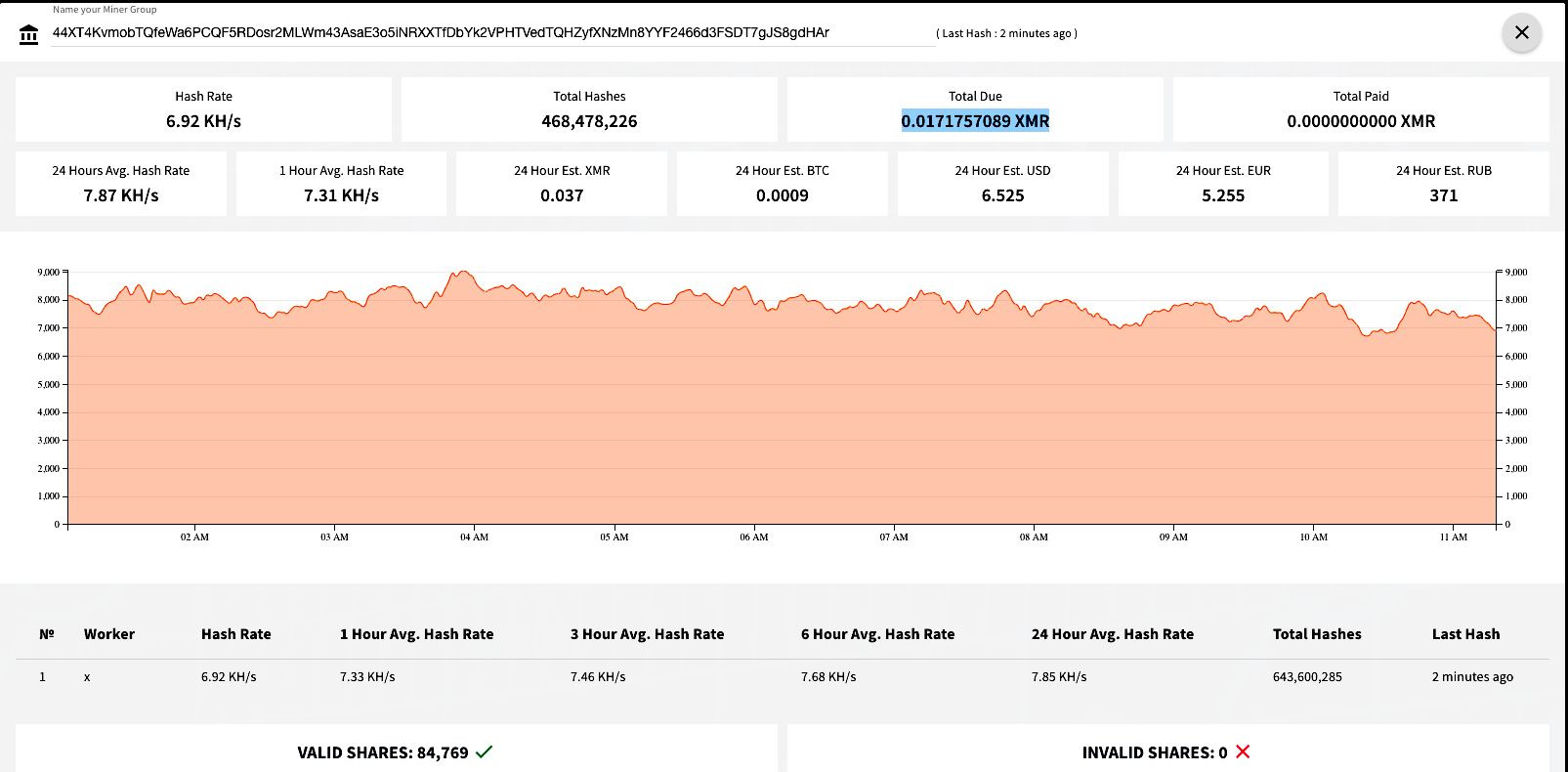
Information returned by Monero Hash Vault—the mining pool the malicious apps use to generate the digital coin—showed the attackers have a 24-hour average rate of 7,880 hashes per second. That’s a relatively small amount. So far, the attackers have generated 0.0171757089 XMR, which at current prices is worth about $3.

It’s not yet clear precisely how devices are getting infected. As noted earlier, Netlab researchers are withholding some details, but they did provide one potential clue when they said some of the infection code relies on Mirai, the malware that compromises routers and other Internet-of-Things devices by guessing default administrator passwords.

https://arstechnica.com/?p=1254677


Flash Zero-Day Attacks Analyzed by FireEye, Cisco

FireEye and Cisco have analyzed the attacks involving a recently disclosed Flash Player zero-day vulnerability and linked them to a group known for targeting South Korean entities.

South Korea’s Internet & Security Agency (KISA) warned last week of a zero-day flaw in Flash Player. Some local security experts said the vulnerability had been exploited by North Korean hackers since mid-November 2017 in attacks aimed at individuals in South Korea.

Adobe has confirmed the existence of the flaw, which affects Flash Player 28.0.0.137 and earlier, and it plans on patching it sometime this week. The security hole, tracked as CVE-2018-4878, is a use-after-free issue that can allow a remote attacker to execute arbitrary code.

FireEye has launched an investigation following the alert from KISA and linked the attack to a group it tracks as TEMP.Reaper. This threat actor is believed to be operating out of North Korea based on the fact that it has been spotted interacting with command and control (C&C) servers from IP addresses associated with Star JV, the North Korean-Thai joint venture that connects the country to the Internet.

“Historically, the majority of their targeting has been focused on the South Korean government, military, and defense industrial base; however, they have expanded to other international targets in the last year. They have taken interest in subject matter of direct importance to the Democratic People’s Republic of Korea (DPRK) such as Korean unification efforts and North Korean defectors,” FireEye said.

FireEye said its researchers spotted a new wiper malware, dubbed “RUHAPPY,” being developed by the Reaper group in the past year. North Korean threat actors have been known to use wiper malware, but Reaper has not been seen using RUHAPPY in attacks.

The security firm’s analysis showed that the hackers have exploited the Flash Player zero-day vulnerability using malicious Office documents and spreadsheets containing a specially crafted SWF file. If the flaw is exploited successfully, a piece of malware named by FireEye “DOGCALL” is delivered.

Cisco Talos has published several reports in the past months on this remote access trojan (RAT), which it tracks as ROKRAT.

The company has attributed the Flash Player zero-day attacks to an actor it has named “Group 123.” Talos last month detailed several campaigns conducted by this group against South Korean targets, but researchers have refrained from explicitly attributing the operations to North Korea.

“Group 123 have now joined some of the criminal elite with this latest payload of ROKRAT,” Talos researchers said in a blog post on Friday. “They have used an Adobe Flash 0 day which was outside of their previous capabilities – they did use exploits in previous campaigns but never a net new exploit as they have done now. This change represents a major shift in Group 123s maturity level, we can now confidentially assess Group 123 has a highly skilled, highly motivated and highly sophisticated group.”

Simon Choi of South Korea-based cybersecurity firm Hauri, one of the first people to publicly attribute the attack to North Korea, said they had traced one of the hackers using the Flash zero-day to a Facebook account apparently belonging to a resident of North Korea’s capital city of Pyongyang.

*Updated with information from Simon Choi

Related: U.S. Government Shares Details of FALLCHILL Malware Used by North Korea

Related: Australia, Canada, Others Blame North Korea for WannaCry Attack

Related: North Korean Hackers Target Android Users in South

view counter

Eduard Kovacs is a contributing editor at SecurityWeek. He worked as a high school IT teacher for two years before starting a career in journalism as Softpedia’s security news reporter. Eduard holds a bachelor’s degree in industrial informatics and a master’s degree in computer techniques applied in electrical engineering.

Previous Columns by Eduard Kovacs:

Tags:

http://feedproxy.google.com/~r/Securityweek/~3/OUBDHozwEwg/flash-zero-day-attacks-analyzed-fireeye-cisco


An Adobe Flash 0day is being actively exploited in the wild

Enlarge / A screenshot of the malicious Excel document spreading a Flash zeroday.

An increasingly sophisticated hacking group is exploiting a zero-day vulnerability in Adobe’s Flash Player that lets them take full control of infected machines, researchers said Friday.

The critical, use-after-free vulnerability, which is indexed as CVE-2018-4877, resides in the latest version of the widely installed Flash, researchers from Cisco Systems’ Talos group said in a blog post. Adobe said separately that versions earlier than current Flash 28.0.0.137 are also susceptible. The vulnerability came to light on Wednesday when South Korea’s CERT issued an advisory warning that attack code was circulating in the wild that exploited the zeroday flaw.

Talos said the exploit is being distributed through a Microsoft Excel document that has a malicious Flash object embedded into it. Once the SWF object is triggered, it installs ROKRAT, a remote administration tool Talos has been tracking since January 2017. Until now, the group behind ROKRAT—which Talos calls Group 123—has relied on social engineering or exploits of older, previously known vulnerabilities that targets hadn’t yet patched. This is the first time the group has used a zeroday exploit.

“Group 123 have now joined some of the criminal elite with this latest payload of ROKRAT,” Talos researchers Warren Mercer and Paul Rascagneres wrote in Friday’s post. “They have used an Adobe Flash 0day which was outside of their previous capabilities—they did use exploits in previous campaigns but never a net new exploit as they have done now. This change represents a major shift in Group 123s maturity level, we can now confidentially assess Group 123 has a highly skilled, highly motivated and highly sophisticated group.”

Group 123 has focused almost entirely on infecting targets located in South Korea. According to this post Talos published last month, Group 123 members speak perfect Korean and are thoroughly familiar with the Korean Peninsula region. Talos has stopped short of saying the group has ties to North Korea, but a South Korean security researcher tweeted Thursday that the Flash exploit was “made by North Korea.” The researcher didn’t respond to questions seeking more details.

While the number of in-the-wild attacks exploiting Flash zerodays has dropped significantly over the past year or two, the risk posed by the Adobe media player remains unacceptably high relative to the benefit it provides most users. And now that word of the vulnerability is circulating, it wouldn’t be surprising for other groups to use it against a much wider audience.

Ars has long advised readers to uninstall the Flash app from their computers. For people who rely on sites that require Flash, Google’s Chrome browser provides a customized version of the player that’s protected by a security sandbox and can be turned on for specific sites. Adobe said it plans to release a patched version of Flash the week of February 5.

This post was updated to correct the time frame Adobe gave for fixing the flaw.

https://arstechnica.com/?p=1253961