Kaspersky Patches Vulnerabilities in Secure Mail Gateway

Kaspersky Lab this week released an update for its Secure Mail Gateway to resolve a series of vulnerabilities that could lead to account takeover, code execution, and privilege escalation.

The Kaspersky Secure Mail Gateway is an integrated email system and security solution that comes bundled with anti-spam, anti-malware, and anti-phishing and deployed on a virtual appliance. 

Core Security Technologies found four security flaws in Kaspersky’s product, including Cross-Site Request Forgery, Improper Neutralization of Special Elements in Output Used by a Downstream Component, Improper Privilege Management, and Improper Neutralization of Input during Web Page Generation.

A remote attacker could exploit these issues to gain command execution as root, Core Security’s researchers say. The bugs were found in Kaspersky Secure Mail Gateway 1.1.0.379.

Kaspersky Secure Mail Gateway comes with a Web Management Console to monitor the application status and manage operations, but has no cross-site request forgery protection site-wide, which could lead to administrative account takeover, Core Security’s advisory noted.

An attacker could submit authenticated requests when an authenticated user browses an attacker-controlled domain, the researchers explain. Thus, a feature that allows users to restore a backup file that overwrites the appliance’s configuration can be abused to overwrite the original passwd file and provide the attacker with admin access.

Furthermore, an attacker who accesses the Web Console could gain command execution as root through the injection of arbitrary content into the appliance’s Postfix configuration.

The console makes it possible to add a “BCC Address for all Messages”, a configuration parameter written verbatim to the appliance’s Postfix main.cf configuration file. When adding LF characters to it, an attacker could inject a configuration parameter to execute arbitrary commands on the appliance as root.

This allows the attacker to execute any binary on the system, but can’t pass arguments to it. However, it is possible to overcome this by abusing another Web Console functionality to upload a Python script to the file system, the researchers discovered.

The third issue could allow an attacker to elevate privileges from kluser to root by abusing a setuid binary shipped with the appliance and execute a script on the attacker-controlled location with root privileges.

A reflected cross-site scripting flaw also impacts the Management Console. The issue resides in the callback parameter of the importSettings action method.

The security researchers reported the bugs to Kaspersky in early October 2017. On February 1, 2017, Kaspersky published an advisory to announce the patching of these issues in Kaspersky Secure Mail Gateway 1.1 MR1. Impacted customers are advised to upgrade to the new release as soon as possible.

Related: Kaspersky Releases Open Source Digital Forensics Tool

Related: Kaspersky Patches Flaws in Anti-Virus for Linux File Server

view counter

Ionut Arghire is an international correspondent for SecurityWeek.

Previous Columns by Ionut Arghire:

Tags:

http://feedproxy.google.com/~r/Securityweek/~3/X4h6CmSo5rM/kaspersky-patches-vulnerabilities-secure-mail-gateway



Cryptocurrency botnets are rendering some companies unable to operate

We’re imagining botnets in 2018 aren’t greatly impacting vintage OS systems, but many modern computers aren’t performing their best post-Smominru.

A massive cryptocurrency mining botnet has generated as much as $3.6 million dollars’ worth of the digital coin known as Monero since last May, a researcher said Wednesday. The windfall isn’t the only noteworthy thing about the botnet. Dubbed Smominru, it’s also significant for the 526,000 computers it has infected and for the ability of its operators to withstand takedown attempts by whitehats.

“As Bitcoin has become prohibitively resource-intensive to mine outside of dedicated mining farms, interest in Monero has increased dramatically,” a researcher, who uses the pseudonym Kafeine, wrote in a blog post published by security firm Proofpoint. “While Monero can no longer be mined effectively on desktop computers, a distributed botnet like that described here can prove quite lucrative for its operators.”

Like cryptocurrency mining botnets known as Adylkuzz and Zealot, Smominru appropriates potent exploit code developed by the National Security Agency and later published online by a group calling itself the Shadow Brokers.

Like Zealot, Smominru uses other exploit techniques to infect targeted computers, but it can fall back on the NSA-developed EternalBlue in certain cases, presumably for spreading from machine to machine inside infected networks or when other infection techniques fail on a machine that hasn’t been patched. Smominru also makes use of the Windows Management Interface. Proofpoint said that the botnet is also likely exacting a punishing performance impact on the business networks it infects by slowing down servers and driving up electricity costs.

Kafeine said that Proofpoint worked with other researchers to seize control of the domains used to control Smominru. They also reported the illegal activity to MineXMR, the Monero mining pool the botnet subscribed to. Smominru operators held onto the botnet by registering new domains and new addresses for MineXMR, although it’s possible the operators may have lost control of more than a third of the botnet in the process.

But wait, there’s more

Earlier this week, researchers from security firm CrowdStrike issued their own report on a botnet that bears some resemblance to Smominru. Named WannaMine, it also mines Monero and uses EternalBlue. A CrowdStrike spokeswoman said company researchers believe WannaMine is distinct from Smominru. The researchers said the botnets contact different mining pool addresses and host their command and control servers with different providers.

Another similarity between WannaMine and Smominru is the destructive effect they have on the machines and networks they infect.

“CrowdStrike has recently seen several cases where mining has impacted business operations, rendering some companies unable to operate for days and weeks at a time,” company researchers wrote. “The tools have caused systems and applications to crash due to such high CPU utilization speeds.”

https://arstechnica.com/?p=1253647


New Botnet Is Recruiting IoT Devices

A new botnet is recruiting Internet of Things (IoT) devices by exploiting two vulnerabilities already popular among IoT botnets, Radware has discovered.

Dubbed JenX, the threat is abusing the CVE-2014-8361 (Realtek SDK Miniigd UPnP SOAP Command Execution) and CVE-2017–17215 (Huawei Router HG532 – Arbitrary Command Execution) vulnerabilities. Both of these security issues were previously abused by the Mirai variant Satori.

The new threat also uses techniques associated with the recently detailed PureMasuta variant of Mirai, which recently had its source code published on an invite-only dark forum.

The botnet’s command and control (C&C) server also provides gaming mod servers and distributed denial of service (DDoS) services, Radware’s researchers discovered.

The DDoS feature includes attack vectors such as Valve Source Engine Query and 32bytes floods, TS3 scripts, and a Down OVH option (likely a reference the Mirai attack on a cloud hosting provider OVH in September 2016). The miscreants guarantee attack volumes of 290-300Gbps, supposedly leveraging the power of the new botnet.

JenX uses servers to perform the scanning and exploit operations, unlike previously observed IoT botnets such as Mirai, Hajime, Persirai, Reaper, Satori, and Masuta, which leverage infected systems for scanning and exploiting (which also fuels an exponential growth of the botnet).

Because it does not include scanning and exploit payloads, JenX’ code is unsophisticated and lighter on the delivery, Radware says. With centralized scan and exploit functionality, the operators also have increased flexibility to expand and improve the functionality without impacting the size of the bot.

Because there are fewer nodes scanning and exploiting, the botnet is less noisy and can better avoid being detected by honeypots. This also makes it more difficult to estimate the botnet’s size, without accessing the C&C server, the security researchers say. On top of that, the botnet only impacts the victim’s network connection when instructed to perform an attack.

“The drawback of the central approach is a less than linear growth with the number of deployed servers. Much slower compared to the exponential growth rate of and less aggressive than distributed scanning botnets,” Radware notes.

The malware is protected with anti-debugging detection and its binary forks three processes obfuscated in the process table much like Mirai. All processes listen to a port bound to localhost while one opens a TCP socket to the C&C at 80.82.70.202 on port 127. The bot uses XOR obfuscation with the exact same key used in PureMasuta.

When executed, the malware connects to the C&C server located by the hostname ‘skids.sancalvicie.com’ using the TCP session (the domain is registered to Calvos S.L.). The server supposedly provides a command line interface.

The code has indicators of a Valve Source Engine Query attack payload, likely because of the GTA San Andreas multiplayer servers on the domain. The attack vector was included in the original Mirai code that went public in October 2016, and Radware believes the botnet is being built by the San Calvicie hacker group and served through their Clearnet website.

“Unless you frequently play GTA San Andreas, you will probably not be directly impacted. The botnet is supposed to serve a specific purpose and be used to disrupt services from competing GTA SA multiplayer servers. I do not believe that this will be the botnet that will take down the internet! But it does contain some interesting new evolutions and it adds to a list of IoT botnets that is growing longer and faster every month,” Radware’s Pascal Geenens note.

Two providers informed on the issue have already taken down the exploit servers hosted in their datacenters, but some servers remain active and the botnet is still operational, Geenens says. However, should the attackers decide to move their exploit servers to the darknet, the botnet’s takedown would be much more difficult, as was the case with BrickerBot.

“JenX, in particular, can be easily concealed and hardened against takedowns. As they opted for a central scan and exploit paradigm, the hackers can easily move their exploit operations to bulletproof hosting providers who provide anonymous VPS and dedicated servers from offshore zones. These providers do not care about abuse,” Geenens says.

Related: Mirai-Based Masuta Botnet Weaponizes Old Router Vulnerability

Related: Researchers Connect Lizard Squad to Mirai Botnet

view counter

Ionut Arghire is an international correspondent for SecurityWeek.

Previous Columns by Ionut Arghire:

Tags:

http://feedproxy.google.com/~r/Securityweek/~3/VmFGHBDfR8I/new-botnet-recruiting-iot-devices


Web Server Used in 100 ICS Products Affected by Critical Flaw

A critical vulnerability that could allow a remote attacker to execute arbitrary code has been found in a component used by more than 100 industrial control systems (ICS) from tens of vendors.

The flaw affects the web server component of 3S-Smart Software Solutions’ CODESYS WebVisu product, which allows users to view human-machine interfaces (HMIs) for programmable logic controllers (PLCs) in a web browser.

According to the CODESYS website, the WebVisu product is used in 116 PLCs and HMIs from roughly 50 vendors, including Schneider Electric, WAGO, Hitachi, Advantech, Beck IPC, Berghof Automation, Hans Turck, and NEXCOM.

Zhu WenZhe of Istury IOT discovered that the CODESYS web server is affected by a stack-based buffer overflow vulnerability that could allow an attacker to cause a denial-of-service (DoS) condition and possibly even execute arbitrary code on the web server.

“A crafted web server request may cause a buffer overflow and could therefore execute arbitrary code on the web server or lead to a denial-of service condition due to a crash in the web server,” 3S-Smart Software Solutions explained in an advisory.

The vendor says that while there is no evidence that the flaw has been exploited in the wild, even an attacker with low skill may be able to exploit it remotely.

Related: Learn More at SecurityWeek’s ICS Cyber Security Conference

The vulnerability is tracked as CVE-2018-5440 and it has been assigned a CVSS score of 9.8. CODESYS v2.3 web servers running on any version of Windows (including Windows Embedded Compact) as stand-alone or part of the CODESYS runtime system prior to version 1.1.9.19 are affected. Version 1.1.9.19, which is also part of the CODESYS 2.3.9.56 setup, patches the vulnerability.

While 3S-Smart Software Solutions says it has not identified any workarounds for this security hole, the company has advised organizations to ensure that access to controllers is restricted through minimization of network exposure, and the use of firewalls and VPNs. The company has also published a white paper with general recommendations on security in industrial control applications.

Vulnerabilities in CODESYS components are not uncommon. Last April, industrial cybersecurity startup CyberX uncovered several critical flaws in the CODESYS web server. More recently, SEC Consult reported that a CODESYS component flaw exposed PLCs from WAGO and possibly other vendors to attacks.

Shodan has been crawling port 2455, which is specific to the CODESYS protocol, since 2014. The search engine currently shows more than 5,600 systems reachable via this port, with a majority in the United States, Germany, Turkey, China and France.

Shodan map shows CODESYS devices

Related: Increasing Number of Industrial Systems Accessible From Web

view counter

Eduard Kovacs is a contributing editor at SecurityWeek. He worked as a high school IT teacher for two years before starting a career in journalism as Softpedia’s security news reporter. Eduard holds a bachelor’s degree in industrial informatics and a master’s degree in computer techniques applied in electrical engineering.

Previous Columns by Eduard Kovacs:

Tags:

http://feedproxy.google.com/~r/Securityweek/~3/hb1y9P6HXHQ/web-server-used-100-ics-products-affected-critical-flaw


Increasing Number of Industrial Systems Accessible From Web: Study

The number of industrial control systems (ICS) accessible from the Internet has increased significantly in the past year, reaching more than 175,000 components, according to a new report from Positive Technologies.

Using the Shodan, Censys and Google search engines, researchers identified 175,632 ICS components accessible from the Web. In comparison, similar searches conducted in the previous year uncovered just over 162,000 systems.

Of all the systems identified in 2017, more than 66,000 were accessible via HTTP, followed by the Fox building automation protocol associated with Honeywell’s Niagara framework (39,000), Ethernet/IP (25,000), BACnet (13,000), and the Lantronix discovery protocol (10,000).

The highest percentage of exposed devices, representing 42% of the total, was spotted in the United States. The number of Internet-accessible ICS components in the U.S. increased by 10% compared to 2016, from roughly 50,000 to 64,000. The U.S. is followed at a distance by Germany (13,000 accessible systems), France (7,000), and Canada (7,000).

Many of the industrial systems connected to the Web come from Honeywell (26,000), Lantronix (12,000), SMA (9,000), Beck IPC (9,000), Siemens (6,000) and Rockwell Automation (5,000).

The distribution of Internet-exposed components by type has remained largely the same compared to 2016.

Types of ICS components exposed to the Internet

John Matherly, CEO of the search engine Shodan, has confirmed for SecurityWeek that there has been an increase of roughly 10% year-over-year in terms of ICS exposure on the Internet.

“The increase is mostly in building automation protocols and despite the news coverage we haven’t seen any decrease in devices,” Matherly said.

Related: Learn More at SecurityWeek’s ICS Cyber Security Conference

According to Positive Technologies, a total of nearly 200 new vulnerabilities were disclosed in 2017, compared to 115 in 2016. Worryingly, 61% of the flaws whose existence was made public last year were rated critical and high severity.

The most common types of vulnerabilities were remote code execution (24%), information disclosure (17%), and buffer overflows (12%). “Most vulnerabilities detected in 2017 can be exploited remotely without needing to obtain any privileges in advance,” Positive Technologies said in its report.

A report published in October by CyberX revealed that one-third of industrial and critical infrastructure systems had been connected to the Internet, based on data obtained by the industrial security firm by passively monitoring traffic from hundreds of operational technology (OT) networks.

Related: Industrial Firms Slow to Adopt Cybersecurity Measures, Says Honeywell

Related: Average Patching Time for SCADA Flaws Is 150 Days

Related: Fuzzing Tests Show ICS Protocols Least Mature

view counter

Eduard Kovacs is a contributing editor at SecurityWeek. He worked as a high school IT teacher for two years before starting a career in journalism as Softpedia’s security news reporter. Eduard holds a bachelor’s degree in industrial informatics and a master’s degree in computer techniques applied in electrical engineering.

Previous Columns by Eduard Kovacs:

Tags:

http://feedproxy.google.com/~r/Securityweek/~3/pSS-wJ2U4zE/increasing-number-industrial-systems-accessible-web-study


South Korea Warns of Flash Zero-Day Exploited by North Korea

South Korea’s Internet & Security Agency (KISA) has issued an alert for a zero-day vulnerability in Flash Player that has reportedly been exploited in attacks by North Korean hackers.

Few details have been provided, but KISA says the vulnerability affects Flash Player 28.0.0.137 and earlier. Version 28.0.0.137 is the latest, released by Adobe in January as part of the Patch Tuesday updates.

The security hole can be exploited by getting a user to open a document, web page or email containing a specially crafted Flash file, KISA said on Wednesday.

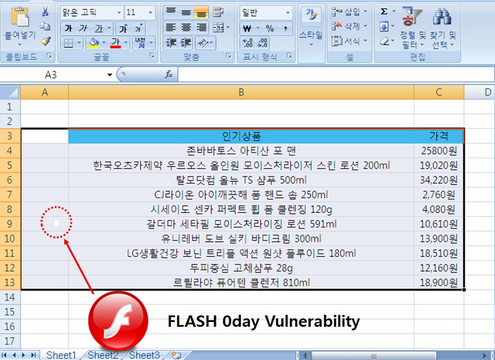
Simon Choi of South Korea-based cybersecurity firm Hauri said on Twitter the Flash Player zero-day has been exploited by North Korea since mid-November 2017 in attacks aimed at South Korean individuals who focus on researching North Korea.

According to the expert, the flaw has been leveraged to distribute malware. A screenshot he posted appears to show that the exploit has been delivered via malicious Microsoft Excel files.

Flash zero-day exploited by North Korea - credits: Simon Choi (@issuemakerslab)

SecurityWeek has reached out to Adobe for comment and will update this article once the company responds. Since the activities of North Korean threat actors have been closely monitored by several security firms, it’s possible that Adobe has already been made aware of the zero-day and is working on a patch.

UPDATE. Adobe says it’s aware of a report that an exploit for a vulnerability it tracks as CVE-2018-4878 exists in the wild, and is being used in limited, targeted attacks against Windows users. The company says it will address the flaw with an update planned for the week of February 5.

In an advisory, Adobe said the vulnerability is a critical use-after-free that allows remote code execution. Until a patch becomes available, the company has provided some mitigations.

“Beginning with Flash Player 27, administrators have the ability to change Flash Player’s behavior when running on Internet Explorer on Windows 7 and below by prompting the user before playing SWF content,” Adobe said. “Administrators may also consider implementing Protected View for Office. Protected View opens a file marked as potentially unsafe in Read-only mode.”

Related: Middle East Group Uses Flash Zero-Day to Deliver Spyware

Related: APT Group Uses Flash Zero-Day to Attack High-Profile Targets

Related: Adobe Patches Flash Zero-Day Exploited by APT Group

view counter

Eduard Kovacs is a contributing editor at SecurityWeek. He worked as a high school IT teacher for two years before starting a career in journalism as Softpedia’s security news reporter. Eduard holds a bachelor’s degree in industrial informatics and a master’s degree in computer techniques applied in electrical engineering.

Previous Columns by Eduard Kovacs:

Tags:

http://feedproxy.google.com/~r/Securityweek/~3/atz71vUkfRY/south-korea-warns-flash-zero-day-exploited-north-korea


AutoSploit: Automated Hacking Tool Set to Wreak Havoc or a Tempest in a Teapot?

AutoSploit Automatically Finds Vulnerable Targets via Shodan and Uses Metasploit Exploits to Compromise Hosts

AutoSploit is a tool designed to automate the use of Metasploit exploits. It was announced on Twitter on Wednesday.

“I just released AutoSploit on #Github. #Python based mass #exploit #tool. Gathers targets via #Shodan and automatically invokes selected #Metasploit modules to facilitate #RCE,” announced Twitter user VectorSEC, Wednesday. Just to be clear, this tool automatically finds vulnerable targets and uses Metasploit exploits to provide remote code execution for the user.

No great skill is necessary: all that is required is AutoSploit (available from GitHub), Python Blessings, Shodan, and Metasploit. Shodan locates the targets, Metasploit provides the exploits, and AutoSploit actions them. Since new vulnerability exploits are added to Metasploit faster than many companies can apply vulnerability patches, the immediate concern is whether this new tool will further commoditize cybercrime by facilitating a new army of unskilled, wannabee, skiddie, hackers able to hack computers automatically.

Just how dangerous is this? Opinions are varied. “[AutoSploit] makes being a script kiddie infinitely easier,” comments Chris Morales, head of security analytics at Vectra Networks. “It is combining a whole set of automated tools for identifying exposed hosts and then executing exploits. Where I think this will have the most dramatic effect, and what scares me most, is with IoT. I’m predicting a rash of new IoT DOS, cryptocurrency mining, and general debauchery.”

But he notes that it will simply lead to a compromised host — something security teams have to handle every day. There is still time for incident response. “We cannot rely on prevention and need to be vigilant in finding attackers once they infect systems and before they can cause real damage.”

Chris Roberts, chief security architect at Acalvio, agrees that it will attract the wannabees. “Good to know we’ve weaponized for the masses. Everyone can now be a script kiddie simply by plugging, playing and attacking.” But he points out that attack tools with ‘very nice interfaces’ are not new, and only exist because the root problem is the bad products, code, systems and infrastructures used by everyone.

“The kids are not more dangerous,” he says. “They already were dangerous. We’ve simply given them a newer, simpler, shinier way to exploit everything that’s broken. Maybe we should fix the ROOT problem.”

“The basic functionalities [of AutoSploit] were already accessible,” says ESET senior research fellow, David Harley, “but AutoSploit lowers the level of knowledge and competence necessary to take advantage of them. So, I guess there could be more skiddies snapping at the heels of companies and individuals whose patching isn’t up to scratch.”

He warns that companies cannot rely on prevention technologies to neutralize AutoSploit. “Security companies watch Metasploit with the intention of remediating where they can, so some (at least) of the modules used will be less effective on well-protected systems. Sadly, not every exploit can be 100% defended against by third-party security software. Not every system out there is well-protected. And it sounds as if AutoSploit will make it easier to find and probe systems that are less likely to be properly patched or defended with security software. Like the Internet-of-unnecessarily-interconnected-things…”

AutoSploit Hacking Tool

There are others who simply dismiss AutoSploit. Jerry Gamblin, lead security analyst at Carfax, tweeted, “While everyone is freaking out I hacked together antiautosploit to stop autosploit from sploiting you (This just blocks Shodan from scanning you).”

The general consensus from the security industry seems to be that AutoSploit will attract the kiddies but won’t change the current threat landscape — beyond perhaps making existing good practice (patching, incident response) more important and urgent.

“This doesn’t really change anything from way things are already,” says F-Secure principal researcher Jarno Niemela. “My 11-year-old son learned Metasploit when he was 10 years old, and there is a ton of tradecraft videos in YouTube for anyone who is interested… This tool simply makes something that was already very easy just a bit easier.”

But he also has a word of warning for wannabees attracted by AutoSploit. “The fact that something is really easy, does not make unauthorized computer access any less a crime. And tools like this leave a forensic footprint that is miles wide. Yes, you can compromise poorly protected systems very easily with this tool, but you can also end up in a lot of trouble.”

view counter

Kevin Townsend is a Senior Contributor at SecurityWeek. He has been writing about high tech issues since before the birth of Microsoft. For the last 15 years he has specialized in information security; and has had many thousands of articles published in dozens of different magazines – from The Times and the Financial Times to current and long-gone computer magazines.

Previous Columns by Kevin Townsend:

Tags:

http://feedproxy.google.com/~r/Securityweek/~3/fbDRT85pPQU/autosploit-automated-hacking-tool-set-wreak-havoc-or-tempest-teapot


Siemens Patches Flaws in Plant Management Product

Siemens has informed customers that a component of its TeleControl Basic product is affected by several vulnerabilities that can be exploited by an attacker to escalate privileges, bypass authentication, and launch denial-of-service (DoS) attacks.

Siemens’ TeleControl Basic system allows organizations to monitor and control plant processes. The solution can also be used to optimize the operation of municipal facilities, including water treatment, traffic monitoring, and energy distribution. TeleControl Server Basic is the software used for the TeleControl Basic control center.

According to advisories published by Siemens and ICS-CERT, the TeleControl Server Basic system is affected by a total of three vulnerabilities. The most serious of them, tracked as CVE-2018-4836 and rated high severity, allows an attacker with a low privileged account and access to TCP port 8000 to escalate privileges and perform administrative tasks.

Another flaw, CVE-2018-4835, allows an attacker with network access to port 8000 to bypass the system’s authentication mechanism and obtain limited information.

The last security hole, CVE-2018-4837, can be exploited by an attacker with access to the TeleControl web server on TCP ports 80 or 443 to cause the web server to enter a DoS condition. However, Siemens pointed out that the DoS condition does not affect other functionality.

CVE-2018-4835 and CVE-2018-4837 have been classified as medium severity with a CVSS score of 5.3.

Related: Learn More at SecurityWeek’s 2018 ICS Cyber Security Conference

Siemens has patched the vulnerabilities with the release of TeleControl Server Basic 3.1. In addition, the company has identified some workarounds and mitigations that can be used to reduce the risk of attacks.

These include blocking TCP port 8000 using the Windows firewall to mitigate CVE-2018-4835 and CVE-2018-4836, and blocking ports 80 and 443 to prevent attacks involving CVE-2018-4837.

While this is the first advisory released by Siemens and ICS-CERT for a vulnerability specific to TeleControl products, a privilege escalation flaw disclosed in November 2016 had been found to impact TeleControl Server Basic – among many other industrial solutions from Siemens. That security hole was addressed in TeleControl Server Basic with the release of version 3.0.

Related: Flaw in Siemens RTU Allows Remote Code Execution

Related: Serious Flaw Found in Many Siemens Industrial Products

Related: Siemens Patches Several Flaws in Teleprotection Devices

view counter

Eduard Kovacs is a contributing editor at SecurityWeek. He worked as a high school IT teacher for two years before starting a career in journalism as Softpedia’s security news reporter. Eduard holds a bachelor’s degree in industrial informatics and a master’s degree in computer techniques applied in electrical engineering.

Previous Columns by Eduard Kovacs:

Tags:

http://feedproxy.google.com/~r/Securityweek/~3/uQkrZE7qPrI/siemens-patches-flaws-plant-management-product


Serious Flaws Affect Several ManageEngine Products

Researchers at Digital Defense have uncovered several potentially serious vulnerabilities in IT management products from ManageEngine, including ones that allow an attacker to take complete control of the affected application. The vendor has released patches to address the flaws.

Zoho-owned ManageEngine provides network, data center, desktop and mobile device, and security solutions to more than 40,000 customers, including three out of every five Fortune 500 company.

One of the flaws found by Digital Defense affects ManageEnegine’s ServiceDesk Plus help desk software. An unauthenticated file upload vulnerability allows an attacker to upload a JavaScript web shell and use it to execute arbitrary commands with SYSTEM privileges.

Experts also discovered several blind SQL injection vulnerabilities that allow an unauthenticated attacker to take complete control of an application and possibly even the underlying host.

These types of flaws have been found in the OpManager network monitoring product, Network Configuration Manager, bandwidth monitoring and traffic analysis product NetFlow Analyzer, firewall configuration and log management product Firewall Analyzer, and IP address management app OpUtils.

These products are also impacted by an enumeration issue that can be exploited to access user information such as usernames, email addresses and phone numbers.

An attacker could gain access to the content of files on the host running ManageEngine applications by leveraging an unauthenticated XML External Entity (XXE) vulnerability.

Digital Defense said ManageEngine promptly responded to its vulnerability reports and released updates for each of the affected applications to address the security holes.

“Application layer vulnerabilities continue to be a key area of focus for software vendors,” said Mike Cotton, vice president of engineering at Digital Defense. “We are pleased to work collaboratively with affected vendors to facilitate prompt resolution, ensuring our clients and enterprises are protected from any potential exploitation of these vulnerabilities.”

Digital Defense recently reported discovering authentication bypass, arbitrary file upload, and path traversal vulnerabilities affecting data protection products from both Dell EMC and VMware.

Related: Serious Vulnerabilities Found in Riverbed SteelCentral Portal

Related: Critical Flaws Found in Dell SonicWALL Product

view counter

Eduard Kovacs is a contributing editor at SecurityWeek. He worked as a high school IT teacher for two years before starting a career in journalism as Softpedia’s security news reporter. Eduard holds a bachelor’s degree in industrial informatics and a master’s degree in computer techniques applied in electrical engineering.

Previous Columns by Eduard Kovacs:

Tags:

http://feedproxy.google.com/~r/Securityweek/~3/079ZUXYbX7Q/serious-flaws-affect-several-manageengine-products


Remotely Exploitable Vulnerability Could Impact 300,000 Oracle PoS Systems

A vulnerability Oracle addressed in the MICROS Point-of-Sale (PoS) terminals with the January 2018 Critical Patch Update could impact more than 300,000 payment systems worldwide.

Tracked as CVE-2018-2636 and featuring a CVSS v3 score of 8.1, the vulnerability was discovered in September 2017 as a directory traversal vulnerability. Hackers looking to abuse it could read any file by sending a packet to a particular web service of a PoS terminal.

The security bug can be exploited remotely without authentication to read files from the impacted PoS systems. Furthermore, attackers could abuse it to access configuration files that store sensitive information including passwords.

Attackers looking to exploit the flaw could gain full access to the operating system for espionage, sabotage or fraud operations, ERPScan, a company that specializes in securing Oracle and SAP products, reveals. By exploiting the flaw, cybercriminals could, for example, pilfer credit card numbers, the company says.

Because of the wide use of MICROS PoS terminals, the impact of such a security issue could be dire. At the moment, Oracle’s MICROS has more than 330,000 cash registers worldwide. The terminals can be found in over 200,000 food and beverage outlets and more than 30,000 hotels across 180 countries, ERPScan points out.

The vulnerability was discovered as a directory traversal in Oracle MICROS EGateway Application Service. With access to the URL, an attacker could exfiltrate files from the MICROS workstations, including services logs, and could also read files that contain usernames and encrypted passwords to gain full access to the database with all business data.

“After sending a malicious request, for example, the request to read SeviceHost.xml file, the vulnerable MICROS server sends back a special response with the SeviceHost.xml contents,” the security firm explains.

The vulnerability was addressed in Oracle’s January 2018 CPU, but the patch was unlikely to have been already deployed to all of the vulnerable MICROS PoS systems out there.

“POS systems directly process and transmit our payment orders, so it’s self-evident that they are extremely important and valuable. We use them on the daily and hope to be secure from thefts. As a user, I want to rest safe and to avoid any problem while making payments with my card. We worry for the security of our money, and it makes sense,” Alexander Polyakov, CTO of ERPScan, says.

Related: Oracle Fixes Spectre, Meltdown Flaws With Critical Patch Update

Related: Oracle Patches Critical Flaw in Identity Manager

view counter

Ionut Arghire is an international correspondent for SecurityWeek.

Previous Columns by Ionut Arghire:

Tags:

http://feedproxy.google.com/~r/Securityweek/~3/DvpJ8PzccpM/remotely-exploitable-vulnerability-could-impact-300000-oracle-pos-systems