Flaws Allowed Facebook Account Hacking via Oculus App

Facebook recently patched a couple of vulnerabilities that could have been exploited by malicious hackers to hijack accounts by abusing integration with the Oculus virtual reality headset.

Facebook announced the acquisition of Oculus VR back in July 2014 and added Oculus assets to its bug bounty program a few weeks later. Several vulnerabilities have been found in Oculus services since, including a series of flaws that earned a researcher $25,000.

In October, web security consultant Josip Franjković decided to analyze the Oculus application for Windows, which includes social features that allow users to connect their Facebook account.

Franjkovic discovered that a malicious actor could have used specially crafted GraphQL queries to connect a targeted user’s Facebook account to the attacker’s Oculus account. GraphQL is a query language created by Facebook in 2012 and later released to the public.

According to the researcher, a specially crafted query allowed an attacker to obtain the victim’s access token, which under normal circumstances should not be accessible to third-party apps, and use it to take control of their Facebook account.

Franjkovic demonstrated an account takeover method by using a specially crafted query to add a new mobile phone number to the targeted account and then leveraging that number to reset the victim’s password.

The vulnerability was reported to Facebook on October 24 and a temporary fix, which involved disabling the facebook_login_sso endpoint, was implemented on the same day. A permanent patch was rolled out on October 30.

A few weeks later, the expert discovered a login cross-site request forgery (CSRF) flaw that could have been exploited to bypass Facebook’s patch.

This second flaw was reported to Facebook on November 18 and again the facebook_login_sso endpoint was disabled on the same day as a temporary fix. A complete patch was implemented roughly three weeks later.

The researcher has not disclosed the amount of money he earned from Facebook for finding the vulnerabilities, but he told SecurityWeek that the social media giant classified the issues as critical and he was happy with the reward he received.

Facebook revealed last week that it had paid a total of $880,000 in bug bounties in 2017, with an average of roughly $1,900 per submission.

Technical details for the vulnerabilities can be found on Franjkovic’s blog. In the past years, the expert reported several vulnerabilities to Facebook, including ones that could be exploited to hijack accounts.

Related: Facebook Flaw Allowed Removal of Any Photo

Related: Facebook Awards $40,000 Bounty for ImageTragick Hack

view counter

Eduard Kovacs is a contributing editor at SecurityWeek. He worked as a high school IT teacher for two years before starting a career in journalism as Softpedia’s security news reporter. Eduard holds a bachelor’s degree in industrial informatics and a master’s degree in computer techniques applied in electrical engineering.

Previous Columns by Eduard Kovacs:

Tags:

http://feedproxy.google.com/~r/Securityweek/~3/MEcPXFf_3FI/flaws-allowed-facebook-account-hacking-oculus-app


Shared Accounts Increasingly Problematic for Critical Infrastructure: ICS-CERT

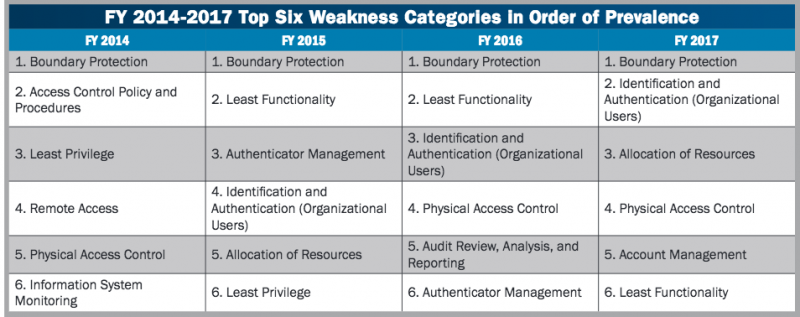
Assessments conducted last year by the U.S. Department of Homeland Security’s Industrial Control Systems Cyber Emergency Response Team (ICS-CERT) showed that boundary protection remains the biggest problem in critical infrastructure organizations, but identification and authentication issues have become increasingly common.

Critical infrastructure owners and operators can ask ICS-CERT to conduct onsite cybersecurity assessments of their industrial control systems (ICS) in order to help them strengthen their cybersecurity posture.

In 2017, ICS-CERT conducted 176 assessments, which represents a 35 percent increase compared to the previous year. The agency analyzed organizations in eight critical infrastructure sectors, but more than two-thirds of the assessments targeted the energy and water and wastewater systems sectors.

The highest number of assessments were conducted in Texas (27), followed by Alaska (20), Nebraska (15), New York (14), Washington (13), Idaho (12), Nevada (10) and Arizona (10).

ICS-CERT identified 753 issues as part of 137 architecture design reviews and network traffic analyses. The six most common weaknesses, which accounted for roughly one-third of the total, were related to network boundary protection, identification and authentication, allocation of resources, physical access controls, account management, and least functionality.

Security issues found during ICS-CERT assessments

Improper network boundary protection, which includes inadequate boundaries between enterprise and ICS networks and the inability to detect unauthorized activity on critical systems, has been the most common type of weakness since 2014.

Related: Learn More at SecurityWeek’s 2018 ICS Cyber Security Conference

As for identification and authentication issues, these can include the lack of mechanisms for tracing user actions if an account gets compromised, and increased difficulty in securing accounts belonging to former employees, particularly ones with administrator access.

Identification and authentication issues first made ICS-CERT’s top six weakness categories in 2015, when it was on the fourth position. In 2016 it jumped one position and last year it was the second most common security weakness.

Of all the identification and authentication issues, shared and group accounts are particularly concerning.

“[Shared and group accounts] make it difficult to identify the actual user and they allow malicious parties to use them with anonymity. Accounts used by a shared group of users typically have poor passwords that malicious actors can easily guess and that users do not change frequently or when a member of the group leaves,” ICS-CERT said in its latest Monitor report.

Allocation of resources for cybersecurity is also a problem in many critical infrastructure organizations. ICS-CERT’s assessment teams noticed that many sites are short-staffed and in many cases there is no backup personnel.

“Although some sites had started planning or attrition of staff, many did not have a plan to address loss of key personnel. One site had seven key personnel, four of whom would be eligible for retirement next year,” the agency said.

While its assessments do not focus on physical access controls, ICS-CERT has often noticed that organizations fail to ensure that ICS components are physically accessible only to authorized personnel.

“The team observed cases where infrastructure (i.e., routers and switches) was in company space but accessible to staff with no need to have physical access. Other cases included ICS components in public areas without any physical restrictions (i.e., locked doors or enclosures) to prevent access from a passerby. Some sites did not have locked doors to the operations plant, which would allow anyone to walk in and potentially have access to control system components,” ICS-CERT explained.

Related: Over Half of ICS Security Incidents Reported in 2014 Involved APTs

Related: Average Patching Time for SCADA Flaws Is 150 Days

view counter

Eduard Kovacs is a contributing editor at SecurityWeek. He worked as a high school IT teacher for two years before starting a career in journalism as Softpedia’s security news reporter. Eduard holds a bachelor’s degree in industrial informatics and a master’s degree in computer techniques applied in electrical engineering.

Previous Columns by Eduard Kovacs:

Tags:

http://feedproxy.google.com/~r/Securityweek/~3/OiP18CFBrDA/shared-accounts-increasingly-problematic-critical-infrastructure-ics-cert


BitTorrent users beware: Flaw lets hackers control your computer

There’s a critical weakness in the widely used Transmission BitTorrent app that allows websites to execute malicious code on some users’ computers. That’s according to a researcher with Google’s Project Zero vulnerability reporting team, who also warns that other BitTorrent clients are likely similarly susceptible.

Researcher Tavis Ormandy published the proof-of-concept attack code last week, along with a detailed description of the underlying vulnerability it exploited. Normally, Project Zero withholds publication of such details for 90 days or until the developer has released a fix. In this case, however, Ormandy’s private report to Transmission included a patch that completely fixed the vulnerability. The researcher went ahead and disclosed the vulnerability last Tuesday—only 40 days after the initial report—because Transmission developers had yet to apply it. Ormandy said the publication would allow Ubuntu and other downstream projects to independently install the fix.

“I’m finding it frustrating that the Transmission developers are not responding on their private security list,” Ormandy wrote in Tuesday’s public report. “I suggested moving this into the open so that distributions can apply the patch independently.”

A Transmission development official told Ars that he expected an official fix to be released “ASAP” but was not specific. He said the vulnerability was present only when users enabled remote access and disabled password protection. He said people run the unpatched version of Transmission as a daemon should ensure they have enabled password protection.

DNS rebinding strikes again

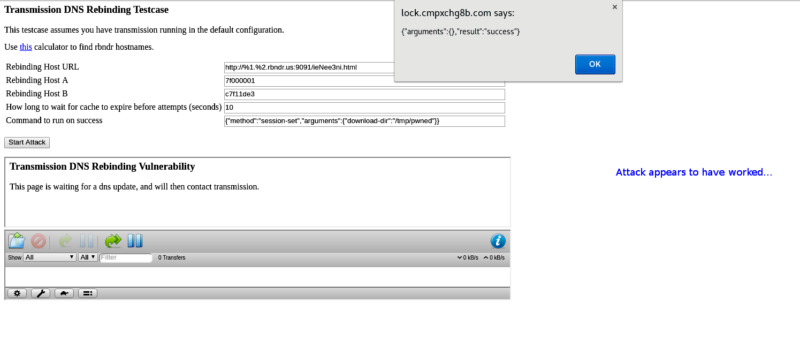
Ormandy’s proof-of-concept attack exploits a Transmission function that allows users to control the BitTorrent app with their Web browser. The researcher said most people don’t enable password protection because they assume the JSON RPC interface can only be controlled by someone with physical access to the computer running Transmission. Using a hacking technique known as domain name system rebinding, Ormandy devised a way that the Transmission interface can be remotely controlled when a vulnerable user visits a malicious site. He said he confirmed his exploit works on Chrome and Firefox on Windows and Linux and that he expects other platforms and browsers are also affected.

Attackers can exploit the flaw by creating a DNS name they are authorized to communicate with and then making it resolve to the localhost name of the vulnerable computer. In a separate posting publishing the patch, Ormandy wrote:

  1. A user visits http://attacker.com, which has an <iframe> to a subdomain the attacker controls.
  2. The attacker configures their DNS server to respond alternately with 127.0.0.1 and 123.123.123.123 (an address they control) with a very low TTL.
  3. When the browser resolves to 123.123.123.123, they serve HTML that waits for the DNS entry to expire (or force it to expire by flooding the cache with lookups), then they have permission to read and set headers.

Among the things an attacker can do is change the Torrent download directory to the user’s home directory. The attacker could then command Transmission to download a Torrent called “.bashrc” which would automatically be executed the next time the user opened a bash shell. Attackers could also remotely reconfigure Transmission to run any command of their choosing after a download has completed. Ormandy said the exploit is of “relatively low complexity, which is why I’m eager to make sure everyone is patched.”

In a tweet, Ormandy said the vulnerability was the “first of a few remote code execution flaws in various popular torrent clients.” He didn’t name the other apps because the 90-day Window hasn’t closed yet.

While last week’s disclosure has the most immediate consequences for Transmission users, its lessons about the dangers of DNS rebinding are broadly applicable to people using a wide range of apps.

“I regularly encounter users who don’t accept that websites can access services on localhost or their intranet,” Ormandy wrote. “These users understand that services bound to localhost are only accessible to software running on the local machine and that their browser is running on the local machine—but somehow believe that accessing a website ‘transfers’ execution somewhere else. It doesn’t work like that, but this is a common source of confusion.”

https://arstechnica.com/?p=1244615


Facebook Paid $880,000 in Bug Bounties in 2017

Facebook received over 12,000 vulnerability submissions in 2017 and ended up paying $880,000 in bug bounties to security researchers.

Of the large number of received submissions, however, just over 400 reports were found valid during the bug bounty program’s sixth year. Last year, Facebook also paid larger bounties to the submitting researchers, as the average reward per submission increased to almost $1,900, up from $1,675 in 2016.

The number of security researchers participating in the company’s bug bounty program also increased, Jack Whitton, Security Engineer with Facebook’s Product Security team, explains in a blog post. 32% of the researchers who received a reward last year submitted for the first time in 2017.

The largest bounty the company has paid to date is a $40,000 reward for ImageTragick, a remote code execution vulnerability introduced by the ImageMagick image processing suite. Last year, the company also paid a $10,000 bounty for a critical vulnerability that could result in deleting any photo from the social media network.

The largest number of valid submissions in 2017, Facebook says, came out of India. The United States ended up on the second position, followed by Trinidad & Tobago in the third place.

Facebook acknowledged more than 100 researchers as part of the bug bounty program in 2017. 

“Going forward, we are going to take a number of things into consideration: dollar amount, submission validity, and more. We’re doing this to continue to encourage high-quality submissions, and we will be offering new perks to our top participants such as swag and prizes, access to exclusive events and new features,” Whitton explains.

He also reveals that Facebook is planning on investing more resources into getting more timely responses and payments to researchers in 2018.

Researchers interested in submitting reports as part of Facebook’s bug bounty program are encouraged to follow the best practices the company is listing at facebook.com/whitehat/resources.

“After celebrating our 6th anniversary, we paid out over $880,000 to researchers last year, bringing our total paid out to over $6,300,000,” Whitton says.

Facebook launched its bug bounty program in 2011 and paid over $5 million to researchers by October 2016.

Related: Facebook Flaw Allowed Removal of Any Photo

Related: Facebook Awards $40,000 Bounty for ImageTragick Hack

view counter

Ionut Arghire is an international correspondent for SecurityWeek.

Previous Columns by Ionut Arghire:

Tags:

http://feedproxy.google.com/~r/Securityweek/~3/xS4Re4c4zOY/facebook-paid-880000-bug-bounties-2017


ICS Vendors Assessing Impact of Meltdown, Spectre Flaws

Organizations that provide solutions for critical infrastructure sectors, including medical device and industrial control systems (ICS) manufacturers, have started assessing the impact of the recently disclosed Meltdown and Spectre exploits on their products.

The Meltdown and Spectre attacks allow malicious applications to bypass memory isolation mechanisms and access potentially sensitive data. Billions of devices using Intel, AMD, ARM, Qualcomm and IBM processors are affected.

While affected companies have been working on releasing both software and firmware mitigations, the changes made to a system can introduce significant performance penalties and in some cases users reported that the patches had broken their operating system and various applications.Spectre and Meltdown affect industrial control systems

Considering that in the case of industrial systems availability and integrity are of the utmost importance, vendors have warned customers that extensive testing should be conducted before any patches are applied in an effort to avoid disruptions.

Several vendors have published advisories to inform customers that they are assessing the impact of the Spectre and Meltdown exploits. The list includes Siemens, Schneider Electric, ABB, Rockwell Automation, and medical technology company Becton Dickinson (BD). ICS-CERT has also published an advisory directing users to the advisories of some vendors.

Siemens

In an advisory published on Thursday, Siemens told customers that it’s analyzing the impact of the vulnerabilities and available mitigations. Several of the company’s products may be affected as they are typically installed on systems powered by one of the affected processors.

“Updates for operating systems, processor firmware, and other systems can help to mitigate these vulnerabilities. Siemens is testing the compatibility of the patches released for supported operating systems for several products,” the company said.

“Siemens is aware that some updates can result in compatibility, performance or stability issues on certain products and operating systems. Operating system vendors, such as Microsoft, are still working to address these compatibility issues with their updates. Siemens will therefore continue to evaluate the applicability of those updates,” it added.

Until patches and workarounds can be safely applied, Siemens has advised organizations to ensure that untrusted code cannot be executed on systems running its products, which is a requirement for launching Meltdown and Spectre attacks.

Rockwell Automation

Spectre and Meltdown affect industrial control systems

Rockwell Automation has also confirmed that its customers’ environments are potentially impacted by the vulnerabilities.

The company is working with software and hardware partners on addressing the problem in its E1000, E2000 and E3000 Industrial Data Center (IDC) offerings. Its employees are also working on testing the updates made available by Microsoft.

Rockwell Automation has warned organizations that some of the updates released by Microsoft are known to cause anomalies in FactoryTalk-based products, including Studio 5000, FactoryTalk View SE, and RSLinx Classic. Rockwell has been working with Microsoft on resolving the anomalies.

Schneider Electric

Schneider Electric is also monitoring the situation. The company has informed customers that the list of impacted products includes StruxureWare Data Center Expert (DCE), StruxureWare Data Center Operation (DCO), NetBotz Appliances, APC Network Management Cards, PowerChute Network Shutdown, PowerChute Business Edition, PowerChute Personal Edition, and 1ph and 3ph UPS.

“Many of the initial mitigations proposed by hardware and operating system vendors indicate a high level of potential performance impact, Schneider Electric recommends caution if mitigations or patches are applied to critical and/or performance constrained systems,” Schneider Electric said. “If you elect to apply recommended patches or mitigations in advance of further guidance from Schneider Electric, we strongly recommend evaluating the impact of those measures on a Test & Development environment or an offline infrastructure.”

Schneider Electric’s Wonderware warned users that one of Microsoft’s updates causes Wonderware Historian to become unstable.

ABB

Swiss power and automation solutions provider ABB told customers that it has launched an investigation, but all products running on affected processors are potentially impacted.

“The vulnerabilities do not target any ABB products specifically, but potentially affect products that use affected processors in general,” ABB said in an advisory published last week.

Until the company assesses the impact of the attacks on each of its products, it has advised customers to ensure that industrial networks are protected against unauthorized access. Unlike other vendors, ABB has advised customers to install operating system updates without mentioning the potential risks associated with applying unstable patches.

BD

BD pointed out to customers that the vulnerabilities are not exclusive to its products or medical devices in general, and the company believes the risk of attacks is low. BD has provided a list of impacted products.

The company has advised users to apply patches from Microsoft and any firmware updates that may become available. However, the updates from Microsoft should only be applied after they have been tested and approved by BD.

Testing needed before applying patches

While not all ICS vendors mentioned it, any patches and mitigations for the Spectre and Meltdown vulnerabilities should be tested before being deployed to critical systems, particularly since some of them may cause devices to become unstable.

“The changes needed to fix Spectre and Meltdown vulnerabilities more thoroughly are so extensive that costly and extensive testing will be needed before the updates can safely be applied to reliability-critical control systems,” explained Andrew Ginter, VP of Industrial Security at Waterfall Security.

“In the very short term, what every control system owner and operator will be asking is ‘how long can we safely delay this very costly testing process?’ and ‘do I need to drop everything and start testing and applying these fixes yesterday?’,” Ginter added.

*Updated with impact of Microsoft patches on Wonderware Historian

Related: IBM Starts Patching Spectre, Meltdown Vulnerabilities

Related: Microsoft, Intel Share Data on Performance Impact of CPU Flaw Patches

Related: Lawsuits Filed Against Intel Over CPU Vulnerabilities

Related: Industry Reactions to Meltdown, Spectre Attacks

view counter

Eduard Kovacs is a contributing editor at SecurityWeek. He worked as a high school IT teacher for two years before starting a career in journalism as Softpedia’s security news reporter. Eduard holds a bachelor’s degree in industrial informatics and a master’s degree in computer techniques applied in electrical engineering.

Previous Columns by Eduard Kovacs:

Tags:

http://feedproxy.google.com/~r/Securityweek/~3/8Y47Q8OslO8/ics-vendors-assessing-impact-meltdown-spectre-flaws


AMD Working on Microcode Updates to Mitigate Spectre Attack

AMD has informed customers that it will soon release processor microcode updates that should mitigate one of the recently disclosed Spectre vulnerabilities, and Microsoft has resumed delivering security updates to devices with AMD CPUs.

Shortly after researchers revealed the Spectre and Meltdown attack methods, which allow malicious actors to bypass memory isolation mechanisms and access sensitive data, AMD announced that the risk of attacks against its products was “near zero.”

The company has now provided additional information on the matter, but maintains that the risk of attacks is low.

According to AMD, its processors are not vulnerable to Meltdown attacks thanks to their architecture. They are, however, vulnerable to Spectre attacks.

Spectre attacks are made possible by two vulnerabilities: CVE-2017-5753 and CVE-2017-5715. The former does impact AMD processors, but the chipmaker is confident that operating system patches are sufficient to mitigate any potential attacks.

Microsoft announced a few days ago that it had suspended the delivery of security updates to devices with AMD processors due to some compatibility issues. AMD said the problem affected some older processors, including Opteron, Athlon and Turion families.

Microsoft said on Thursday that it had resumed the delivery of updates to a majority of AMD devices, expect for a “small subset” of older processors. AMD told customers it expects the issue to be corrected for the remaining processors by next week.

As for the second Spectre vulnerability, AMD believes it is difficult to exploit against its products. Nevertheless, the company has been working with operating system vendors to develop patches, and it has also promised to provide optional microcode updates.

The microcode updates should become available for Ryzen and EPYC processors in the next days, and for previous generation products sometime over the coming weeks. The updates will be available from system manufacturers and OS vendors.

AMD claims its GPUs are not impacted by the vulnerabilities. NVIDIA also says its GPUs are immune, but the company has still provided some display driver updates to help mitigate the CPU flaws.

Intel has already released patches, including processor microcode updates, for many of its processors. Linux users can install the microcode updates through the operating system’s built-in mechanism.

The fixes for the Spectre and Meltdown vulnerabilities appear to cause problems on some systems. Ubuntu users complained that their devices failed to boot after installing updates, forcing Canonical to release a new kernel update to address the issue.

Intel has also become aware of reports that systems with Broadwell and Haswell CPUs reboot more often as a result of the patches.

“We are working quickly with these customers to understand, diagnose and address this reboot issue. If this requires a revised firmware update from Intel, we will distribute that update through the normal channels. We are also working directly with data center customers to discuss the issue,” the company stated.

Related: IBM Starts Patching Spectre, Meltdown Vulnerabilities

Related: Microsoft, Intel Share Data on Performance Impact of CPU Flaw Patches

Related: Lawsuits Filed Against Intel Over CPU Vulnerabilities

Related: Industry Reactions to Meltdown, Spectre Attacks

view counter

Eduard Kovacs is a contributing editor at SecurityWeek. He worked as a high school IT teacher for two years before starting a career in journalism as Softpedia’s security news reporter. Eduard holds a bachelor’s degree in industrial informatics and a master’s degree in computer techniques applied in electrical engineering.

Previous Columns by Eduard Kovacs:

Tags:

http://feedproxy.google.com/~r/Securityweek/~3/wa_aQJtGk8k/amd-working-microcode-updates-mitigate-spectre-attack


Bogus Passwords Can Unlock AppStore Preferences in macOS

A security vulnerability impacting macOS High Sierra allows admins to unlock the AppStore Preferences in System Preferences by providing any password.

The issue was found to affect macOS 10.13.2, the latest iteration of the platform, and can be reproduced only if the user is logged in as administrator. For non-admin accounts, the correct credentials are necessary to unlock the preferences pane.

macOS High Sierra 10.13.2 users interested in reproducing the bug should log into their machines as administrators, then navigate to the App Store preferences in System Preferences.

Next, users should click on the padlock icon to lock it if necessary, then click it again. When prompted to enter the login credentials, they can use any password and still unlock the Prefpane.

One thing that should be noted is that the App Store setting is opened up unlocked by default when the user is logged as admin and that no sensitive user information can be accessed by triggering the bug.

Eric Holtam notes the security oversight only impacts the App Store preferences and no other system preferences menu can be unlocked in a similar manner. The admin password is still required when attempting to change user and other system preferences.

The issue, however, is not as dangerous as it might look. For starters, the bug can only be triggered if the user is logged in as admin, which clearly minimizes the vulnerability’s impact, given that the admin can unlock the specific settings.

Users affected by the flaw would be those who, although logged as admins, would still keep the App Store preferences locked. In such cases, if the machine was left unattended, anyone with physical access to it could change the respective settings.

Apple, however, is already working on addressing the issue. A patch has been included in the latest beta seed of macOS High Sierra (10.13.3) and will be released to all Mac users in a future software update.

In late November, the tech giant patched a critical authentication bypass vulnerability in macOS High Sierra 10.13.1, where anyone could login as root by providing any password. The attack however, was possible only if the root account hadn’t been enabled or a password hadn’t been set for it. However, experts revealed that remote attacks were also possible.

Related: Apple Adds Spectre Protections to Safari, WebKit

Related: Apple Patches Critical Root Access Flaw in macOS


view counter

Ionut Arghire is an international correspondent for SecurityWeek.

Previous Columns by Ionut Arghire:

Tags:

http://feedproxy.google.com/~r/Securityweek/~3/FsJIw29WP9M/bogus-passwords-can-unlock-appstore-preferences-macos


Meltdown Patch Broke Some Ubuntu Systems

Canonical was forced to release a second round of Ubuntu updates that address the recently disclosed CPU vulnerabilities after some users complained that their systems no longer booted after installing the initial patches.

On January 9, Canonical released Ubuntu updates designed to mitigate Spectre and Meltdown, two recently disclosed attack methods that work against processors from Intel, AMD, ARM, Qualcomm and IBM. The Linux kernel updates mitigate the vulnerabilities that allow the Meltdown (CVE-2017-5754) and Spectre (CVE-2017-5753 and CVE-2017-5715) attacks.

Shortly after the kernel was updated to version 4.4.0-108, some Ubuntu users started complaining that their systems had failed to boot. Restoring the system to an earlier version apparently resolved the problem.

The updates released by Microsoft in response to the CPU flaws also caused problems, but only for users with some older AMD processors. The company has decided to no longer deliver the updates to AMD devices until compatibility issues are resolved. In the case of Ubuntu, however, the update has affected users with Intel processors.

Canonical has confirmed that the fix for the Meltdown vulnerability introduced a regression that prevented systems from booting successfully. The issue has been addressed with the release of new updates that deliver version 4.4.0.109 of the kernel.

Many affected users have confirmed that their systems boot properly after updating to 4.4.0-109. While it’s unclear how many devices have been hit, Canonical’s advisories mention “a few systems.”

Affected tech firms started announcing the availability of patches and workarounds for the Spectre and Meltdown vulnerabilities shortly after the flaws were disclosed by researchers. The latest major companies to release mitigations are IBM, whose POWER processors and Power Systems servers are impacted, and NVIDIA, which released updates for GPU display drivers and other products to help mitigate the CPU issues.

Meltdown and Spectre allow malicious applications to bypass memory isolation mechanisms and access passwords, photos, documents, emails, and other sensitive information. Patches for the underlying vulnerabilities may introduce significant performance penalties.

Related: Microsoft, Intel Share Data on Performance Impact of CPU Flaw Patches

Related: Lawsuits Filed Against Intel Over CPU Vulnerabilities

Related: Industry Reactions to Meltdown, Spectre Attacks

Related: Hackers Expected to Remotely Exploit CPU Vulnerabilities

view counter

Eduard Kovacs is a contributing editor at SecurityWeek. He worked as a high school IT teacher for two years before starting a career in journalism as Softpedia’s security news reporter. Eduard holds a bachelor’s degree in industrial informatics and a master’s degree in computer techniques applied in electrical engineering.

Previous Columns by Eduard Kovacs:

Tags:

http://feedproxy.google.com/~r/Securityweek/~3/wvoX2fo-4Mg/meltdown-patch-broke-some-ubuntu-systems


Security Flaws Found in Majority of SCADA Mobile Apps

Researchers from IOActive and Embedi have conducted an analysis of SCADA mobile applications from 34 vendors and found vulnerabilities in a vast majority of them, including flaws that can be exploited to influence industrial processes.

Two years ago, researchers Alexander Bolshev and Ivan Yushkevich analyzed 20 mobile apps designed to work with industrial control systems (ICS) software and hardware. At the time, they had found roughly 50 security issues – at least one in each application.

Bolshev, who now works for IOActive, and Yushkevich, currently an employee of Embedi, have once again decided to analyze mobile applications used for supervisory control and data acquisition (SCADA) systems in an effort to determine how the landscape has evolved now that the Industrial Internet of Things (IIoT) has become more prevalent.

This time, the experts randomly selected SCADA applications offered on the Google Play Store by 34 vendors – in most cases different than the ones tested back in 2015. The analysis focused on the client apps and backend systems, and it targeted both local and remote applications.

Local applications are typically installed on the tablets used by engineers and they connect directly to industrial devices via Bluetooth, Wi-Fi or a serial connection. Since these programs can be used to control devices such as PLCs, RTUs and industrial gateways, they are typically only used within the plant perimeter, which is considered safe. Remote applications, on the other hand, allow engineers to connect to ICS via the Internet and private cell networks. While in most cases they are only designed for monitoring processes, some of them do allow users to control processes.

Bolshev and Yushkevich set out to find vulnerabilities described in the 2016 OWASP Mobile Top 10 list. These flaws can allow attackers with local or remote access to a device – and ones in a man-in-the-middle (MitM) position – to directly or indirectly influence an industrial process, or trick an operator into performing a harmful action.

Apps from both independent developers and major vendors were tested, which led to the discovery of 147 vulnerabilities in clients and their backend systems.

SCADA mobile app vulnerabilities

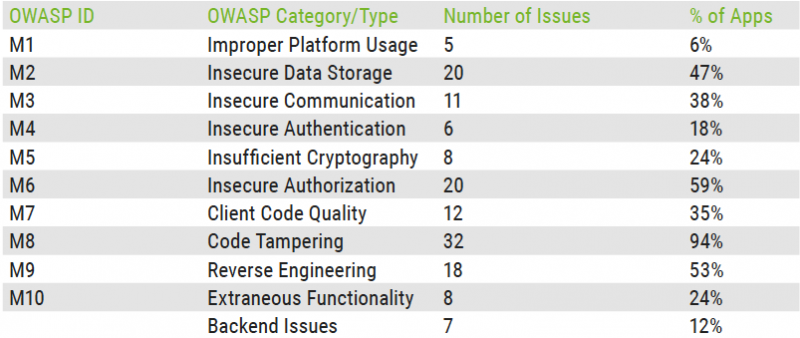
Researchers found that all but two of the applications failed to implement protections against code tampering. The two apps that had such a mechanism only implemented a basic root detection feature. It is easier for malicious hackers to exploit vulnerabilities on rooted Android devices and some malware families are designed to root smartphones and tablets.

Related: Learn More at SecurityWeek’s 2018 Singapore ICS Cyber Security Conference

More than half of the tested applications also lacked secure authorization mechanisms – only 20 percent of the local apps implemented an authorization system correctly. The most common problems are the lack of password protection and the presence of a “remember password” feature, which defeats the purpose of setting password protection.

The experts also found that more than half of the apps lacked code obfuscation and other mechanisms designed to prevent reverse engineering. Allowing attackers to reverse engineer an application makes it easier for them to find and exploit vulnerabilities.

Nearly half of the tested apps also failed to store data securely. Data is often stored on the SD card or on a virtual partition, and it’s not protected with access control lists (ACLs) or other permission mechanisms.

Unsurprisingly, more than one-third of the analyzed applications failed to secure communications, including via poor handshakes, incorrect SSL versions, and cleartext data transmission. Researchers noted that their tests did not cover applications using Modbus and other ICS protocols, which are insecure by design.

As for backend issues, researchers discovered various types of vulnerabilities, including SQL injection, memory corruption, DoS, and information leakage flaws.

Back in 2015, Bolshev and Yushkevich predicted that the problems they had found would disappear in the future as a result of the rapidly developing nature of mobile software and the growth of IoT. However, their predictions have not proved to be correct, with the latest tests showing that more than 20 percent of the discovered issues allow malicious actors to misinform operators and influence industrial processes.

Related: Average Patching Time for SCADA Flaws Is 150 Days

Related: Fuzzing Tests Show ICS Protocols Least Mature

view counter

Eduard Kovacs is a contributing editor at SecurityWeek. He worked as a high school IT teacher for two years before starting a career in journalism as Softpedia’s security news reporter. Eduard holds a bachelor’s degree in industrial informatics and a master’s degree in computer techniques applied in electrical engineering.

Previous Columns by Eduard Kovacs:

Tags:

http://feedproxy.google.com/~r/Securityweek/~3/HxWEq98RfMg/security-flaws-found-majority-scada-mobile-apps


NVIDIA Updates GPU Drivers to Mitigate CPU Flaws

NVIDIA has released updates for its GPU display drivers and other products in an effort to mitigate the recently disclosed attack methods dubbed Meltdown and Spectre.

Shortly after researchers revealed the existence of the flaws that allow Meltdown and Spectre exploits, which can be leveraged to gain access to sensitive data stored in a device’s memory, NVIDIA announced that its GPU hardware is “immune,” but the company has promised to update its GPU drivers to help mitigate the CPU issues.

The Meltdown and Spectre vulnerabilities affect processors from Intel, AMD and ARM. Similar to Qualcomm, some of NVIDIA’s system-on-chip (SoC) products rely on ARM CPUs and the company has promised to develop mitigations.

On Tuesday, NVIDIA informed customers about the availability of GPU display driver updates that include mitigations for one of the Spectre vulnerabilities, specifically CVE-2017-5753. The company is still working on determining if the second Spectre flaw, CVE-2017-5715, affects its GPU drivers. On the other hand, there is no indication that the drivers are impacted by the Meltdown vulnerability (CVE-2017-5754).

NVIDIA has provided display driver updates for the Windows and Linux versions of GeForce, Quadro, and NVS graphics cards. In the case of Tesla GPUs, updates have been provided only for the R384 branch, while an update for R390 is expected to become available during the week of January 22. In the case of the GRID virtual GPU solution, updates should become available by the end of the month.

NVIDIA has also released updates for the Android-based Shield TV media player and Shield Tablet, and the Jetson embedded system, which is built around the Tegra mobile processor. The company says only the Jetson TX2 update includes mitigations for all three CPU vulnerabilities – the other updates include mitigations only for CVE-2017-5753 and in some cases CVE-2017-5715 (i.e. the Spectre flaws).

The mitigations for the Meltdown and Spectre vulnerabilities are known to introduce performance penalties for certain types of operations, but NVIDIA has not provided any information on this issue.

Intel says regular users should not see any difference after applying the fixes, but Microsoft’s tests show that most Windows 7 and 8 systems will likely incur significant penalties if they use 2015-era or older CPUs.

Tests conducted by Red Hat also showed significant slowdowns for certain types of operations. However, Amazon, Google and Apple said they had not seen any noticeable performance problems – although some AWS customers did report degraded performance.

Related: IBM Starts Patching Spectre, Meltdown Vulnerabilities

Related: Lawsuits Filed Against Intel Over CPU Vulnerabilities

Related: Industry Reactions to Meltdown, Spectre Attacks

view counter

Eduard Kovacs is a contributing editor at SecurityWeek. He worked as a high school IT teacher for two years before starting a career in journalism as Softpedia’s security news reporter. Eduard holds a bachelor’s degree in industrial informatics and a master’s degree in computer techniques applied in electrical engineering.

Previous Columns by Eduard Kovacs:

Tags:

http://feedproxy.google.com/~r/Securityweek/~3/PufPuU6kppg/nvidia-updates-gpu-drivers-mitigate-cpu-flaws