Google Patches Multiple Critical, High Risk Vulnerabilities in Android

Google patched several Critical and High severity vulnerabilities as part of its Android Security Bulletin for January 2018.

A total of 38 security flaws were resolved in the popular mobile OS this month, 20 as part of the 2018-01-01 security patch level and 18 in the 2018-01-05 security patch level. Five of the bugs were rated Critical and 33 were rated High risk.

Four of the vulnerabilities addressed with the 2018-01-01 security patch level were rated Critical, all of them remote code execution bugs. The remaining 16 issues resolved in this patch level were High risk elevation of privilege and denial of service vulnerabilities.

An elevation of privilege bug that Google patched in Android runtime could be exploited remotely to bypass user interaction requirements in order to gain access to additional permissions.

The most severe of the 15 vulnerabilities resolved in Media framework could allow an attacker using a specially crafted malicious file to execute arbitrary code within the context of a privileged process. These include 3 Critical remote code execution bugs, 4 High severity elevation of privilege issues, and 8 High risk denial of service flaws.

One other Critical remote code execution bug was patched in System, along with two High severity elevation of privilege flaws and one High risk denial of service vulnerability.

Only one of the flaws fixed with the 2018-01-05 security patch level was a Critical vulnerability. Along with 6 High severity flaws, it was affecting Qualcomm closed-source components.

The patch level also resolved a High risk denial of service issue in HTC components and High risk elevation of privilege bugs in LG components, Media framework, MediaTek components, and NVIDIA components (one in each).

The security patch level addressed three High severity elevation of privilege and one information disclosure bug in Kernel components, along with two High risk elevation of privilege vulnerabilities in Qualcomm components.

Google also resolved 46 vulnerabilities in Google devices as part of the Pixel / Nexus Security Bulletin—January 2018. Most of the flaws were rated Moderate severity, exception making issues addressed in Media framework (some were rated Low risk and others were rated High severity on older Android versions).

Impacted components included Framework (1 vulnerability), Media framework (16 vulnerabilities), System (1 flaw), Broadcom components (1 issue), HTC components (1 flaw), Kernel components (7 bugs), MediaTek components (1 issue), and Qualcomm components (18 vulnerabilities).

In addition to patching security flaws, the security bulletin also addressed functionality issues on Pixel devices. The update adjusted the handling of key upgrades in keystore and improved stability and performance after installing an OTA.

On Google devices, all of these issues are fixed as part of the security patch levels of 2018-01-05 or later.

Related: Android’s December 2017 Patches Resolve Critical Flaws

Related: Google to Warn Android Users on Apps Collecting Data

Related: Google Patches Critical Bugs in Android

view counter

Ionut Arghire is an international correspondent for SecurityWeek.

Previous Columns by Ionut Arghire:

Tags:

http://feedproxy.google.com/~r/Securityweek/~3/gQ243vvScU4/google-patches-multiple-critical-high-risk-vulnerabilities-android


Apple Working on Patch for New Year’s Eve macOS Flaw

Apple is aware of the macOS vulnerability disclosed by a researcher on New Year’s Eve and the company plans on patching it later this month.

A security expert who uses the online moniker Siguza has made public the details and proof-of-concept (PoC) code for a local privilege escalation vulnerability affecting all versions of the macOS operating system.

The flaw, which the researcher described as a “zero day,” allows a malicious application installed on the targeted system to execute arbitrary code and obtain root privileges.

Apple is working on patching the vulnerability and has shared some mitigation advice until the fix becomes available.

“Apple is committed to the security of our customers’ devices and data, and we plan to patch this issue in a software update later this month,” Apple said in a statement emailed to SecurityWeek. “Since exploiting the vulnerability requires a malicious app to be loaded on your Mac, we recommend downloading software only from trusted sources such as the Mac App Store.”

The flaw affects IOHIDFamily, a kernel extension designed for human interface devices (e.g. touchscreens and buttons). Siguza discovered that some security bugs in this component introduce a kernel read/write vulnerability, which he has dubbed IOHIDeous.

The exploit created by the hacker also disables the System Integrity Protection (SIP) and Apple Mobile File Integrity (AMFI) security features.

The PoC exploit is not stealthy as it needs to force a logout of the legitimate user. However, the researcher said an attacker could design an exploit that is triggered when the targeted device is manually rebooted or shut down.

Some of the PoC code made available by Siguza only works on macOS High Sierra 10.13.1 and earlier, but the researcher believes it can be adapted for version 10.13.2 as well.

The vulnerability has been around since at least 2002, but it could actually be much older.

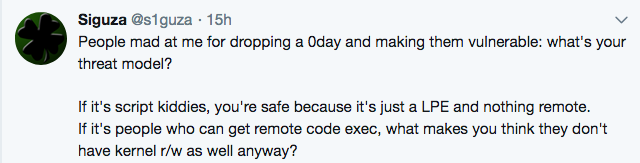
Siguza says he is not concerned that malicious actors will abuse his PoC exploit as the vulnerability is not remotely exploitable. The hacker claims he would have privately disclosed the flaw to Apple had it been remotely exploitable or if the tech giant’s bug bounty program covered macOS.

Related: Apple Patches Critical Root Access Flaw in macOS

Related: macOS Malware Spread Via Fake Symantec Blog

Related: Apple Silently Patched macOS Security Bypass Flaw

view counter

Eduard Kovacs is a contributing editor at SecurityWeek. He worked as a high school IT teacher for two years before starting a career in journalism as Softpedia’s security news reporter. Eduard holds a bachelor’s degree in industrial informatics and a master’s degree in computer techniques applied in electrical engineering.

Previous Columns by Eduard Kovacs:

Tags:

http://feedproxy.google.com/~r/Securityweek/~3/Skl3uAAnKJs/apple-working-patch-new-years-eve-macos-flaw


VMware Patches Critical Flaws in vSphere Data Protection

VMware has patched three critical vulnerabilities in vSphere Data Protection (VDP), including arbitrary file upload, authentication bypass and path traversal issues.

vSphere Data Protection is a backup and recovery solution for vSphere environments. The product is no longer offered by VMware since April 2017, but the company will continue to provide general support for version 6.x until 2020 and technical guidance until 2022.

VMware published a security advisory on Tuesday to inform VDP customers that critical vulnerabilities have been found in versions 5.x, 6.0.x and 6.1.x of the product. VMware has not credited anyone for discovering the weaknesses.

One of the flaws, tracked as CVE-2017-15548, allows an unauthenticated attacker to remotely bypass authentication and gain root access to a vulnerable system. Another bug, identified as CVE-2017-15549, allows a remote attacker with access to a low-privileged account to upload malicious files to any location on the server file system.

The last vulnerability is a path traversal tracked as CVE-2017-15550. It allows an authenticated attacker with low privileges to access arbitrary files on the server in the context of the vulnerable application.

The security holes have been patched with the release of VDP 6.1.6 and 6.0.7. Users of version 5.x have been advised to update to version 6.0.7 or newer.

This is only the third security advisory published by VMware for VDP. Another advisory was released last year to alert users of critical Java deserialization and credentials encryption issues, and one was published in late 2016 for an SSH key-based authentication flaw.

Related: VMware API Allows Limited vSphere Users to Access Guest OS

Related: VMware Patches Vulnerabilities in vCenter Server

view counter

Eduard Kovacs is a contributing editor at SecurityWeek. He worked as a high school IT teacher for two years before starting a career in journalism as Softpedia’s security news reporter. Eduard holds a bachelor’s degree in industrial informatics and a master’s degree in computer techniques applied in electrical engineering.

Previous Columns by Eduard Kovacs:

Tags:

http://feedproxy.google.com/~r/Securityweek/~3/nkxcWBLIjhY/vmware-patches-critical-flaws-vsphere-data-protection


Mitigations Prepared for Critical Vulnerability in Intel CPUs

Researchers have apparently discovered a serious vulnerability affecting all Intel CPUs. Software-level mitigations have already been developed, but they could cause significant performance penalties.

Details of the vulnerability are expected to become available on January 9. The impact of the flaw is comparable to the notorious Heartbleed bug, but an attack is said to be more practical.

The existence of the security hole came to light following the introduction of kernel page table isolation (KPTI) in Linux. A similar feature is being implemented by Microsoft in Windows and Apple is also expected to make some changes in macOS. Experts believe it will not be easy for Intel to address the problem directly in its processors.

Vulnerability Impacts Intel ChipsKPTI is a hardening technique designed to improve security by isolating the kernel space from user space memory. It’s based on the KAISER system developed last year by a team of researchers at the Graz University of Technology in Austria. KAISER brings improvements to address space layout randomization (ASLR), a mitigation designed to prevent control-flow hijacking and code injection attacks.

Back in July 2017, researcher Anders Fogh shared some thoughts on how it may be possible to read kernel memory from an unprivileged process via speculative execution. While his attempts were unsuccessful, his work did yield some results. Some believe that researchers at Graz University – Fogh has previously collaborated with Graz University researchers on memory-related attacks – may have found a way to make it work.

Gaining access to the kernel space poses serious risks as this memory can include highly sensitive information.

AMD says its processors are not vulnerable to the type of attacks mitigated by KPTI, but the company does mention speculative execution.

“The AMD microarchitecture does not allow memory references, including speculative references, that access higher privileged data when running in a lesser privileged mode when that access would result in a page fault,” an AMD representative explained.

Cloud services from Microsoft, Amazon and Google are apparently impacted by the Intel hardware vulnerability – Amazon Web Services (AWS) and Microsoft Azure have informed customers of upcoming security updates that will require a reboot of their cloud instances. A developer who writes on the blog Python Sweetness speculated that the flaw could allow privilege escalation attacks against hypervisors.

As for the impact of the KPTI mitigation on performance, tests conducted by Grsecurity showed an impact of up to 35%, but it depends a great deal on what type of operations are being carried out. Tests done by Phoronix showed that gaming performance on Linux does not appear to be affected by the PTI changes in the kernel.

“Performance penalties from single to double digits are expected on patched kernels,” explained Michael Larabel, founder of Phoronix. “The penalty depends upon how much interaction the application/workload deals with the kernel if there’s a lot of context switching and other activity. If it’s a simple user-space application not doing much, the x86 PTI additions shouldn’t cause much of an impact. Newer Intel CPUs with PCID should also help in ensuring less of a performance impact.”

The developers of the KAISER system claimed that the method has a negative impact of only 0.28%.

Related: Intel Warns of Critical Vulnerability in Processor Firmware

Related: Intel Chip Flaws Expose Millions of Devices to Attacks

view counter

Eduard Kovacs is a contributing editor at SecurityWeek. He worked as a high school IT teacher for two years before starting a career in journalism as Softpedia’s security news reporter. Eduard holds a bachelor’s degree in industrial informatics and a master’s degree in computer techniques applied in electrical engineering.

Previous Columns by Eduard Kovacs:

Tags:

http://feedproxy.google.com/~r/Securityweek/~3/KHKX_t6UQW4/mitigations-prepared-critical-flaw-intel-cpus


Many GPS Tracking Services Expose User Location, Other Data

Researchers discovered that many online services designed for managing location tracking devices are affected by vulnerabilities that expose potentially sensitive information.

Fitness, child, pet and vehicle trackers, and other devices that include GPS and GSM tracking capabilities are typically managed via specialized online services.

Security experts Vangelis Stykas and Michael Gruhn found that over 100 such services have flaws that can be exploited by malicious actors to gain access to device and personal data. The security holes, dubbed Trackmageddon, can expose information such as current location, location history, device model and type, serial number, and phone number.

Some services used by devices that have photo and audio recording capabilities also expose images and audio files. In some cases, it’s also possible to send commands to devices in order to activate or deactivate certain features, such as geofence alerts.

Attackers can gain access to information by exploiting default credentials (e.g. 123456), and insecure direct object reference (IDOR) flaws, which allow an authenticated user to access other users’ accounts simply by changing the value of a parameter in the URL. The services also expose information through directory listings, log files, source code, WSDL files, and publicly exposed API endpoints that allow unauthenticated access.

Stykas and Gruhn have notified a vast majority of the affected vendors in November and December. Nine services have confirmed patching the flaws or promised to implement fixes soon, and over a dozen websites appear to have addressed the vulnerabilities without informing the researchers. However, the rest of the tracking services remain vulnerable.

There are roughly 100 impacted domains, but some of them appear to be operated by the same company. Researchers have identified 36 unique IPs hosting these domains and 41 databases that they share. They estimate that these services expose data associated with over 6.3 million devices and more than 360 device models.

The vulnerable software appears to come from China-based ThinkRace, but in many cases the company does not have control over the servers hosting the tracking services. 

Gruhn and Stykas pointed out that vulnerabilities in ThinkRace products – possibly including some of the issues disclosed now – were first discovered in 2015 by a New Zealand-based expert while analyzing car tracking and immobilisation devices that relied on ThinkRace software.

Users of the online tracking services that remain vulnerable have been advised to change their password and remove any potentially sensitive information stored in their account. However, these are only partial solutions to the problem and researchers have advised people to simply stop using affected devices until patches are rolled out.

Related: Vulnerability in Mobile Networks Allows Easy Phone Tracking

Related: Majority of Android Apps Contain Embedded User-Tracking

view counter

Eduard Kovacs is a contributing editor at SecurityWeek. He worked as a high school IT teacher for two years before starting a career in journalism as Softpedia’s security news reporter. Eduard holds a bachelor’s degree in industrial informatics and a master’s degree in computer techniques applied in electrical engineering.

Previous Columns by Eduard Kovacs:

Tags:

http://feedproxy.google.com/~r/Securityweek/~3/tmU9aXWHAI8/many-gps-tracking-services-expose-user-location-other-data


Internet-connected Sonos Speakers Leak User Information

A vulnerability found in Internet-connected Sonos Play:1 speakers can be abused to access information on users, Trend Micro has discovered.

By exploiting the issue, an attacker could learn a user’s musical preferences, get hold of their email address, and could even learn where the user lives and whether they are at home. Additionally, an attacker could play a recorded message on the device and trick the target into downloading malware.

While analyzing the device, Trend Micro’s researchers discovered the device had only three ports open and that Sonos applications on it were pointed to a specific website, while most of the communications were performed over port TCP/1400.

Looking at the specific URI path of /status on the device, the researchers also noticed that many of its subpages were shown via a simple website. Thus, no authentication was required to access information about the tracks being played or the music libraries the device knows about.

Furthermore, the website revealed personal information such as emails associated with audio streaming services and exposed various debug functions, including “the ability to traceroute, ping, and even make an mDNS announcement via a simple website,” the researchers say. The status page can reveal other information as well.

“Let’s say an attacker knows the target uses a Sonos device. The attacker can then take the information collected here to tailor better attacks against the target. This could include mobile devices, printers, and even types of computers on the networks,” Trend Micro notes in a technical analysis (PDF).

The security researchers also discovered a series of plausible attack scenarios that could be used not only against home users, but also to target enterprise networks.

By learning the user’s musical preferences, an attacker could craft phishing emails and deliver them to the target. In a workplace environment, such an attack could be used to discover other IoT devices connected to the same network and find vulnerabilities on them to further compromise the network.

Using a website that compounds multiple sources of Wi-Fi geolocation an attacker could also find where the user lives (the researchers determined the device location by looking at the wireless access points (WAPs) the device tried to access during installation) and whether they are at home by monitoring when the speaker is activated and deactivated.

“This hybrid attack involving cyber and physical elements presents new dangers that home and enterprise users should be aware of. Devices leaking presence data not only make users easier to predict — they can also put the user at physical risk,” the researchers say.

Leveraging information discovered on the aforementioned status page, including model numbers and serial numbers, an attacker could disrupt the device and even play a crafted status message containing misleading information.

The attacker could also send tailored emails to the user (to the addresses tied to accounts on music streaming applications) and trick them into downloading malware masquerading as a software update. Using other discoverable information on the target, the attacker could add personalized information to the message to make it even more convincing.

With the help of search service Shodan, the security researchers were able to find roughly 5,000 Sonos devices exposed to the Internet. The manufacturer was informed on the findings and has already released and updated to address the discovered bugs, but some of the issues continue to impact users, Trend Micro says.

“The problem of unsecured internet-connected devices is not limited to home users but also extends to workplace environments when seemingly safe IoT devices are introduced into the company network, as was shown in the attack scenarios. Whether these devices are installed to improve productivity or are simply brought to work by employees, the risk of having an exposed and unsecured device should not be taken lightly,” Trend Micro concludes.

Related: Improved IoT Security Starts with Liability for Companies, Not Just Legislation

Related: Millions of IoT Devices Possibly Affected by ‘Devil’s Ivy’ Flaw

view counter

Ionut Arghire is an international correspondent for SecurityWeek.

Previous Columns by Ionut Arghire:

Tags:

http://feedproxy.google.com/~r/Securityweek/~3/0KA8uaNRGVc/internet-connected-sonos-speakers-leak-user-information


Critical Vulnerability Patched in phpMyAdmin

An update released just before the holidays by the developers of phpMyAdmin patches a serious vulnerability that can be exploited to perform harmful database operations by getting targeted administrators to click on specially crafted links.

phpMyAdmin is a free and open source tool designed for managing MySQL databases over the Internet. With more than 200,000 downloads every month, phpMyAdmin is one of the top MySQL database administration tools.

India-based researcher Ashutosh Barot discovered that phpMyAdmin is affected by a cross-site request forgery (CSRF) flaw that can be exploited by an attacker to drop tables, delete records, and perform other database operations.

For the attack to work, an authenticated admin needs to click on a specially crafted URL. However, Barot noted that the attack works as long as the user is logged in to the cPanel web hosting administration interface, even if phpMyAdmin has been closed after use.

These types of attacks are possible due to the fact that vulnerable versions of phpMyAdmin use GET requests for database operations, but fail to provide CSRF protection.

[embedded content]

The researcher also discovered that the URLs associated with database operations performed via phpMyAdmin are stored in the web browser history, which can pose security risks.

“The URL will contain database name and table name as a GET request was used to perform DB operations,” Barot said in a blog post published on Friday. “URLs are stored at various places such as browser history, SIEM logs, firewall logs, ISP logs, etc. This URL is always visible at client side, it can be a serious issue if you are not using SSL (some information about your previous queries were stored in someone’s logs!). Wherever the URL is being saved, an adversary can gain some information about your database.”

phpMyAdmin developers fixed the CSRF vulnerability found by Barot with the release of version 4.7.7. All prior 4.7.x versions are impacted by the security hole, which phpMyAdmin has classified as “critical.” Users have been advised to update their installations or apply the available patch.

Related: Free Access to Legal Docs Provided by Flaw in PACER Court System

Related: Symantec Patches Code Execution Flaw in Email Security Product

view counter

Eduard Kovacs is a contributing editor at SecurityWeek. He worked as a high school IT teacher for two years before starting a career in journalism as Softpedia’s security news reporter. Eduard holds a bachelor’s degree in industrial informatics and a master’s degree in computer techniques applied in electrical engineering.

Previous Columns by Eduard Kovacs:

Tags:

http://feedproxy.google.com/~r/Securityweek/~3/AiSHPL1T1ZY/critical-vulnerability-patched-phpmyadmin


Unpatched macOS Flaw Allows Code Execution, Root Access

A researcher who specializes in hacking Apple’s iOS operating system has made public the details of an unpatched vulnerability in macOS that can be exploited to take complete control of a system.

The details of the exploit and proof-of-concept (PoC) code were made public on the first day of 2018 – or the last day of 2017, depending on where you are located in the world – by a researcher who uses the online moniker Siguza (s1guza). An attacker who has access to a system can leverage the vulnerability, which the expert has described as a “zero day,” to execute arbitrary code and obtain root permissions.

This local privilege escalation (LPE) vulnerability affects IOHIDFamily, a kernel extension designed for human interface devices (HID), such as a touchscreen or buttons. While trying to discover flaws that would let him hack the iOS kernel, Siguza noticed that some components of this extension, specifically IOHIDSystem, exist only on macOS, which led him to identify a potentially serious security hole.

The bugs he discovered affect all versions of macOS and they can lead to an arbitrary read/write vulnerability in the kernel. The exploit created by the hacker also disables the System Integrity Protection (SIP) and Apple Mobile File Integrity (AMFI) security features.

However, the expert pointed out that his exploit, dubbed IOHIDeous, is not stealthy as it needs to force a logout of the logged-in user. On the other hand, an attacker could design an exploit that is triggered when the targeted device is manually shut down or rebooted.

Some of the PoC code made available by Siguza only works on macOS High Sierra 10.13.1 and earlier, but the researcher believes the exploit can be tweaked to work on the latest version as well, namely 10.13.2, which Apple released on December 6.

The expert believes the vulnerability has been around since at least 2002, but some clues suggest it could actually be a decade older than that. “One tiny, ugly bug. Fifteen years. Full system compromise,” Siguza said.

The researcher said he would have reported his findings to Apple instead of disclosing them to the public if the flaw had been remotely exploitable or if the tech giant’s bug bounty program covered macOS.

SecurityWeek has reached out to Apple for comment and will update this article if the company responds.

Some may argue that making the exploit public puts macOS users at risk of attacks, but Siguza believes that is not the case.

Researcher discloses macOS privilege escalation zero day

Researcher discloses macOS privilege escalation zero day

Researcher discloses macOS privilege escalation zero day

Related: Apple Patches Critical Root Access Flaw in macOS

Related: macOS Malware Spread Via Fake Symantec Blog

Related: Apple Silently Patched macOS Security Bypass Flaw

view counter

Eduard Kovacs is a contributing editor at SecurityWeek. He worked as a high school IT teacher for two years before starting a career in journalism as Softpedia’s security news reporter. Eduard holds a bachelor’s degree in industrial informatics and a master’s degree in computer techniques applied in electrical engineering.

Previous Columns by Eduard Kovacs:

Tags:

http://feedproxy.google.com/~r/Securityweek/~3/rrcvCaG6qCE/unpatched-macos-flaw-allows-code-execution-root-access


Improved IoT Security Starts with Liability for Companies, Not Just Legislation

With the holiday season upon us, take a moment to think on the security of the plethora of IoT devices that will be purchased, gifted and implemented into the daily lives of countless people. Despite troubling reports like the IoT teddy bear that leaked two million message recordings of kids and was found to be easily hacked and turned into a spy device, a quick look at one recap of 2018 Cyber Monday sales shows that connected and ‘smart’ gadgets are at the top of everyone’s shopping list. And yet it seems that people are buying these devices for their homes and offices without considering, or ultimately choosing to ignore, very real risks! 

IoT Security

Whether the general population is aware of these hacks or not, there must be ways to prevent such massive breaches of sensitive information for these mainstream technologies. My question for discussion is this: if policies like the EU’s General Data Protection Regulation (GDPR) are being developed to maintain user security and privacy as companies continue to collect our data, could legislation improve the state of IoT security for devices that are also putting our privacy at risk?

I believe that in theory, legislation could help with IoT security. However, laws regulating new technologies are often poorly crafted, and can significantly hamper innovation with little benefit. It is critical that any new laws be written with great deliberation and input from all stakeholders.

One of the biggest problems with IoT devices is that most are never updated or patched. It is almost guaranteed that no one has the time or desire to manually patch their refrigerator or thermostat on a regular basis, and the average person using these devices may not even have a basic understanding of their security risks. Improving IoT security needs to start with the companies that make these devices – they must be held accountable for supporting secure, authenticated and automatic updates.

This issue is very complex, and any new laws need to avoid creating unintended negative consequences. For example, new laws should state requirements at an abstract level. If the language is too technologically specific, the law will be outdated almost immediately due to the speed at which companies are innovating and how quickly technology changes today. Beyond this kind of legislation, we need some level of liability for the damage that poorly designed IoT devices inflict. Without that, manufacturers have no incentive to spend money to make them secure. Unfortunately, there is almost no market pressure for security at the moment – bad security and good security look the same to the untrained eye.

Consider two smart toasters on the store shelf. Both have cool features, and both claim to be easy to use and secure. If one is $10 cheaper than the other, which is likely to sell best? There is huge pressure on companies to compete on price, and almost no ability to compete on security with typical buyers. Additionally, many IoT devices are created by young companies in a desperate race to get to be one of the first devices in a category and grab market share. The odds of a startup surviving at all are slim. Anything that distracts from the ability to deliver the product as fast as possible with the coolest features will be ignored if possible. And it is possible for them to ignore good security, so most do.

It is easy to vilify the IoT makers, but they are simply responding to the constraints and market realities in front of them. Moral persuasion will not meaningfully change their behavior. To get better IoT security, that needs to actually be a priority for the business, and that means changing the regulatory and liability landscape to make it so.

Laws to support swift and automatic updates for all devices, and consequence to organizations that fail to ensure their IoT devices are truly secure, would be a big step forward for IoT security. A major hurdle for this kind of change will be educating the general population that most of the devices they interact with are extremely insecure. Without public outcry, there is little chance IoT device manufacturers will be held to account for the security of their products. 

Related Reading: New Legislation Could Force Security Into IoT

view counter

Lance Cottrell founded Anonymizer in 1995, which was acquired by Ntrepid (then Abraxas) in 2008. As Chief Scientist, Lance continues to push the envelope with the new technologies and capabilities required to stay ahead of rapidly evolving threats. Lance is a well-known expert on security, privacy, anonymity, misattribution and cryptography. He speaks frequently at conferences and in interviews. Lance is the principle author on multiple Internet anonymity and security technology patents. He holds an M.S. in physics from the University of California, San Diego and a B.S. in physics from the University of California, Santa Cruz. In his spare time Lance grows high-end pinot noir grapes in the Russian River Valley AVA.

Previous Columns by Lance Cottrell:

Tags:

http://feedproxy.google.com/~r/Securityweek/~3/CnSeAc9NxbQ/improved-iot-security-starts-liability-companies-not-just-legislation


Chinese Hackers Target Servers With Three Types of Malware

An established Chinese crime group uses a large coordinated infrastructure to target servers running database services with three different types of malware, GuardiCore security researchers say.

The group is operating worldwide and has been observed launching multiple attacks over the past several months. Each of the three malware families employed – Hex, Hanako and Taylor – is targeting different SQL servers and has its own goals, scale and target services.

According to GuardiCore, a campaign targeting a single server has started in March of this year and evolved into thousands of attacks per day during summer, hitting numerous MS SQL Server and MySQL services. The compromised machines were used for various activities, including cryptocurrency mining, distributed denial of service (DDoS), and for implanting Remote Access Trojans (RATs).

While most of the compromised machines are located in China, some were observed in Thailand, the U.S., Japan, and other countries. Database services on both Windows and Linux machines are targeted.

The three campaigns launched from this infrastructure differ mostly in target goals: Hex focuses on cryptocurrency miners and RATs; Hanako builds a DDoS botnet; and Taylor installs a keylogger and a backdoor. To date, the security firm has observed hundreds of Hex and Hanako attacks and tens of thousands of Taylor incidents each month.

“From what we’ve seen, the attackers often compromise public and private cloud deployments without chasing any specific domain. This is shown in their frequent scanning of Azure and AWS public IP ranges (which are publicly available) while looking for potential victims,” GuardiCore says.

Compromised machines aren’t used for long

To fly under the radar, the actors use each machine to attack only a small number of IPs. The security researchers discovered that victims are re-purposed to make tracing as difficult as possible: every compromised machine is used for about a month and then rotated out of use.

The infected systems are used for scanning, launching attacks, hosting malware executables and as command and control (C&C) servers. Most of the attacks feature three simple steps: scanning, attacking and initial implant.

The scan machines search for subnets and create ‘hit lists’ of IPs and credentials. The attackers, the researchers say, start from a large set of IP ranges and look for machines running services such as HTTP web servers, MS SQL Server, ElasticSearch, and more.

Based on said ‘hit lists’, the attacker machines attempt to gain an initial foothold on the servers through brute forcing MS SQL and MySQL databases. Next, they execute predefined SQL commands to gain full control of the victim machine, such as creating new users for persistency.

Parts of the campaign, such as the RATs, are hosted on separate file servers, to ensure attacks aren’t dependent on a single server. In addition to this modular approach, the infrastructure features both FTP and HFS (HTTP File Server) servers and is used to deliver additional attack tools after the initial dropper runs.

While the Tylor attacks were observed downloading the files from two domains [email protected]@info and [email protected]@info, both registered in March 2017, Hex and Hanako were observed using a unique file server per attack.

Attack flow

After brute forcing their way onto the target servers (an operation possible because many admins don’t harden the database beyond the use of a password), the attackers use xp_cmshell, a variety of stored procedures and OLE automation, to upload their first set of tools.

The droppers employed by the group usually establish persistency by creating a backdoor user and opening the Remote Desktop port. Next, malware is downloaded from a short lived FTP or HTTP server.

Later on, the attackers also stop or disable anti-virus and monitoring applications and attempt to cover tracks by deleting any unnecessary registry, file, and folder entries. The downloaded malware attempts to trick detection by using a fake MFC user interface and abnormally sized binaries containing large quantities of junk data.

Hex and Hanako, the security researchers discovered, use the same MS SQL Server attack flow and download unique attack configuration files. They create an identical scheduled task to run the same unique binary and target the same antivirus products.

Hanako gets its name after the backdoor user added to targeted databases.

Written in C++, Hex (it uses name variations of Hex.exe) can log key strokes and capture the screen and microphone to extract information from the victim machines and can download and execute additional modules.

The malware masquerades as Kugou Player, a popular Chinese music streaming service. Along with comments in Chinese found in the code, targets’ location, and configuration files showing email addresses from popular Chinese providers, this suggests that the actor behind the campaign is of Chinese origin, the researchers say.

Taylor (named after an image of Taylor Swift used to hide the keylogger) has been observed in over 80,000 attack attempts since March. As part of the attack, a backdoor related to the 2016 Mirai botnet is also downloaded onto the compromised servers, the researchers say.

Although it uses the same domain names over time and does not change IP addresses often, Taylor uses a more cautious attack script, where the hackers send most of the queries encoded in hex. They also store references to the servers in HTML pages downloaded during the attack.

“The best way to minimize your exposure to campaigns targeting databases is to control the machines that have access to the database. Routinely review the list of machines that have access to your databases, keep this list to a minimum and pay special attention to machines that are accessible directly from the internet. Every connection attempt from an IP or domain that does not belong to this list should be blocked and investigated,” GuardiCore concludes.

“There isn’t a server out there that is connected to a LAN which isn’t vulnerable to malware. If the LAN is connected to the Internet, bad actors can get in. Since infection is inevitable, it is important to watch for the telltale signs of an infection. Behaviors such as abnormal traffic to another host can be an indicator and this could be in the form of excessive connections (E.g. DDoS), bytes, or other metric. Even light scanning behaviors can be detected. Leveraging flow data for network traffic analytics is one of the best resources for monitoring and malware incident response,” Michael Patterson, CEO of Plixer, told SecurityWeek in an emailed comment.

Related: SQL Slammer Worm Crawls Back

Related: Mirai for Windows Built by Experienced Bot Herder: Kaspersky

view counter

Ionut Arghire is an international correspondent for SecurityWeek.

Previous Columns by Ionut Arghire:

Tags:

http://feedproxy.google.com/~r/Securityweek/~3/IEvxLLCVmZU/chinese-hackers-target-servers-three-types-malware