Schneider Electric Patches Flaws in Pelco Video Management System

Schneider Electric recently developed a firmware update for its Pelco VideoXpert Enterprise product to address several vulnerabilities, including a high severity code execution flaw.

Pelco VideoXpert Enterprise is a video management system used in commercial facilities worldwide. Researcher Gjoko Krstic discovered that the product is affected by two directory traversal bugs and an improper access control issue that can allow arbitrary code execution.

The most serious of the flaws is CVE-2017-9966, which allows an attacker to replace certain files and execute malicious code with system privileges, Schneider Electric and ICS-CERT said in their advisories.Schneider fixes vulnerabilities in Pelco video management system

The directory traversal vulnerabilities are tracked as CVE-2017-9964 and CVE-2017-9965, and they have been classified as medium severity. The first security hole allows an attacker to bypass authentication or hijack sessions by “sniffing communications.”

The second directory traversal can be exploited by an unauthorized user to access web server files that could contain sensitive information.

These Pelco VideoXpert Enterprise vulnerabilities have been patched with the release of firmware version 2.1. All prior versions are affected.

This is the third round of Pelco product vulnerabilities covered in advisories published by ICS-CERT. The organization also released an advisory in June 2016 for a serious vulnerability in the Digital Sentry video management system, and in March 2015 for a high severity flaw in the DS-NVs software package.

Related: Researchers Disclose Unpatched Flaws in Schneider Electric PLCs

Related: Schneider Electric Patches Critical Flaw in HMI Products

Related: Unpatched Flaws in Schneider Electric U.motion Builder Disclosed

Related: Schneider Electric, Claroty Partner on Industrial Network Security

view counter

Eduard Kovacs is a contributing editor at SecurityWeek. He worked as a high school IT teacher for two years before starting a career in journalism as Softpedia’s security news reporter. Eduard holds a bachelor’s degree in industrial informatics and a master’s degree in computer techniques applied in electrical engineering.

Previous Columns by Eduard Kovacs:

Tags:

http://feedproxy.google.com/~r/Securityweek/~3/951xpnSqeLE/schneider-electric-patches-flaws-pelco-video-management-system


Google Warns DoubleClick Customers of XSS Flaws

Google has warned DoubleClick customers that some of the files provided by third-party vendors through its advertising platform can introduce cross-site scripting (XSS) vulnerabilities.

The tech giant has shared a list of more than a dozen advertising firms whose files are vulnerable to XSS attacks. The company has advised website owners and administrators to check if the files are present on their server – they are typically hosted in the root domain – and remove them.

“We have disabled these vendors where possible for all DoubleClick for Publishers and DoubleClick Ad Exchange customers. However, any of the mentioned files hosted on your site may still pose a risk and should be taken down. We will notify you as we learn more,” Google said.

Google’s DoubleClick for Publishers (DFP) and DoubleClick Ad Exchange advertising services allow customers to display ads outside an iframe, the inline frame used for embedding content within an HTML page. In order to expand ads outside the iframe, Google and third-party ad firms provide what is called an “iframe buster kit,” which includes several HTML and JavaScript files that need to be hosted on the customer’s domain.

Some of these files contain XSS vulnerabilities that allow attackers to execute arbitrary JavaScript code in the context of a user’s browser by getting the victim to click on a specially crafted link.

The issue was brought to light earlier this week by a researcher who uses the online monikers “Zmx” and “Tr4L.” He is an employee of IDM, a company that specializes in solutions for managing, delivering and monetizing content. The firm uses the problematic iframe buster kit, which led to the discovery of the vulnerabilities.

A proof-of-concept (PoC) provided by Zmx shows how these XSS bugs can be triggered:

https://www.jobisjob.ch/predicta/predicta_bf.html?dm=bgtian.life

Zmx told SecurityWeek that he disclosed his findings via the Full Disclosure mailing list on Tuesday without notifying Google “because he is lazy.” It’s unclear if Google’s alert to customers comes in response to the researcher’s post or if it learned about the flaws from other sources. We have reached out to Google for clarifications and will update this article if the company responds.

Zmx also pointed out that there are several other problematic iframe buster kits for expandable ads that may not be provided by Google. The vulnerable kits identified by the researcher and not included in Google’s list come from Undertone, Interpolls and IgnitionOne (netmng.com).

UPDATE. Google has provided the following statement to SecurityWeek:

“We have disabled these vendors, removed these files, and added instructions in our help center to help publishers manage any additional steps to help ensure their users are secure.”

Related: Google Releases New XSS Prevention Tools

Related: Researcher Gets $5,000 for XSS Flaw in Google Apps Admin Console

Related: jQuery Mobile Can Expose Websites to XSS Attacks

view counter

Eduard Kovacs is a contributing editor at SecurityWeek. He worked as a high school IT teacher for two years before starting a career in journalism as Softpedia’s security news reporter. Eduard holds a bachelor’s degree in industrial informatics and a master’s degree in computer techniques applied in electrical engineering.

Previous Columns by Eduard Kovacs:

Tags:

http://feedproxy.google.com/~r/Securityweek/~3/GtEEoE-8TYw/google-warns-doubleclick-customers-xss-flaws


Keeper Sues Ars Technica Over Reporting on Critical Flaw

Keeper Security has filed a lawsuit against Ars Technica and reporter Dan Goodin over an article covering a serious vulnerability found by a Google researcher in the company’s password manager.

Google Project Zero researcher Tavis Ormandy revealed last week that he had identified a critical vulnerability in the browser extension for the Keeper password manager.

The flaw, very similar to one discovered by the expert just over one year ago in the same application, could have been exploited by hackers to steal passwords stored by the extension if they could convince an authenticated user to access a malicious website.

Keeper Security released a patch within 24 hours of the flaw being reported and there had been no evidence of exploitation in the wild. The vendor highlighted that the security hole only impacted the browser extension and not the Keeper desktop application.

These types of vulnerabilities are often covered by the media, particularly ones found by Ormandy, who is known for discovering critical, easy-to-exploit weaknesses in popular software. However, Keeper Security does not like the article written by Ars Technica Security Editor Dan Goodin on this story and filed a lawsuit against him and his employer.

Goodin’s initial article, titled “Microsoft is forcing users to install a critically flawed password manager,” claimed the application had a 16-month-old bug, but it was later updated after Keeper clarified that only a version released this month had been impacted. Despite at least two other updates made to the story, Keeper is still not happy with it and has filed a lawsuit in an effort to get the article removed.

It its complaint, Keeper claims the article “was intended to and did cause harm” to the company by making “false and misleading statements.” The suit covers three counts: defamation, violation of the Uniform Deceptive Trade Practices Act, and commercial disparagement.

Keeper, which requested a jury trial, wants Ars and Goodin not only to remove the story, but also to be awarded damages and have legal costs covered.

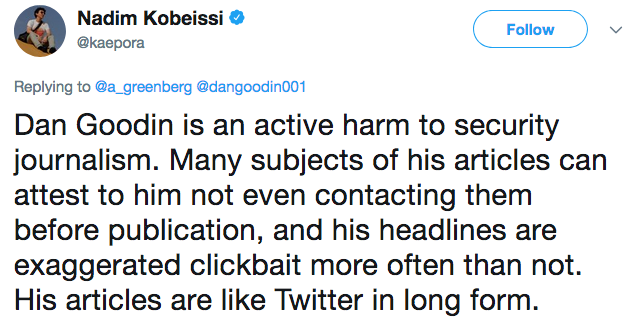
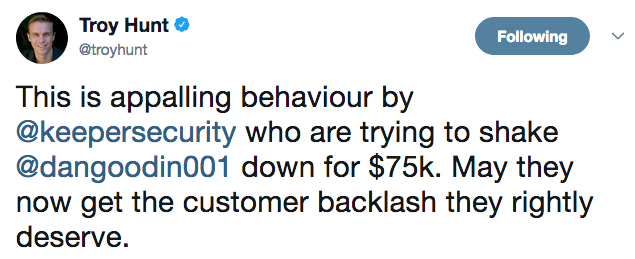
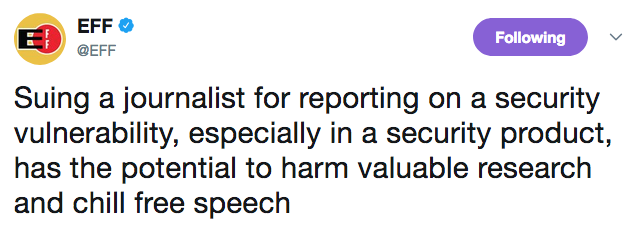
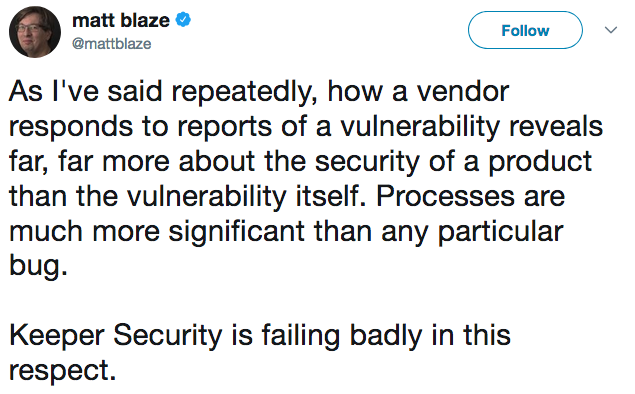
While some members of the cybersecurity industry have taken Keeper Security’s side, saying that many of Goodin’s stories are sensationalized, most have sided with the reporter and believe the lawsuit will cause more damage to the company than the article. Several people believe it will have a so-called “Streisand effect.”

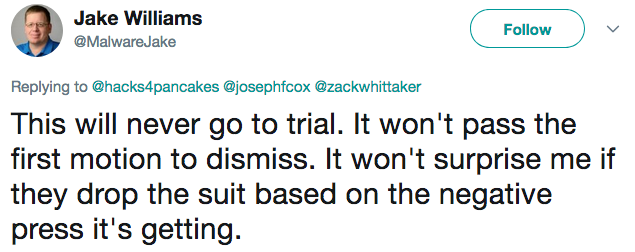
Response to Keeper Security suing Ars Technica and Dan Goodin

Response to Keeper Security suing Ars Technica and Dan Goodin

Response to Keeper Security suing Ars Technica and Dan Goodin

Response to Keeper Security suing Ars Technica and Dan Goodin

Response to Keeper Security suing Ars Technica and Dan Goodin

This is not the first time Keeper Security has resorted to legal action over vulnerability disclosures. Back in 2013, it threatened to sue Netherlands-based security firm Fox-IT after it had discovered a critical flaw in one of its products.

Related: Cylance Battles Malware Testing Industry

Related: Kaspersky Sues U.S. Government Over Product Ban

view counter

Eduard Kovacs is a contributing editor at SecurityWeek. He worked as a high school IT teacher for two years before starting a career in journalism as Softpedia’s security news reporter. Eduard holds a bachelor’s degree in industrial informatics and a master’s degree in computer techniques applied in electrical engineering.

Previous Columns by Eduard Kovacs:

Tags:

http://feedproxy.google.com/~r/Securityweek/~3/0VicRHuJOyA/keeper-sues-ars-technica-over-reporting-critical-flaw


Windows Hello Face Recognition Tricked by Photo

The facial recognition-based authentication system in Windows Hello has been bypassed by researchers using a printed photo, but the method does not work in the latest versions of Windows 10.

Windows Hello, a feature available in Windows 10, allows users to quickly and easily log into their devices using their face or fingerprints. The face authentication system uses near-infrared (IR) imaging and it’s advertised by Microsoft as “an enterprise-grade identity verification mechanism.”

Researchers have demonstrated on several occasions that face authentication can be bypassed, but some systems, such as Apple’s Face ID, are more difficult to bypass than others. In the case of Windows Hello, experts managed to bypass facial authentication using only a photograph of the legitimate user printed in a certain way.

Matthias Deeg and Philipp Buchegger of Germany-based penetration testing firm SySS managed to conduct successful attacks using low-resolution near-IR photos even with the “enhanced anti-spoofing” feature enabled, which should make it more difficult to trick the system.

“By using a modified printed photo of an authorized user, an unauthorized attacker is able to log in to or unlock a locked Windows 10 system as this spoofed authorized user,” the researchers said in an advisory. “Thus, by having access to a suitable photo of an authorized person (frontal face photo), Windows Hello face authentication can easily be bypassed with little effort, enabling unauthorized access to the Windows system.”

Deeg and Buchegger have made available several videos demonstrating the spoofing method:

[embedded content]

[embedded content]

The attack was successfully replicated on Windows 10 versions 1511 and 1607 even with the “enhanced anti-spoofing” feature enabled. In newer versions of the operating system, such as 1703 and 1709, the method no longer works if the anti-spoofing mechanism is turned on.

However, the researchers highlighted that updating to newer versions of Windows 10 and enabling the anti-spoofing feature is not enough to block attacks. Users must also reconfigure Hello Face Authentication.

Related: Visa Makes Biometrics Easier for Financial Institutions

Related: U.S. Army to Protect Warfighters With Continuous Biometric Authentication

Related: Mastercard Launches Fingerprint-Based Biometric Card

view counter

Eduard Kovacs is a contributing editor at SecurityWeek. He worked as a high school IT teacher for two years before starting a career in journalism as Softpedia’s security news reporter. Eduard holds a bachelor’s degree in industrial informatics and a master’s degree in computer techniques applied in electrical engineering.

Previous Columns by Eduard Kovacs:

Tags:

http://feedproxy.google.com/~r/Securityweek/~3/VrASzGvaCxI/windows-hello-face-recognition-tricked-photo


Pepperl+Fuchs Ecom Rugged Devices Exposed to KRACK Attacks

Rugged tablets, phones and PDAs made by Ecom Instruments use Wi-Fi components that are vulnerable to a recently disclosed attack method named KRACK.

Ecom Instruments, acquired last year by Germany-based factory automation solutions provider Pepperl+Fuchs, specializes in developing mobile devices designed for use in hazardous areas, including in the chemical and petrochemical, oil and gas exploration, mining, and energy sectors.

According to ICS-CERT and its German counterpart [email protected], several Windows- and Android-based mobile devices from Ecom are affected by the KRACK flaws.

The list of vulnerable products includes Android-based Tab-Ex 01 tablets, Ex-Handy 09 and 209 phones, and Smart-Ex 01 and 201 smartphones, and Windows-based Pad-Ex 01 tablets, and i.roc Ci70-Ex, CK70A-ATEX, CK71A-ATEX, CN70A-ATEX and CN70E-ATEX PDAs.ecom mobile devices vulnerable to KRACK attacks

“ecom instruments devices are in theory attackable by replay, decryption and forging of packets,” [email protected] said in an advisory. “However, to perform the attack, the attacker must be significantly closer to the ecom device than to the access point. The WPA2 password cannot be compromised using a KRACK attack. Note if WPA-TKIP is used instead of AES-CCMP, an attacker can easily forge and inject packets directly into the WLAN.”

Pepperl+Fuchs and Ecom are working on addressing the vulnerabilities in the impacted Android products. As for the Windows-based devices, users have been advised to apply the patches provided by Microsoft and switch to using AES-CCMP encryption instead of WPA-TKIP.

KRACK, or Key Reinstallation Attack, is the name assigned to a series of vulnerabilities in the WPA2 protocol. The flaws can allow an attacker within range of the targeted device to read information that the user believes is encrypted and, in some cases, even inject and manipulate data.

The vulnerabilities affect millions of devices from tens or possibly hundreds of vendors. Pepperl+Fuchs is not the first industrial solutions provider to inform customers that its products are impacted by KRACK.

Days after the vulnerabilities were disclosed, Cisco, Rockwell Automation and Sierra Wireless admitted that their industrial networking devices had been vulnerable. A few weeks later, Siemens, ABB, Phoenix Contact, Lantronix and Johnson Controls also warned customers.

Experts believe the risk of attacks against the industrial devices themselves is not as big as the risk to systems used by ICS engineers and operators for remote access, such as smartphones, tablets, and network communication devices.

Related: Thousands of Malware Variants Found on Industrial Systems

Related: One-Third of Industrial Networks Connected to Internet

view counter

Eduard Kovacs is a contributing editor at SecurityWeek. He worked as a high school IT teacher for two years before starting a career in journalism as Softpedia’s security news reporter. Eduard holds a bachelor’s degree in industrial informatics and a master’s degree in computer techniques applied in electrical engineering.

Previous Columns by Eduard Kovacs:

Tags:

http://feedproxy.google.com/~r/Securityweek/~3/ac6uCmVUbY8/pepperlfuchs-ecom-rugged-devices-exposed-krack-attacks


vBulletin Patches Disclosed Vulnerabilities

vBulletin developers announced on Tuesday that they have patched two recently disclosed vulnerabilities that can be exploited by a remote attacker to execute arbitrary code and delete files from the server.

The flaws were disclosed last week by Beyond Security. One of the security holes is a file inclusion issue that affects Windows-based vBulletin installations. It allows an unauthenticated attacker to inject malicious PHP code into a file on the server and “include” that file by manipulating the routestring= parameter in a request, which results in the code getting executed.

The second vulnerability, identified as CVE-2017-17672, is a deserialization issue that can be exploited by an unauthenticated attacker to delete arbitrary files and possibly even execute arbitrary code.

Beyond Security said the flaws were reported to vBulletin on November 21, but the developers of the forum software told SecurityWeek they only learned about them last week. By Monday, a patch had already been developed and was being tested.

The vulnerabilities impact versions 5.3.2, 5.3.3 and 5.3.4. Fixes were rolled out on Tuesday with the release of vBulletin 5.3.4 Patch Level 1, 5.3.3 Patch Level 1, and 5.3.2 Patch Level 2. Forums hosted on vBulletin Cloud have been patched automatically.

“Two potential issues have been identified in vBulletin 5.3.2 and higher,” said Wayne Luke, vBulletin Technical Support Lead. “The first affects the template rendering functionality and could lead to arbitrary file deletion. The second allows the possibility of remote file inclusion via the legacy routing system on Windows servers. We have applied fixes for these issues. It is recommended that you apply this patch as soon as possible.”

It’s important that vBulletin forum administrators patch their installations as soon as possible. Malicious actors can quickly start exploiting the flaws in the wild, especially since technical details and proof-of-concept (PoC) code have been made available for both vulnerabilities.

Related: vBulletin Resets Passwords After Server Hack

Related: vBulletin Fixes SQL Injection Vulnerability That Exposes Website Databases

view counter

Eduard Kovacs is a contributing editor at SecurityWeek. He worked as a high school IT teacher for two years before starting a career in journalism as Softpedia’s security news reporter. Eduard holds a bachelor’s degree in industrial informatics and a master’s degree in computer techniques applied in electrical engineering.

Previous Columns by Eduard Kovacs:

Tags:

http://feedproxy.google.com/~r/Securityweek/~3/JOjMfMPr0U0/vbulletin-patches-disclosed-vulnerabilities


Code Execution Flaws Patched in Several VMware Products

VMware has released patches and updates for its ESXi, vCenter Server Appliance (vCSA), Workstation and Fusion products to address a total of four vulnerabilities, including ones that can be exploited for arbitrary code execution.

Two of the code execution flaws, discovered by researchers at Cisco Talos, affect the remote management functionality of VMware ESXi, Workstation and Fusion. While VMware has classified them as having “important” severity, Cisco believes they are critical and assigned them a CVSS score of 9.0.

One of these security holes, CVE-2017-4941, allows a remote attacker to execute code in a virtual machine via an authenticated virtual network computing (VNC) session.

“A specially crafted set of VNC packets can cause a type confusion resulting in stack overwrite, which could lead to code execution. An attacker can initiate a VNC session to trigger this vulnerability,” Cisco Talos said in an advisory.

The second vulnerability found by Cisco researchers also allows an attacker to execute arbitrary code in a virtual machine using specially crafted VNC packets. The bug, described as a heap overflow, is tracked as CVE-2017-4933.

VMware pointed out that exploitation of these flaws is possible in ESXi only if VNC is manually enabled in a virtual machine’s configuration file and the application is set to allow VNC traffic through the built-in firewall.

Another flaw patched this week by VMware is CVE-2017-4940, a stored cross-site scripting (XSS) issue affecting the ESXi Host Client. The weakness, discovered by Alain Homewood of Insomnia Security, allows an attacker to inject code that gets executed when users access the Host Client.

The last vulnerability is a privilege escalation affecting vCSA. Identified by Lukasz Plonka and tracked as CVE-2017-4943, the security hole is related to the showlog plugin and it allows an attacker with low privileges to obtain root level access to the appliance’s base operating system.

VMware fixed the vulnerabilities with the release of six different patches for ESXi, version 12.5.8 of Workstation, version 8.5.9 of Fusion, and version 6.5 U1d of vCSA.

Related: VMware Patches ‘Hard-to-Exploit’ DoS Vulnerability

Related: VMware Patches Vulnerabilities in vCenter Server

Related: VMware Patches Critical SVGA Code Execution Flaw

view counter

Eduard Kovacs is a contributing editor at SecurityWeek. He worked as a high school IT teacher for two years before starting a career in journalism as Softpedia’s security news reporter. Eduard holds a bachelor’s degree in industrial informatics and a master’s degree in computer techniques applied in electrical engineering.

Previous Columns by Eduard Kovacs:

Tags:

http://feedproxy.google.com/~r/Securityweek/~3/RZIW08BqLtg/code-execution-flaws-patched-several-vmware-products


DHS Warns of Malware Targeting Industrial Safety Systems

The National Cybersecurity & Communications Integration Center (NCCIC) of the U.S. Department of Homeland Security (DHS) on Monday published an analysis report on a piece of malware designed to target industrial safety systems.

FireEye and Dragos reported last week that sophisticated malware, tracked by the companies as Triton and Trisis, caused a shutdown at a critical infrastructure organization somewhere in the Middle East. CyberX, a firm that specializes in industrial cybersecurity, believes Iran was likely behind the attack and the target was probably an organization in Saudi Arabia.

The NCCIC, which dubbed the malware “HatMan,” published a report that describes the threat, and provides mitigations and YARA rules.

The Python-based HatMan malware targets Schneider Electric’s Triconex Safety Instrumented System (SIS) controllers, designed for monitoring processes and restoring them to a safe state or perform a safe shutdown if a potentially dangerous situation is detected.

The malware communicates with SIS controllers via the proprietary TriStation protocol, and allows attackers to manipulate devices by adding new ladder logic.

The attack on the critical infrastructure organization in the Middle East was discovered after the hackers’ activities resulted in the SIS controller triggering a process shutdown. However, experts believe this was likely an accident, and the final goal may have been to cause physical damage.

The NCCIC pointed out in its report that the malware has two main components: one that runs on a compromised PC and interacts with the safety controller, and one that runs on the controller itself.

HatMan malware diagram

“Although by itself HatMan does not do anything catastrophic — safety systems do not directly control the process, so a degraded safety system will not cause a correctly functioning process to misbehave — it could be very damaging when combined with malware that impact s the process in tandem. Were both to be degraded simultaneously, physical harm could be effected on persons, property, or the environment,” NCCIC said in its report.

“It is safe to say that while HatMan would be a valuable tool for ICS reconnaissance, it is likely designed to degrade industrial processes or worse. Overall, the construction of the different components would indicate a significant knowledge about ICS environments — specifically Triconex controllers — and an extended development lifecycle to refine such an advanced attack,” it added.

Schneider Electric has launched an investigation into this incident. The company said there had been no evidence that the malware exploited any vulnerabilities in its products. The automation giant has advised customers not to leave the device in “Program” mode when it’s not being configured as the malware can only deliver its payload if the controller is set to this mode.

“The fact that this actor has the capability to access the safety instrumentation device, and potentially make changes to the device firmware unnoticed, should make critical infrastructure owner-operators sit up and take heed,” said Emily S. Miller, Director of National Security and Critical Infrastructure Programs at Mocana. “Yes, in this case the malware tripped the safety systems and was noticed, but who’s to say the actor won’t learn from its mistakes or hasn’t already?”

Related: Thousands of Malware Variants Found on Industrial Systems

Related: Non-Targeted Malware Hits 3,000 Industrial Sites a Yea

view counter

Eduard Kovacs is a contributing editor at SecurityWeek. He worked as a high school IT teacher for two years before starting a career in journalism as Softpedia’s security news reporter. Eduard holds a bachelor’s degree in industrial informatics and a master’s degree in computer techniques applied in electrical engineering.

Previous Columns by Eduard Kovacs:

Tags:

http://feedproxy.google.com/~r/Securityweek/~3/NEweyzGhxVA/dhs-warns-malware-targeting-industrial-safety-systems


Code Execution Flaws Found in Trend Micro Smart Protection Server

Researchers at Core Security have discovered five vulnerabilities in Trend Micro’s Smart Protection Server product, including flaws that could have been exploited for remote code execution.

Smart Protection Server is a cloud-based protection solution that leverages file and web reputation technologies to detect security risks. The product’s administration interface was found to contain information exposure, improper authentication, improper control and improper filtering issues.

The vulnerabilities were reported to Trend Micro in early September and they were patched in mid-November with the release of version 3.3. The security firm has made available an advisory of its own for the flaws, which are tracked as CVE-2017-11398, CVE-2017-14094, CVE-2017-14095, CVE-2017-14096 and CVE-2017-14097. The vendor has rated only one of the issues as high severity, while the rest are medium severity.

One of the security holes is related to the fact that an attacker could have accessed diagnostic logs without authentication via HTTP. Accessing the log file can allow an attacker to obtain information needed to hijack active user sessions and perform authenticated requests.

Once authentication has been bypassed using the aforementioned flaw, an attacker could have exploited a weakness related to a PHP script that creates cron jobs when scheduling software updates. Core Security has released proof-of-concept (PoC) exploits that show how a hacker could have leveraged this vulnerability to execute arbitrary commands and open a reverse shell using specially crafted requests.

Researchers also found a local file inclusion vulnerability that can lead to remote command execution. This weakness is more difficult to exploit as the attacker needs to set up a fake update server and get the Trend Micro product to download a malicious file from it.

Successful exploitation results in a PHP script being written to the server. The attacker can then include the script using the file inclusion vulnerability and execute it.

In this case, escalating privileges to root is also possible, including via methods disclosed a few months ago by researchers Steven Seeley and Roberto Suggi Liverani, who reported identifying more than 200 vulnerabilities in Trend Micro products. Core Security said several of the privilege escalation vectors disclosed by the experts remain unpatched.

Core researchers also discovered a stored cross-site scripting (XSS) flaw that could have been leveraged to execute arbitrary code whenever a user accessed a specific URL.

Finally, Trend Micro Smart Protection Server was affected by an improper access control issue that exposed the credentials needed to access monitored servers and other information. The credentials were stored in a SQLite database in an encrypted form, but the database could have been accessed without authentication and the encryption key was stored in an unprotect location and could have been downloaded by an unauthenticated user.

This is not the first time Core researchers have found vulnerabilities in a security product. In late June, the company said it had discovered several potentially serious flaws in Kaspersky Lab’s Anti-Virus for Linux File Server product.

Related: Flaws Patched in Trend Micro Mobile Security for Enterprise

view counter

Eduard Kovacs is a contributing editor at SecurityWeek. He worked as a high school IT teacher for two years before starting a career in journalism as Softpedia’s security news reporter. Eduard holds a bachelor’s degree in industrial informatics and a master’s degree in computer techniques applied in electrical engineering.

Previous Columns by Eduard Kovacs:

Tags:

http://feedproxy.google.com/~r/Securityweek/~3/AVEJOtRs1F4/code-execution-flaws-found-trend-micro-smart-protection-server


New TelegramRAT Exploits Recently Patched Office Vulnerability

A recently discovered Remote Access Trojan (RAT) is being distributed via documents that exploit a 17-year old Office vulnerability patched in November 2017, Netskope warns.

Dubbed TelegramRAT, the malware leverages the Telegram Messenger application for command and control (C&C), and abuses a cloud storage platform to store its payload. This approach allows the threat to evade some traditional security scanners.

Attacks involving TelegramRAT start with a malicious Office document exploiting CVE-2017-11882, a vulnerability that was introduced in the Microsoft Equation Editor (EQNEDT32.EXE) in November 2000. The bug remained unnoticed for 17 years, until Microsoft manually patched it last month, but it didn’t take long for malicious actors to start abusing it.

As part of the newly observed attack, the Bit.ly URL redirection service is used to conceal the TelegramRAT payload hosted on Dropbox. The malware uses the Telegram BOT API to receive commands and send responses to the attacker. By employing SSL cloud applications for infection and C&C operations, the malware can keep communication hidden from security applications.

“The payload executable strings contained lots of references to Python files. After a quick analysis, the payload looked to be a Python program converted into a standalone binary executable that contained everything needed to run the application,” Netskope says.

Because the Python interpreter, the application code, and all the required libraries are packaged, the executable is large in size, which also makes it less suspicious.

Within the extracted directory, the researchers found PYD files, DLL files, and an out00-PYZ.pyz_extracted folder containing .pyc files. They also discovered a file called “RATAttack” which points to an open-source “RAT-via-Telegram” on GitHub.

The attackers used almost the exact code from GitHub when compiling their Python executable, the security researchers have discovered.

By using Telegram, which supports encrypted communication, the attackers ensure that they can easily communicate with the target without anyone snooping into the communication. The RAT’s authors create a Telegram bot and embed the bot’s Telegram token into the TelegramRAT’s configuration file. The malware then connects to the bot’s Telegram channel, where the attacker can issue commands for the infected machines.

Based on the received commands, the malware can take screenshots, execute shell commands, copy files, delete files/folders, download file from target, encode local files and decode them, enable/disable keyboard freeze, get Google Chrome’s login/passwords, record microphone, get keylogs, get PC information, open a proxy server, reboot/shut down the machine, run a file, schedule a command to run at specific time, display services and processes running, and update executable.

“TelegramRAT offers another unfortunate instance of attackers recognizing that the cloud can be leveraged to evade many traditional security scanners. By making itself cloud native, TelegramRAT uses one cloud application for its payload host, and another for its C&C operation. This cloud application splicing offers resilience to the attack, and requires security scanners to be able to discern cloud application instances, and to inspect SSL traffic to be effective,” Netskope concludes.

Related: Iranian Cyberspies Exploit Recently Patched Office Flaw

Related: Popular Chat Platforms Can Serve as C&C Servers: Researchers

view counter

Ionut Arghire is an international correspondent for SecurityWeek.

Previous Columns by Ionut Arghire:

Tags:

http://feedproxy.google.com/~r/Securityweek/~3/9ItRleJOoKo/new-telegramrat-exploits-recently-patched-office-vulnerability