
‘Process Doppelgänging’ Helps Malware Evade Detection

Researchers at enSilo have identified a new method that can be used by hackers to execute a piece of malware on any supported version of Windows without being detected by security products.

The new technique, dubbed “Process Doppelgänging,” is similar to process hollowing, a code injection method that involves spawning a new instance of a legitimate process and replacing the legitimate code with malicious one. This technique has been used by threat actors for several years and security products are capable of detecting it.

enSilo says it has now come up with a similar but more efficient method for executing malicious code, including ransomware and other types of threats, in the context of a legitimate process. Process Doppelgänging abuses the Windows loader to execute code without actually writing it to the disk, which makes it more difficult to detect an attack.

According to researchers, when Process Doppelganging is used, the malicious code is correctly mapped to a file on the disk, just like in the case of a legitimate process – modern security solutions typically flag unmapped code. The method can also be leveraged to load malicious DLLs.

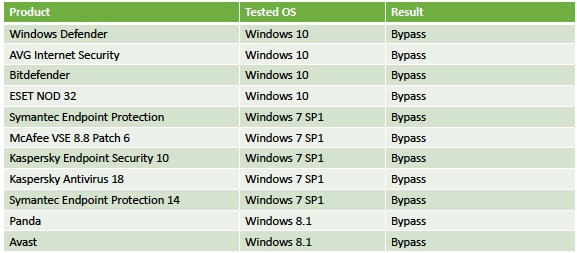
Experts have successfully tested the technique on Windows 7, Windows 8.1 and Windows 10 against security products from Microsoft, AVG, Bitdefender, ESET, Symantec, McAfee, Kaspersky, Panda Security and Avast.

Process Doppelgänging

Doppelganging relies on transactional NTFS, which is designed to make it easier for app developers and administrators to handle errors and preserve data integrity. enSilo has found a way to make changes to an executable file via NTFS transactions without actually committing those modifications to the disk. Undocumented functionality of the Windows process loader is then abused to load the modified executable. The changes made to the original file are reverted in order to avoid leaving any trace.

“We overwrite a legitimate file in the context of [an NTFS transaction],” enSilo said. “We then create a section from the modified file (in the context of the transaction) and create a process out of it. It appears that scanning the file while it’s in transaction is not possible by the vendors we checked so far (some even hang) and since we rollback the transaction, our activity leaves no trace behind.”

“There are a lot of technical challenges involved in making it work,”researchers explained. “One of the hardest challenges is that in order to run a process out of a section (not a file on disk) the process needs to be created using NtCreateProces, which means that most of the initialization must be done manually, which requires knowing a lot of undocumented details on process creation.”

enSilo says its products can detect such an attack, which means other vendors can implement detection mechanisms as well, especially if the technique will be exploited in the wild. However, since the method abuses legitimate features, experts say it cannot be patched.

The security firm disclosed its findings this week at the Black Hat Europe conference in London. Technical details and proof-of-concept (PoC) code will be made available shortly.

Related: AtomBombing – The Windows Vulnerability that Cannot be Patched

Related: GhostHook Attack Can Bypass Windows 10’s PatchGuard

Related: BoundHook Hooking Is Invisible to Windows 10’s PatchGuard

view counter

Eduard Kovacs is an international correspondent for SecurityWeek. He worked as a high school IT teacher for two years before starting a career in journalism as Softpedia’s security news reporter. Eduard holds a bachelor’s degree in industrial informatics and a master’s degree in computer techniques applied in electrical engineering.

Previous Columns by Eduard Kovacs:

Tags:


Apple Patches Vulnerabilities in macOS, watchOS, and tvOS

Apple this week released security updates for macOS, watchOS, and tvOS, as well as updated versions of the Safari browser and the iTunes for Windows application.

The company addressed a total of 22 vulnerabilities with the release of macOS High Sierra 10.13.2 this week (some of the patches were also included in Security Update 2017-002 Sierra and Security Update 2017-005 El Capitan).

Affected components included apache, curl, Directory Utility, Intel Graphics Driver, IOAcceleratorFamily, IOKit, Kernel, Mail, Mail Drafts, OpenSSL, and Screen Sharing Server. Kernel was impacted the most, with 8 bugs addressed in it.

Many of these flaws could result in attackers or malicious applications executing arbitrary code with either kernel or system privileges. Other vulnerabilities, however, could result in disclosure of process memory, administrator authentication bypass, and system termination, or could allow applications to read restricted memory.

Impacting macOS High Sierra 10.13.1, the flaw in Mail could result in an S/MIME encrypted email being inadvertently sent unencrypted if the receiver’s S/MIME certificate was not installed, Apple notes in an advisory.

A total of 9 vulnerabilities were addressed with the release of watchOS 4.2. One of the bugs impacts IOSurface, another affects Wi-Fi, while the remaining 7 were resolved in Kernel. Most of the bugs could result in an application executing arbitrary code with kernel privileges or reading restricted memory.

Affecting Apple Watch (1st Generation) and Apple Watch Series 3, the Wi-Fi bug allowed an attacker in Wi-Fi range to force nonce reuse in WPA multicast/GTK clients.

The issue, known as Key Reinstallation Attacks or KRACK, was discovered earlier this year in the Wi-Fi standard itself, thus impacting all implementations, industrial networking devices included. Apple addressed the bug in most of its products in late October.

Released on Monday, tvOS 11.2 resolves 10 vulnerabilities: one in IOSurface, another in Wi-Fi, and 8 in Kernel. Essentially, it fixes the 9 bugs addressed with watchOS 4.2, along with one other issue in Kernel.

These 10 security vulnerabilities, along with 4 others (one in IOKit, one in IOMobileFrameBuffer, one in Mail, and another in Mail Drafts), were also addressed in iOS with the release of iOS 11.2 on December 2.

On Wednesday, December 6, Apple also released Safari 11.0.2 and iTunes 12.7.2 for Windows, but hasn’t provided information on the security content of these updates.

In late November, Apple released a security update for macOS High Sierra in an effort to patch a critical authentication bypass vulnerability that can be easily exploited to gain root access to a system.

Related: Apple Patches Dangerous KRACK Wi-Fi Vulnerabilities

Related: Apple Silently Patched macOS Security Bypass Flaw

Related: Apple Patches Critical Root Access Flaw in macOS

view counter

Ionut Arghire is an international correspondent for SecurityWeek.

Previous Columns by Ionut Arghire:

Tags:


Serious Flaw Found in Many Siemens Industrial Products

Several product lines from Siemens are affected by a serious vulnerability that can be exploited by a remote attacker to cause systems to enter a denial-of-service (DoS) condition.

The flaw, tracked as CVE-2017-12741 and rated “high severity,” was reported to Siemens by George Lashenko of industrial cybersecurity firm CyberX.

According to Siemens, the list of affected products includes SIMATIC S7-200 Smart micro-PLCs for small automation applications, some SIMATIC S7 CPUs, SIMATIC WinAC RTX software controllers, SIMATIC ET 200 PROFINET interface modules, SIMATIC PN/PN couplers, SIMATIC Compact field units, development kits for PROFINET IO, SIMOTION motion control systems, SINAMICS converters, SINUMERIK CNC automation solutions, SIMOCODE motor management systems, and SIRIUS 3RW motor soft starters.

An attacker can cause affected systems to malfunction by sending them specially crafted packets via UDP port 161, which is used for the simple network management protocol (SNMP). In order to recover from the DoS condition, the devices must be manually restarted.

The mitigating factors section of Siemens’ advisory lists the requirement that the attacker must have network access for exploitation, and the fact that it advises organizations to operate these devices only in trusted environments.

However, CyberX told SecurityWeek that there are roughly 2,000 Siemens devices accessible from the Internet, including approximately 400 that have an open SNMP port, which could make them vulnerable to the company’s exploit.

“DoS vulnerabilities shouldn’t be taken lightly,” CyberX said. “The December 2016 attack on the Ukrainian electrical grid used this type of exploit to disable protection relays and make it more difficult for operators to recover.”

The security firm said Siemens was very responsive to its vulnerability report. The vendor has released firmware updates that patch the flaw in some SIMATIC S7, EK-ERTEC, SIMOTION and SINAMICS products.

Until fixes become available for the other affected products, Siemens recommends disabling SNMP, which fully mitigates the vulnerability, protecting network access to port 161, applying defense-in-depth and cell protection concepts, and using VPNs.

Related: Moxa NPort Devices Vulnerable to Remote Attacks

Related: Exploited Windows Flaws Affect Siemens Medical Imaging Products

Related: Serious Flaw Exposes Siemens Industrial Switches to Attacks

Related: Flaw in Siemens RTU Allows Remote Code Execution

view counter

Eduard Kovacs is an international correspondent for SecurityWeek. He worked as a high school IT teacher for two years before starting a career in journalism as Softpedia’s security news reporter. Eduard holds a bachelor’s degree in industrial informatics and a master’s degree in computer techniques applied in electrical engineering.

Previous Columns by Eduard Kovacs:

Tags:


ICS-CERT Advice on AV Updates Solid, But Impractical

ICS-CERT provides advice on updating antiviruses in ICS

The U.S. Industrial Control Systems Cyber Emergency Response Team (ICS-CERT) has offered some advice on how antivirus software should be updated in industrial environments, but the recommended method is not very practical and experts warn that organizations should not rely only on antiviruses to protect critical systems.

ICS-CERT recommendations on updating AVs in industrial networks

ICS-CERT, a component of the Department of Homeland Security (DHS) National Cybersecurity and Communications Integration Center (NCCIC), coordinates security incidents involving control systems and facilitates information sharing in an effort to reduce the risk of cyberattacks. The organization’s latest Monitor newsletter provides some advice on how organizations should update their antiviruses in ICS environments.

“Antivirus software, when properly deployed and up-to-date, is an important part of a defense-in-depth strategy to guard against malicious software (malware),” ICS-CERT said. “Such software is widely used in Information Technology (IT) and ICS infrastructures. In business IT environments, it is common practice to configure each antivirus client to update directly from the antivirus vendor; however, because ICS and IT systems require separation by the ICS demilitarized zone (DMZ), ICS systems require different antivirus update methods.”

The ICS DMZ is the level between the enterprise zone and the control network. The DMZ, in addition to historians and remote access servers, can include the antivirus, Windows Server Update Services (WSUS), and patch servers.

Since the ICS DMZ is typically not allowed to communicate directly to the Internet, updating these services cannot be done automatically from the vendor’s server. One method for updating antiviruses on these systems is to manually download the update, copy it to a removable media drive, and then connect that drive to the machine needing the update.

ICS architecture

However, the process is not as straightforward as it sounds. ICS-CERT has advised organizations to first verify the source of the update, and then download the update file to a dedicated host. The file should be scanned for malware and its cryptographic hash needs to be verified in order to ensure it hasn’t been tampered with.

The removable media drive should also be scanned for malware and locked (i.e. prevent files from being written to it) once the update files have been copied. Before the updates are deployed on a production system, they should be tested and validated on a test environment that mimics production machines as closely as possible.

“This process is more labor intensive than an automatic chaining of updates, but it is not prohibitively time-consuming,” ICS-CERT said. “This ‘sneakernet’ method is common in air-gapped networks. Automatically ‘daisy chaining’ the updates, which is similar to the process used in many IT environments, is convenient but not recommended.”

Experts say the method is not very practical and AVs alone are not enough

SecurityWeek has reached out to several ICS security experts for comment on the recommendations from ICS-CERT.

Anton Shipulin, an ICS security expert with Kaspersky Lab, pointed out that while the sneakernet method does work for updating protection software in air-gapped networks, in practice, organizations are having difficulties keeping their systems updated. Kaspersky often finds outdated antimalware signature databases in the ICS networks analyzed during its assessments, Shipulin said.

“For the process to work, there should be good discipline in place to carry it out regularly, as well as a technically advanced endpoint solution – with capability to get updates from centralized on-premise update servers; it’s much simpler and faster to deliver updates only to a single point,” Shipulin explained. “It’s also worth mentioning that the same process should be a requirement for all OS, control systems and device software updates (with the agreement of ICS suppliers and vendors).”

Rick Kaun, VP of solutions at industrial cybersecurity firm Verve, noted that manually applying updates can be much more complicated than the process described by ICS-CERT.

“For example, not all AV updates are the same,” Kaun explained. “If you are under warranty support with a specific vendor for a specific AV function you not only need to download the AV file, you need to either get it from the vendor or at least confirm the vendor supports it. Further, many organizations may have multiple OEM vendors each with different AV solutions so you are needing to follow this practice for more than one set of files on different target systems – tracking and reporting of completion becomes a challenge.”

“Now let’s add into the mix the frequency at which AV files are generated. If they files are updated once a month this is likely manageable. If they are updated weekly this is more challenging. Now what happens when AV files get updated daily or even faster than that? What is your corporate stance on AV update frequency? This is an important consideration in deciding an appropriate balance between latest and greatest definition files (maximum protection) versus significant human effort (convenience/manpower),” Kaun added.

“There are very few organizations that are able to maintain the rigor and frequency of an AV program as outlined in the ICS article. It is well written and good advice but not overly practical in day to day application without significant dedication of manpower and/or automated tools,” Kaun said.

All the experts contacted by SecurityWeek agree that antiviruses should not be used – especially not on their own – to protect ICS. While industrial organizations are often concerned that security software could have a negative impact on their operations, modern solutions created specifically for ICS are designed to have minimal impact while still providing comprehensive protection. Furthermore, antiviruses cannot be installed directly on critical control devices, such as PLCs and DCSs. Modern products, however, passively monitor networks for any suspicious activity, regardless of the type of device targeted.

Patrick McBride, CMO at Claroty, pointed out that security products designed for IT environments should never be used in operational technology (OT) networks.

“AV has been proven ineffective and since it is not designed to work in OT environments, you need a Rube Goldberg process just to make ineffective stuff work poorly,” McBride said. “Unfortunately, some companies rely on outdated, ineffective AV solutions because various regulations require them.”

Dana Tamir, vice president of market strategy for Indegy, pointed out another interesting aspect. While antiviruses can provide partial protection, especially against known threats, the use of traditional antiviruses may not even be possible in some organizations due to the fact that many still rely on legacy systems such as Windows NT and XP in their ICS networks, and these legacy systems may not be supported by antivirus vendors, Tamir said.

This is confirmed by a recent CyberX study, which found that three out of four industrial sites are still running outdated operating systems in their ICS networks.

“[ICS-CERT’s advice] ignores the reality that many ICS environments aren’t installing any Windows security patches or running any AV protection whatsoever because of unsupported OSs like Windows 2000 and XP,” Phil Neray, VP of Industrial Cybersecurity at CyberX, told SecurityWeek.

Tamir also noted that an organization can install antiviruses on all managed computers, but if it doesn’t use a more comprehensive solution to monitor unmanaged endpoints, threats can make it into the organization’s ICS network via the devices brought in by integrators and consultants.

view counter

Eduard Kovacs is an international correspondent for SecurityWeek. He worked as a high school IT teacher for two years before starting a career in journalism as Softpedia’s security news reporter. Eduard holds a bachelor’s degree in industrial informatics and a master’s degree in computer techniques applied in electrical engineering.

Previous Columns by Eduard Kovacs:

Tags:


Emerging Trends in Vulnerability Management

Vulnerability management has historically been treated as an engineering exercise that is disconnected from how security flaws relate to the business and the actual threat they pose.

The increasing adoption of undefended new technologies like Internet of Things (IoT) and escalation in cybercrime activity have given rise to more damaging breaches. The ensuing regulatory and legal scrutiny have revealed the shortcomings of this traditional approach. This raises the question about the limitations of traditional vulnerability management and what steps can be taken to drive a new, risk-centric approach designed to expose imminent threats (for mitigation) and more effectively reduce risk across the expanding attack surface.

According to the 2017 U.S. State of Cybercrime Survey (PDF), 39 percent of respondents reported that the frequency of cyber security events has increased over the past 12 months. This is reflected in daily news reports about data breaches and newly found vulnerabilities. In turn, organizations plan to upgrade their IT and data security to avoid cyber-attacks in the years to come. Based on the State of the CIO, 2014 – 2017 report, this has now become the second highest priority behind assisting in achieving set revenue goals.

In light of the wave of data breaches in 2017, we need to consider whether traditional approaches to vulnerability management are still viable and if just upgrading existing methods or tools is sufficient. Traditional mid-sized organizations are faced with an average of 200,000 vulnerabilities across their ecosystem, often leaving their security analysts without a clue on where to start. Given that the enterprise attack surface continues to expand from endpoints, applications, databases, mobile devices to IoT, things will only get worse. That’s why Gartner in its 2017 State of the Threat Landscape talks about the fact that “your roofs are leaky, and getting leakier”.

Vulnerabilities are not a new phenomenon – they are as old as computers. And while vulnerability management tools and practices have evolved over the past few decades by adding new capabilities like authenticated or agent-based scans, at their core they still rely on the Common Vulnerability Scoring System (CVVS), which is maintained by the Forum of Incident Response and Security Teams (FIRST). 

It is easy to be misled by CVVS scores and play math games with them. However, these exercises typically only reduce risk on paper – not in reality. Traditional vulnerability management approaches practice gradual risk reduction. They either focus remediation actions on the most severe vulnerabilities based on a high CVSS score (so-called vulnerability-centric model) or the value and exposure of an asset (i.e., Internet-facing, third-party access, contains sensitive data, provides business critical functions; so-called asset-centric model). Unfortunately, both practices are often tied to reducing the most amount of risk with the least number of patches.

These traditional approaches no longer suffice. Instead, according to Gartner (see “Threat-Centric Vulnerability Remediation Prioritization”), organizations should transform their vulnerability management practices to a threat-centric model, which allows for imminent threat elimination rather than gradual risk reduction. An imminent threat can be identified by correlating vulnerabilities to their prevalence in the wild: 

• Is a vulnerability being targeted by malware, ransomware, or an exploit kit?

• Is a threat actor leveraging the vulnerability and targeting organizations like ours?

Under this new model, imminent threats are prioritized and remediated first. While we can’t predict who will attack us, we can predict who or what successfully could.

Ultimately, organizations that are planning to “upgrade” their existing vulnerability and patch management practices should move beyond looking at the “what is”, in terms of their current security posture. A better approach is to augment tools with emerging security analytics and cyber risk management capabilities that allow for a scenario and objective-based approach that assesses the “what could be”, and predicts the impact and outcomes of potential threats.

view counter

Torsten George is strategic advisory board member at vulnerability risk management software vendor, NopSec. Torsten has more than 20 years of global information security experience. He is a frequent speaker on cyber security and risk management strategies worldwide and regularly provides commentary and byline articles for media outlets, covering topics such as data breaches, incident response best practices, and cyber security strategies. Torsten has held executive level positions with RiskSense, RiskVision (formerly Agiliance), ActivIdentity (acquired by HID® Global, an ASSA ABLOY™ Group brand), Digital Link, and Everdream Corporation (acquired by Dell). He holds a Doctorate in Economics and a Diplom-Kaufmann degree.

Previous Columns by Torsten George:

Tags:


DHS Says Drone Maker DJI Helping China Spy on U.S.

A memo from the U.S. Department of Homeland Security (DHS) warns that China-based Da-Jiang Innovations (DJI), one of the world’s largest drone manufacturers, has been providing information on critical infrastructure and law enforcement to the Chinese government.

The Los Angeles office of Immigrations and Customs Enforcement (ICE), specifically its Special Agent in Charge Intelligence Program (SIP), issued an intelligence bulletin back in August claiming that DJI is helping China spy on the United States.

A copy of the memo, marked “unclassified / law enforcement sensitive,” was published recently by the Public Intelligence project. The document, based on information from open source reporting and a “reliable source” in the unmanned aerial systems industry, assesses with moderate confidence that DJI is providing data on U.S. critical infrastructure and law enforcement to the Chinese government. The authors of the memo provide several examples of law enforcement and critical infrastructure organizations using DJI drones.

The agency also assesses with high confidence that the company is targeting government and private entities in these sectors in an effort to “expand its ability to collect and exploit sensitive U.S. data.”DJI using drones to help China spy on US

ICE claims two of the Android applications provided by DJI for some of its drones automatically tag GPS imagery and location, register facial recognition data even when turned off, and access data in the user’s phone. The data, which the agency claims to include personal information and other sensitive data, such as power control panels and security measures for critical infrastructure sites, is allegedly stored on cloud servers to which the Chinese government “likely has access.”

“SIP Los Angeles assesses with high confidence the critical infrastructure and law enforcement entities using DJI systems are collecting sensitive intelligence that the Chinese government could use to conduct physical or cyber attacks against the United States and its population,” the memo reads. “Alternatively, China could provide DJI information to terrorist organizations, hostile non-state entities, or state-sponsored groups to coordinate attacks against U.S. critical infrastructure.”

The intelligence bulletin also points to a recent memo of the U.S. Army, which instructs units to stop using DJI drones due to cybersecurity vulnerabilities, and a U.S. Navy memo on the operational risks associated with the use of the Chinese firm’s products. DJI has taken some measures to improve privacy following the Army ban.

The ICE document also claims that DJI aggressively dropped drone prices in 2015 to force its main competitors out of the market.

“The bulletin is based on clearly false and misleading claims from an unidentified source,” DJI said in response to the ICE memo. “Several of the key claims made by this unnamed source show a fundamental lack of understanding of DJI, its technology and the drone market.”

The company claims its products are not capable of recognizing a person’s face for identification purposes – a feature exists for tracking the movement of the shape of a person or the shape of their face in order to control the drone, but DJI claims it only works when the system is powered on and the Active Track mode is enabled.

DJI also refutes claims that its pricing strategy has caused competitors to stop production, and denies selling its products cheaper in the U.S. than in China.

“DJI does strive to comply with local laws and regulations in each country where its drones operate and to facilitate compliance by our customers. To the extent that there are location-specific rules and policies within China, we ensure that our systems comply with these rules, including the need to register or include no-fly zones on board,” DJI stated.

“In compliance with the Chinese regulation, DJI utilizes the user’s IP address, GPS location, and MCC ID to determine if a drone is being operated in China. If so, DJI provides the customer with the features necessary to comply with Chinese regulations and policies. Otherwise, DJI provides no information about or data collected by the drone to the Chinese government,” the company added.

DJI has also shared some more information regarding a recent incident involving a researcher who took part in the company’s bug bounty program. The expert had been offered $30,000 after finding some serious vulnerabilities, but he walked away from the deal due to an agreement DJI had asked him to sign.

The accusations brought against DJI are similar to the allegations that Kaspersky Lab is spying for the Russian government. Kaspersky’s products have been banned in U.S. government agencies by the DHS after several media reports on the topic. However, no evidence has been provided to back the claims.

Related: Design Flaws Expose Drones to Hacker Attacks

Related: Chinese Cyberspies Target European Drone Maker, Energy Firm

view counter

Eduard Kovacs is an international correspondent for SecurityWeek. He worked as a high school IT teacher for two years before starting a career in journalism as Softpedia’s security news reporter. Eduard holds a bachelor’s degree in industrial informatics and a master’s degree in computer techniques applied in electrical engineering.

Previous Columns by Eduard Kovacs:

Tags:


System76 to Disable Intel ME on Laptops Due to Security Flaws

Following the discovery of several potentially serious vulnerabilities in Intel’s Management Engine (ME), computer seller System76 announced its intention to disable the feature on its laptops with a future firmware update.

In the past months, Intel and third party security researchers discovered a significant number of flaws in ME and Active Management Technology (AMT), which allow users to remotely manage devices. The security holes can be exploited to execute arbitrary code without being detected by the user or the operating system, bypass security features, and crash systems.

Intel has released patches for these vulnerabilities and vendors such as Acer, Dell, Fujitsu, HPE, Lenovo, and Panasonic informed customers that they are also working on firmware updates that address the weaknesses.

System76, which provides Linux-powered laptops, desktops and servers, has decided to address the risks introduced by Intel ME by disabling the feature altogether.

The company has been working on a system that will allow it to automatically deliver firmware updates to computers in the same way software updates are currently being delivered through the operating system. The new update mechanism has been tested and it’s nearly ready for deployment on laptops.

System76 plans on delivering a firmware update that disables ME on laptops using 6th, 7th and 8th generation CPUs from Intel. This includes Bonobo, Gazelle, Kudu, Lemur, Oryx and Serval laptops.

Users will be informed of an update via email and prompted to install it – updates will not be conducted without user interaction. The automatic updates will work on laptops running Ubuntu 16.04 LTS, Ubuntu 17.04, Ubuntu 17.10, or version 17.10 of Pop!_OS, System76’s own Linux distribution.

ME will continue to be present on System76 desktop computers, but users will be provided firmware updates that patch the vulnerabilities disclosed by Intel.

“There is a significant amount of testing and validation necessary before delivering the updated firmware and disabled ME,” explained System76 CEO Carl Richell. “Disabling the ME will reduce future vulnerabilities and using our new firmware delivery infrastructure means future updates can roll out extremely fast and with a higher percentage of adoption (over listing affected models with links to firmware that most people don’t install).”

The company pointed out that disabling ME on laptops may no longer be possible at some point if Intel makes changes to the feature. “We implore Intel to retain the ability for device manufactures and consumers to disable the ME,” Richell said.

view counter

Eduard Kovacs is an international correspondent for SecurityWeek. He worked as a high school IT teacher for two years before starting a career in journalism as Softpedia’s security news reporter. Eduard holds a bachelor’s degree in industrial informatics and a master’s degree in computer techniques applied in electrical engineering.

Previous Columns by Eduard Kovacs:

Tags:


Chrome to Block Apps from Injecting into Its Processes

Google’s Chrome web browser will soon prevent third-party software from injecting code into its processes.

The search giant announced that the change is planned for Chrome 68 for Windows, which is currently on track to be released in July 2018. Before the switch, however, Chrome 66 will start warning users when other software is injecting code into one of its processes.

Around two thirds of Chrome users on Windows have other applications that interact with the browser, such as accessibility or antivirus software. While some of the software needed to inject code in Chrome to ensure proper functionality, this could lead to unexpected crashes.

“Users with software that injects code into Windows Chrome are 15% more likely to experience crashes,” Chris Hamilton of the Chrome Stability Team explains. 

Hamilton also points out that Chrome extensions and Native Messaging provide new, modern alternatives to running code inside of Chrome processes.

This is why Chrome 68 will start blocking third-party software from injecting code into Chrome on Windows. Before that, however, Chrome 66 will start displaying a warning after a crash, informing users on other software injecting code into the browser.

The browser will also guide users into how to update or remove the third-party software responsible for the crash.

In July 2018, Chrome 68 will start blocking code injections only if the blocking won’t prevent the browser from starting. If it will, Chrome will restart and allow the injection, while also warning the users on the matter and providing guidance into removing the troubling software.

Starting in January 2019, when Chrome 72 is set to be released in the stable channel, the browser will always block code injection.

“While most software that injects code into Chrome will be affected by these changes, there are some exceptions. Microsoft-signed code, accessibility software, and IME software will not be affected,” Hamilton says.

Related: Chrome 62 Update Patches Serious Vulnerabilities

Related: Google to Remove Support for PKP in Chrome

Related: Google Patches High Risk Flaws in Chrome

view counter

Ionut Arghire is an international correspondent for SecurityWeek.

Previous Columns by Ionut Arghire:

Tags:


Siemens Patches Several Flaws in Teleprotection Devices

Siemens has patched several vulnerabilities, including authentication bypass and denial-of-service (DoS) flaws, in its SWT 3000 teleprotection devices.

The SWT 3000 teleprotection devices are designed for quickly identifying and isolating faults in high-voltage power grids. This Siemens product is used in the energy sector worldwide.

According to advisories published by both Siemens and ICS-CERT, medium severity vulnerabilities have been found in the EN100 Ethernet module used by SWT 3000 devices running IEC 61850 and TPOP firmware.

The flaws can be exploited to bypass authentication to the web interface and perform administrative operations (CVE-2016-7112, CVE-2016-7114), and cause devices to enter a DoS condition by sending specially crafted packets (CVE-2016-7113).Siemens teleprotection device vulnerabilities

Flaws related to the product’s web server can be leveraged by a network attacker to obtain sensitive device information (CVE-2016-4784), and data from the device’s memory (CVE-2016-4785).

The security holes have been addressed in IEC 61850 firmware with the release of version 4.29.01. The TPOP firmware is affected by only three of the flaws. These have been fixed with the release of version 01.01.00.

As it’s apparent from the CVE identifiers, these vulnerabilities were actually discovered last year. They were reported to Siemens via ICS-CERT by researchers at HackerDom and Kaspersky Lab.

Siemens and ICS-CERT disclosed CVE-2016-4784 and CVE-2016-4785 in May 2016, when they warned that the flaws had affected SIPROTEC 4 and SIPROTEC Compact devices. An advisory published in September 2016 warned that the same products were also affected by CVE-2016-7112, CVE-2016-7114 and CVE-2016-7113.

In July 2017, Siemens informed customers that all five vulnerabilities also impacted Reyrolle devices, which provide a wide range of integrated protection, control, measurement, and automation functions for electrical substations.

Related: Siemens Patches Flaws in Automation, Power Distribution Products

Related: Serious Flaw Exposes Siemens Industrial Switches to Attacks

Related: Flaw in Siemens RTU Allows Remote Code Execution

view counter

Eduard Kovacs is an international correspondent for SecurityWeek. He worked as a high school IT teacher for two years before starting a career in journalism as Softpedia’s security news reporter. Eduard holds a bachelor’s degree in industrial informatics and a master’s degree in computer techniques applied in electrical engineering.

Previous Columns by Eduard Kovacs:

Tags:


Patch of Dirty COW Vulnerability Incomplete, Researchers Claim

The “Dirty COW” vulnerability (CVE-2016–5195) discovered last year in Linux was incompletely patched, Bindecy researchers say.

The vulnerability was found to be caused by a race condition in the way the Linux kernel’s memory subsystem handles copy-on-write (COW) breakage of private read-only memory mappings. Discovered by Phil Oester, the bug could allow an unprivileged local attacker to escalate their privileges on a targeted system.

The vulnerability was found to impact Android as well, and could even escape containers. Soon after Google released a patch for the vulnerability, however, new attacks exploiting Dirty COW on Android were devised.

The most recent malware family to exploit the issue was observed in September of this year.

Although Dirty COW was one of the most hyped and branded vulnerabilities published, with every Linux version from the last decade affected, including Android, being vulnerable, the patch released for it stirred far little interest, Bindecy says. Because of that, over a year has passed since the patch was released, and no one noticed it was incomplete.

The original vulnerability impacted the get_user_pages function, which is used to get the physical pages behind virtual addresses in user processes. Basically, the bug would allow writing to the read-only privileged version of a page.

The fix for the vulnerability doesn’t reduce the requested permissions. Instead, “get_user_pages now remembers the fact the we went through a COW cycle,” the researchers explain.

Thus, on the next iteration, a read-only page is provided for a write operation only if FOLL_FORCE and FOLL_COW flags are specified, and the PTE is marked as dirty.

The problem, the security researchers say, is that the patch “assumes that the read-only privileged copy of a page will never have a PTE pointing to it with the dirty bit on.”

Bindecy discovered that the vulnerability can still be reproduced when Transparent Huge Pages (THP) and Page Medium Directory (PMD – one level above the PTE level), are involved.

While Linux usually uses 4096-bytes long pages, THPs can be even 2MB long, although they can be split into normal pages. Usually, the default THP support is for anonymous mapping only, but can be turned on or off while the system is running.

THP is implemented by turning on the _PAGE_PSE bit of the PMD, which results in PMD pointing to a 2MB physical page instead of a directory of PTEs.

What the researchers discovered was that Dirty COW patch code that deals with THP contains a function called can_follow_write_pmd that basically applies the same logic of can_follow_write_pte to huge PMDs.

According to the researchers, however, the issue is that, when it comes to huge PMD, “a page can be marked dirty without going through a COW cycle, using the touch_pmd function.” Each time get_user_pages tries to get a huge page, a called function results in the page being marked dirty without going through a COW cycle. Thus, can_follow_write_pmd’s logic is broken, the researchers say.

“At this point, exploiting the bug is straightforward — we can use a similar pattern of the original Dirty COW race. This time, after we get rid of the copied version of the page, we have to fault the original page twice — first to make it present, and then to turn on the dirty bit,” Bindecy notes.

The security researchers revealed information on a couple of exploit scenarios and also published a proof-of-concept to demonstrate the exploit. They reported the vulnerability (which was assigned CVE-2017–1000405) to the kernel and distros mailing lists last week and a patch was already committed to mainline kernel.

“This bug demonstrates the importance of patch auditing in the security development life-cycle. As the Dirty COW case and other past cases show, even hyped vulnerabilities may get incomplete patches. The situation is not reserved for closed source software only; open source software suffers just as much,” the researchers conclude.

Related: Android Malware Exploits Dirty COW Vulnerability

Related: “Dirty COW” Linux Kernel Exploit Seen in the Wild

view counter

Ionut Arghire is an international correspondent for SecurityWeek.

Previous Columns by Ionut Arghire:

Tags: