Updates released by Cisco for components of its online meetings and video conferencing platform WebEx patch nearly a dozen vulnerabilities, including critical flaws that can be exploited for remote code execution.
A total of six vulnerabilities affecting the WebEx Network Recording Player for Advanced Recording Format (ARF) and WebEx Recording Format (WRF) files have been classified as critical.
The impacted player is used to play back recorded WebEx meetings and it can be installed automatically when a recording file hosted on a WebEx server is opened.
The security holes affecting the Network Recording Player can be exploited by a remote attacker to cause a denial-of-service (DoS) condition in the software and possibly execute arbitrary code by getting the targeted user to open specially crafted ARF or WRF files. Cisco noted that the attacker can send the malicious files to victims via email or get them to open a web page hosting the files.
The vulnerabilities have been patched by Cisco in WebEx Business Suite meeting sites, WebEx Meetings sites, WebEx Meetings Server, and WebEx ARF and WRF Players. Cisco’s advisory provides detailed information on affected versions and the availability of fixes. The following CVE identifiers have been assigned: CVE-2017-12367, CVE-2017-12368, CVE-2017-12369, CVE-2017-12370, CVE-2017-12371 and CVE-2017-12372.
The flaws were reported to Cisco by Andrea Micalizzi (rgod) and Steven Seeley of Offensive Security via Trend Micro’s Zero Day Initiative (ZDI), Fortinet’s Kushal Arvind Shah, and Qihoo 360 researcher Yihan Lian. ZDI has yet to make the advisories for the flaws found by Seeley and Micalizzi public.
Cisco found no evidence that the vulnerabilities had been exploited in malicious attacks.
Lian also discovered a medium severity DoS vulnerability in the WebEx Network Recording Player. A remote attacker can cause the player to crash by getting the targeted user to open a malicious WRF file.
The networking giant published four other advisories detailing WebEx vulnerabilities on Wednesday. These weaknesses have also been rated “medium severity” and they include cross-site scripting (XSS) and URL redirection vulnerabilities in WebEx Meeting Center, an information disclosure bug in Event Center, and a flaw that can be exploited to modify the welcome message in Meeting Server.
Eduard Kovacs is an international correspondent for SecurityWeek. He worked as a high school IT teacher for two years before starting a career in journalism as Softpedia’s security news reporter. Eduard holds a bachelor’s degree in industrial informatics and a master’s degree in computer techniques applied in electrical engineering.
Previous Columns by Eduard Kovacs:
Tags:
Patch for macOS Root Access Flaw Breaks File Sharing
The patch released by Apple on Wednesday for a critical root access vulnerability affecting macOS High Sierra appears to break the operating system’s file sharing functionality in some cases. The company has provided an easy fix for affected users.
The flaw, tracked as CVE-2017-13872, allows an attacker to gain privileged access to a device running macOS High Sierra by logging in to the root account via the graphical user interface with the username “root” and any password. Apple has disabled the root account by default and when users attempt to log in to this account, the password they enter is set as its password. If the password field is left blank, there will be no password on the root account.
The vulnerability can be exploited locally, but remote attacks are also possible if sharing services are enabled on the targeted machine.
While the issue was mentioned on Apple developer forums on November 13, the tech giant only learned about it on November 28, when a Turkish developer posted a message on Twitter. A patch was released within 24 hours, but since Apple did not have enough time to test the fix, it appears to introduce other problems.
Some users may find that the file sharing functionality no longer works after they have installed the security update for High Sierra 10.13.1.
An advisory published by Apple shortly after the release of the update provides recommendations on how to repair file sharing. Users simply need to open the Terminal, type the command sudo /usr/libexec/configureLocalKDC, and enter their administrator password when prompted. This should address the issue until Apple releases another update.
Attacks exploiting CVE-2017-13872 can also be prevented by manually setting a password for the root user account or disabling sharing services if not needed. Apple said the security hole does not affect macOS Sierra 10.12.6 and earlier.
This is not the only authentication bug found in macOS High Sierra recently. Last month, a developer noticed that the operating system had leaked the passwords for encrypted Apple File System (APFS) volumes via the password hint.
Eduard Kovacs is an international correspondent for SecurityWeek. He worked as a high school IT teacher for two years before starting a career in journalism as Softpedia’s security news reporter. Eduard holds a bachelor’s degree in industrial informatics and a master’s degree in computer techniques applied in electrical engineering.
Previous Columns by Eduard Kovacs:
Tags:
Samsung Adopts Bugcrowd to Manage Mobile Security Rewards Program
Samsung Adopts Bugcrowd, Offering up to $200,000 Per Vulnerability Through Mobile Security Rewards Program
Bug bounties are cost-efficient partial solutions to the security skills gap. In 2015, Dice reported that that a Lead Software Security Engineer could cost more than $200,000 per year in salary, while an application security manager would cost more than another $150,000.
Employing an in-house team to continuously probe products, software, firmware and all updates for security bugs rapidly becomes an expensive exercise, with — frankly — no guarantee of success. Failure to find and fix security bugs and vulnerabilities before they are exploited by criminals, however, could rapidly become even more costly.
Bug bounties help to solve this problem by tapping into the largest available market of top-class security expertise — the white hat hacker community — and paying only on results. Adequate bounties further encourage white hat hackers to conform to a responsible disclosure ethos for all discovered vulnerabilities, provided they are confident that the vendor will uphold his part of the bargain. Third-party bounty program operators take the idea further by running the bounty scheme on the vendors’ behalf, lowering administrative cost and hassle.
The 2017 Bugcrowd State of Bug Bounty Report (PDF) “highlights not only the continued growth of the bug bounty model, but also the enterprise’s adoption of it, with three times more enterprise bug bounty programs launched in the past year than the previous three years combined.”
Now Bugcrowd affirms this statement with the announcement that from today it will manage payment processing for the Samsung Electronics’ Mobile Security Rewards Program that was launched in September 2017. “By adopting a bug bounty program covering all mobile products, Samsung is not only accessing the most powerful set of resources available, but also demonstrating [its] commitment to security. We are proud to work with such a security-centric organization to help minimize the risk to the millions of consumers using Samsung mobile devices.”
Bugcrowd currently operates the rewards programs of more than 70 different companies (not all of which offer a financial bounty) including security firms BitDefender, Centrify, NETGEAR, 1Password, Okta, Cylance, LastPass. Corporate partners include MasterClass, Fiat Chrysler, Tesla and Western Union. The Samsung Electronics’ Mobile Security program rewards security researchers up to $200,000 per vulnerability, depending on its severity.
Researchers are expected to keep details of any vulnerability confidential until a remedy is in place, but Samsung will provide an initial response within 48 hours and ‘make our best effort’ to release a patch within 90 days.
“Our Mobile Security Rewards Program is yet another initiative being undertaken by Samsung to further this commitment,” said Henry Lee, Senior VP of Mobile Security Technologies Group, Mobile Communications business at Samsung Electronics. “Bugcrowd helps fortify partnership with the security research community by ensuring the community receives payouts in a timely manner.”
Kevin Townsend is a Senior Contributor at SecurityWeek. He has been writing about high tech issues since before the birth of Microsoft. For the last 15 years he has specialized in information security; and has had many thousands of articles published in dozens of different magazines – from The Times and the Financial Times to current and long-gone computer magazines.
Some of the vulnerabilities discovered recently by Google researchers in the Dnsmasq network services software affect several Siemens SCALANCE industrial communications products.
Dnsmasq is a lightweight tool designed to provide DNS, DHCP, router advertisement and network boot services for small networks. It can be found in Linux distributions, smartphones, routers, and many Internet of Things (IoT) devices.
Google’s security team recently found that the tool is affected by seven flaws, including ones that can be exploited via DNS or DHCP for remote code execution, information disclosure, and denial-of-service (DoS) attacks. Linux distributions, Amazon, Cisco, Synology, Sophos and other companies warned customers about the potential risks shortly after the issues were disclosed in early October.
Earlier this month, Siemens also published an advisory to inform customers that four of the seven vulnerabilities affect some of its SCALANCE products, including W1750D controller-based direct access points, M800 industrial routers, and S615 firewalls.
Three of the flaws affecting Siemens devices, CVE-2017-13704, CVE-2017-14495 and CVE-2017-14496, can be exploited to crash the Dnsmasq process by sending specially crafted requests to the service on UDP port 53.
The SCALANCE products are also impacted by CVE-2017-14491, one of the most serious vulnerabilities discovered by Google researchers in Dnsmasq. This security hole allows an attacker to cause a DoS condition or possibly execute arbitrary code.
“In order to exploit this vulnerability, an attacker must be able to trigger DNS requests from the device, and must be in a position that allows him to inject malicious DNS responses, e.g. the attacker must be in a Man-in-the-Middle position,” Siemens said.
The company says it’s preparing patches for the vulnerable products. In the meantime, it has advised customers to apply defense-in-depth recommendations, deploy firewall rules to block incoming traffic on UDP port 53 (applies to W1750D if OpenDNS, Captive
Portal or URL redirection functionality is not used), and disable the DNS proxy and configure devices to use a different DNS server (applies to M800 and S615).
Siemens has also reported the vulnerabilities to ICS-CERT, which also published an advisory this week.
Eduard Kovacs is an international correspondent for SecurityWeek. He worked as a high school IT teacher for two years before starting a career in journalism as Softpedia’s security news reporter. Eduard holds a bachelor’s degree in industrial informatics and a master’s degree in computer techniques applied in electrical engineering.
Previous Columns by Eduard Kovacs:
Tags:
macOS Bug Allows Root Access With No Password
macOS High Sierra is plagued by a bug that can be exploited to gain root access to a machine by leaving the password field blank. Apple is expected to quickly release a patch, especially since remote exploitation is also possible.
Ever since High Sierra came out, some users have complained that their admin accounts had become standard accounts after updating the operating system. While trying to find a solution for the problem, one user on Apple’s Developer Forums suggested logging in with “root” and no password in order to obtain the access needed to create an admin account.
This solution was suggested on November 13, and on November 28 someone realized that logging in to the root account with no password should not be possible and that this is a major vulnerability.
Gaining root access via this flaw requires entering the “root” username in the graphical user interface (GUI) and leaving the password field blank. A couple of attempts are required, but SecurityWeek can confirm that it’s easy to reproduce.
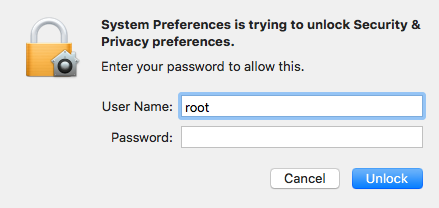
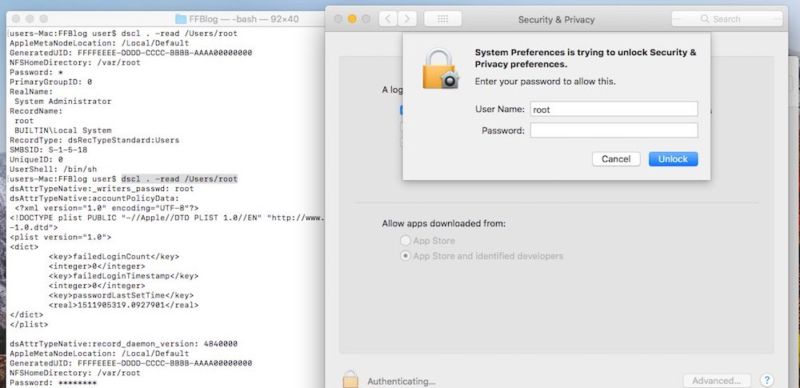
Access “System Preferences” from the Apple menu and click on any of the categories that require administrator privileges in order to make changes (e.g. Security & Privacy, Users & Groups, Parental Controls). Then click on the lock icon in the bottom left corner of the window and enter the username “root” with a blank password when prompted. Hit the Enter key or the Unlock button twice and root access is granted.
An analysis of the flaw revealed that an attempt to log in as root with a blank password actually activates a subroutine that creates the root account, which Apple has disabled by default. Once the root account has been activated, logging in as root with no password works on the first try.
While it may appear that the vulnerability can only be exploited by having physical access to the targeted machine, macOS hacker Patrick Wardle and others have managed to reproduce it remotely as well if sharing services are enabled on the device. Some experts warned that malicious actors could be scanning the Web for remotely accessible computers that they can attack using this security hole.
Apple is working on patching the vulnerability. In the meantime, users can protect themselves against potential attacks by manually setting a password for the root user. Disabling sharing services is also a good way to prevent remote exploitation of the flaw.
This is the second password-related bug found in macOS High Sierra recently. Back in October, a developer noticed that the operating system had leaked the passwords for encrypted Apple File System (APFS) volumes via the password hint.
Eduard Kovacs is an international correspondent for SecurityWeek. He worked as a high school IT teacher for two years before starting a career in journalism as Softpedia’s security news reporter. Eduard holds a bachelor’s degree in industrial informatics and a master’s degree in computer techniques applied in electrical engineering.
Previous Columns by Eduard Kovacs:
Tags:
macOS bug lets you log in as admin with no password required
Patrick Wardle
In one of Apple’s biggest security blunders in years, a bug in macOS High Sierra allows untrusted users to gain unfettered administrative control without any password.
The bypass works by putting the word “root” (without the quotes) in the user name field of a login window, moving the cursor into the password field, and then hitting enter button with the password field empty. With that—after a few tries in some cases—the latest version of Apple’s operating system logs the user in with root privileges. Ars reporters were able to replicate the behavior multiple times on three Macs. The flaw isn’t present on previous macOS versions.
The password bypass can be exploited in a variety of ways, depending on the way the targeted Mac has been set up. When full-disk encryption is turned off, an untrusted user can turn on a Mac that’s fully powered down and log in as root. Exploiting the vulnerability was also not possible when a Mac was turned on and the screen was password protected. Even on Macs that have filevault turned on, the bypass can also be used to make unauthorized changes to the Mac System Preferences (including disabling filevault), or the bypass can be used to log in as root after logging out of an existing account but not turning off the machine. The behavior observed in Ars tests and reported on social media was extremely inconsistent, so results are likely to vary widely.
The upshot of all of this: as long as someone has filevault turned on, their files are most likely safe from this exploit as long as their Mac is turned off before an attacker gets hold of it. Locking a screen with a password also appeared to protect a computer while it’s unattended.
Privilege escalation
Of more concern is that malicious hackers can exploit this vulnerability to give their malware unfettered control over the computer and OS. Such escalation-of-privilege exploits have become increasingly valuable over the past decade as a way to defeat modern OS defenses. A key protection found in virtually all OSes is to restrict the privileges given to running software. As a result, even when attackers succeed in executing malicious code, they’re unable to get the malware permanently installed or to access sensitive parts of the OS.
“This looks like something that a piece of malware or an attacker could use in a multistage attack,” Patrick Wardle, a researcher with security firm Synack, told Ars. In cases such as these, attackers use one exploit to run their malicious code and a second exploit to escalate the privileges of that code so it can perform actions that the OS normally wouldn’t allow. “This appears to be one way malware or an attacker would be able to do that.”
Amit Serper, principal security researcher at Cybereason, said his tests showed the vulnerability is located in com.apple.loginwindow, a macOS component that’s one of at least two ways users can log into accounts. He said he was unable to reproduce the exploit using a Mac’s terminal window, although he said he saw reports on Twitter from other people who said the bypass worked using the terminal window as well. Whatever the case, he agreed with Wardle that the flaw likely represents a major privilege-escalation vulnerability that can be exploited easily by malware developers.
“If they’re using API (programming interface) calls, it’s a matter of writing the appropriate code,” Serper told Ars. “An attacker should be able to trigger it.”
The vulnerability can also have dire consequences for people who have made their Macs accessible through remote management screen sharing provided through macOS or third-party services. Will Dormann, a vulerability analyst at CERT, said on Twitter that having remote options turned on will allow attackers to remotely access the machine with no password required. Results from a quick search that were posted on Twitter showed more than 105,000 Macs alone had the VNC remote desktop app installed. To check if remote management or screen sharing is on, users can check the Sharing menu in System Preferences.
Dear @AppleSupport, we noticed a *HUGE* security issue at MacOS High Sierra. Anyone can login as “root” with empty password after clicking on login button several times. Are you aware of it @Apple?
A vulnerability that logs users in as root without requiring any password at all is extraordinary, both because of the lack of testing it suggests on the part of Apple developers and the potential harm it presents to end users. The last time in recent memory Apple made an error of this magnitude was the so-called goto fail bug that gave attackers an easy way to bypass TLS encryption. It took Apple four days to patch the critical flaw, which got its name from one of the lines of code responsible for the vulnerability.
Apple representatives issued the following statement:
We are working on a software update to address this issue. In the meantime, setting a root password prevents unauthorized access to your Mac. To enable the Root User and set a password, please follow the instructions here: https://support.apple.com/en-us/HT204012. If a Root User is already enabled, to ensure a blank password is not set, please follow the instructions from the “Change the root password” section.
Specifically, users should do the following:
open the Users & Account menu in System Prefereces
click the padlock at the bottom and enter an administrator name and password
click Login Options
Click Join (or Edit)
Click Open Directory Utility
Click the padlock at the bottom and enter an administrator name and password
From the menu bar in Directory Utility, choose Edit > Change password
Enter a strong password
The most important part for now is not to disable the root account. That only allows the root account to be re-enabled by putting “root” in a user name field and leaving the password blank. Until Apple issues a patch, people should secure the root account with a strong password and leave the account enabled. As always, passwords should be at least 13 characters long, randomly generated, and contain a mixture of numbers, upper- and lower-case letters, and symbols. As an added layer of security, users should also ensure they have filevault turned on.
Some researchers are speculating unsecured root account doesn’t exist until someone with physical access to the Mac attempts to log in while leaving the password blank. That has prompted advice Mac users not test their systems lest they create a persistent root user account that wasn’t there previously. Other researchers report here and here being able to exploit the weakness to remotely log into a Mac, with no previous local login attempts.
This post was updated extensively over several hours as new details became available.
Several Vulnerabilities Patched in PowerDNS
Updates released for the authoritative nameserver and recursive nameserver components of PowerDNS patch several vulnerabilities that can be exploited for denial-of-service (DoS) attacks, records manipulation, modifying configurations, and cross-site scripting (XSS) attacks.
PowerDNS Recursor versions 4.0.0 through 4.0.6 are affected by a DNSSEC validation issue that can be exploited by a man-in-the-middle (MitM) attacker to forge signatures and alter DNS records (CVE-2017-15090).
Another flaw affecting these versions of Recursor is CVE-2017-15092, an XSS bug that allows a remote attacker to inject arbitrary HTML and JavaScript code into the Recursor web interface. The security hole can be exploited by sending specially crafted DNS queries to the server in order to alter the web interface or cause it to enter a DoS condition.
The Recursor is also impacted by a vulnerability that allows an authenticated attacker to inject new directives into its configuration (CVE-2017-15093). The last issue affecting this component is a DoS flaw caused by a memory leak that can occur when parsing specially crafted DNSSEC ECDSA keys (CVE-2017-15094). The vulnerability can be exploited by using an authoritative server to send specially crafted keys to the recursor.
The only security hole affecting PowerDNS Authoritative versions 4.0.4, 3.4.11 and prior is CVE-2017-15091, which allows an authenticated attacker to cause a DoS condition.
The vulnerabilities have been rated medium and low severity as they do not impact default configurations. Patches are included in PowerDNS Authoritative 4.0.5 and Recursor 4.0.7. Minimal fixes have also been provided for the 3.4.11 and 3.7.4 releases, but users of these versions have been advised to migrate to the 4.x branch.
These security holes were discovered by Finland-based cybersecurity services company Nixu during a source code audit, Chris Navarrete of Fortinet’s Fortiguard Labs, Kees Monshouwer, and a researcher who uses the online moniker “everyman.”
Eduard Kovacs is an international correspondent for SecurityWeek. He worked as a high school IT teacher for two years before starting a career in journalism as Softpedia’s security news reporter. Eduard holds a bachelor’s degree in industrial informatics and a master’s degree in computer techniques applied in electrical engineering.
Previous Columns by Eduard Kovacs:
Tags:
Bulletproof Coffee Failed to Keep Hackers Out
Bulletproof 360, the Bellevue, Wash.-based company that offers Bulletproof coffee and dietary supplements, is having trouble keeping cybercriminals out of its systems. The firm has sent out several notifications in the past year informing customers that hackers may have obtained their personal and payment card information.
Bulletproof only has three physical stores in Seattle and Los Angeles, but many people buy the company’s products from its website, which appears to have been breached several times in the past year.
The company first discovered that hackers had broken into its website on February 23, 2017. An investigation revealed that cybercriminals had compromised Bulletproof’s e-commerce system and they may have obtained payment card data submitted by users who had made online purchases, including names, card numbers, expiration dates, and CVVs. The exposed data also included email addresses, physical addresses and phone numbers.
An initial investigation found that the hackers had access to Bulletproof’s systems from October 26, 2016 until January 31, 2017. However, the final forensics report revealed that the attackers actually had access until May 30, 2017, which triggered a second breach notification for the period between February and May 2017.
Bulletproof then initiated another internal investigation, which showed that hackers had compromised the checkout page on its website, bulletproof.com, in an effort to capture payment card data submitted by customers making online purchases. This time, the attackers appeared to have had access between August 28, 2017 and September 5, 2017.
In the notifications sent out on September 15, the company told customers that it had “implemented enhanced security measures, including installing a new website security platform, implementing a security information and event management system (SIEM), and implementing enhanced logging” in an effort to prevent future incidents.
However, the new security measures did not help much and this week Bulletproof started sending out a new round of data breach notifications. It turns out that cybercriminals may have also intercepted information submitted to the company via the checkout page on its website between May 20 and October 13, 2017, and October 15-19, 2017.
The company has promised to reimburse affected customers for costs incurred as a result of these breaches if their financial institution refuses to reimburse them. It remains to be seen if this is the last breach notice sent out by the company or if hackers will gain access to its systems once again – if they haven’t done so already.
Eduard Kovacs is an international correspondent for SecurityWeek. He worked as a high school IT teacher for two years before starting a career in journalism as Softpedia’s security news reporter. Eduard holds a bachelor’s degree in industrial informatics and a master’s degree in computer techniques applied in electrical engineering.
Previous Columns by Eduard Kovacs:
Tags:
Cobalt Hackers Exploit 17-Year-Old Vulnerability in Microsoft Office
The notorious Cobalt hacking group has started to exploit a 17-year-old vulnerability in Microsoft Office that was addressed earlier this month, security researchers claim.
The issue was found in a component that remained unchanged in Microsoft’s Office suite since November 9, 2000, and appears to have been patched manually instead of being corrected directly in the source code, an analysis 0patch published last week reveals.
An Office component designed to facilitate the creation of math and science equations, the Equation Editor was replaced in Office 2007 with new methods of displaying and editing equations. However, the old tool continues to be part of the popular Office suite to ensure compatibility with older documents.
The newly addressed vulnerability has recently started being exploited by the Cobalt hackers in live attacks, ReversingLabs, which managed to capture a RTF document specifically designed to exploit CVE-2017-11882, says.
The malicious file was observed contacting a remote server to grab a first-stage payload it would execute using MSHTA.exe. The executed code would then connect to the remote server to fetch a second-stage payload, a script that would drop an embedded, final payload.
This appears to be the Cobalt Strike backdoor, the group’s preferred malicious tool. The malware allows the attackers to execute remote commands on the infected systems.
Considering that unpatched EQNEDT32.EXE instances put Office users at risk, regardless of the Windows version their systems run. The 17 year-old bug was found to impact even machines running Windows 10 Creators Update, which explains why hackers are already exploiting the vulnerability.
What’s more, proof-of-concept exploits for the vulnerability were published soon after the vulnerability became public, so there’s no surprise in the fact that Cobalt has already started targeting the bug, especially since the hacking group is known to be a fast adopter of newly discovered exploits.
A financially-motivated group, Cobalt was first described in 2016 and is known to be targeting banks, financial exchanges, insurance companies, investment funds, and other financial organizations. The hackers use phishing emails carrying malicious documents or ZIP archives packing executables to distribute their malware.
Earlier this year, the group started abusing CVE-2017-0199, a vulnerability patched in April, expanded its operations to North America, and started using supply chain attacks. The group was initially focused only on Eastern Europe and Central and Southeast Asia, but is now hitting targets worldwide.
A report published last week revealed that the group started targeting banks themselves, instead of bank customers. The attacks were attempting to exploit CVE-2017-8759, a code injection/remote code execution vulnerability in Microsoft’s .NET Framework that was patched in September 2016.
Ionut Arghire is an international correspondent for SecurityWeek.
Previous Columns by Ionut Arghire:
Tags:
Critical Code Execution Flaw Found in Exim
Serious vulnerabilities that can be exploited for remote code execution and denial-of-service (DoS) attacks have been found in the popular mail transfer agent (MTA) software Exim.
Exim is an open source MTA for Unix systems created at the University of Cambridge. An analysis of more than one million mail servers conducted back in March showed that over 56 percent of them had been running Exim.
A researcher who uses the online moniker “Meh,” a member of the research team at Taiwan-based security firm DEVCORE, discovered that Exim is affected by a couple of potentially serious vulnerabilities.
One of them, tracked as CVE-2017-16943 and classified as critical, is a use-after-free bug related to a feature called “chunking.” It allows a remote attacker to execute arbitrary code or cause a DoS condition via specially crafted BDAT commands.
Chunking is a feature that allows sending emails in chunks. BDAT commands specify the length of the binary data packet so that the Simple Mail Transfer Protocol (SMTP) host does not have to continuously scan for the end of the data.
Sending specially crafted BDAT commands to the targeted mail server can trigger the use-after-free vulnerability and allow an attacker to execute arbitrary code. There are reportedly more than 400,000 servers with the vulnerable chunking feature visible on the Internet.
The second flaw discovered by Meh is CVE-2017-16944, a high severity issue that allows a remote attacker to cause a DoS condition using specially crafted BDAT commands.
In the advisory informing Exim users of the vulnerability, developers said the issue had been disclosed publicly before a patch could be released. Meh said he did not find an email address for privately reporting security holes so he reported it via the Exim bug tracker. However, the bug tracker did not have an option for setting reports to private and the researcher wrongly assumed that security bugs are set to private by default. Exim developers have taken steps to prevent such incidents in the future.
The details of the code execution vulnerability, along with proof-of concept (PoC) code, were posted to the Exim Bugzilla on November 23. A workaround that involves disabling the chunking feature and a patch were made available within two days. Only the source code patch is available – the fix for CVE-2017-16943 will likely be included in the next release.
Exim is currently at version 4.89 and the flaw was apparently introduced in 4.88 when the chunking feature was added. Developers are still working on a patch for CVE-2017-16944.
Just over a dozen vulnerabilities have been identified in Exim since 2010, and only five of them, reported several years ago, allow remote code execution without authentication.
Eduard Kovacs is an international correspondent for SecurityWeek. He worked as a high school IT teacher for two years before starting a career in journalism as Softpedia’s security news reporter. Eduard holds a bachelor’s degree in industrial informatics and a master’s degree in computer techniques applied in electrical engineering.


 Tags:


 Tags:


 Tags:


 Tags:


 Tags:


 Tags:


 Tags:


 Tags:


 Tags: