Cyber Insights 2023 | Supply Chain Security

About SecurityWeek Cyber Insights | At the end of 2022, SecurityWeek liaised with more than 300 cybersecurity experts from over 100 different organizations to gain insight into the security issues of today – and how these issues might evolve during 2023 and beyond. The result is more than a dozen features on subjects ranging from AI, quantum encryption, and attack surface management to venture capital, regulations, and criminal gangs.

Cyber Insights | 2023

SecurityWeek Cyber Insights 2023 | Supply Chain Security – The supply chain threat is directly linked to attack surface management (it potentially represents a hidden part of the attack surface) and zero trust (100% effective zero trust would eliminate the threat). But the supply chain must be known and understood before it can be remediated.

In the meantime – and especially throughout 2023 – it will be a focus for adversaries. Why attack a single target when successful manipulation of the supply chain can get access to dozens or even hundreds of targets simultaneously. 

The danger and effectiveness of such attacks is amply illustrated by the SolarWinds, log4j, Spring4Shell, Kaseya, and OpenSSL incidents.

The missed wake-up calls

Supply chain attacks are not new. The iconic Target breach of late 2013 was a supply chain breach. The attackers got into Target using credentials stolen from its HVAC provider, Fazio Mechanical Services – that is, via Target’s supply chain.

The 2018 breach of Ticketmaster was another supply chain breach. A Ticketmaster software supplier, Inbenta, was breached and Inbenta software was modified and weaponized. This was automatically downloaded to Ticketmaster. 

Island hopping is another form of supply chain attack. In 2017, Operation Cloud Hopper was revealed. This disclosed that an advanced group, probably APT10, was compromising managed service providers to gain access to the MSP’s customers. 

Despite these incidents, it has only been in the last couple of years, fueled by more extensive incidents such as SolarWinds, that industry has become cognizant of the full threat from increasingly sophisticated and wide-ranging supply chain concerns. But we should not forget that the 2017 NotPetya incident also started as a supply chain attack. Software from the Ukrainian accounting firm M.E.Doc was weaponized and automatically downloaded by the firm’s customers, before spreading around the globe. Both SolarWinds and NotPetya are believed to be the work of nation state actors.

All forms of supply chain attacks will increase in 2023, and beyond. Chad Skipper, global security technologist at VMware, specifically calls out island hopping. “In 2023, cybercriminals will continue to use island hopping, a technique that aims to hijack an organization’s infrastructure to attack its customers,” he warns. “Remote desktop protocol is regularly used by threat actors during an island-hopping campaign to disguise themselves as system administrators. As we head into the new year, it’s a threat that should be top of mind for all organizations.”

Attacks will increase

That supply chain attacks will increase in 2023 and beyond is the single most extensive prediction for 2023. “Supply chain attacks happen when hackers gain access to a company’s inner workings via a third-party partner, a method that provides them with a much greater amount of privileged information from just one breach,” explains Matt Jackson, senior director security operations at Code42. “This type of attack already rose by more than 300% in 2021, and I anticipate this trend will continue in 2023, with these attacks becoming more complicated and intricate.”

Lucia Milică, Resident CISO, Proofpoint

Lucia Milică, global resident CISO at Proofpoint, worries that despite all the wake-up calls so far, “We are still a long way from having adequate tools to protect against those kinds of digital supply chain vulnerabilities. We predict these concerns will mount in 2023, with our trust in third-party partners and suppliers becoming one of the primary attack channels.”

The result, she added, is, “We expect more tension in supply chain relationships overall, as organizations try to escalate their vendors’ due diligence processes for better understanding the risks, while suppliers scramble to manage the overwhelming focus on their processes.”

Jackson added, “Because many third-party partners are now privy to more sensitive data than ever before, companies can no longer rely on their own cybersecurity prowess to keep information safe,” he said. 

“Supply chain attacks purposefully target the smaller organizations first because they’re less likely to have a robust cybersecurity setup, and they can use those companies to get to the bigger fish,” he continued. “In the next year, companies will become even more diligent when deciding on an outside organization to work with, creating an increase in compliance verifications to vet the cyber tools used by these prospective partners.”

Anand Raghavan, co-founder and CPO at Armorblox, expands on this theme. “This becomes particularly relevant,” he said, “for the Fortune 500 or Global 2000 companies that have a large ecosystem of suppliers, vendors, and distributors whose security stacks are nowhere as mature as those of large organizations. Large organizations might consider requiring all vendors to follow certain security best practices, including modernizing their email security stack if they want to continue being a vendor in good standing.”

Interestingly, despite all the warnings of an escalating threat, Christopher Budd, senior manager of threat research at Sophos, notes, “Unlike two years ago when the SolarWinds attack put supply chain attacks high on people’s radar, supply chain attacks have faded from prominence.” This may be a misleading premise. The discovery of a vulnerability in a widely used piece of software, such as the log4j vulnerability, will be used by individual cybercriminals and nation state actors alike.

However, targeted attacks such as that against SolarWinds requires resources and skill. These attributes are more usually found only in the more advanced gangs and nation state actors. Such adversaries have another attribute: patience. “Today’s and undoubtedly tomorrow’s threat actors have shown they can play the long game,” warns Pieter Arntz, senior intelligence reporter at Malwarebytes.

Budd also warns that despite their immediate lack of prominence (at the time of writing, but anything could happen tomorrow), “Supply chain may be something that continues to not gather news, similar to 2022. But it will remain a real threat and one that organizations should be prioritizing across the board, in part because effectively countering this threat requires a comprehensive, careful, methodical approach.”

The software supply chain

The primary growth area in supply chain attacks will likely be the software supply chain. “Over the past few years,” explains Eilon Elhadad, senior director of supply chain security at Aqua, “increasing pressure to deliver software faster has widened attack surfaces and introduced severe vulnerabilities.”

New tools, languages and frameworks that support rapid development at scale are being targeted by malicious actors, who understand the widespread impact that results from attacks to the software supply chain.

“In 2023,” Elhadad continued, “software supply chain threats will continue to be a significant area of concern. These attacks have a larger potential blast radius to allow hackers to impact entire markets and wreak havoc for organizations.”

Eric Byres, founder and CTO at aDolus, agrees. “Software supply chain attacks will continue to increase exponentially in 2023,” he said; “the ROI on these attacks is just too sweet for professional adversaries to resist.” He notes that supply chain attacks have increased by 742% over the last three years.

Much of the software supply chain threat comes from the growing reliance on open source software libraries as part of the ‘increasing pressure to deliver software faster’. Zack Zornstain, head of supply chain security at Checkmarx, believes the software threat will particularly affect the open source supply.

“We believe that this threat of compromising open source packages will increase as malicious code can endanger the safety of our systems, ranging from ransomware attacks to the exposure of sensitive information, and more. We expect to see this as a general attack vector used both by cyber firms and nation-state actors. SBOM adaptation will help clarify which packages we’re using in applications, but we will need to invest in more controls to ensure the safety of those packages,” he said.

“Organizations should be on high alert for supply chain attacks if they use open-source software,” warns Kevin Kirkwood, deputy CISO at LogRhythm. “Bad actors examine the code and its components to obtain a thorough understanding of its flaws and the most effective ways to exploit them.”

If the source code of an open source software library either has – or can be engineered by bad actors to have – a vulnerability, then every company that downloads and uses that code becomes vulnerable.

“In 2023,” continues Kirkwood, “we’ll see bad actors attack vulnerabilities in low-hanging open-source vendors with the intention of compromising the global supply chain that uses third-party code. Attackers will infect the open-source repositories and chromium stores with malicious code and will wait for developers and other end users to come along and pick up the new sources and plugins.”

Venafi’s Matt Barker, president of cloud native solutions, adds, “We’re seeing many instances of vulnerable code brought inside their firewall by developers trying to go fast using unverified code from GitHub, or copypasta from Stack Overflow.”

He continues, “Thankfully, we’ve reached a collective sense of focus on this area and are seeing tremendous developments in how we tackle it. This is only going to increase through 2023 as we see more start-ups popping up and open source tools like cosign and sigstore designed to help it. Biden’s SBOM initiative has helped bring attention to the requirement, and The OpenSSF is leading in this charge.”

Mark Lambert, VP of products at ArmorCode, expands on this. “As the software supply chain continues to get more complicated, it is vital to know what open source you are indirectly using as part of third-party libraries, services (APIs) or tools. This is where SBOM comes in,” he said. “By requiring a disclosure of all embedded technologies from your vendors, you can perform analysis of those libraries to further assess your risk and react appropriately.”

The SBOM

Biden’s May 2021 Executive Order on Improving the Nation’s Cybersecurity introduced the concept of a software bill of materials (SBOM), effectively if not actually mandating that software bought (or supplied) by government agencies be accompanied with a bill of materials. It described the SBOM as “a formal record containing the details and supply chain relationships of various components used in building software,” and analogous to a list of ingredients on food packaging.

While the advantages of the SBOM may appear obvious in helping software developers understand precisely what is included in the open source libraries they use, it must be said that not everyone is immediately enthusiastic. In December 2022, it emerged that a lobbying group representing major tech firms such as Amazon, Microsoft, Apple, Intel, AMD, Lenovo, IBM, Cisco, Samsung, TSMC, Qualcomm, Zoom and Palo Alto Networks was urging the OMB to ‘discourage agencies’ from requiring SBOMs. The group argued that the requirement is premature and of limited value — but it didn’t ask for the concept to be abandoned.

It is the complexity and difficulty in both compiling and using an SBOM that is the problem — and it is these concerns that will drive a lot of activity through 2023. The value of the concept outlined in the executive order remains undiminished. 

“Incidents such as Log4shell [log4j] and the most recent SpookySSL vulnerabilities [CVE-2022-3602 and CVE-2022-3786] will push the adoption of a software bill of materials as a core component of achieving effective incident response, while efforts will continue in maturing the SBOM ecosystem (adoption across sectors, tooling, standardization around sharing and exchanging of SBOMs and more),” explains Yotam Perkal, director of vulnerability research at Rezilion.

“One of the big challenges I see in the year ahead is that this is more data for the development teams to manage as they deliver software,” notes Lambert. “In 2023, organizations are going to need ways to automate generating, publishing and ingesting SBOMs – they will need ways to bring the remediation of the associated vulnerabilities into their current application security programs without having to adopt whole new workflows.”

As part of this process, Michael Assraf, CEO and co-founder at Vicarius, said, “We predict that a new market will evolve called binary software composition analysis, which will look for software files that are different from what was pre-packaged and shipped. Automated techniques can utilize machine learning that will find this discrepancy, which will be vital in knowing where your risk lies and how large your attack surface can potentially be.”

Thomas Pace
Thomas Pace, Co-founder & CEO at NetRise

Thomas Pace, CEO at NetRise, suggests, “SBOM is going to continue to garner mainstream adoption, not just from software/firmware suppliers that are building products they are selling, but also for internal development teams that are building applications and systems for internal use.”

He adds, “The need to be able to rapidly understand the provenance of software components is becoming increasingly critical. Without this visibility, the window for attackers to exploit these vulnerabilities is much too big and puts cyber defenders at a significant disadvantage.” But he also notes, “strong efforts from organizations like Google have moved the ball forward in a positive way. Efforts such as open-source insights provide a lot of visibility for end users and vendors alike to scale out the analysis of these components.”

The problems involved with SBOM generation and use have not yet been solved, but enthusiasm remains. We can expect considerable effort into automating these processes to continue throughout 2023.

Nevertheless, Kurt Baumgartner, principal security researcher at Kaspersky, warns, “Open source projects continue to be polluted with malicious code. Awareness of these issues and challenges increase, but the attacks continue to be effective on a large scale. Despite the best efforts of software bill of materials, complex dependency chains help ensure that malicious code is uncontrolled for a time in some projects.”

The physical supply chain

Despite all companies’ need to be wary of potential software supply chain attacks via the code they develop for their own use, we should not forget that there is a potentially more catastrophic physical supply chain threat. We need only consider the effect the prevention of grain supplies leaving Ukraine (because of the Russia/Ukraine conflict) had on global food supplies to see the potential. Covid-19 also affected many different global supply chains, causing panic buying and popular distress in its early days.

These were not the result of cyberattacks – but many of those physical supply chains could be disrupted by cyberattacks. The Colonial Pipeline incident, although a financially motivated attack, had an immediate effect on the supply of oil to eastern USA. The longer the Ukraine/Russia conflict continues, and the greater that east/west tensions increase, the possibility of physical supply chain cyber disruption will equally increase through 2023, and possibly beyond.

SecurityWeek discussed one such possibility in May 2022: The Vulnerable Maritime Supply Chain – a Threat to the Global Economy here.

Lorri Janssen-Anessi, director of external cyber assessments at BlueVoyant notes that in the utilities and energy sector, “99% of energy companies say they have been negatively impacted by at least one supply chain breach in the past year, representing the highest rate of overall impact in any other industry. Because it remains one of the most frequently attacked verticals, it is especially crucial that it rises to the challenge of supply chain defense in 2023.”

Taylor Gulley, senior application security consultant at nVisium, comments, “The past few years have shown that both the digital supply chain, as well as the physical world supply chain, are very fragile. This fragility is due to a lack of redundancy and resources due to economic constraints or skill gaps. For 2023, this situation will still stand true. Supply chain security is a weak link that needs to be strengthened.”

Solutions and the way forward

Sam Curry, Cybereason

Sam Curry, CSO at Cybereason, believes the SBOM will be an important part of solving the software supply chain problem. “It would be naive in the extreme to think that with thousands of trusted software and service providers to choose from… that the handful of known supply chain compromises were the sum total of them. No. 2023 will show us more, and we will be lucky to learn of them because the attacker can quietly exploit these without tipping their hands.” 

He added, “We need to use 2023 to be innovative and vigilant and to find new answers to the supply chain problem, to build on software bills of material, to innovate with the men and women building our software and to find the solutions to deter, to detect and to remove the vulnerabilities and exposures that enable this most insidious and trust eroding of attacks.”

Sharon Chand, Deloitte US’ cyber risk secure supply chain leader, believes that software supply chain security will require continuous realtime monitoring of third-party risks and vulnerabilities in inbound packaged software and firmware components. “For instance,” she said, “this includes implementing leading practice techniques around ingesting SBOMs and correlating the output to emerging vulnerabilities, identifying risk indicators such as geographical origin of the underlying components, and providing visibility to transitive dependencies.”

Christian Borst, EMEA CTO at Vectra AI, suggests collaboration and cooperation across the software industry will be required. “A holistic approach may help turn the tables on the matter: supply chain means partnership – partnership means collaboration and supporting each other. Only as a ‘mesh’ interconnected structure with consistent resiliency can companies thrive in the digital economy. This includes ensuring that they review the security policies of all those in the chain.”

Sounil Yu, CISO at JupiterOne, makes a fitting summary, referencing a paper written by Richard Danzig in July 2014 (Surviving on a Diet of Poisoned Fruit: Reducing the National Security Risks of America’s Cyber Dependencies). “To borrow Richard Danzig’s analogy,” says Yu, “we are on a diet of poisoned fruit with respect to our software supply chain. This poison is not going to go away, so we will need to learn how to survive and thrive under these conditions. Being aware of the risks, through efforts such as SBOM, and managing the risks through compensating controls such as egress filtering, will be a priority in 2023 and the foreseeable future.”

Related: US Gov Issues Software Supply Chain Security Guidance for Customers

Related: OpenSSF Adopts Microsoft-Built Supply Chain Security Framework

Related: Hundreds Infected With ‘Wasp’ Stealer in Ongoing Supply Chain Attack

Related: US Gov Issues Supply Chain Security Guidance for Software Suppliers

Cyber Insights 2023 | Supply Chain Security


Up to 29,000 unpatched QNAP storage devices are sitting ducks to ransomware

Up to 29,000 unpatched QNAP storage devices are sitting ducks to ransomware

As many as 29,000 network storage devices manufactured by Taiwan-based QNAP are vulnerable to hacks that are easy to carry out and give unauthenticated users on the Internet complete control, a security firm has warned.

The vulnerability, which carries a severity rating of 9.8 out of a possible 10, came to light on Monday, when QNAP issued a patch and urged users to install it. Tracked as CVE-2022-27596, the vulnerability makes it possible for remote hackers to perform a SQL injection, a type of attack that targets web applications that use the Structured Query Language. SQL injection vulnerabilities are exploited by entering specially crafted characters or scripts into the search fields, login fields, or URLs of a buggy website. The injections allow for the modifying, stealing, or deleting of data or the gaining of administrative control over the systems running the vulnerable apps.

QNAP’s advisory on Monday said that network-attached storage devices running QTS versions before 5.0.1.2234 and QuTS Hero versions prior to h5.0.1.2248 were vulnerable. The post also provided instructions for updating to the patched versions.

On Tuesday, security firm Censys reported that data collected from network scan searches showed that as many as 29,000 QNAP devices may not have been patched against CVE-2022-27596. Researchers found that of the 30,520 Internet-connected devices showing what version they were running, only 557, or about 2 percent, were patched. In all, Censys said it detected 67,415 QNAP devices. The 29,000 figure was estimated by applying the 2 percent patch rate to the total number of devices.

“Given that the Deadbolt ransomware is geared to target QNAP NAS devices specifically, it’s very likely that if an exploit is made public, the same criminals will use it to spread the same ransomware again,” Censys researchers wrote. “If the exploit is published and weaponized, it could spell trouble to thousands of QNAP users.”

In an email, a Censys representative said that as of Wednesday, researchers found 30,475 QNAP devices that showed their version numbers (45 fewer than on Tuesday), and that of those, 29,923 are running versions that are vulnerable to CVE-2022-27596.

The mention of Deadbolt refers to a series of hack campaigns over the past year that exploited earlier vulnerabilities in QNAP devices to infect them with ransomware that uses that name. One of the most recent campaign waves occurred in September and exploited CVE-2022-27593, a vulnerability in devices that use a proprietary feature known as Photo Station. The vulnerability was classified as an Externally Controlled Reference to a Resource in Another Sphere.

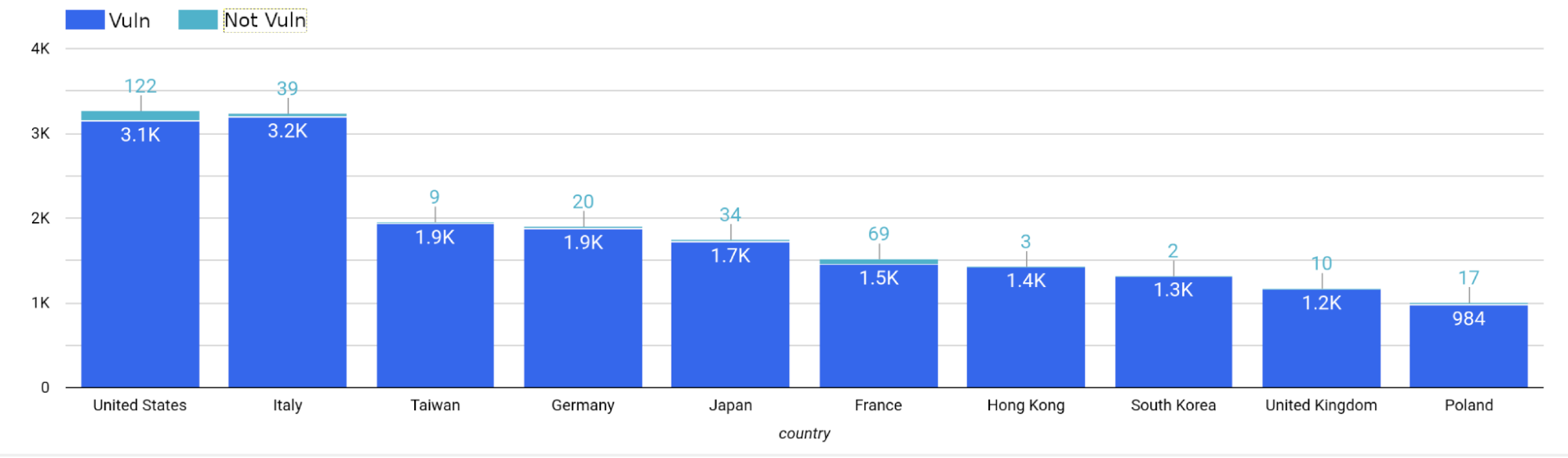
Tuesday’s Censys report said that devices vulnerable to CVE-2022-27596 were most common in the US, followed by Italy and Taiwan.

Censys also provided the following breakdown:

Country Total Hosts Non-Vulnerable Hosts Vulnerable Hosts
United States 3,271 122 3,149
Italy 3,239 39 3,200
Taiwan 1,951 9 1,942
Germany 1,901 20 1,881
Japan 1,748 34 1,714
France 1,527 69 1,458
Hong Kong 1,425 3 1,422
South Korea 1,313 2 1,311
United Kingdom 1,167 10 1,157
Poland 1,001 17 984

In the past, QNAP has also recommended that users follow all of these steps to lower the chances of getting hacked:

  1. Disable the port forwarding function on the router.
  2. Set up myQNAPcloud on the NAS to enable secure remote access and prevent exposure to the Internet.
  3. Update the NAS firmware to the latest version.
  4. Update all applications on the NAS to their latest versions.
  5. Apply strong passwords for all user accounts on the NAS.
  6. Take snapshots and back up regularly to protect your data.

As reported by Bleeping Computer, QNAP devices over the years have been successfully hacked and infected with other ransomware strains, including Muhstik, eCh0raix/QNAPCrypt, QSnatch, Agelocker, Qlocker, DeadBolt, and Checkmate. Users of these devices should take action now.

https://arstechnica.com/?p=1914239


Critical QNAP Vulnerability Leads to Code Injection

QNAP Systems this week issued a warning on a critical vulnerability that could allow attackers to inject malicious code on network-attached storage (NAS) devices.

The Taiwan-based manufacturer is known for its NAS appliances and professional network video recorder (NVR) solutions, but also produces various types of networking equipment.

Tracked as CVE-2022-27596 (CVSS score of 9.8), the newly disclosed vulnerability is described as an SQL injection flaw impacting QuTS hero and QTS.

“A vulnerability has been reported to affect QNAP devices running QTS 5.0.1 and QuTS hero h5.0.1. If exploited, this vulnerability allows remote attackers to inject malicious code,” QNAP warns in its advisory.

The company has issued patches for the vulnerability and urges users to update their devices to QTS 5.0.1.2234 build 20221201 and later, or QuTS hero h5.0.1.2248 build 20221215 and later.

“To secure your device, we recommend regularly updating your system to the latest version to benefit from vulnerability fixes,” the manufacturer notes.

Users are advised to update their QNAP appliances as soon as possible, as these devices have long been the target of choice for cybercriminals looking to infect them with ransomware and other malware.

Furthermore, users should ensure that their NAS devices cannot be directly accessed from the internet, and instead secured behind a firewall or VPN.

Related: QNAP Patches Critical Vulnerability in Network Surveillance Products

Related: QNAP Devices Targeted in New Wave of DeadBolt Ransomware Attacks

Related: QNAP Extends Security Updates for Some EOL Devices

https://www.securityweek.com/critical-qnap-vulnerability-leads-to-code-injection/


Meta Awards $27,000 Bounty for 2FA Bypass Vulnerability

A researcher has disclosed the details of a two-factor authentication (2FA) vulnerability that earned him a $27,000 bug bounty from Facebook parent company Meta. 

Gtm Manoz of Nepal discovered in September 2022 that a system designed by Meta for confirming a phone number and email address did not have any rate-limiting protection.

A fix was rolled out by Meta in October 2022 and the company highlighted Manoz’s findings in its annual bug bounty program report. The tech giant has paid out more than $16 million through its program since 2011, with $2 million awarded in 2022.

In a blog post published earlier this month, Manoz said he discovered the vulnerability while analyzing a new Meta Accounts Center page in Instagram. Here, users can add an email address and phone number to their Instagram account and the Facebook account linked to their Instagram. In order to verify the email address and phone number, users have to enter a six-digit code received via email or SMS. 

The researcher’s analysis revealed that the system verifying the six-digit code did not have rate-limiting in place, which could have allowed an attacker to enter every possible code until they got the right one.

Specifically, a hacker would have needed to know the phone number assigned by the targeted user to their Instagram and Facebook account. By exploiting the vulnerability, the attacker could have obtained the six-digit verification code through a brute-force attack and assigned the victim’s phone number to an account they controlled.

This resulted in the phone number being removed from the victim’s Facebook and Instagram account and 2FA getting disabled due to security reasons — if a phone number is verified by another user, that user would be getting the SMS containing the 2FA code, and Meta is trying to prevent that. 

Manoz showed that Facebook users did receive a notification when their phone number was removed due to being verified by a different person. 

Based on the maximum potential impact of the vulnerability, Meta decided to pay out $27,200 for the researcher’s findings.

Related: Facebook Patches Vulnerability Exposing Page Admin Identity

Related: Twitter Finds No Evidence of Vulnerability Exploitation in Recent Data Leaks

Related: Facebook Pays Out $40,000 for Account Takeover Exploit Chain

https://www.securityweek.com/meta-awards-27000-bounty-for-2fa-bypass-vulnerability/


Critical Vulnerability Impacts Over 120 Lexmark Printers

Printer and imaging products manufacturer Lexmark this week published a security advisory to warn users of a critical vulnerability impacting over 120 printer models.

The issue, tracked as CVE-2023-23560 (CVSS score of 9.0), is described as a server-side request forgery (SSRF) flaw in the Web Services feature of newer Lexmark devices, which could be exploited to execute arbitrary code.

“Successful exploitation of this vulnerability can lead to an attacker being able to remotely execute arbitrary code on a device,” Lexmark warns in an advisory (PDF).

The manufacturer lists roughly 125 device models that are impacted by the security defect, including B, C, CS, CX, M, MB, MC, MS, MX, XC, and XM series printers.

The company has announced firmware updates that resolve the vulnerability on all impacted devices and encourages users to find update instructions on its support website.

Additionally, Lexmark says that exploitation of CVE-2023-23560 can be blocked by disabling the Web Services feature on the vulnerable printers (TCP port 65002).

To block TCP port 65002, users would have to go to Settings > Network/Ports > TCP/IP > TCP/IP Port Access, uncheck TCP 65002 ( WSD Print Service ), and then click Save.

Lexmark also warns that, while it is not aware of any malicious attacks targeting the vulnerability, proof-of-concept (PoC) code exploiting it has been made public.

Given that it is not unusual for threat actors to target unpatched printers and other Internet of Things (IoT) devices, users are advised to apply the available patches as soon as possible.

Related: Hundreds of Thousands of Konica Printers Vulnerable to Hacking via ​​Physical Access

Related: Serious Vulnerability Exploited at Hacking Contest Impacts Over 200 HP Printers

Related: Xerox Quietly Patched Device-Bricking Flaw Affecting Some Printers

https://www.securityweek.com/critical-vulnerability-impacts-over-120-lexmark-printers/


BIND Updates Patch High-Severity, Remotely Exploitable DoS Flaws

The Internet Systems Consortium (ISC) this week announced patches for multiple high-severity denial-of-service (DoS) vulnerabilities in the DNS software suite BIND.

The addressed issues could be exploited remotely to cause named – the BIND daemon that acts both as an authoritative name server and as a recursive resolver – to crash, or could lead to the exhaustion of the available memory.

The first of the security defects, tracked as CVE-2022-3094, can be exploited by sending a flood of dynamic DNS updates, which would cause named to allocate large amounts of memory, resulting in a crash due to a lack of free memory.

According to ISC, because allocated memory is only retained for clients for which access credentials are accepted, the scope of the vulnerability is limited to trusted clients that are allowed to make dynamic zone changes.

For BIND 9.11 and earlier branches, the flaw can be exploited to exhaust internal resources, which results in performance issues, but not a crash.

Tracked as CVE-2022-3736, the second issue leads to a crash “when stale cache and stale answers are enabled, option stale-answer-client-timeout is set to a positive integer, and the resolver receives an RRSIG query,” ISC explains. A remote attacker can trigger the bug by sending crafted queries to the resolver.

The third vulnerability, CVE-2022-3924, impacts the implementation of the stale-answer-client-timeout option, when the resolver receives too many queries that require recursion. If the number of clients waiting for recursion to complete is high enough, a race may occur between providing a stale answer to the longest waiting client and sending an early timeout SERVFAIL, causing named to crash.

All three vulnerabilities were resolved with the release of BIND versions 9.16.37, 9.18.11, and 9.19.9. ISC says it is not aware of any of these vulnerabilities being exploited, but encourages all users to update their BIND installations as soon as possible.

ISC also warns of CVE-2022-3488, a bug impacting all supported BIND preview edition versions (a special feature preview branch provided to eligible customers).

The issue can be triggered by sending two responses in quick succession from the same nameserver, both ECS pseudo-options, but with the first response broken, causing the resolver to reject the query response. When processing the second response, named crashes.

BIND preview edition version 9.16.37-S1 resolves all four security defects. Additional information on the addressed vulnerabilities can be found in the BIND 9 security vulnerability matrix.

Related: BIND Updates Patch High-Severity Vulnerabilities

Related: High-Severity Vulnerabilities Patched in BIND Server

Related: High-Severity DoS Vulnerability Patched in BIND DNS Software

https://www.securityweek.com/bind-updates-patch-high-severity-remotely-exploitable-dos-flaws/


In-the-Wild Exploitation of Recent ManageEngine Vulnerability Commences

Cloud risk management and threat detection firm Rapid7 warns that it has seen organizations being compromised in attacks exploiting a recently patched Zoho ManageEngine vulnerability.

Tracked as CVE-2022-47966, the security defect exists in a third-party dependency (Apache xmlsec, also known as XML Security for Java, version 1.4.1), allowing attackers to execute arbitrary code remotely without authentication.

Deemed ‘critical severity’, the issue was brought to light in November 2022, when Zoho announced that patches were released for more than 20 on-premises products that are impacted.

A NIST advisory explains that the bug exists “because the xmlsec XSLT features, by design in that version, make the application responsible for certain security protections, and the ManageEngine applications did not provide those protections.”

Earlier this month, automated penetration testing firm Horizon3.ai warned that there are at least a thousand vulnerable ManageEngine products exposed to the internet, and that all of them were susceptible to spray and pray attacks.

Horizon3.ai also published a proof-of-concept (PoC) exploit targeting the issue.

Now, Rapid7 says it has been responding to compromises resulting from the active exploitation of CVE-2022-47966. The attacks appear to have started before Horizon3.ai released its PoC exploit.

The cybersecurity firm underlines that some of the impacted products, including ADSelfService Plus and ServiceDesk Plus, are highly popular among organizations, and that they are known to have been targeted in previous attacks.

Other impacted products include Access Manager Plus, Active Directory 360, ADAudit Plus, ADManager Plus, Application Control Plus, Device Control Plus, Endpoint Central, Endpoint Central MSP, PAM 360, Password Manager Pro, Remote Monitoring and Management (RMM), SupportCenter Plus, and Vulnerability Manager Plus.

“Organizations using any of the affected products listed in ManageEngine’s advisory should update immediately and review unpatched systems for signs of compromise, as exploit code is publicly available and exploitation has already begun,” Rapid7 warns.

Threat intelligence company GreyNoise has also started seeing attacks exploiting CVE-2022-47966.

Related: Zoho Urges ManageEngine Users to Patch Serious SQL Injection Vulnerability

Related: CISA Warns of Zoho ManageEngine RCE Vulnerability Exploitation

Related: Zoho Patches Critical Vulnerability in Endpoint Management Solutions

view counter

Ionut Arghire is an international correspondent for SecurityWeek.

Previous Columns by Ionut Arghire:
Tags:

https://www.securityweek.com/wild-exploitation-recent-manageengine-vulnerability-commences


Critical Vulnerabilities Patched in OpenText Enterprise Content Management System

Several vulnerabilities described as having critical and high impact, including ones allowing unauthenticated remote code execution, have been found and patched in OpenText’s enterprise content management (ECM) product.

The vulnerabilities were discovered by a researcher at cybersecurity consultancy Sec Consult in OpenText’s Extended ECM, which is designed for managing the distribution and use of information across an organization. Specifically, the flaws impact the product’s Content Server component.

The security firm this week published three different advisories describing its findings.

OpenText was informed about the vulnerabilities in October 2022 and patched them earlier this month with the release of version 22.4, according to Sec Consult.

One of the critical vulnerabilities, tracked as CVE-2022-45923, can allow an unauthenticated attacker to execute arbitrary code using specially crafted requests.

The second critical flaw, CVE-2022-45927, impacts the Java Frontend of the OpenText Content Server component and can allow an attacker to bypass authentication. Exploitation could ultimately lead to remote code execution.

Sec Consult has also identified five types of vulnerabilities in the Content Server component that can be exploited by authenticated attackers.

These issues, rated ‘high impact’, can be exploited to delete arbitrary files on the server, escalate privileges, obtain potentially valuable information, launch server-side request forgery (SSRF) attacks, and execute arbitrary code.

Proof-of-concept (PoC) code is available for the high-impact issues, but the advisories describing the critical flaws do not include PoC code in an effort to prevent malicious exploitation.

Related: Vendor Refuses to Remove Backdoor Account That Can Facilitate Attacks on Industrial Firms

Related: InfiRay Thermal Camera Flaws Can Allow Hackers to Tamper With Industrial Processes

Related: OpenText Acquires Email Security Firm Zix for $860 Million

view counter

Eduard Kovacs (@EduardKovacs) is a contributing editor at SecurityWeek. He worked as a high school IT teacher for two years before starting a career in journalism as Softpedia’s security news reporter. Eduard holds a bachelor’s degree in industrial informatics and a master’s degree in computer techniques applied in electrical engineering.

Previous Columns by Eduard Kovacs:
Tags:

https://www.securityweek.com/critical-vulnerabilities-patched-opentext-enterprise-content-management-system


Chinese Hackers Exploited Fortinet VPN Vulnerability as Zero-Day

A China-linked threat actor was observed exploiting a recently disclosed Fortinet FortiOS SSL-VPN vulnerability when it was still a zero-day, months before patches were released, Mandiant reports.

The security bug, tracked as CVE-2022-42475 (CVSS score of 9.8), is described as a buffer overflow issue that could be exploited by remote, unauthenticated attackers to execute code or commands via crafted requests.

The flaw impacts FortiOS SSL-VPN versions 7.2.0 – 7.2.2, 7.0.0 – 7.0.8, 6.4.0 – 6.4.10, 6.2.0 – 6.2.11, and 6.0.15 and earlier, as well as FortiProxy SSL-VPN versions 7.2.0 – 7.2.1, and 7.0.7 and earlier.

In December 2022, Fortinet announced emergency patches for the bug, warning that it was already being exploited in attacks. Last week, the company warned that threat actors were seen exploiting CVE-2022-42475 to hack governments.

The company noted that the observed exploitation could be attributed to an advanced threat actor that, based on malware compilation times, could be located somewhere in the APAC region.

Now, Mandiant says that a China-linked threat actor started exploiting the vulnerability in October 2022, targeting a European government organization and a managed service provider in Africa.

The attackers deployed a backdoor called Boldmove, which can be used to enable lateral movement and the tunneling of commands to the command-and-control (C&C) server. Both Windows and Linux variants of the malware have been identified, with the latter tailored to run on FortiGate firewalls.

Mandiant says it has not directly observed exploitation of CVE-2022-42475 to deploy Boldmove, but identified hardcoded C&C IP addresses in the malware that Fortinet previously associated with the flaw’s exploitation.

The threat intelligence firm discovered Windows variants of the malware compiled in 2021, but says it did not see the threat in attacks before.

A fully featured backdoor written in C, Boldmove has a core set of features across the identified Windows and Linux variants, but at least one Linux iteration can modify the behavior and functionality of Fortinet firewalls.

The malware includes support for commands to list information on files, create/delete folders, move and replace files, execute shell commands, create an interactive shell, and delete and replace itself, among others.

The extended version of Boldmove can disable specific Fortinet daemons, likely to prevent logging, can modify proprietary Fortinet logs on the system, features a watchdog that allows it to persist across upgrades, and allows the attackers to send requests to an internal Fortinet service.

“We assess with low confidence that this operation has a nexus to the People’s Republic of China. China-nexus clusters have historically shown significant interest in targeting networking devices and manipulating the operating system or underlying software which supports these devices,” Mandiant notes.

Related: Fortinet Patches High-Severity Authentication Bypass Vulnerability in FortiOS

Related: Fortinet Confirms Zero-Day Vulnerability Exploited in One Attack

Related: Cybercriminals Selling Access to Networks Compromised via Recent Fortinet Vulnerability

view counter

Ionut Arghire is an international correspondent for SecurityWeek.

Previous Columns by Ionut Arghire:
Tags:

https://www.securityweek.com/chinese-hackers-exploited-fortinet-vpn-vulnerability-zero-day


Drupal Patches Vulnerabilities Leading to Information Disclosure

Drupal this week announced software updates that resolve a total of four vulnerabilities in Drupal core and three plugins, and which could lead to unauthorized access to data.

The Drupal core issue exists because the Media Library module does not perform proper checks on entity access in some cases, which could allow users who can edit content to view metadata about media items that they should not have access to.

An identical issue impacts the Media Library Form API Element plugin, which supports the use of the media library in custom forms, without having to use the Media Library Widget.

According to Drupal, both vulnerabilities are “mitigated by the fact that the inaccessible media will only be visible to users who can already edit content that includes a media reference field”.

The third flaw, which was patched in the Media Library Block plugin, which supports the rendering of media entities in a block, has a similar root cause: improper check of media access in some circumstances.

The vulnerability could allow users to see media items without authorization, provided that a block containing restricted media is placed on a page. To mitigate the bug, administrators can remove blocks referencing media items with access restrictions.

The fourth vulnerability was identified in the Entity Browser plugin, which enables users to “select entities from entity reference fields using a custom browser widget”.

Lack of proper entity access checks in some cases could allow users who have access to edit content to view entity metadata without authorization. Only users who can edit content using Entity Browser would be able to view the metadata.

The issues were resolved with the release of Drupal versions 10.0.2, 9.5.2, and 9.4.10, Media Library Form API Element version 2.0.6, Media Library Block version 1.0.4, and Entity Browser version 8.x-2.9.

Drupal assessed these vulnerabilities with a severity rating of ‘moderately critical’, which is roughly the equivalent of ‘medium severity’. More information on the resolved issues can be found on Drupal’s product security page.

Related: Drupal Updates Patch Vulnerability in Twig Template Engine

Related: Code Execution and Other Vulnerabilities Patched in Drupal

Related: Drupal Patches ‘High-Risk’ Third-Party Library Flaws

view counter

Ionut Arghire is an international correspondent for SecurityWeek.

Previous Columns by Ionut Arghire:
Tags:

https://www.securityweek.com/drupal-patches-vulnerabilities-leading-information-disclosure