The Internet’s biggest players are all affected by critical Log4Shell 0-day

The Internet’s biggest players are all affected by critical Log4Shell 0-day

The list of services with Internet-facing infrastructure that is vulnerable to a critical zero-day vulnerability in the open source Log4j logging utility is immense and reads like a who’s who of the biggest names on the Internet, including Apple, Amazon, Cloudflare, Steam, Tesla, Twitter, and Baidu.

The vulnerability, now going by the name Log4Shell, came to light on Thursday afternoon, when several Minecraft services and news sites warned of actively circulating attack code that exploited the vulnerability to execute malicious code on servers and clients running the world’s bestselling game. Soon, it became clear that Minecraft was only one of likely thousands of big-name services that can be felled by similar attacks.

A compilation of screenshots posted online documents how some of the world’s most popular and trusted cloud-based services react when they are fed parameters used in the attack. To wit:

The images use a domain name system leak detection service called dnslog.cn to see if the target cloud service is performing a DNS lookup. Each images shows that service is accepting connections from an attacker-controlled machine (as evidenced by the IP connection log).

“Normally, typing something into a username box should never be making any external network connections, so the fact that it does proves that Log4j is being used here and therefore that the server may be vulnerable to the remote code execution attack,” Ars reader skizzerz explained in the comments below.

While the images show the services responding in unintended and potentially dangerous ways to the user input, the services aren’t automatically vulnerable to the types of code-execution attacks that compromised Minecraft servers. That’s because these services typically have multiple layers of defense. If one layer fails, additional layers are often available to lessen or completely eliminate any real damage.

Then again, the images demonstrate that unauthorized people can exploit Log4Shell to access the servers of the some of the world’s most powerful corporations in ways they never intended. Asked about the access to Apple servers, Malwarebytes director of Mac offerings Thomas Reed said: “This is far worse than if individual devices were vulnerable, and I think it’s an open question at this point exactly what kind of data attackers are probably pulling from Apple’s services as we speak.” Apple representatives didn’t respond to an email seeking comment.

Cloudflare, meanwhile, said in a post that it has taken steps to block attacks on its network and against its customers. Cloudflare Chief Security Officer Joe Sullivan said his team has been unable to reproduce the behavior depicted in the image and doesn’t recognize the IP addresses shown.

Minecraft on Friday rolled out a fix.

The takeaway is that it’s too early now to say these services aren’t vulnerable. For the time being, people should remain wary and await guidance from affected providers.

Listing image by Jeffrey Coolidge / Getty Images

https://arstechnica.com/?p=1819636



300,000 MikroTik routers are ticking security time bombs, researchers say

300,000 MikroTik routers are ticking security time bombs, researchers say
Getty Images

As many as 300,000 routers made by Latvia-based MikroTik are vulnerable to remote attacks that can surreptitiously corral the devices into botnets that steal sensitive user data and participate in Internet-crippling DDoS attacks, researchers said.

The estimate, made by researchers at security firm Eclypsium, is based on Internet-wide scans that searched for MikroTik devices using firmware versions known to contain vulnerabilities that were discovered over the past three years. While the manufacturer has released patches, the Eclypsium research shows that a significant proportion of users has yet to install them.

“Given the challenges of updating MikroTik, there are large numbers of devices with these 2018 and 2019 vulnerabilities,” Eclypsium researchers wrote in a post. “Collectively, this gives attackers many opportunities to gain full control over very powerful devices, positioning them to be able to target devices both behind the LAN port as well as target other devices on the Internet.”

Embraced by script kiddies and nation-states alike

The concern is far from theoretical. In early 2018, researchers at security firm Kaspersky said that a powerful nation-state malware called Slingshot, which had gone undetected for six years, initially spread through MikroTik routers. The attacks downloaded malicious files from vulnerable routers by abusing a MikroTik configuration utility known as Winbox, which transferred the payloads from the device file system to a connected computer.

A few months later, researchers at security firm Trustwave discovered two malware campaigns against MikroTik routers after reverse engineering a CIA tool leaked in a WikiLeaks series known as Vault7.

Also in 2018, China’s Netlab 360 reported that thousands of MikroTik routers had been swept into a botnet by malware attacking a vulnerability tracked as CVE-2018-14847.

The Eclypsium researchers said that CVE-2018-14847 is one of at least three high-severity vulnerabilities that remains unpatched in the Internet-connected MikroTik devices they tracked. Combined with two other vulnerabilities located in Winbox—CVE-2019-3977 and CVE-2019-3978—Eclypsium found 300,000 vulnerable devices. Once hackers infect a device, they typically use it to launch further attacks, steal user data, or participate in distributed denial-of-service attacks.

The researchers have released a free software tool that people can use to detect if their MikroTik device is either vulnerable or infected. The company also provides other suggestions for locking down the devices. As always, the best way to secure a device is to ensure it’s running the latest firmware. It’s also important to replace default passwords with strong ones and turn off remote administration unless it’s necessary.

https://arstechnica.com/?p=1819231


New ‘SharkBot’ Android Banking Malware Hitting U.S., UK and Italy Targets

A new Android banking trojan has been found, targeting international banks from the United Kingdom and Italy (including in the U.S.). and five different cryptocurrency services. Twenty-two instances have been discovered, but more are expected.

The malware, first detected at the end of October 2021, appears to be new and still being developed. It was discovered by Cleafy, a Milan, Italy-based online fraud detection and prevention firm. Cleafy calls it ‘SharkBot’, named after the frequency of the word ‘sharked’ in its binaries.

SharkBot is not found in Google’s official marketplace. This means it must be sideloaded by delivering the APK to the device and ensuring it is manually loaded. In a technical analysis of the malware, Cleafy notes that it poses as a legitimate application using common names and icons.

If the deception succeeds and the malware is installed, it immediately attempts to enable Android’s Accessibility Services by delivering fake pop-ups to the victim – such as ‘Allow Media Player to have full control of your device’. If this is successful, SharkBot has all the permissions it needs. 

Once accepted the malware can enable keylogging (to steal typed credentials), intercept SMS messages (to circumvent MFA), deliver overlay attacks (to steal login credentials and credit card information) and remotely control the device because permissions were granted via the fake pop-up. “Basically,” comments Corey Nachreiner, CSO at WatchGuard Technologies, “the malicious Accessibility Services can read anything a user can read and can recreate any action a user can on the device.”

Notably, SharkBot also attempts a relatively novel technique known as an Automatic Transfer Systems (ATS) attack. “This technique has been seen recently from other banking trojans, such as Gustuff,” explains Cleafy. “ATS is an advanced attack technique (fairly new on Android) which enables attackers to auto-fill fields in legitimate mobile banking apps and initiate money transfers from the compromised devices.” 

The ATS functionality is contained in a module downloaded separately from the C2. “Given its modular architecture,” comments Cleafy, “we don’t exclude the existence of botnets with other configurations and targets.”

[ READ: Android Trojan Targets Banks, Crypto-Currencies, e-Commerce ] 

The assumption is that ATS is used by SharkBot to bypass the behavioral detection measures used by many financial institutions. If ATS is used on what is a trusted device, a ‘new device enrollment’ phase is not necessary, SMS-based MFA can be bypassed,  and behavioral biometrics are not effective.

Although relatively few instances of SharkBot have been discovered in the wild, Cleafy suspects that the threat will grow. This is partly because it is new, and apparently still being developed.  

“The implications of becoming infected with SharkBot could be severe, so it’s important,” says Nachreiner, “to avoid being infected altogether.” This is not yet easy. The malware is new and not well detected by existing detection means. Apart from the DGA for its C2s, it also uses anti-analysis techniques including obfuscated strings and emulator detection.

The best solution is to avoid side-loading religiously. Without 100% certainty in the authenticity of the application and the validity of its source, simply do not install it. 

Related: Android Banking Trojan ‘Vultur’ Abusing Accessibility Services

Related: Android Trojan Targets Banks, Crypto-Currencies, e-Commerce

Related: Automatic Transfer System Evades Security Measures, Automates Bank Fraud

view counter

Kevin Townsend is a Senior Contributor at SecurityWeek. He has been writing about high tech issues since before the birth of Microsoft. For the last 15 years he has specialized in information security; and has had many thousands of articles published in dozens of different magazines – from The Times and the Financial Times to current and long-gone computer magazines.

Previous Columns by Kevin Townsend:
Tags:

https://www.securityweek.com/new-%E2%80%98sharkbot%E2%80%99-android-banking-malware-hitting-us-uk-and-italy-targets


Supply Chain Security Fears Escalate as Iranian APTs Caught Hitting IT Services Sector

Fears of software supply chain attacks escalated again this week with a new warning from Microsoft that it has caught Iranian threat actors breaking into IT services shops in India and Israel and using that access to hit the real targets.

Two of Redmond’s premier threat hunting units  — the Microsoft Threat Intelligence Center (MSTIC) and Microsoft Digital Security Unit (DSU) — are sounding the alarm for a series of intrusions at companies that sell business management and integration software to millions of global organizations.

Once inside the IT services organizations, Microsoft said the Iranian hackers are “extending their attacks to compromise downstream customers,” much like the SolarWinds supply chain mega-hack that snagged thousands of corporate victims globally.

Microsoft warned of a significant surge in these attacks — more than 1,600 notifications to over 40 IT companies in response to Iranian targeting, compared to 48 notifications in 2020 — and warned that downstream attacks are targeting organizations in the defense, energy, and legal sectors

“As India and other nations rise as major IT services hubs, more nation state actors follow the supply chain to target these providers’ public and private sector customers around the world matching nation state interests,” Microsoft said in a report calling attention to the surge in these Iran-linked attacks.

[ READ: Hacked SolarWinds Software Lacked Basic Anti-Exploit Mitigation ]

In July 2021 this year, Microsoft said it caught a threat actor based in Iran that compromised a single Israel-based IT company that provides business management software.  Microsoft said the hacking group then used access to that IT company to extend their attacks and compromise downstream customers in the defense, energy, and legal sectors in Israel. 

A few months later, Redmond’s threat hunting teams caught  a separate Iranian group hacking into email accounts at a Bahrain-based IT integration company that works on IT integration with Bahrain government clients.

Microsoft surmises that the downstream Bahrain government clients “were likely the ultimate target” and warned that the group has also compromised various accounts at a partially government-owned organization in the Middle East that provide information and communications technology to the defense and transportation sectors.

The hacking group maintained persistence at the Bahrain IT integration organization from September through at least October.

[ READ: Microsoft Exposes Iran-Linked APT Targeting U.S., Israeli Defense ]

Microsoft said credential theft from the original compromises of IT services companies are used in the downstream attacks.  [The Iranian attackers] dumped credentials from the on-premises network of an IT provider based in Israel in early July. Over the next two months, the group compromised at least a dozen other organizations, several of which have strong public relations with the compromised IT company,” Microsoft explained.

The company said at least four of those victims were compromised using the acquired credentials and access from the IT company in the July and August attacks. 

Redmond’s telemetry has picked up a major surge in these and other Iranian groups targeting IT companies based in India beginning in mid-August. From mid-August to late September, Microsoft said it issued 1,788 nation state notifications (NSNs) across Iranian actors to enterprise customers in India, roughly 80% of which were to IT companies.   

Over the three previous years, Microsoft barely issued 10 such notifications in response to Iranian hacking activity and because there are no obvious geo-political reasons for the India targeting, the company believes the Indian IT shops are being used “for indirect access to subsidiaries and clients outside India.”

Related: Microsoft Exposes Iran-Linked APT Targeting U.S., Israeli Defense

Related: Hacked SolarWinds Software Lacked Basic Anti-Exploit Mitigation

Related: Researchers Link Mysterious ‘MeteorExpress’ Wiper to Iranian Train Cyber Attack 

Related: New Code Execution Flaws In Solarwinds Orion Platform

view counter

Ryan Naraine is Editor-at-Large at SecurityWeek and host of the popular Security Conversations podcast series. He is a journalist and cybersecurity strategist with more than 20 years experience covering IT security and technology trends.
Ryan has built security engagement programs at major global brands, including Intel Corp., Bishop Fox and Kaspersky GReAT. He is a co-founder of Threatpost and the global SAS conference series. Ryan’s career as a journalist includes bylines at major technology publications including Ziff Davis eWEEK, CBS Interactive’s ZDNet, PCMag and PC World.
Ryan is a director of the Security Tinkerers non-profit, and a regular speaker at security conferences around the world.
Follow Ryan on Twitter @ryanaraine.

Previous Columns by Ryan Naraine:
Tags:

https://www.securityweek.com/supply-chain-security-fears-escalate-iranian-apts-caught-hitting-it-services-sector


Microsoft Says HTML Smuggling Attacks On The Rise

Microsoft says it has observed an increase in the use of HTML smuggling in malicious attacks distributing remote access Trojans (RATs), banking malware, and other malicious payloads.

HTML smuggling leverages HTML5/JavaScript for the download of files onto a victim machine, which in this case of these attacks is an encoded malicious script designed to assemble the final payload directly on the victim computer.

Phishing emails are used to either deliver specially crafted HTML attachments or to direct the intended victim to a web page malicious page designed to smuggle the script.

Microsoft said it observed the Chinese threat actor NOBELIUM leveraged the technique in a series of attacks in May, and is now seeing the same method being used to deliver AsyncRAT/NJRAT, Trickbot, and the banking Trojan Mekotio.

Because the malicious payload is built behind the firewall, the technique allows adversaries to easily bypass standard perimeter security controls that check network traffic for suspicious attachments or patterns.

“Because the malicious files are created only after the HTML file is loaded on the endpoint through the browser, what some protection solutions only see at the onset are benign HTML and JavaScript traffic, which can also be obfuscated to further hide their true purpose,” Microsoft said.

[ Related: Ongoing Campaign Uses HTML Smuggling for Malware Delivery ]

The tech giant said it observed HTML smuggling being used in attacks against banking users in Brazil, Mexico, Spain, Peru, and Portugal, where adversaries were looking to infect victim systems with either Mekotio or Ousaban.

The technique is also making its way into the arsenal of sophisticated threat actors, such as NOBELIUM.

In July and August, adversaries employed HTML smuggling to deliver remote access Trojans (RATs) such as AsyncRAT/NJRAT, while in September the method was used to deploy Trickbot, likely by DEV-0193, an emerging financially motivated cybercrime ring.

The threat actor mainly targets healthcare and education organizations, and shows close connections with ransomware operators, such as those behind Ryuk. DEV-0193 seeks to compromise organizations to sell unauthorized access to ransomware operators.

Disabling JavaScript could prevent such attacks, but that option might not be viable within enterprise environments, where business-related pages and other legitimate resources depend on JavaScript. Thus, a multi-layered defensive approach is recommended.

Related: Ongoing Campaign Uses HTML Smuggling for Malware Delivery

Related: IcedID Trojan Operators Experimenting With New Delivery Methods

view counter

Ionut Arghire is an international correspondent for SecurityWeek.

Previous Columns by Ionut Arghire:
Tags:

https://www.securityweek.com/microsoft-says-html-smuggling-attacks-rise


Diebold Nixdorf ATM Flaws Allowed Attackers to Modify Firmware, Steal Cash

Security researchers with Positive Technologies have published information on a couple of vulnerabilities in Diebold Nixdorf ATMs that could have allowed for an attacker to replace the firmware on the system and withdraw cash.

Tracked as CVE-2018-9099 and CVE-2018-9100, the flaws were identified in the CMD-V5 and RM3/CRS dispensers – one in each device – of the Wincor Cineo ATMs and were addressed a couple of years ago. Diebold acquired Wincor Nixdorf in 2016 and the companies later merged.

During research sanctioned by the vendor, Positive Technologies discovered that, while the ATMs had in place a series of security measures meant to prevent blackbox attacks, such as end-to-end encrypted communication with the cash dispenser, it was actually possible to work around these.

Specifically, the researchers figured out the command encryption between the ATM computer and the cash dispenser, bypassed it, replaced the ATM firmware with an outdated one, and exploited the vulnerabilities to tell the system to spew cash.

While encryption is used to prevent blackbox attacks, the researchers discovered that an attacker could actually extract the keys used for encryption and then forge their own firmware to load on the compromised ATM.

The system performs firmware integrity checks as an additional protection step, but the researchers were able to identify the components involved in the check process in the code responsible for verifying the firmware signature and in the firmware, “namely the public key and the signed data itself.”

“As a signature verification algorithm, RSA was used with an exponent equal to 7, and the bit count of the key was determined by the size of the public part N. It turned out that if you fitted into the offsets at which the signature and public key were written, you could set almost any length,” Positive Technologies explains.

Before being able to withdraw cash from the ATM, an attacker also needed to find a way to send commands to the dispenser and to specify the amount of money in each cassette.

Diebold Nixdorf, which issued patches for these vulnerabilities in 2019, recommends enabling physical authentication when an operator performs firmware installation, to further prevent unauthorized access. Earlier this year, the vendor warned of an uptick in jackpotting attacks on RM3-based Cineo systems in Europe.

Related: France Says Breaks Up International ATM ‘Jackpotting’ Network

Related: Driver Vulnerabilities Facilitate Attacks on ATMs, PoS Systems

Related: The Latest Threats to ATM Security

view counter

Ionut Arghire is an international correspondent for SecurityWeek.

Previous Columns by Ionut Arghire:
Tags:

https://www.securityweek.com/diebold-nixdorf-atm-flaws-allowed-attackers-modify-firmware-steal-cash


IoT Protocol Used by NASA, Siemens and Volkswagen Can Be Exploited by Hackers

Researchers Warn DDS Protocol Can Be Abused for Lateral Movement and Malware C&C

Researchers have shown that a widely used protocol named Data Distribution Service (DDS) is affected by vulnerabilities that could be exploited by threat actors for various purposes.

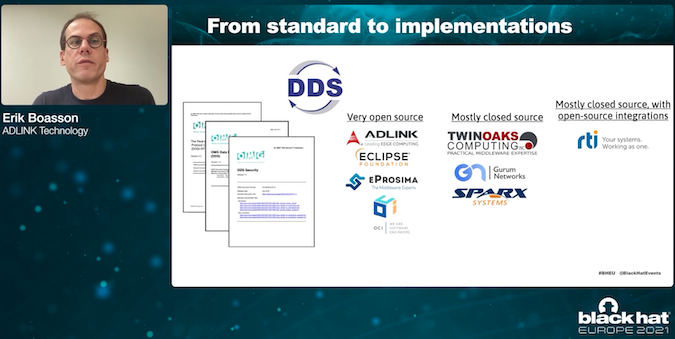
Maintained by the standards development organization Object Management Group (OMG), DDS is a middleware protocol and API standard for data connectivity that is advertised as ideal for business-critical IoT systems. DDS has been used in sectors such as public transportation, air traffic management, aerospace, autonomous driving, industrial robotics, medical devices, and missile and other military systems.

DDS has been used by organizations such as NASA, Siemens, and Volkswagen, as well as in the popular Robot Operating System (ROS).

There are both open source and closed source implementations of DDS, including by ADLINK Technology, Eclipse (CycloneDDS), eProsima (Fast DDS), OCI (OpenDDS), TwinOaks Computing (CoreDX DDS), Gurum Networks (GurumDDS), and RTI (Connext DDS).

Researchers from Trend Micro, TXOne Networks, Alias Robotics, and ADLINK Technology have analyzed the DDS standard and the aforementioned implementations and discovered a total of more than a dozen vulnerabilities.

The researchers disclosed some of their findings at the Black Hat Europe 2021 cybersecurity conference last week, with a research paper detailing their work being planned for early next year.

DDS security research presented at Black Hat

In the meantime, the U.S. Cybersecurity and Infrastructure Security Agency (CISA) has released an industrial control systems (ICS) advisory related to the research.

“CISA is issuing this advisory to provide early notice of the reported vulnerabilities and identify baseline mitigations for reducing risks to these and other cybersecurity attacks,” CISA said.

According to CISA, patches have been released for CycloneDDS, FastDDS, OpenDDS, Connext DDS, and CoreDX DDS. There do not appear to be any patches from Gurum, which the researchers said ignored several notification attempts.

Identified vulnerabilities include write-what-where condition, improper handling of invalid structure, network amplification, buffer allocation, and buffer overflow issues.

The flaws can be exploited by threat actors for arbitrary code execution, obtaining information, or causing a denial of service (DoS) condition.

However, the researchers noted in their presentation at Black Hat that since DDS is typically deployed locally and deep in the control network, it’s unlikely that attackers would find internet-exposed systems.

On the other hand, they pointed out that DDS could still be abused by an attacker who already has access to the targeted entity’s systems for the discovery of other endpoints, lateral movement, and for malware command and control (C&C).

The researchers noted that the DDS codebase is large and complex and this research only scratches the surface.

Related: Vulnerabilities in OpENer Stack Expose Industrial Devices to Attacks

Related: Industrial Firms Informed About Serious Vulnerabilities in Matrikon OPC Product

Related: Vulnerabilities in Protocol Gateways Can Facilitate Attacks on Industrial Systems

view counter

Eduard Kovacs (@EduardKovacs) is a contributing editor at SecurityWeek. He worked as a high school IT teacher for two years before starting a career in journalism as Softpedia’s security news reporter. Eduard holds a bachelor’s degree in industrial informatics and a master’s degree in computer techniques applied in electrical engineering.

Previous Columns by Eduard Kovacs:
Tags:

https://www.securityweek.com/iot-protocol-used-nasa-siemens-and-volkswagen-can-be-exploited-hackers


Fake Emails Sent From FBI Address via Compromised Law Enforcement Portal

Thousands of fake emails coming from an FBI email address were sent out on Friday by someone who exploited a vulnerability in a law enforcement portal. The FBI has confirmed the breach, but said impact was limited.

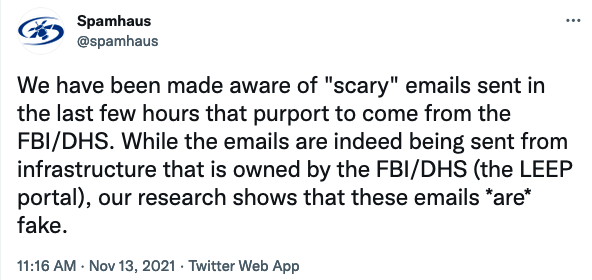
Threat intelligence organization Spamhaus reported seeing more than 100,000 fake emails being sent out in two waves.

Spamhaus warning

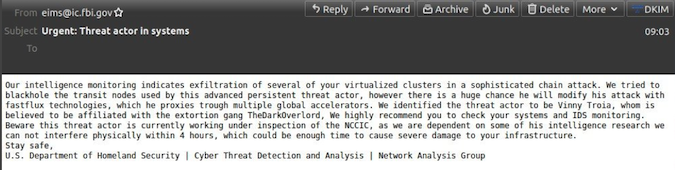
The hoax emails, coming from “[email protected],” carried the subject line “Urgent: Threat actor in systems.” The message appeared to come from the DHS and it informed recipients about “exfiltration of several of your virtualized clusters in a sophisticated chain attack.”

Fake FBI email

The emails claimed the threat actor was identified as Vinny Troia. Troia is a security researcher who claims to have been targeted numerous times by some hackers for exposing them.

Troia on Twitter said he suspected an individual who uses the online moniker “pompompur_in” was behind the attack. He said the individual is associated with a cybercrime group named The Dark Overlord, whose alleged members were exposed in a report published last year by Troia’s company, NightLion Security.

Indeed, an individual with the online nickname pompompurin contacted security blogger Brian Krebs shortly after the fake FBI emails were sent out, taking credit for the attack.

In a statement issued on Sunday, the FBI said the emails were sent out by someone who leveraged a “software misconfiguration” affecting the Law Enforcement Enterprise Portal (LEEP), which is used by the agency to communicate with state and local law enforcement partners.

“While the illegitimate email originated from an FBI operated server, that server was dedicated to pushing notifications for LEEP and was not part of the FBI’s corporate email service,” the FBI stated. “No actor was able to access or compromise any data or PII on the FBI’s network. Once we learned of the incident, we quickly remediated the software vulnerability, warned partners to disregard the fake emails, and confirmed the integrity of our networks.”

Pompompurin told Krebs that they exploited a vulnerability in the LEEP portal account registration process to be able to send out emails from the fbi.gov email address.

Specifically, the registration process involves sending a one-time passcode to the email address of the user who creates an account on the LEEP portal. Pompompurin discovered — or learned from someone else — that this one-time passcode was generated on the client side and included in a POST request. The same request also included parameters for the subject and body content of an email coming from eims(at)ic.fbi.gov, which the hacker replaced with their own subject and content.

The hacker created a script that automated the process, enabling them to send out thousands of fake emails.

The FBI says it has taken steps to prevent exploitation of the weakness leveraged in this attack.

Related: ​​Phishers Target C-Suite with Fake Office 365 Password Expiration Reports

Related: Enterprises Warned About Zix-Themed Credential Phishing Attacks

view counter

Eduard Kovacs (@EduardKovacs) is a contributing editor at SecurityWeek. He worked as a high school IT teacher for two years before starting a career in journalism as Softpedia’s security news reporter. Eduard holds a bachelor’s degree in industrial informatics and a master’s degree in computer techniques applied in electrical engineering.

Previous Columns by Eduard Kovacs:
Tags:

https://www.securityweek.com/fake-emails-sent-fbi-address-compromised-law-enforcement-portal


Intel, AMD Patch High Severity Security Flaws

Chipmakers Intel and AMD this week released patches for multiple security vulnerabilities in a wide range of product lines, including fixes for a series of high-risk issues in software drivers.

AMD published three bulletins this week documenting at least 27 security problems in the AMD Graphics Driver for Windows 10.

Exploitation of these flaws could allow an attacker to escalate privileges on a vulnerable system, leak information, bypass KASLR, cause a denial of service condition, or write arbitrary data to kernel memory, the company said.

AMD rated 18 of vulnerabilities as high-severity, while the remaining 9 are considered medium-risk. Some of these issues were identified and reported last year, and all are addressed with the release of Radeon software 21.4.1 and higher, and 21.Q2 Enterprise Driver.

[READ: Researchers Disclose New Side-Channel Attacks Affecting All AMD CPUs ]

Separately, Intel published a total of 25 advisories this week with patches for many of these vulnerabilities are also available for Intel Core processors with Radeon RX Vega M GL integrated graphics.

The flaws impact Intel Core i5-8305G and i7-8706G processors that feature AMD’s integrated graphics, as well as the Intel graphics driver for Windows 10 64-bit for NUC8i7HNK and NUC8i7HVK. Intel said Version 21.10 or later of these drivers address the bugs.  

Intel also shipped patches for high severity vulnerabilities in PROSet/Wireless WiFi and Killer WiFi, Solid State Drive (SSD) Data Center (DC) products, SoC Watch driver, and Intel processors.

Adversaries could exploit these vulnerabilities to cause a denial of service condition, escalate privileges, or leak information, the company said.

Related: Researchers Disclose New Side-Channel Attacks Affecting All AMD CPUs

Related: Intel Fixes Bugs in NUC 9 Extreme Laptops, Ethernet Linux Drivers

view counter

Ionut Arghire is an international correspondent for SecurityWeek.

Previous Columns by Ionut Arghire:
Tags:

https://www.securityweek.com/intel-amd-patch-high-severity-security-flaws


‘BotenaGo’ Malware Targets Routers, IoT Devices with Over 30 Exploits

A newly discovered Golang-based malware is using over 30 exploits in attacks, potentially putting millions of routers and Internet of Things (IoT) at risk of malware infection, according to a warning from AT&T Alien Labs.

Dubbed BotenaGo, the threat deploys a backdoor on the compromised device, and then waits for commands – either from a remote operator or a malicious module on the device – to initiate an attack.

As part of a typical BotenaGo attack, the malware first maps potential targets to attack functions, then queries the target with a GET request, after which it searches the returned data, and only then it attempts to exploit the vulnerable target.

On a compromised device, the malware creates two backdoor ports: 31412 and 19412, and starts listening on port 19412 to receive the victim’s IP. Next, it loops through mapped exploit functions to execute them with the supplied IP.

AT&T Alien Labs researchers have identified a total of 33 exploit functions that BotenaGo initiates.

One of malware’s functions was designed to exploit CVE-2020-8958, a vulnerability that potentially affects over 2 million Guangzhou devices. Another one targets CVE-2020-10173, a vulnerability in the Comtrend VR-3033 routers that potentially impacts roughly 250,000 devices.

The threat also targets vulnerabilities in devices from DrayTek (CVE-2020-8515), D-Link (CVE-2015-2051, CVE-2020-9377, CVE-2016-11021, and CVE-2013-5223), Netgear (CVE-2016-1555, CVE-2016-6277, CVE-2017-6077, and CVE-2017-6334), GPON (CVE-2018-10561 and CVE-2018-10562), Linksys (CVE-2013-3307), XiongMai (CVE-2018-10088), TOTOLINK (CVE-2019-19824), Tenda (CVE-2020-10987), ZyXEL (CVE-2020-9054 and CVE-2017-18368) and ZTE (CVE-2014-2321).

“As payload, BotenaGo will execute remote shell commands on devices in which the vulnerability has been successfully exploited. Depending on the infected system, the malware uses different links, each with a different payload,” the researchers explain.

The malware doesn’t have active command and control (C&C) communication capabilities, suggesting that another module is likely being deployed on compromised devices alongside BotenaGo, or that the threat currently in testing or may have been been accidentally leaked.

“The links used for the payload on a successful attack imply a connection with Mirai malware. It could be [that] the BotenaGo is a new tool used by Mirai operators on specific machines that are known to them, with the attacker(s) operating the infected end-point with targets,” the researchers added.

Related: Crypto-Hijacking Campaign Leverages New Golang RAT

Related: Zoom Patches High-Risk Flaws in Meeting Connector, Keybase Client

Related: Researcher Shows Windows Flaw More Serious After Microsoft Releases Incomplete Patch

view counter

Ionut Arghire is an international correspondent for SecurityWeek.

Previous Columns by Ionut Arghire:
Tags:

https://www.securityweek.com/botenago-malware-targets-routers-iot-devices-over-30-exploits