Capital One Open Sources AI-Powered ‘VulnHunter’ Security Tool
Financial services giant Capital One has released an internally developed AI-powered security tool to the public as open source.
Dubbed “VulnHunter”, the tool was designed to find and fix software vulnerabilities at the code level, but Capital One says it is not a traditional, passive vulnerability scanner.
“We designed VulnHunter with a developer-first mindset to solve a massive industry pain point: overwhelming false positives that create friction and slow down daily workflows,” Chris Nims, EVP & Chief Information Security Officer (CISO) at Capital One, explained in a LinkedIn post.
“It represents a shift in defensive tooling with an agentic reasoning workflow to identify potentially exploitable defects, map prospective attack paths, and propose highly targeted code remediations,” the company says.
Available on GitHub, along with a quickstart guide, architecture documentation, and example workflows showing how the tool traces code paths and generates remediations, users currently need access to Claude Opus 4.8 and access to a working Claude Code environment.
“Modern software supply chains are deeply interconnected. A single vulnerability in a widely-used open-source component can ripple across thousands of enterprises simultaneously. We’re open-sourcing VulnHunter because no single organization can solve this challenge alone,” Capital One said. “The defensive tools to address this reality need to be just as widely distributed, tested, and improved as the codebases they protect.”
Advertisement. Scroll to continue reading.
Capital One claimed that, when using VulnHunter internally, it was able to quickly and efficiently identify and remediate vulnerabilities across thousands of repositories, spanning tens of business areas.
Chrome 150 Update Patches Severe Memory Safety Bugs
Google has released a Chrome 150 security update that resolves seven memory safety bugs, including critical and high-severity use-after-free vulnerabilities.
The browser refresh patches three critical-severity use-after-free flaws impacting Chrome’s CameraCapture, GPU, and Network components. All three weaknesses were discovered by Google.
Additionally, the update fixes three high-severity use-after-free issues in Cast, Ozone, and Aura; Google discovered these vulnerabilities as well.
The seventh security defect is an out-of-bounds read and write flaw in the V8 JavaScript engine that was identified by OpenAI Codex Security. Google has yet to determine the bug bounty amount to be paid for the finding.
Google makes no mention of any of these security defects being exploited in the wild, but users are advised to update their browsers as soon as possible, as threat actors have targeted memory safety issues in Chrome.
For years, the internet giant has been hardening the browser against the exploitation of memory safety bugs, including by transitioning to memory-safe programming languages such as Rust.
Advertisement. Scroll to continue reading.
Since April, the internet giant has patched over 1,400 Chrome vulnerabilities, including hundreds of memory safety flaws, most of which were discovered by Google, likely through the use of AI.
The latest Chrome iteration is now rolling out as versions 150.0.7871.128/.129 for Windows and macOS and as version 150.0.7871.128 for Linux.
WP2Shell WordPress Vulnerabilities Exploited in the Wild
Two newly patched WordPress vulnerabilities are being exploited in the wild, with attacks beginning shortly after they came to light.
The vulnerabilities have been dubbed WP2Shell and they are officially tracked as CVE-2026-60137 and CVE-2026-63030.
According to Searchlight Cyber, whose researchers discovered the flaws, WordPress versions 6.9.0 through 6.9.4 and 7.0.0 through 7.0.1 are affected.
“The attack has no preconditions and can be exploited by an anonymous user in a stock install of WordPress with no plugins,” the security firm warned.
WordPress announced patches on Friday with the release of versions 6.9.5 and 7.0.2.
“Due to the severity, the WordPress.org team have enabled forced updates via the auto-update system for sites running affected versions,” WordPress developers said.
Advertisement. Scroll to continue reading.
Cloudflare has also rolled out rules to detect exploitation and protect customers whose installations were not immediately patched.
CVE-2026-60137 is a high-severity SQL injection bug and CVE-2026-63030 is a critical arbitrary code execution vulnerability. Chaining the two flaws enables an attacker to achieve unauthenticated remote code execution on affected WordPress websites. Threat actors can exploit these vulnerabilities to take control of targeted sites.
While Searchlight Cyber has not made public any details to prevent abuse, PoC exploits have already been made public by others.
WP2Shell exploited in the wild
The in-the-wild exploitation of the WP2Shell vulnerabilities has been confirmed by several cybersecurity firms. One of them is the WordPress security company Patchstack.
WatchTowr has also seen in-the-wild exploitation attempts.
“This is going to hurt,” the company’s CEO and founder, Benjamin Harris, told SecurityWeek. “WordPress runs on hundreds of millions of websites globally. Some of those will be auto-patched by their hosting providers, but plenty will not, and that is where the damage will be done.”
Harris added, “This is also the latest example in a clear trend of vulnerabilities being surfaced by AI-assisted tooling, representing a significant shift in both how our industry finds these issues and how quickly attackers weaponize them. We saw PoCs appear within hours of disclosure, where historically that would have taken 24 hours or more. The window between disclosure and exploitation has collapsed, and WordPress is simply today’s reminder of it.”
AI Data Centers Are Being Built Faster Than They Can Be Secured
The use and reliance on AI is the biggest single growth area in technology. But AI is enormously energy-intensive and requires a new quality of data center.
The demand is fueling rapid growth in AI data center builds. The danger is that those building this new type of data center, at speed, do not readily understand the difference between traditional data centers and AI data centers – and the result is leaving the new AI data centers open to a new scale of risk.
Traditional data centers are primarily data processing warehouses serving a known clientele. AI data centers are more akin to high power data compute factories serving a larger and unknown clientele. Traditional data centers can comprise a series of independent servers, an AI data center must function as a single engine capable of massive parallel processing to handle a much greater computational demand. AI data centers simply cannot be built in the same way as traditional data centers.
Lava Labs has examined and now reports (PDF) on the security needs of AI data centers (The Top 10 Data Center and AI Infrastructure Security Risks) and concludes they are being built faster than they are being secured. Both traditional data centers and new AI data centers carry largely similar risks; but AI changes their exploitability and blast radius: “Systems originally designed for trusted operators are now supporting high-value, multi-tenant workloads from unrelated customers,” it notes.
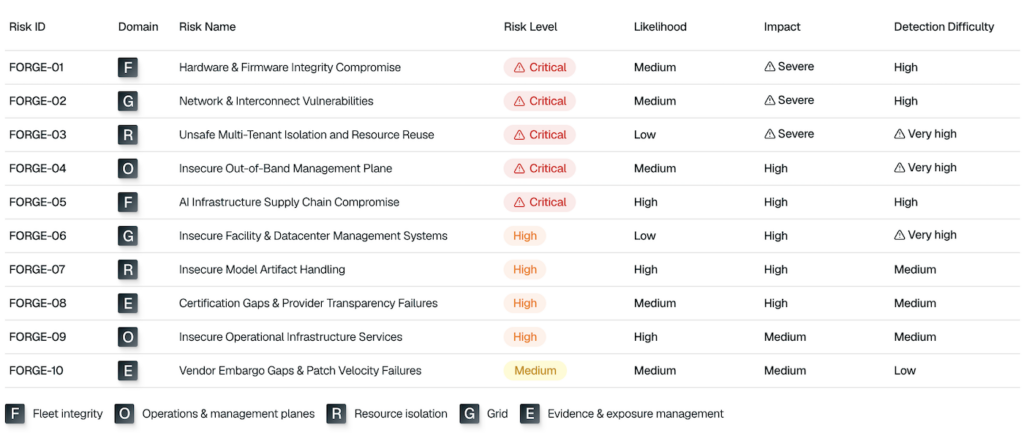
The Lava Labs report lists the top ten AI data center and infrastructure security risks, naming them ‘Forge’ (because the purpose is to ‘harden the metal beneath the model’).
Forge 01: firmware and hardware integrity compromise
Forge 02: network and interconnect vulnerabilities
Forge 03: unsafe multi‑tenant isolation and resource reuse
Forge 04: insecure out‑of‑band management plane
Forge 05: AI infrastructure supply chain compromise
Forge 06: insecure facility and data center management systems
Forge 07: insecure data and artifact handling
Forge 08: certification gaps and provider transparency failures
Forge 10: vendor embargo gaps and patch velocity failures
The sequencing of these risks is primarily based on severity. Risks 01 to 05 operate below the operating system, are difficult to detect, and have a cluster-wide blast radius. Risks 06 to 09 are generally easier to detect and recover from. Risk 10 is the easiest to detect and remediate; and is the least likely to cause catastrophic tenant compromise.
FORGE IDs are ordered by severity, from highest to lowest. The matrix groups each risk by domain and shows its likelihood, impact, and detection difficulty.
The risks arise because the nature of AI breaks the basic trust model of traditional data centers. For 03, 07, and 08. AI introduces unrelated commercial tenants, high‑value workloads, and GPU nodes that are reassigned between customers.
For 01, 06 and 10, new hardware realities from the dense GPU clusters require complex firmware stacks, have extreme thermal sensitivity, and a larger blast radius for facility failures.
Advertisement. Scroll to continue reading.
For 02, the required high performance fabrics such as InfiniBand, RoCE, RDMA, and NVLink are often unencrypted, poorly monitored, and highly privileged. Weak fabric isolation can expose paths to discovery, abuse, or lateral movement.
In 04 and 09, an operational concentration of privilege can result from a heavy reliance on BMC automation, Redfish/IPMI, firmware pipelines, and orchestration systems.
For 05 and 10, a scarcity of GPU processors often means that new AI data centers opt for processors that are less suitable, with weaker isolation that can lead to more likely supply chain compromise.
The functional purpose of Lava Labs analysis and report is threefold: to expose the unique risks of AI data centers; to prioritize the most severe risks, thus effectively providing a triage sequence; and to provide example attack scenarios and practical mitigations for those risks.
The moral from the Lava Labs analysis is, yes, you will need a new data center to feed your AI; but, no, you cannot use your existing data center model as a design blueprint.
Splunk and Zoom this week announced patches for multiple vulnerabilities across their products, including several critical and high-severity security defects.
Only three of the five advisories that Splunk published address flaws that are specific to its products, while the other two resolve dozens of bugs in third-party components.
The Splunk-specific issues include CVE-2026-20296 (a high-severity command safeguards bypass), CVE-2026-20297 (a high-severity path traversal), and CVE-2026-20298 (a medium-severity information disclosure).
Successful exploitation of these weaknesses could allow attackers to access credentials and data, write files outside the intended application directory, and view stored credential hashes.
Patches for all three were included in Splunk Enterprise versions 10.4.1, 10.2.5, 10.0.8, and 9.4.13, which also address critical- and high-severity vulnerabilities in Golang, Go compiler, OpenSSL, and other third-party libraries.
Zoom published four advisories that resolve as many vulnerabilities across its clients and tools for Windows.
Advertisement. Scroll to continue reading.
The most severe is CVE-2026-53412 (CVSS score of 9.8), a critical bug in Zoom’s Workplace and Workplace VDI Client for Windows that could allow remote, unauthenticated attackers to mount account takeover attacks.
The company’s updates also resolve three high-severity flaws: a time-of-check-to-time-of-use (TOCTOU) race condition and two privilege elevation issues.
Neither Splunk nor Zoom makes any mention of these vulnerabilities being exploited in the wild.
F5 on Wednesday announced an out-of-band security rollout that patches eight vulnerabilities in NGINX and BIG-IP.
The most severe flaw is CVE-2026-42533 (CVSS score of 9.2), a critical issue in NGINX Plus and NGINX Open Source that could be exploited via crafted HTTP requests to cause a heap buffer overflow and restart the NGINX worker process.
“A vulnerability exists in NGINX Plus and NGINX Open Source when a map directive uses regex matching and a string expression references the map’s regex capture variables before referencing the map output variable. Alternatively, the same result could be achieved by using a non-cacheable variable in a string expression under certain conditions,” F5 explains.
An attacker can exploit the security defect without authentication, but only under conditions they cannot control. On systems with Address Space Layout Randomization (ASLR) disabled, the attacker can achieve code execution.
F5’s patches also resolve several high-severity NGINX bugs, including weaknesses in the ngx_http_slice_module module and the ngx_http_ssi_module module that can be exploited without authentication.
Successful exploitation of the flaws allows attackers to leak memory contents, restart the NGINX worker process, or cause a use-after-free in the NGINX worker process to modify memory or restart the process.
Advertisement. Scroll to continue reading.
Two high-severity vulnerabilities addressed in NGINX Ingress Controller could allow authenticated attackers to inject arbitrary NGINX configuration directives to delete files and disable services, or create or modify Ingress or TransportServer resources to cause a denial-of-service (DoS) condition.
F5 also resolved a high-severity security defect in BIG-IP that could be exploited by remote, unauthenticated attackers to increase memory resource utilization when an HTTP/2 profile is configured on a virtual server, causing a DoS condition.
F5 makes no mention of any of these vulnerabilities being exploited in the wild. Additional information can be found in the company’s out-of-band security notification.
Nightmare Eclipse Drops ‘LegacyHive’ Windows Zero-Day
Nightmare Eclipse, the disgruntled security researcher who has been dropping zero-day exploits targeting Microsoft products, released another unpatched Windows vulnerability this week, right on the July 2026 Patch Tuesday.
The fresh exploit, named LegacyHive, is a local privilege escalation bug in the Windows User Profile Service that allows an attacker to load other users’ hives, including those of administrators.
Also known as Chaotic Eclipse, Nightmare Eclipse released proof-of-concept (PoC) exploit code that works on systems running Microsoft’s July 2026 patches.
“The PoC requires another standard user credentials and a third username (which can be an administrator account), if the PoC is successful, it will end up mounting the target user hive in current user classes root,” the researcher explains.
Unlike previously dropped zero-day exploits from Nightmare Eclipse, LegacyHive was released with a stripped PoC to prevent the security defect’s in-the-wild exploitation.
According to the researcher, the exploit originally did not require user credentials and allowed any hive to be loaded, not just the usrclass.dat hive. That is still possible, the researcher says, but would require some work.
Microsoft has yet to acknowledge the LegacyHive exploit. SecurityWeek has emailed the company for a statement and will update this article if it responds.
Unpatched Cursor Vulnerability Exposes Users to Code Execution
An unpatched vulnerability in Cursor on Windows can be triggered for code execution when a developer opens a repository in the application, Mindgard reports.
Cursor is one of the most popular AI-assisted development environments, with more than 7 million active users.
The security defect, Mindgard says, is straightforward: when opening a repository, Cursor would automatically execute a malicious git.exe binary in the project’s root without warning the user or asking for approval.
“The vulnerability is not theoretical and does not depend on a complex chain of exploitation, prompt injection, model manipulation, jailbreaks, memory corruption, or sophisticated attacker tradecraft. Exploitation simply requires a developer to open a project containing a git.exe binary in the repository at the root,” Mindgard says.
According to Mindgard, the issue exists because, when loading a project, Cursor looks for Git binaries in multiple locations, including the workspace itself.
“If an attacker planted a malicious git.exe in the repository root, Cursor will execute it automatically as part of its path resolution logic without warning, approval, or even an indication that executable content from the repository is about to run,” Mindgard explains.
Advertisement. Scroll to continue reading.
Mindgard has disclosed the vulnerability publicly after reporting it to Cursor on December 15, 2025, and receiving no response regarding a potential patch for seven months.
The company says Cursor’s CISO invited Mindgard to its bug bounty program on HackerOne in January, where the security defect was resubmitted and confirmed as reproducible, but it has not received a response from Cursor.
“But coordinated disclosure only works when there is coordination. Seven months after initial disclosure, we have no indication that users are being protected, that remediation is underway, or that affected organizations have been informed. And at this point, withholding information no longer serves users; it serves silence,” Mindgard notes.
SecurityWeek has emailed Cursor for a statement on the matter and will update this article if the company responds.
CISA Urges Immediate Patching of Exploited SharePoint Vulnerabilities
The US Cybersecurity and Infrastructure Security Agency (CISA) on Tuesday urged immediate hardening of Microsoft SharePoint servers in light of recently disclosed zero-day vulnerabilities.
The freshest of the exploited flaws is CVE-2026-56164, a privilege escalation issue that can be exploited remotely without authentication, and which was resolved with Microsoft’s July 2026 Patch Tuesday updates.
On Tuesday, CISA added the CVE to its Known Exploited Vulnerabilities (KEV) catalog, urging federal agencies to patch it within three days, in line with BOD 26-04 recommendations.
Microsoft’s latest round of security updates also resolved CVE-2026-55040 and CVE-2026-58644, critical-severity SharePoint bugs that could be exploited remotely to bypass a security feature and to execute arbitrary code.
Although not flagged as exploited, these vulnerabilities pose a risk to organizations if they are not patched in due time, CISA warns.
The cybersecurity agency also draws attention to CVE-2026-32201, a spoofing issue in SharePoint patched in April after being exploited in attacks as a zero-day.
Advertisement. Scroll to continue reading.
Another exploited SharePoint flaw is CVE-2026-45659, a code execution issue patched in May via an out-of-band security update, which was added to CISA’s KEV list in early July.
“These vulnerabilities affect all supported on-premises SharePoint Server versions (Subscription Edition, 2019, and 2016) and involve establishing remote code execution (RCE) and post-exploitation activities, such as stealing Internet Information Services (IIS) machine keys and performing deserialization techniques, to gain persistence and deploy malware,” CISA warns.
The agency recommends that organizations monitor their SharePoint servers to identify any signs of unusual activity, which could point to active exploitation.
In addition to applying Microsoft’s patches, organizations are advised to ensure that their security products cover all SharePoint web applications, hunt for intrusions, rotate IIS machine keys, enable tailored logging, ensure that SharePoint servers are not directly exposed to the internet, and restrict access to the administration interfaces.
Google pays $250K for Linux vulnerability allowing guest VM escapes
A Linux vulnerability that allows untrusted virtual machines to gain root access to host machines is one of two high-severity flaws to surface this week in the open source operating system.
The vulnerability resides in KVM, which is, in essence, a virtual machine app included in the kernel of many Linux distributions. The vulnerability, tracked as CVE-2026-53359, allows guest virtual machines—such as those used in cloud platforms to isolate one user’s instance from the host OS and other user instances—to break out of that container.
Januscape: A threat to cloud platforms
The vulnerability affects KVM running on both AMD and Intel processors. It exploits bugs residing in the KVM guest-side, the portion of the VM that consists of only resources like the OS or drivers present in the guest VM, rather than resources present on the host machine. The threat went unnoticed in the Linux kernel for 16 years.
“With guest-side actions alone, an attacker can compromise the host that runs their VM,” Hyunwoo Kim, the researcher who discovered the flaw, wrote. “For example, an attacker who has rented just a single instance on a public cloud could panic the host kernel to take down every other tenant VM on the same physical machine (DoS), or run code with root privilege on the host to take over the host and all the guests on it (RCE).”
Kim has named the vulnerability Januscape. The flaw is a use-after-free vulnerability—a form of memory corruption vulnerability that injects malicious code into recently freed regions of memory. The vulnerability resides in the shadow MMU emulation, a process that translates host memory addresses to hypervisor memory addresses and vice versa.
Exploits will trigger guest-side actions alone to corrupt the host kernel’s shadow page, a data structure in the host that assists in the address translation. Kim has released a proof-of-concept exploit that runs in the guest VM to trigger a crash on the host OS. He said an exploit that fully escapes the guest also exists but won’t be released until “the very distant future.”