Over 80,000 Exchange Servers Still Affected by Actively Exploited Vulnerabilities
Roughly 80,000 Exchange servers have yet to receive patches for the actively exploited vulnerabilities, Microsoft says.
The bugs were publicly disclosed on March 2, when the Redmond-based tech giant announced not only patches for them, but also the fact that a Chinese threat actor had been actively exploiting them in attacks.
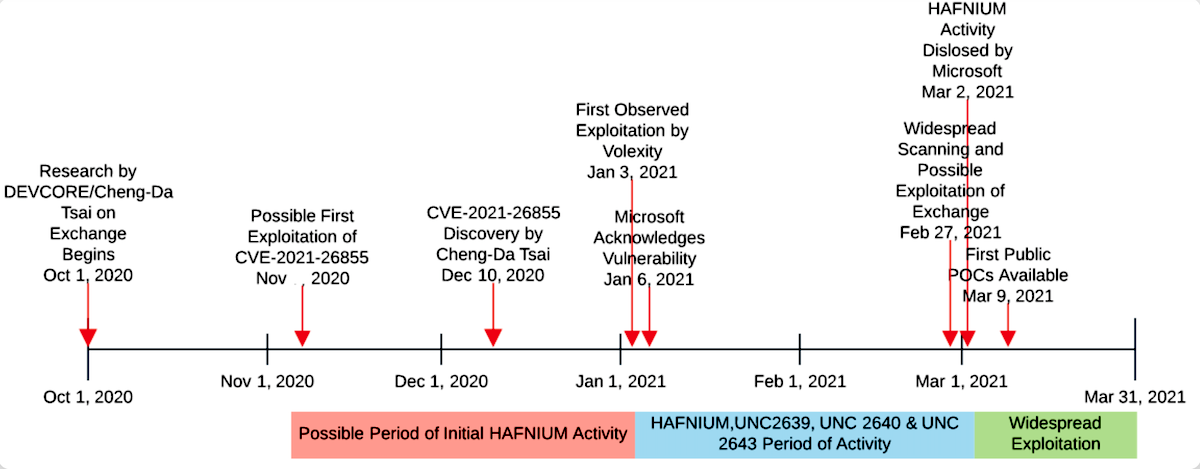
Within days, security researchers revealed that multiple adversaries were quick to pick up exploits for the Exchange bugs, but also that some had been targeting the flaws even before patches were released. The first known exploitation attempt is dated January 3, 58 days before public disclosure.
Over the course of last week, Microsoft released additional fixes for these vulnerabilities, including security updates (SUs) for older and unsupported Exchange Server versions, or Cumulative Updates (CU), as the company calls them.
“This is intended only as a temporary measure to help you protect vulnerable machines right now. You still need to update to the latest supported CU and then apply the applicable SUs,” Microsoft said.
With the latest set of released updates, more than 95% of the Exchange Server versions that are exposed to the Internet are covered, yet tens of thousands of machines remain vulnerable. Microsoft revealed that, as of March 12, more than 82,000 Exchange servers were still left to be updated (out of 400,000 identified on March 1).
Last week, ESET reported that more than 10 threat actors were observed targeting vulnerable Exchange servers. Ransomware operators also started targeting the flaws, and the overall number of attacks aimed at the Exchange zero-days grew exponentially over the course of several days only.
On Sunday, security researchers at Check Point pointed out that “the number exploitation attempts multiplied by more than 6 times” within “the past 72 hours alone,” adding that they had identified more than 4,800 exploits and hundreds of compromised organizations worldwide.
The United States was being targeted the most, accounting for 21% of all exploitation attempts, followed by the Netherlands and Turkey, both at 12%. According to Check Point, government/military was the sector being targeted the most (27% of attempts), followed by manufacturing (22%) and software (9%).
“As we enter the second week since the vulnerabilities became public, initial estimates place the number of compromised organizations in the tens of thousands,” Palo Alto Networks said last week.
In a timeline of the attacks, the security firm revealed that the first two bugs were identified on December 10 and 30, 2020, respectively, and reported to Microsoft on January 5, 2021. A third security hole was identified and reported while already under attack, on January 27.
“Ongoing research illustrates that these vulnerabilities are being used by multiple threat groups. While it is not new for highly skilled attackers to leverage new vulnerabilities across varying product ecosystems, the ways in which these attacks are conducted to bypass authentication — thereby providing unauthorized access to emails and enabling remote code execution (RCE) — is particularly nefarious,” Palo Alto Networks noted.
Microsoft published additional information on how organizations can protect their on-premises Exchange servers against exploitation, reiterating that applying the available patches represents the first step, followed by identifying possibly compromised systems and removing them from the network.
For the third time this year, Google has shipped an urgent fix to block in-the-wild zero-day attacks hitting its flagship Chrome browser.
The latest emergency Chrome patch, available for Windows, MacOS and Linux, provides cover for at least five (5) documented vulnerabilities. Three of the five bugs are rated “high-risk,” Google’s highest severity rating.
Buried in Google’s advisory is a throwaway line that “Google is aware of reports that an exploit for CVE-2021-21193 exists in the wild.”
The company did not release any additional information on the live attacks or the operating system platforms being targeted.
It is the third in-the-wild zero-day attack hitting Chrome users in 2021, and in all three cases, Google has been stingy with information on the malware used, the OS platforms targeted or the indicators of compromise that help enterprise defenders.
In one prominent case, the North Korean state-sponsored hacks against security researchers, Google has barely confirmed the existence of the Chrome zero-day with a one-line mentioned that fully-patched Chrome installations were being compromised.
The latest zero-day is described simply as a use-after-free vulnerability in Chrome’s Blink rendering engine that was anonymously reported to Google.
By contrast, when Google research teams discovered a massive cyber-espionage operation rampant on Apple’s iOS platform, the company produced a riveting blog post with “a very deep dive into iOS Exploit chains found in the wild.”
The Chrome patch is being pushed to Chrome users via the browser’s automatic updating mechanism but users are urged to restart browser sessions to properly apply the fixes.
Ryan Naraine is Editor-at-Large at SecurityWeek and host of the popular Security Conversations podcast series. Ryan is a journalist and cybersecurity strategist with more than 20 years experience covering IT security and technology trends. He is a regular speaker at cybersecurity conferences around the world.
Ryan has built security engagement programs at major global brands, including Intel Corp., Bishop Fox and Kaspersky GReAT. He is a co-founder of Threatpost and the global SAS conference series. Ryan’s career as a journalist includes bylines at major technology publications including Ziff Davis eWEEK, CBS Interactive’s ZDNet, PCMag and PC World. Follow Ryan on Twitter @ryanaraine.
Google Releases PoC Exploit for Browser-Based Spectre Attack
Google last week announced the release of proof-of-concept (PoC) code designed to exploit the notorious Spectre vulnerability and leak information from web browsers.
Initially detailed in early 2018 alongside Meltdown, the side-channel attack could allow a malicious application to access data being processed on the device. The vulnerability could expose passwords, documents, emails, data from instant messaging apps, and more.
Since the public disclosure of Meltdown and Spectre, both hardware makers and software developers alike have been working on devising protections against similar flaws, and browser makers too have been implementing application-level mitigations.
In 2019, the Google team responsible for Chrome’s V8 JavaScript engine said that the attack can’t be mitigated at the software level, arguing that security boundaries in browsers should be aligned with low-level primitives, such as process-based isolation.
To keep their users safe, browser makers have already implemented protections such as Site Isolation, Cross-Origin Read Blocking, and out-of-process iframes, with a variety of security features available for other application developers as well, including Cross-Origin Resource and Cross-Origin Opener Policies, and more.
The purpose of these mechanisms is to prevent sensitive data from being present in memory sections that an attacker could read. However, they do not prevent Spectre exploitation.
In order to assess the effectiveness of such mitigations, Google’s researchers have released JavaScript PoC code functional across multiple operating systems, architectures, and hardware variants, and which “confirms the practicality of Spectre exploits against JavaScript engines.”
While Chrome has been used to demonstrate the attack, the exploited issues are not specific to Google’s browser, but affect other modern browsers as well. An interactive demonstration of the attack can be accessed on this page, while the code and technical details were published on Github.
“The demonstration website can leak data at a speed of 1kB/s when running on Chrome 88 on an Intel Skylake CPU. Note that the code will likely require minor modifications to apply to other CPUs or browser versions; however, in our tests the attack was successful on several other processors, including the Apple M1 ARM CPU, without any major changes,” Google explains.
In addition to releasing the PoC, Google is making recommendations (Post-Spectre Web Development and Mitigating Side-Channel Attacks) on how web developers can improve site isolation to deny access to cross-origin resources, thus effectively mitigating Spectre-style hardware attacks, among others.
Such mitigations include Cross-Origin Resource Policy (CORP) and Fetch Metadata Request Headers, Cross-Origin Opener Policy (COOP), and Cross-Origin Embedder Policy (COEP), along with standard protections, such as the X-Frame-Options and X-Content-Type-Options headers, along with SameSite cookies.
“It’s important to note that while […] the mechanisms […] are important and powerful security primitives, they don’t guarantee complete protection against Spectre; they require a considered deployment approach which takes behaviors specific to the given application into account,” Google notes.
WSJ: Microsoft Probing Possible PoC Exploit Code Leak
Software giant Microsoft Corp. has launched an investigation to determine whether one of its flagship information-sharing programs sprung a leak that led to the widespread exploitation of Exchange server deployments around the world.
According to a bombshell report in the Wall Street Journal, Redmond is looking closely at its Microsoft Active Protections Program (MAPP) to figure out if an anti-malware partner in China leaked proof-of-concept code ahead of the availability of security updates.
The MAPP program lets Microsoft share vulnerability data to give anti-malware, intrusion prevention/detection and corporate network security vendors a head-start to add signatures and filters to protect against Microsoft software vulnerabilities.
The program is popular with defenders but it has long been controversial because of there is legitimate risk that data on serious, unpatched vulnerabilities could land in the wrong hands.
In 2012, Microsoft dropped a Chinese vendor from the program after violations and there is rampant speculation that something similar happened in late February this year ahead of the Exchange Server patches.
The WSJ says Microsoft’s new investigation centers on the question of how a stealthy attack that began in early January picked up steam in the week before the company was able to send a software fix to customers.
Some of the tools used in the second wave of the attack, which is believed to have begun Feb. 28, bear similarities to “proof-of-concept” attack code that Microsoft distributed to antivirus companies and other security partners Feb. 23, investigators at security companies say. Microsoft had planned to release its security fixes two weeks later, on March 9, but after the second wave began it pushed out the patches a week early, on March 2, according to researchers.
One focus of the investigation has been an information-sharing program called the Microsoft Active Protections Program, which was created in 2008 to give security companies a head start in detecting emerging threats. Mapp includes about 80 security companies world-wide, about 10 of which are based in China. A subset of the Mapp partners were sent the Feb. 23 Microsoft notification, which included the proof-of-concept code, according to sources familiar with the program.
The report said Microsoft declined to say whether any Chinese companies were included in this release.
Microsoft’s probe comes amidst news that ransomware gangs are starting to take aim at the Exchange Server vulnerabilities, adding a new sense of urgency to the need for organization to apply patches and disinfect backdoors from networks.
Ryan Naraine is Editor-at-Large at SecurityWeek and host of the popular Security Conversations podcast series. Ryan is a journalist and cybersecurity strategist with more than 20 years experience covering IT security and technology trends. He is a regular speaker at cybersecurity conferences around the world.
Ryan has built security engagement programs at major global brands, including Intel Corp., Bishop Fox and Kaspersky GReAT. He is a co-founder of Threatpost and the global SAS conference series. Ryan’s career as a journalist includes bylines at major technology publications including Ziff Davis eWEEK, CBS Interactive’s ZDNet, PCMag and PC World. Follow Ryan on Twitter @ryanaraine.
Serious Vulnerabilities Found in Schneider Electric Power Meters
Industrial cybersecurity firm Claroty this week disclosed technical details for two potentially serious vulnerabilities affecting PowerLogic smart meters made by Schneider Electric.
PowerLogic is a line of revenue and power quality meters that are used not only by utilities, but also industrial companies, healthcare organizations, and data centers for monitoring electrical networks.
Researchers at Claroty discovered that some of the PowerLogic ION and PM series smart meters are affected by vulnerabilities that can be exploited remotely by an unauthenticated attacker by sending specially crafted TCP packets to the targeted device.
“These smart meters communicate using a proprietary ION protocol over TCP port 7700, and packets received by the device are parsed by a state machine function,” Claroty explained in a blog post. “We found that It is possible to trigger the flaw during the packet-parsing process by the main state machine function by sending a crafted request. This can be done without authentication because the request is fully parsed before it is handled or authentication is checked.”
Claroty said its researchers identified two different exploitation paths — depending on the architecture of the targeted device — and two different CVE identifiers have been assigned.
One of them, CVE-2021-22714, is considered critical as it allows an attacker to cause the targeted meter to reboot (i.e. DoS condition) and possibly even to execute arbitrary code. The other one, CVE-2021-22713, can only be exploited to force the device to reboot and it has been assigned a high severity rating.
The vulnerabilities impact several PowerLogic ION device models and one PM model. Security updates for some of the impacted devices were released in July 2020, while others were patched in January and March 2021. Some of the impacted power meters will not receive patches as they are no longer supported.
Vulnerabilities affecting smart meters have been known to pose a risk to both consumers and utilities so it’s important that users of the affected Schneider Electric products apply the patches or mitigations to prevent potential attacks, particularly since information about the flaws has been made public.
Additional details about the patches and mitigations are available in the advisories (CVE-2021-22714 and CVE-2021-22713) released this week by Schneider Electric.
Eduard Kovacs (@EduardKovacs) is a contributing editor at SecurityWeek. He worked as a high school IT teacher for two years before starting a career in journalism as Softpedia’s security news reporter. Eduard holds a bachelor’s degree in industrial informatics and a master’s degree in computer techniques applied in electrical engineering.
Patient data protection provider Tausight this week announced that it has raised $20 million in Series A funding.
The new funding, Tausight says, will help expand the go-to-market team and invest in a healthcare-specific solution designed to identify security flaws in clinical workflows.
The new funding round was co-led by existing investors Polaris Partners and Flare Capital Partners. New investor .406 Ventures also participated.
Founded in 2018 and based in Boston, Mass., Tausight aims to help organizations ensure the confidentiality, integrity, and availability of patients’ protected health information (PHI).
Tausight’s offerings help healthcare provider CIOs, CISOs, and IT organizations understand the risk associated with the manner in which PHI is used, and help them secure access to clinical workflows and PHI.
“Existing cybersecurity solutions address critical aspects of securing the healthcare IT system but are not adequately addressing hidden vulnerabilities found in clinical workflows – Tausight was created to close this gap and solve this vital problem,” Tausight CEO Dave Dickinson said.
At Least 10 Threat Actors Targeting Recent Microsoft Exchange Vulnerabilities
At least 10 threat actors are currently involved in the targeting of Microsoft Exchange servers that are affected by recently disclosed zero-day vulnerabilities, according to cybersecurity firm ESET.
On March 2, Microsoft announced patches for four bugs (CVE-2021-26855, CVE-2021-26857, CVE-2021-26858, and CVE-2021-27065) that were part of a pre-authentication remote code execution (RCE) attack chain already being exploited in the wild.
Successful exploitation of the bugs could result in the attacker deploying webshells onto the vulnerable Exchange servers, potentially taking full control of them. To date, ESET has identified more than 5,000 compromised servers, but others previously reported that tens of thousands of organizations may have been hacked.
Last week, Microsoft said that the flaws were being exploited by Chinese hacking group HAFNIUM, but security researchers were quick to report that several cyber-espionage groups were already targeting the vulnerable Exchange servers.
Now, ESET reveals that at least 10 threat actors are actively engaged in such attacks, including Tick (also known as Bronze Butler), LuckyMouse (also tracked as APT27), Calypso, Websiic, Winnti Group (BARIUM, APT41), Tonto Team (CactusPete), ShadowPad, Mikroceen, and DLTMiner. Activity involving the “Opera” Cobalt Strike and IIS backdoors was also observed.
“On 2021-02-28, we noticed that the vulnerabilities were used by other threat actors, starting with Tick and quickly joined by LuckyMouse, Calypso and the Winnti Group. This suggests that multiple threat actors gained access to the details of the vulnerabilities before the release of the patch,” ESET notes.
Immediately after the patches were released, the researchers noticed a spike in attacks, with adversaries “scanning and compromising Exchange servers en masse.” Overall, more than 10 different threat actors are currently abusing the RCE exploit chain to install implants on vulnerable servers.
“Once the vulnerability had been exploited and the webshell was in place, we observed attempts to install additional malware through it. We also noticed in some cases that several threat actors were targeting the same organization,” ESET says.
Targeted organizations include governmental entities, IT services providers and other private companies (IT, telecommunications, engineering, oil, construction equipment, procurement, cybersecurity consulting, software development, and utility).
“Our ongoing research shows that […] multiple APTs have access to the exploit, and some even did so prior to the patch release. It is still unclear how the distribution of the exploit happened, but it is inevitable that more and more threat actors, including ransomware operators, will have access to it sooner or later,” ESET notes.
The targeted entities are located in the US, Germany, the UK and other European countries (including some located in Eastern Europe), Asia, South America, Africa, and the Middle East.
According to Reuters, at least “60,000 computer systems in Germany” were exposed to the Exchange zero-day flaws. Norway’s parliament, the Storting, was affected by these attacks as well. With proof-of-concept code published online, the number of attacks will only increase.
On Wednesday, the Federal Bureau of Investigation (FBI) and the Cybersecurity and Infrastructure Security Agency (CISA) issued a joint advisory on the compromise of Exchange servers, noting that both state-sponsored actors and cybercriminals are targeting the zero-day flaws.
The attacks could result in adversaries gaining access to and control of enterprise networks, the two agencies warn, adding that tens of thousands of systems in the United States — containing research, personally identifiable information (PII), technology data, and other sensitive information — are potentially at risk.
“Threat actors have targeted local governments, academic institutions, non-governmental organizations, and business entities in multiple industry sectors, including agriculture, biotechnology, aerospace, defense, legal services, power utilities, and pharmaceutical,” the advisory reads.
The FBI and CISA also note that threat actors will continue to exploit these issues, looking to compromise networks and exfiltrate data, encrypt data for ransom, sell access to the compromised networks, or even launch destructive attacks on the vulnerable systems.
There’s a vexing mystery surrounding the 0-day attacks on Exchange servers
The Microsoft Exchange vulnerabilities that allow hackers to take over Microsoft Exchange servers are under attack by no fewer than 10 advanced hacking groups, six of which began exploiting them before Microsoft released a patch, researchers reported Wednesday. That raises a vexing question: how did so many separate threat actors have working exploits before the security flaws became publicly known?
Researchers say that as many as 100,000 mail servers around the world have been compromised, with those for the European Banking Authority and Norwegian Parliament being disclosed in the past few days. Once attackers gain the ability to execute code on the servers, they install web shells, which are browser-based windows that provide a means for remotely issuing commands and executing code.
When Microsoft issued emergency patches on March 2, the company said the vulnerabilities were being exploited in limited and targeted attacks by a state-backed hacking group in China known as Hafnium. On Wednesday, ESET provided a starkly different assessment. Of the 10 groups ESET products have recorded exploiting vulnerable servers, six of those APTs—short for advanced persistent threat actors—began hijacking servers while the critical vulnerabilities were still unknown to Microsoft.
It’s not often that a so-called zero-day vulnerability is exploited by two groups in unison, but it happens. A zero-day under attack by six APTs simultaneously, on the other hand, is highly unusual, if not unprecedented.
“Our ongoing research shows that not only Hafnium has been using the recent RCE vulnerability in Exchange, but that multiple APTs have access to the exploit, and some even did so prior to the patch release,” ESET researchers Matthieu Faou, Mathieu Tartare, and Thomas Dupuy wrote in a Wednesday post. “It is still unclear how the distribution of the exploit happened, but it is inevitable that more and more threat actors, including ransomware operators, will have access to it sooner or later.”
Beyond unlikely
The mystery is compounded by this: within a day of Microsoft issuing the patches, at least three more APTs joined the fray. A day later, another one was added to the mix. While it’s possible that those four groups reverse-engineered the fixes, developed weaponized exploits, and deployed them at scale, those types of activities usually take time. A 24-hour window is on the short side.
There’s no clear explanation for the mass exploitation by so many different groups, leaving researchers few alternatives other than to speculate.
“It would seem that while the exploits were originally used by Hafnium, something made them share the exploit with other groups around the time the associated vulnerabilities were getting patched by Microsoft,” Costin Raiu, director of the Global Research and Analysis Team at Kaspersky Lab, told me. “This could suggest a certain degree of cooperation between these groups, or it may also suggest the exploits were available for sale in certain markets and the potential of them getting patched resulted in a drop of price, allowing others to acquire it as well.”
Juan Andres Guerrero-Saade, principal threat researcher at security firm SentinelOne, arrived at largely the same assessment.
“The idea that six groups coming from the same region would independently discover the same chain of vulnerabilities and develop the same exploit is beyond unlikely,” he wrote in a direct message. “The simpler explanation is that there’s (a) an exploit seller in common, (b) an unknown source (like a forum) available to all of these, or (c) a common entity that organizes these different hacking groups and provided them the exploit to ease their activities (say, China’s Ministry of State Security).”
Naming names
The six groups ESET identified exploiting the vulnerabilities when they were still zero-days are:
Hafnium: The group, which Microsoft said is state sponsored and based in China, was exploiting the vulnerabilities by early January.
Tick (also known as Bronze Butler and RedBaldKnight): On February 28, two days before Microsoft issued patches, this group used the vulnerabilities to compromise the web server of an East Asian IT services company. Tick has been active since 2018 and targets organizations mostly in Japan but also in South Korea, Russia, and Singapore.
LuckyMouse (APT27 and Emissary Panda): On March 1, this cyber-espionage group known to have breached multiple government networks in Central Asia and the Middle East compromised the email server of a governmental entity in the Middle East.
Calypso (with ties to Xpath): On March 1, this group compromised the email servers of governmental entities in the Middle East and South America. In the following days, it went on to target organizations in Africa, Asia, and Europe. Calypso targets governmental organizations in these regions.
Websiic: On March 1, this APT, which ESET had never seen before, targeted mail servers belonging to seven Asian companies in the IT, telecommunications, and engineering sectors and one governmental body in Eastern Europe.
Winnti (aka APT 41 and Barium): Just hours before Microsoft released the emergency patches on March 2, ESET data shows this group compromising the email servers of an oil company and a construction equipment company, both based in East Asia.
ESET said it saw four other groups exploiting the vulnerabilities in the days immediately following Microsoft’s release of the patch on March 2. Two unknown groups started the day after. Two other groups, known as Tonto and Mikroceen, began on March 3 and March 4, respectively.
China and beyond
Joe Slowik, senior security researcher at security firm DomainTools, published his own analysis on Wednesday and noted that three of the APTs that ESET saw exploiting the vulnerabilities ahead of the patches—Tick, Calypso, and Winnti—have previously been linked to hacking sponsored by the People’s Republic of China. Two other APTs that ESET saw exploiting the vulnerabilities a day after the patches—Tonto and Mikroceen—also have ties to the PRC, the researcher said.
Slowik produced the following timeline:
DomainTools
The timeline includes three exploitation clusters that security firm FireEye has said were exploiting the Exchange vulnerabilities since January. FireEye referred to the groups as UNC2639, UNC2640, and UNC2643 and didn’t tie the clusters to any known APTs or say where they were located.
Because different security firms use different names for the same threat actors, it’s not clear if the groups identified by FireEye overlap with those seen by ESET. If they were distinct, the number of threat actors exploiting the Exchange vulnerabilities prior to a patch would be even higher.
A range of organizations under siege
The tracking of the APTs came as the FBI and the Cybersecurity and Infrastructure Security Agency issued an advisory on Wednesday that said threat groups are exploiting organizations including local governments, academic institutions, non-governmental organizations, and business entities in a range of industries, including agriculture, biotechnology, aerospace, defense, legal services, power utilities, and pharmaceutical.
“This targeting is consistent with previous targeting activity by Chinese cyber actors,” the advisory stated. With security firm Palo Alto Networks reporting on Tuesday that an estimated 125,000 Exchange servers worldwide were vulnerable, CISA and FBI officials’ call for organizations to patch took on an extra measure of urgency.
Both ESET and security firm Red Canary have seen exploited Exchange servers that were infected with DLTMiner, a piece of malware that allows attackers to mine cryptocurrency using the computing power and electricity of infected machines. ESET, however, said it wasn’t clear if the actors behind those infections had actually exploited the vulnerabilities or had simply taken over servers that had already been hacked by someone else.
With so many of the pre-patch exploits coming from groups tied to the Chinese government, the hypothesis from SentinalOne’s Guerrero-Saade—that a PRC entity provided the exploits to multiple hacking groups ahead of the patches—seems to be the simplest explanation. That theory is further supported by two other PRC-related groups—Tonto and Mikroceen—being among the first to exploit the vulnerabilities following Microsoft’s emergency release.
Of course, it’s possible that the half-dozen APTs that exploited the vulnerabilities while they were still zero-days independently discovered the vulnerabilities and developed weaponized exploits. If that’s the case, it’s likely a first, and hopefully a last.
https://arstechnica.com/?p=1748741
Researchers Show First Side-Channel Attack Against Apple M1 Chips
New Browser Side-Channel Attack Doesn’t Require JavaScript
A team of researchers from universities in the United States, Australia and Israel has demonstrated that attackers could launch browser-based side-channel attacks that do not require JavaScript, and they’ve tested the method on a wide range of platforms, including devices that use Apple’s recently introduced M1 chip.
The researchers — representing the Ben-Gurion University of the Negev, the University of Michigan and the University of Adelaide — have published a paper on what they have described as the first browser side-channel attack that uses only CSS and HTML, and works even if JavaScript is completely disabled.
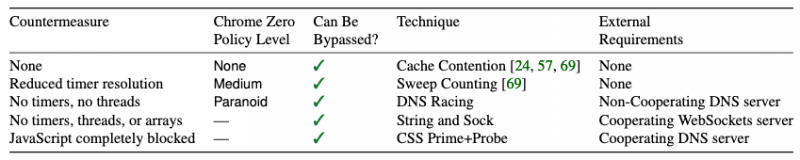
The analysis focused on Prime+Probe, a cache side-channel attack method that can detect which cache sets are accessed by the target and uses that to infer potentially valuable information.
Conducting these types of attacks in the browser typically involves the execution of JavaScript code and timing measurements. Web browsers vendors and third parties have been working on developing protections against such attacks, including by limiting or completely preventing JavaScript execution and by trying to prevent attackers from precisely measuring time.
The researchers have developed a sequence of attacks where they have progressively decreased dependency on JavaScript features, which resulted in a method that relies entirely on HTML and CSS. They claim to have shown that all existing countermeasures can be bypassed.
The attack method has been successfully tested — with various levels of success depending on the targeted architecture and existing mitigations — against hardened browser environments (e.g. Tor, Chrome Zero, DeterFox) on devices with Intel, AMD, Samsung and Apple chips.
Impacted vendors have been notified. Apple told the researchers that the public disclosure of their findings does not raise any concerns.
“We show that advanced variants of the cache contention attack allow Prime+Probe attacks to be mounted through the browser in extremely constrained situations,” the researchers said in their paper. “Cache attacks cannot be prevented by reduced timer resolution, by the abolition of timers, threads, or arrays, or even by completely disabling scripting support. This implies that any secret-bearing process which shares cache resources with a browser connecting to untrusted websites is potentially at risk of exposure.”
Eduard Kovacs (@EduardKovacs) is a contributing editor at SecurityWeek. He worked as a high school IT teacher for two years before starting a career in journalism as Softpedia’s security news reporter. Eduard holds a bachelor’s degree in industrial informatics and a master’s degree in computer techniques applied in electrical engineering.
Hackers Breach Cameras at Banks, Jails, Tesla and More
A US hacker collective on Tuesday claimed to have tapped into footage from 150,000 security cameras at banks, jails, schools, carmaker Tesla and other sites to expose “the surveillance state.”
Images captured from hacked surveillance video were posted on Twitter with an #OperationPanopticon hashtag.
“What if we just absolutely ended surveillance capitalism in two days?” a purported member of a group called APT-69420 Arson Cats asked amid a string of tweeted images.
“This is the tip of the tip of the tip of the iceberg.”
The hacker group claimed to have ferreted out credentials of an high level administrator account at Silicon Valley firm Verkada, which runs a platform operating security systems online.
“We have disabled all internal administrator accounts to prevent any unauthorized access,” a Verkada spokesperson said in response to an AFP inquiry.
“Our internal security team and external security firm are investigating the scale and scope of this issue, and we have notified law enforcement.”
Verkada added that it has notified companies that rely on its platform.
Surveillance camera imagery posted on Twitter included a jail cell block and a man wearing a fake beard dancing in a bank storage room.
The Verkada breach shows the risk of outsourcing security surveillance to companies in the internet cloud, according to Rick Holland, chief information security officer at Digital Shadows, a risk protection firm.
“Verkada positions itself as a ‘more secure, scalable’ alternative to on-premises network video recorders,” Holland said.
“You don’t always get more secure when you outsource your security to a third party.”
He said he expected the breach to trigger investigations by privacy regulators in the US and Europe.


 Tags:
Tags: 


 Tags:
Tags: 


 Tags:
Tags: 


 Tags:
Tags:  “These smart meters communicate using a proprietary ION protocol over TCP port 7700, and packets received by the device are parsed by a state machine function,” Claroty explained in a blog post. “We found that It is possible to trigger the flaw during the packet-parsing process by the main state machine function by sending a crafted request. This can be done without authentication because the request is fully parsed before it is handled or authentication is checked.”


 Tags:
Tags: 


 Tags:
Tags: 


 Tags:
Tags: 



 Tags:
Tags: 


 Tags:
Tags: