The $1,000 Gucci T-Shirt Problem
We’ve partnered with industry icon Mark Ritson on the ADWEEK MiniMBA in Marketing, a program that helps you become the best marketer you can be. The next course begins April 7 — sign up now (or consider it for one of your team members).
Half a lifetime ago I was working in Paris for a very famous Champagne brand. Analyzing global sales data was proving difficult because the Japanese section just didn’t make any sense. The country’s economic bubble had famously burst, yet Japanese clients were apparently drinking more high-end Champagne than ever before.
Certain of an error in the data, I queried it with my French CEO. He gave a Gallic shrug and said: “When you are on the plane, and the plane is about to crash, you don’t drink piss.”
The relationship between economic conditions and luxury spending has never been linear. In boom times, luxury sales explode, but tough economic conditions aren’t always bad for luxury either.
Leonard Lauder called it the “lipstick effect,” the theory that economic hardship drives consumers toward small luxuries as substitutes for larger ones they can no longer afford. When you can’t buy a fur coat, a Chanel lipstick provides an affordable indulgence.
Boom or bust, luxury brands traditionally do well. Add global expansion, the luxury obsession of the Chinese, and a general democratization of luxury from thousands of clients to millions today, and you had a golden formula for unprecedented growth since the start of the Century.
According to Bain & Company, the global luxury market tripled from $120 billion in 2000 to $400 billion in 2023. LVMH’s share price tells the same story: from $100 in 2007 to nearly $1,000 by April 2023, making Bernard Arnault the world’s richest man.
But change is in the air. Tuesday’s news that Saks Global, the company that owns luxury retailers Saks Fifth Avenue, Neiman Marcus and Bergdorf Goodman, had filed for bankruptcy protection is merely the latest in a series of bad omens. Declining sales were a significant factor in the company’s situation.
And they aren’t alone. Bain’s latest data confirms that the luxury goods spending will decline this year and the number of consumers buying luxury items will drop from 400 million in 2022 to around 340 million.
That trend is borne out by consultancy group MAD who estimate that 20% of affluent and high-net-worth individuals intend to spend less on designer fashion this year. For leather goods, that figure is 30%. For jewelry, 32%. For watches, 44%. Wealthy consumers making no luxury purchases at all grew from 15% in 2019 to 25% today.
The reasons are manifold. Post-pandemic price increases were too aggressive and often unjustified. Consumers began to question the value proposition of a cotton Gucci T-shirt priced north of $1,000. Geopolitical tensions disrupted Chinese tourism and dampened confidence. The aspirational middle-class consumer who drove so much growth has been squeezed by inflation. And younger consumers increasingly prefer experiences over products.
Today’s economy is marked by a strange uncertainty. We live in a period of neither boom nor bust — an odd, unsettled phase in which AI, political upheaval, and technological disruption have somehow undermined the enduring allure of luxury.
The key strategic question is how luxury brands will respond. The usual 21st Century options – more stores, global expansion, price increases – have been exhausted. And the perennial question of luxury brand management now presents itself to a new generation of managers: go up or go down?
Going down means embracing “masstige”: accessible luxury that captures aspirational consumers without pretending to be something it’s not. Coach has executed this strategy brilliantly. After nearly a decade in the wilderness, dismissed as “grocery bags” by fashion snobs, the brand leaned into its heritage as quality American leather goods at attainable prices.
With bags mostly under $1,000 and a laser focus on Gen Z, Coach gained over 6.5 million new customers in North America last year. Its market cap has expanded roughly 140% since January 2020. The brand isn’t trying to compete with Hermès — it’s occupying the space between mass market and true luxury where consumers can trade up, or down, from their usual repertoire.
Going up means the opposite: making less, charging more, and rebuilding genuine exclusivity.
Hermès and Brunello Cucinelli have prospered during the current downturn precisely because neither diluted their position during the boom. The founder Cucinelli famously rejected a Chinese investor who urged rapid expansion, choosing instead to preserve exclusivity. “If you overdistribute your products, that’s goodbye to exclusivity,” he told the investor. “If in the stores there is a queue outside to get in, you can rest assured that there will be no one else wanting your brand in two years’ time.”
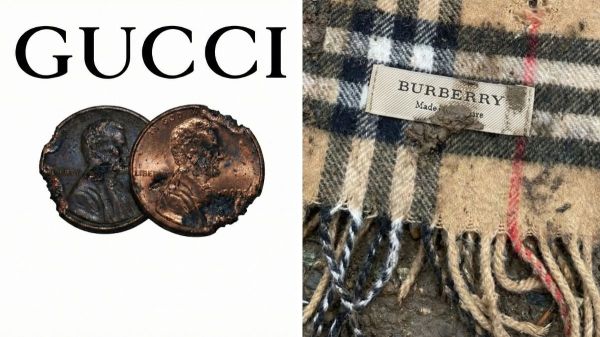
The muddle in the middle — charging Hermès prices without Hermès exclusivity, claiming craftsmanship while outsourcing production — is where the damage is being felt. Gucci and Burberry, caught in this no-man’s-land, are watching customers defect in both directions.
While both Hermès and Cucinelli shares have risen, Gucci Group’s share price has fallen 25% from its 2024 peak, while Burberry has collapsed by more than 50%. When luxury appears less scarce, it becomes less attractive.
Bernard Arnault understands this tension. “The fundamental goal is not revenue,” he once explained at an LVMH shareholders meeting. “The fundamental goal is the desirability of the brand.”
For two astonishing decades, luxury brands managed to achieve both growth and desirability. That equilibrium now appears broken, and strategy, as it eventually always does, demands choice.
Either make beautiful things for the many and price accordingly, or make beautiful things for the few and accept the constraints that come with the profits. Coco Chanel said it best: “Luxury is a necessity that begins where necessity ends.” As the industry recalibrates, the brands that remember luxury must remain beyond most people’s reach are ironically the ones that will retain widespread allure.
https://www.adweek.com/brand-marketing/the-1000-gucci-t-shirt-problem/