The Backstreet Bowl: Behind the T-Mobile-Coinbase Pop Showdown at Super Bowl 60
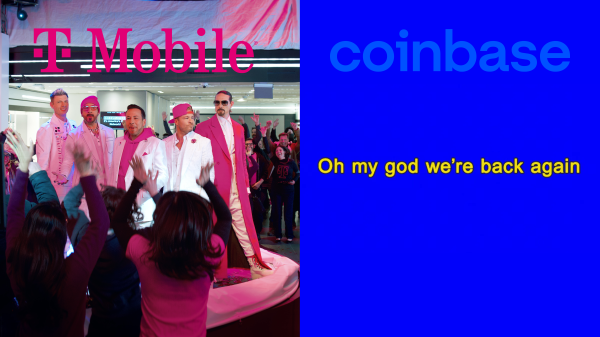
Amid the celeb sightings, 1990s nostalgia, GLP-1s galore, sports betting promos, and AI overload from last night’s Super Bowl — the Backstreet Boys found themselves in their own battle between brands.
Their 1999 hit “I Want It That Way” was a surprise performance during T-Mobile’s 13th consecutive Super Bowl ad, which aired during the second quarter. It was flamboyant, silly, and riddled with celeb cameos from the likes of rapper-rocker Machine Gun Kelly, comedian Druski, and actor Pierson Fodé.
During the same quarter, a slightly rejiggered version of the iconic boy band’s “Everybody (Backstreet’s Back)” anthem showed up in a lo-fi karaoke-inspired ad that was eventually revealed to be an ad for the cryptocurrency exchange Coinbase. The brand framed the spot as “an ode to crypto” in a blog post, saying it was meant to signal that crypto is for everyone, and pointing to the roughly 52 million Americans who have used it.
The idea to cast the band for T-Mobile’s spot, and license “I Want It That Way,” came from Andrew Panay, the producer of Wedding Crashers and head of Panay Films, which is responsible for many of T-Mobile’s flashiest commercial campaigns.
He decided to hire the group after a “spiritual” experience last summer watching the band perform at The Sphere in Las Vegas, he previously told ADWEEK.
But there was competition over licensing rights, as multiple brands were interested in using the song for a Super Bowl ad, Panay said. “I licensed the song, I put money down, and then more brands came after it,” he said. It almost amounted to a bidding war, he said, “but I stopped it.”
T-Mobile declined to comment.
Coinbase said it wasn’t one of the brands that went after “I Want It That Way,” and that it had planned to use “Everybody” since the early days of planning.
The brand’s karaoke-style spot came together quickly after the brand’s creative agency, the New York-based Isle of Any, proposed the idea in the fall of 2025.
It was a smooth process because the idea was “wildly participatory,” said Joe Staples, vice president of creative at Coinbase. The Super Bowl experience, he said, is like going to a karaoke, with the party atmosphere, the drinking, and people huddled around the TV like a campfire. “Same amount of people, same amount of inebriation, same amount of playfulness. It just seemed to fit.”
But Coinbase felt the pressure to deliver standout creative four years after making a Super Bowl splash in 2022 with its famous 60-second spot displaying a floating QR code — a defining moment that helped Coinbase stand out against a field of rivals during the so-called “Crypto Bowl.”
Since that moment, crypto’s star has faded. FTX, a one-time Coinbase competitor that also advertised in that Super Bowl, has since been bankrupted and seen its founder Sam Bankman-Fried imprisoned for fraud. A frenzied crypto selloff this month, meanwhile, has seen Bitcoin’s value drop 20% since the start of 2026.
Coinbase was the only crypto brand that invested in a Super Bowl spot this year, and it did so despite industry headwinds and the growing price of Super Bowl media — NBCUniversal charged upwards of $10 million for some 30-second in-game spots.
“There aren’t many forums with 120 million people watching,” Staples said.
Coinbase believed the Backstreet Boys were the ideal vehicle for its message, and it wasn’t deterred when they learned “early on” that T-Mobile was working with the band for its own Super Bowl spot.
In fact, Staples said, Coinbase doesn’t mind the comparisons of its ad with T-Mobile’s, because the approaches are distinct — and both brands might benefit from the chatter pitting the two against each other.
Plus, “They’re very different approaches to advertising,” Staples said.
Andrew Panay didn’t say whether T-Mobile knew that Coinbase was also airing a Backstreet Boys spot. But the fact that both brands did was testament to the band’s enduring cultural sway, he said.
“The Backstreet Boys have legacy, they have freshness, they have long-time fans, new fans, male and female fans. Gen Z and boomers know their music. They have extremely broad appeal,” he said.
Neither brands specified the total investment value of their campaigns.
Advertising industry insiders were amused and surprised by the Backstreet Boys bombardment Sunday night. “Two ads featuring the Backstreet Boys was not on my Super Bowl bingo card,” Jon Laughlin, chief creative officer at Laughlin Constable, said.
Many creatives who spoke with ADWEEK preferred the Coinbase spot.
“The winner for me, for sure, is the Coinbase spot,” said Annika Welander, CEO of creative agency Someoddpilot. “I love creative that punches so far out of its weight class.”
Amir Sahba, founder and CEO of creative agency Thinkingbox, however, felt T-Mobile won the Backstreet Bowl: “T-Mobile gave us something to feel. Coinbase gave us something confusing to figure out in real time.”Despite the varied reactions, T-Mobile’s spot ranked much higher than Coinbase’s on EDO’s TV Outcomes rankings, which measure the impact of each ad in the game based on immediate engagements that are most predictive of future sales. On that assessment, T-Mobile’s ad was 17th out of 98, while Coinbase’s ranked 47th.
Watch both T-Mobile’s and Coinbase’s full Super Bowl 60 ads below.
https://www.adweek.com/brand-marketing/the-backstreet-bowl-behind-the-t-mobile-coinbase-pop-showdown-at-super-bowl-60/