To Reach Its Lofty Goals, The Messenger Pursues a Depolarized News Environment
Introducing the Adweek Podcast Network. Access infinite inspiration in your pocket on everything from career advice and creativity to metaverse marketing and more. Browse all podcasts.
Although recent years have seen the launch of a number of ambitious media ventures, few have raised more eyebrows than The Messenger.
The general news publisher, which is set to debut next month, has drawn scrutiny for its aggressive roadmap, which mandates it hire 550 journalists, crack $100 million in revenue and top 100 million monthly visitors by the end of next year.
Founded by media veterans Jimmy Finklestein and Richard Beckman, The Messenger has raised $50 million in financing, making it one of the most highly capitalized media startups in recent memory. In a mordant twist last month, it used a part of that allowance to acquire Grid, itself a once-promising media startup.

But while the size, scope and speed of its ascent have inspired incredulity, the core appeal of The Messenger is deceptively modest. By charting a centrist political tack, the publisher aims to attract a broad audience and create a depolarized environment for its advertisers.
“We want to be as far to the right as the liberals will read,” Beckman said, “and as far to the left as the conservatives will read.”
While The Messenger positions this bipartisan approach as a source of differentiation, a number of publishers, including CNN and Semafor, have recently adopted a similar strategy.
The publisher finds other distinctions. For instance, while many media startups have lately embraced a lightweight model, growing from a niche audience through direct channels like email, The Messenger touts a product whose success lies in achieving and maintaining vast scale, an increasingly elusive goal.
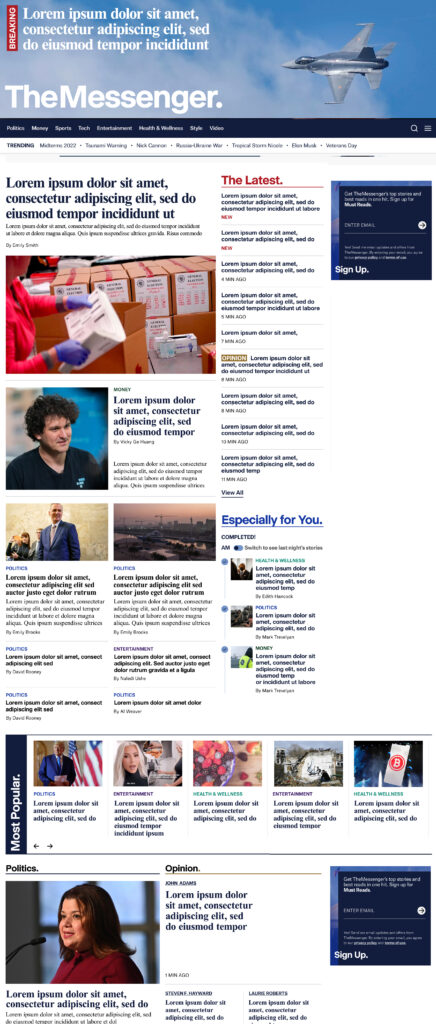
And where other newcomers have deployed a variety of business lines at launch, The Messenger will forgo subscriptions, commerce and affiliate revenue for at least its first year, eschewing even a registration wall to capture first-party data.
This resulting blend of bombast and simplicity has piqued the interest of the advertising community, said Lou Paskalis, the chief strategy officer at Ad Fontes Media, although its ability to capture an audience remains the outstanding question.
“I like the premise,” Paskalis said. “Marketers are looking for more opportunities with news, and I hope the platform is as unbiased as Jimmy claims it will be.”
The Messenger’s direct advertising strategy
In its first year, The Messenger will generate the entirety of its revenue from advertising across channels, including digital, newsletters, events and video.
Drawing on the relationships Beckman has built throughout his career, the publisher aims to sign most of its business directly, including an eight-figure media commitment it recently penned with a major holding company.
Chief revenue officer Mia Libby, formerly of The Daily Beast, will oversee its 20-person team of sales staff, as well as direct its branded content division and marketing group. The Messenger plans to monetize its remaining digital inventory using private marketplace, programmatic guaranteed and open-exchange programmatic deals.

In line with broader trends, the publisher hopes to sell large, multichannel packages to brand clients, drawing on its experiential division, in particular, to help it do so. It aims to host 10 events this year beginning in September, and between 40 and 50 in 2024, according to Beckman.
The Messenger will ultimately include nine verticals, which it will unveil throughout the year: news and politics in May; entertainment and business in June; sports and technology in July; health in August; purpose, which includes topics like DEI and sustainability, in September; food in October; travel in November and style in December.
This portfolio offers The Messenger a strong chance of reaching a wide, top-of-funnel audience—a valuable asset in an age of increasingly fractionalized media, said Josh Rosenberg, the chief executive of Day One Agency.
“You need to build within niche communities to gain credibility, but every marketer needs a scale play,” Rosenberg said. “And in 2023, there really is no one watering hole for news.”
With each new vertical, the publisher will launch a newsletter, and newsletter sponsors will rotate on a weekly basis. These will complement its core email products: a daily morning, lunch and evening news report, as well as a flagship political newsletter. When The Messenger acquired Grid, it gained a headstart on these efforts via its roughly 200,000 newsletter subscribers.
You have to give the benefit of the doubt to a guy who’s done this twice before.
Patrick Steel, the former chief executive of Politico
The publisher has also dogeared a chunk of its financing to build video production studios in New York, Los Angeles and Washington D.C. When operational, The Messenger plans to offer a blend of daily news programming and premium docu-series, taking as its blueprint a show created at The Hill called The Rising.
Building a depolarized platform for generalist news will attract readers, but cultivating loyalty will prove its more daunting challenge, said Patrick Steel, the former chief executive of Politico.
“The recipe for success here is different than it was at The Hill,” Steel said. “I think the odds are against them, but you have to give the benefit of the doubt to a guy who’s done this twice before.”
https://www.adweek.com/media/the-messenger-lofty-goals-modest-strategy/