Viktor&Rolf: Spectrum — Fashion as Image, Art and Provocation
There has always been something slightly unstable about Viktor&Rolf ’s relationship with fashion. A dress is rarely just a dress. It can become sculpture, slogan, performance, contradiction or even an argument against fashion itself. For more than thirty years, Viktor Horsting and Rolf Snoeren have worked in this ambiguous territory, using haute couture not simply as a way of making clothes, but as a language through which to question the mechanisms, rituals and images of fashion.
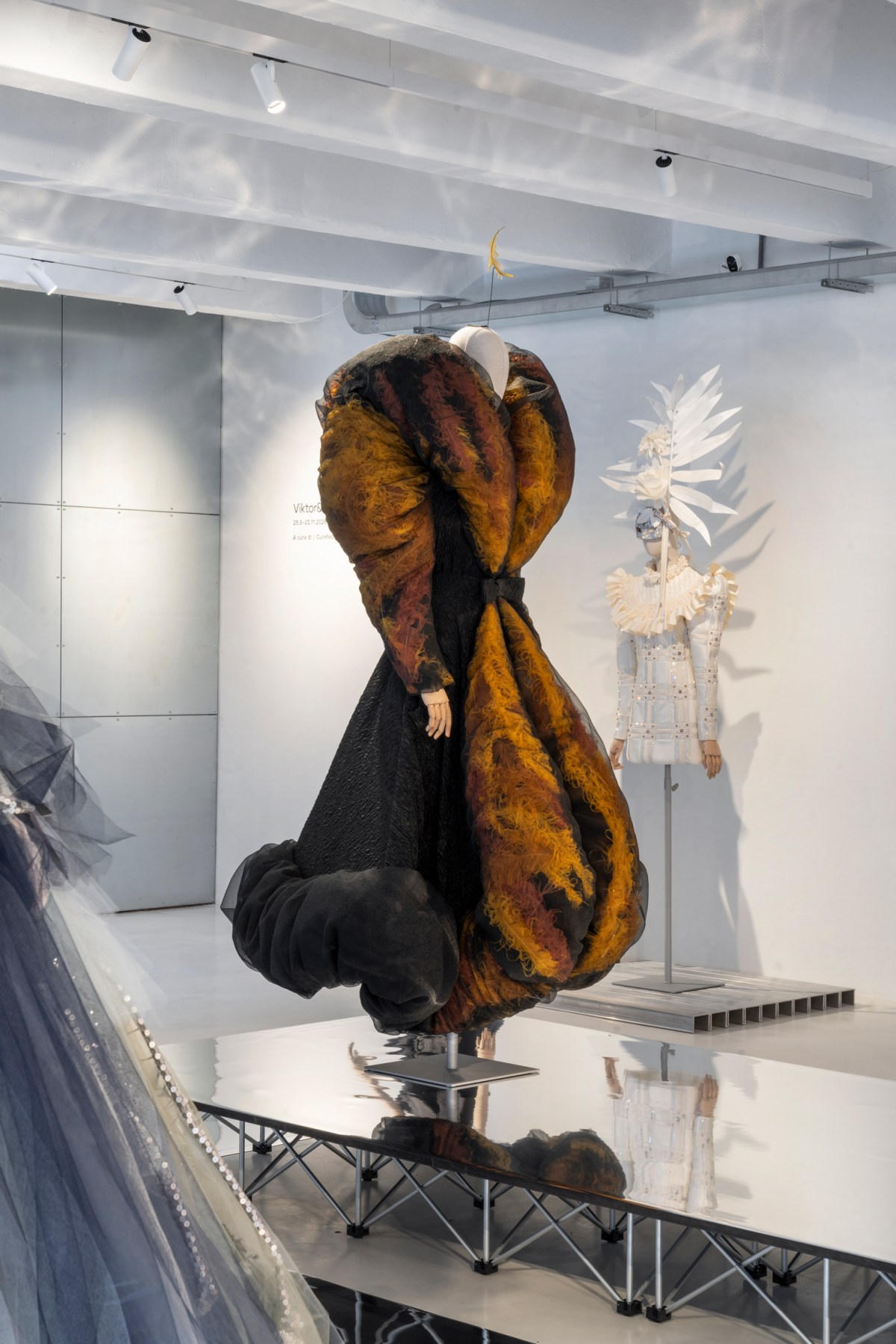
This approach is at the centre of Viktor&Rolf. Spectrum, opening at 10 Corso Como Gallery in Milan from September 25 to November 22, 2026. Curated by Alessio de’ Navasques, the exhibition is the first in Italy entirely dedicated to the Dutch duo and brings together more than twenty haute couture looks created across three decades of their career.
Rather than arranging these works chronologically, Spectrum allows different periods to collide. Collections separated by years appear alongside one another, revealing ideas, silhouettes and obsessions that disappear and then unexpectedly return. It feels particularly appropriate for designers whose work has never really progressed in a straight line.
Since their appearance at the Festival International de Mode et de Photographie in Hyères in 1993, Viktor&Rolf have occupied a peculiar space somewhere between the runway, the gallery and the stage. Their collections borrow freely from contemporary art, performance and visual culture, while repeatedly questioning some of fashion’s most familiar mechanisms: branding, spectacle, consumption, beauty and the relationship between a garment and the body.
At times, the clothes almost seem to want to escape fashion altogether. In Wearable Art (A/W 2015–16), garments became framed paintings, shifting between body and wall. With Fashion Statements (S/S 2019), enormous tulle dresses carried phrases across their surfaces, transforming couture into a form of visual communication. Elsewhere, exaggerated volumes and impossible constructions turn the silhouette into something closer to sculpture. It is no coincidence that Viktor&Rolf’s work has entered the collections of institutions including the Metropolitan Museum of Art in New York, the Victoria and Albert Museum in London and the Kyoto Costume Institute.
The title Spectrum offers a useful way of reading all of this. Like light passing through a prism, the exhibition separates Viktor&Rolf’s practice into elements that have always existed within it: irony, theatricality, surrealism, social critique and sartorial virtuosity. The exhibition design, conceived by architecture studio Parasite 2.0 together with the curator, translates the same principle into a space built around reflections, correspondences and contrasts.
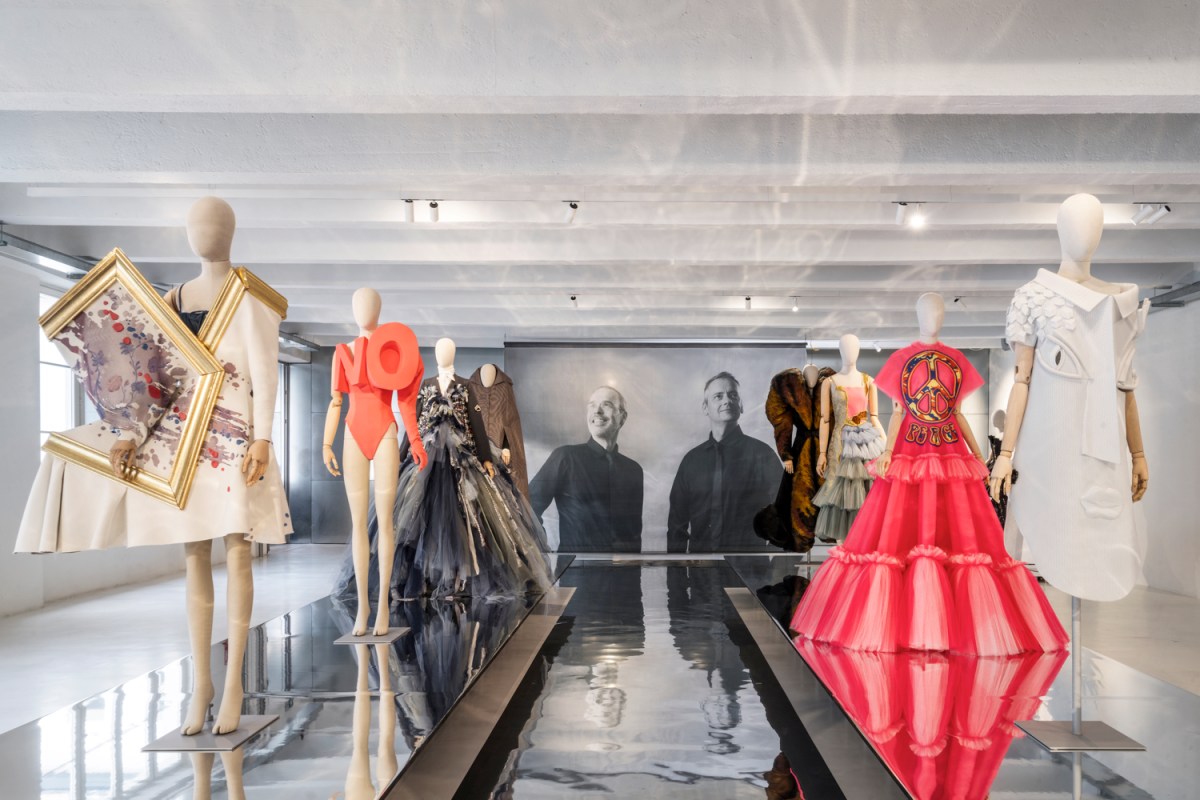
At the beginning of the exhibition, two looks from the recent Gilded Age 2.0 collection (A/W 2026–27) share essentially the same volume but are made from radically different materials: one in gold, the other in jute. Decadence and restraint become opposite versions of the same image.
This idea of repetition through difference continues throughout the exhibition. Fabrics and existing garments are dismantled and reconstructed in Vagabonds (A/W 2016–17) and Boulevard of Broken Dreams (S/S 2017). The explosive silhouette of Atomic Bomb (A/W 1998–99) reappears, transformed, in Haute Abstraction (A/W 2024–25) and Couture Prompt (S/S 2025). Monumental shoulders return across different periods, while dresses detach themselves from the conventional relationship between clothing, gravity and the human body.
Seen together, these works make the archive feel less like a record of the past than a vocabulary. Viktor&Rolf continually return to the same words, only to rearrange them into different sentences.
There is also the question of the double, something that has followed Viktor&Rolf almost from the beginning. Two designers, two deliberately similar public figures, two identities that have often been presented as one creative entity. In Spectrum, mirrors and repetitions extend that idea beyond the designers themselves. A mirrored portrait by photographers Blommers & Schumm, made thirty years after the duo’s debut, appears within the exhibition, while porcelain dolls reproduce garments in miniature, including Bedtime Story (A/W 2005–06).
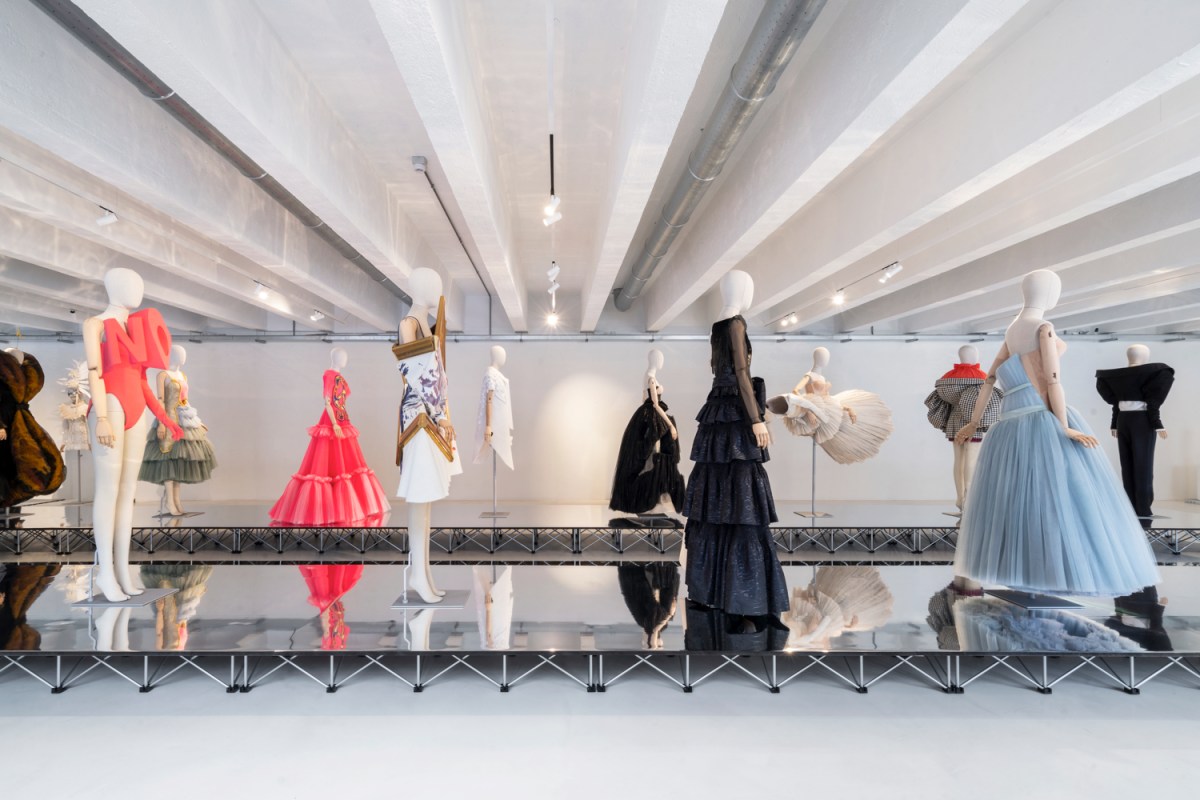
Original and reproduction, body and object, garment and image begin to overlap. And perhaps this is where Viktor&Rolf become particularly interesting from a photographic point of view. Haute couture is experienced physically by very few people. For most of us, its existence is mediated through photographs, runway videos, campaigns, magazines, museum catalogues and, increasingly, the endless circulation of images online. The photograph of a dress can eventually become more familiar than the dress itself.
Viktor&Rolf seem to have understood this condition unusually early.
In 1996, for Launch at Amsterdam’s Torch Gallery, they staged the fictitious launch of a fashion brand, reconstructing a miniature shop, atelier and photographic studio. The project culminated in Le Parfum, an impossible fragrance inspired by Marcel Duchamp’s Air de Paris. An original bottle returns in Spectrum, connecting the exhibition with an experiment conceived three decades earlier.
Seen from 2026, the gesture feels remarkably contemporary. Fashion has become increasingly inseparable from the machinery that represents it. The campaign, the launch, the identity and the spectacle surrounding an object can sometimes become as important as the object itself. Viktor&Rolf were already playing with that distinction long before fashion communication became the enormous image-producing system it is today.
Perhaps this is also why Spectrum works better as a conversation between different moments than as a retrospective. The exhibition is not simply interested in demonstrating how Viktor&Rolf have changed over thirty years. It reveals how persistently they have returned to the same questions.
What happens when clothing stops behaving like clothing? Where does fashion end and art begin? What remains of a garment when function, wearability and even the body become secondary? And at what point does fashion become primarily an image?
There is no need for Spectrum to answer these questions. Its strength lies precisely in allowing different answers to coexist. Three decades of couture are broken apart and reflected back through one another, revealing a body of work that has continually moved between seriousness and humour, craftsmanship and absurdity, beauty and provocation.
Like the prism from which the exhibition takes its name, Spectrum does not create these different identities. It simply makes visible what was there all along.
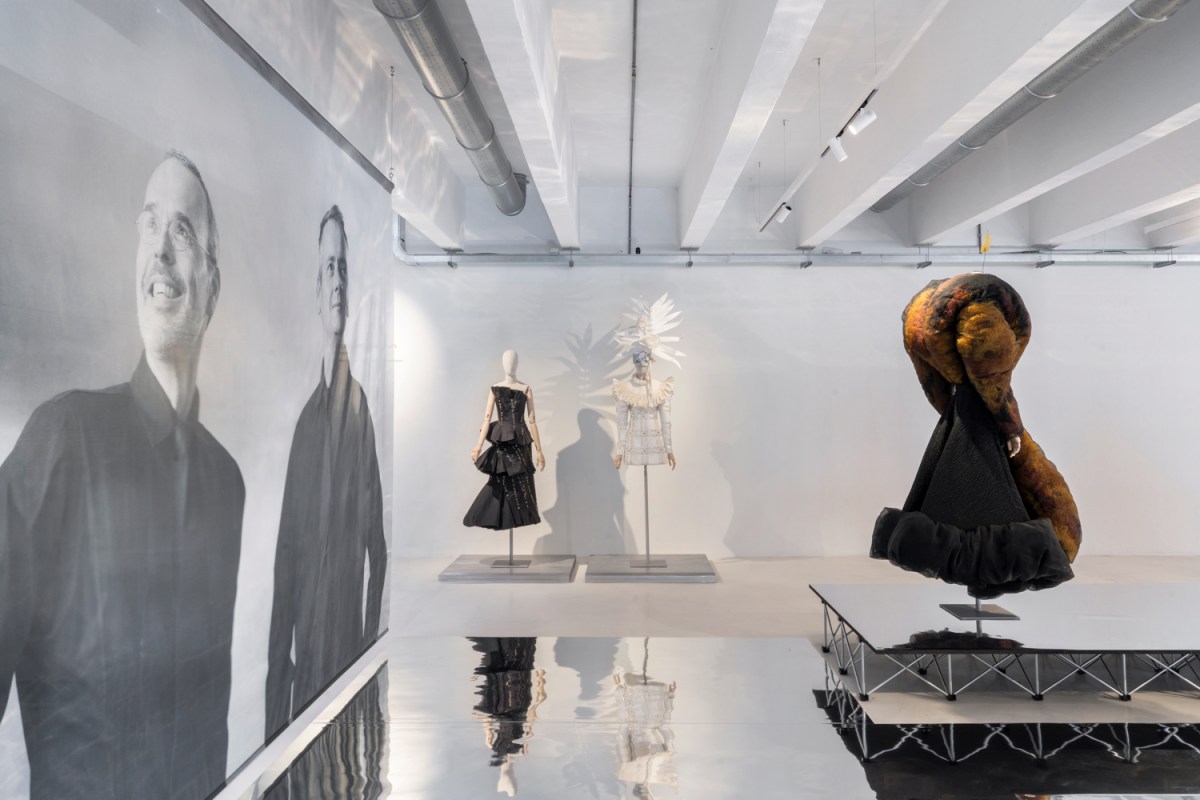
Viktor&Rolf. Spectrum is on view at 10 Corso Como Gallery, Milan, from September 25 to November 22, 2026, curated by Alessio de’ Navasques. The gallery is open every day from 10:30 am to 7:30 pm and admission is free.
Useful links: 10 Corso Como · Viktor&Rolf official website
The post Viktor&Rolf: Spectrum — Fashion as Image, Art and Provocation appeared first on Positive Magazine.
https://www.positive-magazine.com/viktor-rolf-spectrum-10-corso-como-milan/?utm_source=rss&utm_medium=rss&utm_campaign=viktor-rolf-spectrum-10-corso-como-milan