

-
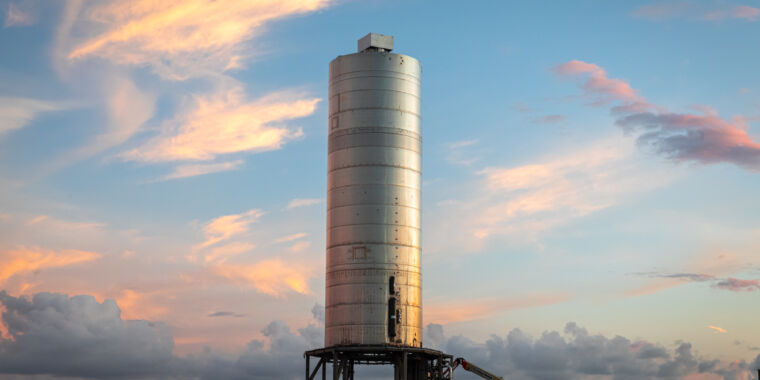
SN5 with sunset clouds in the background. A majestic sight just days away from a historic flight test.Trevor Mahlmann
-
(Soon to be) flying water tower.Trevor Mahlmann
-
As a truckload of liquid oxygen arrives and the sun sets over SpaceX’s South Texas launch site, the full moon rises in the background behind Starship SN5.Trevor Mahlmann
-
Wide view of moonrise over Starship SN5.Trevor Mahlmann
-
SpaceX’s Starship SN5 (center) reflected in South Bay alongside SpaceX’s South Texas launch site and nearby rocket factory. Starhopper (left) is seen as well opposite ground support/fueling equipment (right).Trevor Mahlmann
-
Close-up view of SN5 on the stand.Trevor Mahlmann
-
320.5 megapixel shot of SpaceX’s SN5 Starship.Trevor Mahlmann
-
Starhopper, repurposed now as a launch photographer with cameras galore atop it.Trevor Mahlmann
-
With the recent hurricane, there are a lot of puddles in Boca Chica.Trevor Mahlmann
After successfully completing a static fire test of its Starship prototype last Thursday, SpaceX engineers and technicians in Boca Chica have been preparing the vehicle for its first test flight.
This brief hop, to an altitude of 150 meters, may come as early as today. According to the Federal Aviation Administration’s temporary flight restrictions, SpaceX has a “launch window” from 8am local time in South Texas to 8pm. This means the window closes at 01:00 UTC Tuesday.
Although the company has not announced precisely when it will launch, based upon activity at the pad, SpaceX will likely target later this afternoon or evening for the hop. Photojournalist Trevor Mahlmann is on hand to document activities and provide images of the launch and landing attempt. If the company runs into technical problems on Monday, SpaceX also has a backup day on Tuesday.
This is a significant moment for SpaceX and its founder, Elon Musk. He has staked the company’s future on developing the ambitious Starship vehicle, as well as the Super Heavy booster needed to launch it. Although SpaceX just flew its first astronauts into space and plans to begin private spaceflights on Crew Dragon next year, Musk is looking ahead to Starship and its capability to fly dozens of people at a time into low-Earth orbit and beyond.
The prototype now standing on the South Texas launch pad, which is named Serial Number 5, or SN5, has survived a series of ground-based tests that have led to the destruction of previous prototypes in recent months. Now the company has decided to try flying it. The prototype does not have all of the features of a Starship, including a nose cone, flaps, and other structural features that will guide Starship during its flight through the upper atmosphere.
But the guts of the vehicle are here, including a single Raptor engine and the very large liquid oxygen and methane fuel tanks. This short test flight will validate the integrity of those systems, as well as the software and avionics used to steer the launch and landing of the full-scale vehicle.
-
Highway 4. Highway to Mars.Trevor Mahlmann
-
Grinding metal can be heard in the distance over a bustling South Texas rocket factory.Trevor Mahlmann
-
Sunsets, highbays, and the original Starship reveal event nose cone.Trevor Mahlmann
-
Bluezilla building the Super Heavy highbay.Trevor Mahlmann
-
Bluezilla building the Super Heavy highbay.Trevor Mahlmann
-
Trevor Mahlmann
This would be the first flight test of Starship hardware since a stubby prototype—Starhopper—soared to 150 meters in late August 2019. That test, in which a single Raptor engine powered the vehicle upward and laterally for about 100 meters before landing, was successful in demonstrating thrust and vector control of the methane-fueled engine.
Success is far from guaranteed with this attempt, but that’s perhaps to be expected in an iterative design program. And SpaceX already has several prototypes, through SN8 at least, in various states of development to make further tests, in the future.
Listing image by Trevor Mahlmann
https://arstechnica.com/?p=1695933
